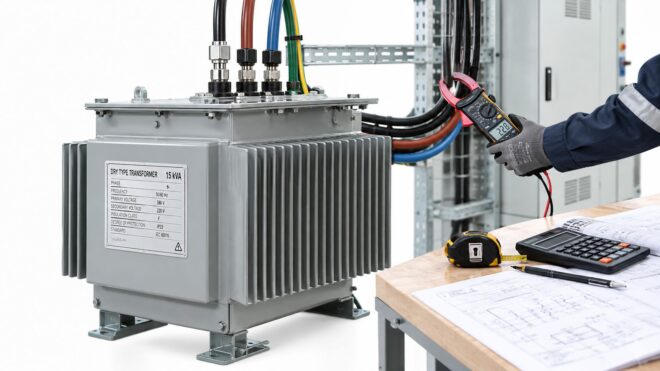
You're standing in front of a panel schedule, the tenant wants a new HVAC unit tied in, the LED parking lights are already on the same distribution path, and someone says, “Just put in a 15 kVA transformer.” That's where mistakes start. A 15 kVA transformer is not a universal answer, it's a starting point that has to be checked against the actual load profile, the voltage, the phase, the starting current, and the way the property really operates.
In the field, I see the same pattern over and over. Someone matches nameplate numbers on paper, then wonders why the unit runs hot, trips at the wrong time, or looks fine until a motor starts and the whole picture changes. A better decision starts with the load mix, not with the smallest standard size.
Why a 15 kVA Transformer Rarely Means What People Expect
A property manager once called after a “simple” replacement turned into a headache. The building had added more than one kind of load over time, some lighting, some controls, some HVAC, and the original thought was to match the old transformer with another 15 kVA transformer and move on. On paper it looked tidy. In service, it didn't behave that way.
The problem is that kVA is not the same thing as usable real power. A load that shows 12 kW at 0.8 power factor requires 15 kVA before you've added any margin at all, which is why a straight wattage comparison can mislead you. The transformer doesn't care about wishful thinking, it cares about what the windings carry.
Practical rule: If the load profile includes motors, LED drivers, controls, or other nonlinear equipment, treat the nameplate as a boundary, not a promise.
The other trap is assuming every 15 kVA unit behaves the same. A transformer's suitability changes with secondary voltage, phase configuration, load profile, and starting current, so two units with the same rating can perform very differently in practice. A 15 kVA transformer supplies about 41.6 A at 208 V three-phase, 18.0 A at 480 V, and 14.4 A at 600 V (ABB transformer sizing reference), but those are apparent-power limits, not guaranteed usable capacity.
The rest of the decision comes down to what the building does during the day and night. Multifamily common-area loads behave differently from retail, office, or a small commercial distribution setup. That's why a good sizing call starts with the operating profile, then checks whether 15 kVA is enough, whether 25 kVA is the practical step up, or whether the true constraint is voltage conversion or phase rather than capacity.
Understanding the 15 kVA Rating and What It Actually Delivers
A transformer nameplate gives you kVA, not a magical usable output number. That matters because power factor changes how much real work you get from the same apparent-power rating. If you only look at watts, you can end up underestimating the current the transformer has to carry.
For a commercial buyer, the useful question is simple. What secondary voltage do you need, and what current will the transformer deliver at that voltage? A 15 kVA transformer on 208 V three-phase gives a much different usable current picture than the same rating at 480 V or 600 V. The label alone doesn't tell you which winding arrangement you're buying, so the secondary matters just as much as the kVA.
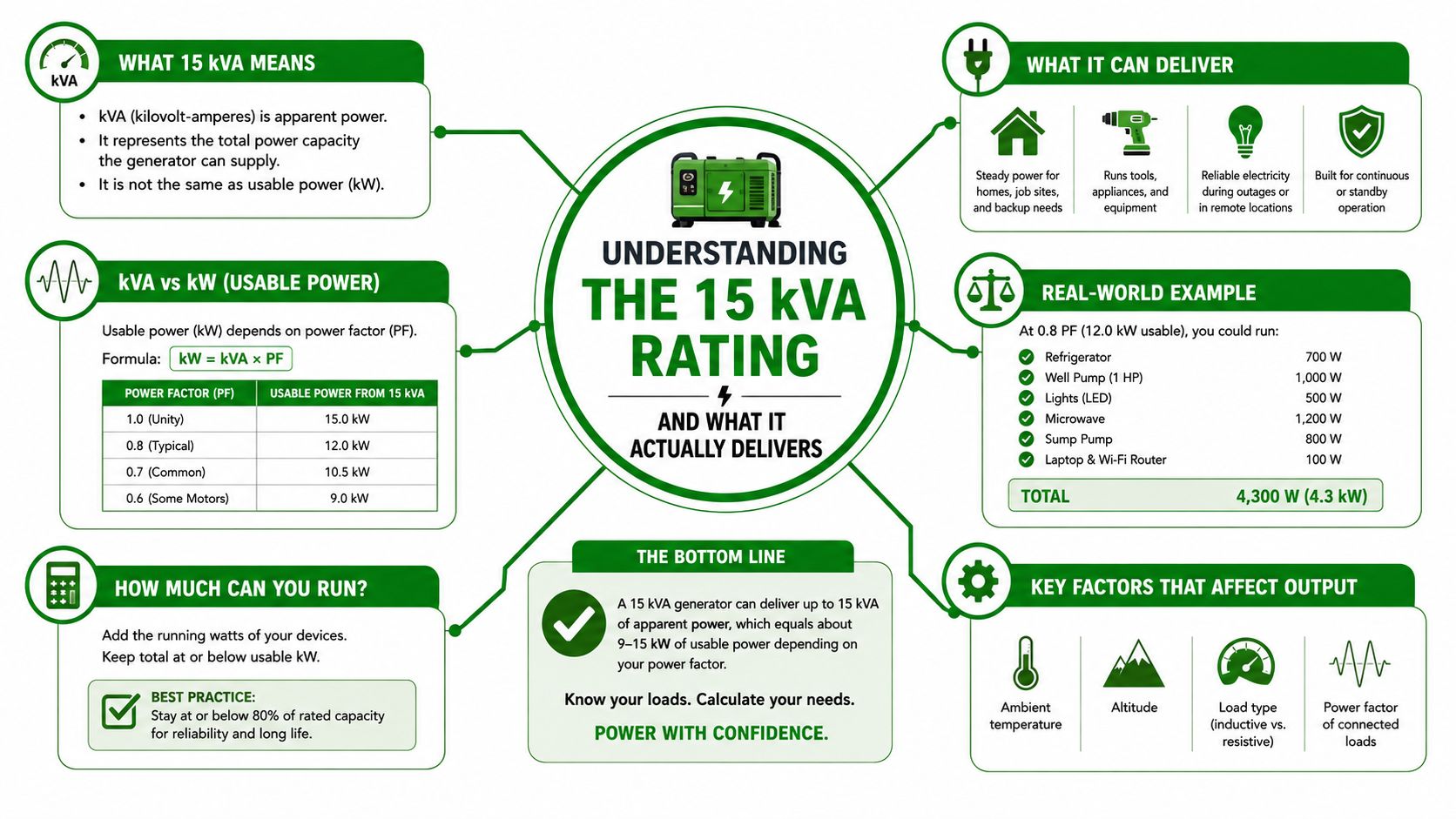
A lot of buyers also confuse current and capacity. The current number is what the downstream conductors see, but the transformer still has to satisfy the full apparent-power demand. That's why the same 15 kVA nameplate can be adequate in one setup and too small in another, even when the connected wattage looks similar.
If you're checking your own numbers, a full-load amps calculator helps translate the nameplate into usable current. That's the first honest step before you compare it with panel loading or conductor size.
A transformer size only makes sense after you've matched the voltage, phase, and the actual load mix.
How 15 kVA Transformers Are Used in Commercial Properties
In the field, 15 kVA shows up most often where the load is real but not huge. In multifamily properties, I've seen it feeding hallway and exterior LED lighting, intercoms, booster systems, and low-voltage controls. That kind of load can look light on paper, then become less forgiving once you add controls, occupancy changes, and overnight operation.

Multifamily and apartment common areas
Multifamily common loads often stay on for long hours, which makes the transformer's continuous behavior matter more than people expect. Hallway lighting and controls are steady, but pumps, door operators, and other equipment can create brief demand swings that change the thermal picture. If the property has future EV-related work or added tenant loads nearby, the original “just enough” approach gets fragile fast.
Retail bays and office suites
Small retail bays and office suites usually combine lighting, receptacles, point-of-sale gear, and a small amount of HVAC or IT equipment. The issue isn't one giant load, it's the mix. LED drivers and electronics can add nonlinear characteristics, while a small motor load can create short peaks that don't show up in a simple connected-load summary.
Light commercial sites
Gate operators, parking lot lighting feeds, and irrigation controls often look like low-demand loads until they're bundled together. I've seen property teams assume the load was “tiny” because each item was modest, then discover the transformer wasn't the limitation, the voltage conversion or phase configuration was. A 15 kVA transformer can be the right fit, but only when the equipment list is stable and the operating pattern is understood.
For a commercial property, the key question is not “Can 15 kVA power one device?” It's “Can it serve this mix, at this voltage, with the way the site starts and runs equipment?”
Sizing a 15 kVA Transformer for the Load You Actually Have
Start with the connected loads, but don't stop at the wattage totals. Separate what runs all the time from what cycles on and off, then check the actual electrical character of each group. Lighting, controls, motors, HVAC, and electronics don't all stress a transformer the same way.
A field-first sizing workflow
- List every load by type. Continuous loads deserve more respect than intermittent ones because they sit on the transformer hour after hour.
- Convert watts to VA where needed. A device group with a lower power factor pulls more apparent power than its wattage suggests.
- Apply diversity where the loads don't coincide. A retail bay and a multifamily common area don't peak the same way, so a worst-case sum can overstate reality.
- Add starting and harmonic margin. Motors and nonlinear loads can push the transformer harder than nameplate sums imply.
- Check growth and operating conditions. Ambient conditions, future tenant changes, and added equipment can move a borderline design into a bad one.
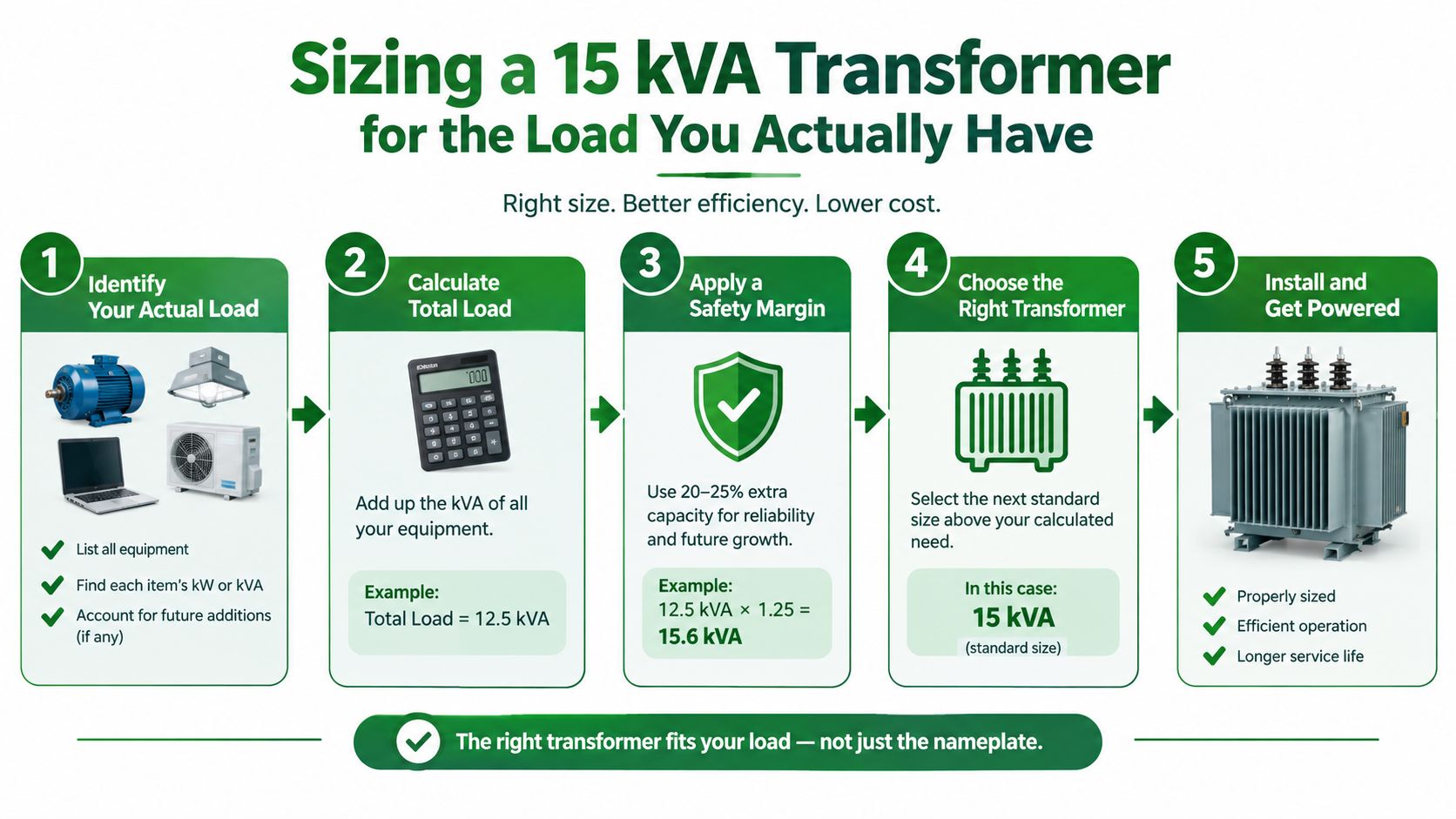
The popular 80% loading rule is a starting point, not a universal finish line. It's often repeated like a hard law, but the correct answer depends on the installation requirements and the operating conditions around the transformer. A lightly loaded unit can still be a poor choice if the load is noisy, intermittent, or likely to expand.
The same is true in reverse. A unit can look oversized on paper and still be the right answer if the site has motor starts, nonlinear loads, or meaningful future growth. That's why I'd rather see a contractor work through the actual duty profile than blindly accept the smallest standard size.
If you're doing the math from scratch, use a transformer size calculator as a check, then compare the result against the operating profile before you buy.
When 25 kVA Beats 15 kVA and Why Lifecycle Cost Matters
The cheapest transformer isn't always the least expensive decision. A 15 kVA transformer can be attractive because it's compact and standard, but the lifecycle cost story includes standby losses, load losses, replacement timing, and the cost of getting it wrong. In commercial work, the hidden cost is often not the equipment itself, it's the callout, the downtime, and the second replacement later.
A useful comparison starts with efficiency. A U.S. Bonneville Power Administration report lists measured or modeled efficiency values around 97.70% and 97.89% for 15 kVA dry-type transformer examples (BPA dry transformer report). That shows small differences can matter even at this size. It also shows why you should ask about both no-load and load-loss behavior, not just the headline rating.
Practical rule: A lightly loaded transformer can still burn energy all day through core losses, even when the connected load looks small.
When the next size makes more sense
A 25 kVA unit often becomes the practical choice when the current load is stable but there's a credible path to growth. I'm thinking of tenant improvements, added controls, future equipment swaps, or properties that tend to accumulate miscellaneous loads over time. If the existing load is already near the edge, buying the larger transformer upfront is usually cheaper than doing the same job twice.
The reverse can also be true. Oversizing just because it feels safer can be a bad trade if the load is small and stable, since standby losses keep running every hour the transformer is energized. The right call is a balance between utilization, utility cost, expected service life, and whether the building is likely to change.
In Southern California, I'd also ask whether the replacement is really a repair or the first step in a distribution upgrade. That's where teams sometimes call Access Electrical and Lighting for the transformer replacement, related lighting work, or the broader electrical distribution changes in the same project.
Installation Notes for Commercial 15 kVA Transformers
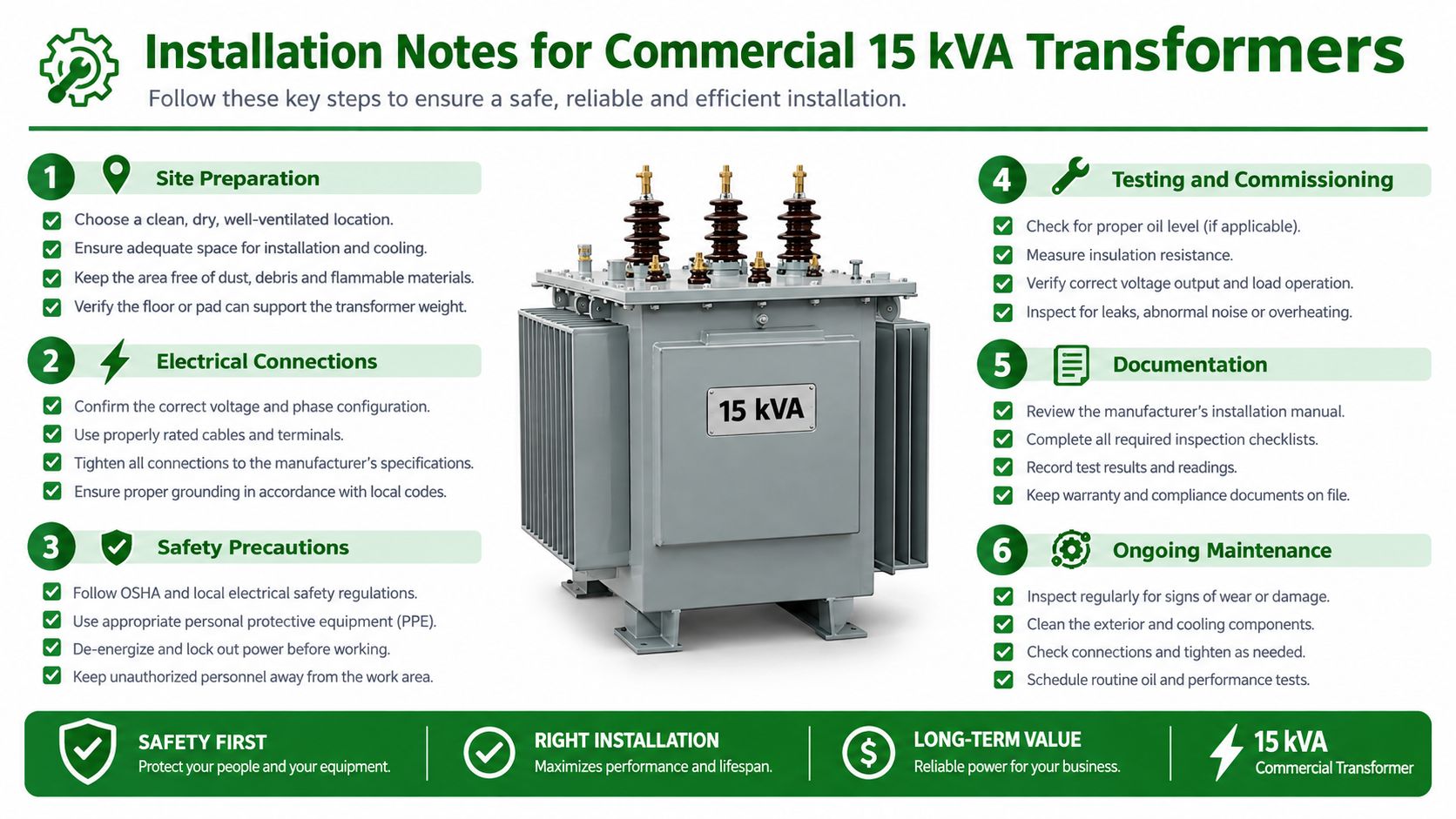
A good install starts before the transformer is set in place. The room or outdoor location needs enough ventilation, enough working space, and a clean path for maintenance. If the unit is indoors, dry-type gear is the normal fit for commercial interiors because it avoids the complications that come with other constructions in occupied buildings.
What a facilities team should confirm
- Ventilation and heat flow: The transformer needs room to shed heat, and tight mechanical closets are a common mistake.
- Clearances and access: Working space has to let a technician inspect, test, and service the unit without tearing apart the room.
- Grounding and bonding: The equipment has to be tied into the building's grounding system correctly, not just “landed somewhere metal.”
- Primary and secondary protection: Overcurrent protection has to make sense on both sides, not just at the source.
- Labeling and identification: The panel, the source, and the transformer should all be marked clearly so the next contractor doesn't guess.
Ambient temperature matters too. A transformer installed in a hot, cramped location doesn't behave like one mounted in a cooler, better-ventilated space. The nameplate rating is the starting point, but the installation environment decides how comfortable that rating really is in service.
Before energizing, I always want the field crew to confirm the voltage, the phase, the grounding, and the conductor terminations. That's not paperwork, that's the difference between a clean start and a call-back.
Inspection and Maintenance Habits That Extend Service Life
A transformer usually gives warning signs before it fails hard. Facilities staff don't need to be electricians to spot the early clues. They just need a simple routine and the discipline to call a licensed contractor when something changes.
A practical quarterly check
- Listen for new noise: A louder hum or a different tone can point to stress, loose hardware, or an abnormal condition.
- Look for heat marks or discoloration: Darkened paint, dust patterns, or signs of overheating deserve attention.
- Check for moisture or corrosion: Water intrusion and corrosion shorten life fast, especially in utility rooms and exterior settings.
- Watch the load behavior: If lights sag or motors stumble during startup, the transformer may be running closer to its limit than anyone thought.
- Measure secondary voltage under normal load: If the voltage is drifting, that's worth documenting before the problem spreads.
If a transformer starts tripping protection without an obvious cause, treat it as a real fault, not a nuisance.
The right maintenance habits protect the investment you already made. They also reduce the odds that a small issue turns into a panel failure, a tenant complaint, or an emergency after-hours call. For teams that want a structured service plan, this is the kind of work that fits into a broader commercial electrical maintenance program.
If you're deciding whether your building needs a replacement, a load review, or a bigger distribution upgrade, Access Electrical and Lighting can help with transformer work, panel changes, lighting, and ongoing maintenance across Southern California. Visit Access Electrical and Lighting to discuss the load you have and get a field-based recommendation that fits the property, not just the nameplate.