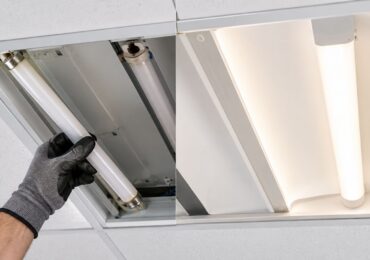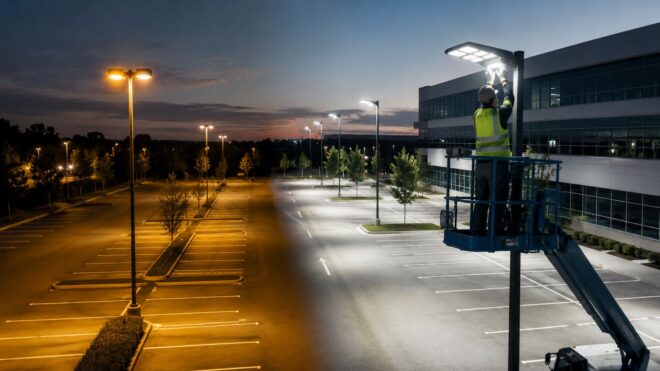
The first call usually starts the same way. A parking lot light is dark, a tenant says the lobby feels dingier than last month, or maintenance keeps swapping lamps in the same stairwell fixture and the problem never really goes away. At that point, the question isn't whether to switch to retro fit LED lights, it's whether the property needs a lamp swap, a full fixture change, or a controls upgrade that sticks.
That decision matters because lighting on a commercial site is never just lighting. It touches safety, tenant experience, inspection risk, and the part of the operating budget that seems to get more painful every time utility rates move or a circuit starts acting up. On a property with multiple building types, different fixture families, and exterior lighting that runs hard every night, a retrofit becomes a scope decision, not a shopping decision.
The Retrofit Decision Most Property Managers Eventually Face
A property manager usually doesn't plan an LED project from scratch. The decision gets forced by a real event, a pole that goes dark in the lot, a stairwell complaint about glare, a rate increase that makes the bill sting, or a failed emergency lighting check that can't be ignored. That's when the retrofit conversation shifts from “Should we do this?” to “How much of the site should be touched?”
For commercial owners, that's a useful pivot. A retrofit is often the fastest way to get measurable building-wide savings, especially where lights operate many hours a day, and the Department of Energy's LED adoption report shows how quickly that became mainstream, with installations roughly doubling from 2016 to 2018 and reaching 2,325 million units by 2018, or 30.0% of all general illumination lighting DOE LED adoption report. The same report estimated about 1.3 quadrillion Btu in annual U.S. energy savings and nearly 5% of total electricity use from buildings tied to LED adoption in 2018 DOE LED adoption report.
What the on-site question really is
The practical question is not “LED or no LED.” It's whether the existing fixture body still makes sense, whether the lamp can be upgraded safely, and whether the controls and code obligations are going to force a deeper scope anyway. On one site, the answer is a simple tube or lamp change. On another, the housing is tired, the pole hardware is questionable, and a full replacement is cheaper than revisiting the same problem later.
Practical rule: if the light source is cheap but the access is expensive, think harder before choosing the shallowest retrofit.
The other reason managers get pulled into retrofits is visibility. A site with good lighting looks cared for, and a site with patchwork lighting looks deferred, even if the budget story is more complicated. Once tenants notice that difference, the retrofit stops being an energy project and becomes a property standards issue.
What a Retrofit Actually Is and How It Differs from a Replacement
A retrofit is not always a new fixture. In commercial work, it often means keeping part of the existing lighting infrastructure and updating the pieces that waste energy, fail too often, or no longer meet the property's needs. It is like renovating a kitchen. Sometimes you replace the whole room. Sometimes you keep the cabinets and swap the heart of the system.
The distinction matters because cost, permitting, and downtime all move with scope. A lamp-and-tube swap inside an existing housing is a very different job from a re-engineered fixture that needs rewiring, new drivers, or controls tied into the building system. Older fluorescent, HID, and incandescent setups can often be modernized without tearing out every mount point, but the condition of the existing fixture and the site goals determine whether that's the smart move.
The four main paths
Commercial retrofits usually land in one of four buckets. Site and parking pole lighting covers exterior lots, drives, and pole heads. Full fixture replacement means the old body comes out and a new luminaire goes in. Lamp-and-tube swaps keep the housing and replace the light source inside it. Controls overlays add occupancy sensing, scheduling, or daylight response on top of one of the other options.
Each path carries a different level of disruption. Exterior pole work usually pushes crews into boom-truck scheduling and may require longer site access windows. Interior lamp swaps are faster, but they can leave you with an old housing that still looks old if trim, optics, or thermal conditions are poor. Controls can be the best value when the usage pattern is predictable, but controls that never get programmed properly don't save much.
A useful way to sort zones is simple:
- High-hour exterior areas: parking lots, drives, and site poles often justify deeper retrofit work because the lights run hard and failures are visible.
- Interior general lighting: offices, corridors, and support spaces often work well with lamp or troffer retrofits when the fixture body is sound.
- Aging or damaged fixtures: if the housing is unstable, discolored, or difficult to service, replacement usually beats patching.
- Spaces with tight compliance needs: emergency routes, egress paths, and code-sensitive areas often need controls and documentation alongside the hardware.
The Four Retrofit Paths and When Each One Makes Sense
The right retrofit path depends less on what's cheapest per unit and more on how the property works. A 25-foot parking pole, a troffer in an office ceiling, and a recessed downlight in a lobby are three different business cases, even if the package says “LED upgrade” on all of them. One can be a quick swap. Another becomes a labor and access project before the first fixture is changed.
| Retrofit Path | Best For | Cost Tier | Disruption Level |
|---|---|---|---|
| Site and parking pole retrofit | Lots, drives, poles, exterior circulation areas | Higher upfront, often justified by access and operating hours | Medium to high |
| Full fixture replacement | Damaged, outdated, or nonstandard luminaires | Highest upfront | High |
| Lamp-and-tube retrofit | Sound interiors, repetitive housings, straightforward access | Lower upfront | Low to medium |
| Controls overlay | Areas with predictable schedules or excess runtime | Variable | Low, if planned well |
Where the numbers start to matter
For fluorescent-to-LED troffer retrofits, the Department of Energy uses 120 lm/W as a retrofit-kit efficacy target in federal facility criteria, while the DesignLights Consortium guidance treats 110 lm/W as a practical minimum for tube-style retrofits to get roughly 10% energy savings beyond fluorescent minimums DOE troffer retrofit guide. The DOE also cites 1,600 lumens as a useful minimum bare-lamp output benchmark for TLED retrofits DOE troffer retrofit guide. Those are not just lab numbers, they're the kind of thresholds that keep a retrofit from looking dim after install.
Recessed downlights tell a similar story. Many mainstream products operate at 9.5 to 12 W while delivering about 780 to 1,120 lumens, with CCT options from 2700 K to 5000 K, CRI around 80 to 90+, dimming support, and damp or wet-location ratings Lotus LED downlight retrofit spec. In practice, that means a good retrofit can cut input power by roughly an order of magnitude versus old halogen-style sources while still preserving color and beam control for commercial interiors.
A lamp swap is attractive when the fixture body is still healthy. It's a bad bargain when the housing, optics, or access cost is the real problem.
For properties with mixed inventories, the smartest rule is to match retrofit depth to fixture condition and access difficulty. The deeper the access burden, the less sense it makes to save a little upfront by leaving a weak component in place.
Modeling the Savings and the ROI Picture
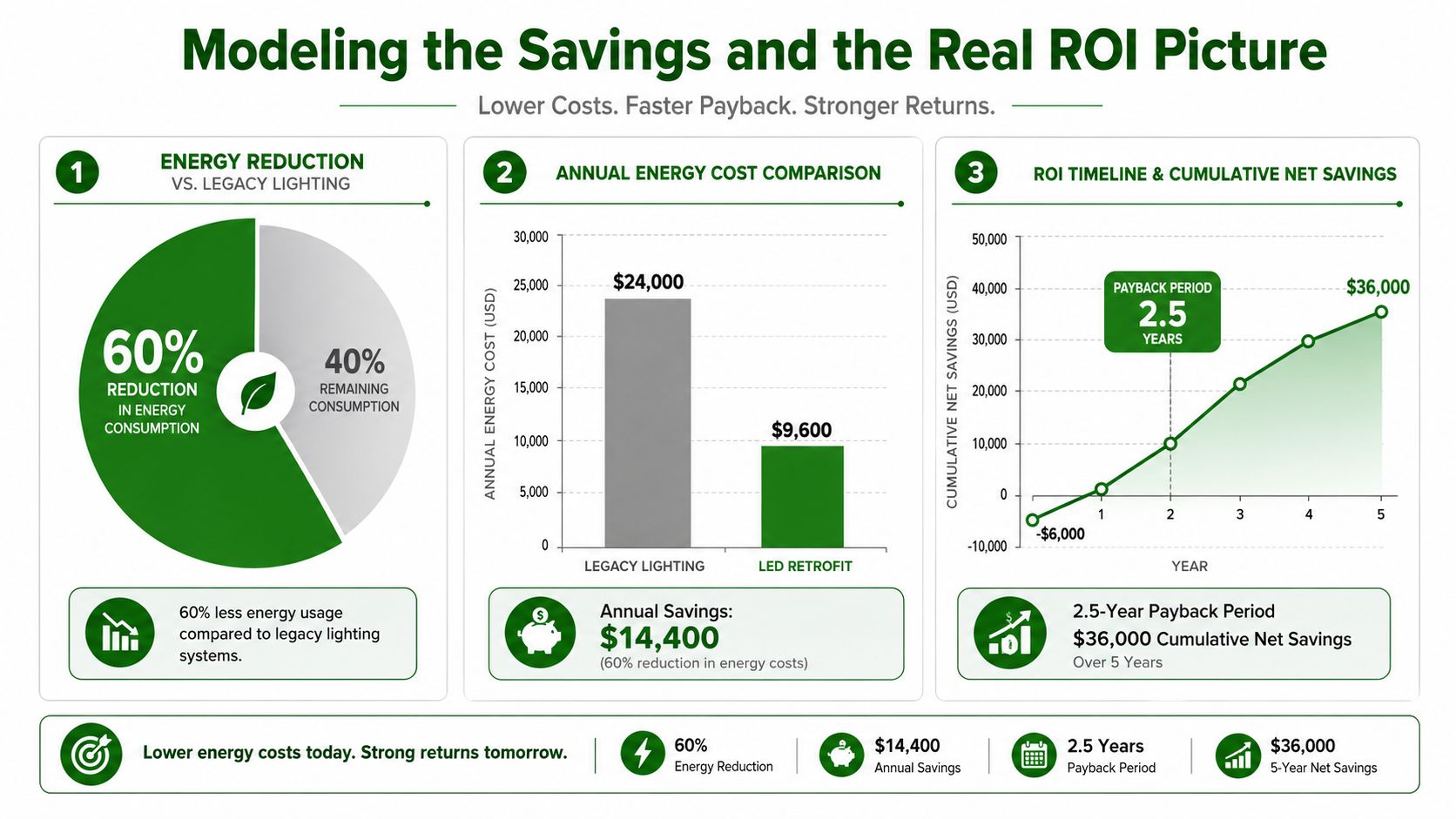
A retrofit budget looks easy on paper until the crew starts opening fixtures, checking poles, and measuring how the site is wired. The energy savings usually justify the project, but the payback only holds when the scope matches the property condition and the operating schedule. That is where owners either get a clean return or end up paying for avoidable rework.
The International Energy Agency reports that LED lamps use 80 to 90% less energy than incandescent lamps and 50 to 60% less than fluorescent lamps IEA LED lighting report. It also notes that LED retrofit tubes can pay back in a few months when they replace linear fluorescent lamps, and that general lighting service LED lamps can pay back in a few weeks or even immediately versus tungsten-filament and compact fluorescent lamps IEA LED lighting report.
A simple ROI framework that holds up in a meeting
The cleanest way to defend a lighting capital request is to compare the existing wattage to the proposed wattage, then layer in annual burn hours, the utility rate, and the total project cost. That basic math gets the conversation started, but it does not finish the job. Soft costs, controls that are never programmed, fixtures that stay on all night when they should not, and pole work that only becomes visible after the lift arrives can change the number fast.
I see that most clearly on commercial sites with mixed inventories. A warehouse may have high-bay fixtures that are easy to service and a loading area with older exterior heads that need pole inspection before anyone orders parts. A retail center can have parking lot lighting that looks straightforward from the ground, then reveal bad wiring, corrosion, or access issues once the contractor opens the work order. The parking lot lighting LED guidance is a practical reference for thinking through those site-lighting choices without assuming every pole, arm, or circuit is in the same condition.
Maintenance savings matter too, but only if the retrofit is scoped properly. A project that cuts truck rolls, lamp swaps, and emergency callouts can improve the payback quickly, especially on hard-to-reach fixtures. A project that keeps old controls in place, or leaves a weak circuit running because it was “good enough,” gives up a lot of that return.
The best ROI jobs are the ones where the operating pattern is clear before the first purchase order goes out. If the lights are on all night, the schedule should say that. If tenants override the controls, that needs to be addressed before sign-off. If access is difficult, the labor should be priced for the site conditions instead of the preferred version of the site.
Title 24, Controls, and the Compliance Work Most Owners Underestimate
In California, a lighting retrofit is often a paperwork project as much as a hardware project. Title 24 compliance can pull in controls acceptance, automatic shutoff, daylight harvesting, demand response capability, and the certification trail that proves the job was installed and tested correctly. A retrofit that ignores those pieces can look fine on day one and still fail at sign-off.
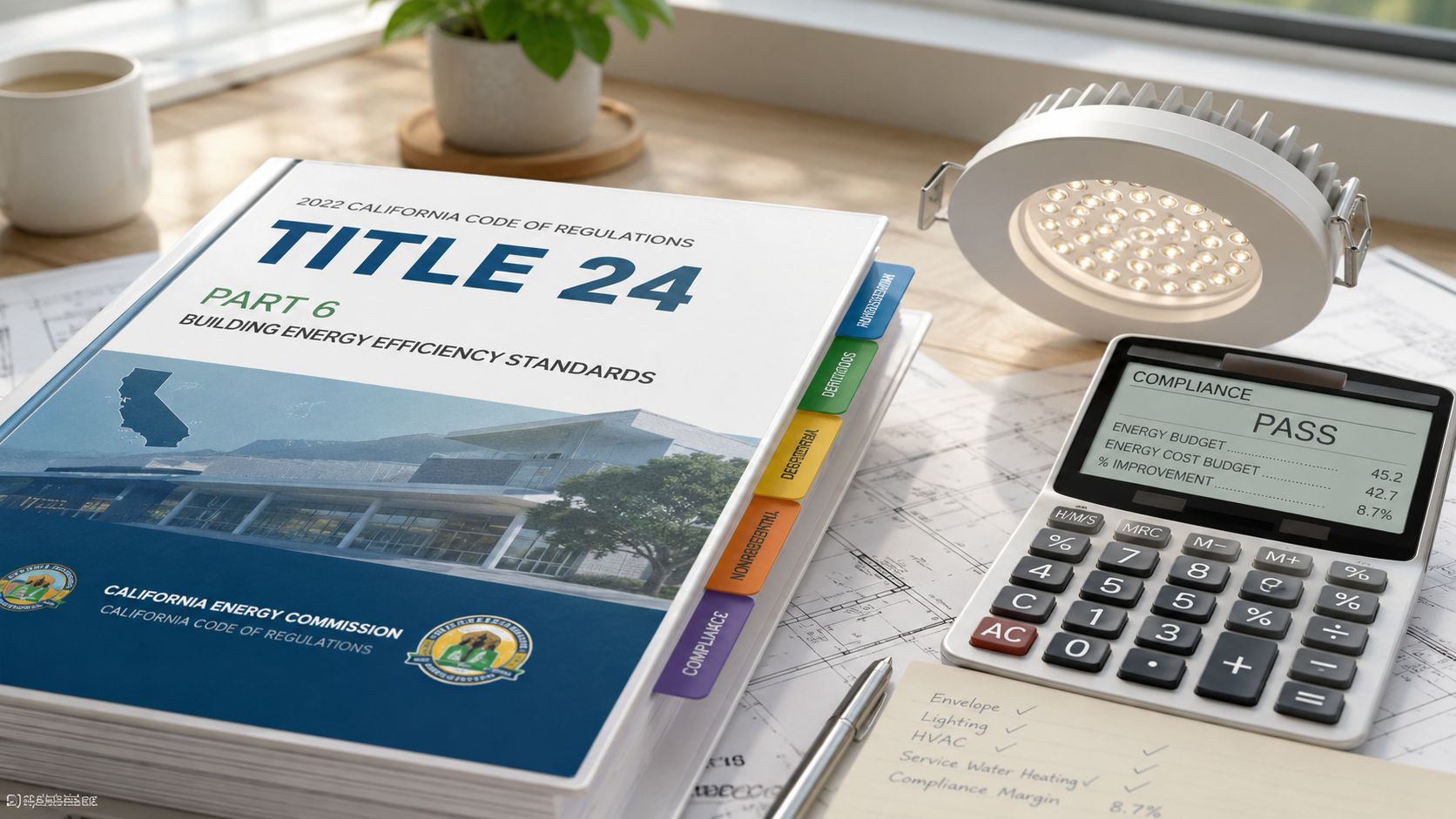
The simple mistake is treating controls as optional add-ons. Controls now affect fixture selection, bid scope, and commissioning. If a project triggers acceptance testing, the contractor needs to know who is performing it, what documentation will be handed over, and what the owner will need to keep on file later.
What inspectors and acceptance testers usually care about
They want proof that the installed system matches the approved scope. They want the controls to respond the way they're supposed to, the shutoff function to work, and the documentation trail to be clean. They also care about whether the retrofit was done as a true modification in place or as a scope that requires deeper compliance work.
That's why scope language matters before anyone orders product. If the bid says “controls included,” that still doesn't tell you whether the photocells, schedules, dimming behavior, and acceptance testing are covered. If a contractor can't explain the documentation packet in plain English, that's a warning sign.
For a practical overview of how the code side gets handled, the Title 24 lighting requirements guide is the kind of reference owners should review before the first fixture gets touched.
Practical rule: if the retrofit changes the lighting system, assume controls and documentation will matter until someone proves they don't.
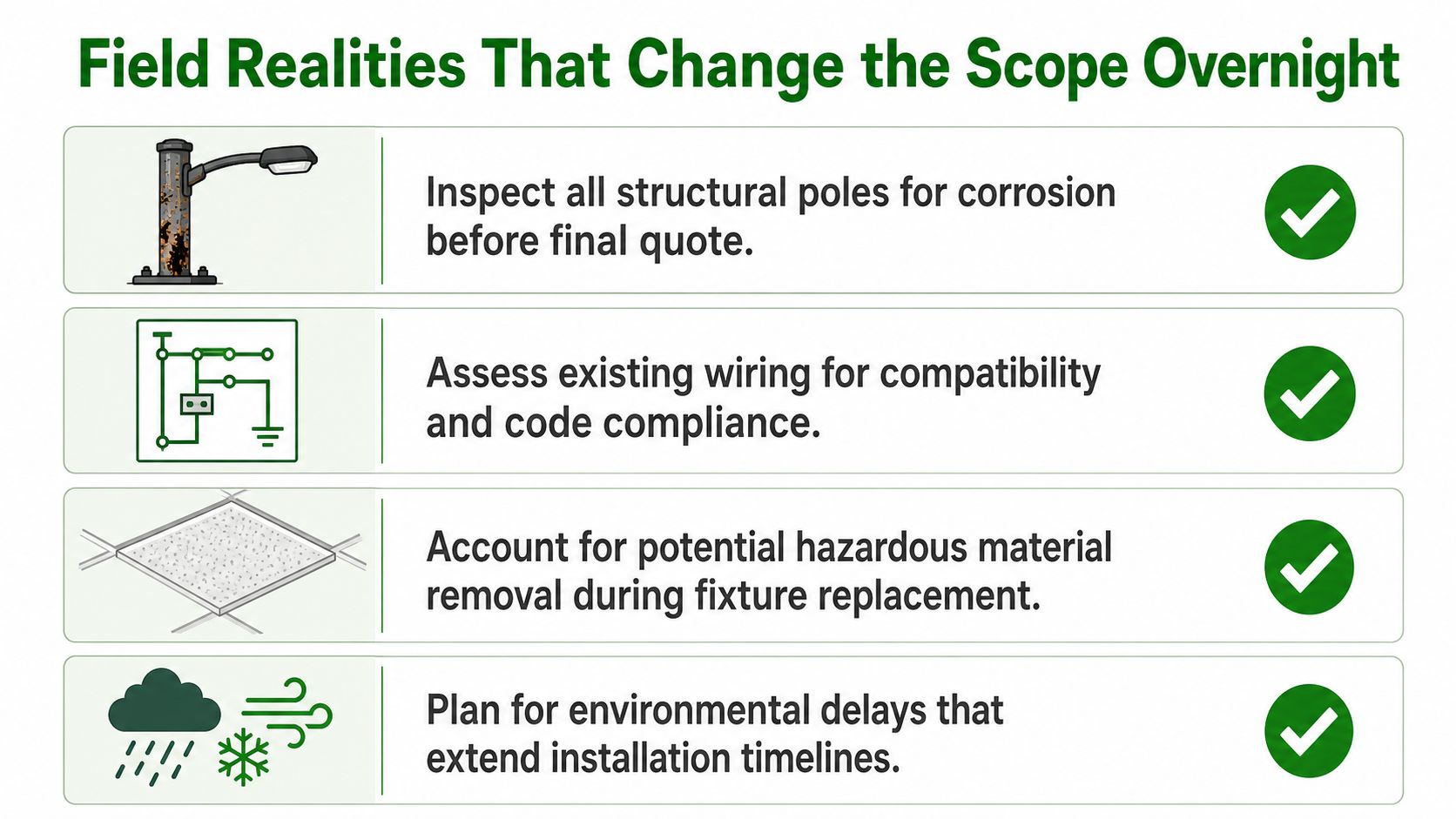
Field Realities That Change the Scope Overnight
A lot of retrofit bids fall apart because the estimator never saw the ugly parts. Light poles corrode at the base, fixtures sit higher than expected, and the electrical gear underneath the pretty part of the site has problems nobody mentioned during the walk. That's where the scope changes, fast.
The issues that force a better quote
- Pole condition: corroded or damaged poles can turn a simple retrofit into a replacement decision, and pole integrity testing is worth the cost when the structure has age, visible deterioration, or impact history.
- Access height: fixtures mounted high enough to need a boom truck change both scheduling and pricing. That's not a minor detail, it's often the difference between a tidy night shift and a multi-day access plan.
- Electrical health: infrared thermography can find hidden hotspots in panels and switchgear before they turn into downtime, which is especially useful when the site has a history of unexplained trips or heat-related failures.
- Compatibility issues: missing clips, mismatched hardware, or nonstandard housing and trim combinations can slow installation and create fit problems that only show up after the crew is already on-site.
The biggest mistake is assuming the cheapest bid includes all of that inspection work. Often it doesn't. The result is a change order after the lift is on site, or worse, a finish that looks fine from the ground but leaves an installation issue behind.
Contractor habit to watch: the careful bidder asks about structure, access, and panel condition before pricing, not after the job starts.
That's why owners should expect more than a fixture count. The contractor should look at the pole, the wiring path, the access plan, and any material conditions that could alter the scope. For properties that need those diagnostics bundled with the lighting work, Access Electrical and Lighting provides infrared inspections, light pole integrity testing, and high-reach boom truck services as part of commercial electrical and lighting scopes.
Commissioning, Maintenance, and Protecting the Warranty
A retrofit is only finished when it's commissioned and documented. The crew should verify aiming, controls programming, photocell operation, emergency lighting transfer where applicable, and any acceptance-test results tied to the project scope. If that doesn't happen, the property inherits a partial installation with no clean handoff.
The maintenance side matters just as much. LED systems still need periodic checks for failed drivers, stuck photocells, tenant overrides, and control settings that drift from the original intent. A small annual walk-through can keep those problems from growing into repeated service calls.
What to keep on file
Keep the cut sheets, model numbers, warranty terms, commissioning notes, control settings, and sign-off documents together. That paperwork protects you later if a driver fails, a fixture performs differently than expected, or a warranty claim needs proof of what was installed. If you can't show what went in, it's harder to argue about what should be covered.
The same logic applies to maintenance planning. The cleaner the documentation, the easier it is to tell whether a problem is a product issue, an installation issue, or a setting issue. That saves time for owners, and it saves the contractor from chasing a complaint without enough information.
The commercial lighting and maintenance guide is a sensible reference if your team is deciding how much of the post-install work should stay with the contractor versus your own maintenance staff.
Choosing a Retrofit Contractor Without Getting Burned
Commercial lighting retrofits are not a handyman job. In California, the right contractor should carry a C-10 electrical contractor license, along with the bonding and insurance needed for site lighting, electrical work, and compliance-heavy scopes. A low-voltage installer or general handyman might be fine for a small cosmetic task, but that's not enough when poles, controls, permits, and acceptance testing are in play.
The bid itself should tell you whether the contractor knows the work or just knows how to price a fixture. You want fixture model numbers, controls scope, permit responsibility, Title 24 documentation, pole testing if needed, boom-truck inclusion, warranty terms, and a clear line on who owns the paperwork after closeout.
Questions that expose weak bids fast
- Who pulls the permit? If the answer is vague, expect schedule risk.
- Who performs the acceptance test? If nobody owns it, compliance becomes the owner's problem.
- What happens if a pole fails inspection? If there's no answer, the bid is incomplete.
- Which model numbers are included? Generic language usually hides substitutions.
- Who keeps the warranty packet? Missing paperwork turns a simple claim into a headache.
A strong bidder will also talk through comparable property references, not just product brochures. That matters because a warehouse yard, a retail center, and a multifamily garage each have different access, safety, and control challenges. The contractor should know how to sequence work so the site stays open and the lighting stays reliable.
For some owners, that contractor may be Access Electrical and Lighting, which handles commercial LED retrofits, infrared inspections, pole work, boom-truck access, and Title 24 support under one commercial electrical scope. The important part is not the logo, it's whether the team can prove they've done this kind of work before and can document it cleanly when the job is done.
If your property is dealing with dark poles, tired fixtures, or a retrofit scope that keeps getting more complicated, talk to a commercial lighting contractor before you buy product or let a low bid lock in the wrong approach. Visit Access Electrical and Lighting to review retrofit options, compliance support, and field services that match the way commercial sites work.