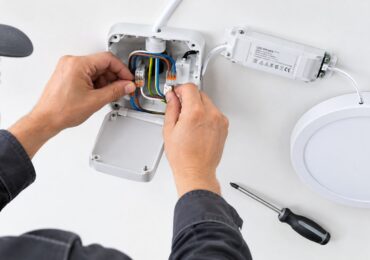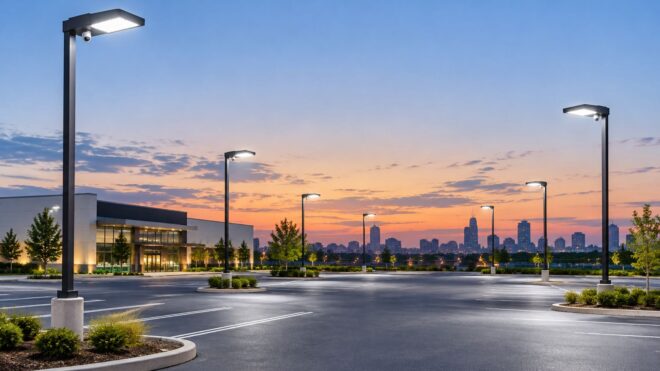
A property manager walks the lot midmorning and notices every pole light is still burning. The LED retrofit was supposed to reduce the utility bill, yet the lighting schedule hasn't changed and nobody can confirm whether the photocell is aimed at the sky, the fixture, or a reflective wall.
That situation is common because LED parking lot lights with photocell controls solve two different problems. The LED reduces the wattage required to produce useful light. The photocell determines whether the fixture should be operating at all based on available daylight. One without the other can leave savings, reliability, and compliance gaps.
The practical question isn't whether to install a photocell. It's whether the lot needs photocell-only control, scheduled reduction, occupancy sensing, bi-level dimming, or a combination that preserves safe security lighting. The right answer depends on the property's operating profile, pole layout, nighttime activity, electrical circuits, and local requirements.
Why Parking Lot Owners Are Pairing LEDs with Photocells
A parking lot can have efficient LED fixtures and still waste energy if those fixtures remain on after sunrise. A photocell measures ambient light and switches outdoor lighting off when daylight is available. The U.S. Environmental Protection Agency's ENERGY STAR outdoor-lighting guidance identifies photocells or photosensors as standard outdoor-lighting controls and states that ENERGY STAR-qualified outdoor fixtures include them.
Commercial parking lights often operate through the night, then stay energized after dawn when a control is missing, miswired, shaded, or bypassed. In Southern California, long daylight periods and bright building façades make sensor location a practical design issue. Mounting a photocell where it sees a wall, fixture output, or persistent shade can delay shutoff or cause unwanted cycling. If lights remain on through the morning, the problem usually lies in control setup or commissioning rather than the LED technology.
LEDs reduce demand, controls shape operation
Specify the fixture and control as one system. An LED optic may distribute light more effectively than the metal-halide or high-pressure-sodium fixture it replaces, but operating hours, daylight exposure, circuiting, and the programmed sequence determine the actual result.
The photocell is only one part of that sequence. Pair it with occupancy sensing where nighttime traffic varies, an astronomical timeclock where scheduled control is useful, or bi-level operation that maintains security lighting at a reduced level. A photocell detects brightness. It cannot determine whether a retail center is empty, residents are arriving late, or a perimeter zone needs low-level illumination.
Practical rule: Treat the photocell as the daylight gate, not the complete energy-management strategy.
What property teams should expect
Require a documented site survey, photometric plan, control schedule, and functional test. The baseline should record existing fixture wattage and operating hours, not rely only on the proposed LED wattage. The commissioning record should also confirm sensor orientation, timeclock settings, occupancy response, dimming levels, and the required six-hour override behavior where applicable.
Contractors and procurement teams should verify switching, dimming, relay, and line-voltage compatibility before ordering equipment. The project should leave clear answers to three questions: how much wattage the new fixtures use, when they operate, and what minimum light level remains during low-use periods.
The Wattage and Hours Behind the Savings
A parking lot can show a large fixture-wattage reduction and still miss its energy target if the circuit runs through daylight or stays at full output after closing. The useful calculation combines fixture load, operating hours, and control behavior.
A measured California parking-lot assessment compared seven 250-watt metal-halide fixtures with seven 135-watt LED fixtures. The installation reduced calculated demand from 2.0 kilowatts to 1.0 kilowatt and annual energy use from 8,484 kilowatt-hours to 4,053 kilowatt-hours, a 52% reduction in both demand and energy for that test installation, according to the California Emerging Technologies Coordinating Council parking-lot assessment.
A separate comparison reported high-pressure sodium equipment drawing 137 watts against 62 watts for an LED system, a 55% reduction in installed wattage. Treat those figures as a comparison point, not a promise for every lot. Existing fixture condition, voltage, optics, circuit loading, and control settings can change the result.
| System | Fixture Wattage | Demand | Annual kWh |
|---|---|---|---|
| Metal halide, seven-fixture test | 250 watts | 2.0 kW existing | 8,484 existing |
| LED, seven-fixture test | 135 watts | 1.0 kW proposed | 4,053 proposed |
| High-pressure sodium comparison | 137 watts | Not specified | Not specified |
| LED comparison system | 62 watts | Not specified | Not specified |
Hours determine the opportunity
A parking-lighting analysis used an operating profile of 18 hours per day, equivalent to 6,570 hours annually, while broader guidance states that most parking lots operate more than 13 hours per day. Those profiles show why the control sequence deserves the same scrutiny as the fixture schedule. A lower-wattage luminaire still consumes energy whenever its circuit remains on.
The photocell removes daylight operation. It does not lower the fixture's nighttime wattage by itself. An astronomical timeclock can shape the schedule, while occupancy sensing or bi-level control can reduce output during low-use periods. Where a six-hour override rule applies, include that required full-output period in the calculation rather than treating all overnight hours as dimmable.
Model the project in stages: multiply the existing fixture load by annual operating hours, repeat the calculation for the LED load, then account for photocell shutoff, scheduled reductions, occupancy response, and override requirements. The result should match the programmed sequence, not a best-case assumption.
Read a quote like an electrician
A credible proposal separates:
- Fixture reduction: Existing watts compared with proposed LED watts.
- Control reduction: Daylight hours removed by the photocell.
- Scheduled reduction: Planned overnight dimming or switching.
- Occupancy behavior: Whether sensors reduce selected fixtures or trigger full output.
- Assumptions: Utility rates, operating hours, maintenance condition, and circuit behavior.
If one savings number appears without the fixture load and control schedule, the projection cannot be checked. The LED conversion supplies the primary wattage reduction. The control sequence determines how often the new system operates at full output.
Choosing the Right Control Strategy for Your Lot
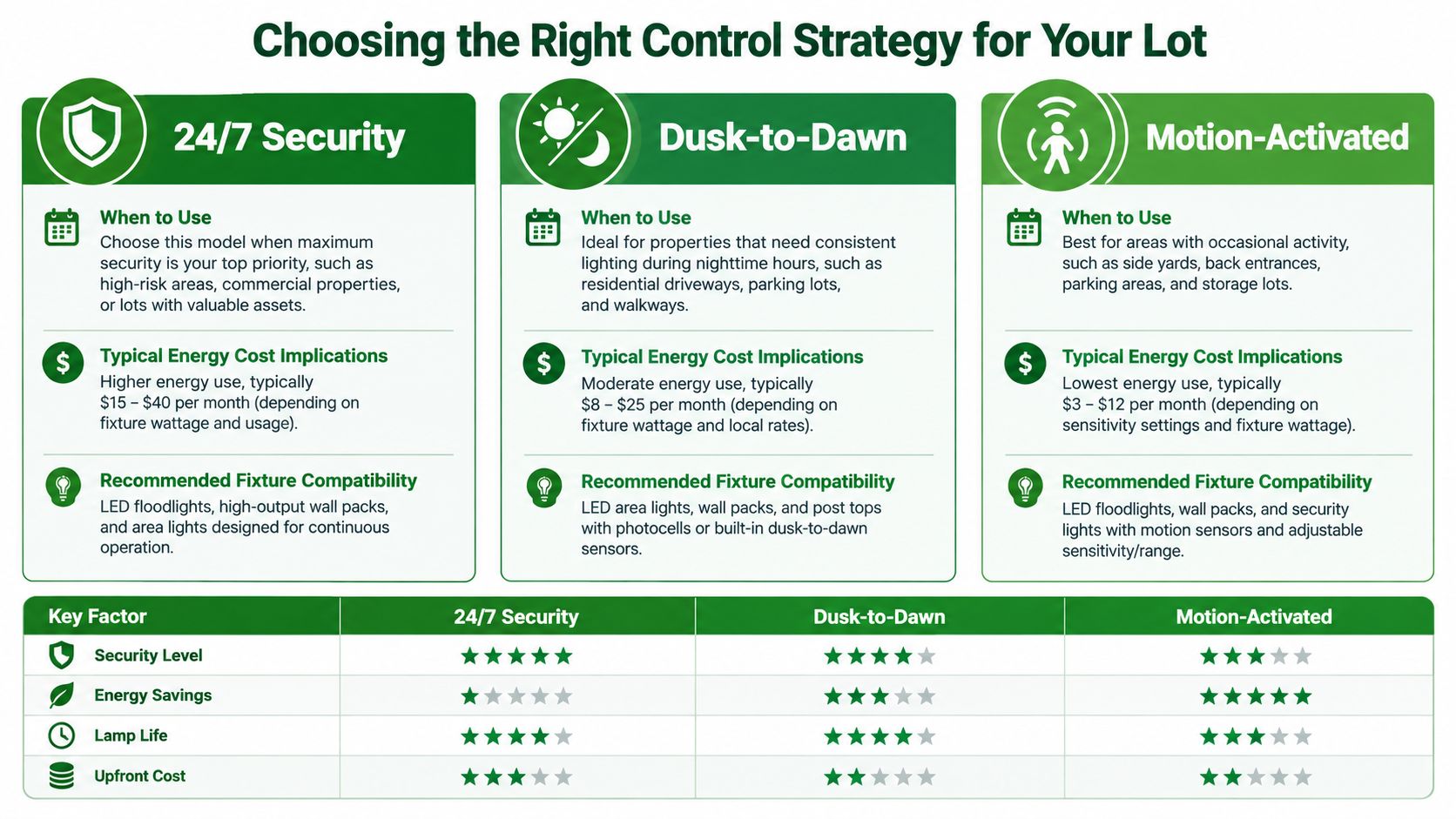
A photocell-only design fits a lot that needs dependable illumination from dusk through dawn. It doesn't fit every property. A retail center with predictable closing hours, a multifamily community with intermittent traffic, and a security-sensitive commercial site may all need different control zones.
The three common packages are straightforward:
- Photocell only: The fixtures turn on as daylight fades and turn off as daylight returns.
- Photocell plus astronomical timeclock: The photocell confirms daylight conditions while the timeclock applies a planned operating schedule or reduction.
- Photocell plus occupancy or bi-level dimming: The system maintains a defined low level and raises output when movement or activity is detected.
Match the package to the operating profile
24/7 security properties usually need a stable nighttime state. Use the photocell for daylight shutoff, then consider bi-level operation or carefully zoned dimming rather than switching the entire site off. Perimeter fixtures, pedestrian routes, and camera views may need continuous low-level illumination even when the lot is empty.
Business-hours retail properties can often use a photocell with an astronomical timeclock. The photocell prevents daytime operation, while the schedule reduces or switches selected zones after closing. Keep a security circuit active where the owner, insurer, or site-security plan requires it.
Intermittent multifamily properties may benefit from photocell control combined with occupancy sensing or bi-level luminaires. The system can maintain safe background lighting and increase output when vehicles or pedestrians enter a zone. Sensor coverage must account for vehicle movement, landscaping, parked cars, and the difference between a passing headlight and actual occupancy.
The automated lighting controls guidance from Access Electrical and Lighting is useful when the project requires coordination between line-voltage controls, scheduling, and commissioning.
The lowest-energy design isn't automatically “lights off.” It is a documented minimum-security state that activates at dusk, reduces output during low use, and preserves safe illumination where people still move.
The control sequence should state what happens during a sensor failure, a timeclock fault, a manual override, and a loss of communication. Don't approve a design that describes only normal operation. A safe fail state and a clear handover record matter more than a feature list.
Surveying and Sizing Your Parking Lot
A fixture swap should start with a field survey, not a catalog cut sheet. Record pole locations, mounting heights, fixture types, wattages, circuit assignments, operating hours, and existing nighttime illuminance. Take photographs from the driving lanes and pedestrian paths, because a plan that looks orderly on paper can hide tree shadows, façade reflections, damaged arms, or poles that don't match the original drawings.
Build the survey in the field
Start at the panel and work outward. Trace each lighting circuit, confirm line voltage, identify which fixtures share a control, and note whether a single photocell would control independent circuits that need separate sensing.
Then measure existing light levels on a repeatable grid. Don't rely on an average reading taken under the brightest fixtures. PNNL identifies 0.2 footcandles as a minimum horizontal illuminance at any point on typical asphalt parking surfaces under general IES guidance, and IES RP-20-14 preview material gives 4:1 average-to-minimum uniformity for certain open-parking pedestrian areas, as summarized in the PNNL parking-lot lighting report.
Design for the minimum, not just the average
A retrofit can produce an acceptable average while leaving dark pockets along curbs, between poles, beside islands, or near building edges. Those areas are where pedestrians and vehicles interact, so the minimum reading and uniformity matter more than a flattering reading under one luminaire.
Use the survey to decide whether the existing pole spacing and mounting height support a direct replacement. If the old fixture throws light broadly and the new optic is narrower, identical wattage and identical mounting may create dark zones. In other cases, a lower-wattage LED with better optics can improve distribution without increasing installed load.
For calculations and field verification, a parking-lot foot-candle calculator can support the design process, but it doesn't replace site measurements. The contractor still needs to verify actual pole positions, obstructions, surface conditions, and the final grid.
Installing Photocells the Right Way
A photocell can work perfectly on the bench and fail on a pole if its view, wiring, or control logic is wrong. On a pole-top or shoebox fixture, mount the sensor where it sees open sky. In the northern hemisphere, an unobstructed northern exposure can reduce direct low-angle sunlight, but inspect the actual site for canopies, poles, trees, building façades, and the fixture's own light.
A canopy can keep the sensor dark during the day. A bright wall can make it report daylight too early. Light from the luminaire can also cause cycling: the fixture turns on, illuminates the sensor, and then commands itself off.
Specify the sensor before the crew arrives
Confirm compatibility between the photocell and luminaire before installation. Check the line-voltage rating, switching arrangement, neutral and line conductors, grounding, surge protection, relay rating, and LED driver requirements. The drawings and field records should identify whether the control switches the line or neutral, based on the equipment and applicable electrical design.
Technical parking-lighting specifications recommend a 15 to 30 second time delay to prevent nuisance switching from lightning, headlights, or moving clouds. They also recommend a controlled turn-on and turn-off ratio of no greater than 5:1, as described in the LED site-lighting performance specification. A separate control specification may identify an approximately 10-footcandle sensor set point, but the installer still needs to confirm that the setting suits the site and sensor location.
These settings address different failure modes. The delay filters brief changes in light, while the ratio helps prevent rapid cycling between the commanded states. The set point determines when the control interprets the available light as day or night.
Protect the installation from predictable faults
Before energizing the circuit, check:
- Sensor view: The photocell sees open sky and is clear of a pole arm, canopy, sign, tree, or building.
- Fixture light: The luminaire does not shine directly into the sensor.
- Reflections: Walls, glass, painted surfaces, and wet pavement do not create a false daylight signal.
- Electrical compatibility: The photocell, relay, driver, voltage, grounding, and surge protection match the circuit.
- Control zoning: Each independently scheduled circuit has the sensing arrangement it requires.
- Manual override: Any override has a defined return to automatic operation.
A photocell should be treated as one part of the control decision. Pair it with occupancy sensing, an astronomical timeclock, or bi-level operation when the lot has predictable periods of lower use. That approach can reduce output after the evening rush without asking the photocell to make every control decision.
Before handover, simulate dusk and dawn, observe the programmed delay, confirm the commanded state, and record circuit behavior. “The lights came on” is only an operating check, not a commissioning record.
Commissioning, Testing, and Troubleshooting
An LED installation is unfinished until its controls perform under real conditions. Test the lot in daylight and after dark, then measure completed illuminance on a grid. Confirm that the photocell prevents daytime operation, while the astronomical timeclock, occupancy sensor, or bi-level setting handles scheduled reductions during quieter nighttime periods. The photocell supplies the day-night signal, not the entire control strategy.
Before testing, compare the programmed schedule with the intended operating sequence. Verify full output at the required times, reduced output during the scheduled period, and restoration after occupancy or schedule changes. Record sensor response, commanded state, measured illuminance, and circuit current. A mapped set of grid readings gives the owner something to troubleshoot later, unlike a simple statement that the system passed.
Match symptoms to causes
- Fixture stays on during daylight: Check for a shaded or dirty sensor, incorrect aiming, reflected light, a bypassed control, or wiring that does not match the sequence.
- Fixture cycles on and off: Inspect the time-delay setting, direct exposure to fixture light, relay compatibility, and line-voltage terminations.
- Fixture turns off too early: Look for direct sun, façade reflections, or a set point that does not suit the installation.
- Fixture does not turn on consistently: Verify sensor orientation, line and neutral connections, grounding, voltage, and driver compatibility with the switching device.
- Average illuminance looks acceptable but dark areas remain: Review minimum readings and uniformity. Adjust optics, mounting height, spacing, or zoning instead of accepting the average alone.
Test the override behavior
Treat manual overrides as a programmed control function. For covered applications, California requirements may call for a photocell paired with a motion sensor or automatic time switch. An astronomical timeclock can provide another permitted control path. Test the override at the control panel, confirm the lights respond as intended, and verify that automatic operation returns within six hours. Record the test result and the programmed return behavior.
The handover package should state the normal schedule, reduction level, override method, automatic-return behavior, and the person responsible for changing settings. Commissioning should also confirm the fail-safe response after a sensor, relay, or communication fault. Without those records, the next service call begins with guesswork instead of a defined sequence.
Procurement, Compliance, and Long-Term Ownership
A useful bid request asks for more than fixture brand and wattage. Require the contractor to describe the photocell location, control zones, dimming behavior, fail-safe state, commissioning tests, and the records delivered at closeout. For Southern California properties, include Title 24 testing, certification, and documentation in the procurement conversation when the application requires it.
The as-built record should show fixture locations, circuit assignments, sensor locations, control settings, measured light levels, and any scheduled reduction. Ask whether the contractor can also provide infrared electrical inspections, light-pole integrity testing, and high-reach boom-truck maintenance. Those services address different ownership risks, from overheated connections to deteriorated poles and fixtures that are hard to reach.
Use commercial parking-lot lighting fixtures as a starting point for the luminaire conversation, but make the final selection from the survey and photometric design. The cheapest fixture isn't necessarily the lowest-cost ownership choice if its optic creates dark zones, its driver doesn't match the controls, or its sensor location is impossible to commission.
Before signing, confirm:
- Baseline: Existing wattage, operating hours, and circuit current are documented.
- Design: Photometrics address minimum readings and uniformity, not only average output.
- Controls: Photocell, timeclock, occupancy, and bi-level behavior are written down.
- Compliance: Required Title 24 records and control testing are included.
- Maintenance: Pole access, infrared inspection, cleaning, and repairs performed at height have an assigned plan.
Access Electrical and Lighting provides commercial LED parking-lot retrofits, photocell and automated control installation, commissioning, testing, and maintenance for commercial, retail, office, and multifamily properties. Visit Access Electrical and Lighting to request a site evaluation that connects fixture selection, control zoning, photometric verification, and California compliance documentation.