
If you're trying to calculate transformer size for a commercial property, you're usually not doing it in a vacuum. A tenant is expanding. A rooftop unit got replaced with something larger. An EV charging project is on the table. Or an older transformer is running hot and nobody trusts the original load assumptions anymore.
That's where a lot of bad decisions start. Someone adds up nameplate wattage, picks a unit that seems close, and assumes the job is done. In a modern Orange County property, that shortcut can create overheating, nuisance trips, poor equipment performance, and expensive rework when the next tenant improvement lands.
A transformer has to fit the actual operating conditions of the building. That means load type, phase, voltage, power factor, demand patterns, future growth, heat, harmonics, code requirements, and the realities of the site. The formulas matter. So does everything around the formulas.
Understanding Key Transformer Sizing Concepts
A transformer that looks right on a submittal can still be wrong for the building. I see that on Orange County commercial projects when a space adds EV charging, swaps fluorescents for LED drivers, or pushes more equipment into a hot electrical room. The sizing basics have to be right before anyone talks about demand factors or future tenant growth.
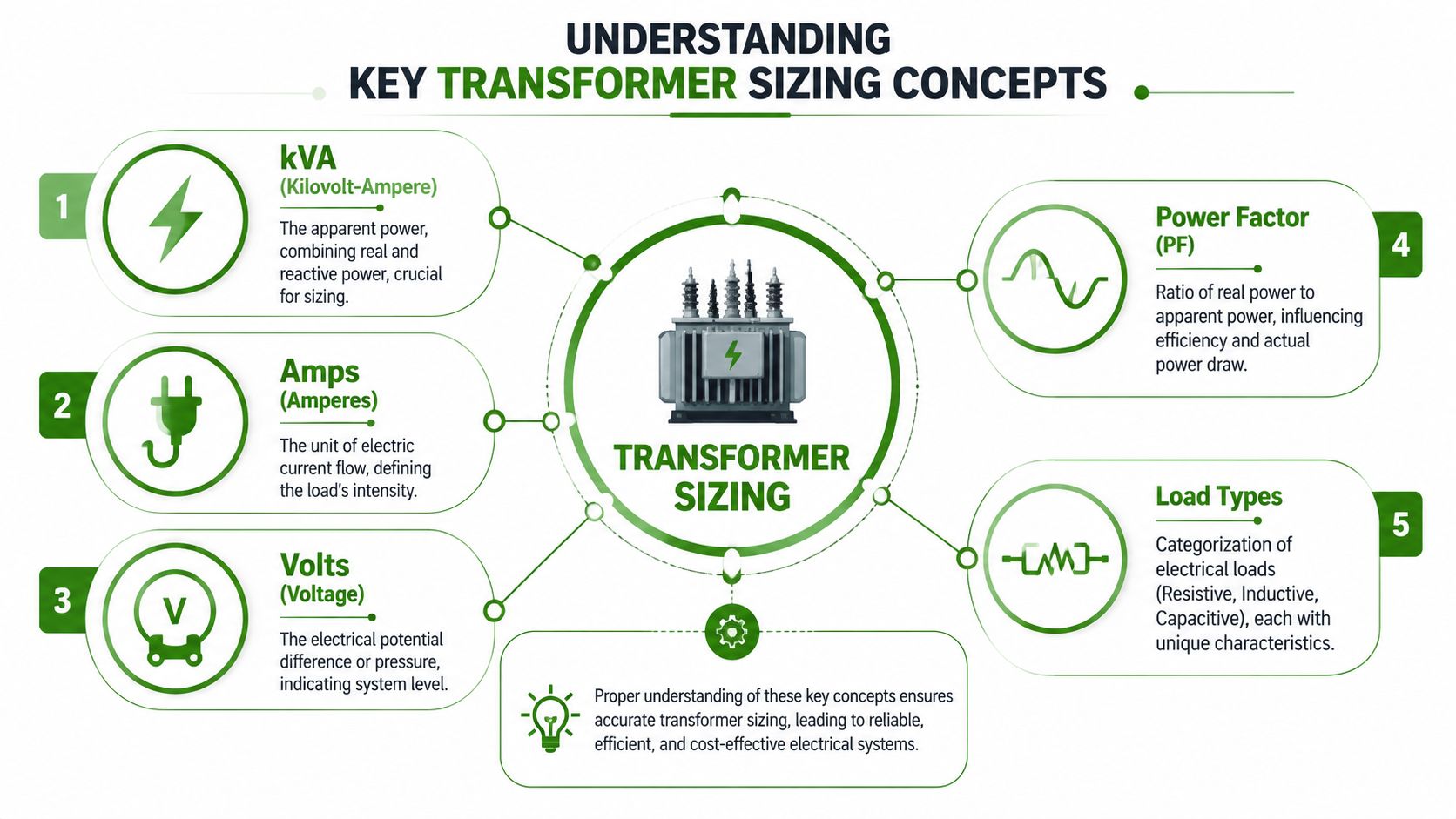
kW and kVA are not the same thing
Facility teams often track load in watts or kilowatts because that is how equipment is sold and discussed. Transformers are sized in kVA, or apparent power. That distinction matters on commercial properties with motors, electronic power supplies, and mixed tenant loads.
kW is the usable power. kVA is the total load the transformer must support. If the power factor is below unity, the transformer has to carry more than the kW number suggests. That is why a service upgrade based only on nameplate watts can come up short.
The basic conversion is kVA = kW / power factor. In the field, the hard part is not the formula. The hard part is using a power factor that reflects the actual load mix. A small office with conventional plug loads behaves differently from a retail space with signage, LED drivers, and HVAC motors cycling through the day.
Practical rule: Nameplate watts are a starting point, not a final transformer size.
Voltage, current, and phase drive the base calculation
A lot of transformer sizing starts with what can be verified fast. Equipment nameplates, panel schedules, and one-lines usually give you voltage, current, and phase. From there, the base formulas are straightforward:
- Single-phase load: kVA = (Voltage × Current) / 1,000
- Three-phase load: kVA = (√3 × Voltage × Current) / 1,000
The three-phase formula uses √3, approximately 1.732, because of the relationship between line voltages and current in a three-phase system.
Errors here are common, especially in mixed-use commercial buildings. A tenant suite panel may be mostly single-phase. A rooftop unit is often three-phase. A transformer serving common areas, lighting, and mechanical loads may feed both at the same time. Use the wrong phase assumption and the math still looks tidy, but the installation runs hot, trips unexpectedly, or leaves no room for the next improvement.
Voltage selection matters just as much. A 208Y/120V system, a 480Y/277V system, and a buck-boost application are different design problems. The transformer has to match the distribution strategy for the building, not just one piece of equipment.
Power Factor's Impact on Sizing
Power factor directly affects transformer capacity because the transformer carries apparent power, not only productive output.
On older commercial properties, low power factor often comes from motor loads and aging equipment. On newer sites, the issue is different. Electronic loads can distort current even when the listed power factor looks acceptable on paper. That shows up in Orange County office, retail, and mixed-use properties that now include LED lighting, control systems, variable frequency drives, and EV charging equipment. Those loads can increase heat and neutral loading, which matters when the transformer sits in a warm exterior enclosure or a cramped electrical room with poor ventilation.
This is also where code and compliance start to matter. A transformer that barely pencils out in mild conditions may not hold up well in Southern California summer heat. Title 24 driven lighting upgrades can reduce some load while adding electronic drivers and controls that change how the load behaves. Good sizing accounts for both the quantity of load and the character of the load.
A simple screening check helps avoid bad assumptions:
| Question | Why it matters |
|---|---|
| What voltage does the load require | A wrong voltage assumption invalidates the calculation |
| Is the load single-phase or three-phase | The sizing formula changes immediately |
| Do you know the power factor | If not, estimate carefully before converting kW to kVA |
| Does the load include non-linear equipment | Harmonics and extra heat can push you toward a different transformer type or larger capacity |
A correct transformer size starts with an accurate picture of how the building uses power. That includes the electrical characteristics of the load, the site conditions around the equipment, and the fact that modern commercial properties rarely behave like a clean textbook example.
How to Conduct a Commercial Electrical Load Audit
A transformer calculation is only as good as the load audit behind it. On commercial properties, the mistakes usually aren't in arithmetic. They're in the missing loads.
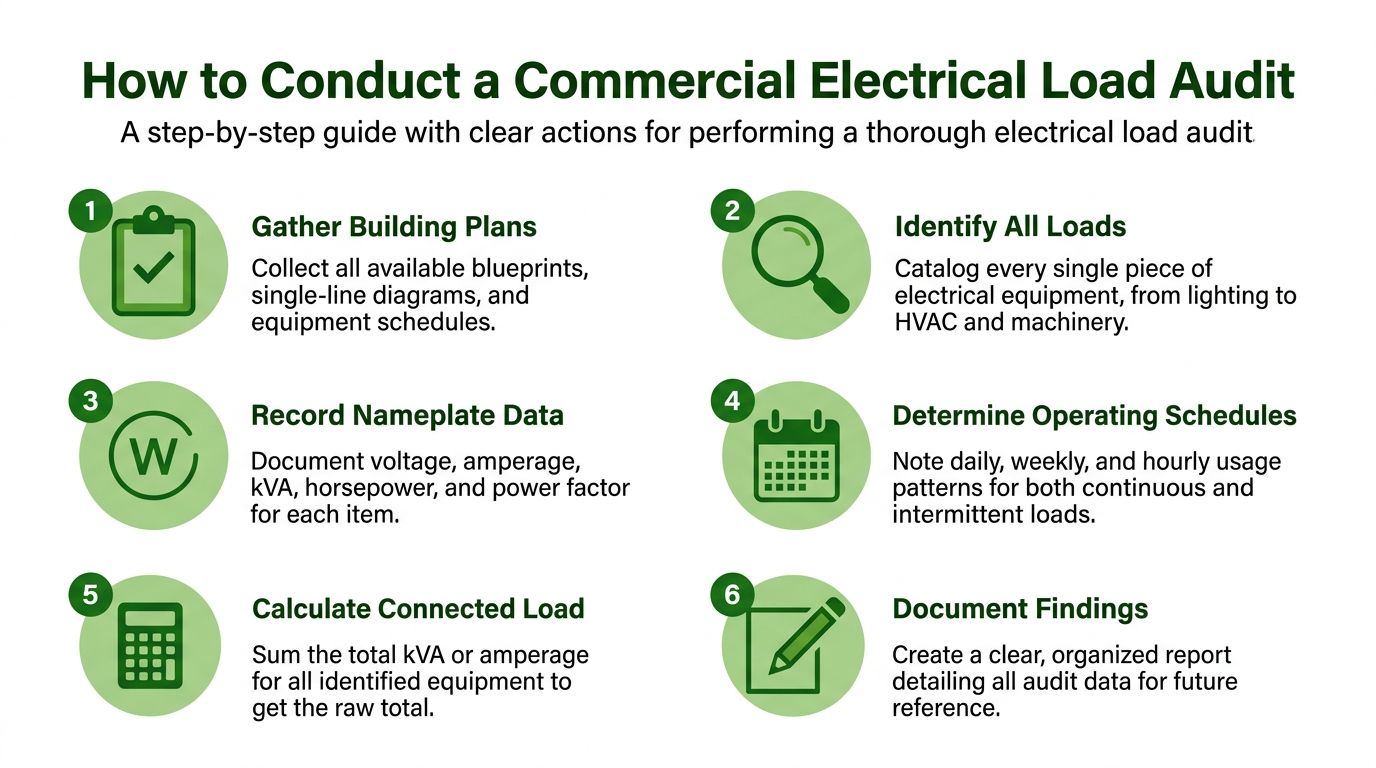
Start with documents, then verify in the field
Begin with the latest single-line diagrams, panel schedules, equipment schedules, and tenant improvement records. Those documents give you a map, but not always the current reality. Commercial properties change. Suites get remodeled. Lighting gets retrofitted. Equipment gets swapped without perfect documentation.
That's why a real audit includes a field walk. On Orange County properties, that usually means checking rooftops, electrical rooms, tenant spaces, parking areas, common areas, and any separate house systems.
Look for loads in these categories:
- HVAC equipment such as rooftop units, split systems, exhaust fans, and control panels
- Lighting systems including tenant lighting, common area lighting, parking lot lighting, and lighting controls
- Receptacle and plug loads in offices, retail suites, leasing areas, and break rooms
- House systems such as gates, elevators, fire alarm support equipment, irrigation controls, and sign circuits
- Special equipment including kitchen gear, refrigeration, compressors, server racks, or tenant machinery
- Newer infrastructure like access control, telecom rooms, EV chargers, battery-backed systems, and digital signage
Record the right nameplate data
The goal isn't just to list equipment. The goal is to record the values that let you calculate actual load.
For each piece of equipment, capture what's available:
| What to record | Where you usually find it |
|---|---|
| Voltage | Nameplate, panel schedule, submittal |
| Amperage | Nameplate, breaker schedule, manufacturer label |
| Phase | Nameplate, panel designation, one-line |
| kVA or kW | Manufacturer documentation or equipment label |
| Horsepower | Motor nameplate or disconnect label |
| Power factor if available | Equipment data sheet or manufacturer info |
Don't assume office plug load is trivial, and don't assume common area systems are already accounted for somewhere else. A surprising number of transformer overload issues come from a load inventory that was incomplete from day one.
On older commercial sites, exterior lighting, signage, telecom gear, and tenant-installed equipment are the loads most likely to be missed.
Separate connected load from likely operating load
Once you've built the load list, don't stop at raw totals. Commercial buildings rarely run every load at full value at the same time.
That's where demand and diversity matter. In more complex scenarios, engineers apply those factors to avoid sizing a transformer around a theoretical maximum that the property never reaches. One example from Electrical Trader's step-by-step sizing guide shows a 500 kVA connected load with a 0.8 demand factor becoming 400 kVA before safety margins are added.
That adjustment matters because it keeps you from buying more transformer than the site will realistically use. It also prevents the opposite mistake, which is assuming diversity without documenting why.
A load audit should end with two separate numbers:
- Connected load, straight from the inventory
- Expected operating load, adjusted for how the building runs
That distinction is what turns a walkthrough into a real sizing basis.
Calculating Your Total kVA Requirement
A transformer can look fine on a one-line and still run hot by the first summer afternoon in Orange County. The calculation has to reflect the actual electrical characteristics of the building, not just a neat total from a spreadsheet.
Convert every load into kVA before you total anything
Start by putting each load into the same unit. For transformer sizing, that means kVA.
Use the formula that matches the equipment:
- Single-phase: kVA = (Amps × Volts) / 1,000
- Three-phase: kVA = (Amps × Volts × 1.732) / 1,000
That sounds basic, but mistakes commonly occur in the field. I see mixed commercial properties where a 120/208V panel gets treated the same as a 277/480V rooftop unit, or a nameplate current gets copied over without checking whether it reflects full-load operation, continuous use, or manufacturer-specific conditions. If the input is wrong, the transformer size will be wrong.
For modern commercial properties, pay close attention to loads that do not behave like older linear equipment. LED drivers, variable frequency drives, IT equipment, and EV charging equipment can distort current and increase transformer heating beyond what a simple arithmetic total suggests.
A simple building example
Here's a sample load table for a small commercial building. It does not represent every site. It shows how individual loads convert into total kVA.
| Load Type | Quantity | Volts | Amps (per unit) | Phase | Calculated kVA |
|---|---|---|---|---|---|
| Rooftop HVAC Unit | 2 | 480 | 30 | Three-phase | 24.94 each |
| Lighting Panel | 1 | 208 | 80 | Three-phase | 28.83 |
| Office Receptacle Panel | 1 | 120 | 90 | Single-phase | 10.8 |
| Exterior Signage | 1 | 277 | 20 | Single-phase | 5.54 |
| Small Exhaust Fan | 2 | 208 | 8 | Three-phase | 2.88 each |
Adding those values gives you the connected load in kVA for this sample set.
That number is useful, but it is still only the electrical starting point.
Adjust the total for real operating conditions
Commercial transformers should not be selected to live at their nameplate limit all day. Heat, load profile, and installation conditions matter, especially on Southern California sites where electrical rooms, rooftop areas, and service yards can see high ambient temperatures for long stretches.
A practical approach is to leave headroom, then round up to the next standard transformer size. Common commercial sizes include 75 kVA, 112.5 kVA, and 150 kVA. If the calculated requirement lands between sizes, choose the next size up. That gives the transformer room to handle normal variation, seasonal HVAC demand, and the kind of tenant changes that happen on office, retail, and mixed-use properties.
The right margin also depends on the load type. A building with steady lighting and receptacle load behaves differently than a property with cycling HVAC, kitchen equipment, elevator motors, or fast-growing EV demand. If the project includes commercial EV charger installation requirements, include that scope in the transformer decision early. Charger count, charging speed, feeder sizing, and future expansion can all push the transformer selection higher than the existing building load alone would suggest.
Account for power quality, not just arithmetic
This is one of the places generic sizing guides miss the actual job.
On many Orange County commercial properties, the issue is not only total kVA. It is the type of kVA. Non-linear loads can create harmonics, raise neutral current, and add transformer heat. LED lighting retrofits, electronic power supplies, server closets, and EV chargers can all contribute. In those cases, a standard transformer that looks acceptable on paper may not be the best choice in service. A K-rated transformer or a different sizing approach may be warranted depending on the load mix.
Title 24 can also shift the numbers. High-efficiency lighting controls, upgraded HVAC strategies, and electrification work can reduce some loads while increasing others or changing when they operate. A code-compliant building is not automatically a simple building to size.
A practical workflow
Use this sequence on a commercial job:
- Convert each load to kVA with the correct single-phase or three-phase formula.
- Total the connected kVA for the equipment being served.
- Check how the load behaves under normal operation, including continuous and non-linear loads.
- Add reasonable headroom for temperature, operating margin, and planned expansion.
- Round up to the next standard size that fits the project and installation conditions.
That gives you a transformer size you can justify to the engineer, the inspector, and the owner. It also reduces the chance of installing a unit that is technically adequate on day one but undersized by the time the next tenant improvement permit is pulled.
Factoring in Load Diversity and Future Growth
A transformer that pencils out at permit stage can still become a problem six months after occupancy. In Orange County, that usually happens after a tenant improvement, an added rooftop unit, or a parking lot upgrade that brings in EV charging.
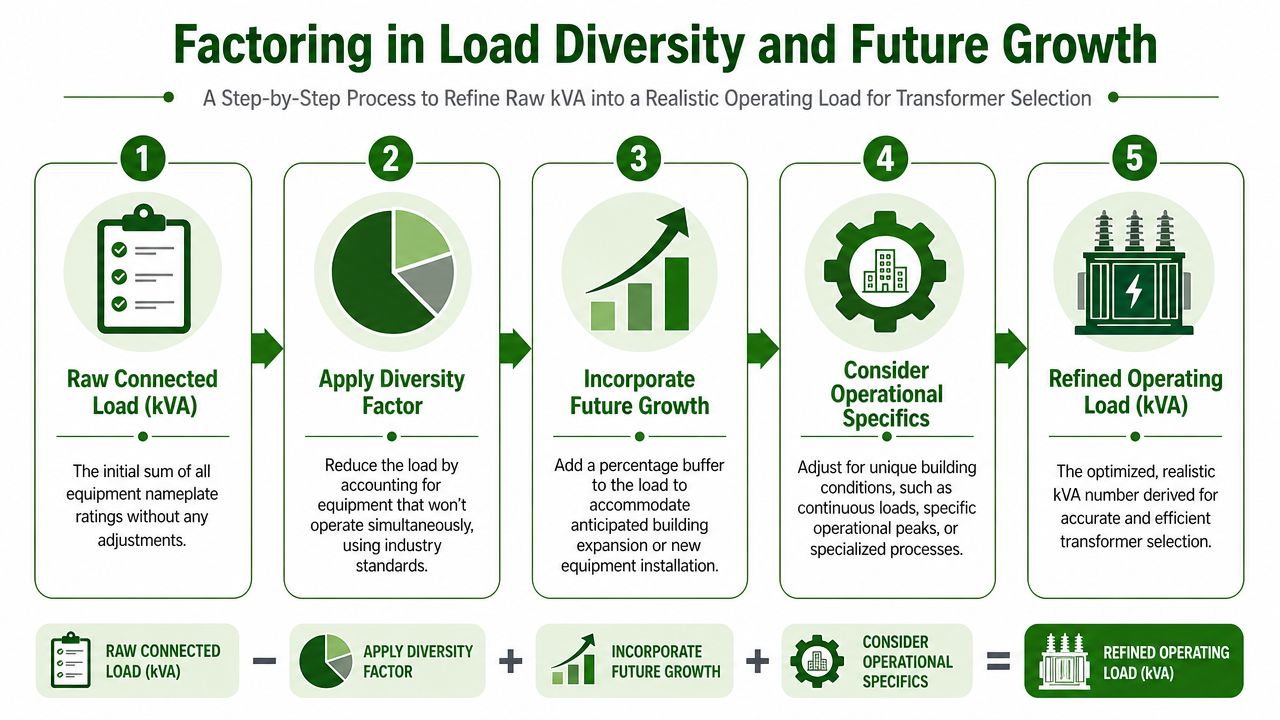
Diversity keeps the load calculation tied to real operation
Connected load is a starting point. Operating load is what matters for transformer selection.
Office suites, retail bays, medical offices, and mixed-use properties rarely hit every branch circuit at full demand at the same time. The common area lighting may stay predictable while tenant receptacle load shifts all day. HVAC cycles may overlap only part of the time. Restaurant prep equipment, salon dryers, or refrigeration loads can change the profile again.
That is why demand and diversity factors need to be based on the building's actual use, not a guess that the load will "probably be fine." Facility managers usually know more about that operating pattern than anyone else on the job. If a suite turns over every few years, if a vacant bay may become food service, or if the owner is planning outdoor amenity upgrades, that information should affect the transformer decision now.
Future growth should be priced into the decision
Commercial properties do not stay electrically static for long. A transformer sized to the bare minimum often becomes the first bottleneck when the property changes use.
Common growth items on Orange County sites include:
- Tenant improvements that add receptacle, lighting, or small equipment loads
- Parking lot upgrades with EV chargers
- Security, access control, and low-voltage system expansion
- HVAC replacements tied to electrification or efficiency work
- Exterior lighting and control upgrades driven by renovation or Title 24 work
A practical approach is to leave headroom for known expansion and reasonable tenant turnover, then round up to the next standard size where the budget and installation conditions support it. That usually costs less than replacing an undersized transformer, reworking feeders, and dealing with outage coordination later. For properties expected to add load in phases, planning electrical infrastructure for commercial expansion in Orange County should happen before the new transformer is ordered.
One hard lesson from field work is simple. Minimum code compliance and good long-term capacity are not the same thing.
Motor loads need separate attention
Motor load is one of the easiest ways to end up with a transformer that looks right on paper and performs poorly in service. Running current is only part of the story. Startup current can create voltage drop that shows up somewhere else in the building first, usually in lighting, controls, or sensitive electronics.
That comes up regularly in commercial properties such as:
| Property type | Typical problem |
|---|---|
| Retail centers | HVAC startup affects lighting and control circuits |
| Multifamily common areas | Exhaust, pump, or fan loads create brief but disruptive dips |
| Office buildings | Sensitive electronics and controls react poorly to unstable voltage |
| Mixed-use properties | Shared house loads and tenant equipment overlap in unpredictable ways |
The fix is not always a larger transformer. Sometimes it means separating loads differently, reviewing starting methods, or checking whether the transformer serving sensitive equipment should be configured another way. But if motor inrush is ignored during sizing, the building staff usually finds out after turnover, when complaints start and the correction costs more.
Good sizing accounts for how the property runs now, how it will change, and what kinds of loads create trouble even when the total kVA still looks acceptable.
Advanced Sizing for Modern Electrical Systems
A standard load calculation can still produce the wrong transformer. That's the part many generic guides miss.
Modern commercial properties don't just carry linear loads. They carry electronic drivers, switched power supplies, controls, communications gear, and EV charging equipment. In Southern California, they also deal with heat exposure that can change how a transformer performs after installation.
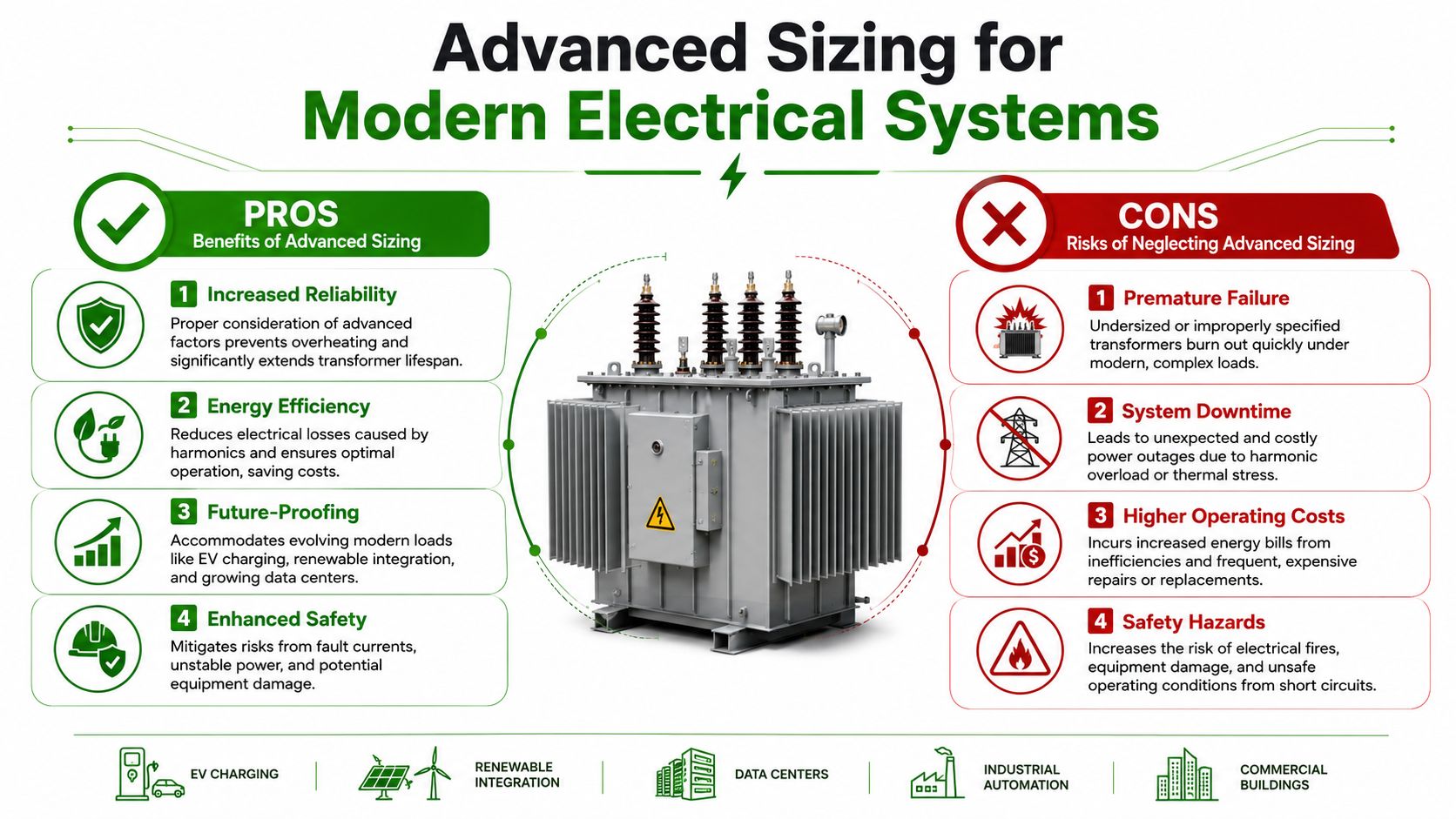
Heat changes the usable capacity
A transformer installed indoors in a controlled electrical room is one thing. A transformer mounted where ambient conditions run hotter is another.
That matters in Orange County. Rooftops, parking areas, and service locations exposed to direct sun often operate above the standard assumptions used in generic sizing tools. According to Consulting-Specifying Engineer's guidance on properly sizing a transformer, high-temperature or high-altitude conditions can reduce effective transformer output by 10% to 25%, which means the common safety margin alone may not be enough in non-standard environments.
A calculation that ignores site temperature can look fine during design and still leave the unit thermally stressed in service.
Harmonics are a modern load problem, not a niche issue
The other big miss is non-linear load. Standard formulas assume a cleaner electrical profile than many commercial sites possess.
EV chargers, LED drivers, and low-voltage support equipment can introduce harmonic distortion. That distortion creates extra heating in the transformer even when the kVA math looked reasonable at first glance. Meta Power Solutions notes that harmonic heating from modern EV charging and low-voltage infrastructure loads can increase transformer losses by 15–30% without proper sizing or K-factor selection.
That's why a plain “add a flat buffer” approach often fails on newer projects.
A transformer can be large enough in basic kVA terms and still be the wrong transformer for the load type.
When a K-rated transformer makes sense
If a meaningful share of the building load is non-linear, a standard unit may not be the safest or most durable choice. In those cases, a K-rated transformer or harmonic mitigation strategy may be the better specification.
This comes up often in:
- EV charging installations
- LED-heavy retrofit projects
- Buildings with substantial control electronics
- Mixed office and retail properties with dense plug loads
- Low-voltage infrastructure upgrades
It also ties directly to voltage performance. Harmonics and poor load handling can contribute to thermal stress and unstable operation, and that's one reason understanding voltage drop in commercial systems matters when evaluating the full distribution path.
Title 24 changes the context
California projects add another layer. Title 24-driven lighting upgrades, controls, and efficiency work can change load profiles in ways older transformer assumptions didn't anticipate.
A property may reduce some lighting demand through LED conversion while also adding more electronic drivers, smarter controls, and charging infrastructure. That means the question isn't only “Is the total lower?” It's also “Is the load electrically cleaner or dirtier, and is the transformer suited to it?”
What works today is a broader review of the system. What doesn't work is relying on a legacy transformer selection because the old one “seemed fine for years.”
Selecting the Right Transformer and Ensuring Compliance
A common Orange County scenario looks like this. A retail center adds EV charging, converts to LED lighting, upgrades controls, and keeps the same transformer because the old unit still has nameplate capacity on paper. Then summer heat hits, harmonic content rises, and the equipment room runs hotter than the original design assumed. The transformer may still be "large enough" by a simple kVA check, but it is no longer the right fit for the way the building operates.
After the load is finalized, select the next standard transformer size up. Common commercial sizes include 75, 112.5, and 150 kVA. Do not round down to satisfy budget pressure or a tight electrical room. A transformer that runs near its limit in a cool lab can struggle in a South County rooftop-adjacent electrical room or a warehouse service area with high ambient temperature and limited ventilation.
The kVA rating is only part of the selection. The transformer also has to match system voltage, phase, available fault current, installation location, and the type of load connected to it. In many newer commercial properties, that last point gets missed. EV chargers, LED drivers, variable frequency drives, and dense electronic loads can increase heat and stress even when the total connected load seems reasonable. In those cases, the right answer may be a transformer with a different rating approach, better heat handling, or a design better suited to harmonic-heavy service.
Compliance is tied to all of it.
Once the transformer is selected, the rest of the distribution has to be checked against that choice. That includes conductor sizing, overcurrent protection, termination ratings, working clearance, grounding and bonding, ventilation, and labeling. These are the details that affect permit approval, field inspection, and whether the installation stays reliable after the tenant is fully operational.
California projects add another layer. Title 24 may affect the scope when lighting, controls, or tenant improvements are involved, and those changes can alter how the system performs even if total wattage drops. Lower lighting load does not automatically mean easier transformer duty. More drivers, controls, and charging equipment can make the electrical profile less forgiving, especially in mixed-use and office-retail properties across Orange County.
A good transformer selection gives the property operating headroom, supports future tenant changes, and fits the actual code path for the job. That is how you avoid nuisance trips, excess heat, failed inspections, and a second round of upgrade costs a year or two later.
If you need help calculating transformer size for a commercial property in Orange County or anywhere in Southern California, Access Electrical and Lighting can evaluate existing loads, review future expansion plans, and support compliant transformer upgrades for office, retail, multifamily, and mixed-use facilities.