
The popular advice is to choose commercial lighting bollards for their appearance and worry about performance later. That order is backwards. A bollard can complement a building beautifully while producing glare, leaving dark patches, trapping heat, or requiring costly excavation when a driver fails. For property managers, the actual purchase decision is not the finish or silhouette. It's whether the fixture will deliver usable light, tolerate the site, and remain serviceable throughout its working life.
A sound specification starts with photometry, protection ratings, access, controls, and maintenance, then evaluates the appearance. That approach protects pedestrian routes, controls operating costs, and prevents a large installed population of attractive but unreliable fixtures from becoming a recurring service problem.
Rethinking the Role of Pathway and Site Lighting
A pathway bollard should be judged by what it costs to operate and maintain, not by its silhouette in a product photo. Its job is to reveal walking surfaces, grade changes, and route edges without creating glare. On multifamily properties, retail centers, offices, and campuses, that makes each fixture part of the site's safety and energy strategy.
Poor optical design creates lifecycle costs that are easy to miss during procurement. A narrow beam can leave dark gaps, while excessive output can produce hot spots and light trespass into nearby windows. If the distribution is wrong, managers may add fixtures to compensate, increasing installation, energy, and service work. Components that cannot be reached without removing the housing or excavating around the base create another recurring expense when drivers or wiring fail.
The LED transition made efficiency a specification issue rather than a decorative preference. Older high-wattage exterior fixtures commonly produced more heat and used more electricity. Modern solid-state products can meet a defined performance floor with lower demand. The U.S. Department of Energy exterior lighting guidance lists bollards at a minimum luminaire efficacy rating of 100, showing how commercial specifications have shifted toward efficient LED sources.
Independent technical studies cited in DOE material found that level bollards could achieve 50% to 85% energy savings compared with incumbent HID and fluorescent bollards. Broader exterior-lighting specifications commonly delivered 50% to 80% savings against older code baselines, as reported in this DOE-referenced lighting analysis. These figures explain the category's importance beyond appearance, but they do not make every LED bollard a sound purchase.
The fixture is part of the operating budget
A property with many pathway fixtures pays for more than electricity. Service calls can include lift access, fault tracing, replacement parts, traffic control, site coordination, and urgent work to restore a dark route. Driver access, seal quality, wiring protection, and control compatibility deserve the same attention as finish and form.
Evaluate the installation as a system. Review efficacy, distribution, glare control, protection ratings, access, and controls together. A restrained fixture with predictable spacing and serviceable components can cost less over its working life than a brighter product that creates uneven coverage and requires specialist replacement work.
Practical rule: Treat the bollard as electrical infrastructure with an architectural finish, not as garden decoration with a wire attached.
For an existing property, start with fixture locations, outage history, circuit condition, and nighttime visibility. A documented commercial outdoor lighting evaluation can show whether failures come from old lamps, poor spacing, damaged wiring, glare, or an unsuitable layout. Replacing every unit before identifying the failure pattern can preserve the same maintenance problem in the next installation.
Market Scale and the Shift to Standardized LED Fixtures
Commercial lighting bollards are no longer niche architectural products. They are a repeat-purchase category, and that changes what property managers should demand. Standardized fixtures are easier to compare, source, replace, and document than one-off decorative units with limited service information.
Market forecasts use different category definitions, so their figures are not interchangeable. One estimate values the global LED bollard-light market at $1.8 billion in 2025 and projects $3.1 billion by 2034, at a 7.2% CAGR, according to this LED bollard-light market estimate. Another places the 2025 market at USD 1,142.6 million, with more than 12.5 million units installed across urban, commercial, and residential applications, as described in this lighted bollard market analysis. A separate forecast estimates USD 514 million in 2024, rising to USD 941.48 million by 2034 at a 4.5% CAGR, using a different methodology in this 2024-2034 lighted bollard forecast.
The practical conclusion is more useful than choosing one forecast. A large installed base supports expectations for published photometry, replacement support, and repeatable specifications. It also means a poor optical design or inaccessible driver can create the same service problem across an entire property portfolio.
Standardization reduces portfolio risk
For a property group, standardization should define service and performance requirements, not just a shared appearance:
- Photometric documentation: Require published IES files and usable distribution data.
- Electrical compatibility: Confirm voltage, driver behavior, controls, and surge protection before ordering.
- Mechanical serviceability: Check how technicians reach the driver, terminals, and optical compartment.
- Environmental protection: Match the housing, lens, finish, and ratings to site conditions.
- Replacement continuity: Confirm future units and service parts will remain available during the planned maintenance period.
LED adoption also supports a practical retrofit path. A commercial LED retrofit assessment should compare circuit condition, fixture performance, driver access, and optical distribution, not only lamp wattage. Replacing a sealed, inaccessible fixture with another sealed unit may cut energy use while preserving lift costs, replacement delays, and difficult fault tracing.
Smart controls and solar products broaden the specification choices, but they do not remove the need for disciplined engineering. Portfolio buyers should select fixtures that can be documented, inspected, repaired, and replaced consistently. Lifecycle efficiency depends on those details, not on the fixture's appearance at handover.
Engineering Light Output and Photometric Spacing
Fixture count is a poor substitute for a lighting design. Ten bollards can produce an uneven route if their beam patterns stop short of one another, while fewer well-distributed fixtures may provide a more comfortable and efficient result. The design should begin with photometry, not with a preferred spacing rule from a catalog.
Read the data that matters
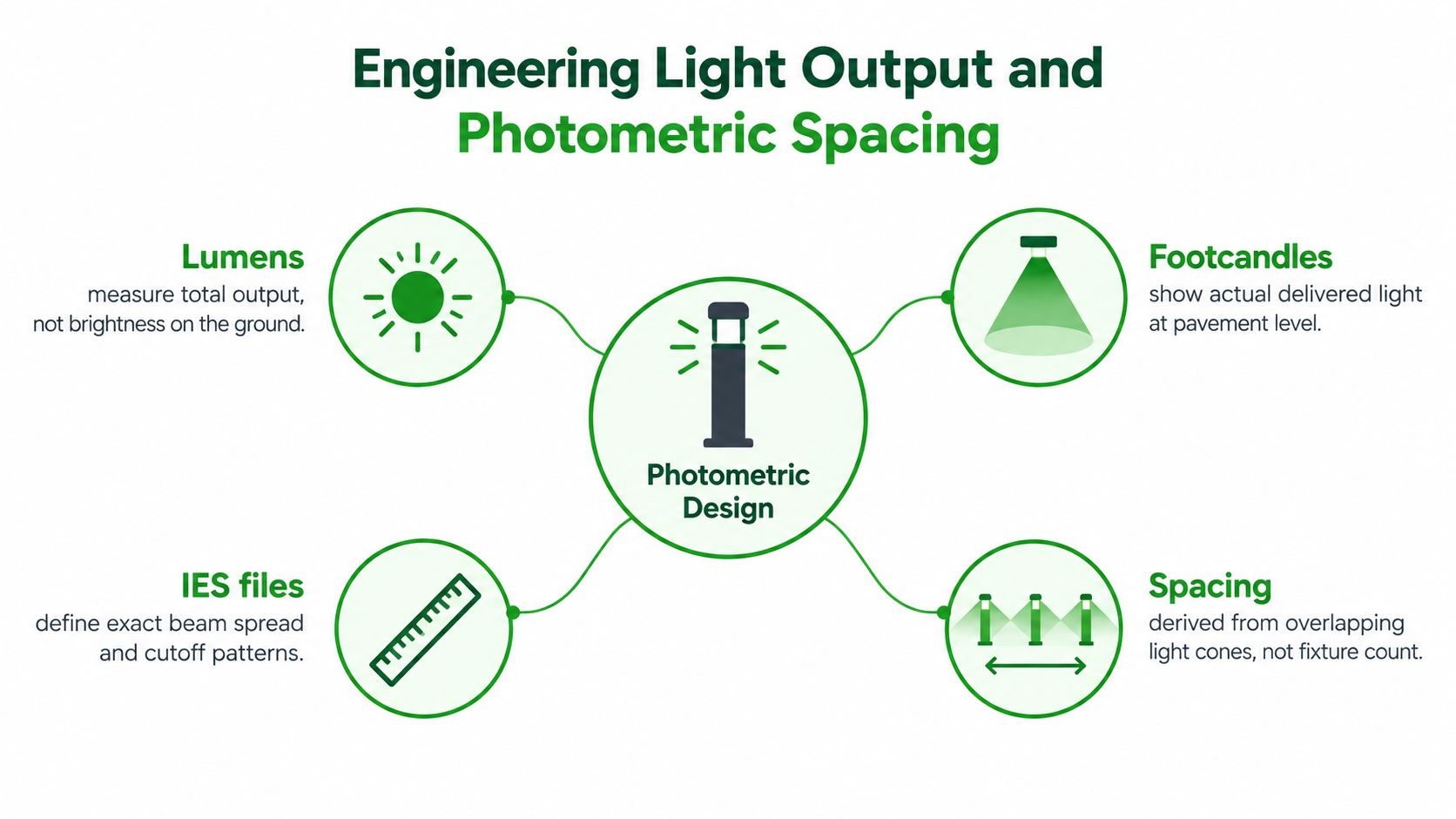
Lumens describe the total light emitted by a source or luminaire. They don't tell you how much light reaches the pavement where a pedestrian needs it. Delivered illuminance is evaluated in footcandles, and the commercial bollard photometry reference identifies common walkway targets of approximately 0.5 footcandles minimum for standard paths and 1.0 to 2.0 footcandles for enhanced-security areas.
Those are design reference points, not permission to illuminate every route at the highest level. Higher output can increase glare, trespass, contrast, and energy use if the beam is uncontrolled. The right target depends on the route, surrounding lighting, visibility hazards, security expectations, and applicable project requirements.
Use the manufacturer's IES file in a photometric program and check the actual mounting height, fixture orientation, surface assumptions, and proposed spacing. Review more than the average value. Look for minimum illuminance, uniformity, transitions at intersections, and areas where landscaping or site furniture may block the distribution.
Design the route, then select the fixture
A practical workflow is straightforward:
- Map the walking surface. Include ramps, crossings, stairs, loading-area edges, entrances, and changes in grade.
- Identify conflict points. Give extra attention to locations where pedestrians meet vehicles, security staff, service carts, or uneven paving.
- Test mounting height and distribution. A taller fixture may cover more ground, but it can also change glare and visual comfort.
- Model overlap. Spacing should come from overlapping light patterns, not from the number of fixtures available in a package.
- Verify in the field. A finished installation still needs a nighttime walk-through because trees, walls, parked vehicles, and paving reflectance can change the result.
The foot-candle calculation resource is useful for initial evaluation, but it shouldn't replace a coordinated photometric layout or field verification. Ask for the IES file before approving a fixture. If the manufacturer provides only lumens, wattage, and a product photograph, the submittal is incomplete for a commercial path.
Design check: Brightness at the fixture is not the same as visibility along the route. Judge the pavement, transitions, faces, and obstacles that users actually need to see.
Glare deserves particular scrutiny. An exposed lens at eye level can make the surrounding area appear darker by reducing visual adaptation. Shielding, cutoff, asymmetric distributions, and careful orientation often deliver a better experience than just increasing output.
Specifying Durability and Vandal Resistance Ratings
A polished bollard can still become an expensive liability if its enclosure, lens, or internal connections cannot handle the site. Moisture and contaminants attack the housing, while impacts damage the body, optics, base, and wiring. Specify protection for the property's actual exposure and failure consequences, not for the fixture's appearance at handover.
The IP rating covers ingress protection. Commercial pedestrian applications commonly specify IP65 or IP66, according to this commercial bollard protection guide. The first digit covers solids such as dust, and the second covers water. Test conditions still matter. An IP label does not automatically cover every wash-down, coastal environment, or installation error.
IK ratings cover impact resistance. IK08 corresponds to a 5-joule impact, while IK10 corresponds to 20 joules, as defined in this IEC 62262 impact-rating reference. IK10 is the more appropriate choice where public access, vandalism, carts, or deliberate strikes are credible risks.
Impact and Ingress Protection Guide
| Rating | Protection Level | Ideal Commercial Application |
|---|---|---|
| IP65 | Dust-tight enclosure with protection against water jets | Covered or typical outdoor walkways where rain and routine contamination are expected |
| IP66 | Dust-tight enclosure with stronger water-jet protection | Exposed plazas, wash-down areas, and sites with more demanding weather exposure |
| IK08 | Resistance to a 5-joule impact | Controlled-access properties with moderate physical risk |
| IK10 | Resistance to a 20-joule impact | Public-access plazas, retail routes, campuses, and vandal-prone installations |
Ratings are only one part of the submittal. Review whether the body is aluminum, stainless steel, or a composite suited to the climate. Check the lens material, fastener security, finish warranty, base anchorage, and drainage. A high rating on a thin decorative housing may still leave the property exposed to its most likely failure mode.
Match the rating to the consequence
Use stronger protection where a broken fixture could create a sharp edge, expose wiring, interrupt a critical route, or require an emergency lift call. Retail centers, transit-adjacent spaces, public plazas, and open campuses usually justify more protection than restricted courtyards with controlled access.
Heavy-duty construction can raise capital cost, and it does not compensate for weak foundations or poor fastening. Document the site risk, expected abuse, and cost of service before selecting the lowest rating that provides a credible margin. Also confirm how the fixture is serviced. A sealed assembly may resist weather well, but inaccessible drivers or damaged optics can turn a minor failure into a full fixture replacement, increasing lifecycle cost.
Navigating ADA Compliance and Maintenance Access
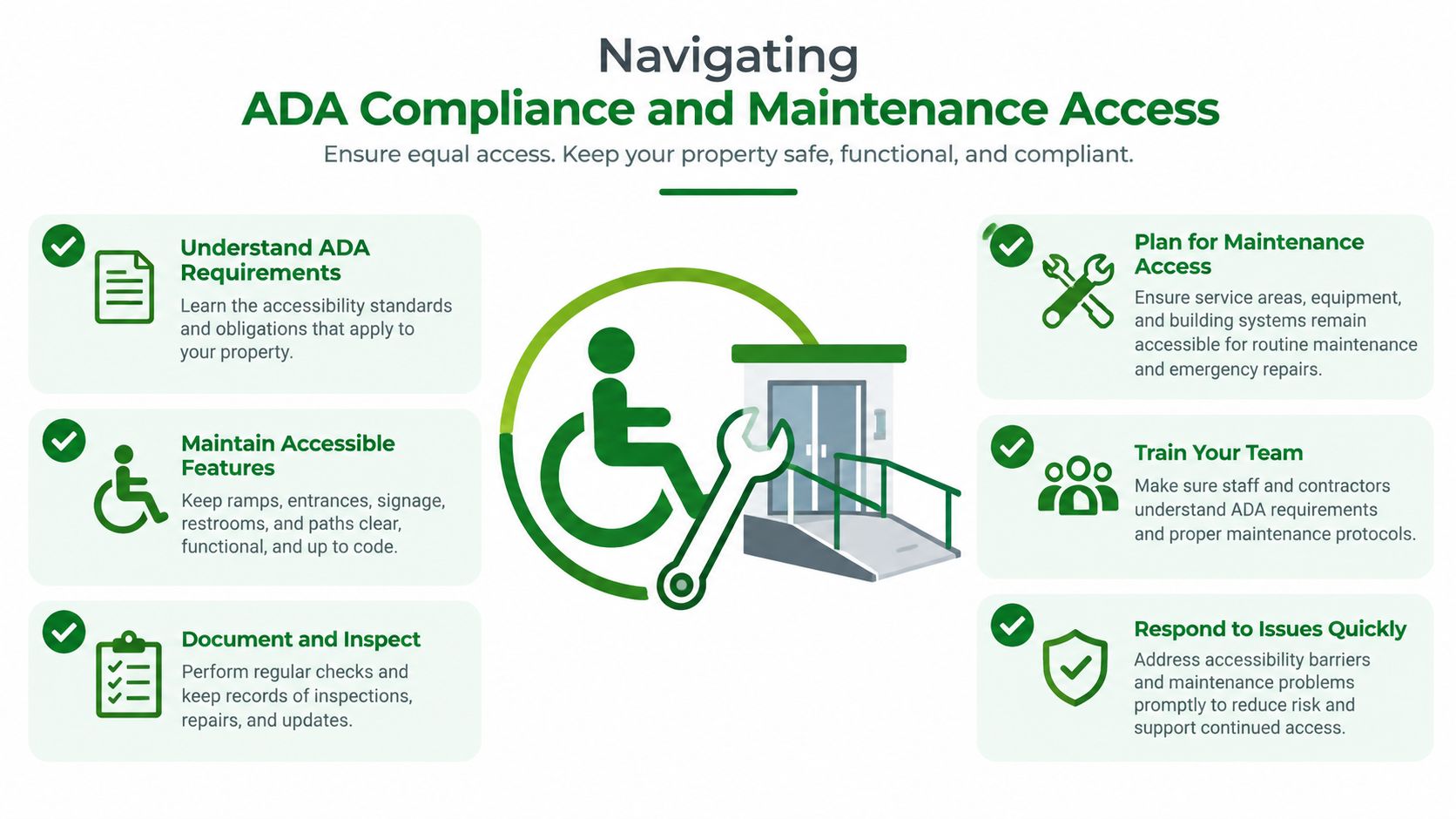
Accessibility and serviceability need to be coordinated before the concrete is poured. A bollard placed too close to a circulation path can create a hazard even if the light level is excellent. A bollard installed correctly but boxed into paving with no room for a technician creates a different operational problem.
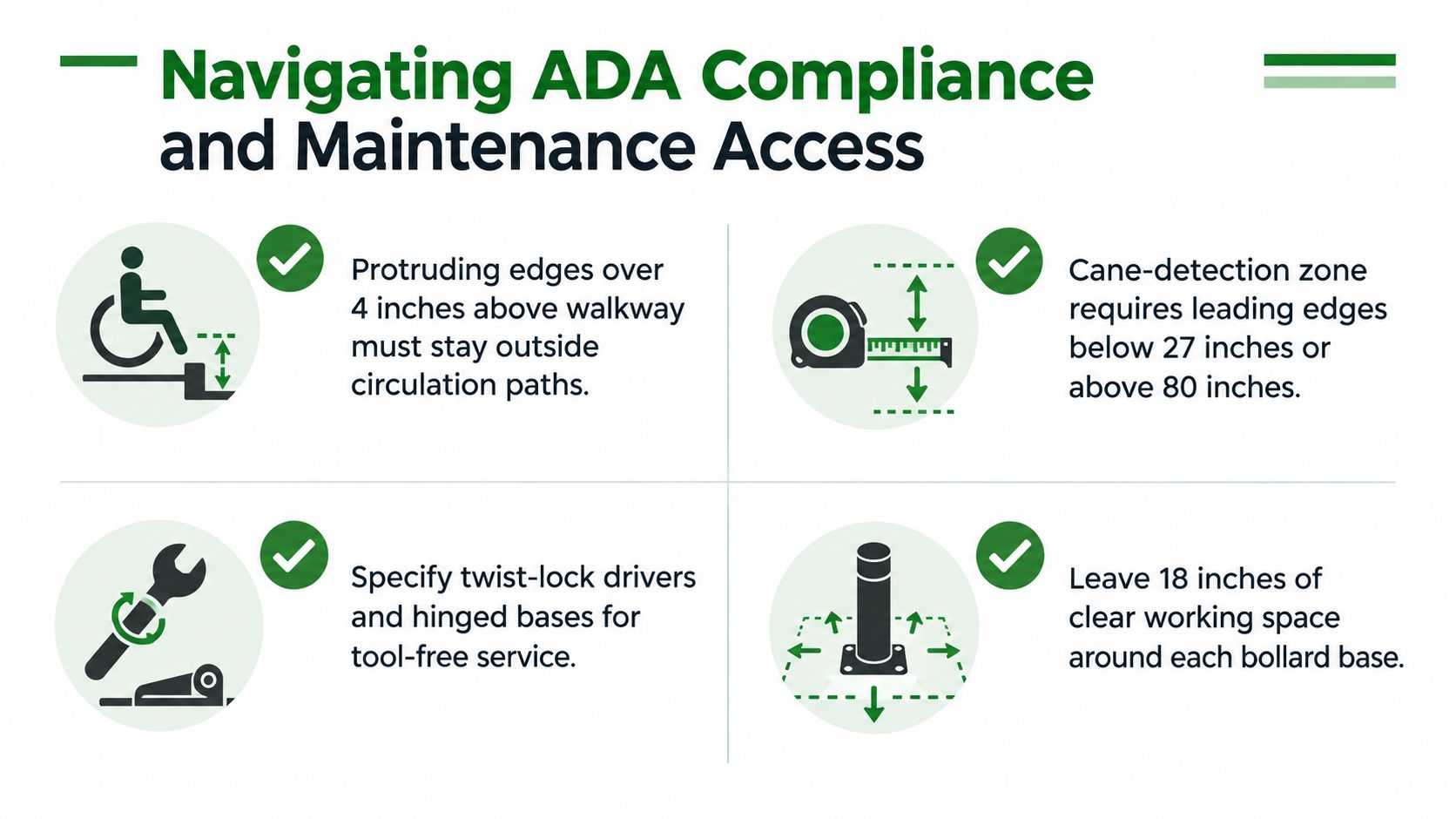
The ADA accessibility guidance infographic highlights two practical clearance concerns. Protruding edges over 4 inches above a walkway must stay outside circulation paths, while cane-detection zones require leading edges below 27 inches or above 80 inches. Treat those values as design checkpoints, then confirm the complete project against the adopted accessibility requirements and authority having jurisdiction.
Keep the route clear
The fixture location should preserve the usable path, not merely fit inside a site plan. Coordinate bollards with curb lines, handrails, detectable warnings, doors, ramps, benches, irrigation, and snow or maintenance equipment. A narrow side clearance may look acceptable on a drawing but become inaccessible once plants grow or a service vehicle parks nearby.
The base also needs a service strategy. Provide clear working space around the enclosure, keep access hardware away from paving joints where debris collects, and document the removal method for the driver and optical assembly. If the unit requires a special tool or complete excavation for routine component replacement, that weakness will appear repeatedly across the portfolio.
Serviceability protects performance
A U.S. Department of Energy and Pacific Northwest National Laboratory study found that typical bollards are only about 25% efficient, meaning roughly 75% of generated light never leaves the luminaire, according to the PNNL bollard-lighting technical report. That figure makes optical cleanliness, thermal management, and component access important design concerns, not minor maintenance preferences.
Integrated LED products can be efficient, but an inaccessible driver or sealed assembly may turn a manageable electrical repair into a fixture replacement. Specify replaceable drivers where practical, accessible terminals, durable gaskets, and an optical compartment that technicians can inspect without damaging seals.
Maintenance principle: The cheapest part to replace is the part a technician can reach without dismantling the site.
Create an asset record for each fixture family. Include the driver model, surge device, control method, mounting detail, warranty terms, and approved replacement. That information reduces diagnosis time and prevents technicians from guessing when a product line changes.
Evaluating Wired LED Versus Solar and Smart Controls
Solar bollards are appealing where trenching is difficult, remote areas lack electrical service, or a project needs independent operation. They aren't automatically the lower-lifecycle-cost choice for a commercial property with established site power.
A solar unit combines the luminaire with a photovoltaic module, battery, charge controller, and often a motion sensor or communications device. Every added component introduces another failure mode and another replacement question. Battery aging, shading, heat, cold, vandalism, and control faults can reduce the dependable operating period even when the LED source itself remains healthy.
Market reporting indicates that solar-powered bollards grew at 11.8% annually from 2021 to 2025 in some segments, with commercial and urban deployments increasingly associated with smart-city or sensor-based controls, according to this outdoor LED bollard market report. That growth shows genuine interest, not proof that solar is suitable for every route.
Use the power architecture that fits the site
For most primary commercial walkways, wired LED remains the more predictable option. It can draw from an existing electrical system, support consistent nighttime output, use centralized photocells or controls, and avoid battery replacement across every fixture. A hardwired system also makes it easier to coordinate emergency operation, circuit testing, and property-wide scheduling.
Solar is more defensible when:
- Trenching would damage finished sitework: Remote perimeter paths may justify an independent fixture.
- Utility service is unavailable: A self-contained unit can solve a practical infrastructure problem.
- The route has modest operational demands: Lower-risk paths may tolerate reduced output during poor solar conditions.
- Maintenance access is planned: Battery and controller replacement must be possible without disturbing the foundation.
Smart controls can add value when the property has a clear operating objective. Dimming, scheduling, occupancy response, and fault reporting should be tied to a documented need. Installing connected hardware without a responsible owner, network plan, commissioning process, and replacement strategy turns a control feature into abandoned equipment.
Dark-sky compliance and glare control matter in either architecture. A solar fixture with poor optics still creates glare, and a wired fixture with excessive output still wastes light. Specify the distribution first, then choose the power and control system that can sustain it in the property's climate and maintenance model.
Implementing a Long-Term Inspection and Care Routine
A commercial bollard maintenance routine should start with the route, not the fixture. Walk the property after dark and record dark patches, glare, flicker, delayed switching, damaged lenses, leaning bases, exposed fasteners, and vegetation blocking the distribution. Compare those observations with the original layout so the team can distinguish a failed component from a design or site-change problem.
A practical service sequence
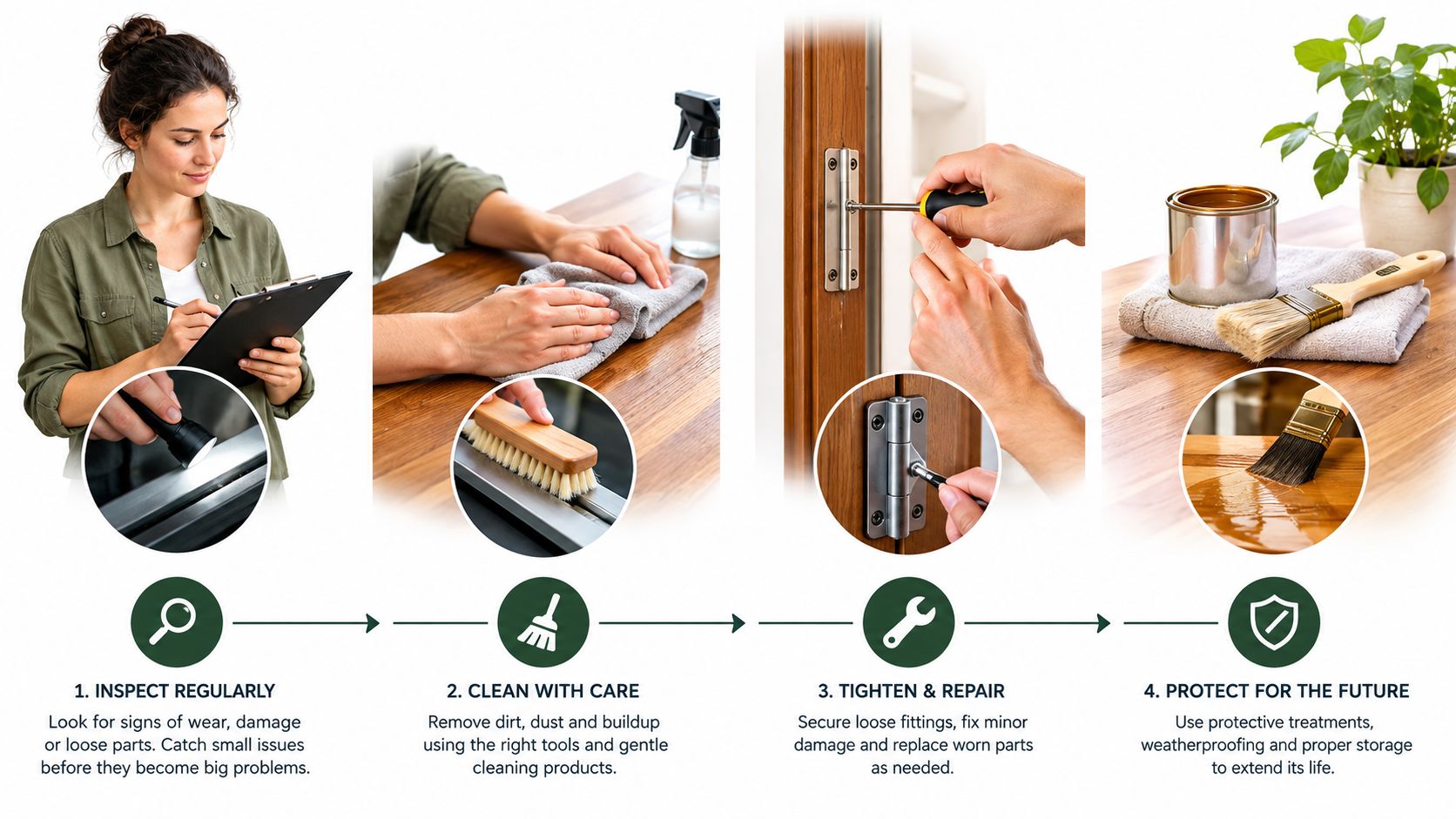
- Inspect the enclosure and base. Look for cracks, corrosion, loose anchors, impact marks, water staining, damaged gaskets, and movement at the foundation.
- Clean the optical surfaces. Remove dust, salt residue, irrigation deposits, and insect buildup with materials approved by the manufacturer. Don't use an abrasive pad that clouds the lens.
- Check electrical behavior. Confirm switching, photocell response, dimming, sensor operation, and visible flicker. De-energize equipment before opening an enclosure, and use qualified personnel for electrical testing.
- Repair the cause, not only the symptom. Replace a failed driver or damaged seal when the design permits, then investigate overheating, moisture, voltage issues, or physical impact that may have caused the failure.
- Protect the next service visit. Update the asset record, photograph the repair, note the component installed, and flag recurring failures by location or fixture family.
Use infrared thermography as a non-invasive diagnostic where appropriate. A developing hotspot at a termination, driver, or upstream connection can justify scheduled corrective work before the fixture goes dark or the fault spreads to other equipment. The inspection report should identify the asset, observed condition, recommended action, and priority.
Cleaning frequency depends on the environment. Coastal air, construction dust, irrigation spray, tree cover, and vehicle exhaust all change how quickly optical surfaces and housings degrade. Set the initial routine conservatively, review findings after several visits, and adjust based on actual contamination and failure history.
Field habit: Keep a small sample of removed drivers, gaskets, and lenses. Reviewing failed parts with the maintenance team often reveals patterns that an outage log misses.
Access Electrical and Lighting provides commercial lighting installation, maintenance, testing, LED retrofit work, infrared electrical inspections, and site-lighting support for commercial, retail, and multifamily properties. For a bollard program, the useful deliverables are a documented assessment, a serviceable specification, and a maintenance plan tied to the property's actual routes and equipment.
If your property has dark walkways, recurring bollard failures, or an upcoming LED upgrade, contact Access Electrical and Lighting for commercial site-lighting evaluation, installation, repair, and preventive maintenance. Ask for a review that covers photometric performance, electrical condition, protection ratings, service access, and controls before you approve the next fixture package.