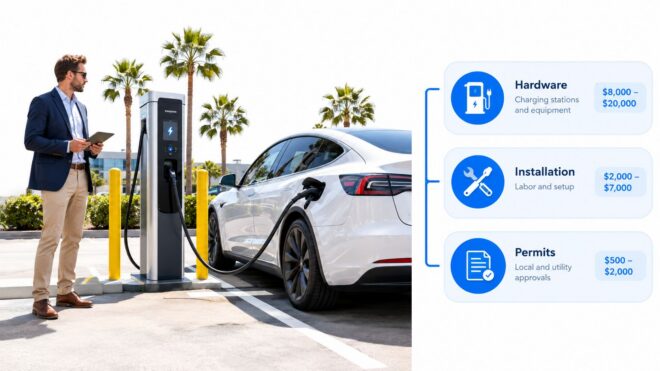
For Southern California commercial properties, EV charging station price ranges from $3,500 to $15,000 or more per Level 2 port, depending on site readiness, while DC fast charging starts at $38,000 to $90,000 per connector including installation. The final invoice can move far beyond those figures when the property needs new service, trenching, switchgear, utility coordination, or extensive civil work.
A property manager in Orange County may see chargers appearing at office parks, apartment communities, hotels, and retail centers, then face a very different question from tenants: “Can we install them here, and what will they cost?” A hardware quote rarely answers that question. The charger might be affordable, but the electrical room, parking structure, permits, conduit route, and utility service often determine the true budget.
That distinction matters across Southern California. Two sites can use the same charging equipment and receive dramatically different project totals because one has spare panel capacity near the parking area while the other needs an electrical upgrade and long underground runs. A useful budget starts with the property, not the product brochure.
Why EV Charging Station Price Matters for Southern California Commercial Properties
A property manager walking through a parking garage in Costa Mesa may notice drivers searching for open charging spaces on their phones, while tenants ask whether the building plans to add more ports. The demand is visible, but the financial answer isn't. A quote that lists only charger hardware leaves out the work that makes the equipment usable.
EV charging station price is a property decision, not just an equipment decision. A workplace may benefit from Level 2 charging because employees remain parked for long periods. A retail center may need visible, accessible stations that support customer visits. A multifamily community must think about resident access, parking assignments, billing, and future expansion. A highway-oriented commercial site may justify DC fast charging, but only if its electrical service and traffic pattern support that use.
The wrong comparison creates predictable problems. An owner who selects equipment before reviewing electrical capacity may discover that the panel cannot support the planned load. A manager who chooses high-power charging for a long-dwell workplace can pay for capacity that drivers rarely need. A site that installs too few ports may frustrate tenants, while a site that builds too much infrastructure too early can tie up capital without a clear operating model.
The budget question behind the charger question
The U.S. Department of Energy separates charger equipment from installation. Its guidance places public Level 2 equipment at about $3,500 per connector, while DC fast charger equipment typically costs $38,000 to $90,000 per connector. Installation adds roughly $1,300 per connector for residential Level 2, about $2,500 per connector for public or workplace Level 2, and $20,000 to $60,000 per connector for DC fast charging, as detailed in the Department of Energy infrastructure guidance.
Those figures show why a hardware-only quote can mislead. Electrical distribution, trenching, permitting, and utility work can eclipse the equipment price. Property owners need a scope that identifies what already exists, what must be built, and what remains an operating expense after commissioning.
Practical rule: Never approve a charger count from a catalog alone. Approve a site plan, load review, utility path, and complete installed-cost scope.
A properly planned project can become a useful tenant amenity, a customer-service feature, or part of a fleet strategy. It can also reserve electrical pathways for future expansion. The value comes from matching charging speed and port count to how people use the property, not from buying the most powerful charger available.
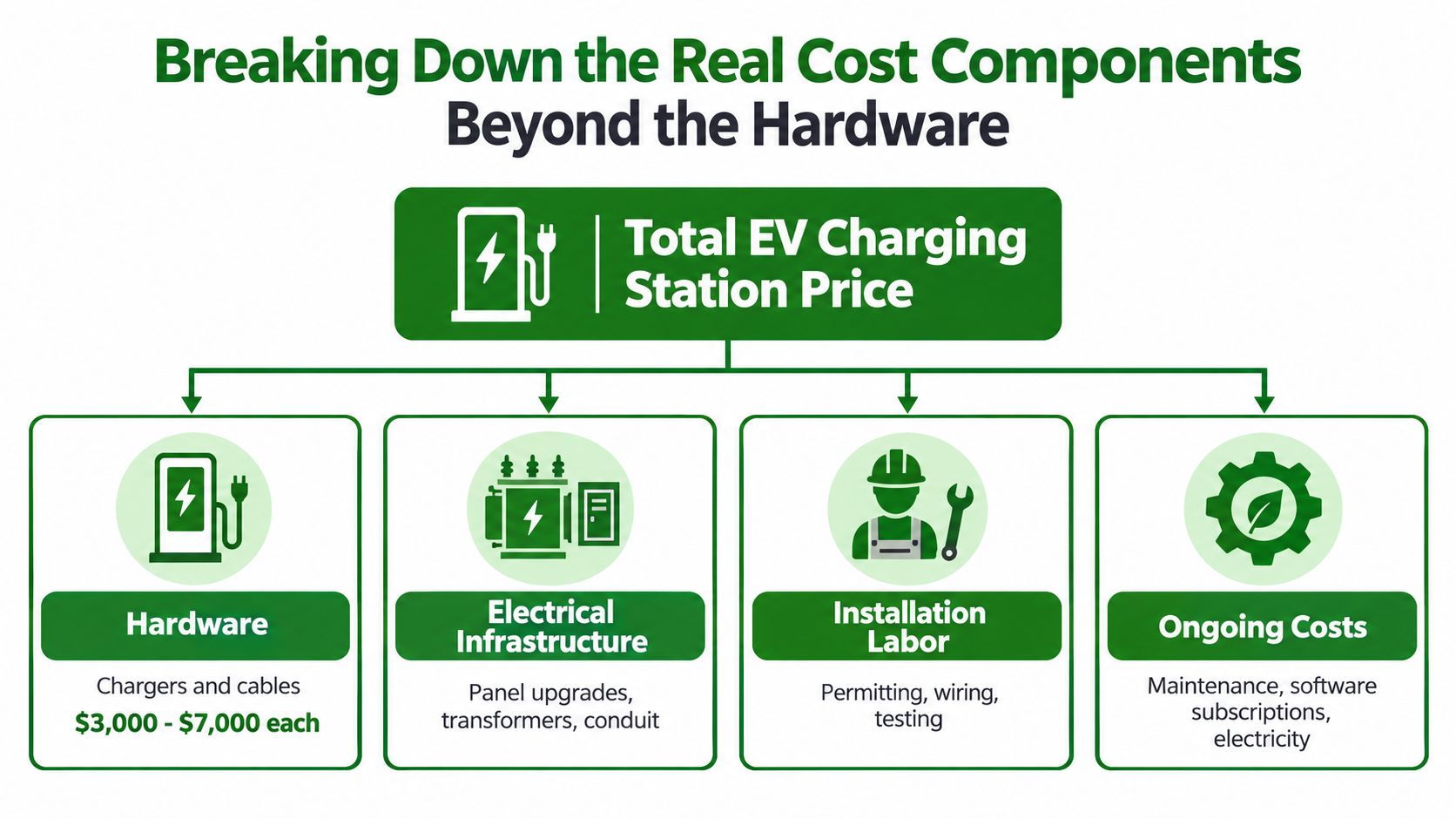
Breaking Down the Real Cost Components Beyond the Hardware
Most owners start with the visible item, the charger mounted on a wall or pedestal. The electrical contractor starts elsewhere, with the source of power, the route to the parking space, and the conditions between those two points. That difference in perspective explains many budget surprises.
Four cost layers
Hardware includes the EVSE, cable, connector, pedestal or wall mount, protective bollards, and communications components. The hardware is easy to compare because vendors publish model numbers and prices, but it doesn't tell you whether the building can supply the required power.
Electrical infrastructure includes feeders, conductors, conduit, disconnects, panels, switchgear, transformers, and service upgrades. The DOE notes that public and workplace Level 2 installation averages about $2,500 per connector, while DC fast deployment installation can run $20,000 to $60,000 per connector. Those DOE installation figures demonstrate why the electrical source deserves as much attention as the charger selection.
Installation labor covers layout, mounting, wiring, termination, testing, commissioning, permit coordination, and inspection support. A contractor may also need to coordinate accessibility features, signage, striping, pavement restoration, or work in a live commercial facility where shutdowns must be carefully scheduled.
Ongoing costs include network software, payment processing, cellular connectivity, preventive maintenance, repairs, replacement parts, and electricity. These expenses don't always appear in a construction proposal, but they affect whether the station functions as an amenity, a cost-recovery system, or a public revenue service.
Why identical equipment produces different totals
A charger close to a suitable panel may require a relatively direct installation. The same charger at the far end of a parking structure may need a longer conduit route, additional protection, structural attachment, drilling, or concrete restoration. If the existing panel lacks capacity, the project can also require new distribution equipment or utility involvement.
Historical data makes the regional variation clear. The Idaho National Laboratory EV Project recorded an average of $3,108 per publicly accessible Level 2 unit, with the five most expensive markets above $4,000 and the least expensive five below $2,600. The study found an overall spread from under $600 to more than $12,000 per unit, and California was the most expensive among the markets studied. See the Idaho National Laboratory geographic installation-cost study for the underlying historical data.
A quote should therefore separate equipment, electrical work, civil work, design, permitting, and activation. That format lets an owner see which line items are fixed, which depend on site conditions, and which can be reduced through layout or load-management decisions.
How Site Conditions Drive Your EV Charging Station Price in Southern California
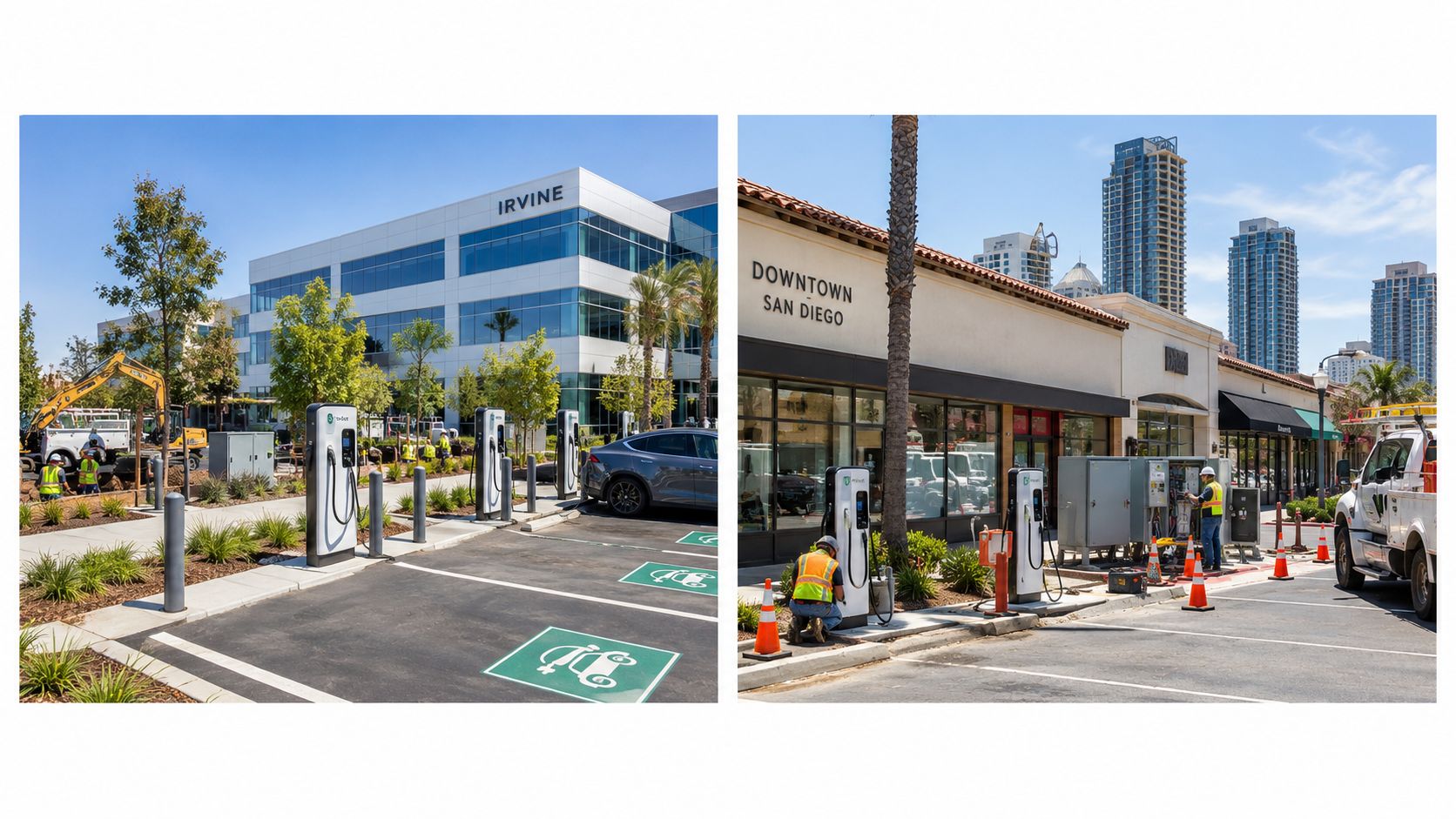
A new office property in Irvine and an older retail center in San Diego may request the same Level 2 charger, but the installation conditions can be completely different. The newer site may have electrical rooms, spare capacity, and planned pathways near the parking area. The older site may have congested panels, limited spare space, deteriorated pavement, and no convenient route to the proposed charging spaces.
The site visit is where the budget becomes credible.
Start with the electrical source
A useful assessment should identify the serving panel, available capacity, voltage, feeder route, equipment condition, and location of the proposed chargers. It should also account for other planned loads. A panel that appears to have room today may not have enough capacity after a tenant improvement, HVAC replacement, solar addition, or future charger phase.
The physical route matters just as much. Conduit may run through a parking garage, across a concrete deck, below a surface lot, or along a wall that requires protection from vehicle impact. Every change in direction, penetration, trench, and restoration requirement adds scope. Property teams can review practical planning considerations in these commercial EV charger installation requirements.
Walk the installation in the right order
Mark the charging spaces. Confirm parking ownership, circulation, accessible routes, stall dimensions, signage, and whether the spaces can remain available during construction.
Trace the power path. Measure the route from the electrical room to the chargers. Check whether existing pathways are suitable rather than assuming they can be reused.
Review the distribution equipment. Inspect panels, disconnects, switchgear, and transformers. Confirm that the equipment can accept the planned conductors and protective devices.
Coordinate permits and utilities. The authority having jurisdiction may require drawings, load calculations, inspections, accessibility details, or separate reviews. A service or transformer change can introduce utility coordination beyond the contractor's installation work.
Build a phased design. Where the final port count is uncertain, installing shared infrastructure and reserving pathways can make future expansion more practical. Load management may also allow a property to serve more ports without immediately sizing the entire service for every charger at full output.
The cheapest charger is not necessarily the cheapest installation. The shortest compliant route to a suitable power source usually has more influence on the final invoice.
An electrical assessment can't remove every site constraint, but it identifies them before procurement. That protects the project from change orders caused by inaccessible panels, unsuitable conduit routes, insufficient capacity, or unexpected civil work.
Commercial EV Charging Station Price by Charger Type and Technology
Level 2 and DC fast charging serve different parking behaviors. Treating them as interchangeable creates either unnecessary cost or an underpowered customer experience.
| Charger type | Best commercial fit | Cost and planning context |
|---|---|---|
| Level 2 | Offices, multifamily properties, hotels, and retail locations with longer dwell times | Commercial installations commonly fall around $3,500 to $15,000 per port, depending on site conditions, as described in commercial Level 2 cost guidance |
| DC fast | High-turnover retail, fleet operations, and locations serving shorter stops | The DOE places DC fast equipment at $38,000 to $90,000 per connector, with installation adding $20,000 to $60,000 per connector in its cited ranges, according to the federal infrastructure cost reference |
Level 2 for dwell time
Level 2 is usually the practical choice where vehicles remain parked while people work, live, shop, or stay overnight. It uses less demanding electrical infrastructure than DC fast charging, though it still requires a proper load calculation, suitable circuit, protection, mounting, communications, and code-compliant installation.
The commercial decision is not just whether Level 2 costs less. Owners should ask whether the charging session aligns with the property's operating pattern. A workplace may gain more from several appropriately managed ports than from one high-power charger that serves fewer vehicles at greater infrastructure cost.
DC fast for turnover
DC fast charging makes sense where drivers need meaningful charging during a shorter visit or where fleet schedules demand rapid turnaround. The equipment requires a much larger electrical commitment, and the site may need service upgrades, a transformer, heavier conductors, switchgear, and more substantial civil work.
Historical public Level 2 data from the Idaho National Laboratory shows why regional assumptions can be unreliable. Installations averaged $3,108 per unit, while studied markets ranged from under $600 to more than $12,000, with California the most expensive market in that dataset. Those historical geographic cost findings shouldn't be treated as a current Southern California quote, but they do show how location and site complexity affect comparisons.
Load management deserves consideration for multi-port Level 2 projects and selected higher-power designs. A properly engineered commercial EV charging load-management approach can coordinate available capacity, but it doesn't eliminate the need to verify code requirements, equipment compatibility, and utility conditions.
The Hidden Infrastructure Costs That Surprise Most Property Owners
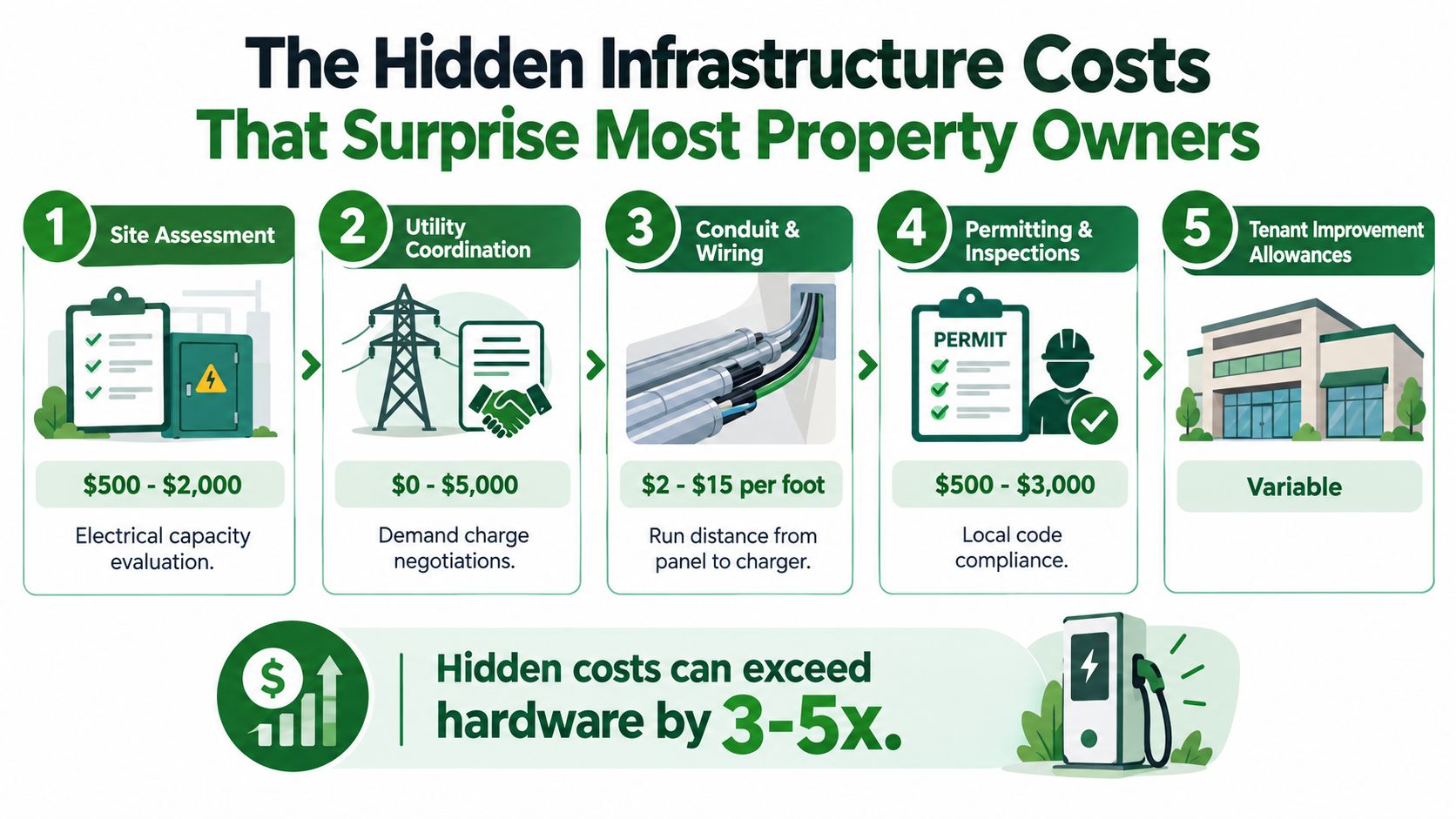
The largest pricing gap often appears between the equipment quote and the construction scope. Owners see a charger price, while the project also requires a reliable path from the utility service to a protected, accessible, networked charging space.
Commercial Level 2 planning commonly falls around $3,000 to $15,000 per port. DC fast projects can range from about $18,000 to well over $350,000 per port once electrical upgrades, trenching, networking, permitting, and related site work are included, according to commercial EV charging cost analysis from Verdek. These are broad planning ranges, not promises for a particular Southern California site.
Where the money goes
Service capacity becomes expensive when the existing electrical service can't support the planned load. The work may involve new feeders, switchgear, a transformer, or utility coordination rather than a simple breaker installation. A panel review determines whether the constraint is local to the building or extends back to the service.
Conduit and civil work depend on distance and construction method. Trenching, boring, core drilling, pavement cuts, concrete restoration, and structural penetrations can dominate a project when the charging spaces sit far from the electrical room.
Permitting and inspection require more than submitting a form. Plan sets may include a site layout, one-line diagram, load calculations, equipment information, accessibility details, and inspection coordination. Local requirements vary, so the contractor should identify the authority having jurisdiction early.
Protection and parking work includes bollards, wheel stops, signage, striping, lighting, and route protection. These items prevent vehicle damage and help the site operate as intended, but they're easy to omit from a hardware-centered budget.
Networking and operations include communications, payment functions, remote monitoring, software, maintenance, and repairs. A station that will charge the public or recover costs from tenants needs a clear operating model before equipment is ordered.
Shared infrastructure changes the math
Multiple ports can share feeders, pathways, distribution equipment, communications, and load-management controls. That doesn't make every expansion inexpensive, but it can improve the per-port economics when the design anticipates future capacity.
Ask the estimator, “What am I paying for beyond the charger?” A useful answer names the panel, feeder, conduit route, civil work, permits, utility scope, commissioning, and operating requirements.
Property owners can also review the condition of the building's distribution equipment before finalizing a charger design. An electrical panel upgrade assessment may reveal that the project needs corrective electrical work regardless of the charging equipment selected.
Southern California Incentives That Reduce Your Effective EV Charging Station Price
Incentives can improve the business case, but they shouldn't be used to conceal an incomplete scope. A rebate applies to eligible work under a specific program, while the property still needs to fund design, construction, utility coordination, and any ineligible improvements.
Program availability changes by utility, location, property type, funding window, and project design. Southern California owners should verify current rules directly with the applicable program administrator before treating an incentive as committed revenue or subtracting it from a contractor's proposal.
Build the application around the real project
Start by defining the property and operating model. A multifamily community, office building, retail center, hotel, and fleet site may face different eligibility rules and documentation requirements. Public access, ownership, equipment listing, networking, installation timing, and construction milestones can all affect eligibility.
Then separate the project into eligible and noneligible scopes. The charger may qualify while unrelated electrical repairs, broader service modernization, or certain site improvements may not. A contractor who tracks program requirements can help align the electrical design, invoices, equipment documentation, inspection records, and commissioning evidence with the application.
Southern California utilities have offered commercial charging support, and utility rebates may materially lower out-of-pocket costs for eligible work. Because programs change, owners should confirm the current offering with their serving utility rather than rely on a past rebate amount or an old proposal.
Choose technology based on use, not incentive excitement
An incentive shouldn't push a property into DC fast charging when Level 2 better matches parking behavior. Conversely, a high-turnover retail or fleet site may need faster charging even when the infrastructure scope is more demanding. The financial model should include electricity, network services, maintenance, demand-related utility charges, access controls, and the cost of managing charging spaces.
A sound proposal should show at least three figures:
- Gross project cost, including equipment, electrical work, civil work, design, permits, and commissioning.
- Potential incentive amount, clearly labeled as pending, conditional, or approved.
- Net owner responsibility, including costs the program won't cover and any required payment timing.
The strongest business case combines practical tenant or customer value with disciplined electrical planning. It may position the property for future charging demand, support a fleet transition, improve the parking experience, or create a cost-recovery service. Those benefits are site-specific, so they should support the financial analysis rather than replace it.
Access Electrical and Lighting provides commercial EV charger installation, electrical distribution work, panel and switchgear upgrades, permitting support, testing, and low-voltage coordination across Orange County, the Inland Empire, and San Diego. For a site-specific EV charging station price, visit Access Electrical and Lighting to request an assessment that accounts for the charger, power source, conduit route, permits, and ongoing operating needs.