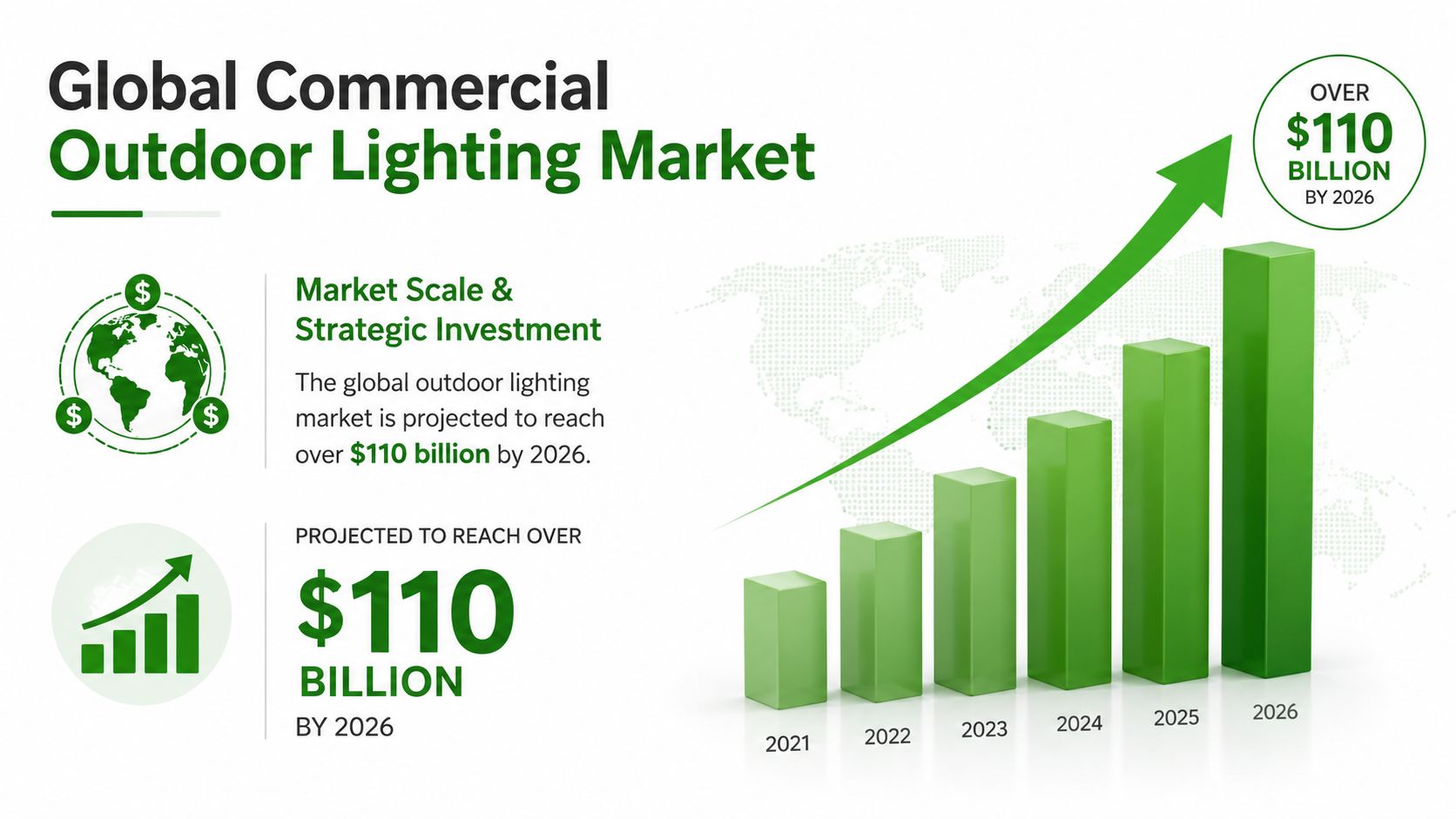
Commercial outdoor lighting is no longer a small upkeep line. The global outdoor lighting market is projected to grow from USD 39.4 billion in 2024 to USD 64.4 billion by 2034, a rise of about 63% at a 5% CAGR (global outdoor lighting market forecast). That kind of growth tells you property owners aren't just replacing lamps anymore, they're investing in site visibility, control, and long-term operating stability.
On the job, that shift is obvious. A retail center wants fewer dark corners and fewer tenant complaints. A multifamily owner wants safer walkways without lighting up every bedroom window. An office park wants clean coverage, lower utility use, and a system that doesn't turn into a maintenance headache every few months.
The properties that do this well treat lighting as site infrastructure, not as a last-minute repair. They ask better questions, measure actual output, and document what gets installed so the system can be maintained without guesswork.
Why Commercial Outdoor Lighting Demands Strategic Investment
The numbers alone show why owners keep revisiting exterior systems. The outdoor lighting market is forecast to keep expanding, either from USD 39.4 billion in 2024 to USD 64.4 billion by 2034 at 5% CAGR or from USD 31.85 billion in 2025 to USD 63.5 billion by 2035 at 7.14% CAGR (market forecast). That's not just product churn, it's a sign that property stakeholders are pushing lighting into the same planning category as roofing, electrical distribution, and security systems.
Lighting affects more than visibility
A dark site creates uncertainty before anyone steps out of a car. On a multifamily property, that can mean tenant complaints and a more expensive security posture. On a retail center, it can mean customers shortening visits or avoiding certain parking rows after sunset.
Practical rule: If lighting only gets attention after a failure, the property is already paying for it through complaints, labor, or risk.
Commercial owners also feel lighting in the budget. Energy is only one line item. The bigger cost is usually the combination of callouts, relamping, bucket truck time, and the nuisance of repeated outages across scattered fixtures. That's why modern site lighting gets tied to asset planning instead of handled as a one-off service call.
Why strategy beats patchwork repairs
Patchwork repairs usually preserve the same problems. Old fixture layouts stay in place, controls remain inconsistent, and the site still has hot spots, shadows, and overlit edges. The result is a system that looks updated on paper but still behaves like an aging installation.
The better approach starts with a site-wide view. What needs real visibility, what needs controlled spill, and what should be left darker? Once those questions are answered, the lighting plan can support security, tenant experience, and maintenance planning at the same time.
Selecting Fixtures Based on Photometric Performance
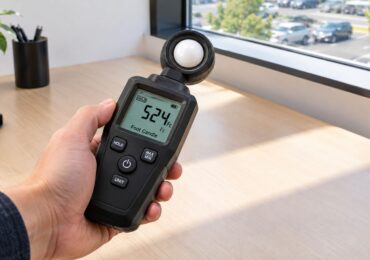
A fixture can look strong in a brochure and still underperform on site. In commercial outdoor lighting, delivered illuminance at the work surface matters more than raw fixture lumens, because the key test is how much usable light reaches the pavement, walkway, loading zone, or façade after optics, spacing, and mounting height do their work (photometric and specification guidance).
Start with the photometric report
A contractor should be able to show a photometric layout, not just a cut sheet. That report shows how the fixture spreads light, where the bright zones land, and whether the plan will create dead spots or glare at the actual mounting height. If a proposal cannot show that, it is mostly marketing.
The details that matter are usually the ones buyers skip first. Optical distribution, CCT, CRI, input voltage, driver type, and dimming protocol all affect how the installed system performs. The DOE Better Buildings outdoor area lighting guidance asks owners to review LM-79 photometric reports, check IP ratings, evaluate glare at nighttime viewing conditions, and measure payback using energy, equipment, maintenance, and control costs (DOE Better Buildings outdoor area lighting guidance).
Compare fixture types by application
| Fixture Type | IP Rating | Min Efficacy | Key Photometric Metric | Typical Application |
|---|---|---|---|---|
| Area lights | IP65 or IP66 | 50 lm/W, where the applicable project specification or code requires that threshold (technical requirement) | Foot-candles or lux at grade | Parking lots, roadways, large site coverage |
| Wall packs | IP65 or IP66 | Qualitative selection based on tested output and layout needs | Wall wash, spill control, mounting-height coverage | Building perimeters, service entries, walk paths |
| Flood lights | IP65 or IP66 | Qualitative selection based on beam control and application | Beam spread, aiming, glare at viewing angle | Signage, façade accents, targeted security lighting |
For vandal-prone or abuse-prone locations, IK08 impact resistance is worth asking for. For inground products, higher ingress protection like IP67 or IP68 is more appropriate, while wall, flood, and area lights commonly sit in the IP65 to IP66 range (technical requirement). That is where the field trade-off shows up, because a tighter seal can help with weather exposure, but the wrong housing or lens choice can still leave you with glare, trapped heat, or a fixture that is hard to service.
Ask for the report that proves the fixture works in the field, not the one that makes the catalog look bright.
For buyers comparing parking-lot options, a useful starting point is a contractor page that discusses commercial parking lot lighting fixtures in practical terms. The test is whether the proposal ties fixture choice to mounting height, spacing, and target foot-candles instead of wattage alone.
Balancing Safety, Security, and Light Pollution Concerns
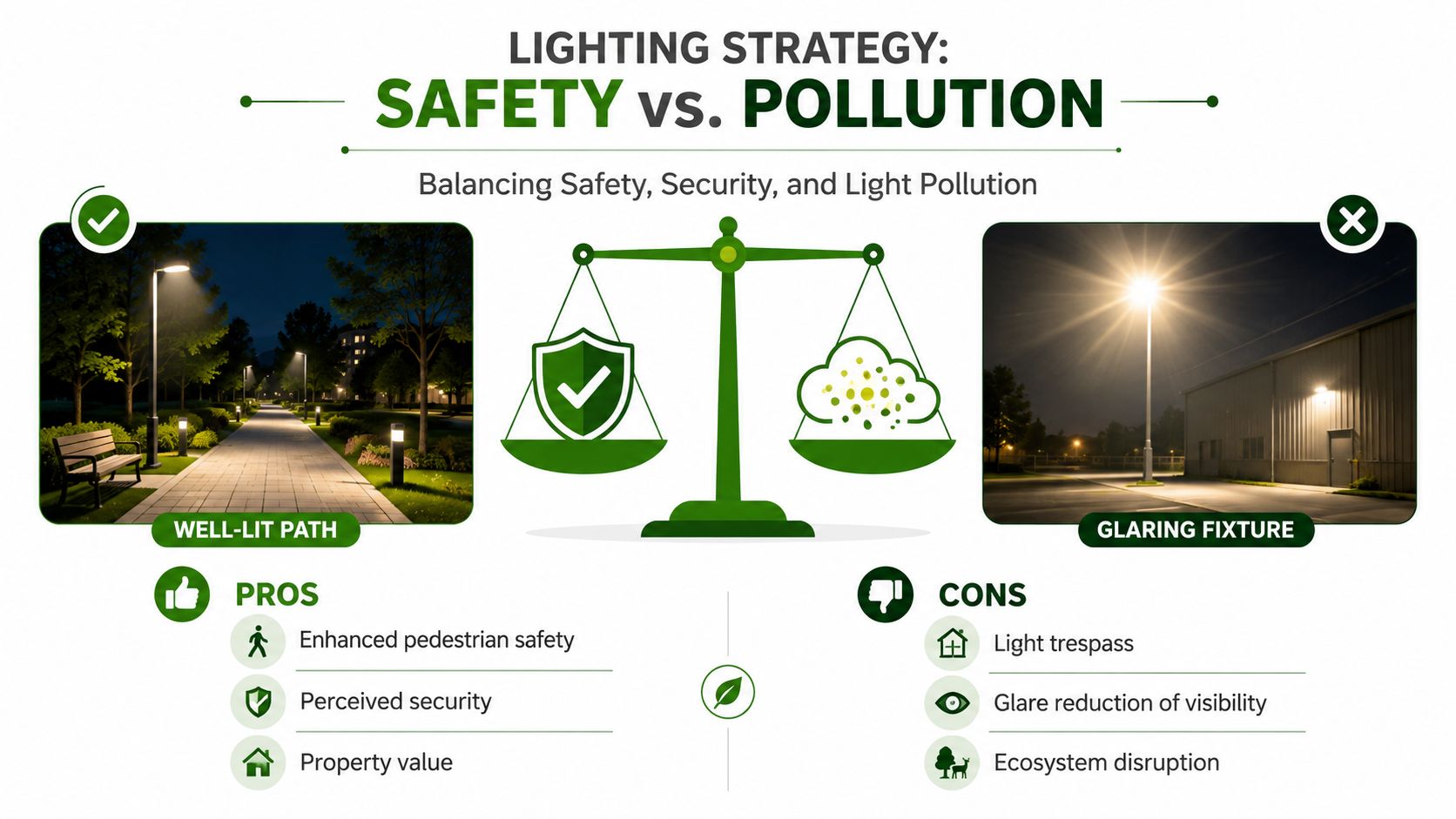
Brighter isn't automatically safer. In the field, overlighting often produces the opposite effect, because glare reduces visibility, flattens contrast, and makes cameras work harder. The right answer is usually controlled light, not more light.
Compare control, not just brightness
DarkSky luminaire criteria cap uplight to as little as 0.5% of total output for larger luminaires and limit high-angle light above 80 degrees (DarkSky luminaire guidelines). Federal guidance also pushes full cutoff or fully shielded luminaires to reduce light trespass and skyglow (DOE and CSU design guidance).
That matters on parking structures, multifamily campuses, and hospitality sites where nearby units, guest rooms, or neighboring tenants can absorb the spill. A fixture that throws light upward or sideways may seem powerful on paper, but it often creates complaints and redraws the problem elsewhere on the property.
What tends to work in the field
Shielding makes a measurable difference when the property has active foot traffic and nearby windows. It keeps the beam on the surface instead of washing the surrounding area, and it helps security cameras see faces and movement without blown-out highlights. That's one reason many night-time camera issues aren't camera issues at all, they're lighting problems.
A practical decision framework looks like this:
- Use full cutoff where people live or sleep nearby. That reduces trespass and makes the site less contentious.
- Aim for uniformity before intensity. A smooth field with fewer shadows is easier to find your way than a patchwork of hot spots.
- Treat accent lighting separately. Decorative brightness shouldn't drive the whole site strategy.
- Check the site after dark. Daytime assumptions miss glare and reflection problems that show up only at night.
Where complaints, glare, and light pollution are a concern, the best projects are rarely the brightest ones. They're the ones where the optics, shielding, and mounting height are matched to the actual use of the property.
Building the Business Case for LED Retrofits
LED retrofits work when the math is based on real site conditions. The U.S. Department of Energy estimated that the commercial sector used 303 TWh of electricity for lighting in 2009, which was about 23% of commercial electricity consumption, and that exterior lighting made up at least 8% of lighting energy use (DOE and PNNL lighting data). That gives owners a useful baseline, not a final answer. Energy use, maintenance, relamping frequency, and access costs are what usually make the retrofit pencil out.
Why adoption has already proved the case
DOE adoption data show that from 2016 to 2018, LED installations roughly doubled to 2,325 million units, and outdoor lighting had a higher LED penetration rate at 51.4% than indoor lighting at 29.8%. That history matters because it shows the technology has moved well past trial use. The market has already accepted LEDs for exterior applications, including parking lot lighting LED.
Use those figures as context, then base today's payback on current utility rates, fixture wattage, operating hours, labor rates, and available incentives.
The financial case is strongest when you stop looking only at wattage and start tracking site labor. Exterior lighting failures are expensive because they are spread out. One fixture on a pole, another by a loading dock, another at the back of a lot, each one can require a separate access setup.
How to frame payback
A credible retrofit model should include:
- Energy use before and after.
- Relamping frequency.
- Maintenance labor and equipment access.
- Control savings from dimming or scheduling.
- Utility incentives, if available.
For a property manager, the key question is not whether LEDs use less power. It is how fast the lower energy use and reduced maintenance will offset the project cost under current operating conditions.
This is why retrofits on parking lots, perimeter lighting, and courtyard systems often outperform purely decorative upgrades. They carry repeat operating expense, and that expense drops once the source, driver, and controls are modernized.
Field note: If the proposal does not show labor savings, it is not a real payback model, it is just an energy estimate.
Navigating Title 24 and Code Compliance Requirements
California property managers know this pain well, a lighting project looks straightforward until inspection day. Then a missing control, an unverified report, or a mismatch between the installed system and the approved documents turns into delay. Title 24 compliance is not only about saving energy, it's about proving the system does what the paperwork says it does.
What owners should ask for before final inspection
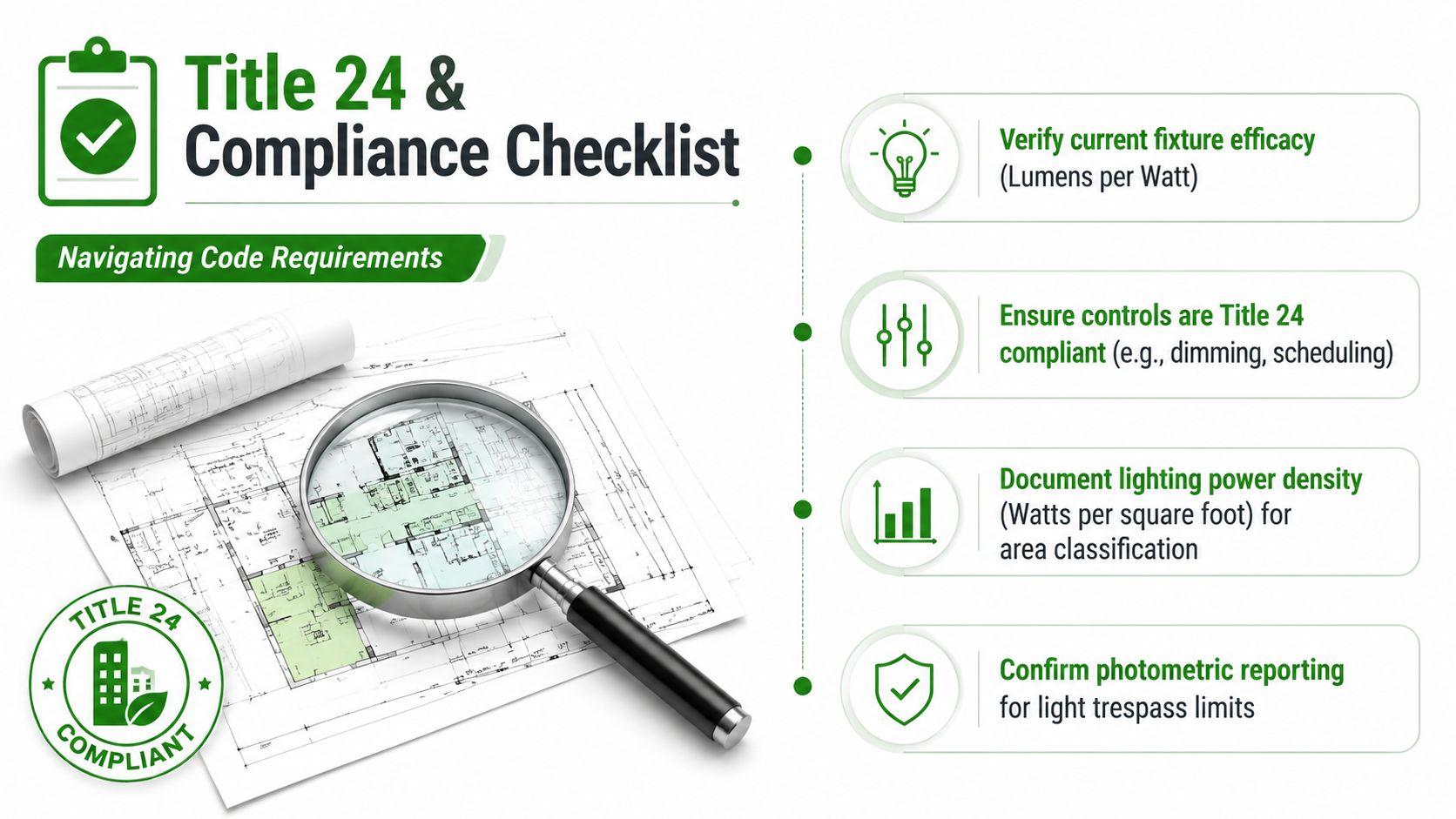
The contractor should be able to produce the control documentation, fixture data, and testing records without scrambling. For outdoor work, that usually means photocells, scheduling, dimming details, and whatever supporting forms the building department expects. If the installed controls don't match the submittal, the project is exposed.
The checklist should also verify:
- Fixture efficacy documentation. Confirm the installed products meet the proposed performance.
- Control functionality. Test dimming, scheduling, and automatic shutoff where required.
- Lighting power density documentation. Match the area classification and the submitted calculations.
- Photometric reporting. Confirm the system respects light trespass expectations.
Common gaps that create avoidable risk
A failed photocell looks small until the lot stays on all night. A missing control in a stairwell or at a common exterior zone can turn into an inspection issue or a tenant complaint. In practical terms, those are the problems that become the hardest to defend later because everyone assumed someone else had tested them.
Documentation matters just as much as hardware. If the contractor can't hand over a clean record set, property management gets stuck proving what was installed, what was tested, and what still needs correction. That's where a well-organized certification package saves time.
Implementing Preventive Maintenance and Testing Protocols
The cheapest lighting program is the one that avoids emergency calls. Reactive maintenance always costs more because the failure already happened, the site already has a gap, and the crew usually has to mobilize quickly with less flexibility. Preventive work catches electrical and structural issues before they become outages or safety incidents.
What routine testing actually catches
On one parking structure, emergency lights failed a routine battery test long before a tenant noticed the issue. That mattered because the problem wasn't visible during normal daytime use, but it would have been obvious during a power loss. In another office-park style setting, infrared scanning found switchgear hotspots before the equipment tripped, which gave the owner time to schedule corrective work instead of waiting for an outage.
A maintenance program should usually include:
- Infrared electrical inspections. These help identify overheated terminations, failing components, and loose connections before they create downtime.
- Light pole integrity testing. Poles age structurally, especially when exposure, corrosion, or impact is part of the history.
- Emergency lighting battery backup checks. This is basic compliance work, but it's also where many sites find hidden failures.
- Documented follow-up. A report should identify what was tested, what failed, and what needs immediate action.
Why documentation changes the outcome
A good maintenance report does more than say a fixture was replaced. It tells property management what condition the system was in, what was corrected, and what still needs watching. That record becomes useful during inspections, insurance reviews, and capital planning.
If you manage poles or exterior assets, a maintenance partner that handles why regular light pole maintenance and repairs are crucial for your property's safety and efficiency can help reduce surprises. The value isn't just in the repair, it's in finding the structural or electrical issue before it creates a bigger shutdown.
Don't wait for a dark lot to tell you the system is in trouble.
Selecting a Qualified Commercial Lighting Contractor
The right contractor doesn't just install fixtures, they control risk. Licensing and bonding matter because they give property owners a layer of protection when work touches power distribution, raised assets, or compliance-driven lighting systems. For California properties, a licensed C-10 electrical contractor with documented outdoor experience is a very different choice from a general handyman or a low-bid installer without the right equipment.
What separates a workable bidder from a risky one
The strongest proposals tend to come from teams that can show real project volume, emergency response capability, and the equipment needed to work fixtures safely. High-reach boom trucks matter when poles or wall-mounted luminaires need access. Infrared thermography certification matters when maintenance work includes diagnostics. Title 24 experience matters when the project must pass inspection without rework.
A solid RFP review should ask for:
- License and insurance verification.
- Documented outdoor lighting and pole work history.
- Emergency response availability.
- Testing and reporting capability.
- Access equipment for high-reach work.
Access Electrical and Lighting fits that type of scope as one example of a contractor that handles commercial lighting, maintenance, infrared inspections, pole work, and Title 24 documentation under one roof. That unified delivery reduces coordination errors when a project includes both line-voltage and low-voltage scopes.
Choosing on price alone is a mistake. A lower bid that leaves out testing, access equipment, or documentation usually comes back as a change order, a failed inspection, or a callback. The better contractor protects the owner from those costs before they ever show up.
If you're planning a retrofit, chasing a compliance issue, or trying to make a site safer without overlighting it, Access Electrical and Lighting can help with design, installation, testing, and maintenance for commercial outdoor lighting systems. Visit Access Electrical and Lighting to discuss a project that needs photometric planning, code-ready documentation, and a maintenance plan that holds up in the field.