If you manage a commercial property in Southern California, this probably sounds familiar. A tenant asks for EV charging. Then another one does. Your ownership group wants a proposal. Your maintenance team looks at the electrical room and says, “Maybe.” The city has permit requirements, the utility wants details, and every charger vendor says their product is the easy part.
That's usually true. The charger itself rarely causes the biggest problems. The problems start when a property installs too few ports, picks the wrong parking stalls, underestimates panel capacity, or gets deep into procurement before anyone has done a proper load review. On multifamily sites, those mistakes show up fast as resident complaints, parking conflicts, and expensive change orders.
In Southern California, the job also sits inside a tighter compliance environment than many generic online guides admit. You're not just mounting equipment on a wall. You're dealing with electrical distribution, utility coordination, accessibility rules, local permitting, and California energy code expectations that can affect design decisions early.
Your Guide to Commercial EV Charger Installation
A Southern California property manager usually gets pulled into EV charging the same way. A resident asks for one charger. Ownership asks for a budget. Then the scope widens from a simple amenity request into electrical design, utility coordination, parking rework, permits, and long-term operations.
That shift happens fast.
Commercial EV charger installation is a site infrastructure project first and a product purchase second. The charger brand matters, but the bigger cost drivers usually sit behind the wall or under the pavement. Panel capacity, conduit distance, trenching, service limitations, accessible parking layout, and utility timing decide whether the job stays manageable or turns into a string of change orders.
Southern California adds another layer. Multifamily and commercial properties here have to account for California code requirements, local plan check expectations, Title 24 implications, and utility programs that can change the economics of the project. A retail center in Anaheim, a mixed-use property in Irvine, and a garden-style apartment community in Orange County can all need different installation strategies even if they plan to serve the same number of drivers.
The first decision is not charger brand or app platform. It is how the property will use charging.
For many commercial and multifamily sites, Level 2 charging is the practical starting point because it fits the dwell time of residents, employees, and longer-stay visitors. The exact circuit size, charger output, and number of ports should follow the building load profile, parking assignment rules, and future expansion plan. A property with overnight resident charging has different needs than a shopping center trying to support short customer visits.
I tell owners to budget for the entire path of work, not just the hardware on the wall. That includes electrical review, civil work if trenching is needed, utility coordination, permitting, striping or signage changes, load management decisions, and the possibility that the existing service is already spoken for during peak building demand. If the property expects to grow charger count over time, it also helps to plan conduit routes and distribution capacity early, the same way you would handle electrical infrastructure planning for commercial expansion in Orange County.
Projects run better when the property team answers a few practical questions up front. Who will use the chargers: residents, tenants, employees, customers, or fleet vehicles? Are the stalls assigned or shared? Will billing be public, private, or rolled into rent or CAM recovery? Does the owner want a small first phase with room to expand, or a larger deployment now to avoid reopening finished areas later?
Clear answers at the start reduce rework later. That matters more in Southern California, where permit comments, ADA layout corrections, and utility lead times can push a simple concept well past the original schedule if the job starts with assumptions instead of a real site plan.
Strategic Site Assessment and Project Planning
The best way to think about EV planning is the same way you'd plan a kitchen remodel. You don't buy appliances first and then hope the room works around them. You decide where power, circulation, and daily use need to happen. EV charger planning works the same way.
Start with the parking lot, not the product catalog.
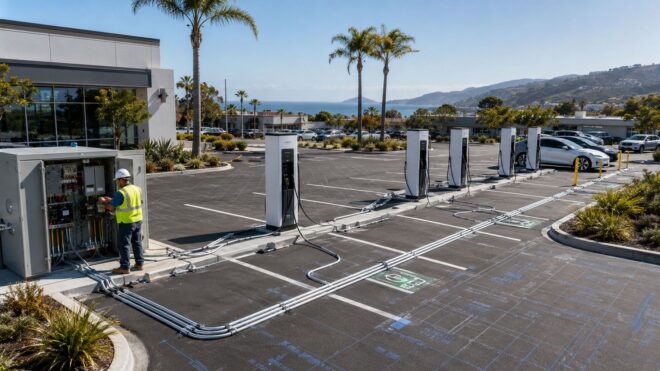
Pick locations that reduce electrical pain
The cheapest stall to stripe is often not the cheapest stall to electrify. A charger location may look convenient from a user standpoint but become expensive if it requires long conduit runs, saw cutting, trenching, bollard protection, or work across active traffic areas.
Look at these factors together:
- Electrical proximity: Stalls near existing electrical rooms, distribution panels, or house power usually create cleaner projects.
- Traffic flow: Drivers need room to pull in, park, plug in, and leave without blocking fire lanes or loading zones.
- Visibility and management: Chargers hidden in remote corners tend to create operational headaches and weaker user experience.
- Future expansion: A location that supports a few chargers today should also allow additional conduit paths or capacity planning later.
On larger multifamily sites, it often makes more sense to create a small charging zone than to scatter single chargers across distant buildings. That keeps installation work more centralized and gives management a clearer way to control access.
Estimate demand like an operator, not a marketer
The common planning mistake in multifamily properties is assuming that one or two chargers will cover demand because only a few residents currently drive EVs. That works for a short time, then the queue starts.
A useful benchmark is the general rule of 1 shared charger for every 3 EV drivers, as discussed in this multifamily charging planning guide from SWTCH on charger ratios and resident demand. The same source also points out that many properties install fewer chargers than needed and fail to account for changing adoption, which leads to access conflicts.
That doesn't mean every property should install to that ratio on day one. It means you should plan around it.
A smart assessment usually includes:
- Current user count from residents, staff, or tenants who already own EVs.
- Near-term interest gathered through surveys, lease inquiries, or tenant outreach.
- Parking assignment realities such as reserved stalls, guest parking, and shared use windows.
- Expansion path so you're not reopening concrete or redesigning the same area later.
For owners planning broader property improvements, this same growth mindset applies to the rest of the site's electrical backbone. It helps to review commercial electrical infrastructure planning for expansion in Orange County before locking in charger locations.
If the charger plan only works at today's demand, it's already undersized.
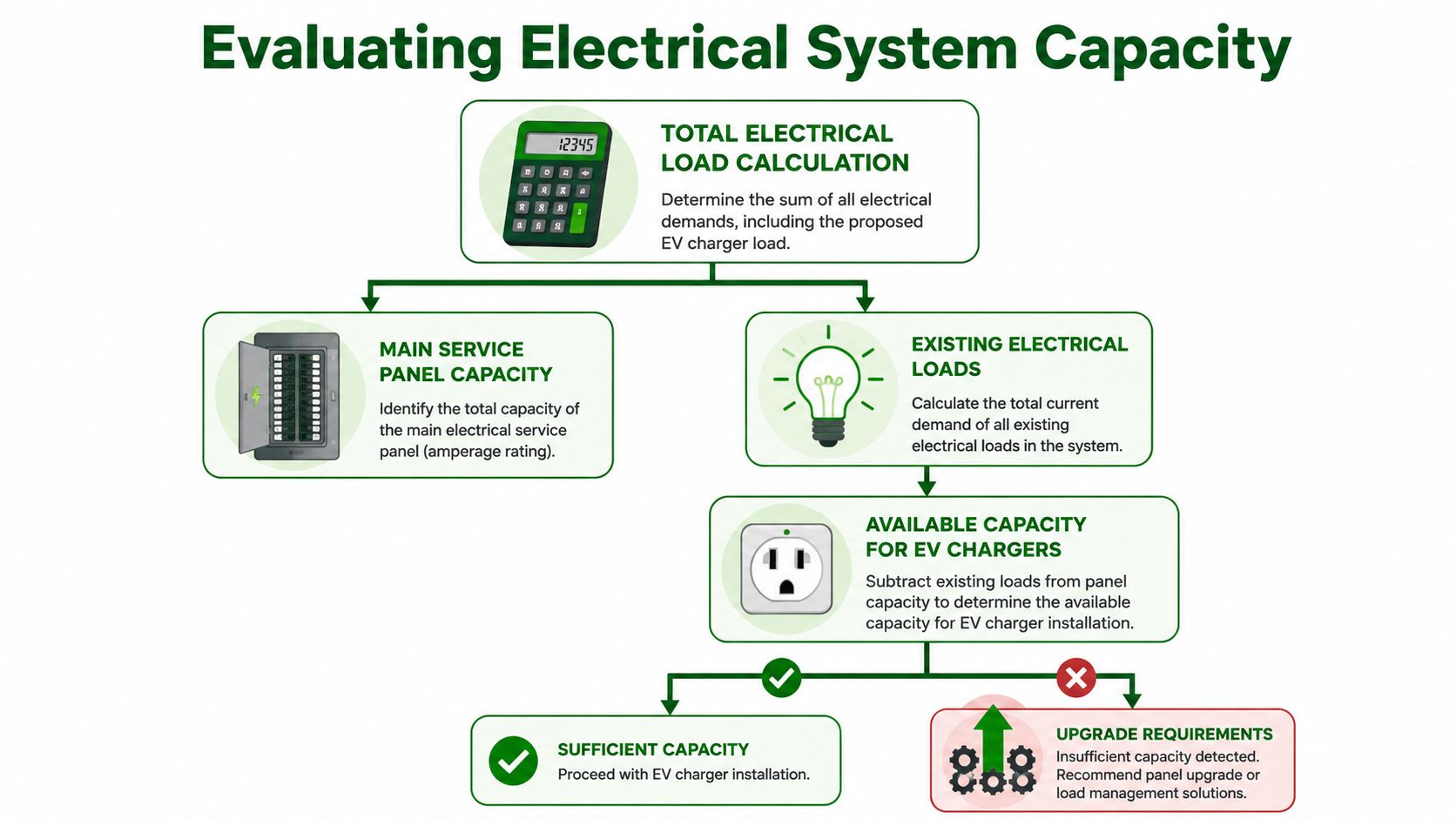
Evaluating Your Electrical System Capacity
A lot of multifamily EV projects in Southern California look fine on paper until the electrical review starts. The owner sees open parking, picks charger locations, and assumes the rest is a straightforward permit and install. Then we open panel schedules, trace feeder paths, and find the main constraint. The service has no room for new continuous load, the closest panel is full, or the parking area is too far from a practical tie-in point to keep costs under control.
What a load review actually checks
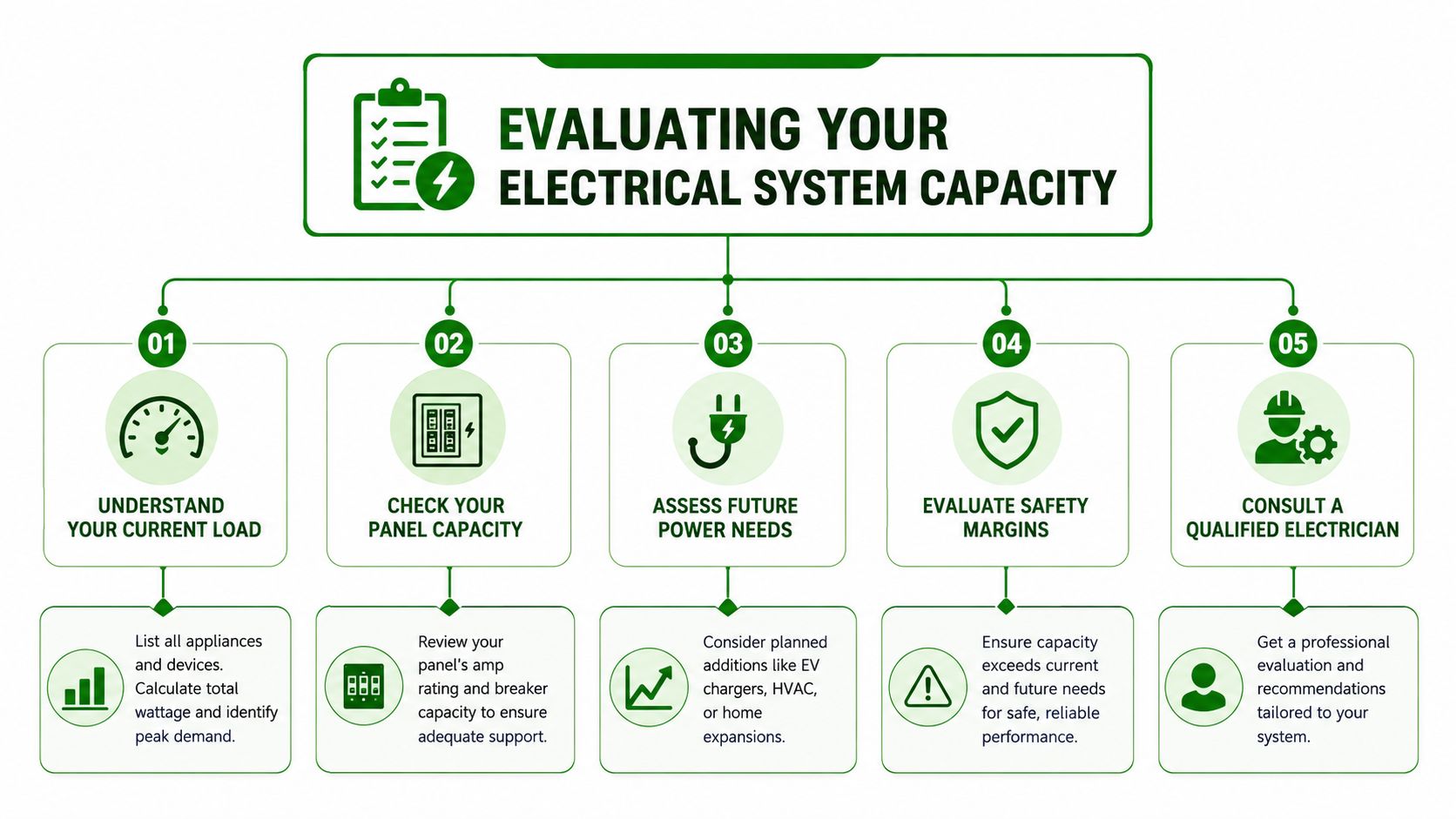
A proper capacity review starts at the utility service and works downstream through the gear that will carry the charger load. Breaker space alone does not answer the question.
The electrician or engineer should verify existing demand, available ampacity, equipment condition, and the route power will take to the stalls. On older SoCal properties, I often see enough theoretical capacity at the building level but no practical way to get that power to the parking area without expensive trenching, saw-cutting, coring, or gear replacement.
| Component | What it affects | Common issue on older SoCal sites |
|---|---|---|
| Main service | Total site power available | Original service was sized for the building's past use, not EV charging |
| Transformer | Upstream supply to the property | Utility or customer-owned transformer can limit expansion |
| Switchgear | Distribution and protection | Older gear may have limited spare capacity or replacement parts |
| Panelboards | Local branch circuit capacity | Panels serving parking areas are often full or poorly documented |
| Feeder path | How power reaches charger locations | Long runs raise labor, material, and design constraints |
For commercial and multifamily work, Level 2 charging is usually the starting point. In practice, that means dedicated circuits, continuous-load calculations, and careful panel and feeder sizing. The exact breaker, conductor, and conduit requirements depend on the charger rating, run length, temperature conditions, and manufacturer instructions.
The part owners often miss is continuous load treatment. EV charging is not sized like a short, intermittent load. If the equipment draws 40 amps continuously, the overcurrent device and conductors have to be selected accordingly under NEC rules. A charger that barely fits on paper usually creates problems in plan review, inspection, or actual use.
Long runs across parking lots and garages create another issue. Voltage drop can turn a workable design into a bad one if the conductors are undersized or the route gets longer during field layout. A practical understanding of voltage drop in commercial electrical systems helps explain why the cheapest feeder design is often not the lowest-cost option over the life of the installation.
Southern California projects add another layer because future expansion matters from day one. Title 24 and local review practices push owners to think beyond the first few chargers, especially on multifamily properties where EV adoption keeps rising and parking layouts are already tight. If the first phase uses every bit of available panel space and every workable conduit path, the second phase gets expensive fast.
Signs your project may need upgrades
Some warning signs show up early and should be treated as budget flags, not minor inconveniences:
- Panel schedules are missing, vague, or outdated
- Existing panels are physically full or have no breaker capacity that can be used
- Service equipment is older and already carrying heavy building load
- Parking areas are far from realistic tie-in points
- The project needs load management or phased installation to avoid service upgrades
- Ownership wants future charger expansion without reopening finished areas later
On many apartment and mixed-use sites, the best answer is not a full service upgrade on day one. It may be a phased make-ready approach, load management, oversized conduit for future circuits, or a distribution upgrade in the parking area that avoids repeating demolition later. That decision should be made before permit drawings are finished, not after bids come back high.
Navigating Permits Codes and ADA Compliance
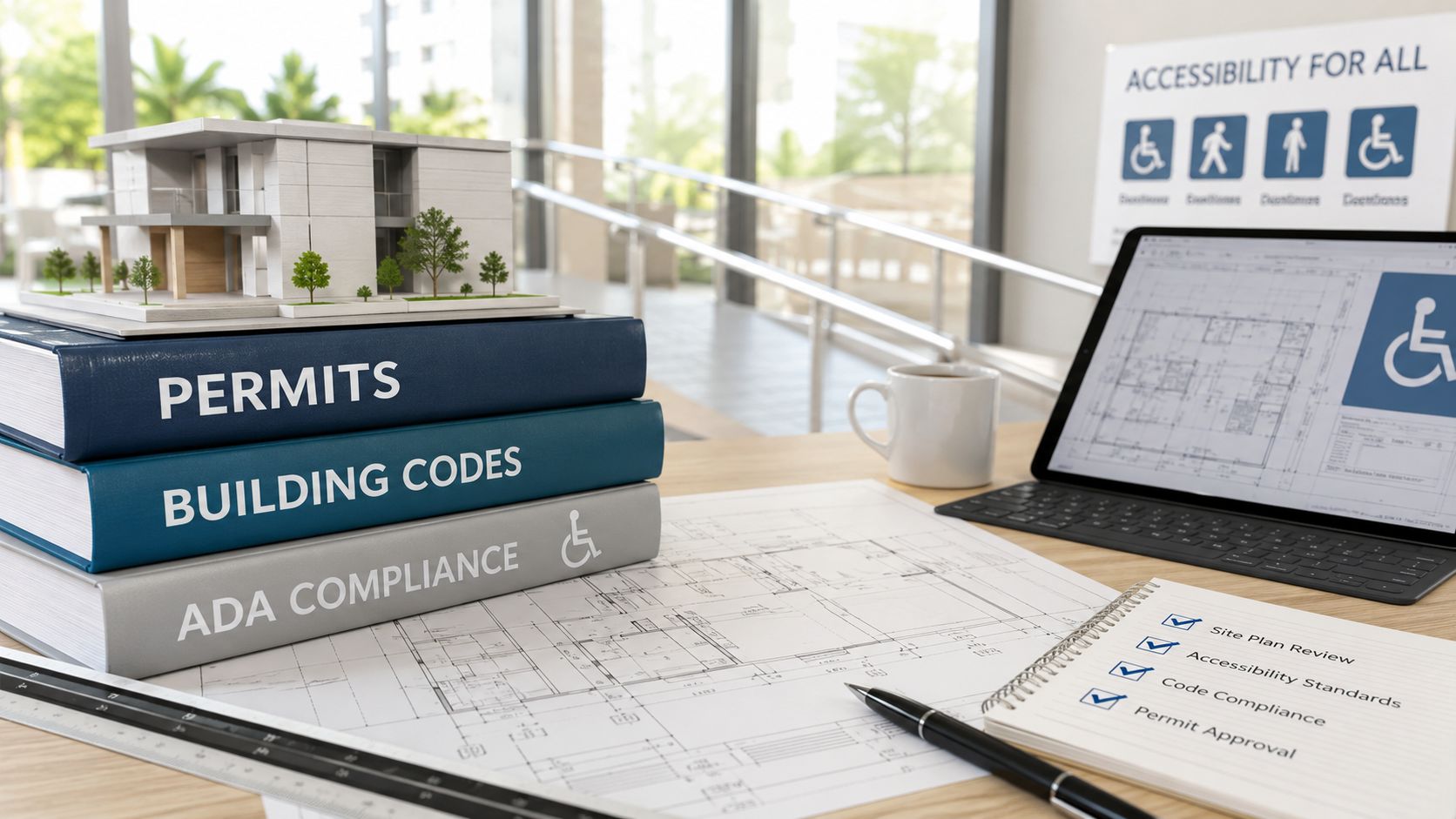
EV charger installation requirements aren't just electrical. They're also architectural, civil, accessibility-related, and local-jurisdiction specific. In Southern California, that means your charger layout has to survive plan check, field inspection, and practical daily use.
What code reviewers care about
The city or AHJ isn't just looking for a charger cut sheet. They want to see a compliant installation that addresses mounting, protection, path of travel, labeling, and power distribution. In California, that often intersects with Title 24 and CALGreen expectations, especially on new construction, remodels, and projects that trigger EV-capable or EV-ready considerations.
Even when a property isn't in new construction, local reviewers still look closely at how the installation fits within existing site conditions. On a commercial lot, that can include bollards, wheel stops, curb placement, striping changes, trench details, and whether the installation interferes with accessible parking circulation.
This is why permit drawings matter. A charger mounted in the wrong place can fail for reasons that have nothing to do with voltage.
ADA and mounting details that get missed
One of the most common avoidable failures is poor physical placement.
Under NEC 625.29, the EVSE connector must be mounted between 18 and 48 inches above the finished floor for indoor installations, while outdoor setups require a minimum of 24 inches. The same reference notes that ADA guidelines require a minimum 36-inch-wide accessible pathway (EVSE mounting height and accessible pathway requirements).
Those numbers affect real design choices:
- Wall-mounted units: Check connector reach and cable management before finalizing elevation.
- Pedestal chargers: Confirm they don't intrude into pedestrian travel areas.
- Garage installations: Watch for columns, wheel stops, and low-clearance obstructions.
- Retrofits near accessible stalls: Coordinate with striping and pathway requirements before installation starts.
A charger can be electrically perfect and still fail inspection if a wheelchair user can't approach it properly or if the connector sits outside the required mounting range.
Field note: Accessibility issues are easier to solve on paper than after concrete work, striping, and equipment installation are complete.
Why contractor selection matters here
Permitting goes smoother when the contractor understands both the electrical scope and the property-management realities around scheduling, tenant impact, and inspections. On occupied sites, that also means planning shutdowns, maintaining safe walkways, and sequencing work so residents or customers can still use the property.
If you're vetting firms, this is the point to review what separates the right commercial electrical contractor in Orange County from a contractor who mainly handles light residential work. EV projects at commercial properties need code literacy, documentation discipline, and field coordination. Not just someone who can mount hardware.
Utility Interconnection and Finding Rebates
A lot of EV projects lose money before the first charger is energized because the owner treats utility coordination and rebate paperwork like admin work. It isn't. It's part of the installation.
If the site crosses a capacity threshold, approval from the grid operator is required, and commercial charge point operators must register as a business and obtain an operation permit before installation. Public charging stations also have to be incorporated into a national public charging register with details including the operator name, location, outlet type, charging power, and operating hours. The same regulatory summary notes that installations must be done by certified technicians using certified equipment, and in the United States both DC fast chargers and AC Level 2 chargers must be certified to appropriate UL standards. It also identifies ISO 15118 as the communication interface behind Plug & Charge functionality (EV charging regulatory framework and certification requirements).
For a Southern California property manager, the takeaway is simple. The utility isn't being difficult. The utility is trying to confirm that the grid connection, site equipment, and charging hardware all fit within a compliant operating framework.
Documentation affects ROI
Consequently, owners miss incentives.
Some rebate programs require invoices that do more than show a total contract amount. One verified reference notes that programs in several states require itemized utility invoices showing the contractor's license number and a clear breakdown of the EV charging circuit cost separate from general electrical work, and that missing this documentation can lead to denied rebates (itemized EV charging invoice requirements for rebate eligibility).
That lesson carries directly into California incentive work. Even if the exact program requirements differ, the pattern is the same. Sloppy paperwork can kill reimbursement.
Use this standard when reviewing proposals and change orders:
- Separate charger hardware from electrical infrastructure
- Break out EV circuit work from unrelated site electrical work
- Make sure license details appear on invoices
- Match model numbers and installed quantities to application paperwork
- Keep permit records, inspections, and paid invoices organized from day one
Utility planning should start early
Owners often wait to involve the utility until the permit set is nearly complete. That's backwards. If the project may affect service capacity, transformer loading, or metering approach, utility coordination needs to happen early enough to shape the design.
In practice, that means your budget should include not just charger equipment and installation labor, but also time for utility review, permit processing, and any revisions needed to align both.
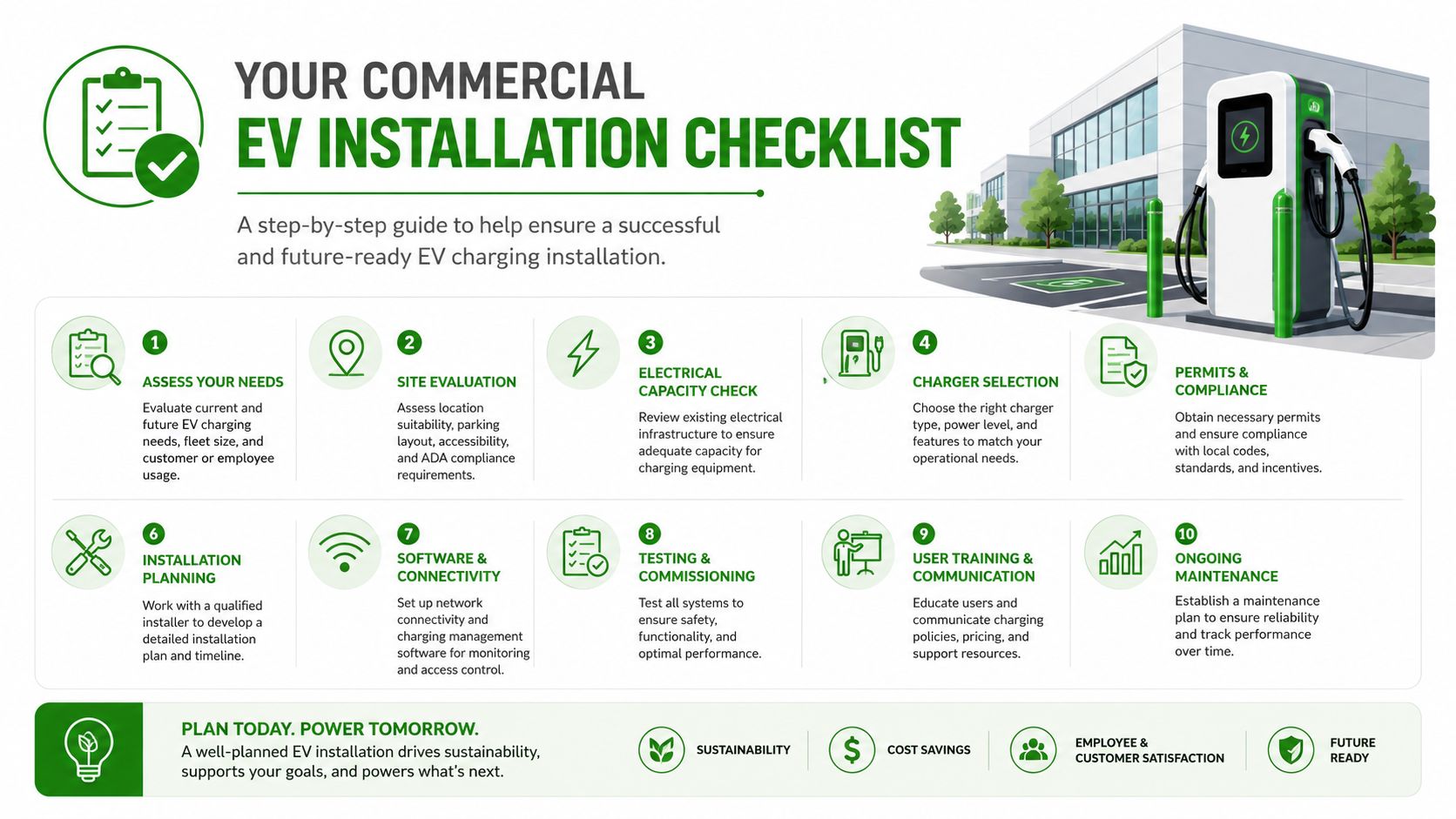
Your Commercial EV Installation Checklist
A commercial EV project gets easier when it's run like a sequence, not a scramble. The checklist below is the format many property teams need because it turns a broad idea into an actual work plan.
Phase 1 planning and assessment
Clarify who the chargers are for
Residents, employees, fleet vehicles, retail visitors, or mixed use all create different turnover patterns and operating rules.Survey demand before choosing quantity
For multifamily properties, don't rely on informal guesses. Ask current users, likely future users, and leasing staff what demand looks like in practice.Walk the site with operations in mind
Look at stall availability, accessible routes, lighting, signage, traffic flow, and distance to likely electrical tie-in points.Request an electrical capacity review
This step should happen before hardware selection is finalized. It determines whether the property can support the initial installation and future phases.
Phase 2 design and permitting
Choose charger type and mounting method
Wall-mounted units, pedestal units, and grouped charging zones each solve different site problems. Match the equipment to the parking layout.Decide how the chargers will be managed
Some properties want open access. Others need resident-only authorization, user billing, or time-based access control. Handle that decision before procurement.Prepare permit drawings and accessibility details
Include mounting heights, pathway clearances, equipment protection, panel connections, and site modifications that may affect inspection.
The cleanest projects are usually the ones where parking layout, electrical design, and operating rules were decided together instead of in separate meetings.
Phase 3 utility, installation, and closeout
Coordinate utility review and incentive paperwork early
If the site may need utility approval or wants to pursue rebates, line up those requirements before construction starts.Schedule installation around the property's rhythm
Occupied multifamily and retail sites need traffic control, communication to users, and sequencing that limits disruption.Collect final records before calling the project done
Keep permits, approved plans, inspection sign-off, equipment data, and itemized invoices together. Those documents matter later for maintenance, warranty, and rebate support.
A practical checkpoint before you start
Use this short decision screen with your team:
| Question | If the answer is no | What to do |
|---|---|---|
| Do we know where the power will come from? | Design risk is still high | Get an electrical assessment first |
| Do we know who will use the chargers? | Quantity may be wrong | Survey residents, tenants, or staff |
| Do we know permit and ADA impacts? | Inspection risk is high | Review layout before submittal |
| Do we know documentation needs for incentives? | Money may be left on the table | Set invoice requirements upfront |
Frequently Asked Questions
How much does a commercial Level 2 charger installation cost
For Southern California commercial sites, the charger itself is rarely the number that drives the budget. The primary cost usually comes from trenching, long conduit runs, panel work, load management equipment, parking lot restoration, and utility-related upgrades. On a clean site with available capacity and short wire pulls, the job stays manageable. On an older multifamily property with a full service and tight parking geometry, the electrical infrastructure can cost more than the charging hardware.
Can we install one charger now and add more later
Yes, and phased installation is often the smart call for apartments, retail centers, and office properties.
The first phase needs to be built with expansion in mind. That means reserving breaker space, sizing conduit for future circuits, planning network coverage, and laying out stalls so added chargers do not create ADA conflicts later. I see avoidable cost overruns when a property installs one or two chargers without a long-term plan, then has to reopen finished pavement or rework parking striping a year later.
Do EV chargers always need a dedicated circuit
For a typical commercial Level 2 installation, that is usually the right assumption. Shared circuits create plan review problems, operating issues, and safety concerns, especially once the charging load is treated as continuous. Final circuit design still needs to match the equipment listing, manufacturer instructions, and the approved electrical design for the site.
Why does breaker sizing get so much attention
Because EV charging can run for hours at a time. That changes how load and overcurrent protection are calculated.
A charger that looks straightforward on paper can turn into nuisance tripping, overheated conductors, or failed inspection if the breaker, wire size, and load calculation do not line up. This is one place where casual estimating causes expensive corrections.
What usually slows projects down
Incomplete site information is first on the list. Missing panel schedules, outdated as-builts, and unclear utility service details waste time before the first charger is installed.
After that, delays usually come from parking layout changes, ADA corrections, utility review, and incentive paperwork that started too late. In Southern California, Title 24 documentation and local plan check comments can also add time if the design team treated EV charging like a simple equipment swap instead of a site improvement project.
Do multifamily properties need more chargers than they think
Often, yes. Multifamily demand is easy to underestimate because managers look at current EV ownership instead of lease turnover and resident expectations over the next few years.
Shared charging can work, but only if the rules match the actual number of drivers. If residents are competing for too few ports, the property ends up managing complaints, vehicle overstays, and billing disputes. It is cheaper to plan the electrical backbone correctly at the start than to keep patching an undersized system.
Are ADA details really that important if the chargers are in a private lot
Yes. Private lot does not mean ADA issues disappear.
Accessible route requirements, reach ranges, clear floor space, signage, and stall layout can all affect charger location and mounting details. A project can have solid electrical work and still get kicked back for access violations. That is common on multifamily sites where parking is already tight.
Should the lowest bidder handle this kind of project
Only if that contractor can show real experience with commercial EV work in occupied properties. The bid should reflect permitting, load review, utility coordination, Title 24 impacts, ADA layout, trenching assumptions, commissioning, and closeout records.
Low numbers often leave out the hard parts. Property managers usually pay for that later through change orders, failed inspections, resident disruption, or rebate paperwork that does not hold up.
If you're planning EV charging for a commercial, retail, office, or multifamily property in Southern California, Access Electrical and Lighting can help you evaluate site conditions, plan infrastructure, and install compliant charging systems with the documentation property managers need.