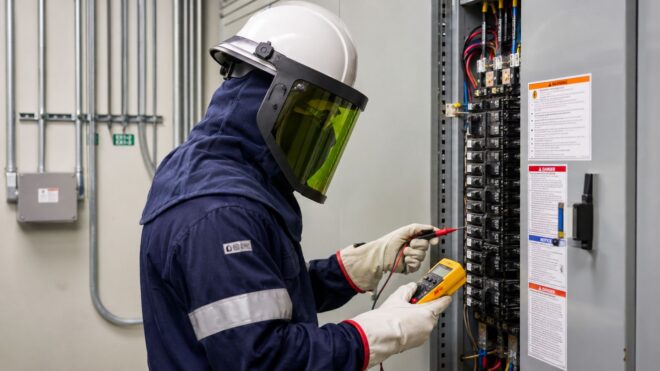
Electrical hazards aren't limited to industrial plants. NIOSH recorded 3,378 workers killed by on-the-job electrical injuries between 1992 and 2002, along with 46,598 nonfatal electrical injuries during the same period. Overhead power lines were involved in 42% of electrocutions in that analysis, a reminder that the surrounding work environment can be as dangerous as the equipment itself. (NIOSH historical electrical injury data)
For commercial property owners, OSHA compliance breaks down in predictable places: panels accessed from unsafe ladders, lighting work performed from poorly controlled lifts, undocumented field modifications, and maintenance carried out without proving that every energy source is dead. The rules matter, but the inspection outcome usually depends on how those rules are applied in the field and whether the property can prove it.
Why OSHA Electrical Standards Matter for Every Commercial Property
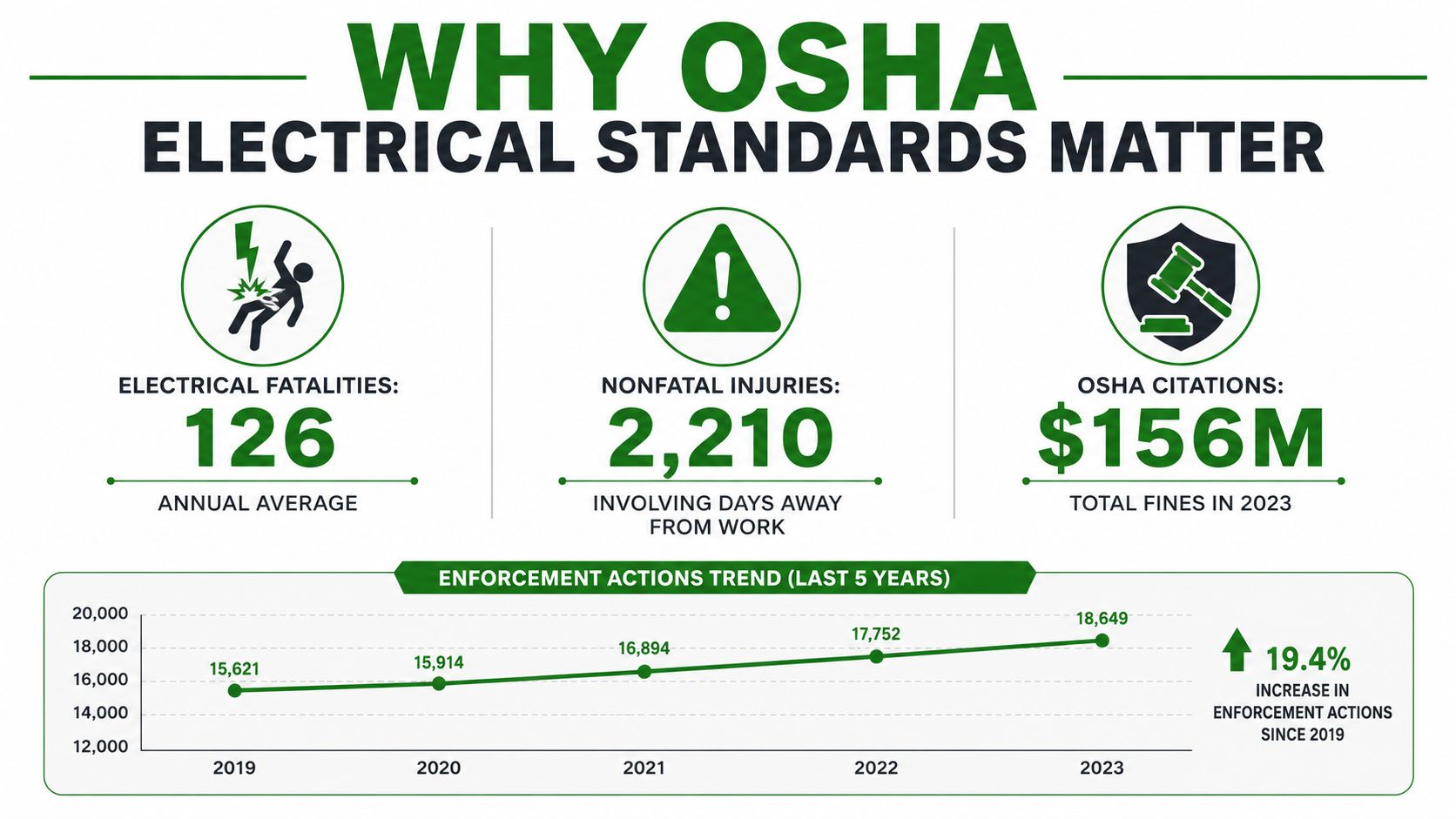
Electricity remains a persistent workplace hazard, not a rare event reserved for electricians. OSHA-recorded workplace fatalities involving electricity totaled 1,201 between 2011 and 2021, accounting for 6% of all workplace deaths in that period. A separate analysis covering 2011 through 2023 counted 1,940 electrical fatalities out of 70,692 total occupational deaths, with 96% occurring in the private sector and 74% involving non-electrical occupations. (CPWR electrical safety data)
Those findings apply directly to commercial properties. A maintenance employee opening a panel, a contractor servicing parking structure lighting, and a facilities worker working near an overhead service all face different tasks, but each task belongs inside a structured electrical safety program. A property doesn't avoid responsibility because the work is routine or because an outside contractor has been hired.
Enforcement remains a practical concern
OSHA construction citations for electrical standards declined from about 4.9 thousand in 2011 to about 1.3 thousand in 2021, a 73.5% decrease. Electrical citations also fell from 6.5% to 2.7% of all construction citations, while annual penalties for electrical-standard violations averaged $3.2 million and declined from $4.5 million in 2011 to $1.9 million in 2021. (CPWR enforcement analysis)
A lower citation count doesn't make a neglected property safe. It means enforcement patterns, work practices, and the kinds of projects inspected have changed. One serious condition can still expose workers to shock, arc flash, burns, falls, or electrical fire, particularly where property teams assume that a recently installed system is automatically compliant.
Field reality: OSHA electrical safety standards protect anyone exposed to energized equipment, not only the person holding the screwdriver.
Commercial buildings also have a complicated maintenance profile. Retail centers may combine illuminated signs, rooftop equipment, parking lot poles, emergency lighting, and tenant-installed systems. Multifamily properties add distributed electrical rooms, common-area lighting, pumps, gates, and resident-facing work zones. Each setting requires coordination between electrical controls and access, housekeeping, contractor supervision, and emergency procedures.
The Core OSHA Regulations You Need to Know
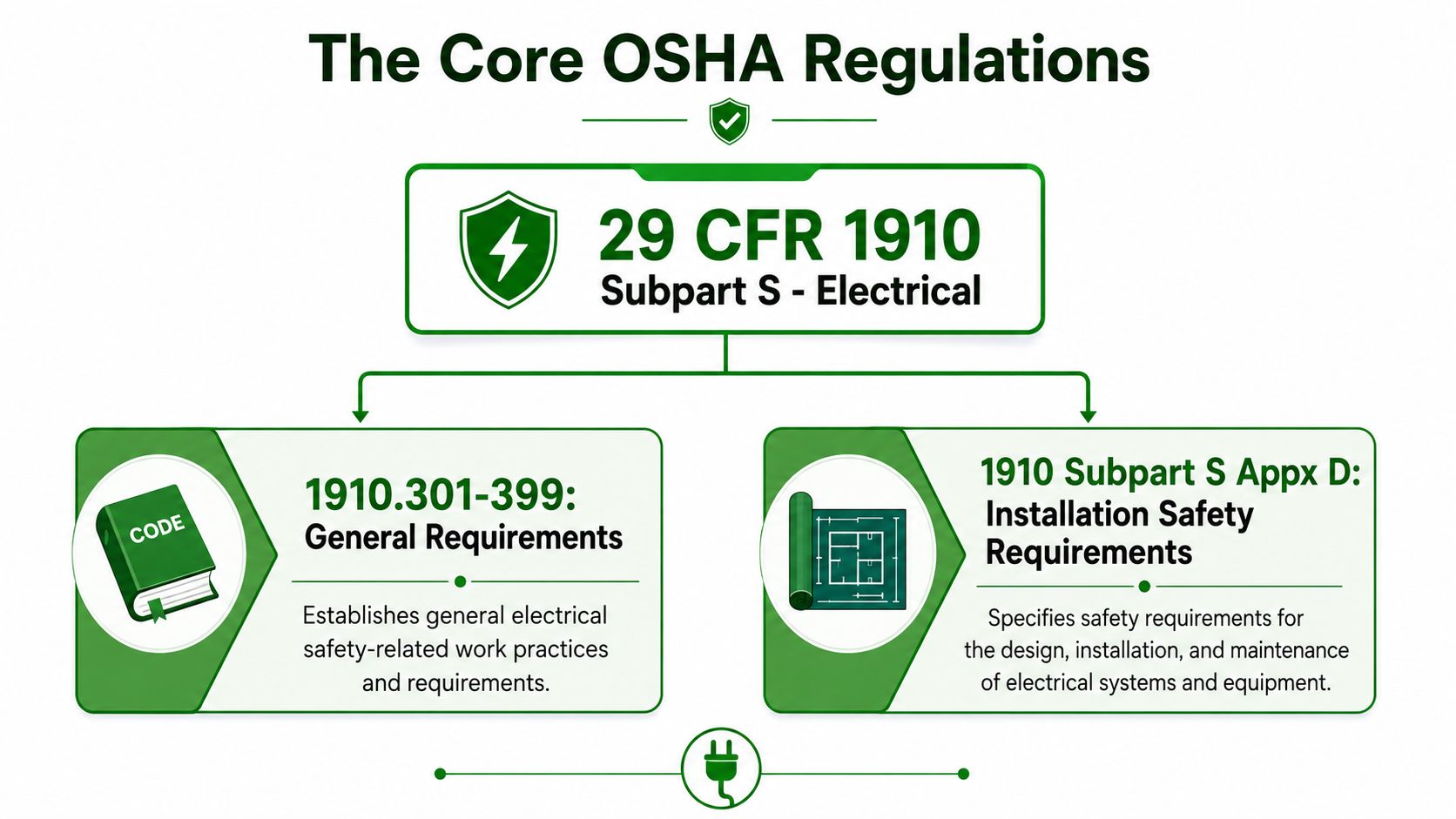
The applicable OSHA framework depends on the work, not the property. 29 CFR 1910 Subpart S governs electrical safety for general industry, covering ongoing operations and maintenance in many commercial buildings. 29 CFR 1926 Subpart K applies to construction activities, including new construction, remodels, tenant improvements, and other covered project work. Both address exposure to shock, arc flash, and energized parts. (OSHA electrical injury and standards overview)
That classification must be settled before work starts. Replacing a failed lighting component during normal building operations may fall under general-industry work practices. A contractor completing a tenant improvement may operate under construction requirements. Put the applicable framework in the scope documents, then confirm it with the contractor. Leaving that decision to whoever arrives on site creates a predictable inspection gap.
Installation rules and work-practice rules serve different purposes
Subpart S installation provisions address how electrical equipment and systems are constructed, installed, and maintained. Work-practice provisions address how employees approach, test, isolate, and work on or near those systems. A properly installed panel can still produce an OSHA citation if a worker opens it without the required controls, training, or protective equipment.
OSHA's 2018 update to the general-industry electrical safety-related work practices rule reinforced controls such as de-energizing equipment, lockout/tagout, and safe approach distances. (OSHA electrical safety guidance) For property managers, the practical test is whether those controls are available at the work location, understood by the assigned worker, and reflected in the job record. A clean installation does not correct missing access control or incomplete documentation.
NFPA 70E helps turn broad duties into field procedures
NFPA 70E is a consensus standard, not an OSHA regulation. Employers use it to develop procedures for shock and arc-flash risk assessment, approach boundaries, energized-work decisions, and PPE selection. OSHA remains the enforceable authority. NFPA 70E supplies a detailed operating framework that can make the employer's process consistent and repeatable. (NFPA 70E workplace safety guide)
For higher-voltage work, OSHA 1910.269 includes specific arc-flash protection boundaries and approach requirements. The listed minimum arc-flash protection boundaries include 455 millimeters, or 18 inches, for low-voltage MCCs and panelboards, 610 millimeters, or 24 inches, for low-voltage switchgear, and 910 millimeters, or 36 inches, for 5-kV or 15-kV switchgear. (OSHA 1910.269 Appendix E) In commercial properties, violations often arise when stored materials, tenant activity, or temporary work blocks those boundaries even though the equipment itself meets installation requirements.
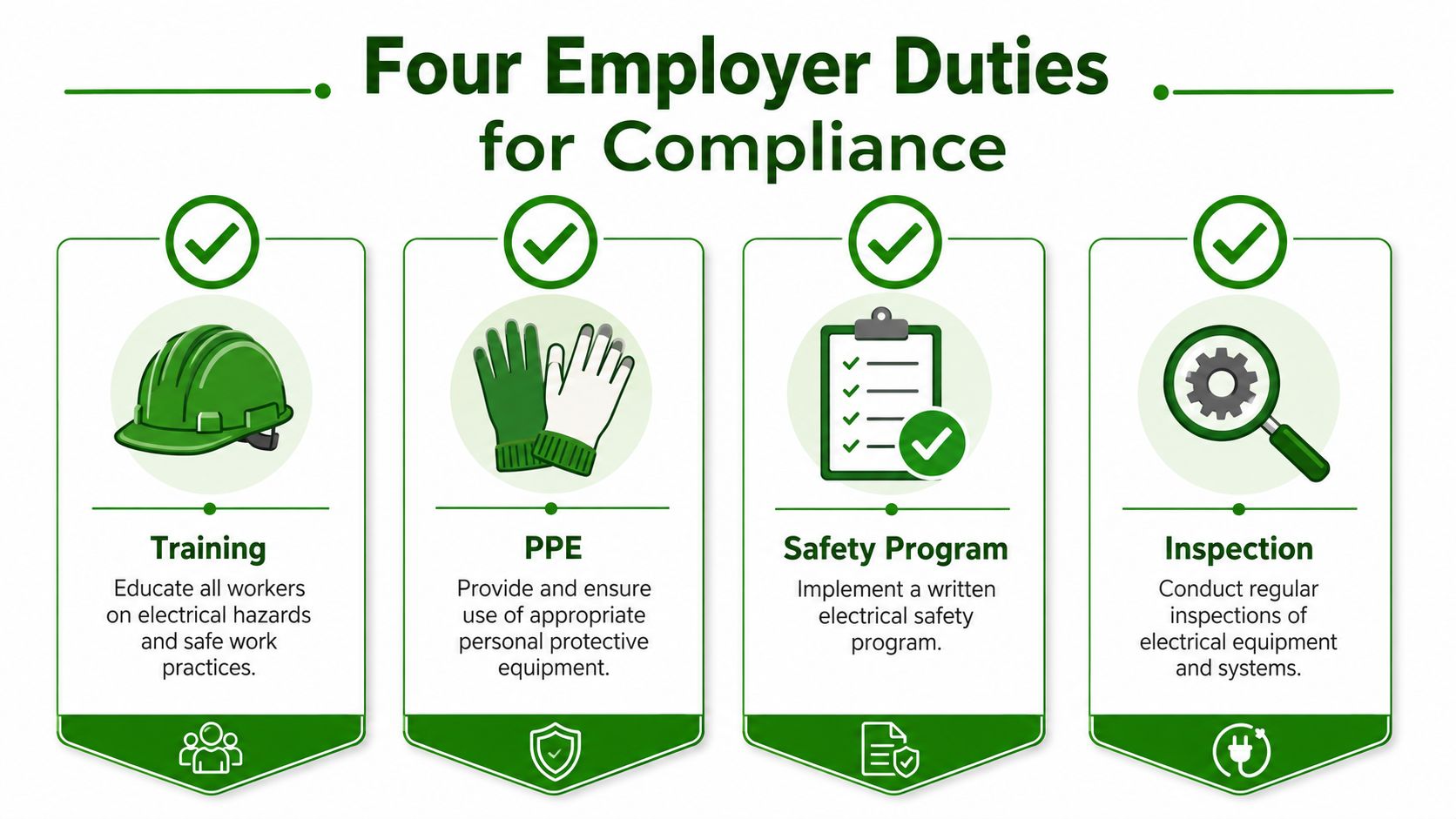
Four Employer Duties That Define Compliance
Compliance is an operating program, not a binder placed on a shelf. Employers must match training, protective equipment, procedures, and verification to the hazards workers encounter. That obligation continues whether the worker is an employee, a maintenance technician, or a contractor performing assigned work under the property's control.
Training must match the task
Training shouldn't stop at a general electrical awareness video. Employees who work near exposed parts need instruction suited to their exposure, while workers who troubleshoot or perform electrical tasks need equipment-specific knowledge. That includes recognizing energized components, understanding labels and boundaries, using test instruments correctly, and knowing when a task must be stopped.
A parking garage attendant may need hazard awareness and restricted access procedures. A maintenance electrician working on a distribution panel needs a far deeper qualification record. Property teams should document who is qualified for which equipment and task, instead of treating “maintenance” as a universal qualification.
PPE supports the procedure, but it doesn't replace it
Appropriate PPE can include arc-rated clothing, insulated gloves, eye and face protection, and other task-specific equipment. The selection should follow the hazard assessment and the planned work method. PPE that is unavailable, damaged, improperly sized, or stored where workers can't reach it isn't a functioning control.
For a practical explanation of how arc-flash analysis supports PPE and work planning, review this arc-flash study guide.
Lockout/tagout has to control every energy source
OSHA warns that switching equipment off isn't enough. Before electrical maintenance begins, the employer should identify every energy source, including generators and batteries, disable or isolate those sources, apply locks and tags, test for the absence of voltage, and dissipate stored energy. (OSHA electrical safety inspection guidance)
A lighting circuit is a common failure point. A worker may open the local switch while a control circuit, emergency source, generator, or backfeed remains energized. The written procedure needs to reflect the actual system, and the person performing the work must verify the result with an appropriate test instrument.
Inspections verify what procedures can't
Routine inspections should examine more than visible damage. Teams should look for overheating, loose connections, missing covers, damaged cords, blocked working space, deteriorated labels, and changes that no longer match the equipment's listing or installation instructions. Infrared thermography can help identify abnormal heat without invasive dismantling, but it supplements, rather than replaces, de-energized inspection and corrective repair.
A signed inspection form is useful only when it records what was checked, what failed, who owns the correction, and whether the hazard was removed from service.
The Hidden Citation Pattern Most Properties Miss
Commercial properties often prepare for citations by reviewing panels, disconnects, and wiring methods first. OSHA's FY 2025 federal citation data for electrical contractors show why that approach misses common exposures. Fall protection with 42 citations, ladder safety with 31, and aerial lifts with 24 were cited more often than wiring-method and equipment issues, which accounted for 13 citations. (OSHA cited-standard data for NAICS 238210)
Electrical compliance and access planning belong in the same job review. A correct panel procedure does not protect a worker using an unsuitable ladder. Isolating a pole-light circuit does not control a fall from a raised platform. Before work begins, confirm how the crew will reach the equipment, what surfaces support them, and which surrounding hazards could change the risk.
Common commercial examples
A high-ceiling LED retrofit includes wiring and controls, but the immediate exposure may involve the lift, floor condition, nearby occupants, falling materials, and the worker's position while handling fixtures. A boom-truck repair on a parking lot pole adds traffic control, ground conditions, overhead obstructions, and fall protection to the electrical scope.
Emergency lighting work in a stairwell creates the same mixed-risk condition. The worker may need to isolate the circuit, control building occupants, position equipment safely, and keep tools or materials from falling through the stair flight. Calling the task “just a fixture replacement” leaves those controls undefined.
What property owners should require
Contractor prequalification should ask how the crew will reach the equipment, not only whether the contractor is licensed. The work plan should identify the lift or ladder, ground and traffic controls, fall protection, barricades, electrical isolation, and emergency response arrangements. It should also name who verifies those controls before the crew starts.
Practical rule: Review the access method and the electrical method on the same page. If either one is vague, the job isn't ready.
Ask what workers will stand on, what they can contact, what can fall, what remains energized, and how the area will be controlled during the work. Those answers expose the gaps that a panel-only review misses.
Documentation Failures That Trigger Serious Citations
A property can have a safe-looking electrical room and still struggle during an inspection if it can't prove how the installation was selected, modified, tested, and maintained. OSHA enforcement increasingly focuses on whether equipment was installed, used, and labeled according to its listing and manufacturer instructions. That makes records part of the safety control, not an administrative afterthought.
One 2025 serious OSHA citation described employees exposed to shock hazards when a 480-volt panel was improperly installed contrary to its listing and labeling instructions. (OSHA violation detail for the 480-volt panel citation) The lesson is straightforward. A field modification that appears functional may still fail because the equipment's approved configuration, labeling, or installation instructions were ignored.
Build a defensible electrical file
For each major system or modification, retain the documents that explain what exists and how it should be serviced:
- As-built information: Keep updated panel schedules, circuit identification, equipment locations, and drawings after tenant improvements or retrofit work.
- Manufacturer instructions: Retain installation, operation, and maintenance documents for panels, switchgear, controls, emergency systems, and charging equipment.
- Labels and ratings: Confirm that field labels match the installed equipment and don't conceal or contradict the manufacturer's requirements.
- Testing records: File commissioning, functional testing, emergency-lighting tests, and corrective-action records with dates and responsible parties.
- Training evidence: Maintain records showing who was trained, for which tasks, and under which procedures.
The file should also explain unresolved conditions. If a report identifies an immediate danger, the property team should isolate the affected equipment when advised and authorize corrective action rather than filing the report without follow-through. A documented hazard with no closure can be more damaging than a missed observation because it demonstrates that the organization knew about the condition.
Retrofit work deserves special control
EV charging, lighting controls, LED upgrades, and low-voltage additions frequently connect new equipment to older infrastructure. The installer must confirm compatibility, overcurrent protection, grounding, enclosure requirements, labeling, and the impact on existing distribution. The property manager should receive updated records at closeout, not weeks later when nobody remembers which circuits changed.
The strongest documentation is practical. It lets a technician identify the correct disconnect, lets an inspector understand the installation, and lets the owner show that maintenance decisions followed a controlled process.
Your Practical Compliance Checklist
Use the checklist below as a working audit, not as a substitute for a site-specific evaluation. Assign an owner to each item, record deficiencies, and set a corrective action path. A qualified commercial electrical contractor can verify technical conditions, but the property team still needs to control access, retain records, and close findings.
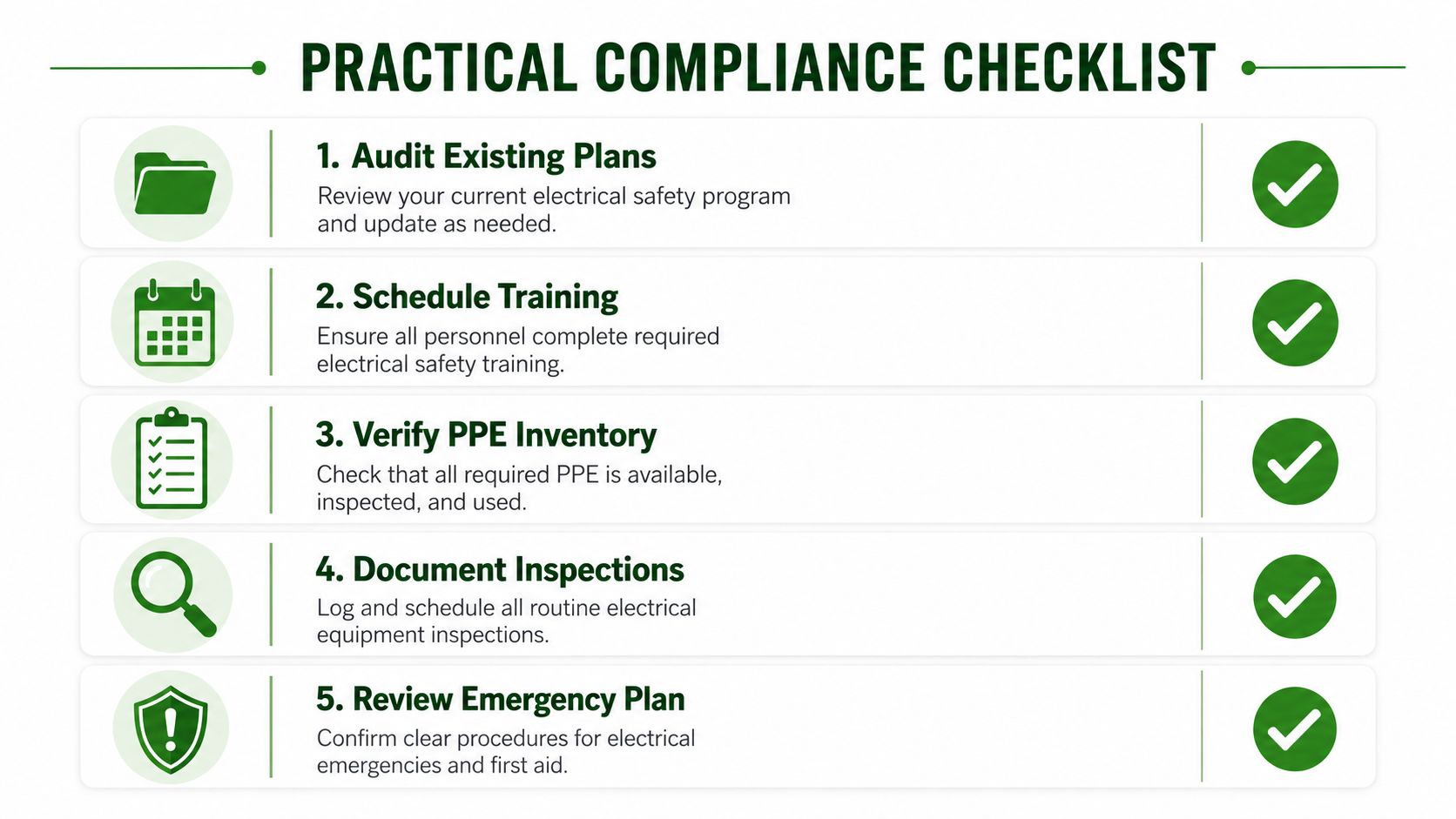
Start with the physical condition
- Panel access: Keep required working spaces clear, prevent storage in electrical rooms, and confirm that doors, dead fronts, and covers are intact.
- Identification: Match panel schedules, disconnect labels, circuit directories, and equipment markings to the actual installation.
- Visible defects: Remove damaged cords, cracked enclosures, missing blanks, exposed parts, and equipment with signs of overheating from service until evaluated.
- Access equipment: Verify that ladders, lifts, platforms, barricades, and fall-protection systems are suitable for the task.
Audit the written program
Your electrical safety program should explain who may perform each task, how the property controls hazardous energy, what PPE is required, and how energized work is authorized. Compare the procedure with the equipment in the building. A generic LOTO form won't cover a generator, battery backup, automatic transfer equipment, or a control-system backfeed unless those sources appear in the isolation steps.
Review training records alongside job assignments. If a technician is expected to troubleshoot switchgear but the file contains only general orientation, the qualification claim is weak. The same review should cover outside contractors, their scope, access plan, and evidence of required training.
Schedule verification and closeout
Document routine inspections, emergency lighting and exit-sign testing, infrared surveys, repairs, and reinspection after corrective work. Access Electrical and Lighting describes a commercial electrical safety inspection as a structured evaluation of safety, code compliance, and operating reliability, which is the right mindset for a property-wide review.
For larger portfolios, use a corrective-action register with the location, hazard, temporary control, assigned party, target completion, and closure evidence. Contractor closeout should include revised drawings, equipment information, test results, labels, and photographs where they help establish conformity. This process supports inspections while also giving the maintenance team reliable information for the next service call.
California Requirements and NFPA 70E Updates
California properties operate under Cal/OSHA, so a federal OSHA baseline may not be the end of the compliance review. The practical differences often appear in how employers document training, evaluate arc-flash and shock hazards, establish approach controls, and demonstrate that procedures match the work being performed. Property teams should confirm the requirements that apply to their location, workforce, and project type before approving electrical work.
NFPA 70E remains useful as a consensus framework for hazard assessment, de-energization decisions, approach boundaries, PPE, and energized-work planning. It doesn't replace Cal/OSHA requirements, and a training certificate alone doesn't establish that a worker is qualified for a particular piece of equipment. The program still needs equipment-specific procedures, field verification, and records that explain the employer's decisions. (NFPA 70E relationship to OSHA)
Coordinate electrical work with California energy compliance
Lighting controls, LED retrofits, emergency lighting, and tenant improvements may also involve California energy-code documentation. For Southern California properties, Title 24 testing, certification, and closeout records should be coordinated with electrical safety documentation so that the final file reflects both how the system performs and how workers will maintain it.
Review the applicable California electrical code requirements before work begins, particularly when a retrofit changes distribution, controls, equipment access, or labeling. A coordinated review reduces the chance that an energy upgrade leaves behind incomplete as-built information or an unsafe maintenance condition.
Federal OSHA rules establish the enforceable foundation. Cal/OSHA, local requirements, manufacturer instructions, and NFPA 70E add the practical detail that commercial property teams need to manage real work safely.
Access Electrical and Lighting provides commercial electrical and lighting installation, maintenance, testing, infrared inspections, emergency-lighting service, panel and switchgear work, EV charging installation, and high-reach access for fixtures at height across Southern California. If your property needs a documented electrical safety review or corrective work plan, visit Access Electrical and Lighting to request service.