If you manage an office building, retail center, or multifamily property, you've probably seen the symptoms before you ever heard the term. A row of parking lot fixtures looks weaker at the far end. A tenant complains that lights dip when rooftop equipment starts. An exit sign stays on, but it looks tired. A motor still runs, but it runs hotter than it should and fails earlier than expected.
Those problems often get blamed on bad fixtures, old breakers, or “just a heavy load.” Sometimes that's true. But in commercial properties, one of the most common underlying causes is simpler and more stubborn: voltage drop.
When people ask me to define voltage drop, I don't start with theory. I start with consequences. In a California property, voltage drop affects lighting quality, equipment life, troubleshooting time, compliance, and operating cost. It also causes a lot of wasted service calls because the issue hides until the system is working hard.
The Hidden Culprit Behind Flickering Lights and High Energy Bills
A California facility manager usually hears about voltage drop before anyone names it. The call comes in as a lighting problem in the back half of a retail center. A leasing office reports corridor lights dipping when a large exhaust fan starts. A multifamily maintenance team keeps replacing LED drivers in one area, and the new parts do not solve the complaint.
In the field, that pattern points to the supply side. The equipment is getting power, but it is not getting enough of the right voltage once the circuit is working under real load. Some of that pressure is being lost on the way from the source to the fixture, motor, or control device.
That is voltage drop in practical terms.
For commercial properties, the issue shows up where runs are long, loads change over time, and original designs get stretched by tenant improvements, EV charging, added HVAC, or lighting retrofits. Office buildings, retail centers, and multifamily sites in California deal with this all the time because the electrical system rarely stays exactly as it was on day one.
Why commercial properties see it so often
Commercial buildings create the conditions that make voltage drop hard to ignore:
- Long conductor runs: Parking lot lighting, detached structures, monument signs, garage ventilation, and remote suites all add distance.
- Load swings: Motors, compressors, kitchen equipment, elevators, and house loads do not draw evenly all day.
- Aging connections: Loose or deteriorated terminations add resistance and create localized trouble.
- Incremental remodels: Circuits that were acceptable years ago can become marginal after several rounds of tenant work.
I see one mistake repeatedly. People check voltage with little or no load on the circuit, find something close to normal, and move on. That misses the actual problem. Voltage drop has to be checked while the equipment is operating, because that is when the weakness shows itself.
That matters in California properties for more than comfort. Poor delivered voltage can affect life safety lighting, equipment reliability, tenant satisfaction, and energy performance. It can also complicate Title 24 related upgrades, because efficient lighting and controls still need solid power at the load to perform the way the design intended.
What Is Voltage Drop in Simple Terms
When I explain voltage drop to a facility manager, I start with what they observe on site. The panel shows normal voltage. The equipment at the far end still struggles. That gap between source voltage and delivered voltage is voltage drop.
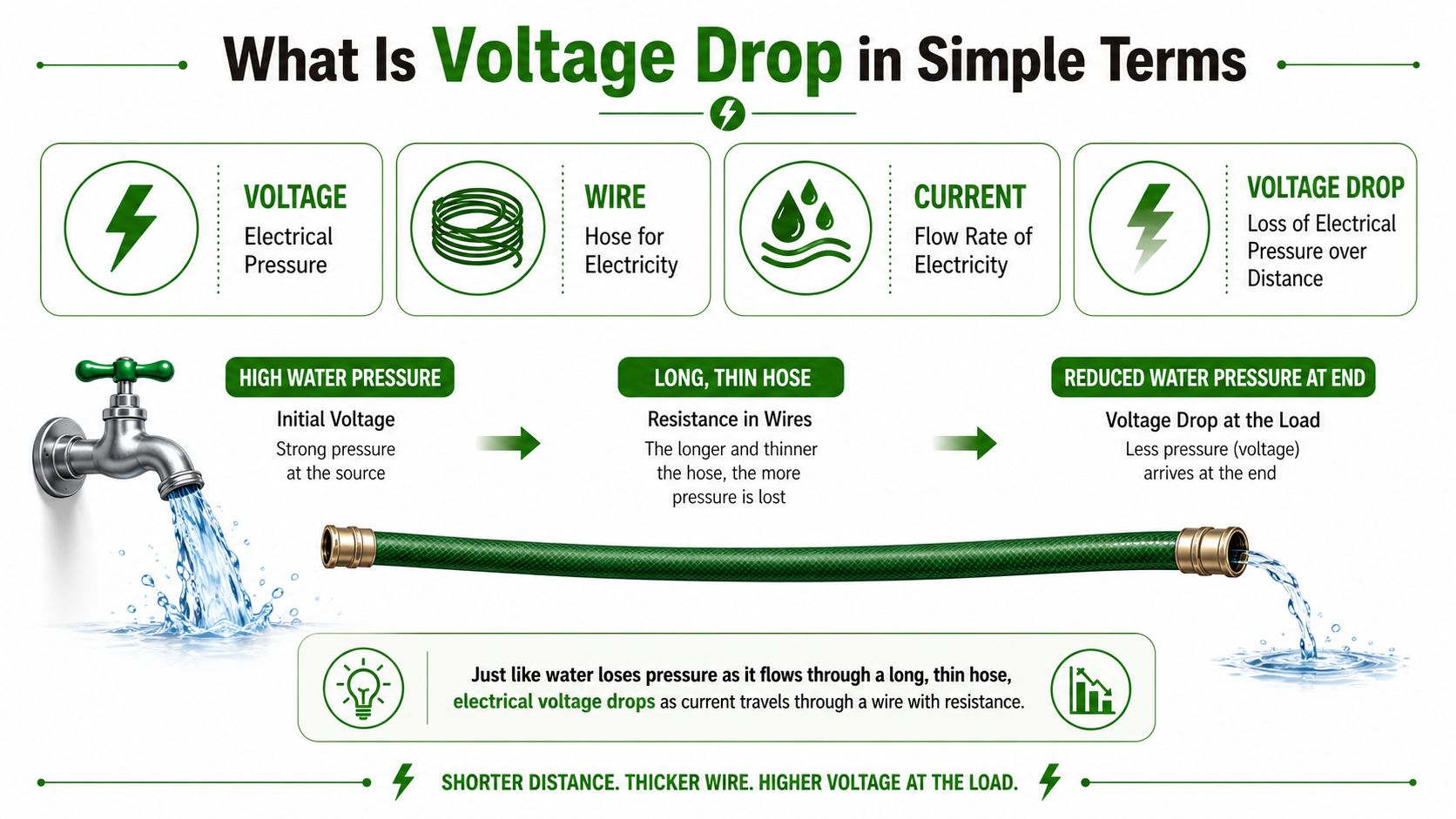
In simple terms, voltage drop is the reduction in voltage that happens as electricity travels through wire, terminations, and equipment connections before it reaches the load. The farther the run, the higher the current, or the poorer the connection, the more voltage is lost along the path.
The basic idea behind the loss
Electricity does not move through a perfect path. Conductors have resistance, and AC systems also involve impedance. Every foot of wire and every connection adds a little opposition to current flow. Under load, that opposition turns into lost voltage before power gets to the light fixture, motor, receptacle, or control panel that needs it.
A simple example helps. If a circuit starts at 120 volts and enough voltage is lost in the run, the equipment may only receive 114 volts or something close to that range. The circuit is still energized, but the load is no longer getting what the design intended.
That is why voltage drop has to be checked under load to mean anything. A no-load reading at the panel can look fine while a rooftop unit, corridor lighting circuit, or garage exhaust fan is starved once it starts drawing real current.
The formulas behind it
For a simple DC circuit, the voltage drop formula is:
- ΔU = I × R
That means voltage drop equals current times resistance.
In AC systems, the idea expands because impedance matters too:
- V = I × Z
For exact AC analysis, voltage drop also depends on resistance, reactance, and power factor. For a property manager, the working rule is simpler. Longer runs, smaller conductors, heavier loads, and poor terminations all increase the loss.
Practical rule: If the equipment is far from the source, the wire is marginal for the load, or the connections are deteriorated, expect lower voltage at the equipment than at the panel.
Why this matters more in commercial settings
Commercial properties feel voltage drop faster than a small residential job because the electrical system is larger, the runs are longer, and the loads are less forgiving. Office buildings have long lighting and receptacle circuits. Retail centers push power out to signage, tenant spaces, and parking lot lighting. Multifamily properties often combine house loads, garage systems, elevator equipment, and long feeder runs in the same service.
In California, this matters during upgrades as much as during troubleshooting. Title 24 lighting and control projects can improve efficiency, but the new equipment still needs proper delivered voltage to operate correctly. If the circuit looks acceptable on paper but sags under load, the result can be nuisance issues, poor equipment performance, and callbacks that eat into maintenance budgets.
So in plain English, voltage drop is the loss of usable voltage between the source and the equipment. In commercial buildings, that loss shows up where owners care about it most: lighting quality, motor life, tenant comfort, and operating cost.
Common Causes of Voltage Drop in Commercial Buildings
In commercial work, voltage drop usually comes from a handful of repeat offenders. The physics is simple. The diagnosis isn't always simple because multiple small problems can stack together.
Long conductor runs
The most common cause is distance. Voltage drop increases as cable runs get longer, especially in large sites with parking lot lighting, detached structures, long tenant bays, or extended corridor circuits. The relationship is straightforward: voltage drop becomes more pronounced with longer cable runs and smaller wire gauges because resistance rises with length and falls with conductor size.
That's why the farthest pole lights in a retail center often tell the story first. They're at the end of the run, so they get whatever voltage remains after the trip.
Conductors that are too small
Undersized wire is a design problem that turns into a maintenance problem. Someone may have picked a conductor size that technically carried the load, but didn't leave enough margin for distance or future additions. Years later, the property adds new lighting, signage, controls, or charging equipment, and the weak point shows up.
Common symptoms include:
- Uneven lighting: The fixtures operate, but brightness falls off with distance.
- Motor complaints: Fan motors, pumps, and similar equipment start hard or run hotter.
- Sensitive electronics: Controls and drivers may behave erratically when supply voltage sags.
Loose, damaged, or corroded connections
A perfect conductor path on paper can still perform badly in the field if terminations are compromised. Loose lugs, worn contacts, poor splices, and corrosion all add resistance.
This is one reason voltage drop can be so frustrating to track down. The wire size may look acceptable, but a single bad connection in a panel, handhole, pole base, disconnect, or junction box can create a measurable problem under operating conditions.
A bad connection acts like a pinch in the hose. Power still gets through, just not cleanly or efficiently.
Load changes after the original installation
Commercial properties evolve. Suites get remodeled. Lighting gets changed. Equipment gets added. Common-area loads increase. A circuit that was acceptable years ago may not be acceptable after repeated changes.
That shows up often in:
- Retail centers: New tenant equipment on existing infrastructure
- Office buildings: Added workstations, lighting controls, and remodel loads
- Multifamily properties: Gate systems, laundry equipment, garage ventilation, and amenity upgrades
Poor load distribution
Sometimes the issue isn't one bad run. It's an overloaded panel section or an imbalanced distribution setup. One part of the building carries more than it should while another part has capacity. The result is avoidable stress on selected circuits.
Facility managers don't need to calculate every conductor by hand, but they should know what to look for. If the same branch of the property has recurring low-performance symptoms, the cause is often upstream in length, wire size, connections, or accumulated load.
The Real-World Costs of Ignoring Voltage Drop
A property can have power everywhere and still have an electrical problem that wastes money every month. In office buildings, retail centers, and multifamily sites, voltage drop often shows up as “annoying but tolerable” symptoms first. Lights flicker at the far end of a corridor. A gate operator hesitates. HVAC controls act erratically on hot afternoons. Staff replaces parts, tenants complain, and the root cause stays in the wiring.
That is why voltage drop gets expensive before anything fully quits.
Equipment stress, callbacks, and operating waste
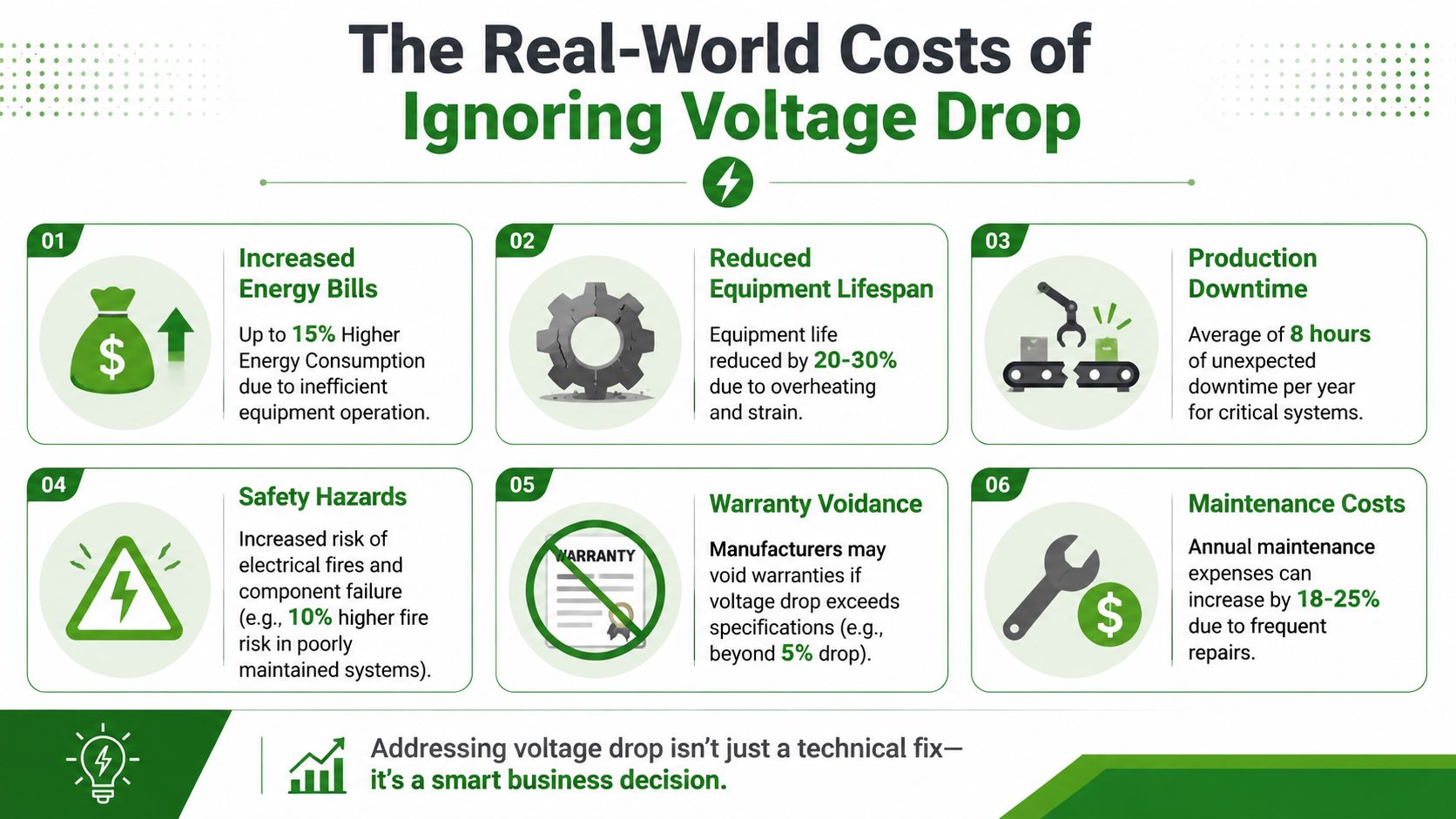
Equipment that receives low voltage does not perform the way it was designed to. Motors draw harder and run hotter. LED drivers and control components can behave inconsistently. Electronic systems may reset, dim unevenly, or fail early. For a facility manager, that usually means service calls, replacement parts, and labor spent chasing symptoms instead of fixing the circuit.
Some of that loss turns into heat in the conductors and terminations. Some shows up as poor equipment performance. Either way, the building pays for power that is not doing useful work. In larger commercial properties, that wasted energy can hide inside a broad utility bill and look like a general efficiency problem rather than a circuit problem.
California compliance risk is part of the cost
In California, the issue is not limited to maintenance. Poor electrical performance can affect lighting and control systems that need to meet project requirements, owner expectations, and inspection standards. On commercial remodels and tenant improvements, that matters. A system that technically energizes but does not perform properly under load can create rework, failed inspections, and documentation problems after the job should be closed out.
Title 24 raises the stakes for office, retail, and multifamily properties because lighting and controls are expected to operate as intended. If voltage drop interferes with that performance, the correction cost usually lands later, after ceilings are closed, tenants are in place, and access is harder.
Why the wrong troubleshooting sequence costs so much
I see the same pattern on commercial service calls. The fixture gets replaced first. Then the driver. Then someone suspects the breaker. Then another vendor gets pulled in. Only after that does somebody test voltage at the load while the equipment is operating.
That last part matters. Voltage drop has to be checked under load to mean anything. A circuit can look acceptable with little or no load on it, then fall out of range once the lights, motors, or controls are working. If the test is done at the panel only, or with the equipment off, the reading can miss the problem entirely.
The cheaper fix is often straightforward. Tighten or remake a bad termination. Correct a poor splice. Rebalance the load. In other cases, the fix is capital work, such as conductor upsizing or rerouting a long run. Property teams already planning energy-efficiency electrical upgrades for commercial properties can often address both reliability and operating cost at the same time.
The expensive part is not usually the repair. It is the delay, the repeat labor, and the months of reduced performance before someone tests the circuit the right way.
Calculating Voltage Drop and Understanding Code Limits
On a commercial project, the math matters because the fix gets expensive fast once walls are closed, tenants are open, and the complaint is tied to the far end of the building. A facility manager does not need to size every conductor by hand, but you do need to know what “acceptable” looks like so you can ask the right questions before a dim lighting circuit or underperforming rooftop unit turns into a change order.
The code benchmarks to know
The National Electrical Code treats voltage drop as a design recommendation rather than a pass-fail rule in most cases, but good contractors still use it as a working limit. The usual benchmark is 3% on a feeder, 3% on a branch circuit, and 5% total for both combined.
| Circuit Type | NEC Recommended Max Voltage Drop |
|---|---|
| Feeder | 3% |
| Branch circuit | 3% |
| Feeder plus branch circuit combined | 5% |
A feeder carries power from service equipment or a main distribution point to downstream panels or equipment. A branch circuit is the final leg serving the actual load, such as tenant lighting, receptacles, signage, HVAC controls, garage lighting, or house loads in a multifamily building.
That split matters in commercial properties. If the feeder uses up too much of the allowable drop, the branch circuit has very little room left. The result shows up at the farthest or heaviest load first.
What drives voltage drop
Voltage drop rises with distance and current. It also gets worse when conductor size is too small, connections add resistance, or the circuit has AC characteristics that increase impedance.
For property teams, these are the inputs that usually matter most:
- Run length
- Load current
- Conductor size and material
- Single-phase or three-phase system
- Connection quality at lugs, splices, and terminations
The simple version is easy to remember. Longer run, higher load, smaller wire, more drop.
A practical example from commercial work
Take an office or retail center with a long exterior lighting run to parking lot poles. The fixtures near the panel look normal. The fixtures at the end of the run look weak, cycle drivers early, or fail sooner than expected. In many cases, the problem is not the fixture package. It is the voltage arriving at the last pole after the feeder and branch circuit losses are added together.
The same issue shows up in multifamily properties. A house panel may be fine at the source, but corridor lighting, gate operators, laundry equipment, or detached garage loads can see poor performance if the circuit length and load were not handled properly in design or during later tenant improvements.
Engineers use formulas that account for resistance, impedance, and power factor, especially on AC systems with motor loads. Facility managers do not need to run that calculation in the field. You do need to know that voltage drop is not just a wire-length issue. Real load and connection condition matter too.
California projects need a tighter conversation
In California, voltage drop is tied to more than comfort and maintenance. It can affect whether lighting systems, controls, and connected equipment perform as intended under Title 24-driven designs. Office, retail, and multifamily projects often have sensors, drivers, control devices, and efficiency targets that depend on proper operating voltage at the actual load, not just at the panel.
That is why I tell property teams to ask three direct questions during design review, troubleshooting, or turnover. What is the voltage at the farthest load? What is it under normal operating load? Does the combined feeder and branch circuit stay within the recommended limit?
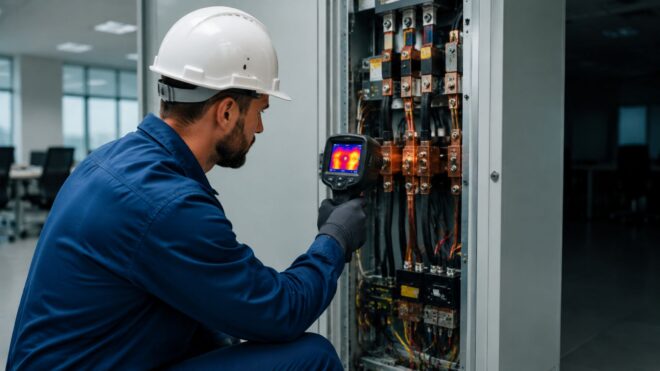
If there is any doubt about hot spots or failing terminations, pair the voltage-drop evaluation with infrared electrical testing for commercial panels and connections. Bad connections often add resistance, and resistance creates both heat and voltage loss.
A clean submittal and a good panel reading do not prove the circuit performs properly in the field. In commercial buildings, the useful answer is the loaded answer.
How Professionals Test for and Mitigate Voltage Drop
Most beginner explanations miss the most important part. A voltage drop test is only meaningful when the circuit is doing work.
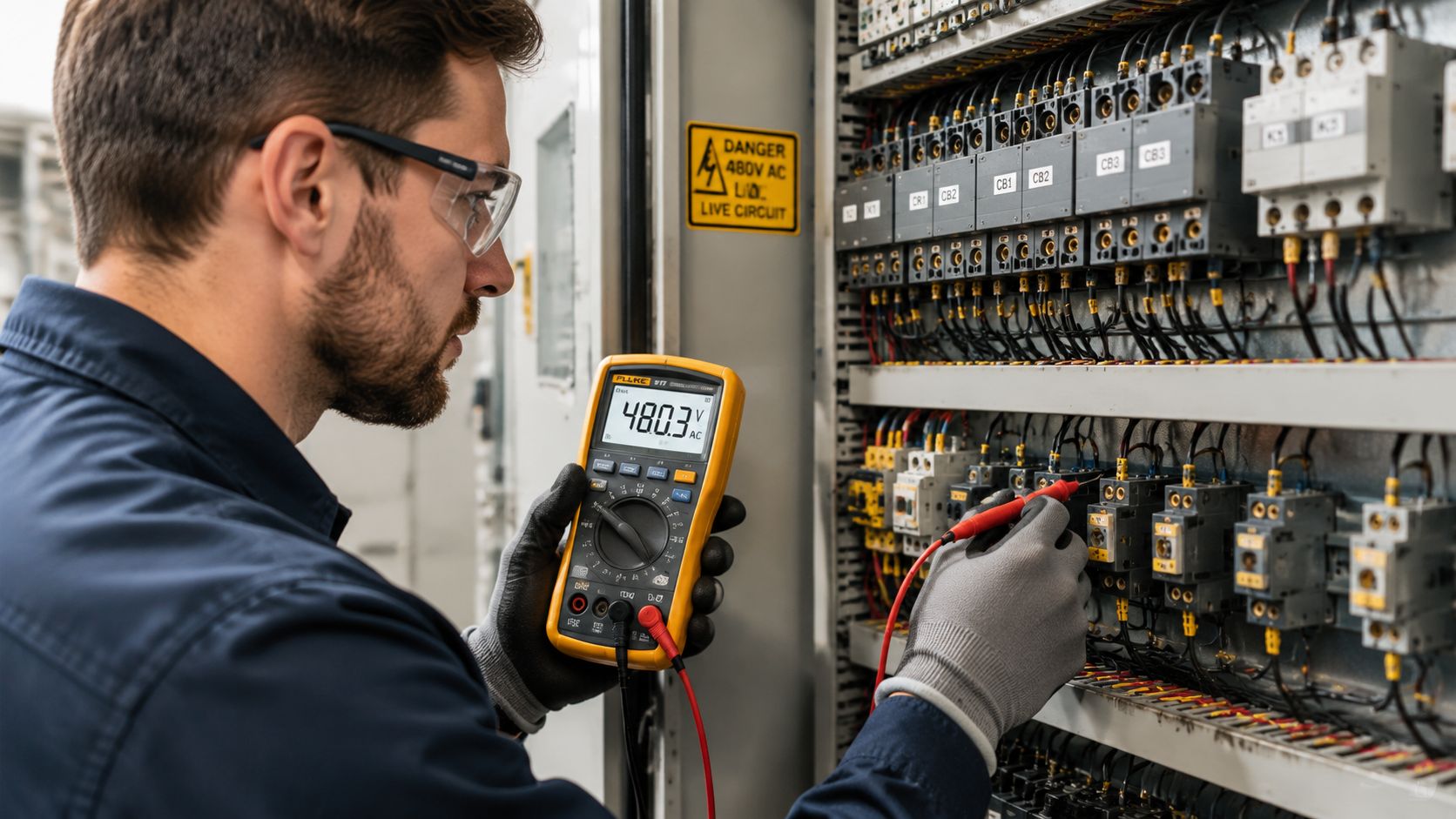
Test it under load or don't trust the result
A circuit can look fine with no meaningful demand on it. Then the lights come on, the motor starts, or the equipment ramps up, and the problem appears. That's why voltage drop tests must be performed while the circuit is under load, because otherwise the results won't show how the system performs during actual use.
A common pitfall in DIY troubleshooting occurs when someone checks voltage with little or no load, sees something close to normal, and assumes the circuit is healthy. The complaint then returns because the underlying problem only shows itself under operating conditions.
What a proper field test looks like
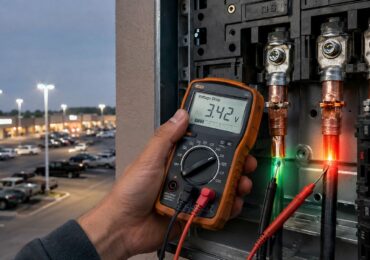
A qualified electrician typically uses a digital multimeter to compare voltage at the source and at the load. The goal is to identify how much voltage is lost along the path, then isolate where that loss is happening.
The process usually includes:
- Establishing a source reading: Measure voltage at the feed point.
- Measuring at the load: Check what the actual equipment receives while operating.
- Comparing the difference: The gap shows the drop.
- Narrowing the fault location: Test across segments, terminations, and devices to find where resistance is being added.
In real commercial troubleshooting, this often happens while lights are energized, motors are running, or the affected circuit is carrying normal demand.
What professionals look for beyond the meter
Meters tell you the symptom. A thorough inspection finds the cause.
That may include:
- Loose lugs in panels or disconnects
- Failing splices in pull boxes or pole bases
- Corroded terminations
- Undersized conductors for the present load
- Runs that are too long for the application
- Load distribution issues across panels
Infrared thermography is especially useful here because high-resistance connections often generate heat before they fail completely. An electrician can scan energized equipment and spot abnormal hotspots without taking the system apart first. For many commercial facilities, infrared electrical testing is one of the best preventive tools for catching voltage-drop-related trouble early.
A meter tells you there's a loss. Heat often tells you where the loss is happening.
The fixes that usually work
The correction depends on the cause, but the common remedies are practical:
- Tighten or remake bad terminations if a connection is adding resistance.
- Repair corroded or damaged splices that are restricting current flow.
- Upsize the conductor when the existing wire is too small for the load and distance.
- Shorten the run if redesign makes that possible.
- Rebalance loads across distribution equipment so one section isn't carrying unnecessary stress.
- Review additions to the system after tenant improvements or equipment upgrades.
What doesn't work is replacing end devices over and over without verifying circuit performance under normal operating conditions.
When to Contact a Qualified Electrical Contractor
Call a qualified electrical contractor when the building shows repeat symptoms that don't stay fixed. In commercial properties, that usually means dim or uneven lighting, motors that run hot, nuisance breaker activity, weak equipment performance, or the same area generating maintenance calls again and again.
It's also time to bring in a pro when a property has had major load changes, tenant improvements, EV charging additions, recurring lighting complaints in remote areas, or compliance concerns tied to lighting controls, emergency systems, or Title 24 documentation. Voltage drop isn't a safe DIY problem in a live commercial electrical system.
The right contractor should be able to test under load, trace the loss through the distribution path, inspect terminations, and recommend a correction that addresses the cause instead of the symptom. For ongoing building reliability, it also helps to work with a team experienced in commercial electrical repairs and troubleshooting.
Access Electrical and Lighting helps commercial, retail, office, and multifamily properties across Southern California diagnose and correct electrical problems that waste energy, shorten equipment life, and create compliance risk. If your building has flickering lights, recurring failures, weak site lighting, or suspected voltage drop issues, contact Access Electrical and Lighting for professional troubleshooting, testing, and repair.