You're probably dealing with this already. A tenant asks for charging at an office property. A resident wants a reserved EV space in a multifamily garage. A retail client wants to know whether chargers will bring in drivers who stay long enough to spend money on site.
At that point, EV charging stops being a future conversation and becomes a facilities problem. It affects parking layout, service capacity, permitting, accessibility, utility coordination, and long-term maintenance. On commercial properties in Southern California, those issues get more complicated fast because older panels, tight parking fields, Title 24 requirements, and city review comments can all push a simple idea into an expensive project if the early planning is weak.
The Inevitable Question EV Charging Is Here to Stay
Property managers usually reach the same point in different ways. At an office building, it starts with employee demand. At a multifamily property, it comes from residents comparing your building to the one down the street. At a shopping center, ownership starts asking whether charging should be part of the tenant mix and customer experience.
That pressure isn't temporary. The charging market has moved well past pilot-project territory. The global stock of public EV charging points reached 2.7 million in 2022, with over 900,000 installed that year alone, a 55% increase from 2021, according to the IEA's charging infrastructure data.
For property owners, that matters for a simple reason. Charging is becoming part of the base electrical infrastructure discussion, the same way lighting upgrades, panel capacity, and distribution planning already are. If a site can't support tenant demand, the problem doesn't stay theoretical for long. It shows up in lease conversations, resident retention, parking disputes, and delayed capital planning.
Practical rule: Treat EV charging like a phased infrastructure upgrade, not a one-off amenity purchase.
In Southern California, that shift is especially clear because so many properties are already balancing service limitations with modernization work. A site that barely has room in the switchgear for current tenant loads usually isn't ready to absorb chargers without planning. A garage with awkward stall widths and old conduit pathways can become a permitting headache if someone tries to force the installation into the wrong area.
The better approach is to tie EV planning to your broader electrical roadmap. That means looking at expansion capacity, not just immediate charger count. If your property team is already thinking about lighting controls, tenant improvements, or service upgrades, EV work should be folded into that conversation early. That's the same logic behind broader commercial electrical infrastructure planning for growth.
What property managers get wrong early
The most common mistake is starting with hardware selection. The charger brand and the pedestal style matter, but not first.
Start with the site. Start with the utility service. Start with parking circulation. Start with who will use the chargers and how long they'll typically stay.
A workplace property with long dwell times has a different charging profile than a retail pad with fast customer turnover. A multifamily podium garage has different accessibility and routing constraints than an open surface lot. When those differences are ignored, projects either get overbuilt and overpriced or underbuilt and frustrating to use.
What usually works
The sites that go smoothly tend to have three things in place before design gets too far:
- A clear user case: Resident charging, employee charging, customer charging, or fleet charging.
- A realistic electrical picture: Actual field verification of available capacity, not assumptions from old one-lines.
- A phased buildout plan: Install for current demand, but leave a clean path for future expansion.
That's the foundation of successful EV charging points installation. Everything else comes after.
Start with Your Power Site Assessment and Electrical Capacity
A Southern California property manager approves six chargers for an existing garage, expecting a straightforward retrofit. Then the field verification starts. The panel schedule is outdated, the transformer is already carrying more than expected, conduit routing is tighter than the plans suggested, and ADA stall impacts were never mapped. That is how a simple EV project turns into a service upgrade, a redraw, and a delayed permit.
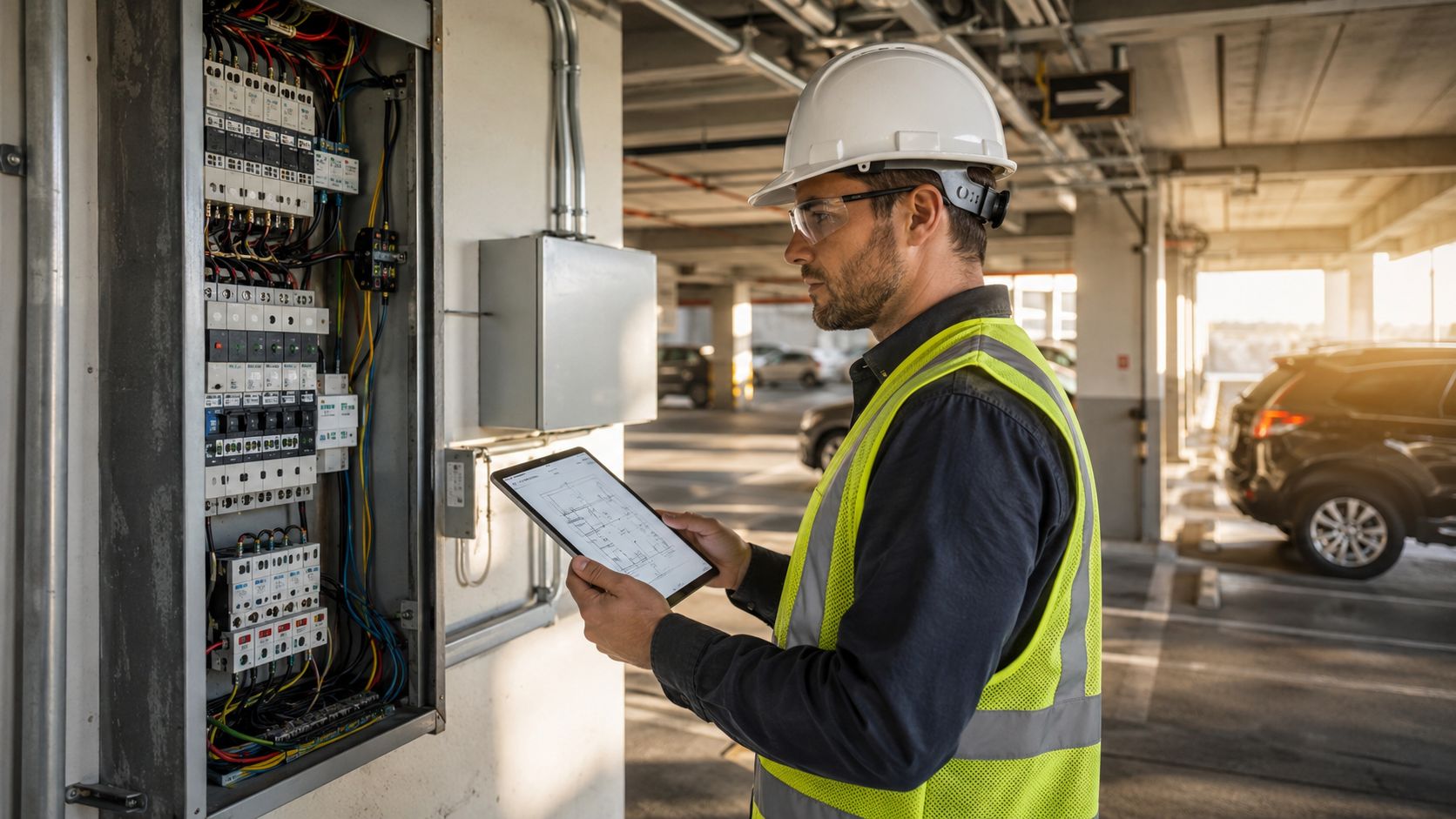
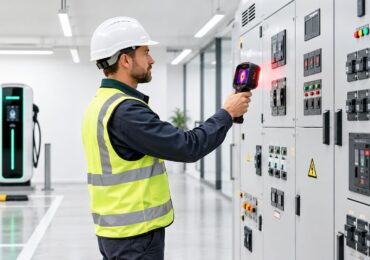
At Access Electrical and Lighting, we start commercial EV charging points installation with field verification of the electrical system and the parking area together. On paper, a site can look ready. In the field, we often find limited spare capacity, older gear with no room for additional breakers, or parking layouts that create ADA and circulation problems once charger locations are marked out. In Southern California, those issues also tie directly into Title 24 documentation, local utility coordination, and the permit review process.
A real assessment checks the parking layout and the electrical backbone at the same time.
From the site side, the contractor should confirm:
- Stall placement: Charger locations should reduce trenching, long conduit runs, and avoidable core drilling.
- Parking circulation: Drivers need enough room to pull in, connect, and back out without creating conflict points near entries, ramps, or loading areas.
- Accessibility impacts: Existing accessible stalls, access aisles, path of travel, and reach ranges have to be reviewed before striping and equipment locations are set.
- Physical constraints: Columns, curbs, bollards, slab conditions, drainage, ceiling height, and fire-rated walls all affect constructability.
From the electrical side, the review should verify:
- Service equipment in the field: Main switchboards, panels, feeders, and transformers need to be inspected, not assumed from old drawings.
- Actual available capacity: Load calculations should reflect real building use and any known tenant or house load changes.
- Feeder and conduit paths: Existing raceways, overhead routes, garage access, and trench options drive labor cost and outage planning.
- Upgrade triggers: Some sites can add chargers with load management. Others need new distribution equipment, a transformer change, or utility service work.
If the gear has not been opened, the one-lines have not been checked against field conditions, and the proposed EV load has not been compared to the building's actual demand, the budget is still a placeholder.
That step matters more in older retail centers and multifamily properties than many owners expect. We regularly see garages where spare breaker space exists, but upstream capacity does not. We also see the opposite. A service may have usable capacity, but the distribution section closest to the parking area is full, obsolete, or in poor condition. Those are different problems with different price tags.
Property managers can speed up the first design meeting by bringing a few decisions to the table early:
- Primary user group: Residents, employees, customers, fleet drivers, or a mix.
- Typical parking duration: That affects load assumptions and how aggressively power needs to be distributed across stalls.
- Future expansion areas: Phase one should not block the conduit path or panel strategy for phase two.
- Other scheduled work: Paving, lighting upgrades, tenant improvements, reroofing, and waterproofing can either help or disrupt the EV schedule.
Ask one plain question early. Where does the charger load land upstream, and what has to change to support it? If the answer involves feeder upsizing, transformer replacement, or utility coordination with Southern California Edison or the local utility serving the site, that should be known before equipment is ordered. For teams reviewing upstream impacts, this overview of transformer sizing for commercial properties helps frame the discussion.
Code changes the math, too. EV charging is treated as a continuous load, so breaker and conductor sizing often grow faster than owners expect. Failing to verify main fuse sizes and failing to size overcurrent protection for 125 percent of the EVSE rated load are common reasons projects stall during review or require redesign, as noted in this commercial EV charging installation guide.
On Southern California projects, the best early assessment also asks a practical question that gets missed all the time. Can this property support the first phase without making the second phase expensive? Good planning leaves room in the electrical room, preserves routing paths, and sets equipment in locations that do not create ADA conflicts later. That is how you avoid paying twice for the same work.
Choosing Your Hardware Level 2 vs DC Fast Charging
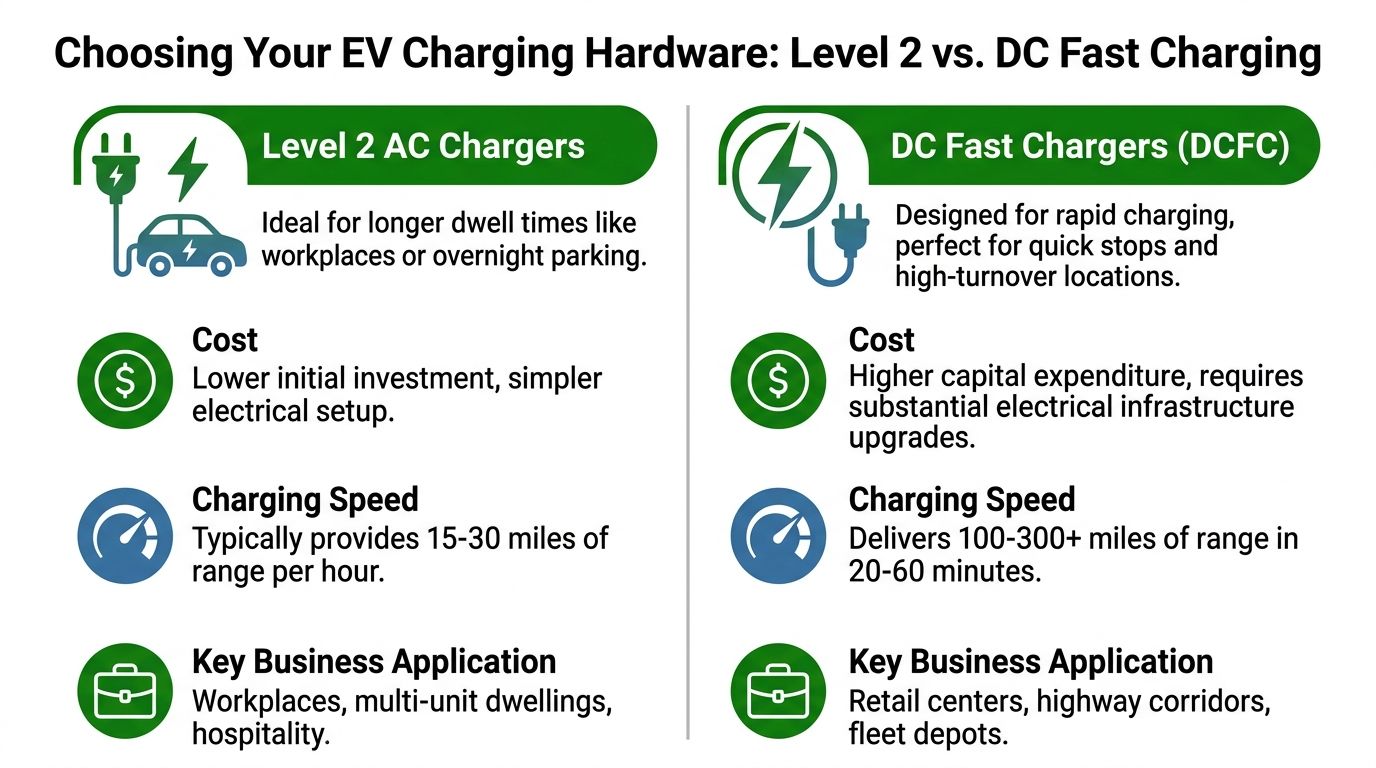
Most commercial properties in Southern California shouldn't start this decision by asking which charger is faster. They should ask what the parking behavior looks like. The right hardware is the one that fits how long cars stay on site, what the property wants the charging experience to accomplish, and what the electrical system can support without causing a chain reaction of upgrades.
The practical difference on commercial sites
Here's the short version.
| Charger type | Best fit | What usually makes sense |
|---|---|---|
| Level 2 AC | Multifamily, workplace, hospitality | Cars are parked for longer periods, so charging can happen steadily without extreme electrical demand |
| DC Fast Charging | Retail, corridor-style stops, fleet operations | Drivers need a quicker turnaround and the site is built to support heavier infrastructure |
Level 2 is usually the better fit for apartment communities, office buildings, and hotels because the dwell time is long enough that drivers don't need a rapid charge event. In those environments, the goal is dependable access over hours, not the fastest possible session.
DC fast charging makes more sense where turnover matters. A retail center trying to serve short-stay visitors may want that faster experience. The trade-off is that the infrastructure gets more demanding, utility coordination gets more serious, and the project cost and design complexity usually go up with it.
What works by property type
For multifamily, Level 2 is usually the most practical starting point. Residents park overnight or for extended periods, and the installation can be built around predictable usage patterns. Shared charging with access control often works better than trying to assign every resident a dedicated charger on day one.
For office and workplace sites, Level 2 also tends to be the right answer. Employees stay for much of the day. The focus should be on fair access, usage policies, and power management rather than maximum charging speed.
For retail, the answer depends on tenant mix and stop duration. Grocery-anchored centers, entertainment sites, and quick-service environments can have very different patterns. Some benefit from Level 2 as an added amenity. Others may justify faster charging if the site layout and utility service can support it.
Faster hardware isn't automatically better. If the customer's car is parked for hours anyway, paying for heavy infrastructure can solve the wrong problem.
What property owners often miss
There's a business side and an operations side to this decision.
On the business side, owners should think about whether the chargers are there to support tenant retention, attract visitors, serve a fleet, or provide a paid public service. On the operations side, they need to ask who manages access, billing, uptime alerts, and user support.
That's why networked Level 2 systems are often the strongest starting point for commercial EV charging points installation. They're easier to fit into existing properties, easier to scale in phases, and usually better aligned with how multifamily and office users charge.
Planning for Success Layout Accessibility and Power Management
A property manager signs off on four new chargers in a parking garage. The electrical plan pencils out. Then accessibility review starts, the accessible route conflicts with a column line, one stall loses proper clearance, and the cable reach only works if drivers park perfectly. That is how a straightforward EV project turns into redesign, re-striping, and change orders.
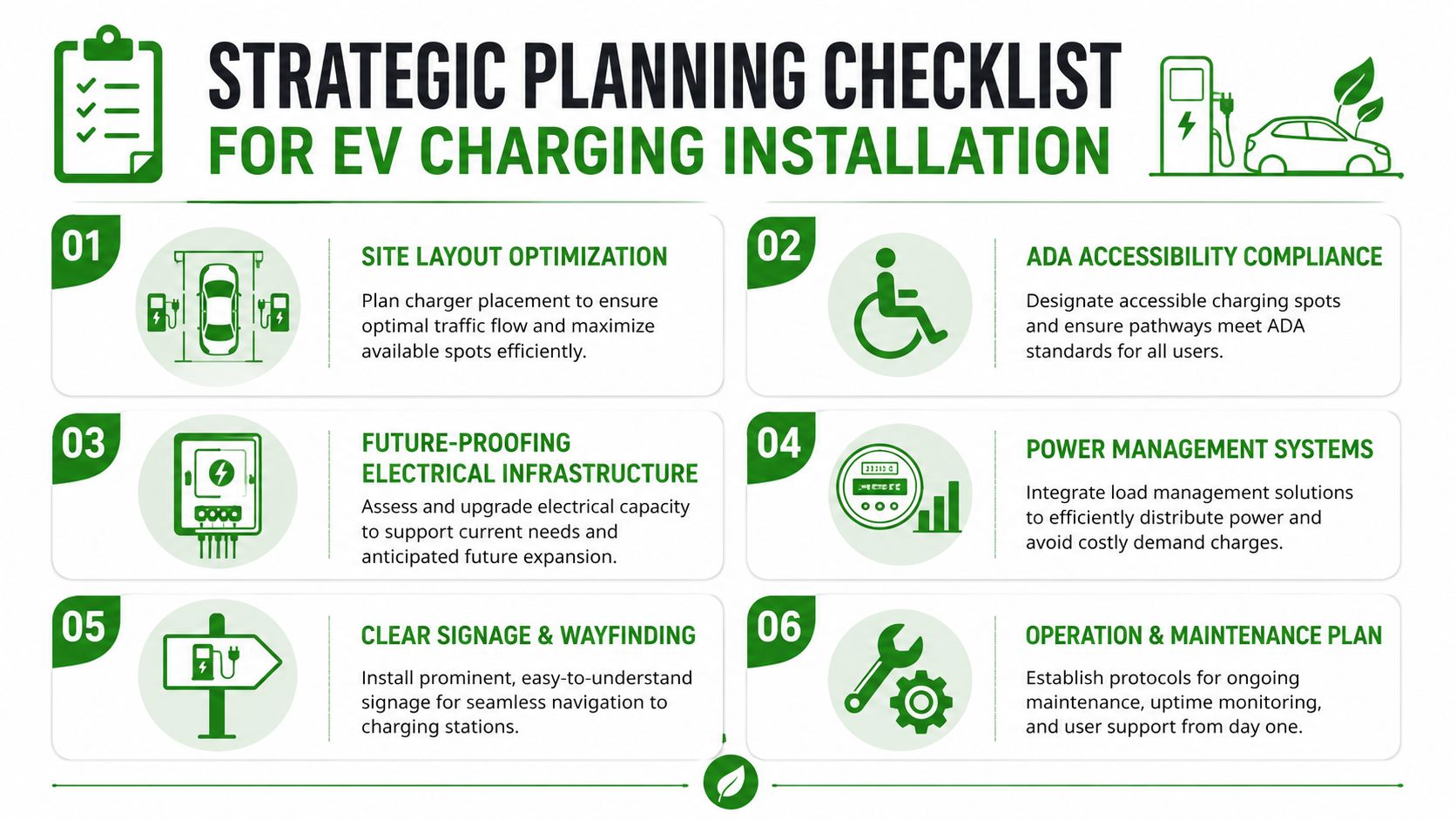
We see this often on Southern California retrofit work. Older multifamily garages, mixed-use podium parking, and retail lots were not built with EV equipment, ADA access routes, or future conduit paths in mind. Columns land in the wrong place. Stall widths are tight. Existing striping and curb details limit where equipment can go. A charger location that looks fine on a simple site sketch can fail once accessibility, circulation, protection, and service access are reviewed together.
Accessibility details that can't be treated as afterthoughts
Mounting height, reach range, clear floor space, path of travel, and usable access to the connector all need to work in the field, not just on paper. Inspectors and plan reviewers in Southern California jurisdictions look closely at these points, especially in existing parking structures where ADA upgrades interact with older conditions.
A few inches matter.
Pedestal height affects who can use the equipment comfortably. Bollard spacing can block access if it is too tight. Wheel stops placed without thinking through cable handling can create a real usability problem. We have also seen projects lose time because the charger was technically installed, but signage, striping, or the route from the accessible stall to the equipment did not pass review.
For existing garages, the practical question is simple. Can a driver pull in, reach the charger, handle the connector, and move through the area safely without fighting the site? If the answer depends on perfect parking or awkward body positioning, the layout needs work before installation starts.
Layout choices that usually save money later
The best layouts solve several field problems at once:
- Keep conduit runs efficient. Shorter routes usually mean less sawcutting, patching, and disruption to active parking areas.
- Protect equipment from real vehicle movement. Bollards and pedestal placement should reflect how people typically turn into stalls, not how they are supposed to.
- Maintain circulation. Chargers near ramps, fire lanes, loading areas, and drive aisles can create headaches fast if turning movements were not reviewed early.
- Leave room to grow. Even a small phase-one installation should reserve wall space, panel capacity, and pathways for additional EVSE later.
Retail and multifamily properties usually need different layout logic. At retail sites, visibility and wayfinding matter because drivers will not hunt for a charger tucked behind a service alley or hidden at the far edge of the lot. At multifamily properties, daily parking behavior matters more. Assigned stalls, shared stalls, after-hours access, and cable reach all affect whether residents will use the system.
A charger that works only in a perfect parking scenario will generate complaints from day one.
Power management often decides whether the project pencils out
Many Southern California properties do not have spare capacity sitting around. Service upgrades can take time, utility coordination can drag out the schedule, and the cost can blow up the budget before the first charger is installed. Power management often gives owners a better first phase.
That usually means load sharing across multiple chargers, controls that limit total demand, and infrastructure sized for phased expansion instead of building the entire ultimate system on day one. In plain terms, the site can support more ports because the system manages how much power is delivered at the same time.
This matters most in multifamily and office settings where every vehicle is not charging at full output all day. The wrong approach is sizing everything for simultaneous peak demand if real usage will never look like that. The better approach is matching the design to actual parking duration, tenant behavior, and available capacity, while leaving a clean path for expansion if adoption grows.
EV charging work has to be coordinated with the rest of the property
EV design does not sit in its own box. Title 24 requirements, lighting controls, panel capacity, signage, access control, and parking reconfiguration all show up in the same conversation on real projects. If a garage lighting zone changes, if parking counts shift, or if new signage affects accessible stalls, those issues need to be addressed together before plans are submitted.
That is one reason property managers benefit from using a contractor who understands both the power side and the site systems around it. Access Electrical and Lighting handles commercial EV charger installation alongside lighting controls, electrical distribution, and Title 24-related work in Southern California. That combination helps catch conflicts early, before they show up as plan check comments or field rework.
From Plans to Power Permitting Installation and Commissioning
Once the design is set, the project becomes a sequence problem. Permits, utility review, material lead times, trenching, shutdown planning, concrete work, equipment mounting, startup, testing. If one piece slips, the whole schedule feels it.
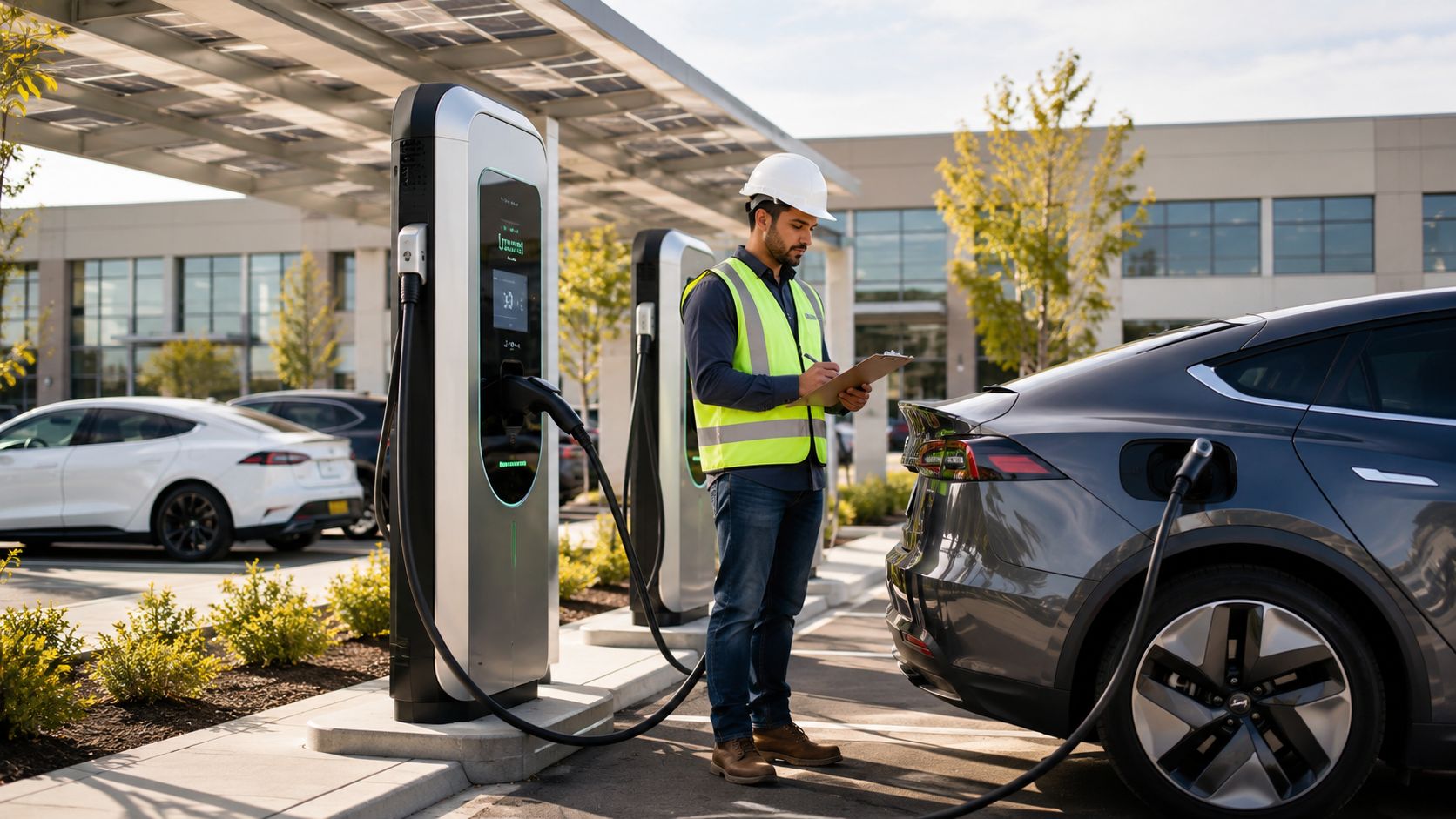
In Southern California, the permitting side can vary a lot by jurisdiction. Some cities move cleanly if the plans are complete. Others come back with detailed comments on signage, accessibility, load calculations, or parking reconfiguration. If utility service changes are involved, that adds another layer because the project timeline no longer belongs entirely to the owner and contractor.
What the field phase usually looks like
A typical commercial installation moves through a predictable pattern:
Permit and plan approval
The plans need to be complete enough to support plan check, accessibility review, and electrical review. Sloppy submittals usually cost more time than they save.Utility coordination
If the chargers can connect to existing infrastructure, this step may be limited. If the project needs new service elements or upstream changes, utility timing becomes critical.Site prep and rough-in
That can include trenching, saw-cutting, coring, conduit runs, pull boxes, and panel modifications. At occupied properties, phasing matters because parking disruptions can affect residents, customers, and tenants quickly.Equipment installation
Pedestals, wall-mounted units, disconnects, signage, protection, and communications components all get installed and tied together.Startup and commissioning
Too many projects cut corners here.
Why commissioning matters more than owners realize
A charger that powers up isn't automatically ready for use. It still has to be tested under real conditions.
That includes verifying continuity, grounding, insulation, communications, breaker operation, and actual charger performance under load. The reason this matters is straightforward. Commercial EV charging stations have an average reliability of only 78%, with many failures stemming from poor installation and skipped commissioning steps like load testing to verify voltage and current under actual vehicle load, according to Harvard Business School's review of EV charging reliability.
If the contractor doesn't test the station with real load conditions before turnover, the property manager becomes the commissioning department after opening day.
That's where a lot of reputation damage starts. Tenants don't care whether the issue came from software setup, grounding, bad commissioning, or a configuration error. They just see a charger that doesn't work.
What a clean turnover should include
Owners should expect a documented closeout, not just energized equipment.
A proper turnover package should include:
- As-built information: So future troubleshooting and expansion aren't guesswork.
- Startup records: Confirmation that testing and commissioning were completed.
- User and admin setup: Access control, billing setup if applicable, and network configuration.
- Maintenance handoff: Clear instructions on who handles support, resets, repairs, and software issues.
The sites that perform well over time are usually the ones where the installation team treated commissioning as part of construction, not an optional extra at the end.
Protecting Your Investment Maintenance and Future-Proofing
The installation isn't the finish line. It's the point where the asset starts needing to perform. If the chargers go down, lose connectivity, stop authorizing users, or show physical wear from traffic and weather, the property feels it right away.
That's why ongoing maintenance matters. Not as a nice add-on, but as part of the operating plan. Charger equipment sits in active parking areas, gets exposed to impact risk, and depends on both electrical reliability and network reliability. A system with no inspection routine and no response plan tends to become a tenant complaint generator.
What owners should have in place from day one
A workable maintenance plan should cover both physical equipment and system operation.
- Routine inspection: Check connectors, mounts, bollards, signage, and visible damage before a small issue turns into downtime.
- Electrical verification: Periodic review of terminations, breakers, and upstream equipment helps catch heat or wear before failure.
- Network and software support: If the stations rely on user authentication or monitoring, someone has to own firmware updates, connectivity checks, and account administration.
- Clear service responsibility: Property teams should know who gets the call when a station is down and what the response process is.
For commercial sites with existing electrical maintenance programs, folding charger support into broader preventive service is usually the smartest move. That same preventive approach used for panels, lighting controls, and distribution equipment applies here too, which is why many owners already see value in commercial electrical maintenance programs built around preventive service.
Future-proofing is a design decision, not a slogan
A lot of owners ask whether they should wait until demand is higher. In most cases, the better answer is to build in expansion capability now, even if phase one is limited.
That can mean reserving panel space, installing spare conduit, choosing a networked platform, planning for additional pedestals, or designing the parking layout so future chargers don't force a full rework. Those decisions are much cheaper during initial construction than after the site has been restored and restriped.
The property that plans for expansion usually spends less than the property that has to reopen finished work later.
There's a long-term reason to think that way. The IEA's Announced Pledges Scenario forecasts that public charging points will need to reach almost 25 million by 2035, a sixfold increase from 2023 levels, as reported in this summary of the IEA projection. That projection isn't a reason to overbuild blindly. It is a reason to avoid dead-end design.
For Southern California property managers, the practical takeaway is simple. Install what the site can support and what users need today. But leave the electrical and physical path open for what the property will need next.
If you're planning your first major EV charging project at a commercial, retail, office, or multifamily property in Southern California, Access Electrical and Lighting can help evaluate site capacity, coordinate installation requirements, and support a code-compliant rollout that fits your property's real operating conditions.