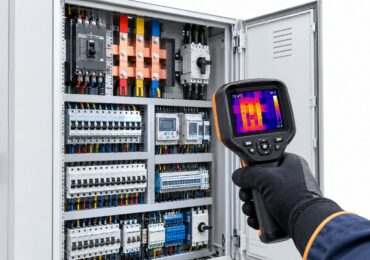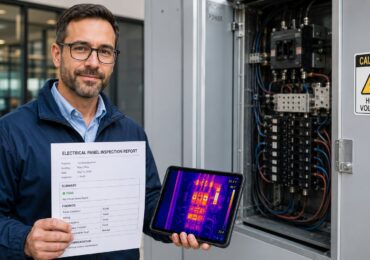
A contractor is scheduled to open a live panel in your building next week. The tenant just wants the power issue fixed. Your operations team wants the job done without disruption. You want the work completed safely, with no injury, no surprise outage, and no uncomfortable questions later from ownership, insurance, or an investigator.
That's where many property managers first ask, what is an arc flash study, and why does it matter to me if I'm not the electrician?
The short answer is this. An arc flash study tells you how dangerous your electrical equipment is at the exact points where people may work on it. It turns an invisible hazard into specific instructions: how much energy could be released, how far people need to stay back, and what protective gear a qualified worker must wear. For commercial buildings, retail centers, office properties, and multifamily sites, that information affects safety, uptime, planning, and liability.
What Is an Arc Flash and Why Should You Care
A technician is standing in front of a live panel in your building. The task sounds ordinary: test voltage, check a breaker, restore power to a tenant space. Then a fault jumps through the air inside the equipment, and the room changes instantly. Heat, pressure, molten metal, and sound are released faster than anyone nearby can react.
That event is an arc flash.
An arc flash happens when electricity leaves its intended path and travels through air between energized parts or to ground. In a building, that usually means a violent release inside switchboards, panelboards, motor control equipment, or similar gear. The equipment may look closed, orderly, and under control from the outside. Inside, the available fault current and the speed of the protective device can make the hazard mild at one location and severe a few feet away.
That last part matters to facility managers. Electrical rooms do not present one uniform level of risk.
Why property managers are part of the equation
You may never put on arc-rated PPE or open energized gear. You still control the property, approve vendor access, schedule shutdowns, answer to ownership, and deal with the fallout if something goes wrong. From a risk standpoint, the hazard sits inside your operation.
For equipment at 50 volts or more, arc flash hazard assessment requirements apply in many common building situations involving energized work, as outlined by NFPA 70E guidance on conditions requiring an arc flash risk assessment. That covers a large share of the electrical distribution equipment found in commercial and multifamily properties.
A useful way to picture it is this. Two doors in the same electrical room can hide very different consequences. One lineup may clear a fault quickly and limit the energy released. The next may take longer to trip because of breaker settings, fuse selection, or coordination decisions made years ago. To a property team, both pieces of equipment can look equally routine until someone needs to work on them.
The business impact goes beyond the worker at the panel
An arc flash incident can injure a qualified electrician. It can also create problems that land directly on the facility manager's desk.
- Tenant safety and disruption: A fault event can cut power to occupied spaces, elevators, life safety support equipment, or revenue-generating areas.
- Unplanned downtime: A device that trips too slowly may increase hazard levels. A device that trips too fast may improve safety at one point while creating nuisance outages elsewhere.
- Liability exposure: After an incident, owners, insurers, and investigators often ask whether the hazard was evaluated, labeled, and kept current.
- Maintenance planning pressure: Missing or outdated labels make service work harder to schedule and harder to defend.
This is why arc flash mitigation cannot be treated as a label-only exercise. Protective device coordination and arc flash reduction are tied together. If you lower incident energy by changing settings without understanding the rest of the system, you can create selective coordination problems and broader outages. If you focus only on keeping the building online, you may leave workers exposed to higher energy than necessary.
For a facility manager, that balance is the core challenge. You need a system that supports safe work, stable operation, and a clear record that the building's electrical risks were evaluated with more than guesswork.
What an Arc Flash Study Actually Is
A contractor opens a switchboard in your building to perform routine service. Before anyone puts a tool near energized parts, two practical questions need clear answers. How much heat could a fault release at that exact location, and how fast will the upstream breaker or fuse stop it?
Those answers come from an arc flash study.
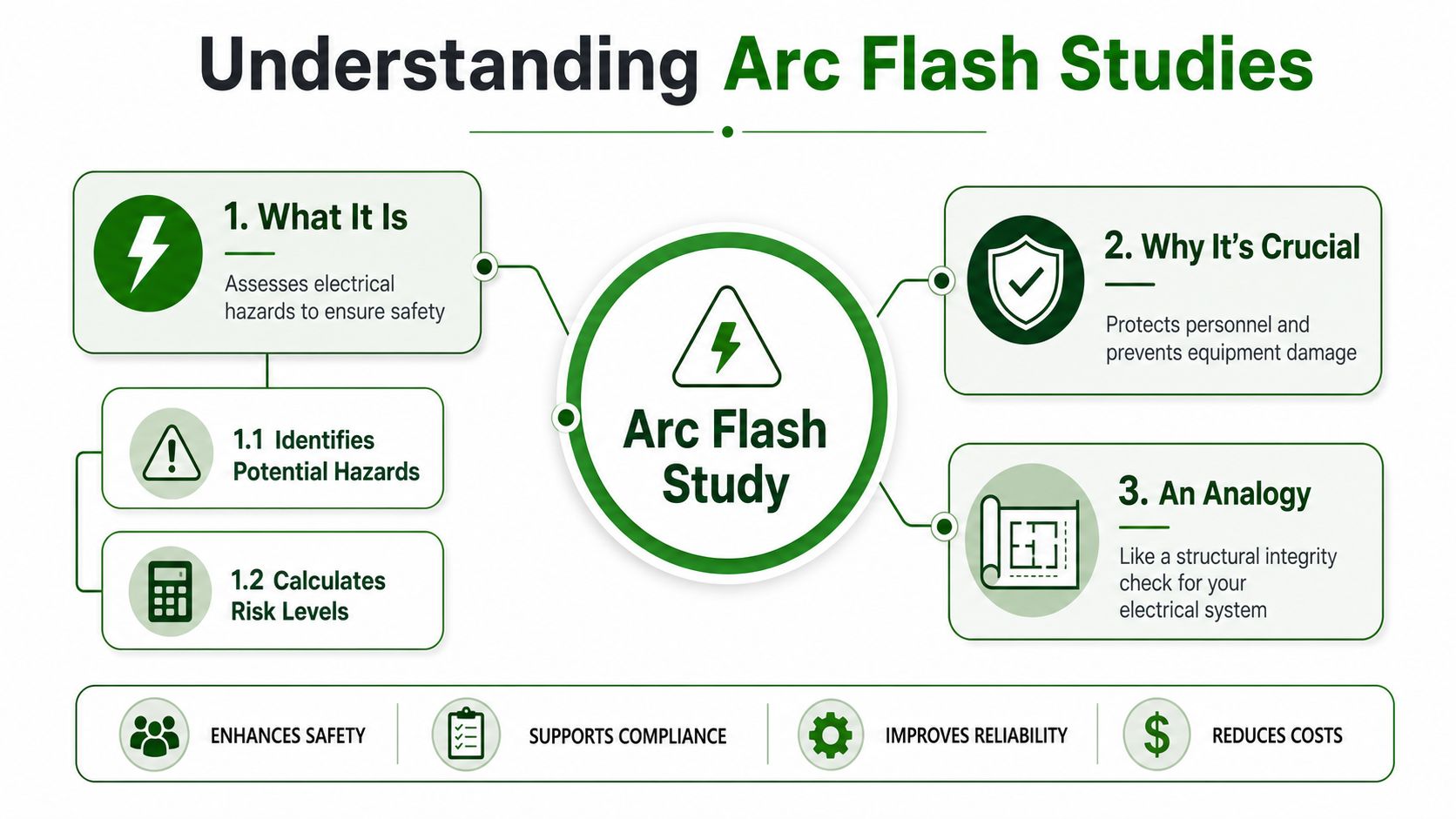
An arc flash study is an engineering analysis of electrical equipment operating at 50 volts or more. It calculates the potential incident energy, measured in calories per square centimeter (cal/cm²), at specific pieces of equipment where qualified people may need to work. The study also establishes the arc flash boundary and supports the warning labels workers rely on in the field.
For a facility manager, that means the study turns a vague electrical hazard into site-specific instructions. It tells your team and service contractors which equipment presents the highest exposure, what protection is required, and where a change in settings could improve safety but create operating problems elsewhere.
The three outputs that matter most
You do not need to master power system engineering to use the results well. You do need to recognize the three outputs that affect safety, uptime, and contractor oversight.
Incident energy
Incident energy is the amount of thermal energy a worker could be exposed to at a particular location if an arc flash occurs. This value drives PPE selection and shapes work procedures.
The key point is precision. The study does not assign one danger level to the whole building. It calculates conditions at each relevant bus, panel, switchboard, motor control center, or other equipment location.
Arc flash boundary
The arc flash boundary is the distance from the equipment where a person could receive a serious burn if an arc flash happens. In practical terms, it helps define who can be in the area, what controls are needed, and how the work zone should be set up around energized equipment.
Equipment labeling
The study also provides the technical basis for equipment labels. Those labels communicate the hazard level, working assumptions, and protection requirements at the gear itself. If labels are missing, outdated, or based on old system conditions, your contractors may be making decisions with the electrical equivalent of an old floor plan.
A good time to verify whether your existing labels and field conditions still match is during an electrical safety inspection for commercial buildings.
What the engineer is calculating
The calculation method commonly used is IEEE Std 1584-2018. Engineers model the system and examine several variables that change the hazard level at each piece of equipment.
Here is the plain-language version:
- Voltage helps define the electrical conditions at the equipment
- Available fault current shows how much current could feed the fault
- Working distance reflects how close the person is to the arc source
- Protective device clearing time shows how long the arc can continue before a breaker or fuse interrupts it
An easy way to picture clearing time is to compare it to response time during a water leak. A small leak stopped quickly causes less damage than one allowed to spray for several minutes. Arc flash energy behaves similarly. If the protective device takes longer to clear, the worker can be exposed to more heat.
This is also where facility priorities can collide. Lowering incident energy often involves changing protective device settings or equipment configurations. Those changes can improve worker safety at one point in the system while affecting selective coordination somewhere else. In a commercial property, that can mean a fault trips more of the building than expected, disrupting tenants or critical operations.
That is why an arc flash study is more than a labeling exercise. It is a decision-making tool that connects electrical safety to maintenance planning, outage risk, and liability control.
Why Your Property Needs an Arc Flash Study
A contractor opens a switchboard in your building during a tenant fit-out. The label on the door is years old. A breaker was changed during a past service call, another panel was added for a remodel, and no one has checked whether the hazard information still matches the actual system. If something goes wrong, the problem is not limited to one worker standing in front of the gear. It can turn into tenant disruption, emergency repairs, insurance scrutiny, and hard questions about what the property team knew.
That is why facility managers should view an arc flash study as part of building risk control.
Compliance is only the starting point
NFPA 70E states that arc flash risk assessment information must be reviewed at intervals not to exceed five years and updated when major electrical changes occur, as explained in NFPA 70E arc flash label and review requirements. For a commercial property, that means a study cannot sit on a shelf after a renovation, service upgrade, generator project, or protective device adjustment.
The hazard itself is severe. Arc flash temperatures can be hotter than the surface of the sun, and the event can release intense heat, pressure, and molten metal in a fraction of a second. For property managers, the practical question is simple. Are the people opening your electrical equipment relying on current information or outdated assumptions?
Why this matters to building operations
An arc flash study helps answer business questions, not just engineering questions.
It tells you whether the labels on switchboards, panelboards, motor control centers, and other equipment still reflect the system your contractors and maintenance staff will face. It also gives you a basis for planning work safely, scheduling shutdowns more carefully, and avoiding the kind of surprise outage that affects multiple tenants at once.
The study also helps you see a tradeoff that is easy to miss. Lowering incident energy often involves changing breaker or relay settings, but those same changes can affect selective coordination. In plain terms, a setting that improves worker safety at one piece of equipment can also make a fault trip a larger portion of the building than intended. For an office, retail, medical, or mixed-use property, that can mean dark tenant spaces, stopped elevators, spoiled inventory, or interrupted critical systems.
That is why arc flash mitigation and protective device coordination should be reviewed together. Treating them as separate tasks can create a new operational problem while solving a safety one.
If you are already assessing the condition of the electrical system, a documented electrical safety inspection for commercial properties can support that effort by identifying field conditions, maintenance concerns, and equipment issues that deserve attention before they contribute to an incident.
Liability shows up after the incident
After an electrical injury, investigators and insurers do not stop with the event itself. They look at maintenance records, equipment labels, training, system changes, and whether the hazard information available to workers matched the equipment in the field.
For ownership and property management, that turns the study into documented due diligence. A current study shows that the hazard was evaluated, the equipment was reviewed, and the resulting labels and work practices were based on the actual system configuration.
If labels are missing, outdated, or based on an old one-line, the exposure is larger than a code issue. It reaches operations, contracts, and legal responsibility.
A current study helps you show that your team took reasonable steps to protect people, support safe contractor work, and reduce avoidable downtime in the building.
The Arc Flash Study Process from Start to Finish
A property manager usually meets the arc flash study at an inconvenient moment. A tenant improvement is underway, a breaker keeps tripping, an insurer wants updated documentation, or a contractor asks why the panel labels do not match the gear in the room. At that point, the process can seem opaque. In practice, it follows a clear sequence, and your role is less about doing the engineering and more about helping the work stay accurate, efficient, and useful for the building.
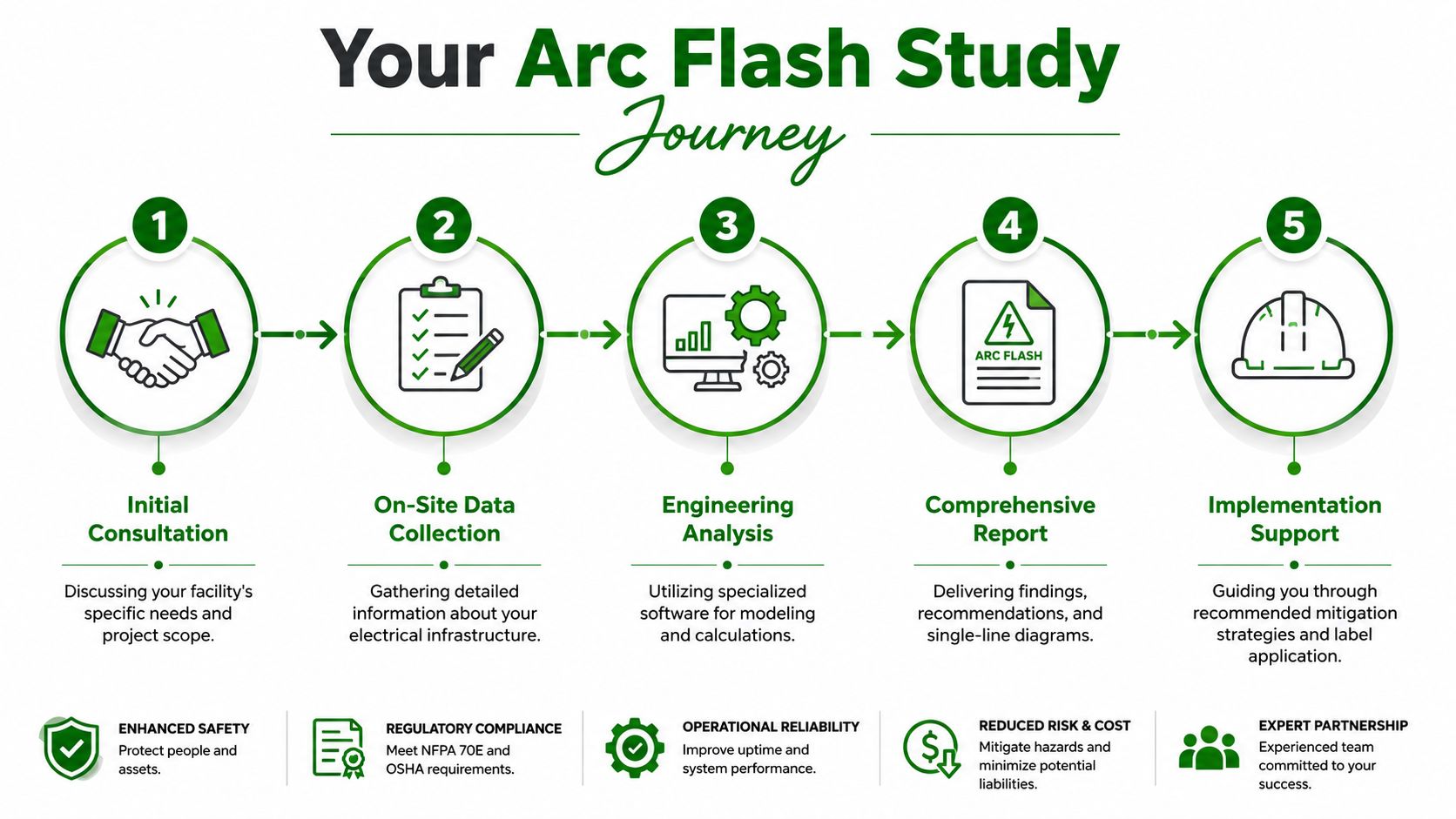
A typical project starts with field data collection, then moves into software modeling, engineering calculations, and label and report production. The exact schedule depends on the size of the property, the condition of the drawings, and how easy it is to access electrical rooms without disrupting tenants.
Step one: gather what already exists
The first task is building a reliable map of your electrical system.
Engineers usually start with existing single-line diagrams, panel schedules, equipment submittals, utility information, and any records of past upgrades. They also need access to nameplate data on breakers, switchboards, transformers, panelboards, motor control centers, and similar equipment. If your documentation is current, this step moves faster. If it is not, the field team has to rebuild the map one room at a time.
For a facility manager, this step is part records search and part logistics. Who has the latest drawings. Which electrical rooms need tenant access. Which shutdown windows are realistic. Good coordination here saves time later because the study will only be as accurate as the information collected at the start.
Step two: verify what is actually in the building
Drawings show intent. Field verification shows reality.
During the site visit, the study team checks breaker types and trip settings, fuse sizes, conductor details, transformer data, equipment ratings, and how sections are connected. This detailed verification is necessary because many commercial buildings have seen years of changes that never made it back onto the one-line. A replaced breaker, an added panel, or a modified transformer can change fault current, clearing time, and incident energy results.
This is also where practical building concerns come into view. Locked rooms, blocked working clearances, missing panel directories, and equipment that cannot be opened safely all affect the pace of the work.
In many facilities, pairing the study with infrared electrical testing for panels and switchgear helps identify overheated connections or stressed components before new settings are applied or labels are installed. That gives you a clearer picture of equipment condition, not just the math model.
Step three: model the system and run the analyses
Once the field data is verified, the engineer builds the electrical model in software such as ETAP, SKM, or EasyPower. That model works like a detailed road map with traffic rules added. It shows not only how power flows through the building, but how the system responds when something goes wrong.
The study usually includes three related analyses:
- Short-circuit analysis to calculate the available fault current at each bus
- Arc flash analysis to calculate incident energy and arc flash boundaries at each equipment location
- Protective device coordination review to examine how breakers and fuses operate in relation to one another during faults
Property managers often focus on the arc flash result because that is what appears on the label. The coordination review deserves equal attention because it affects uptime.
Here is the practical issue. Lowering incident energy often means getting a breaker to clear a fault faster. That can improve worker protection at that piece of equipment. But if the rest of the system is not reviewed with it, the adjustment can create nuisance trips or cause an upstream device to open too soon, shutting down a larger part of the building than necessary. In a multi-tenant property, that can turn one localized electrical problem into complaints, service interruptions, and avoidable business loss.
Arc flash mitigation and coordination need to be checked together. One addresses worker exposure. The other helps keep a fault from darkening half the building.
Step four: review the results and decide what needs to change
After the calculations are complete, the engineer reviews locations with high incident energy, equipment with inadequate interrupting ratings, and coordination problems that could lead to poor selectivity during a fault. Some findings lead to documentation updates. Others call for physical changes, such as adjusting trip settings, replacing a breaker, revising fuse sizes, or planning equipment upgrades.
This is the point where the study shifts from engineering exercise to management tool.
You can start weighing options in business terms. Which corrections can be made during routine maintenance. Which items require planned outages. Which recommendations reduce liability with minimal operational disruption. Which changes should be bundled into a capital project rather than handled as one-off repairs.
Step five: issue the report, labels, and implementation plan
The final step is the formal deliverable package. That usually includes the engineering report, updated one-line diagrams if revisions were needed, and equipment labels showing the calculated hazard information for qualified workers.
The labels matter, but the report is what makes them defensible. It documents the system configuration, the assumptions used in the model, the protective device settings reviewed, and the recommendations that came out of the analysis. For ownership and facility management, that record supports contractor safety, maintenance planning, and due diligence if an incident is ever investigated.
A good study does not end with labels on panels. It gives you a clearer electrical map of the property and a prioritized list of actions that protect people without creating new operating problems.
What You Get from an Arc Flash Study
A contractor is about to open a 480V panel in your building. Your question is not just, "What PPE do they need?" You also need to know whether the label is current, whether the upstream breaker will clear a fault fast enough, and whether one electrical problem could take out a larger part of the property than necessary.
That is why the deliverable package matters.
An arc flash study gives facility managers a working set of documents for safety decisions, maintenance planning, contractor control, and liability records. The label on the equipment is the visible part. The report behind it is what makes the label usable and defensible.
Labels give the field team fast, equipment-specific guidance
At the equipment, workers need quick answers. The label is built for that moment.
For a qualified worker standing in front of a panel, the label typically identifies:
- the equipment name or location
- the nominal voltage
- the calculated incident energy or required PPE level
- the arc flash boundary
- any working-distance assumptions used for the calculation
The practical value is simple. Clearing time changes exposure. A protective device that trips quickly can lower incident energy. A slower device can raise it enough to change PPE requirements and work planning, as explained in this overview of how clearing time affects arc flash incident energy at 480V.
For property managers, that means labels are not decoration. They are field instructions tied to a specific system configuration. If the system changes, the label may no longer reflect the actual hazard.
The report is what management, engineers, and contractors rely on
The report carries the primary weight of the study. It shows how the engineer modeled the system, what utility and equipment data were used, which protective settings were reviewed, and where the highest exposures appear.
A strong deliverable package usually includes these items:
| Deliverable | Why It matters to building operations |
|---|---|
| Arc flash equipment labels | Guides qualified workers on PPE and approach limits at the point of work |
| Single-line diagrams | Shows how power is distributed, which helps with shutdown planning and contractor oversight |
| Short-circuit results | Identifies available fault current and whether equipment ratings are adequate |
| Coordination curves | Shows whether the right protective device trips first or whether a small fault could cause a wider outage |
| Incident energy calculations | Quantifies worker exposure at specific equipment locations |
| Arc flash boundaries | Defines how close personnel can be without arc-rated protection |
| Engineer-sealed report | Creates a formal record for due diligence, safety programs, and post-incident review |
NFPA 70E expects more than labels alone. This summary of NFPA 70E's 12 mandatory arc flash report elements outlines the reporting components owners and managers should expect to see documented.
Coordination results are one of the most useful parts for owners
This is the part many commercial property managers do not expect.
Arc flash mitigation and protective device coordination have to be considered together. If an engineer reduces incident energy by making an upstream device trip faster, that change can also make the building more likely to lose a larger section of power during a downstream fault. It is similar to setting every sprinkler zone in a building to dump water at the first sign of trouble. You may control one problem faster, but you can also create more disruption than necessary.
That is why the coordination curves and settings review matter so much from an operations standpoint. They help you ask better questions before approving changes:
- Will this setting change reduce worker exposure?
- Will it also increase the chance of a broader tenant outage?
- Can the same safety goal be met with a more selective protection strategy?
- Should this work be bundled into a shutdown or capital project instead of treated as a quick adjustment?
Those are management questions, not just engineering questions.
How facility managers use the package after the study is done
The value of the study shows up long after the engineer leaves the site.
During maintenance planning, your team can confirm whether energized tasks are being evaluated against current hazard information.
During tenant improvement work, you have a baseline for reviewing changes to gear, loads, and protective settings before old labels are treated as valid.
During audits, insurance reviews, or incident investigations, you can produce an engineering record that shows the property used documented analysis rather than assumptions.
A label helps the electrician at the panel. The full study package helps ownership and facility management protect people, control outages, and document responsible decision-making.
Common Findings and How to Address Them
An arc flash study rarely ends with, “Everything is perfect.” More often, it reveals a mix of manageable problems. Some affect worker safety directly. Others affect reliability, maintenance planning, or future project scope.
The value of the study is that it gives you a decision list.

High incident energy at specific equipment
This is one of the most common and most important findings. The study may show that some equipment exposes workers to very high incident energy.
Possible responses include:
- Adjust protective settings: In some cases, changing breaker or relay settings can reduce clearing time.
- Add mitigation methods: Engineers may recommend arc-flash relays or other measures that reduce exposure duration.
- Change work practices: Some tasks may need to shift toward de-energized work whenever feasible.
Poor protective device coordination
This is the issue many managers don't expect. The system may be safe enough on paper for PPE selection but still poorly coordinated from an uptime standpoint.
When coordination is off, a downstream problem can trip an upstream device too. That can expand a small issue into a larger outage.
Common responses include:
- Review time-current relationships: Engineers compare upstream and downstream device behavior.
- Revise settings carefully: The goal is to improve selectivity without creating a worse hazard elsewhere.
- Test changes in context: Safety improvements shouldn't be made in isolation from reliability concerns.
Equipment that doesn't match system conditions
Sometimes the study uncovers gear that is underrated for available fault current or configured in a way that no longer matches the building's actual electrical system.
That can lead to recommendations such as:
- Targeted equipment upgrades
- Replacement of aging breakers or switchgear
- Updated one-lines and labeling after corrective work
The best mitigation plan isn't always the most dramatic one. Often it's a sequence of practical fixes, completed in the right order.
For property managers, that sequence matters. You may not solve every issue in one budget cycle, but the study helps you prioritize the work that most affects life safety, compliance, and continuity.
How Access Electrical Can Manage Your Arc Flash Study
Property managers often don't need another vendor to hand them a report and disappear. They need a contractor who can help organize the field side of the project, coordinate with the engineering team, and then carry out the corrective work the study identifies.
That's where a practical, end-to-end approach helps.

Access Electrical and Lighting serves commercial properties across Southern California, with a strong focus on Orange County. For facilities that need an arc flash study, the company can support the on-site data collection, help coordinate with the engineering side, and perform the electrical corrections that often follow, such as panel work, switchgear updates, troubleshooting, infrared diagnostics, and related field execution.
Why that matters for facility teams
A study often identifies work that can't stay on paper.
You may need breaker setting changes, equipment repairs, replacement of outdated components, updated labeling, or follow-up maintenance planning. Having one contractor manage the field logistics can reduce handoff problems and keep the project moving.
For managers overseeing office, retail, multifamily, and mixed-use properties, commercial electrical services in Orange County for occupied properties can be especially useful when the job involves tenant coordination, access restrictions, or after-hours electrical work.
A practical fit for local properties
Access Electrical and Lighting focuses on commercial electrical and lighting systems, including testing, repairs, maintenance, upgrades, and low-voltage work. That means the same team that helps you manage the study process can also support the practical electrical scope that follows from the findings.
For a property manager, that's the difference between getting an answer and getting the problem resolved.
If your building has aging electrical gear, outdated labels, recent system changes, or upcoming contractor work, Access Electrical and Lighting can help you take the next step. Their team supports commercial properties across Southern California with electrical testing, repairs, upgrades, and field coordination that help turn arc flash findings into safer, more reliable building operations.