If you manage a commercial property in Southern California, you've probably seen the same waste over and over. Lights stay on in empty suites after tenants leave. Conference rooms glow all night. Parking structure fixtures burn at full output even when traffic is light and daylight is already doing half the job.
That waste shows up in three places. Your utility bill, your maintenance budget, and your compliance risk.
The pressure is sharper in SoCal because you're not just trying to cut overhead. You're also dealing with Title 24 expectations, tenant comfort, retrofit logistics, and inspectors who want the controls to work exactly as designed, not just look good on a submittal. A lighting system that saves energy on paper but fails acceptance testing is a headache you pay for twice.
Automated lighting controls solve that problem when they're selected, installed, and commissioned correctly. They give the building a way to react to occupancy, daylight, schedules, and operating hours without depending on someone to walk around flipping switches. In practical terms, that means less wasted burn time, better consistency, and fewer surprises during compliance review.
Your Building Is Wasting Energy While You Read This
A lot of properties are still running lighting the old way. Somebody turns lights on in the morning, somebody forgets to turn them off at night, and the building keeps spending money until the next complaint or utility bill shows up.
That's common in office buildings, retail centers, mixed-use properties, and parking structures across Southern California. The issue usually isn't bad intent. It's that manual lighting depends on perfect human behavior, and buildings never get that for long.
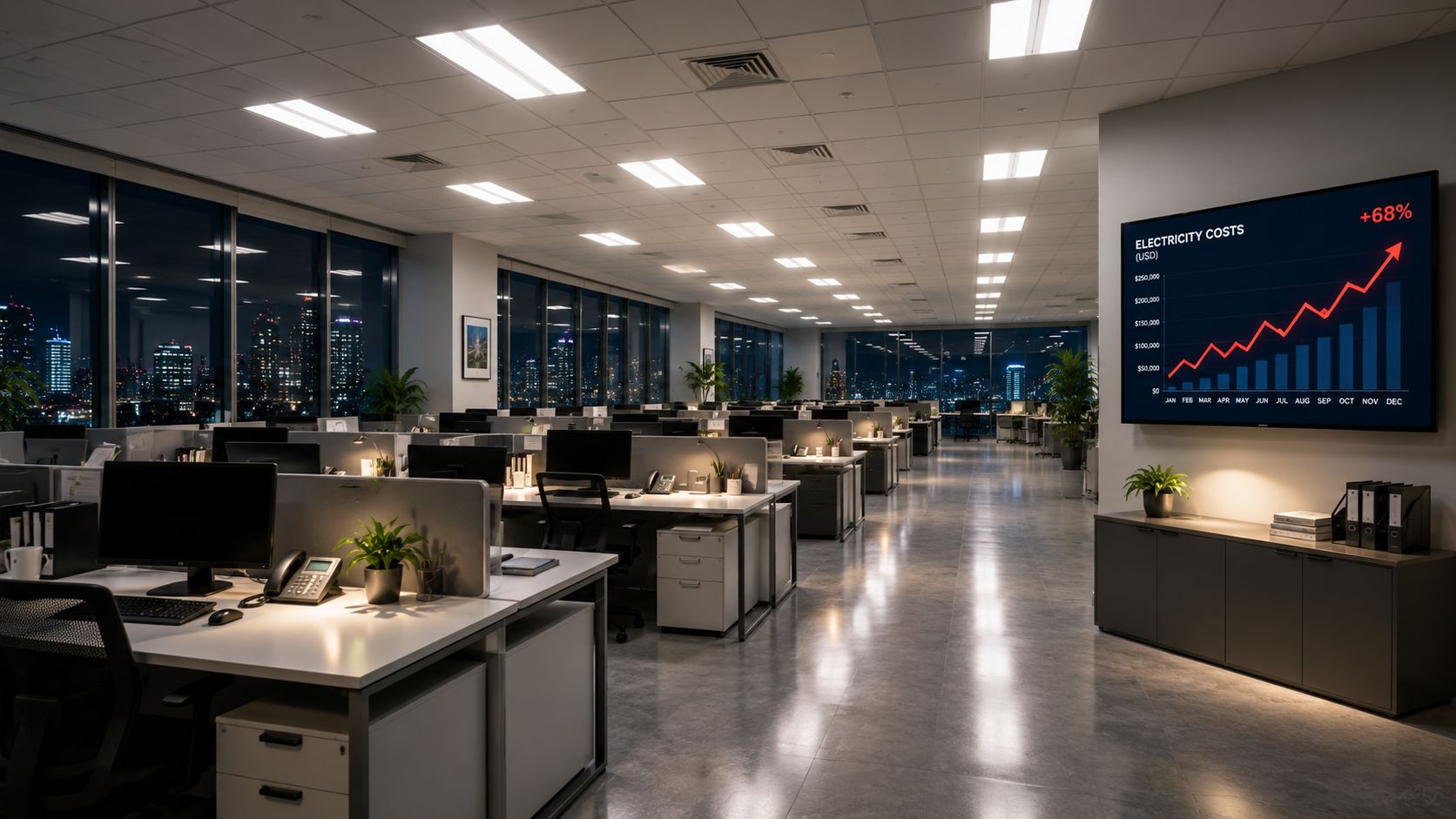
Where the waste usually hides
The biggest losses tend to come from spaces that look minor on a floor plan:
- Conference rooms: People leave, the lights stay on, and the room sits empty for hours.
- Private offices: One wall switch controls everything, so fixtures run at full output whether the person is there or not.
- Perimeter zones: Daylight comes in, but the electric lighting never backs off.
- Parking and exterior areas: Controls are often too simple, badly aimed, or never calibrated after installation.
In SoCal, those small misses add up fast because properties often run long hours, face high electricity costs, and have code requirements that don't leave much room for sloppy execution.
Practical rule: If your lighting strategy depends on staff remembering to shut things off, you don't have a strategy. You have a habit, and habits break.
Why this matters beyond the utility bill
Property managers usually start looking at automated lighting controls because of energy costs. That's fair. But energy is only one part of it.
A better control system also helps you standardize operation across suites, support tenant improvement work, and reduce the scramble around inspections and turnover. It makes the building behave more predictably. That matters when you're managing multiple vendors, multiple spaces, and multiple deadlines.
In Southern California, the best reason to act is simple. You're already paying for lighting. The question is whether you want to keep paying for wasted hours, missed code details, and avoidable callbacks.
What Are Automated Lighting Controls
Walk a Southern California office building at 7:30 p.m. and the gaps show up fast. A conference room is fully lit with nobody inside. Perimeter fixtures are still at full output with plenty of daylight on the glass. In the parking structure, lights are on, but the control sequence is so basic it treats every hour the same.
Automated lighting controls fix that by making the lighting respond to actual conditions in the space. The system can adjust based on occupancy, vacancy, daylight, time of day, or commands from a centralized platform. Instead of relying on someone to hit the right switch at the right time, the building handles those decisions automatically.
A simple switched system gives you one instruction. On or off. An automated control system adds feedback, zoning, and logic, so lighting output matches how the space is really being used.
More than timers and motion sensors
A lot of property managers hear "lighting controls" and think of a standalone motion sensor in a restroom or break room. That is one piece of the job, not the whole job.
In a typical SoCal commercial property, an automated lighting control strategy can include dimming controls, daylight-responsive zones, local room controls, centralized scheduling, relay panels, wireless devices, and addressable fixtures that report status back to the system. Each piece solves a different problem. Scheduling handles predictable hours. Occupancy controls catch empty rooms. Daylight response trims excess output at windows and storefront glass. For a broader view of how these upgrades fit into an energy-saving lighting plan, see our commercial lighting guide for Orange County businesses.
The trade-off is straightforward. More capability gives you better control, but it also raises the importance of proper design, startup, and documentation. I have seen good hardware perform poorly because the zones were laid out badly, the sensor coverage missed key areas, or the programming was left at factory defaults.
That problem shows up often in outdoor areas and parking structures. On paper, the controls check the box. In the field, the photocell is aimed wrong, the timeclock is never adjusted, the high-end trim is ignored, or the partial-off sequence does not match how the property operates in practice. The result is a system that technically exists but does not save much energy and creates callback headaches.
In Southern California, that gap between installed and working matters more than many owners expect. Title 24 does not stop at buying the right devices. The controls have to be configured correctly, tested correctly, and documented correctly. If the sequence of operations is sloppy, acceptance testing will expose it, especially in tenant improvements, exterior lighting, and parking garage applications where control requirements are easy to miss.
Good automated lighting controls make the building behave predictably. For a property manager, that means lower waste, fewer complaints, cleaner inspections, and a better shot at getting the savings you paid for.
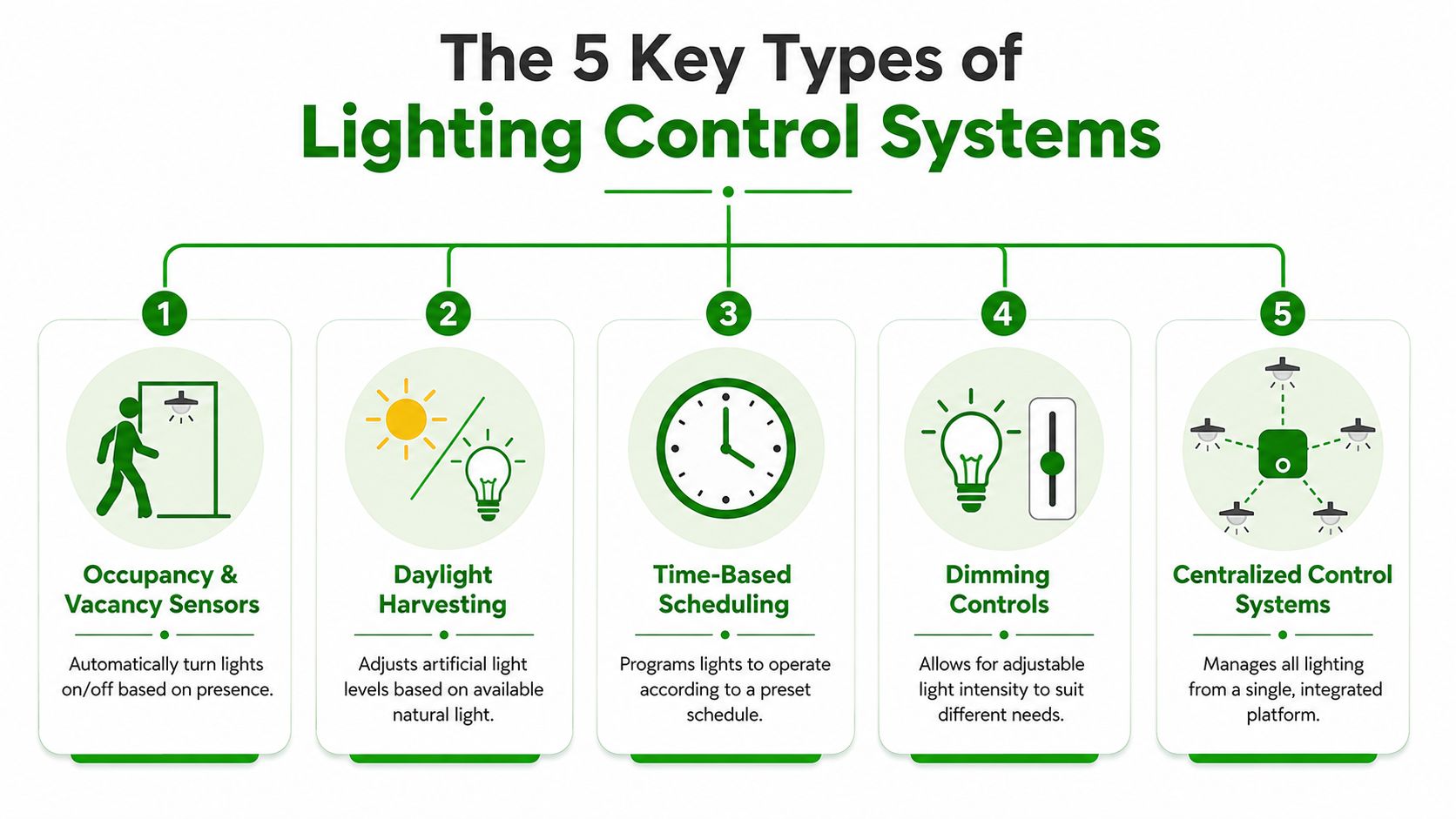
The 5 Key Types of Lighting Control Systems
Every control strategy solves a different problem. In a Southern California commercial building, the right mix usually comes down to five categories. The best projects use more than one, because a lobby, a private office, and a parking structure do not behave the same way.
Time-based scheduling
Scheduling is still one of the simplest ways to cut waste. It fits spaces with predictable hours, such as office common areas, retail corridors, exterior lighting, and amenity areas that follow a set operating schedule.
It also has clear limits. A schedule only follows the clock. If a tenant starts early, stays late, or changes hours seasonally, the lights can end up on when they should be off, or off when people are still working.
That is why I treat scheduling as a baseline control, not the whole strategy.
Occupancy and vacancy sensors
Sensors handle spaces that people use inconsistently. Private offices, conference rooms, restrooms, storage areas, copy rooms, and back-of-house spaces are strong candidates because the lights do not need to run just because the building is open.
The field issue is rarely the sensor itself. It is placement, coverage, and settings. A sensor aimed poorly can miss someone sitting still at a desk. A sensor with too much reach can pick up hallway traffic and keep a small room lit all day. In tenant improvements, I also see vacancy sensor sequences specified correctly on plans, then changed in the field because someone wants the lights to turn on automatically. That can create a Title 24 problem later if the space no longer matches the required control sequence.
Daylight harvesting
Daylight harvesting dims electric lighting in areas that already get usable daylight. In Southern California, that usually means perimeter offices, glass-lined lobbies, storefront edges, and some open office zones near the facade.
This control type saves money only when the zoning is right. If the first row of fixtures near the windows is tied to the interior rows, the whole sequence falls apart. The perimeter lights need to respond to daylight without dragging the entire room up and down with them. Setpoint tuning matters too. If nobody adjusts the system after installation, the fixtures often stay brighter than needed or dim so aggressively that occupants start complaining.
For buildings considering broader efficiency upgrades, this guide to commercial lighting in Orange County and energy-efficient solutions for businesses gives useful context on where controls fit into the larger lighting scope.
Networked and addressable controls
Networked controls give the property team more precision. Instead of controlling one floor as a single block, they let you set schedules, scenes, trim levels, and overrides by room, fixture group, or tenant area.
That flexibility helps in retrofit work, especially in Orange County and Los Angeles properties where rewiring can get expensive fast. Wireless systems can reduce disruption, but they bring their own trade-offs. Signal reliability, device naming, battery maintenance for some components, and software handoff all need attention. If the contractor finishes the install but the owner never gets a clean map of what controls what, the extra capability turns into service calls.
Building management system integration
Lighting can also tie into the larger building system. That makes sense in bigger office buildings, campuses, medical facilities, and properties with an in-house operations team that wants centralized control.
Used well, integration helps the staff manage schedules, alarms, after-hours overrides, and operating patterns from one place. Used poorly, it adds cost without improving day-to-day operation. I have seen buildings with lighting tied into the management system, but nobody updates schedules after tenant turnover and nobody keeps the graphics current. At that point, the system is harder to use than a standalone control panel.
The outdoor blind spot many projects miss
Outdoor and parking structure controls deserve their own attention because they fail for different reasons than indoor systems. In Southern California, these areas often combine photocells, astronomic scheduling, motion-based reduction, and partial-off sequences. If one part is set wrong, the whole energy strategy weakens.
Parking garages are the usual trouble spot. Fixtures stay at full output because the reduction level was never programmed, the sensor coverage leaves dead zones, or the timeclock was left on factory settings. Exterior site lighting has its own failure points. Photocells can read the wrong light source, catch glare, or respond poorly because of where they were mounted.
This matters for more than utility bills. Outdoor and parking structure controls are also where Title 24 acceptance testing and documentation can expose sloppy setup fast. A system that looks complete on a submittal can still fail in the field if the sequence of operations, installed devices, and final programming do not match.
Calculating the Benefits and Return on Investment
A 60,000-square-foot office building in Orange County can lose money every night in ways that are easy to miss. Corridor lights stay at full output after cleaning crews leave. Conference rooms sit empty with lights on. Parking area fixtures burn harder and longer than the site needs. That waste shows up on the utility bill, but it also shows up in complaints, overrides, and maintenance calls.
Property managers usually ask three practical questions. How much will this save, how long is the payback, and will the system be simple enough for the staff to keep working after turnover, tenant changes, and schedule revisions.
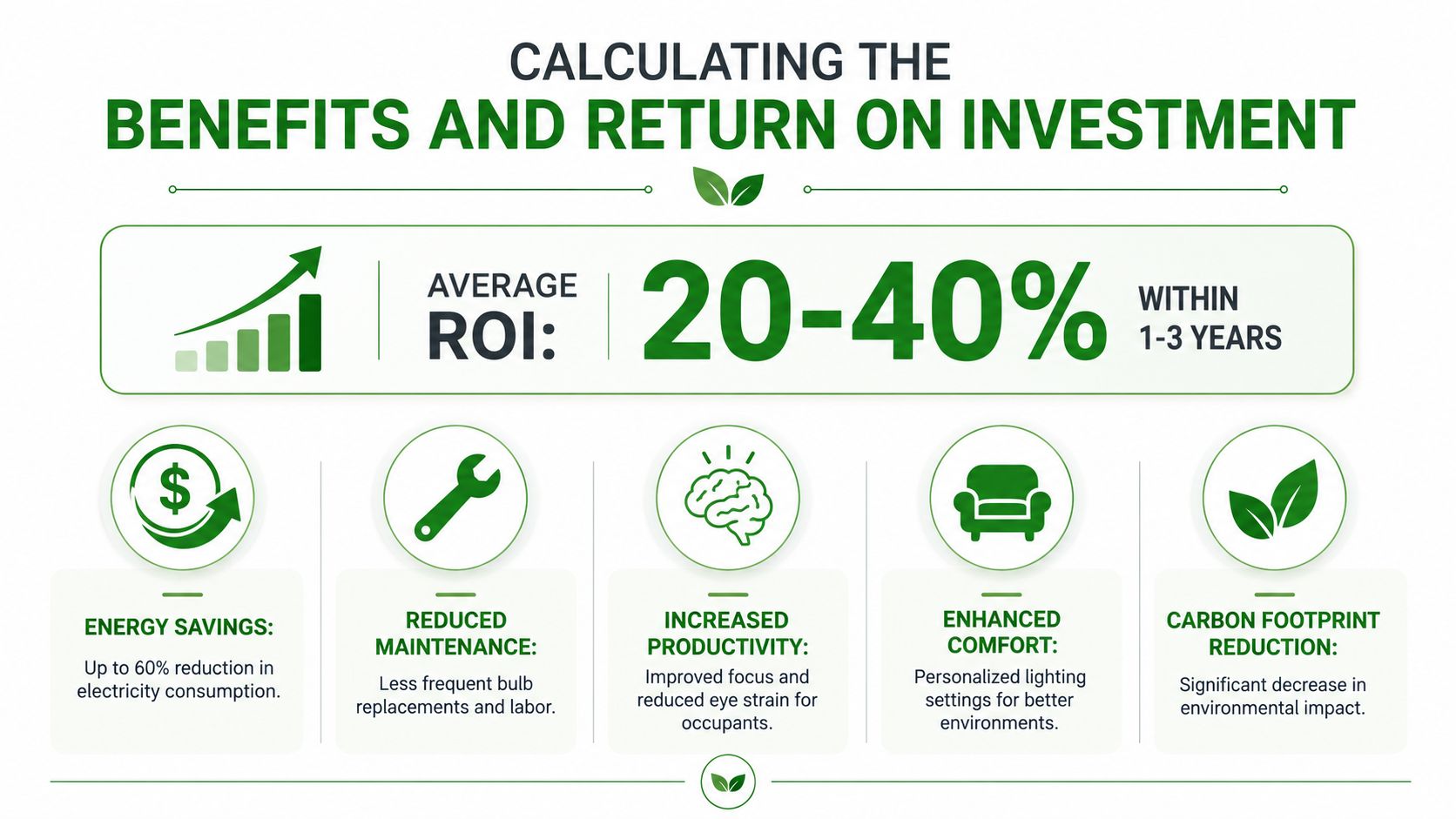
The return comes from control of run time and light level. Occupancy sensors cut operation in empty spaces. Scheduling reduces after-hours burn. Dimming trims output where full light is unnecessary. Daylight response cuts electric light near windows and skylights when the sun is already doing the job.
What the numbers support
For commercial facilities using LED lighting with advanced automated controls, documented results commonly fall around meaningful energy reduction with payback often landing in a reasonable capital-improvement window, as noted earlier in the article. In the field, that matches what tends to get owner attention. The project is easier to justify when the savings show up fast enough to compete with other deferred work.
The exact result depends on the building. A medical office with long operating hours behaves differently than a suburban office campus with light daytime occupancy on Fridays. A parking structure that never got proper reduction settings can produce a better return than an interior office area that already has disciplined scheduling.
Where the return actually comes from
Utility savings get the headline, but they are only part of the picture. Good controls also reduce the operational drag that comes from inconsistent lighting behavior.
| Benefit area | What improves in practice |
|---|---|
| Utility spend | Lights run fewer hours and can operate at lower output where dimming is part of the design |
| Maintenance planning | Staff spend less time responding to spaces left on, chasing overrides, or correcting bad schedules |
| Tenant experience | Offices, meeting rooms, and common areas feel consistent instead of overlit, underlit, or forgotten |
| Risk management | Exterior zones and parking areas are easier to manage with defined control sequences instead of manual workarounds |
That last line matters more in Southern California than many owners expect. Outdoor and parking structure lighting often drives complaints, security concerns, and failed inspections if the sequence is poorly set up. If those areas are part of the project, this guide to LED parking lot lighting upgrades for commercial properties is a useful reference for the exterior side of the budget.
A better way to judge ROI in SoCal
In Southern California, a control upgrade should be judged on more than simple fixture wattage math.
Start with wasted hours. Empty suites, after-hours common areas, daylit perimeter zones, and garages that never reduce output usually reveal the fastest financial return. Then look at labor. If engineers or site staff keep adjusting schedules, answering tenant complaints about lights staying on, or overriding exterior controls after sunset, the building is already paying a hidden operating cost.
Then check the compliance side. A system that saves energy but creates confusion during Title 24 acceptance testing can burn up savings in callbacks, reprogramming time, and delayed sign-off. I have seen projects pencil well on a rebate sheet, then lose momentum because the installed sequence, sensor placement, and documentation did not match what the acceptance test technician had to verify in the field.
Owners usually regret under-scoping controls long before they regret installing the right ones. The best ROI comes from systems that save energy, pass inspection cleanly, and keep working without constant babysitting.
Implementation for New and Existing Buildings
The retrofit versus new-build decision isn't really about technology. It's about disruption, flexibility, and how much control you want over the final result.
Existing buildings usually need a strategy that works around occupants, limited ceiling access, old branch circuits, and unfinished record drawings. New construction gives you cleaner coordination, but it also raises the bar because there's no excuse for sloppy zoning or mismatched devices when the building starts from scratch.
Why retrofits dominate
Retrofit work is the center of the market. Retrofit installations account for 56.57 percent of market revenue in 2025, and wireless systems can reduce installation costs by 50 percent compared to hardwired solutions, according to this lighting control system market analysis.
That lines up with what makes sense in occupied SoCal properties. Wireless controls can reduce ceiling demolition, shorten disruption windows, and make phased upgrades far more practical in offices, retail centers, and multifamily common areas.
What works in occupied properties
Retrofits go well when the team respects building operations.
- Phase the upgrade by zone: Start with suites, common areas, or parking levels that produce the most waste or complaints.
- Match controls to actual use: Don't put the same logic in a private office, a corridor, and a parking structure. They behave differently.
- Protect tenant hours: Night work, weekend cutovers, and staged commissioning are often more important than shaving a little material cost.
- Plan for overrides carefully: Facilities staff need a sane way to operate the system without defeating it permanently.
The biggest mistake in retrofits is trying to force a perfect design onto an imperfect building. Good retrofit design adapts.
What new construction gives you
New builds give you the chance to do the job cleanly from the beginning. You can coordinate fixture types, dimming protocols, switch legs, sensor locations, control zones, and panel schedules before the ceiling ever closes.
That matters because automated lighting controls perform best when they're part of the design logic, not bolted on at the end. In a new office shell or mixed-use project, the electrical plans can align room function, daylight zones, emergency requirements, and control intent before the first inspector walks the site.
Choosing the right path
A simple comparison helps:
| Scenario | Best-fit approach |
|---|---|
| Occupied office renovation | Lean toward wireless or minimally invasive controls with phased commissioning |
| Tenant improvement with ceiling rework | Use the remodel to correct zoning and add room-level intelligence |
| Ground-up commercial project | Design integrated controls from the start, with acceptance testing in mind |
| Parking structure upgrade | Focus on durable sensors, proper exterior logic, and service access after turnover |
New construction gives you more freedom. Retrofit work demands more restraint. In Southern California, most owners need a system that survives real operations, tenant turnover, and future changes, not just one that looks clean on bid day.
Navigating California's Title 24 Compliance
A Southern California office can look finished, occupied, and fully lit, then stall at closeout because one daylight zone is grouped wrong, a parking garage sensor times out badly, or the acceptance paperwork does not match the field installation. That happens more often than owners expect.
Title 24 turns lighting controls into an operational requirement. For property managers, the job is not to memorize code sections. The job is to make sure the system works in the building you run, and that the project team can prove it.

What Title 24 means on the ground
On real projects, Title 24 affects fixture selection, control zoning, sensor placement, programming, panel schedules, and closeout documents. Automatic shutoff, daylight-responsive controls in the right spaces, and documented system performance are part of the work. If the controls are installed but not configured to match the room layout and use case, the project can still fail acceptance.
In Southern California, I see the same pressure points repeatedly. Tenant improvements move fast. Shell buildings change hands midstream. Parking structures get treated like an afterthought even though exterior and garage controls often carry their own set of code and operational issues. The drawings may look clean, but the field conditions decide whether the system passes.
If you need a broader local primer, this breakdown of Title 24 compliance requirements for California buildings is a helpful reference.
Acceptance testing exposes weak coordination
Acceptance testing is where the project gets graded on actual performance. The tester checks what the lights do when the space is vacant, when daylight levels change, when manual controls are used, and whether the installed sequence matches the required sequence.
The common failures are not exotic. They come from coordination gaps.
- Incorrect zoning: Perimeter daylight fixtures and interior fixtures are tied together, so one control action affects both.
- Poor sensor setup: Occupancy coverage misses the actual work area, or photocells are calibrated to the wrong light level.
- Garage and site logic problems: Outdoor and parking structure lighting often needs different scheduling, motion response, and reduction behavior than office space. Treating them the same causes failed tests and tenant complaints.
- Documentation gaps: Device schedules, programming notes, floor plans, and as-builts do not line up with what was installed.
- No owner training: Engineering staff and tenants end up living in override because nobody explained normal sequences or adjustment limits.
A passed inspection starts long before the tester arrives.
Documentation is part of the electrical scope
On Title 24 jobs, paperwork is not an admin chore at the end. It is part of the installation scope, especially in Southern California jurisdictions where inspectors, acceptance testers, and owner reps expect the package to be clean.
That means keeping control intent, device locations, relay assignments, calibration settings, and final programming records aligned from rough-in through turnover. If the electrician, controls technician, and lighting vendor are not working from the same set of facts, the handoff gets expensive fast. Crews return to trace circuits. Testers flag mismatches. Property teams inherit a system they do not trust.
The practical goal is simple. Install it correctly, verify it in the field, document what was built, and hand over a system the building staff can operate without guessing. When Title 24 is handled that way, compliance supports the business case. You get fewer callbacks, smoother inspections, and lighting that performs the way the property was promised it would.
Selecting Your Lighting Contractor in Southern California
Automated lighting controls are not a commodity purchase. Two contractors can price the same drawings and deliver very different outcomes. One gives you stable operation, clean documentation, and a smooth closeout. The other leaves you with nuisance shutoffs, failed testing, and a facilities team stuck in override mode.
In Southern California, that gap gets wider because code pressure is high and many projects involve occupied buildings, parking structures, mixed-voltage scopes, and tight scheduling windows.
What to look for
Choose a contractor who can handle the controls as an operating system, not just a parts list.
- Commercial retrofit experience: Existing buildings have hidden conditions, active tenants, and old circuits. A contractor needs to know how to work around all three.
- Title 24 testing fluency: They should understand acceptance testing, not just mention it in the proposal.
- Line-voltage and low-voltage coordination: A lot of control failures happen in the handoff between power and controls. One team that understands both scopes reduces finger-pointing.
- Exterior and parking knowledge: Parking structures and site lighting need different control logic than an office suite.
- Access capability: If the project includes poles, fixtures at height, or garage lighting, the contractor should be equipped to service those assets safely and routinely.
Questions worth asking before award
A short interview tells you a lot.
| Ask this | Listen for this |
|---|---|
| How do you handle acceptance testing prep? | A clear process for programming checks, documentation, and field verification |
| What usually causes control callbacks? | Specific answers about zoning, sensor placement, calibration, and user handoff |
| How do you approach occupied retrofits? | Phasing, night work, communication, and minimizing disruption |
| Who owns the final documentation package? | Direct accountability, not vague references to another vendor |
The red flags
Be careful if the proposal treats controls as an accessory to fixtures. Be careful if nobody asks about operating hours, tenant behavior, daylight conditions, or parking usage. And be careful if the contractor seems strongest on new construction but weak on troubleshooting existing buildings. In SoCal, a lot of the value comes from solving imperfect field conditions cleanly.
The right contractor should talk comfortably about sensors, dimming, schedules, relays, emergency interfaces, documentation, and the way occupants use the space. That's the person who helps the building perform after the ribbon cutting.
If you're planning an automated lighting controls project in Orange County or anywhere in Southern California, Access Electrical and Lighting can help with commercial lighting upgrades, Title 24 testing and documentation, parking and site lighting controls, and retrofit work that has to function in real operating buildings.