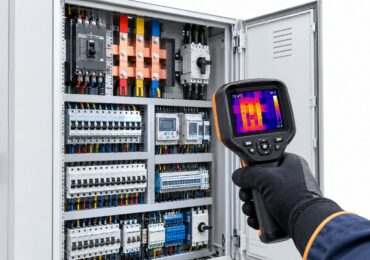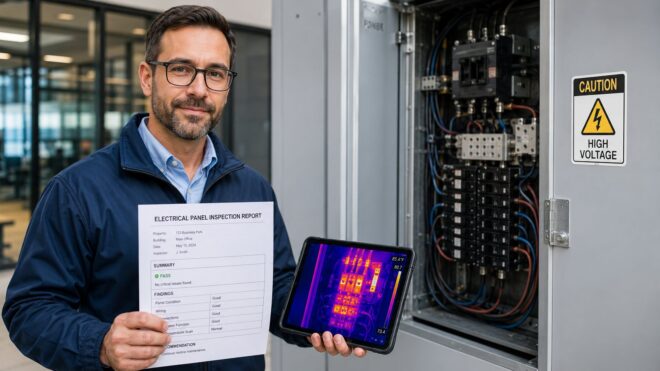
A dense electrical inspection report usually lands at the worst time. You're dealing with tenant requests, vendor scheduling, budget approvals, and one more compliance question from ownership. Then a PDF shows up with thermal images, test values, panel notes, and finding codes that look urgent but don't tell you, in plain business terms, what has to happen today and what can wait.
That's where property managers get exposed. If the report gets filed without a decision, the building still carries the risk. If every item gets treated like an emergency, maintenance dollars disappear into reactive work that could have been planned better. The report only becomes useful when someone translates it into risk, budget timing, and documentation.
For California commercial properties, that matters even more. You're not just maintaining power distribution. You're also dealing with leasing obligations, insurance questions, tenant improvements, life safety systems, and Title 24 documentation that may come back up long after the original inspection date. A visual note on a panel cover is one thing. A documented finding with measurements, photos, and a repair trail is something else entirely.
Electrical hazards cause over 1.2 million injuries globally each year, and in the U.S. the pressure to document and correct hazards is visible in the 29% rise in OSHA Lockout/Tagout citations in 2023, totaling $20.7 million in penalties, according to workplace electrical safety statistics published by OSHA Online Center. For a property manager, that's the primary purpose of an electrical inspection report. It's not paperwork. It's evidence of what was found, how serious it is, and whether the building team acted.
Introduction Why This Report is Your Most Important Tool
A commercial electrical report isn't just a technical snapshot. It's a decision document.
When a report comes in after an annual inspection, service call, or tenant improvement review, most managers go straight to the summary page looking for one answer. Is there anything here that can shut down operations, create liability, or force unplanned spending this month? That's the right instinct. The problem is that many reports don't explain the business impact clearly enough.
What the report means in real terms
A good electrical inspection report tells you four things fast:
- Immediate safety exposure. Which findings create present danger to occupants, staff, or contractors.
- Operational risk. Which issues are likely to cause nuisance outages, equipment damage, or tenant complaints.
- Budget timing. Which repairs need same-day response, and which can be grouped into a scheduled project.
- Compliance record. What documentation you now have for insurance files, internal approvals, and future audits.
An electrical inspection report is a building health check. The report isn't valuable because it says the system has problems. It's valuable because it helps you separate a true hazard from deferred maintenance.
Practical rule: If a report doesn't tell you what must be fixed now, what should be priced next, and what needs more testing, it's incomplete from a property management standpoint.
Why California managers need more than a checklist
Southern California commercial properties deal with a mix of older infrastructure, remodels, changing tenant loads, parking and site lighting controls, and code-driven documentation. That means an electrical inspection report often needs to do more than list visible defects. It has to support decisions tied to occupancy, leasing, insurance, and construction planning.
The managers who use these reports well don't read them like electricians. They read them like risk managers. They ask where the finding is, what fails if it's ignored, whether it affects life safety or tenant operations, and what paperwork needs to exist after repairs are complete.
That shift matters. It turns a stack of observations into a work plan.
The Anatomy of a Commercial Electrical Inspection Report
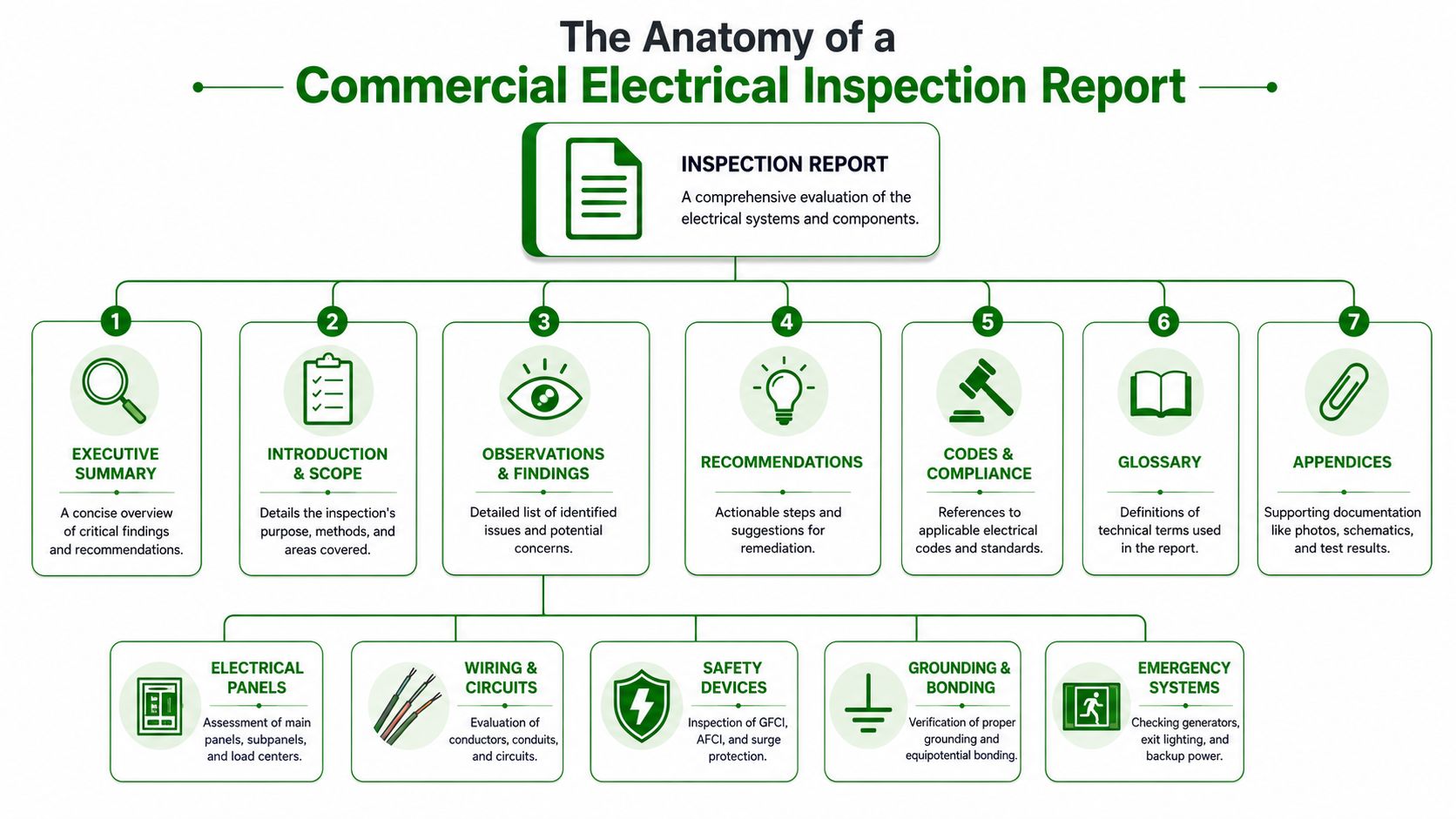
Most strong reports follow a consistent structure. Once you know where each part lives, you can pull out what ownership needs, what your maintenance team needs, and what your electrical contractor needs without reading the whole document front to back every time.
Start with the summary, not the raw data
The first pages should function like an executive briefing. These pages should feature the highest-risk findings, the areas inspected, and a short statement on overall condition. If you manage multiple sites, this section is what helps you triage quickly.
A useful summary should answer basic operational questions right away. Was the inspection visual only, or did it include instrument testing? Were any hazards serious enough to require immediate shutdown, isolation, or restricted access? Were there issues that affect tenant occupancy, lighting controls, emergency systems, or panel reliability?
Where the real substance usually sits
The middle of the report is where the actionable information lives. That's usually broken into findings, photographs, equipment references, and test schedules.
Look for these core parts:
- Introduction and scope. This tells you what was inspected and what wasn't. If a report excluded certain panels, tenant spaces, or energized testing, you need to know that before relying on it for broader decisions.
- Detailed observations. This is the room-by-room or panel-by-panel record. The best reports identify exact locations, not vague descriptions like “electrical room issue.”
- Photo documentation. Annotated images matter because they reduce disputes later. They help your team, contractors, and ownership all look at the same condition.
- Schedule of test results. This section contains measured values. Even if you don't interpret every line, you want this included because it supports the priority codes and recommendations.
- Recommendations and corrective actions. This should convert technical findings into work items.
What property managers should look for first
A report becomes easier to manage when you review it in this order:
- Scope and date. Confirm what the document covers.
- Immediate findings. Pull anything that affects safety or business continuity.
- Location references. Verify whether the issue is in common area equipment, a tenant area, or a base-building system.
- Test-backed findings. Separate measured issues from visual notes.
- Recommended corrective path. Decide whether the item needs repair, replacement, monitoring, or more investigation.
A report with clear locations, photos, and measured findings is easier to bid accurately and easier to defend later if someone asks what the property knew and when it knew it.
The reports that create trouble are the vague ones. They mention overheating, code concerns, or noncompliant equipment, but don't tie the issue to a specific panel section, circuit, or room. That forces a second round of field diagnosis and usually slows down approvals.
How to Interpret Findings and Prioritize Repairs
The report either helps or overwhelms you. A list of findings only becomes useful when you know how to sort them by consequence.
Commercial reports often use priority codes to classify danger and urgency. Those codes matter because they stop every issue from competing for the same budget and response time.
Read the code before you read the recommendation
Inspection standards such as BS 7671 use codes like C1, C2, and FI to classify findings. Those categories are tied to measured conditions, not guesswork. For example, findings linked to impedance testing matter because deviations from less than 0.5Ω for grounding continuity indicate a 78% increased risk of shock hazard, as outlined in the BS 7671 periodic inspection specification referenced here.
That matters for property managers because a coded finding isn't just a contractor opinion. It's usually tied to a recognized inspection framework and measured evidence.
Electrical fault priority codes explained
| Code | Meaning | Risk Level | Required Action for Property Managers |
|---|---|---|---|
| C1 | Immediate danger | Highest | Treat as an urgent safety issue. Restrict access, isolate affected equipment if advised, and authorize immediate corrective action. |
| C2 | Potential danger | High | Schedule prompt repair. Don't leave this sitting until the next budget cycle if it affects core distribution or occupant safety. |
| FI | Further investigation | Uncertain but material | Approve targeted testing or diagnostic work quickly so the issue can be confirmed and classified properly. |
What to do with a mixed list of findings
Most reports don't come back with only one type of issue. You may have a few serious items, several moderate ones, and a handful of notes that are more about housekeeping, labeling, or future improvement.
That's where managers usually make one of two mistakes. They either treat every line item as equally urgent, or they push everything into deferred maintenance. Neither approach works.
A better approach looks like this:
- Pull out life-safety and shock hazards first. If the report indicates immediate danger or compromised grounding, that work moves to the front.
- Separate failure risk from compliance cleanup. A missing label matters, but not in the same way a failing connection or damaged protective path matters.
- Bundle by location. If several C2 items sit in the same electrical room or distribution path, package them together for one outage window.
- Don't ignore FI codes. “Further investigation” doesn't mean low priority. It means the inspector saw enough concern to justify more testing before the condition worsens.
Translate technical findings into budget decisions
A property manager doesn't need to become a testing specialist. You need to know what kind of money and disruption each class of finding may trigger.
A measured fault in a main distribution area often affects scheduling, tenant notification, and shutdown planning. A lesser issue in a localized branch area may be folded into routine maintenance. The report helps you decide whether you're approving an emergency repair, a short planned service call, or a broader capital discussion.
If the report identifies fifteen issues, your first question shouldn't be “How much will all of this cost?” It should be “Which two items create unacceptable risk if we wait?”
That's the discipline that keeps maintenance spending rational. The code system gives you a framework. Your job is to apply it to occupancy, operations, and timing.
Seeing the Unseen with Infrared and Title 24
A visual inspection catches a lot. It does not catch everything that matters.
Loose terminations, overloaded connections, and resistance heating often develop before there's visible damage on the outside of a panel. By the time someone smells insulation, sees discoloration, or loses power, the condition has already progressed.
Why infrared changes the conversation
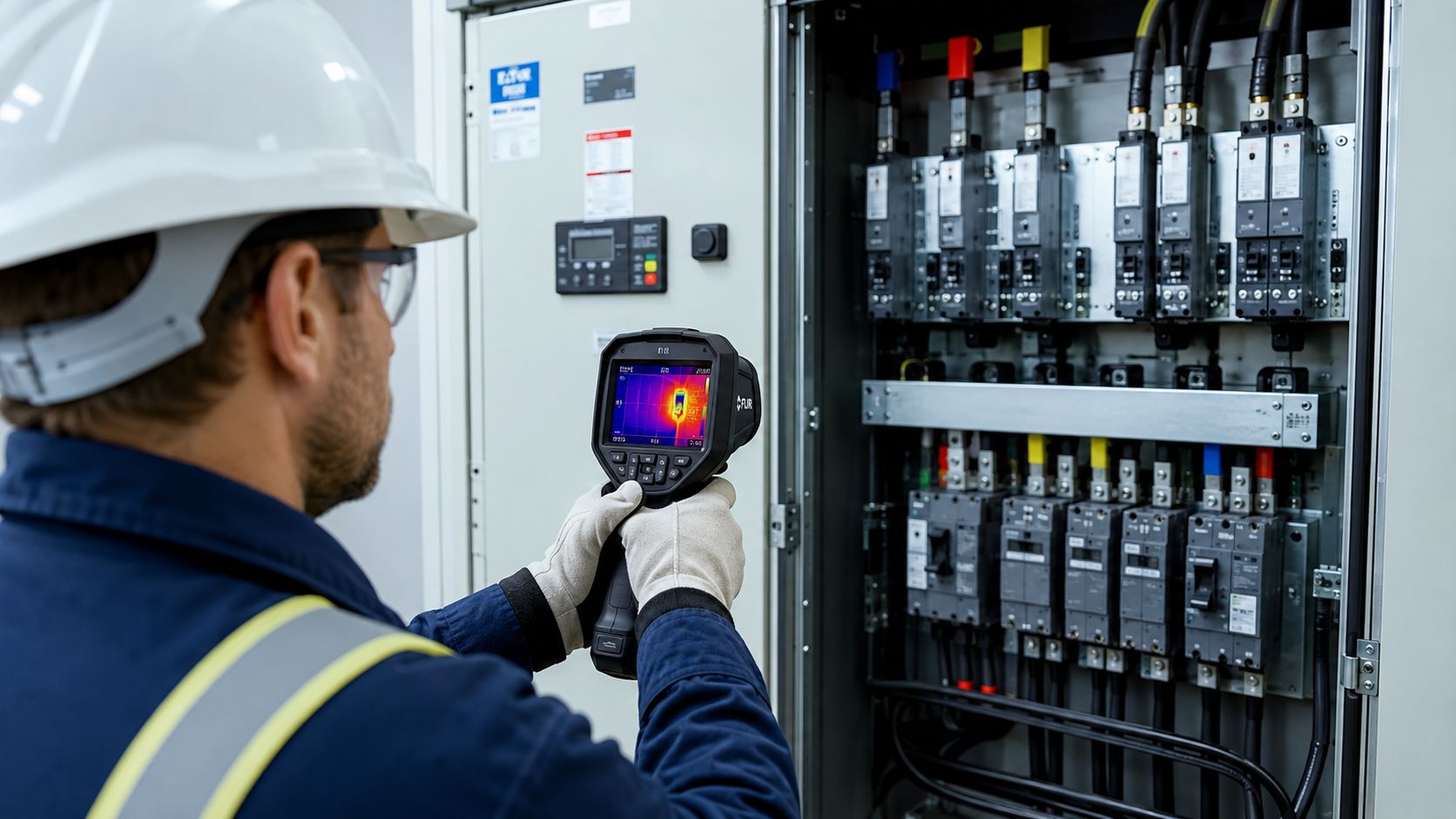
Infrared thermography gives you a predictive view. Instead of waiting for a failure, you can see heat patterns that point to trouble developing inside energized equipment.
Under NFPA 70E, thermal scanning is used to identify hotspots, and a thermal anomaly exceeding 10°C above ambient correlates with a 94% probability of imminent connection failure, according to this NFPA 70E-related infrared inspection reference. For a property manager, that's a practical threshold. It tells you a hotspot isn't just interesting. It may be a near-term failure condition.
An infrared image also helps ownership understand the issue faster than a written note alone. A standard photo may show a normal-looking panel interior. A thermal image can show one lug or breaker connection running hot against cooler surrounding components.
For managers comparing testing options, electrical infrared testing for commercial systems gives a useful picture of how documented thermal scans are used in preventive maintenance.
A visual-only report tells you what the inspector could see. An infrared-backed report tells you what the system is doing under load.
Where Title 24 enters the report
In California, electrical documentation often overlaps with energy compliance. That's where Title 24 notes can create confusion.
On commercial sites, those notes may relate to lighting controls, occupancy sensors, daylighting responses, or tenant improvement documentation. The practical question isn't just whether the controls exist. It's whether the building can prove the required testing and documentation if someone asks during a permit closeout, lease event, or compliance review.
For property managers, the value of including infrared and Title 24-related notes in the same overall electrical record is simple. You build a stronger file. One document trail helps show both system condition and compliance posture, instead of relying on scattered PDFs from different vendors and project phases.
Your Action Plan From Report to Resolution
The report itself doesn't reduce risk. The follow-through does.
A lot of electrical exposure stays in place because nobody owns the next step. The inspection happens, the document gets circulated, a few emails go out, and then the findings sit until a tenant complaint or outage forces action. That's avoidable if you run the report through a standard decision process.
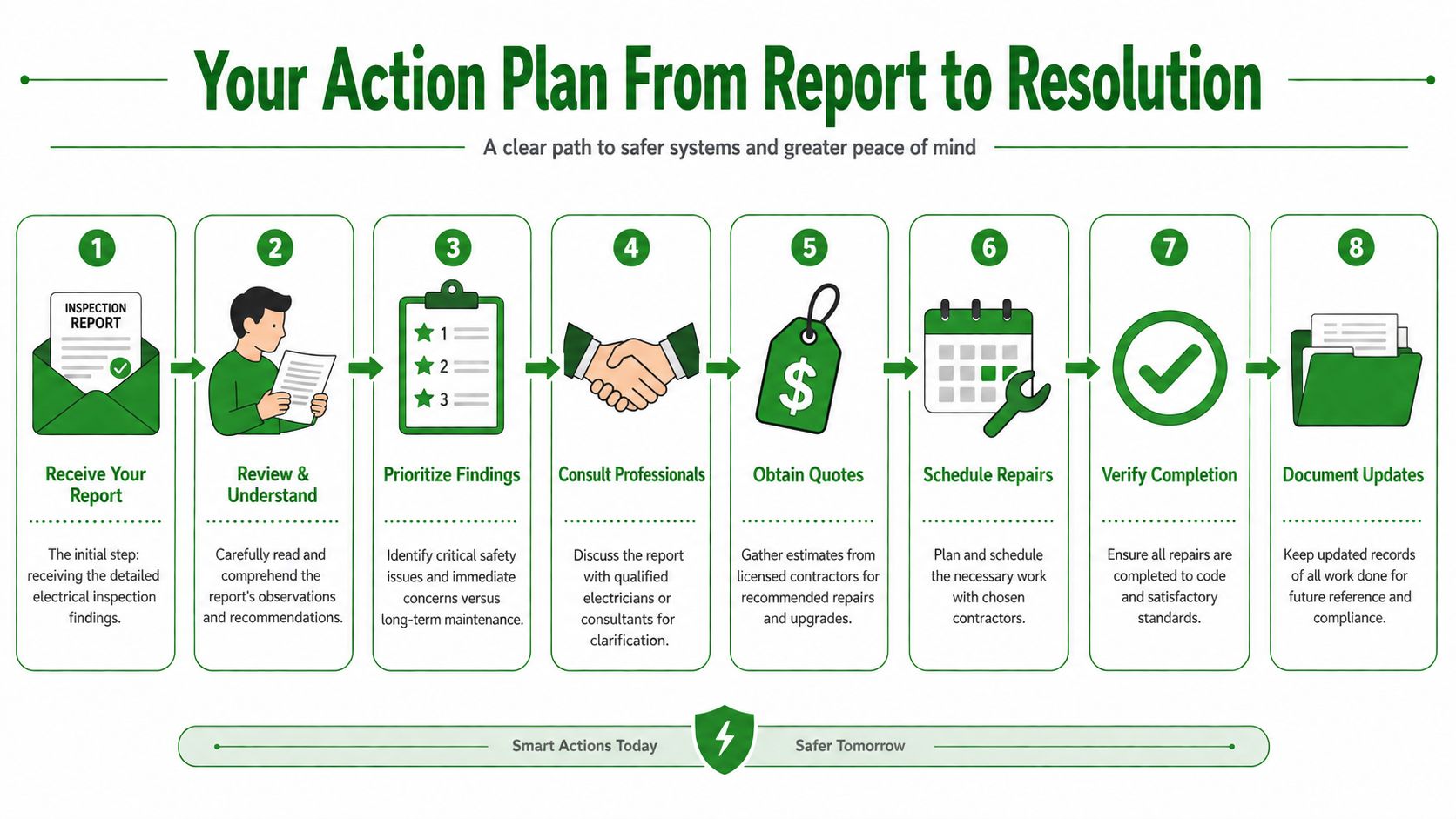
A practical workflow that keeps issues moving
Use the report to create a live work sequence, not a filing record.
- Review the highest-risk findings first. Pull out anything coded as immediate danger or any note that affects occupancy, life safety, or critical distribution.
- Confirm who is affected. Identify whether the issue sits in common area infrastructure, landlord equipment, or tenant-controlled space.
- Group related items into one work package. If several findings involve the same panel lineup, shutdown window, or service area, package them together.
- Send the full report for pricing. Contractors bid more accurately when they can see the photos, test notes, and exact locations.
- Set a decision deadline internally. Safety items shouldn't drift because budget review is waiting on unrelated scope.
- Schedule repairs around operations. Coordinate access, outage planning, and tenant communication early.
- Get closure documentation. Repairs need a written record, not just a closed invoice.
- File the before-and-after set together. That creates a usable compliance history.
Why vague scopes create change orders
When managers send only a screenshot or a single page summary to an electrician, the field team often has to rediscover the issue onsite. That can add delay, extra troubleshooting, and revised pricing because the original request didn't include the full condition.
Sending the complete report usually leads to cleaner proposals. It also helps the contractor plan equipment access, safety requirements, and outage coordination.
If you need repair follow-up after findings are identified, commercial electrical repairs and troubleshooting is the kind of service path typically used to move from report findings to corrective work. Access Electrical and Lighting is one example of a Southern California contractor that handles both documented inspections and repair scopes for commercial properties.
Close the loop or the paperwork won't help you later
The final step is the one many teams skip. After repairs are complete, ask for something that confirms the correction. Depending on the issue, that may be a follow-up report, completion letter, updated photographs, or revised test documentation.
The safest file is not a report that found problems. It's a report that found problems, a record that approved repairs, and a document showing the repairs were completed.
That matters during insurance questions, future inspections, ownership transitions, and tenant disputes. Without closure documentation, the old finding can keep resurfacing even if the work was done properly.
Compliance Documentation and Inspection Frequency
One of the most common questions from California property managers is whether a report is still “valid.” That sounds simple, but in practice it depends on why the document is being used.
A report used for internal maintenance planning isn't judged the same way as a report being reviewed during an insurance renewal, a lease negotiation, or a tenant improvement tied to energy controls. The form of the inspection matters, and the level of documentation matters.
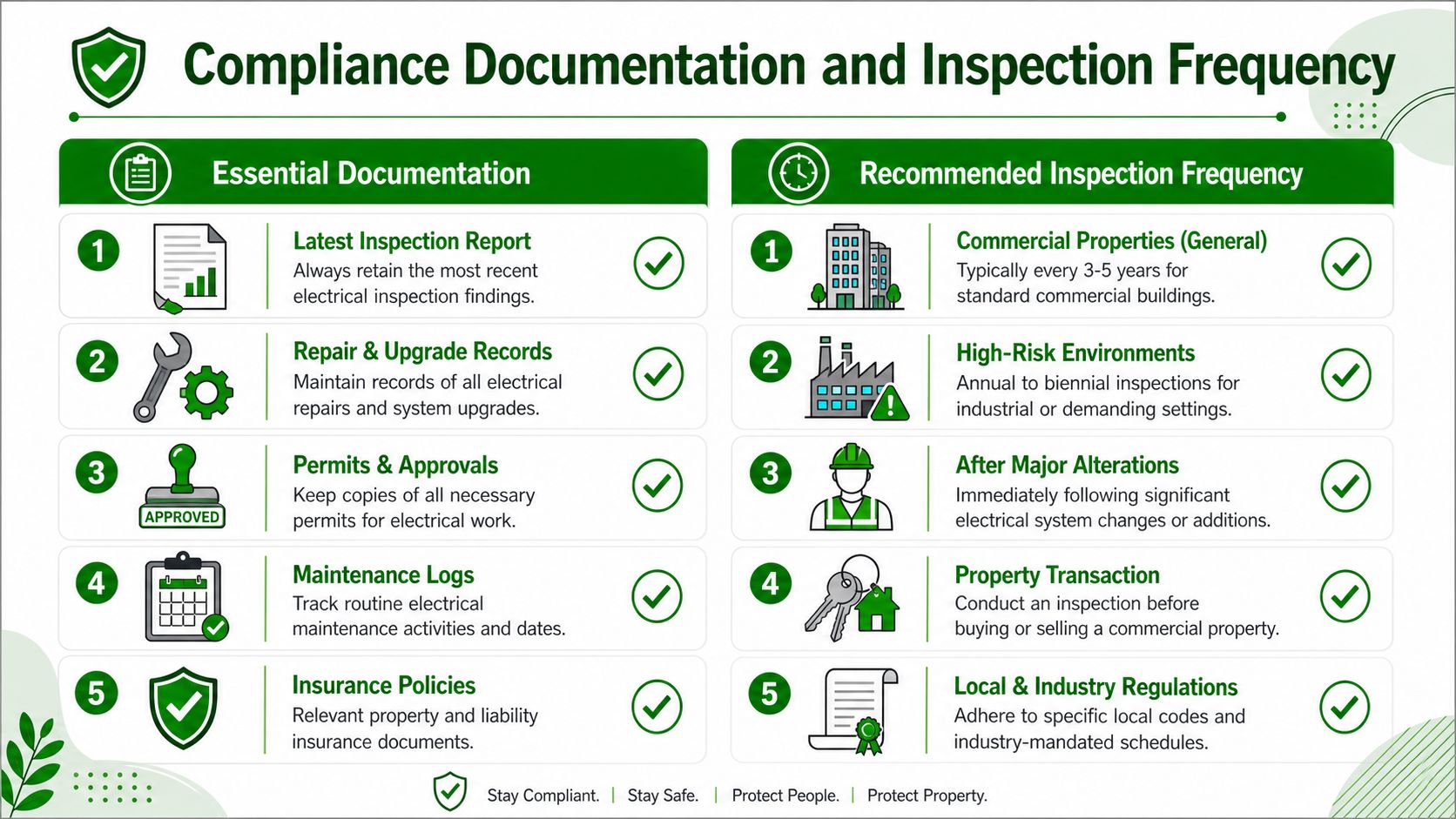
What to keep in the property file
At minimum, your electrical compliance file should include:
- Latest inspection report. Keep the full version, not just the summary pages.
- Repair records. Save proposals, approved scopes, invoices, and completion confirmations together.
- Permits and sign-offs. If electrical work required permitting, keep those approvals with the inspection record.
- Maintenance history. Routine service notes help show the property didn't ignore known issues.
- Title 24-related documentation. Keep any testing, certification, and control-system records tied to lighting compliance.
How to think about frequency in California
A critical issue for California property managers is how long an inspection remains useful for insurance, leasing, or Title 24 purposes. As noted in this guide to understanding electrical inspection report validity and evidentiary weight, annual checks are a general rule, and a documented infrared report carries longer evidentiary weight than a simple visual inspection, especially when you need to show ongoing Title 24 compliance for lighting controls during tenant improvements.
That doesn't mean every building needs the exact same interval or the exact same type of inspection. Older systems, recently altered spaces, properties with recurring electrical complaints, and buildings with active tenant improvement work usually deserve closer attention than a stable site with no recent changes.
For managers dealing with lighting controls and energy documentation, Title 24 compliance requirements for commercial properties is the practical side of the issue. The key point is that a visual walk-through and a documented compliance-oriented inspection do not carry the same weight.
The file should tell a story
When someone reviews your records later, they should be able to see a clean chain:
- The property inspected the system.
- The report identified issues.
- The management team authorized action.
- The work was completed.
- The property retained documentation.
That sequence is what protects a manager far more than a single report sitting in a folder by itself.
Frequently Asked Questions for Property Managers
The questions below are the ones that usually come up after the report has already been delivered and people are trying to decide what to do with it.
Do I need to fix every item immediately
No. You need to identify which findings create current danger, which ones point to likely failure, and which items can be bundled into planned work. That's why coded findings and measured results matter. They let you prioritize instead of reacting to the entire document at once.
Is a visual inspection enough for a commercial property
Sometimes for basic screening, yes. For decision-making on aging equipment, recurring issues, or insurance-facing documentation, visual-only reports are often too thin. If the building needs stronger evidence of condition, a documented report with testing and thermal imaging is more useful than a simple checklist.
What makes a report useful during lease or insurance discussions
Clarity and documentation. The report should identify exact equipment or locations, include photos, explain the severity of findings, and show what was done afterward. A report without repair follow-up often raises as many questions as it answers.
How should I use the report during budgeting
Use it to split work into three buckets:
- Immediate corrective work for dangerous or failure-prone conditions
- Near-term scheduled repairs that should be handled in the next maintenance cycle
- Capital planning items where aging equipment or repeated issues suggest replacement is smarter than ongoing patchwork
That approach gives ownership a cleaner picture than one large undifferentiated repair list.
Why are these reports becoming more important
Because the market around testing, inspection, and certification keeps expanding. The global electrical and electronics testing, inspection, and certification market generated USD 113.4 billion in 2024 and is projected to reach USD 170.2 billion by 2032, according to Market Research Future's electrical and electronics TIC market report. For property managers, the takeaway is straightforward. Buildings are relying more heavily on documented inspection records for safety, insurance, and regulatory reasons.
What should I ask the contractor after receiving the report
Ask practical questions, not generic ones:
- Which findings create immediate safety exposure?
- Which repairs can be grouped into one outage window?
- Which items require more testing before repair pricing is final?
- What documentation will I receive after completion?
- Does any part of this affect tenant improvements, lighting controls, or compliance files?
Those answers usually tell you whether the contractor understands property management realities or is only speaking from a field-service viewpoint.
If you need help turning an electrical inspection report into a clear repair and compliance plan, Access Electrical and Lighting works with commercial, retail, office, and multifamily properties across Southern California on documented inspections, infrared testing, troubleshooting, repairs, and Title 24-related electrical scopes.