A tenant calls before 8 a.m. because someone tripped in a dim parking area. An office suite manager complains that the new LED upgrade is “too bright” but still leaves dark patches near the copy room. Later that week, an inspector asks for emergency light test records, and nobody can find them.
That's how lighting turns from a maintenance issue into a liability issue.
Most property managers don't struggle because they ignore safety. They struggle because lighting compliance sits in the gray area between electrical work, building operations, tenant expectations, and life safety documentation. The fixture may turn on. The bill may be lower after a retrofit. But if the site is unevenly lit, if the exit path isn't dependable, or if the records are missing, the property still has exposure.
The practical problem with OSHA standards for lighting is that the code gives you a floor, not a full lighting strategy. That matters even more in Southern California, where energy rules, retrofits, controls, and local enforcement all collide in the same project.
Why Your Property's Lighting Is a Major Liability
Lighting problems usually don't announce themselves as code violations first. They show up as complaints, near misses, or small work orders that keep repeating.
A parking structure gets a lamp replacement every few weeks because the original fixtures are failing one by one. A janitorial crew props open a door because the service corridor feels too dark. An employee in a warehouse says the aisles are “lit,” but they still can't read labels cleanly where the new LED fixtures create hot spots and shadows. None of that sounds dramatic until someone gets hurt, an insurer starts asking questions, or an inspection turns a routine site visit into a corrective action list.
Where managers usually get blindsided
The biggest mistake is treating lighting as a cosmetic item. Fresh paint and clean landscaping are visible. Lighting risk is often hidden until the wrong moment.
Common pressure points include:
- Slip, trip, and fall exposure: Dim transition areas, stair landings, parking stalls, and walk paths create preventable risk.
- Tenant and employee complaints: People notice glare, dark corners, and flicker long before a meter reading gets checked.
- Inspection gaps: Emergency fixtures may be installed but not tested, tagged, or documented.
- Deferred maintenance: One failed lamp becomes several, then an entire area drifts below a safe operating condition.
Practical rule: If people are using phones as flashlights, the property already has a lighting problem, whether the last walkthrough caught it or not.
Why this reaches beyond OSHA
Property managers often hear “OSHA” and think only about job sites or employer obligations. In practice, lighting also affects premises liability, tenant retention, maintenance planning, and the defensibility of your operations after an incident.
A lawyer won't care that a fixture was “on most of the time.” They'll want to know whether the area was reasonably safe, whether the exit path was visible, whether maintenance was documented, and whether known defects were corrected in a timely way.
That's why the right approach isn't just “meet code.” It's to build a site condition that you can defend. The numbers matter. The documentation matters. The visual result matters too.
Decoding Federal OSHA Lighting Requirements
Federal OSHA sets minimum lighting levels for certain work environments. For many managers, the confusing part is the unit of measurement.
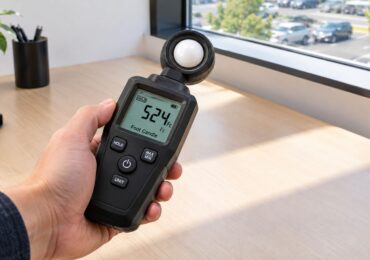
A foot-candle is a measure of how much light lands on a surface. The simplest way to think about it is this: it reflects usable light at the task area, not just how bright the fixture looks from below. A powerful fixture can still leave a workspace underlit if spacing, mounting height, lens condition, or aiming are wrong.
The federal baseline
Under OSHA's construction standards, several minimum illumination levels are clearly defined. According to this summary of OSHA lighting requirements under 29 CFR 1926.56, general construction areas must have at least 5 foot-candles, first-aid stations and offices require 30 foot-candles, and workrooms, shops, and indoor toilets require 10 foot-candles. The same source notes that tunnels and shafts generally require 5 foot-candles, while drilling, mucking, and scaling operations require 10 foot-candles.
Those numbers are minimums. They are not a design target for every space.
OSHA minimum illumination requirements by area
| Area Type | Minimum Illumination (Foot-Candles) |
|---|---|
| General construction areas | 5 |
| First-aid stations | 30 |
| Offices | 30 |
| Workrooms | 10 |
| Shops | 10 |
| Indoor toilets | 10 |
| Tunnels and shafts | 5 |
| Drilling, mucking, and scaling operations | 10 |
What these minimums mean in the field
If you manage mixed-use commercial property, the practical takeaway is simple. You can't evaluate lighting by eye alone.
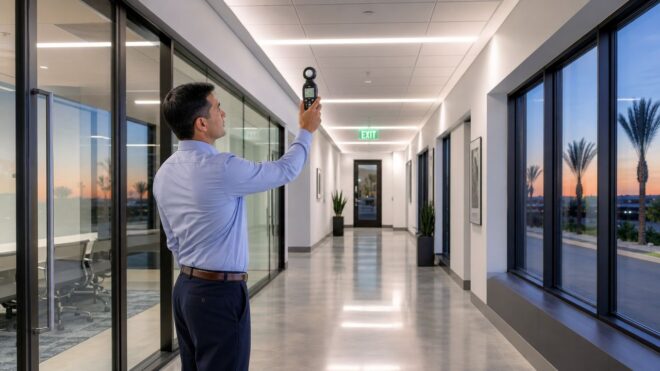
Two spaces can look “bright enough” to different people and still perform very differently. One reason is surface reflectance. Another is fixture placement. Another is lens aging or dirt buildup. This is why competent contractors and safety teams use a light meter and test conditions at the work plane instead of guessing from fixture wattage or visual impression.
A few field realities matter:
- Open areas are easier to pass than task areas: A broad hallway may read acceptably while a workstation, sink, panel, or service counter falls short.
- Fixture replacement alone doesn't guarantee compliance: New LEDs can improve output, but they can also create patchy distribution if the layout isn't recalculated.
- Burned-out lamps change the result fast: A design that barely clears the minimum on paper won't stay compliant long in actual operation.
Meeting the foot-candle number is the starting point. It doesn't prove that the space is comfortable, balanced, or safe for every task being performed there.
What works and what doesn't
What works is a measured approach: identify the task, verify the area classification, meter the space, and correct the lighting pattern.
What doesn't work is relying on old plans, lamp counts, or assumptions like “we upgraded to LED, so we must be fine now.” OSHA standards for lighting are performance based at the surface level. That means your result in the field matters more than your intent.
Emergency and Egress Lighting Mandates
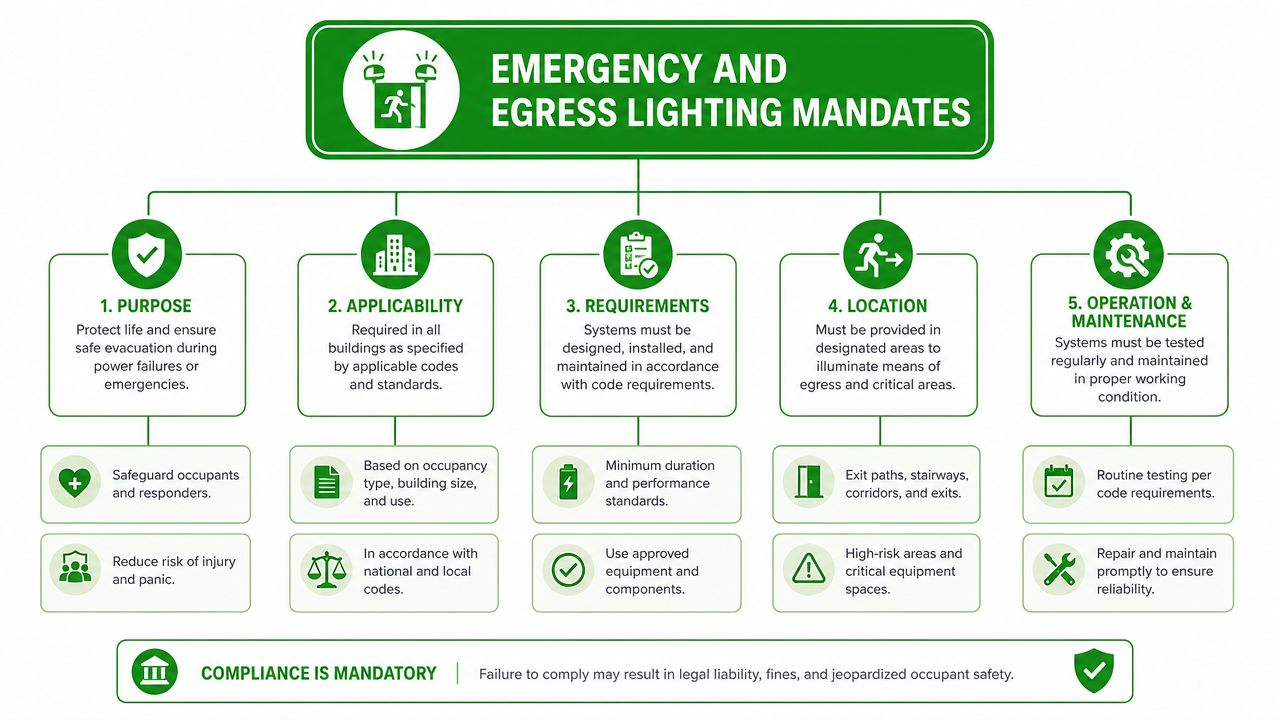
General illumination keeps work moving. Emergency and egress lighting keeps people moving when normal power fails.
Frequently, many properties have the appropriate hardware but poor maintenance discipline. Exit signs, battery packs, remote heads, inverter-supported fixtures, and generator-backed circuits all need to function when the building is under stress, not just during business hours.
What inspectors and risk managers care about
The first question is basic. Can occupants clearly find and follow the exit route if normal lighting goes out?
The second question is tougher. Can you prove the system was maintained?
That's why emergency lighting is more than an installation issue. It's an inspection and recordkeeping issue too. If your site has battery backup units, internally illuminated exit signs, or emergency circuits, they need routine checks, and those checks need to be documented. A strong emergency lighting and exit sign system maintenance program closes that gap before an inspection or incident exposes it.
The failure points that show up over and over
Property teams usually run into the same handful of problems:
- Dead batteries: The fixture looks normal with utility power present, but fails the moment backup mode is tested.
- Blocked visibility: Exit signs are technically installed, but a banner, tenant buildout, or stacked storage interferes with line of sight.
- Unlabeled repairs: Someone replaced a unit, but nobody updated records, tags, or test logs.
- Broken test culture: Staff assume another vendor handled it, while the vendor assumes onsite staff did monthly checks.
A practical testing mindset
A compliant emergency fixture isn't just one that lights up during a quick glance. It has to perform when needed, and the property has to be able to show that it was checked.
Keep your process grounded in a few basics:
- Walk the egress path, not just the fixture list. Start at occupied areas and move outward the way a person would leave during an outage.
- Check visibility under real conditions. Tall displays, temporary partitions, and renovation dust walls often create hidden problems.
- Review the records with the hardware. A complete log tied to fixtures, locations, and service dates matters as much as the equipment itself.
- Treat failed tests as priority repairs. Emergency lighting isn't a “next quarter” work order.
If a building loses power, nobody gets extra time because the emergency lights were scheduled for service next week.
What good properties do differently
The better-run sites don't wait for a life safety inspection to find out what works. They build a repeatable routine around testing, repairs, and documentation. They also make sure tenant improvements, new partitions, and storage changes don't compromise exit visibility after the original install passed.
That discipline matters because emergency lighting failure is one of the easiest issues to discover and one of the hardest to explain away later.
Common Violations and Modern Lighting Challenges
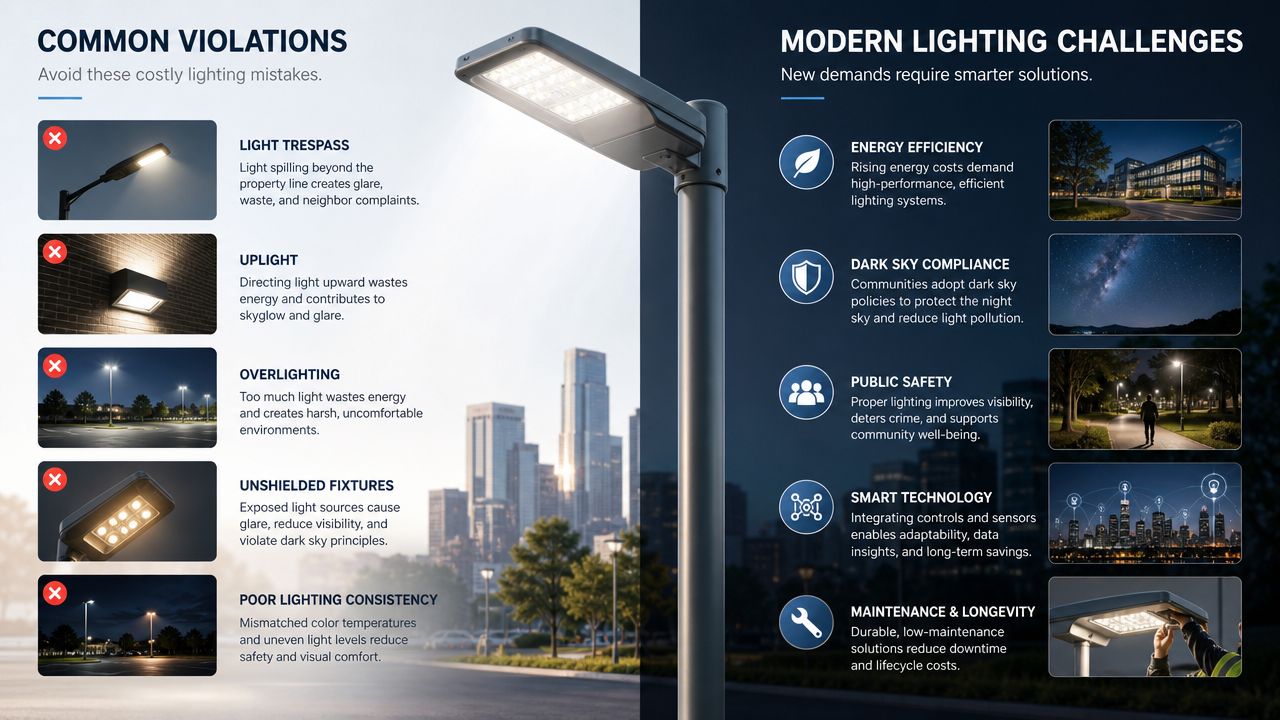
The most common lighting violations aren't exotic. They're boring, preventable, and easy to miss when maintenance is reactive.
A fixture goes out over a service walkway. An exit sign face cracks. A timer drifts after a power event. A temporary cord-and-plug setup stays in place longer than anyone planned. These aren't design theory problems. They're property operations problems.
The violations that keep showing up
When I review troubled sites, the same patterns usually appear together. One missed item tends to signal several others.
- Burned-out lamps in critical areas: Stairwells, loading paths, trash enclosures, service alleys, and parking corners often get neglected because they aren't front-of-house.
- Damaged or dark exit signage: Signs can be physically present and still fail from lamp, ballast, faceplate, or battery issues.
- Expired or inconsistent test records: Even when staff did the work, poor documentation creates the appearance that no testing happened.
- Poorly managed temporary lighting: Renovation areas and tenant improvement zones often drift into unsafe conditions when “temporary” becomes semi-permanent.
The modern problem the code doesn't solve well
Here's where many national code summaries stop too early. OSHA standards for lighting tell you the minimum illumination level, but they don't do a good job addressing glare and uniformity in modern LED environments.
That gap matters. According to this analysis of OSHA lighting requirements and LED retrofit issues, OSHA sets minimum foot-candle levels but doesn't define maximum glare or uniformity thresholds, and 68% of office workers report visual strain in LED-lit environments with poor uniformity. That leaves managers in a difficult position. A space can pass the meter test and still generate headaches, complaints, and unsafe visual conditions.
Why LED retrofits sometimes go wrong
LEDs aren't the problem. Bad retrofit decisions are.
A few examples:
- Wrong beam spread: Narrow distribution creates bright pools with dark gaps between fixtures.
- Overcorrection: Swapping in very bright lamps to “solve” an underlit area often creates reflected glare off polished floors, desks, racking, or screens.
- Ignoring mounting height: A lamp that works in one fixture family may perform poorly in another because the optic and height relationship changed.
- Control settings that are too aggressive: Occupancy sensors and dimming strategies can save energy while making circulation routes feel unstable or underlit.
A light meter can confirm minimum output. It can't, by itself, tell you whether people can work comfortably without squinting, shadowing, or visual fatigue.
What works better in practice
The best retrofit projects start with both compliance and use conditions. That means checking meter readings, but also reviewing sight lines, screen glare, shelf shadows, transition zones, and the contrast between bright and dim areas.
The difference is usually obvious in the finished result. Good lighting feels calm and usable. Bad lighting feels harsh, patchy, or tiring even when the fixture schedule looked efficient on paper.
The California Factor CalOSHA and Title 24
In Southern California, federal OSHA is only part of the picture. The harder part is making worker safety, energy code, and actual building use all work together.
That's where managers often get caught. A retrofit can be excellent from an energy standpoint and still create operational problems if controls, fixture selection, or light distribution aren't coordinated with how the property is occupied.
Why California changes the conversation
California projects bring extra layers. Cal/OSHA can shape how workplace safety is interpreted and enforced, while Title 24 drives lighting controls, energy performance, and documentation expectations. On paper, these systems should align. In the field, they can compete if the project is designed too narrowly.
A common example is a cost-focused LED upgrade paired with aggressive occupancy controls. It may reduce runtime and satisfy energy goals, but if transition zones, back-of-house areas, or parking circulation paths feel inconsistent, the site can become less usable and harder to defend from a safety standpoint.
That's why a local retrofit needs more than fixture replacements. It needs layout review, control strategy review, and commissioning discipline. On Southern California properties, that often means pairing lighting work with commercial LED retrofit and installation planning for Orange County buildings so the finished system performs in daily use, not just on a cut sheet.
Where conflicts usually show up
The problem spots are predictable:
- Occupancy sensors in marginal areas: Storage rooms, service corridors, trash rooms, and support spaces can feel dark on entry if sensor placement or delay timing is poorly tuned.
- Daylight-responsive dimming near windows: Useful for energy savings, but it can create uneven interior contrast if the controls aren't calibrated.
- Parking and exterior controls: Energy code logic has to coexist with clear nighttime visibility for vehicles, pedestrians, and security operations.
- Tenant improvements: One suite upgrade can alter corridor light spill, sight lines, or shared-area expectations for the rest of the property.
The practical standard to use
For California properties, the right question isn't “Did we lower wattage?” It's “Did we lower wattage without making the site harder to use safely?”
Use this framework during planning and punch:
| Decision Area | What to Verify |
|---|---|
| Fixture selection | Does the optic suit the mounting height and task area? |
| Controls | Do sensors and dimming settings preserve safe entry and travel conditions? |
| Documentation | Are testing, certification, and maintenance records organized and current? |
| Occupant experience | Are glare, shadows, and transition zones acceptable in real use? |
California lighting projects fail when the design team treats safety, energy code, and maintenance as separate conversations. On a real property, they're the same conversation.
What a strong Southern California approach looks like
Good projects account for code, utility logic, tenant expectations, maintenance access, and after-hours conditions before material is ordered. They also anticipate how a building changes over time. New partitions go in. Storage creeps into pathways. Hours shift. Security needs change.
That's why local experience matters. Generic national guidance rarely addresses the overlap between Cal/OSHA expectations, Title 24 controls, and the practical realities of Orange County commercial properties.
Your Commercial Property Lighting Compliance Checklist
Most lighting issues become expensive because nobody catches them while they're still small. A quick site walk won't replace a formal audit, but it will reveal whether your property has obvious exposure.
Use this checklist the way a practical manager should. Walk the site at night where applicable. Check occupied spaces during normal operations. Open the electrical rooms. Look at records, not just fixtures.
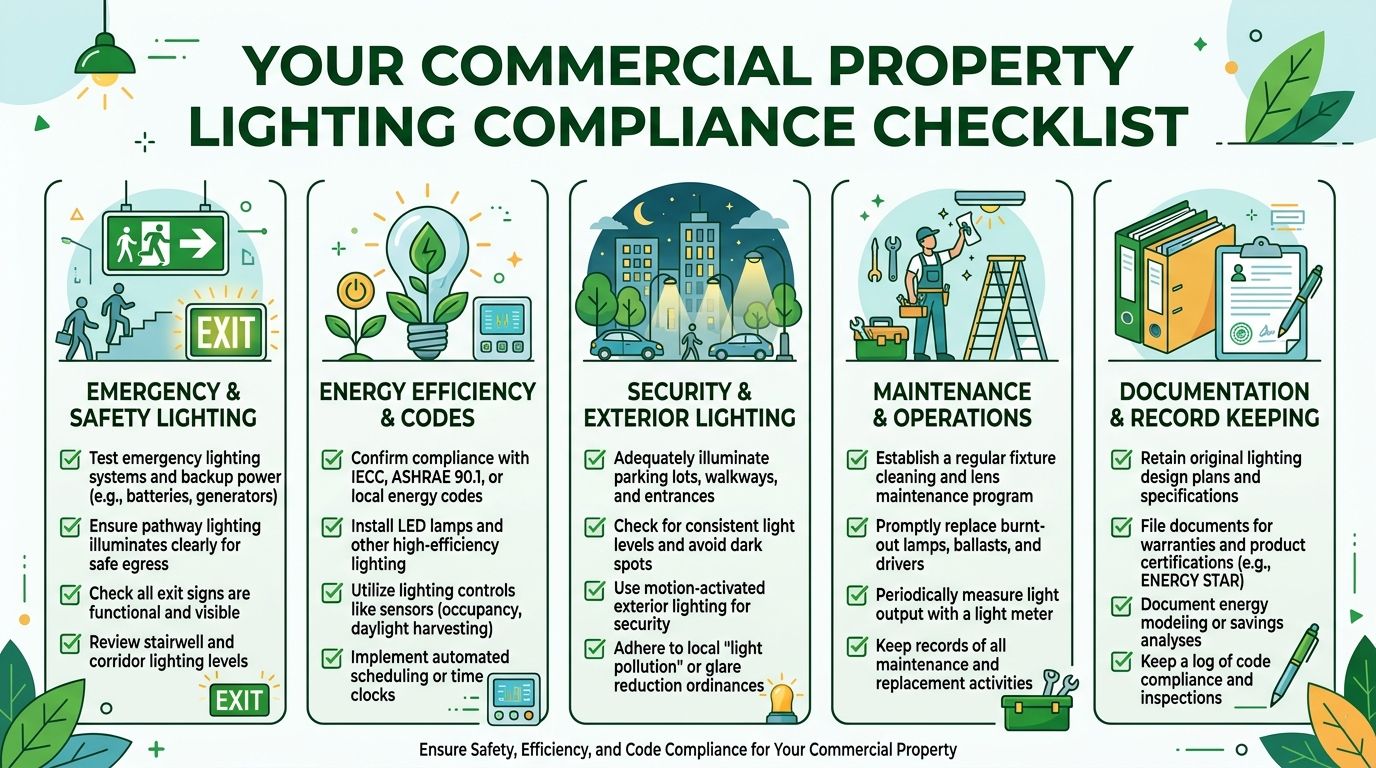
Walkthrough items that matter
- General area lighting: Are there dim zones, dark corners, or obvious lamp outages in corridors, stairs, offices, restrooms, loading areas, and parking surfaces?
- Task visibility: Can staff clearly read labels, controls, signage, and work surfaces without bringing in extra lamps or using phones?
- Emergency units and exit signs: Are all units intact, illuminated where required, unobstructed, and in serviceable condition?
- Test records: Can your team immediately produce emergency light inspection and testing logs?
- Controls behavior: Do occupancy sensors, photocells, and timers operate predictably without creating unsafe dark intervals?
- Temporary conditions: Have any renovation lights, extension-fed fixtures, or provisional setups remained in place too long?
- Fixture condition: Are lenses yellowed, cracked, dirty, or hanging loose? Are pole and wall fixtures physically secure?
- Tenant change impact: Did any recent buildout alter corridor brightness, egress visibility, or shared-area light balance?
What deserves fast action
Some findings can wait for planned maintenance. Others shouldn't.
Treat these as priority items:
- Any failed emergency or exit component
- Dark egress paths or stair sections
- Exterior areas where visibility affects walking or driving
- Lighting complaints tied to glare, headaches, or uneven coverage
- Missing documentation for required testing
Where professional help makes sense
A contractor earns value when the property needs more than lamp replacement.
Bring in specialized support when you need:
- Measured light-level verification: Useful when the space “looks fine” but complaints or risk concerns continue.
- Emergency lighting testing and documentation: Important when records are incomplete or multiple buildings are involved.
- LED retrofit correction: Necessary when an upgrade saved energy but created glare, shadows, or uneven output.
- Lighting control troubleshooting: Critical when Title 24 controls are technically operating but practically causing safety headaches.
- Ongoing site maintenance: Best for portfolios where recurring outages, night calls, and tenant turnover keep creating lighting issues.
For many Southern California properties, the most efficient path is a recurring commercial lighting maintenance program that combines repairs, testing support, and proactive inspections instead of waiting for complaints.
Good compliance programs don't depend on memory. They depend on routines, records, and someone owning the result.
If your checklist turns up more than a few weak spots, don't assume they're isolated. Lighting problems usually cluster. The site that has missing test logs often also has control issues, deferred fixture failures, or retrofit choices that need correction.
Access Electrical and Lighting helps Southern California property teams address lighting compliance, emergency lighting, LED retrofits, controls, and ongoing maintenance with field-tested support. If you need a contractor who understands OSHA lighting requirements, Cal/OSHA concerns, Title 24 coordination, and the practical aspects of commercial properties in Orange County, visit Access Electrical and Lighting.