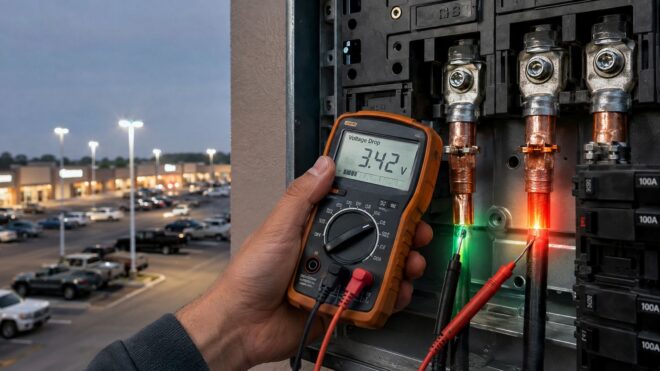
You're standing in a parking lot after dark, and the lights at the far end of the row look weaker than the ones by the building. Or maybe the EV charger on the back wall starts slow, then seems to back off once the site gets busy. That's the kind of problem property managers notice first, because it shows up where people can see it, use it, and complain about it.
The short answer to what is the cause of voltage drop is simple, current moving through real wire has to overcome resistance and impedance, so some loss is unavoidable. The important part is separating that normal, expected loss from the kind of abnormal voltage loss that points to a fault, like a loose lug, a corroded splice, damaged insulation, or conductors that were never sized for the job in the first place. As HVACR School explains in its discussion of voltage drop, many explanations stop at the classic causes and miss that distinction.
That distinction matters on commercial property because you're not just trying to keep a circuit alive. You're trying to keep lighting even, panels cool, chargers reliable, and equipment from working harder than it should. Once you understand which part of voltage drop is physics and which part is a fixable problem, diagnosis gets a lot cleaner.
Why Voltage Drop Matters on a Commercial Site
A dim row of pole lights at the back of a lot usually doesn't start with a dramatic failure. It starts with one circuit that's carrying power farther than it should, or through a connection that's developed resistance over time. A facility manager sees the symptom first, a technician sees the cause later, and the gap between those two moments is where a lot of wasted time and unnecessary parts replacement happens.
At a commercial site, voltage drop is less about a textbook definition and more about whether the property is behaving the way it was designed to behave. Lighting is often the first clue because it gives you a visible result, but the same issue can affect exhaust fans, controls, receptacles, chargers, and any other load that expects stable input. A circuit can look fine at the panel and still perform poorly at the far end of the run.
Practical rule: if the load is weak only at the end of the circuit, don't assume the fixture is the problem first. Follow the power path.
The basic mental model is easy. Every conductor has resistance, so every real wire causes some drop when current flows through it. That doesn't mean the system is failing. It means the system is obeying physics.
The trouble starts when the drop becomes larger than the equipment and the site can tolerate. That's when you start seeing nuisance behavior, uneven light levels, slow chargers, or equipment that runs hot for no obvious reason. In a commercial environment, those symptoms usually point to a site condition, not a mystery inside the fixture itself.
A good diagnosis begins with that difference in mind. Normal drop is expected. Abnormal loss is a clue.
The Physical Causes Behind Voltage Drop

The four classic causes
Think of current like water moving through a hose. A long hose, a narrow hose, a kink, or a blocked fitting all make it harder for the flow to reach the end with the same pressure. Electrical circuits behave the same way, except the “pressure” is voltage and the “restriction” is resistance and impedance.
The four causes heard about first are undersized conductors, poor or loose connections, higher-than-design current, and long runs. Those are still the right starting points, because they describe where the circuit is losing energy. A long feeder has more resistance than a short one, a small conductor has more resistance than a larger one, and a circuit carrying more current than it was designed for will show more drop along the way.
Poor connections deserve special attention because they don't just add resistance in the abstract. A loose lug, a corroded splice, or a damaged termination creates a specific choke point where the circuit can heat up and lose voltage under load. That's why a site can have one bad connection and still look like a wire-sizing problem from a distance.
Temperature and loading change the picture
Recent commercial guidance puts more emphasis on temperature and operating conditions as part of the diagnosis, not just conductor size. As Service Wire notes in its voltage-drop guidance, higher temperatures raise resistance, bundled cables and hot environments make the drop worse, and the effect of load current isn't linear in the way many people expect. In plain terms, the same circuit can behave differently on a cool office floor than on a hot rooftop or inside a crowded equipment chase.
That matters because commercial sites rarely run in perfect conditions. You may have rooftop feeders, outdoor lighting runs, bundled conductors in tight spaces, or equipment that cycles through different load levels during the day. A circuit that looks acceptable in the morning can behave very differently by afternoon if the environment heats up and the load rises at the same time.
Heat doesn't create voltage drop by itself, but it makes the circuit less forgiving.
So the answer isn't one cause. It's a stack of contributors. Some are unavoidable, like the resistance of a conductor. Others are fixable, like bad terminations or a conductor that was never right for the load and distance. Good troubleshooting means separating those pieces instead of treating every dim light as proof that the wire is too small.
Symptoms You Can See on a Commercial Property
A retail center called about dim pole lights at the back of the lot. The front row looked fine, the building lights looked fine, and the tenant thought the fixtures were failing. On site, the pattern told a different story, the farthest loads were the weakest, which usually means the problem lives somewhere in the run, the terminations, or the load profile, not just inside one fixture.
What the site tells you
Dim or uneven parking lot lighting often points to distance, conductor size, or a bad connection somewhere upstream. If the lights closest to the source look normal and the farthest ones don't, that pattern gives you a clue before a meter goes on the circuit.
Hot panels or warm terminations usually point to resistance at a connection point. That may be a loose lug, an aged splice, or a connection that has been stressed by heat and vibration over time. The heat is the symptom you can see with the right tool, but the cause is usually mechanical or environmental.
Flickering interior LEDs can come from a variety of issues, but in a commercial building they often show up where branch circuits are long, loaded heavily, or feeding equipment that shares electrical space with other noisy loads. The flicker is the complaint, but the underlying issue still has to be traced back to the circuit.
EV charging output that seems to taper off can also be a voltage-drop clue, especially on long runs or on circuits that are seeing more demand than they were originally set up for. Chargers are sensitive to input conditions, so they'll often expose weaknesses that lighting can hide.
A facility manager doesn't need to guess the exact cause from the symptom alone. The point is to notice the pattern. If the weakness is uniform across the circuit, that points one direction. If it's strongest at the far end, that points another. If the issue comes and goes, connection quality moves higher on the list.
In commercial work, the symptom often tells you where to start, not where to finish.
How Voltage Drop Is Measured and Diagnosed

A qualified technician starts with the same question every time, how much voltage is available at the source, and how much is left at the load when the circuit is working. That under-load comparison matters, because a circuit can look fine with no demand on it and fall apart once equipment starts pulling current.
The basic field check
The first reading goes at the source under load, usually at the panel, feeder, or disconnect that supplies the circuit. The second reading goes at the load end, at the fixture, charger, outlet, or equipment connection. Once those two numbers are known, the technician can see whether the drop is normal for that circuit or excessive enough to require corrective work.
That's where a multimeter stops being a general-purpose tool and becomes a diagnostic test. The point isn't just to measure voltage, it's to compare voltage at two points in the same energized path while the load is active.
Infrared thermography adds another layer because heat often reveals resistance before the circuit fails completely. Loose connections, corroded joints, and stressed lugs often show up as hotspots under load, which is why infrared inspections are useful on switchgear, panels, and other commercial distribution equipment. If you want the deeper purpose of that method, this infrared testing overview shows why hot spots matter before they become outages.
What the code benchmark means
The NEC recommends keeping branch-circuit voltage drop to 3 percent or less, and the combined feeder and branch drop to 5 percent or less. Those recommendations don't diagnose the fault by themselves, but they give you a practical benchmark for deciding whether a circuit is operating in a healthy range or drifting into trouble.
A good reading at the panel doesn't clear the circuit. You still need to check the load end.
For property teams, the useful takeaway is simple. If a load is weak, confirm the numbers under load, inspect the terminations for heat, and compare the result to the circuit's design intent. That sequence usually tells you whether you're dealing with normal loss, a sizing issue, or a connection problem that needs immediate attention.
Undersized Conductors Versus Long Runs Versus Bad Connections
These three causes get lumped together all the time, but they don't behave the same way on site. If you treat them as one problem, you can replace the wrong part, miss the fault, and spend money twice.
| Cause | Typical Symptom | Most Common Location | Remediation |
|---|---|---|---|
| Undersized conductors | Broad dimming or weak performance across the whole circuit | Feeder, branch circuit, or retrofit run that was never resized | Upsize conductors or redesign the circuit for the actual load |
| Long runs | The farthest fixture or device is the weakest | Parking lot lighting, pole lighting, rooftop equipment, remote loads | Shorten the run, split the load, or create a new circuit path |
| Poor or loose connections | Intermittent operation, heat at a terminal, behavior that comes and goes | Panels, lugs, splices, disconnects, terminations | Re-torque, clean, repair, or replace the compromised connection |
The easiest way to separate them is by pattern. Undersized conductors tend to affect everything on that path in a more uniform way. Long runs usually punish the loads farthest from the source first. Loose or corroded connections are the ones that make technicians chase a ghost, because the symptom can disappear when the load changes or the circuit cools down.
That's why replacing wire should not be the first reflex. If a single bad termination is creating the resistance, a full rewire won't solve the problem at the panel. Likewise, if the run is too long for the load, cleaning a connection might improve things temporarily without fixing the design issue.
Diagnostic shortcut: uniform weakness suggests sizing, distance-related weakness suggests run length, and heat or intermittency points to connection quality.
A seasoned electrician reads all three clues together. On a commercial property, that saves time, avoids unnecessary demolition, and puts the fix where it belongs.
Practical Fixes for Lighting, Panels, and EV Charging

A commercial fix starts with matching the remedy to the cause, not forcing every problem into the same bucket. If a parking lot has weak lighting at the far end, the right answer might be a feeder upgrade during an LED retrofit, not a fixture swap. If a panel has hot terminations, the fix may be repair work at the lugs, not a new branch circuit.
Lighting and site power
For parking lot and pole lighting, the most effective correction is often to rework the feeder or branch arrangement so the conductors better match the load and distance. That can happen during an LED retrofit, when the lighting load changes and the old wiring assumptions no longer make sense. On long site runs, splitting the load or shortening the path can help more than replacing perfectly good fixtures.
Panels and distribution gear
For switchgear and panel upgrades, the focus shifts to connection quality and distribution health. A technician can re-torque terminations, replace compromised lugs, and verify that the enclosure isn't hiding a heat problem that has been building slowly. That kind of work belongs with a licensed contractor, especially when the work touches service equipment, permitting, or inspection requirements in California.
EV charging installations
For EV charging, conductor sizing and load planning matter from the start because chargers can expose voltage-drop weaknesses quickly. If the circuit is long, hot, or loaded heavily, the charger may not perform the way the owner expects. Commercial EV charging station installation has to account for that reality before the equipment goes in, not after drivers start complaining.
In practice, a commercial electrician may also use Access Electrical and Lighting as one option for diagnosing and correcting these issues, since the firm handles lighting, switchgear, and EV charging scopes together. That matters because the fix often crosses categories, and the person tracing the voltage drop has to understand the whole circuit path, not just one device at the end of it.
The right repair is usually the one that addresses the weakest link directly. A new lug can cure a bad termination, a rerouted feeder can cure an overlong path, and a conductor upgrade can cure a sizing mismatch. The art is knowing which one your site needs.
Turning Voltage Drop Into a Preventive Maintenance Habit
Voltage drop gets expensive when nobody tracks it until something fails. A panel that runs hot, a charger that starts derating, or a lighting run that slowly gets dimmer is usually telling you the circuit has been drifting for a while.
The smarter approach is to build it into preventive maintenance. Document baseline readings on critical circuits, then compare them during future inspections so you can spot change instead of reacting to a breakdown. Pair those readings with periodic infrared inspections on panels, disconnects, and other high-value distribution points, because heat often shows the weak connection before the outage does.
Load changes deserve the same attention. Any retrofit, new charger, or equipment addition changes the electrical picture, so pre-retrofit calculations should happen before the work is complete, not after the site starts complaining. That's especially important on dense commercial properties where lighting, controls, and charging can all share space and influence each other.
Best maintenance habit: treat voltage drop like a trend line, not a one-time measurement.
For property teams that want a tighter program, the right cadence depends on load density and how hard the site works. High-use properties, rooftop equipment, and sites with many long runs should be checked more often than low-demand spaces with shorter distribution paths. If you already have a maintenance rhythm in place, voltage-drop checks fit naturally alongside thermal scans, panel inspections, and retrofit planning, not as a separate crisis response.
For a practical maintenance framework that ties into that approach, this preventive service guide shows why catching issues early is easier than fixing them after a failure. The point is simple, the earlier you see the trend, the fewer surprises you have at the worst possible time.
If dim lighting, hot panels, or charger issues are showing up on your property, Access Electrical and Lighting can help with troubleshooting, infrared inspections, lighting upgrades, panel work, and EV charging installations. Visit Access Electrical and Lighting to talk through the symptom you're seeing and get the circuit checked before a small voltage problem turns into a bigger outage.