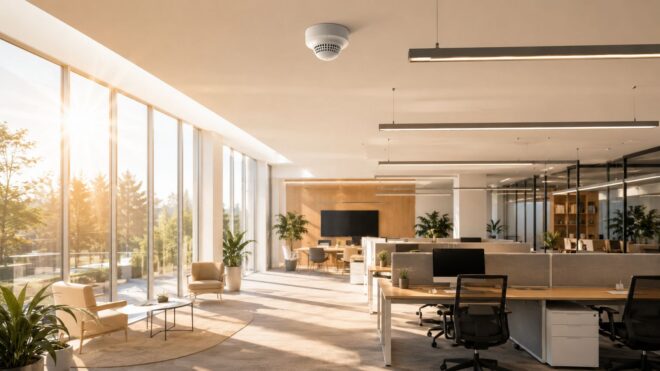
On a clear Southern California afternoon, it's common to walk a property where the sun is pouring through the glass, the perimeter offices are bright, and the ceiling lights are still running at full output. That's not a small leak in the budget. It's a daily operating habit that keeps utility costs higher than they need to be, and tenants notice it when the space feels overlit or inconsistent.
A daylight harvesting system is the practical fix. It uses available daylight to trim electric light automatically, so the building stops paying for brightness the windows are already providing. In the right property, that shift can be a fast way to cut lighting waste, improve visual comfort, and support Title 24 compliance without turning the lighting system into a science project.
Stop Wasting Sunlight in Your Building
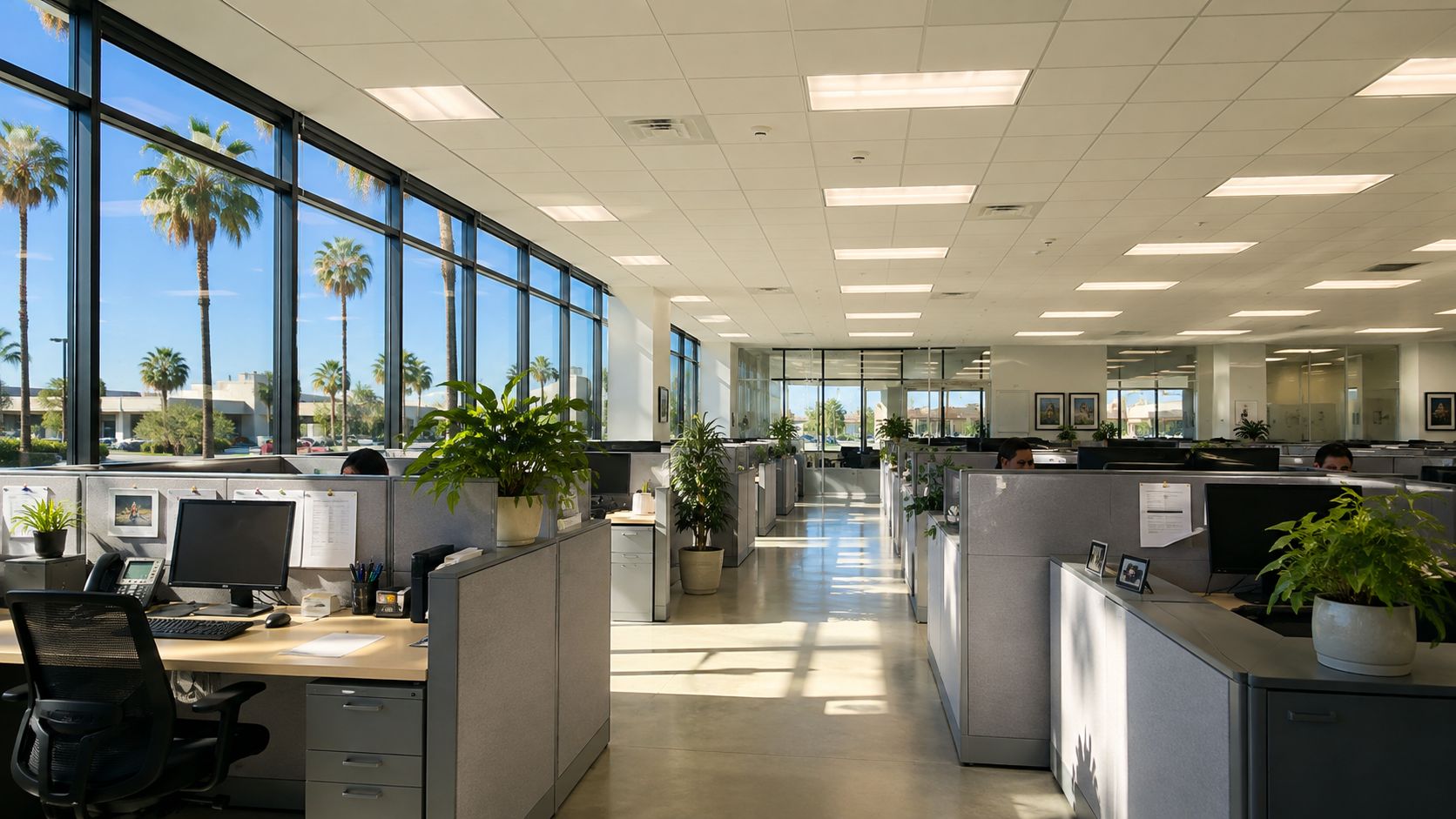
A property manager in Orange County doesn't need to be sold on sunshine. The problem is that too many buildings treat daylight like it's decorative, not operational. The result is easy to spot, lobby lights on at noon, perimeter offices lit the same way they are at dusk, and conference rooms burning energy just to sit in brightness.
A daylight harvesting system changes that pattern by responding to the light already in the space. Instead of waiting for someone to flip a switch, it dims fixtures when daylight is strong enough and brings them back up when clouds move in or the sun drops. That makes it feel less like a gimmick and more like a smart thermostat for lighting, except the control target is illuminance instead of temperature.
For a building owner, the appeal is simple. You're not paying to fully light a room that already has useful daylight. For tenants, the benefit is equally practical, the space feels more balanced, less harsh, and less wasteful.
Practical rule: if the daylight is already doing the job, the electric light should only fill the gap.
For a quick primer on how automated lighting controls fit into a broader lighting strategy, see automated lighting controls. That broader control mindset matters because daylight harvesting works best when it's treated as part of the lighting system, not as a bolt-on sensor.
What Exactly Is a Daylight Harvesting System
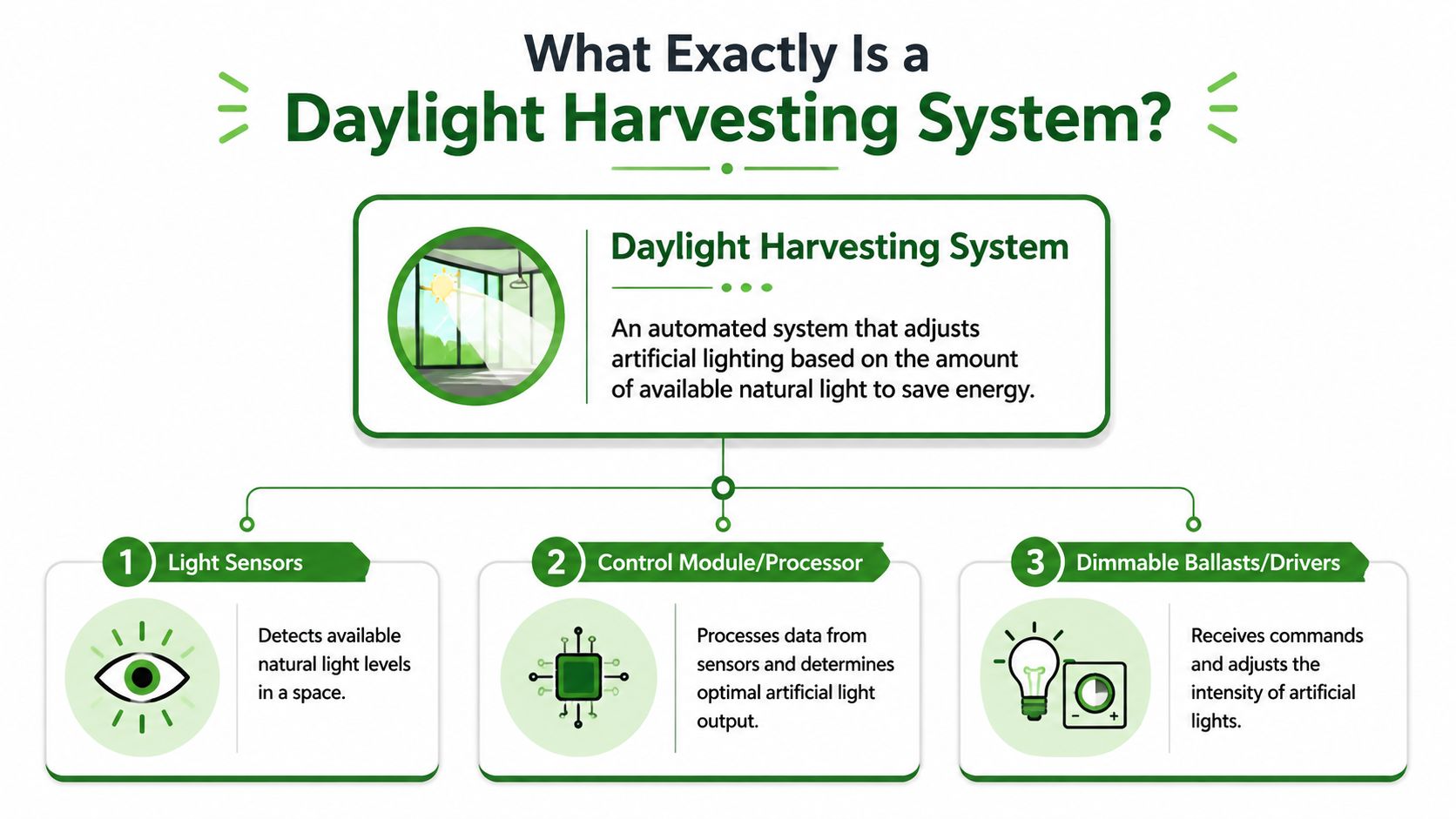
A daylight harvesting system is a control setup that measures available daylight and adjusts artificial light output to match. The simplest way to think about it is a thermostat for brightness. The goal isn't to turn lights off every time the sun comes out, it's to keep the work area at the target level with the least amount of electric light necessary.
The three parts that have to work together
The first part is the photosensor, which acts like the system's eye. It reads how much light is available in the space or at the window edge, depending on the control strategy.
The second part is the controller, which acts like the brain. It compares the sensor reading to a programmed setpoint and decides whether the lights should dim, brighten, or hold steady.
The third part is the dimmable luminaire or driver, which does the actual work. If the fixtures can't dim smoothly and predictably, the whole concept falls apart.
That's why this is not just a sensor add-on. The system has to be designed as a chain, sensor to controller to driver. When those pieces are matched correctly, the building gets a responsive lighting environment that saves energy without making the space feel erratic.
Why the wiring matters in real buildings
In practice, the sensor often sends an analog 0–10 V DC or digital signal to a controller or directly to a dimmable driver, and the wiring is commonly treated as Class 2 low-voltage within NEC limits of 30 V AC / 60 V DC and 100 VA max (Smart Lighting Authority). That's one reason these systems are so common in commercial work, they fit cleanly into modern controls packages and don't require the building to be rebuilt around them.
The phrase that matters on site is compatibility. If the sensor, logic, and driver don't speak the same language, the space can over-dim, under-dim, or keep hunting for the right output. That's where experienced design and installation make the difference between a system that saves money and one that just adds a control box to the ceiling.
How the Technology Automatically Dims Your Lights
A daylight harvesting system can work in two basic ways, open-loop or closed-loop. The difference is what the sensor is watching. In an open-loop setup, the sensor looks at the incoming daylight, usually near a window or skylight. In a closed-loop setup, the sensor reads the combined light in the space, including both daylight and the electric light it's controlling.
Open-loop and closed-loop do different jobs
Open-loop control is often useful where daylight is broad and predictable. Think skylit zones, parking structures, or spaces where the sensor can reliably read available daylight without being fooled by the fixture output itself. Closed-loop control makes more sense where the goal is to hold a stable light level in a defined occupied area, especially near windows in offices or tenant spaces.
The operating logic is straightforward. The sensor reads light, the controller compares that reading to the setpoint, and the driver reduces or increases output. As daylight rises, the lights dim. As daylight falls, the lights come back up. That's the whole value proposition, but the quality of the result depends entirely on how well the system is laid out and commissioned.
A good sensor location keeps the control loop calm. A bad one creates unnecessary dimming swings.
Why smooth dimming beats abrupt switching
Continuous dimming is usually the better commercial choice because it preserves comfort. Abrupt on-off behavior can distract occupants and make the room feel unstable, especially in offices where people are working under changing daylight. Smooth modulation lets the fixture fade instead of snap, which is exactly what most tenants expect from a modern building.
The trade-off is precision versus stability. A system tuned too aggressively can react to every passing cloud. One tuned too loosely leaves savings on the table. In the field, the right answer is rarely “more sensitivity.” It's usually better sensor placement, better zoning, and a driver that behaves consistently through the full dimming range.
For a plain-language conversion reference when you're working through lighting levels during a retrofit, use convert foot-candles to lux. That matters because setpoints are only useful when the team is speaking the same lighting language during design and commissioning.
The Triple Bottom Line Benefits for Your Property
The strongest case for a daylight harvesting system starts with energy. A major federal-building assessment found average annual energy savings of 27%, equal to 0.84 kWh/ft² per year, across five long-term study sites (GSA daylighting findings). In that same study, lighting energy use intensity fell from 2.9 kWh/ft² to 2.1 kWh/ft², which is the kind of measurable reduction that shows up in operating costs, not just in an engineering memo.

Why the savings are only part of the story
The other benefit is maintenance. When fixtures dim for much of the day, they aren't running at full output every hour the building is occupied. That can reduce thermal stress on the lighting system and help the installation age more gracefully, especially in buildings where the lights are on for long schedules.
There's also the occupant side of the equation. Buildings with well-managed daylight tend to feel more comfortable because the light is less harsh and more balanced. That doesn't mean every tenant will notice the controls themselves. It does mean they often notice when a space feels calmer and less overlit.
The values that matter to owners and tenants
For owners, the biggest win is operating cost control. For tenant-improvement projects, the upside is a cleaner sustainability story and a more modern lighting package. For facility teams, the practical value is lower wasted runtime and a system that can support a broader controls strategy.
Daylight harvesting has also shown a broader evidence base. Published reviews report average savings around 24% to 30% and studies note lighting electricity use reductions of 20% to 60% when the controls are integrated properly (MDPI review). Those numbers aren't a promise for every building, but they do show why this strategy keeps showing up in commercial work.
In Southern California, where solar access is common and cooling loads matter, daylight harvesting makes the most sense when the perimeter zones are doing real work. The wrong space can still be a poor fit. The right space gives you savings, code support, and a better tenant experience at the same time.
Strategic Design and Sensor Placement Guidance
A daylight harvesting project lives or dies on placement. In the field, the sensor has to read the daylight that reaches the work plane, not a direct sun patch, a glare hotspot, or the output from the fixture it is trying to control. If the sensor sees the wrong thing, the system over-dims in bright conditions or keeps the lights too high when daylight is already doing part of the work.
Where the sensor belongs
Lutron's design guidance recommends aiming the sensor toward the nearest window and placing it at a distance of 1 to 2 times the effective window height (H) (Lutron daylight sensor guide). That placement helps the sensor read usable daylight in the zone without getting fooled by direct beam sunlight or by a fixture mounted too close to the device.
Perimeter zoning matters just as much. A deep office floor with one sensor trying to control the whole space usually produces poor results. A divided perimeter area lets the sensor follow the daylight band more accurately and keeps the dimming response steady enough for occupants not to notice the control swings.
How I'd think about common Southern California spaces
Perimeter offices are usually the easiest fit because the daylight is directional and the occupancy pattern is predictable. Atriums can work too, but only if the sensor location and zoning match the actual light distribution. Parking structures, especially open-air or partially open ones, often perform better when the daylight source is obvious and the control strategy stays simple.
Commissioning guidance from UC Davis emphasizes verifying luminaire grouping by daylit zone, checking photosensor operation, and tuning setpoints and time delays during daylight changes. That step is where savings become real instead of theoretical. A sensor can be placed correctly and still perform poorly if the zones are grouped badly or the settings are left at default after turnover.
For a contractor or owner deciding whether a retrofit is worth pricing, the building itself gives the answer. Strong daylight access, open perimeter space, and a clean daylit zone are favorable. Heavy partitioning, deep floor plates, and poor sky access usually call for a more careful design review before any equipment gets ordered.
Rule of thumb: if the sensor cannot “see” the right daylight pattern, the system will not save what the submittal promised.
One practical check before design is to confirm the actual light levels at the perimeter. If you need a quick way to relate site readings to design targets, use a simple foot-candle to lux conversion reference before you set the control intent. That keeps the conversation grounded in what the space is really receiving, not what the drawings suggest on paper.
For Southern California owners, the other practical value is coordination. Daylight harvesting works best when it is tied to the broader lighting controls plan and the Title 24 paperwork from the start, and that is where a contractor that handles both installation and compliance work can reduce rework. Access Electrical and Lighting is one of the firms that supports controls coordination on commercial projects. The value there is coordination, because the controls, fixtures, and paperwork all have to line up.
Calculating ROI and Meeting Title 24 Compliance
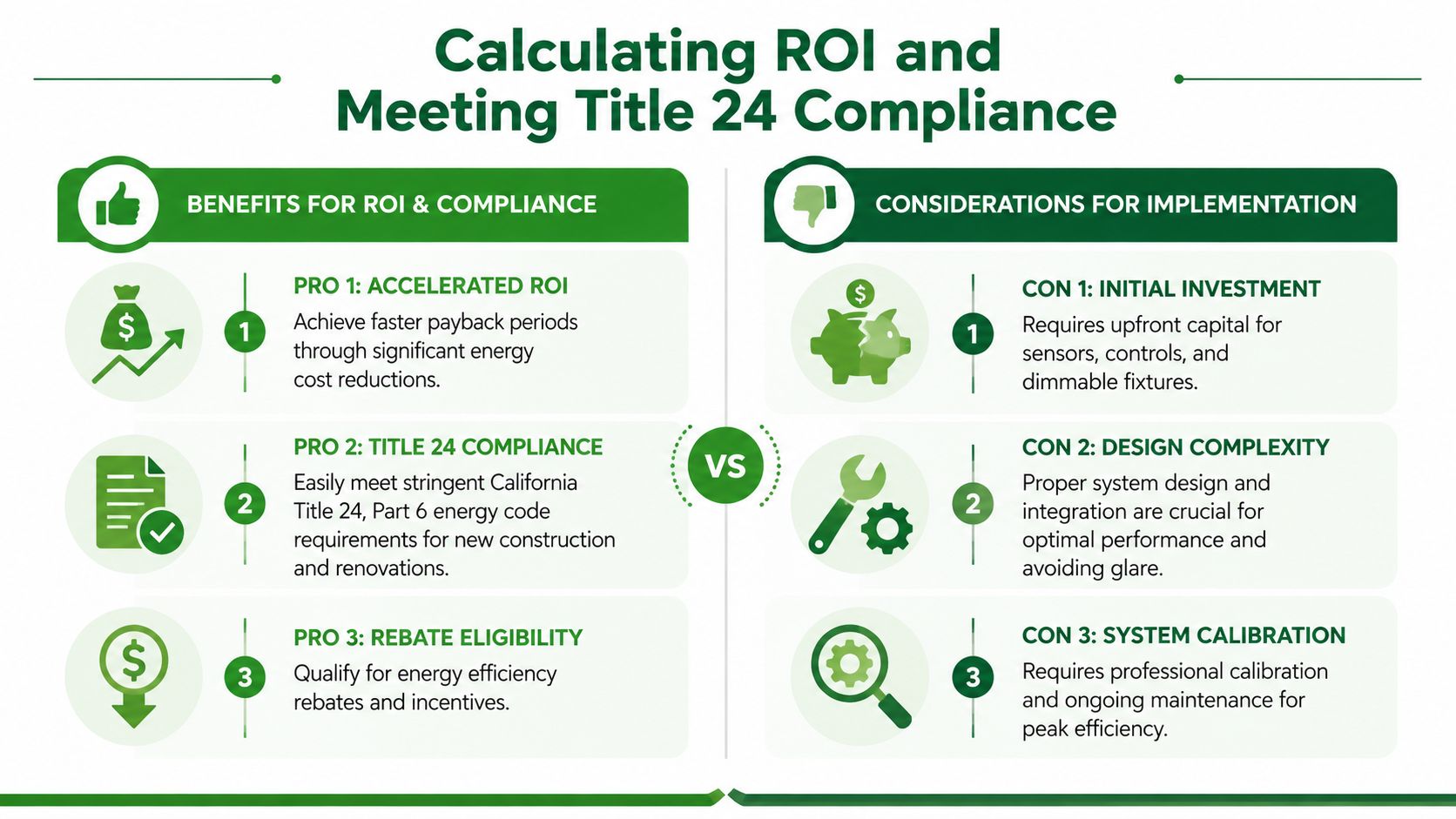
For California property owners, daylight harvesting isn't just a nice-to-have control strategy. It often belongs in the compliance conversation from the start, especially where new construction or major lighting work is involved. Title 24, Part 6 pushes projects toward controls that reduce unnecessary lighting energy, and daylight-responsive dimming is one of the most practical ways to do that in sunlit buildings.
Which buildings usually pencil out
GSA's field guidance says daylight harvesting is most cost-effective in buildings with high lighting power density, high energy use, unobstructed sky views, and window-to-wall ratio above 50% (GSA findings). It is most productive in perimeter zones no deeper than twice the window height, so deep-plan or heavily partitioned spaces are often weaker retrofit candidates.
That screening logic matters more than the hardware brochure. A building with great glazing but no sensible daylit zone may not justify the controls expense. A building with strong perimeter daylight and long operating hours often has a much clearer path to payback.
What drives the project cost
The main cost buckets are hardware, installation labor, and commissioning. Hardware covers sensors, controllers, and dimming-compatible fixtures or drivers. Labor covers wiring, device placement, and integration with the existing lighting layout. Commissioning covers calibration, zoning verification, and final tuning so the system behaves correctly in real use.
The best ROI usually comes from projects where the lighting load is already significant and the daylight access is obvious. The worst ROI often comes from trying to force a complex control strategy into a space that doesn't have a meaningful daylight band. That's why a site walkthrough and a zone-by-zone review matter before a proposal goes out.
For California code context, see Title 24 lighting requirements. A good daylight harvesting retrofit should be planned with both the operating savings and the compliance path in mind, because the smartest projects solve both at once.
Commissioning and Maintenance for Lasting Performance
A daylight harvesting system only pays off if the commissioning is handled correctly. Many systems fail not because the control concept is weak, but because daylight variability, shading, and bad sensor placement undermine comfort and savings (IBPSA proceedings). In other words, the hardware can be fine and the project can still underperform if nobody tunes it in the field.
What needs to happen at turnover
The first step is sensor verification. The second is zone confirmation, so each fixture group matches the daylit area it's supposed to serve. The third is setpoint tuning, which should be checked under real daylight conditions, not just in a dark room with the covers still open.
Time delays matter too. If the system reacts too fast, occupants see annoying light swings as clouds pass. If it reacts too slowly, the savings get diluted and the lights stay higher than they need to be.
What facility staff should keep an eye on
A simple maintenance routine goes a long way:
- Check sensor position: make sure the device hasn't shifted, been obstructed, or been affected by a new fixture layout.
- Verify dimming behavior: confirm the lights still ramp smoothly instead of snapping or hunting.
- Review daylight zones: if walls, blinds, or tenant improvements changed the space, the original zoning may no longer be accurate.
- Watch for glare complaints: if occupants start shielding windows or reporting discomfort, the system likely needs recalibration, not just a service ticket.
The biggest mistake is treating commissioning like a one-time paperwork item. It's a performance step, and it should be scheduled with the same seriousness as the install itself. When that happens, the building gets the actual savings the design promised instead of a control system that only looks smart on the submittal.
If you're planning a daylight harvesting retrofit, a controls upgrade, or a Title 24-driven lighting project in Southern California, Access Electrical and Lighting can help coordinate the installation, controls, and compliance pieces so the system works in the field, not just on paper. Visit Access Electrical and Lighting to talk through your property's daylight zones, retrofit options, and commissioning needs.