A tenant emails after dark and says one corner of the lot feels unsafe. A maintenance tech says two pole lights are cycling on and off. Accounting flags another month of high utility bills. Then someone mentions an inspection, or a near miss at the driveway, or a resident who tripped walking back to their car.
That's usually when parking lot lighting stops being a background item and becomes a management problem.
For Southern California property managers, this isn't just about making a lot look brighter. It's about balancing safety, liability, tenant confidence, energy use, and local code. National guidance helps, but it doesn't answer the questions that come up in Orange County and nearby markets, where Title 24 controls and dark-sky rules can turn a simple fixture swap into a compliance issue.
Good lighting design solves several problems at once. It helps people see where they're walking and driving. It supports security. It reduces the number of emergency calls and patchwork repairs. And when it's done correctly, it avoids the common mistake of spending more on light while getting worse visibility. That same principle shows up in broader commercial lighting design for business properties, where layout and controls matter as much as raw output.
Your Parking Lot Is More Than Just Pavement
A parking lot is one of the first things tenants, shoppers, employees, and visitors experience on your property. If it feels dim, patchy, or harshly lit, people notice right away. They may not know the technical reason, but they know when they don't feel comfortable.
Property managers often inherit lighting systems instead of choosing them. One owner installed metal halide years ago. Another swapped a few heads during emergencies. A previous contractor added mismatched fixtures after a pole failure. The result is common. Bright spots under some poles, dark gaps between them, glare at the driveway, and utility costs that don't match the actual performance on site.
What managers are really dealing with
The issue usually isn't just “we need more light.” It's a bundle of competing demands:
- Safety concerns: Drivers need to see curbs, pedestrians, and lane transitions clearly.
- Security expectations: Tenants expect consistent visibility near stalls, walkways, and building entries.
- Budget pressure: Nobody wants to replace a whole system if a targeted fix will do the job.
- Compliance risk: A lot can look acceptable to the eye and still miss required performance or control standards.
A parking lot is part of your building's operating system. When lighting is wrong, the consequences show up in complaints, service calls, and liability exposure.
Why this matters in Southern California
In SoCal, the challenge gets more complicated because national parking lot lighting standards are only part of the picture. You also have California energy code requirements, local expectations around glare and light spill, and growing scrutiny over fixture color and controls. A property manager who only asks, “How many lumens is this fixture?” usually gets the wrong answer to the underlying problem.
The better question is simpler. Will this layout make the property safer, pass inspection, and reduce operating headaches over time?
Decoding the Core Lighting Language of IES
Most parking lot lighting plans look more complicated than they are. Once you understand a few key terms, you can read them like a property document instead of a technical mystery.
The main reference in the U.S. is the Illuminating Engineering Society, usually shortened to IES. Its parking guidance tells designers and contractors how much light is needed in different areas and how evenly that light should be distributed.
Foot-candles in plain English
A foot-candle measures how much light reaches a surface. The easiest way to think about it is rainfall. One storm can dump a lot of water in one small patch and leave the rest dry. Another storm can spread the same amount more evenly. Lighting works the same way.
For parking lots, IES RP-20-14 sets foundational minimums of 0.2 foot-candles for basic security areas and 0.5 foot-candles for enhanced security zones, with a maximum-to-minimum uniformity ratio not exceeding 20:1 under standard conditions, according to the IES parking lot lighting standards summary.
That sounds abstract until you apply it to the site. Basic open parking can tolerate lower light than a place where people gather, pay, wait, or cross vehicle paths.
The numbers that matter on a site plan
Here's a simple reference based on the verified IES-related guidance provided.
| Area Type | Minimum Maintained Illuminance (fc) |
|---|---|
| Basic security parking areas | 0.2 |
| Enhanced security zones | 0.5 |
| High-activity vehicle areas | 2.0 |
| Cash collection and vehicular access control zones | 5.0 |
Those figures help you ask better questions during design review. If a contractor proposes one fixture type for every corner of the property, that's usually a warning sign. Different zones need different treatment.
Uniformity is the second language you need
The other term property managers should know is uniformity ratio. This tells you how evenly light is spread. If one point in the lot is very bright and another nearby point is very dim, users experience the lot as unsafe even if the average light level looks acceptable on paper.
Consider it similar to irrigation coverage. You don't judge the system by the wettest patch of grass. You judge it by whether the whole area gets what it needs.
A good lighting plan doesn't just chase a minimum foot-candle target. It uses fixture output, optics, mounting height, and spacing to keep the lot readable from one end to the other.
Practical rule: When you review a photometric plan, don't ask only “How bright is it?” Ask “Where are the dark transitions, and how even is the coverage?”
Why managers should care about the jargon
These terms affect decisions that cost real money. They influence whether a retrofit uses fewer high-output fixtures or more carefully placed lower-output ones. They affect whether a tenant sees a comfortable lot or a patchwork of bright circles. They also shape whether the finished installation supports code compliance or creates a new round of corrective work.
If you can read foot-candles and uniformity on a plan, you can have a much more productive conversation with your electrical contractor, lighting rep, or engineer.
Why Uniformity Matters More Than Brightness
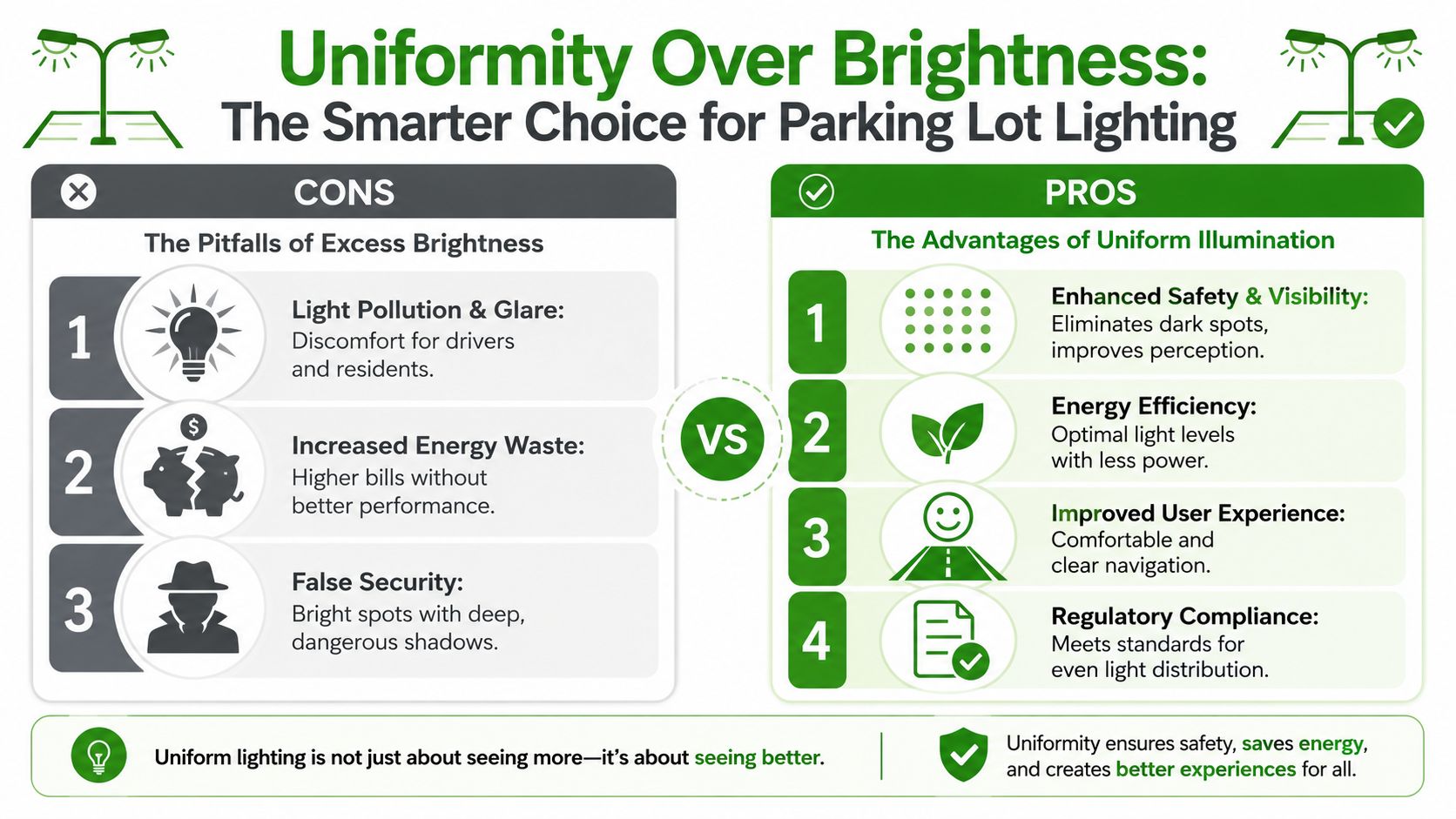
One of the most expensive mistakes in parking lot lighting is assuming brighter automatically means safer. It often doesn't. In the field, over-bright fixtures with poor layout create exactly the problems managers are trying to avoid.
Bright spots can hide real hazards
A lot with aggressive output under each pole and deep shadows between poles feels inconsistent. Drivers' eyes keep adjusting. Pedestrians disappear into darker pockets. Security cameras often get strong highlights and weak detail at the same time.
That's why uniformity deserves more attention than it usually gets. Industry data cited by Jarvis Lighting states that a uniformity ratio worse than 4:1 can create high-contrast shadows that impair visual acuity and increase pedestrian collision risk by up to 35% compared to evenly distributed light, as noted in this parking lot lighting design guide.
What poor uniformity looks like on a property
Managers usually recognize the symptoms before they know the term:
- Dark walk paths: People leave a brightly lit stall row and step into a dim route to the building.
- Harsh pole circles: Light pools directly under fixtures, then drops off too fast.
- False security: A lot looks bright from the street but still has hidden edges and shadowed corners.
- Complaints about glare: Tenants report that lights feel blinding, yet they still can't see clearly across the lot.
Even coverage makes a property feel safer because people can read depth, distance, and movement without their eyes constantly re-adjusting.
Glare and light trespass are management issues too
Uniformity problems usually travel with two other headaches. The first is glare. Poorly aimed or unshielded fixtures can push too much light into the driver's line of sight, reducing comfort and sometimes visibility. The second is light trespass, where spill light reaches neighboring properties, upper-floor units, or public right-of-way areas that weren't meant to be illuminated.
The fixture's design is crucial. Shielding, optics, and aiming can improve visibility more effectively than merely installing a brighter head. A fixture that keeps light on the pavement usually performs better than one that throws a lot of spill sideways.
What actually works
On most sites, the better approach is straightforward:
- Use photometric planning: Don't rely on a fixture schedule alone.
- Match optics to the layout: Edge poles and center poles rarely need the same distribution.
- Control glare at the source: A shielded, well-aimed LED often outperforms a higher-output fixture with sloppy distribution.
- Review the lot at night, not just on paper: Problems show up fast when you walk the property.
If a proposal promises safety by increasing wattage without showing distribution, it's incomplete.
Navigating California's Title 24 and Dark Sky Rules
A lot of national articles stop at IES guidance. That's not enough for Southern California. Here, the design also has to work inside California's energy rules and local expectations around light pollution, fixture color, and controls.
For property managers, issues concerning lighting standards frequently cause projects to falter. The lighting may look fine in a brochure, but the controls, color temperature, or fixture type may not match what the local jurisdiction expects.
Title 24 changes the conversation
Title 24 isn't a suggestion. It drives how exterior lighting is controlled and documented. On parking lot projects, that usually means paying close attention to photocells, scheduling, dimming behavior, and occupancy-based strategies where applicable. If those controls aren't selected and commissioned correctly, the project can stall even when the fixtures themselves are new.
If you want a practical baseline on compliance thinking, this overview of OSHA lighting standards and site safety considerations helps frame why documentation and performance matter, not just appearance.
Where SoCal managers get caught
The most common disconnect is assuming any LED upgrade is automatically compliant. It isn't. A fixture can be efficient and still cause problems if the color temperature is too high, the cutoff isn't appropriate, or the controls don't meet the local requirement.
Recent developments cited for 2024 to 2025 report that 42% of new commercial parking projects in California encounter Title 24 or local dark-sky compliance hurdles because of improper CCT selection above 4000K, leading to redesigns and failed inspections, according to this discussion of California parking lighting compliance issues.
The local rules most managers should ask about
Dark-sky requirements aren't identical in every city, but the pressure is consistent. Before approving a retrofit or new installation, verify these items:
- Color temperature: Many jurisdictions push projects toward warmer light, often 3000K or lower in the verified guidance.
- Fixture cutoff: Full-cutoff or similarly controlled distribution helps reduce upward spill and neighborhood complaints.
- Dimming behavior: Some local rules require lighting to dim on a schedule after business hours.
- Inspection risk: A fixture package that looks interchangeable on paper may not pass local review.
In Southern California, fixture selection is a code decision, not just a purchasing decision.
What works in practice
The safest process is to verify local code before ordering equipment. That means checking the jurisdiction, confirming acceptable CCT, reviewing the control sequence, and making sure the fixture cutsheets align with the submitted plan. If any of those pieces are vague, the property owner usually pays for the correction later.
For managers, the takeaway is simple. IES tells you how the lot should perform. Title 24 and local dark-sky rules tell you how the system must be built and controlled.
Strategic Fixture and Pole Placement by Design
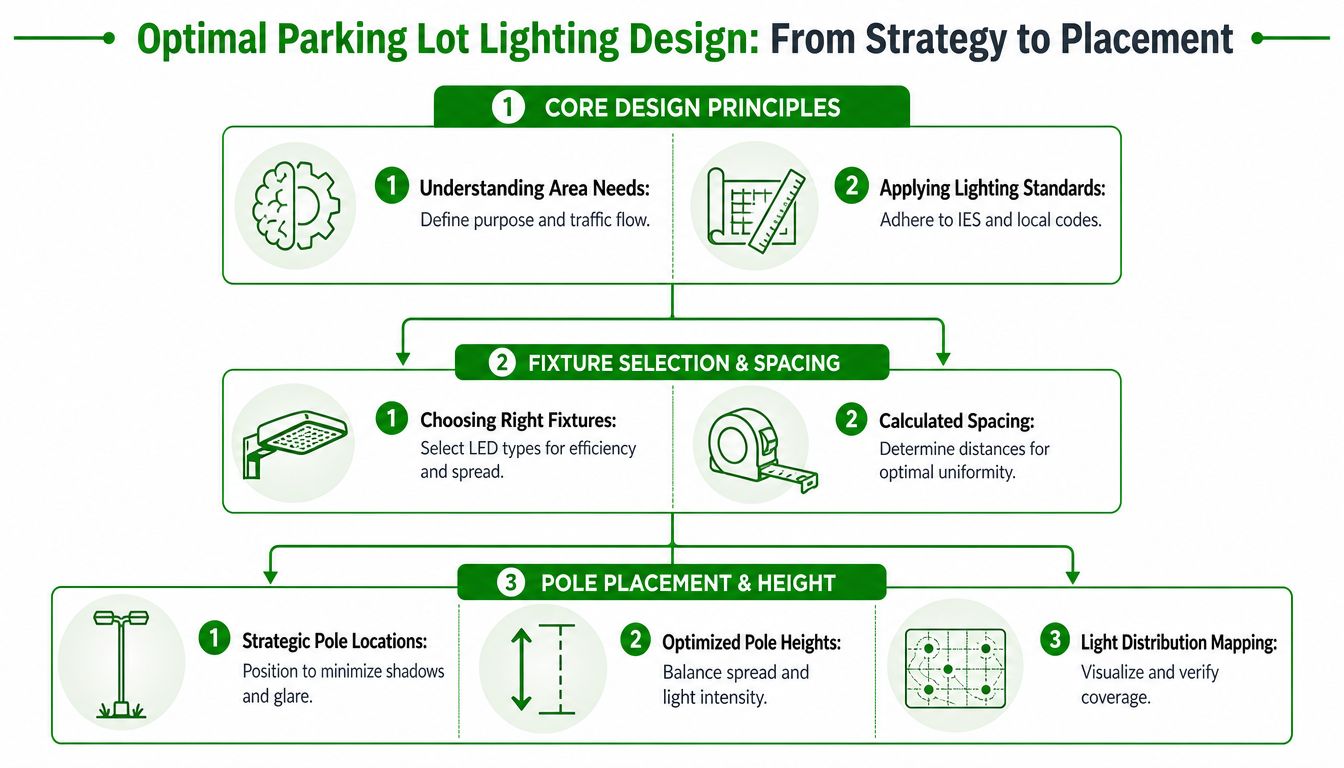
A lighting standard only becomes real when someone lays out poles, selects optics, and proves the lot will perform the way the plan says it will. That's where design either solves problems or creates them.
Pole height, spacing, and optics work together
Property managers don't need to become lighting designers, but they should know the three levers that shape the result:
- Pole height: Taller poles can cover more area, but they can also create wider gaps if spacing isn't adjusted.
- Pole spacing: Distance between fixtures affects how well light overlaps.
- Fixture optics: The distribution pattern determines where light lands and how far it throws.
This is why one-for-one fixture swaps can disappoint. If the old system was laid out around a different lamp type or output pattern, changing only the head may leave dark lanes, hot spots, or glare.
Why distribution type matters
Contractors and reps may talk about Type III or Type V optics. For a manager, the practical meaning is simple. Some fixtures throw light forward and outward, which works well along edges or drive aisles. Others spread light more symmetrically, which often fits center-of-lot pole locations.
A smart layout matches the optic to the pole location. A careless layout uses the same optic everywhere and hopes for the best.
The fixture doesn't solve the problem by itself. The fixture, pole, and aiming direction solve it together.
Entrance and exit lanes need special treatment
Driveway transitions deserve more attention than they usually get. According to IES-related guidance, entrance and exit lanes must reach 5.0 foot-candles to help drivers adapt from brighter exterior street lighting to dimmer property lighting, because rapid luminance change causes temporary disability glare that reduces visibility, as described in this overview of entrance and exit lighting guidance.
That matters on retail centers, multifamily entries, and office sites with strong street exposure. If the entrance is too dim, drivers can momentarily lose detail right where they need it most.
Questions to ask when reviewing a layout
A good review meeting gets better fast when you ask direct questions:
- Where will the darkest points be? Every lot has them. The issue is whether they're acceptable.
- How are entrances handled? These shouldn't be treated like standard parking rows.
- What happens near sidewalks and building edges? Structural shadows often show up there.
- Are neighboring properties protected from spill light? This matters in mixed-use and residential-adjacent areas.
Design is where parking lot lighting standards turn into usable, safe property lighting. If the contractor can't explain the layout in plain language, the design probably needs more work.
Retrofits and Maintenance for Long-Term Value
Most property managers don't replace parking lot lighting because they suddenly want new fixtures. They do it because the old system is costing too much, failing too often, or creating too many complaints.
That's why retrofit decisions should be based on total operating value, not only first cost.
The financial case for LED is straightforward
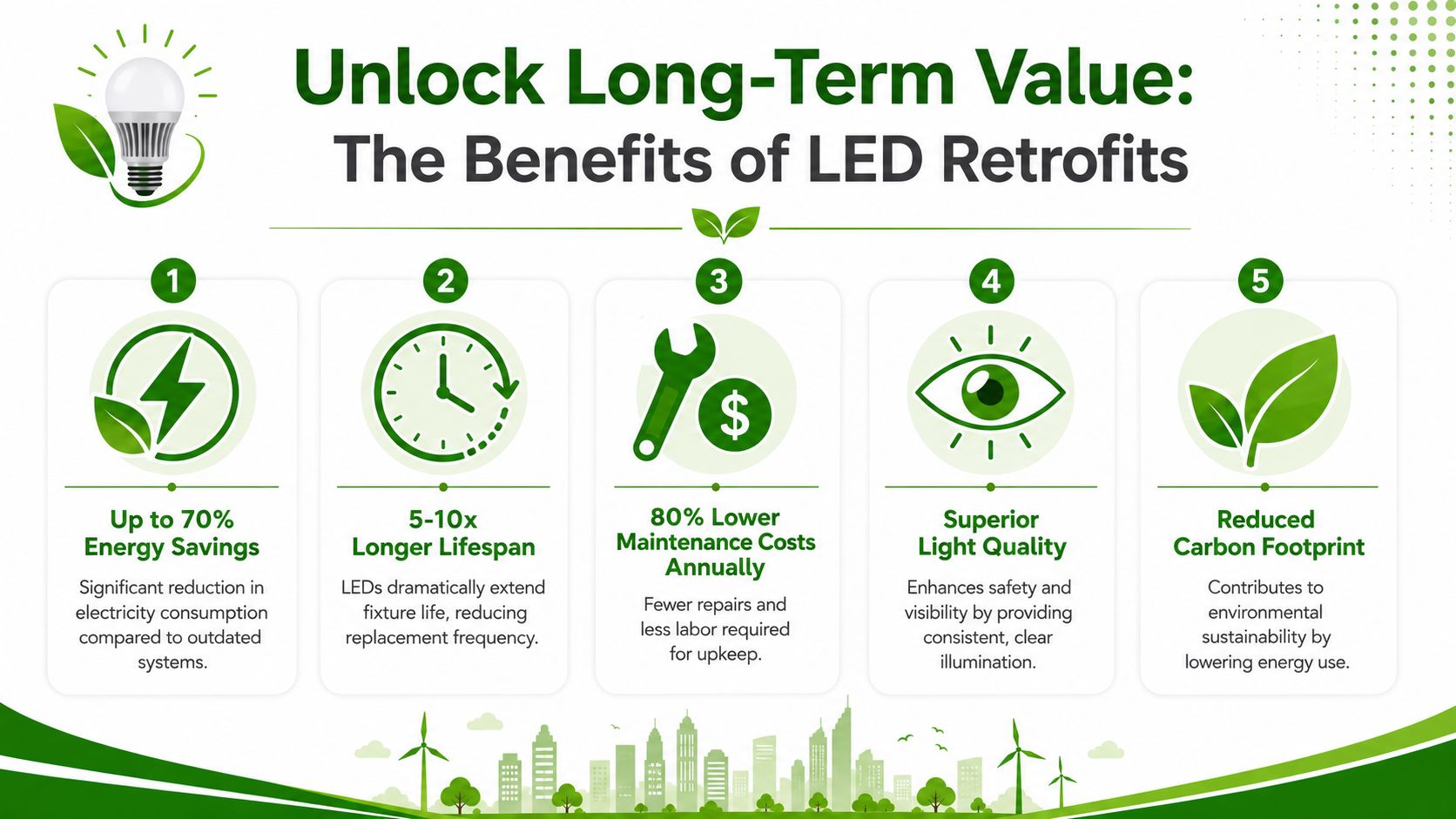
Verified industry guidance shows that replacing a typical 400-watt metal halide fixture with a 150-watt LED cuts energy use by 62%. For a 100-space lot, that can save over $1,100 annually in electricity, and payback often shortens to 3 to 5 years when maintenance savings are included, according to this analysis of garage and parking lighting standards and retrofit economics.
Those numbers matter because parking lot lighting runs for long hours and usually covers a broad exterior area. Small fixture-level savings scale quickly across a property.
Where the maintenance savings show up
Older metal halide systems don't just use more power. They also create maintenance cycles that managers underestimate. Lamps depreciate. Ballasts fail. Color shifts become obvious. Crews end up chasing outages one pole at a time.
LED systems reduce that churn because the fixtures last longer and maintain performance more consistently over time. On a commercial property, that means fewer night calls, fewer spot repairs, and fewer situations where one failed head leaves a visibly dark section of the site.
For properties evaluating broader field work, light pole repair and retrofit services for commercial sites are part of the conversation because fixture upgrades and pole condition often need to be reviewed together.
Don't ignore emergency lighting obligations
Parking facilities and egress paths also bring emergency lighting responsibilities. Verified guidance tied to NFPA 101 and ASIS International requires emergency systems to maintain at least 1 foot-candle along egress paths for 90 minutes during a power outage, with activation within 10 seconds of power loss. The same guidance states those systems should be tested for 30 seconds every 30 days and for a full 1.5 hours annually to confirm sustained operation.
That's not decorative maintenance. It's life-safety documentation.
A practical maintenance checklist
Long-term value comes from treating the site as a system, not a collection of fixtures.
- Inspect poles and bases: Corrosion, impact damage, and anchor issues can outlast several fixture cycles if nobody checks them.
- Verify controls regularly: Photocells, time schedules, and dimming settings drift or fail more often than many owners realize.
- Document emergency tests: If records are missing, the test effectively didn't happen.
- Review night performance after repairs: A daytime visual check won't catch glare, patchiness, or bad aiming.
One mention is enough here. Contractors such as Access Electrical and Lighting handle combinations of LED retrofits, light pole work, emergency lighting testing, and Title 24 documentation for Southern California commercial properties. That kind of bundled scope matters when the lot has both aging infrastructure and compliance gaps.
From Plan to Proof Choosing Your Compliance Partner
A parking lot lighting project isn't finished when the new fixtures turn on. It's finished when the installed system is measured, documented, and shown to match the design intent and code requirements.
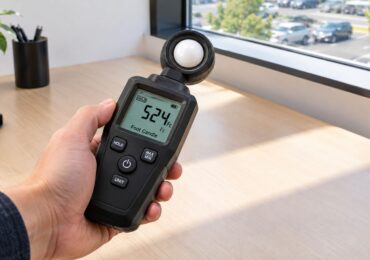
That last step gets skipped more often than it should. A lot can look acceptable during a walkthrough and still miss target performance in the field. The only real proof comes from testing with a light meter, checking control operation, and confirming that the installed equipment matches the approved submittals.
What the closeout package should include
A proper handoff should give the property manager more than an invoice. At minimum, you want:
- The lighting plan: Including the photometric basis for the layout.
- Fixture cutsheets: So you can verify what was installed.
- Control information: Scheduling, dimming behavior, and sensor operation.
- Compliance paperwork: Signed Title 24 forms and related testing records where required.
Choose a contractor who can prove the work
The right contractor for parking lot lighting standards work isn't just an installer. They need to understand local code, controls, emergency requirements, and verification. They should be able to explain why a fixture was selected, how the lot will be measured, and what documents you'll have when the job is done.
If the contractor can install the system but can't close out the compliance side, the property manager is the one left carrying the risk.
That's the dividing line between a simple vendor and a compliance partner. One puts up lights. The other helps protect the property after inspection, after turnover, and after the next complaint comes in.
If your property team is sorting through dim areas, aging poles, Title 24 questions, or a pending LED retrofit, Access Electrical and Lighting provides commercial lighting design, installation, testing, emergency lighting support, pole work, and compliance documentation for Southern California properties. For property managers in Orange County and surrounding markets, that means one contractor can evaluate the existing system, identify safety and code issues, and carry the job through installation and final verification.