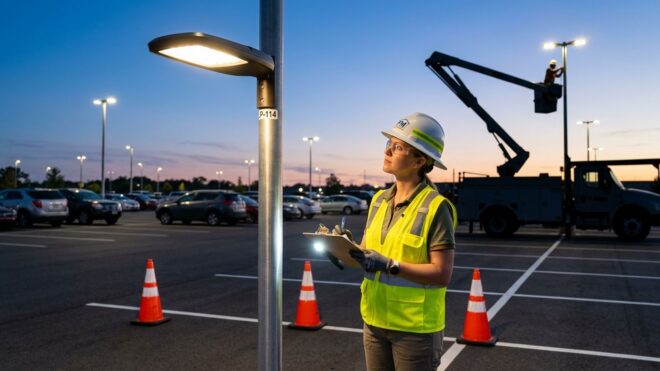
A tenant emails after sunset. A security guard follows with a call. One side of the lot is dark, customers are walking to their cars, and your first question isn't whether a lamp failed. It's whether you now have a safety problem, a complaint problem, and a liability problem at the same time.
This is how parking lot lighting repair typically unfolds for property managers. The issue almost never stays confined to a single fixture. A dark zone affects pedestrian comfort, camera visibility, storefront appearance, and how exposed your property feels after hours. In Southern California, where commercial sites run late and tenants expect clean, consistent illumination, a lighting outage becomes operational fast.
It's also a bigger business issue than many owners realize. The commercial facility parking lot maintenance sector was valued at USD 16.08 billion in 2023 and is projected to reach USD 20.46 billion by 2030, according to parking lot lighting market data and replacement guidance from PKK Lighting. That growth reflects a simple shift in the field. More managers are deciding it costs less to manage lighting systems deliberately than to keep reacting to failures.
The properties that stay ahead of problems treat exterior lighting as an asset system, not a collection of bulbs. That means the repair conversation has to include controls, pole condition, fixture cleanliness, coverage, and site conditions like trees, glare, and dark transitions between poles. Swapping parts has its place. It just doesn't solve chronic underperformance by itself.
Responding to the First Report of an Outage
The first report usually comes in with very little detail. “Lights are out in the back lot.” “The north row is dark.” “A resident says the pole by Building C keeps flickering.” That's normal. At that moment, your job isn't to diagnose the driver, ballast, photocell, or breaker from your desk. Your job is to treat the report as a live site safety issue until proven otherwise.
Treat the complaint like a site condition, not a maintenance ticket
A single failed fixture in a bright lot is one thing. A dark section near stairs, trash enclosures, leasing offices, or pedestrian routes is another. The mistake I see most often is assuming the report describes the scope of the failure. It often doesn't. One tenant notices one symptom. The actual issue may affect a circuit, a timer setting, a control device, or a wider section of the lot.
Start with three questions:
- Where exactly is it dark: Ask for the closest building, storefront, pole, or drive aisle.
- Is the problem steady or intermittent: “Out” and “flickering” point to different next steps.
- Does the site still have safe access: If people are crossing the area, the response has to be immediate.
Practical rule: If you wouldn't want a family member walking through that section alone at night, don't leave it unaddressed until the next business day.
What matters in the first hour
You don't need a technical report yet. You need a clean record and a controlled response. That means documenting the time of report, who observed it, what area is affected, and what temporary safety measures were put in place. If security or on-site staff are available, have them confirm whether it's one pole, multiple poles, or an entire side of the property.
This is also where experienced managers separate themselves from reactive ones. They don't ask only, “Who can replace the bad light?” They ask, “What failed, what else could be affected, and what's the safest temporary condition until the repair is complete?”
Don't assume the fixture is the root cause
A lot that looks “dark” may still have working fixtures. Instead, the problem may be poor uniformity, blocked light, or a control issue that leaves one zone lagging behind another. In practice, effective parking lot lighting repair starts with the site experience. Are there dark pockets between poles? Is glare making the illuminated area look brighter than it is? Are trees cutting off spread to the walkway where complaints keep coming from?
Those questions matter because they change what the repair should look like. If the issue is system performance, replacing one component may restore power without restoring safe coverage.
Initial Triage and On-Site Troubleshooting
A common night call goes like this: tenants report a dark row, security says two poles are out, and by morning everyone assumes the fix is a lamp change. On site, the underlying cause is often a tripped circuit, a photocell that is reading stray light, tree growth that cut off spread to the sidewalk, or an LED driver that failed after repeated overheating inside a dirty fixture head. Good triage saves a wasted service call and gets you to the actual failure faster.
Start with the outage pattern. One dark head points to a fixture-level problem. A dead row usually points upstream, at a breaker, contactor, timeclock, photocell, or branch circuit. An area that feels dark while fixtures are still burning calls for a different conversation. That is usually a distribution problem, not a power problem, and part-swapping will not correct it.
Secure the area, then narrow the fault
If the outage affects a pedestrian route, storefront approach, ADA path of travel, or active parking stalls, protect that area first. In Southern California, that matters for both liability and site operations. Temporary cones, barricades, or a short-term closure are often the right move until light levels are restored. If approved temporary lighting is available, use it where people are walking, not just where it is easy to set a light tower.
Then gather facts a contractor can use.
Walk the affected area at night if possible. Note pole numbers, which fixtures are fully out, which are cycling, and whether the problem starts at dusk or later in the evening. A lot can look underlit because lenses are dirty, optics are mismatched, branches have grown into the light path, or glare from one over-bright fixture is masking darker pavement between poles. Those are repair issues too, because the goal is usable coverage, not just energized equipment.
A light meter helps confirm where illumination drops off. Fixture work at height should never be attempted from a ladder on taller parking lot poles over 12 feet, per OSHA ladder guidance. For those repairs, the contractor should use the right access equipment, typically a boom lift or bucket truck.
A dark lot is often a control, aiming, or coverage problem that happens to show up as a fixture complaint.
Parking Lot Lighting Troubleshooting Checklist
| Symptom | Potential Cause | Manager Action |
|---|---|---|
| One fixture is out | Driver, LED board, socket, internal wiring, local connection issue | Record pole location, check whether nearby fixtures are operating, request service |
| Several fixtures in one area are out | Tripped breaker, failed contactor, photocell issue, circuit fault | Check accessible panel status if authorized, note any tripped devices, contact contractor |
| Lights cycle on and off | Photocell placement, timer error, thermal protection, voltage issue | Record time pattern, weather, and whether nearby building lights affect the sensor |
| Fixtures flicker | Moisture intrusion, loose connection, failing driver, voltage instability | Mark affected poles and raise priority if the area serves pedestrian traffic |
| Area feels dark even though lights are on | Dirty lenses, poor aiming, blocked distribution, vegetation, glare | Photograph dark zones, note obstructions, request a nighttime evaluation |
| Lights stay on in daylight or fail at dusk | Photocell obstruction, mis-aimed sensor, control setting error, relay issue | Verify accessible control settings and report the exact operating behavior |
What managers can check, and where the line is
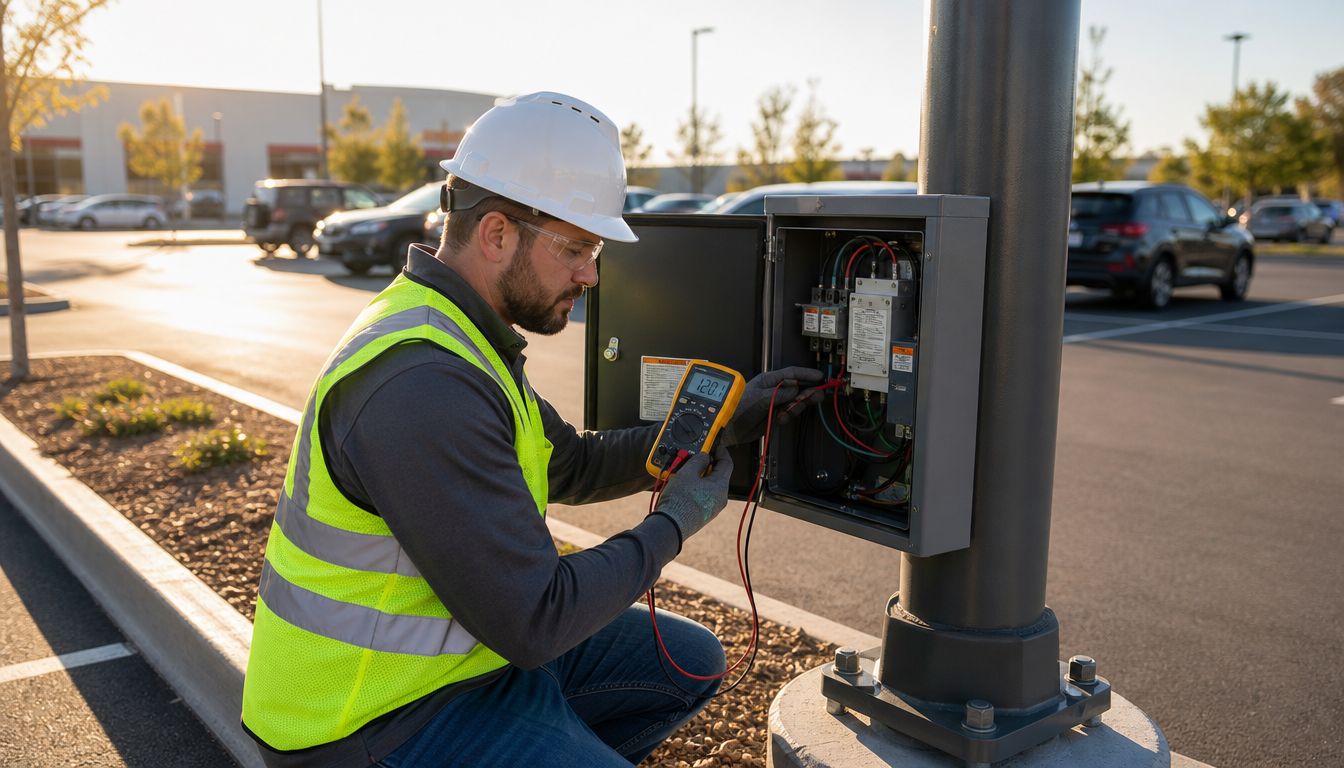
Managers and on-site staff can inspect accessible panels, timeclocks, and control enclosures if training and site policy allow it. Look for obvious issues such as a tripped breaker, a timer schedule that drifted, a photocell blocked by dirt or new signage, or landscaping that now shades part of the lot. On California properties subject to Title 24 lighting control requirements, those control settings and shutoff functions matter. A repair that restores power but leaves the controls misconfigured is not a complete repair.
Do not open energized gear beyond your authorization. Do not send maintenance staff up a ladder to "just swap the head."
If you want a cleaner handoff before dispatch, use a simple commercial electrical repairs and troubleshooting checklist so the contractor arrives with the right access equipment, replacement parts, and a better idea of whether the job is a fixture repair, a control issue, or a broader system correction.
The Smart Decision Repair Versus LED Retrofit
Most bad lighting decisions happen when managers compare only today's invoice. A ballast replacement, socket repair, or one-for-one fixture fix can look cheaper in the moment. Sometimes it is the right call. But if you're dealing with aging HID or metal halide equipment, frequent outages, uneven light, or repeated tenant complaints, you need to compare total operating burden, not just the immediate repair ticket.
When repair still makes sense
Repair is reasonable when the system is structurally sound. If the poles are in good condition, coverage is acceptable, and the failure is isolated, a targeted fix can be the most practical move. That's especially true on newer LED systems where one control device, driver, or photocell has failed but the rest of the lot performs well.
Repair also makes sense when a broader capital project is already planned and you need a short-term bridge. In that situation, be honest about what you're buying. You're not solving the long-term problem. You're stabilizing the site until the right upgrade window opens.
When retrofit is the better business decision
If you're repairing old technology over and over, the repair price stops being the true cost. Older HID and metal halide fixtures draw more power, need more maintenance, and usually deliver worse light quality over time than a modern LED system.
According to FSG's parking lot lighting guidance, LED retrofits reduce energy use and costs by 50 to 70 percent and often deliver ROI in less than 24 months. The same guidance notes that smart controls such as dusk-to-dawn sensors or motion detectors can lower energy consumption by up to 90 percent when they're applied correctly.
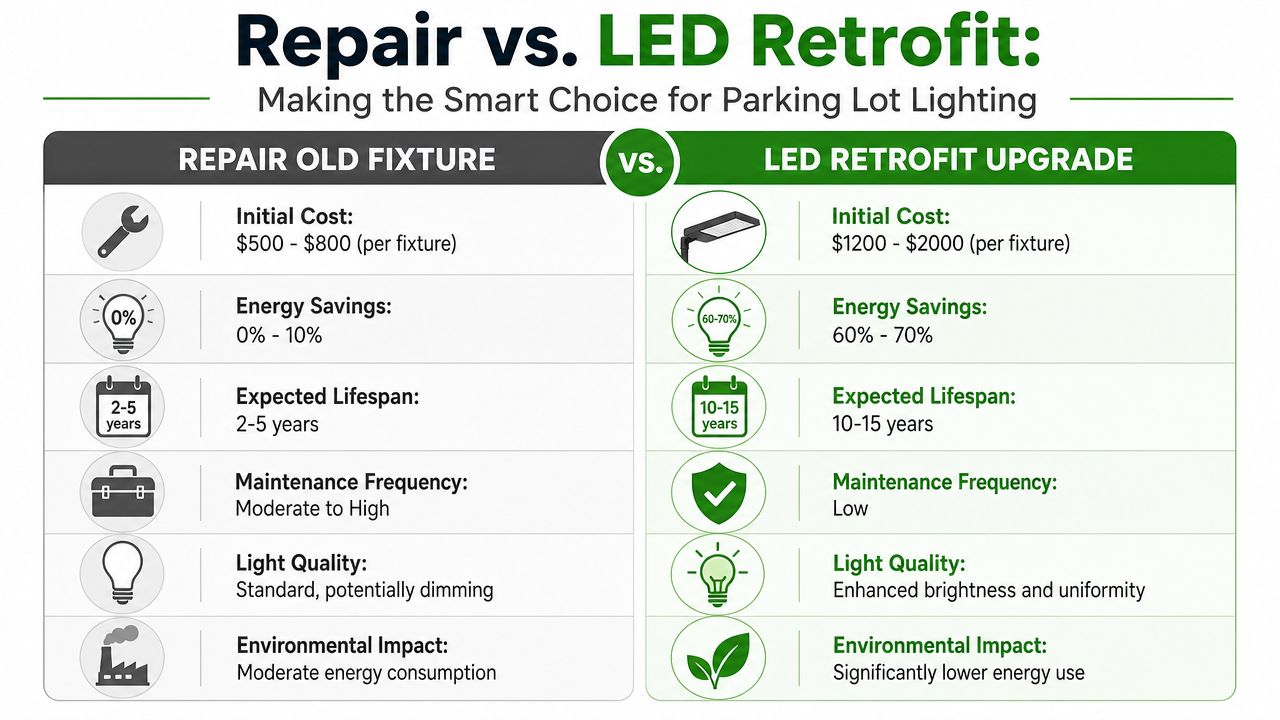
That doesn't mean every outage justifies a full replacement program. It means a repeated repair history should trigger a different financial conversation.
The trade-off managers should actually evaluate
Use a simple decision lens:
- Frequency of failures: If the same area keeps generating work orders, the system is telling you something.
- Energy burden: Older fixtures cost you every night they operate.
- Maintenance access: Pole lights aren't cheap to service because lift access, traffic control, and after-hours scheduling add friction.
- Light quality: A working fixture that leaves dark transitions or poor visibility is still underperforming.
- Controls capability: If the system can't support modern scheduling and occupancy strategies, you're leaving savings on the table.
Decision point: If the fixture can be repaired but the system still won't give you stable coverage, predictable maintenance, and control flexibility, it's time to price the upgrade seriously.
For Orange County properties, the retrofit conversation also ties directly to local energy code requirements and controls expectations. If you're weighing replacement against modernization, this overview of commercial lighting installation and LED retrofits in Orange County is the kind of project context you should expect a qualified contractor to understand.
Inspecting for Structural Integrity and Code Compliance
A fixture that turns on is not the same as a lighting system that is safe. One of the most expensive mistakes in parking lot lighting repair is focusing on lamps and drivers while ignoring the structure carrying them.
A working light can still be a dangerous asset
Every property manager should have a habit of looking at the pole base, anchor area, handhole, and fixture attachment points during routine site walks. You're not trying to replace an engineer or licensed electrician. You're trying to catch visible signs that the asset deserves immediate attention.
Watch for:
- Rust or corrosion at the base: Especially where paint has bubbled or the finish is breaking down.
- Cracked concrete footings: Movement at the base often shows up before a bigger failure.
- Missing handhole covers: Exposed wiring at pedestrian level is an unacceptable condition.
- A visible lean: Even a slight tilt can indicate impact damage, anchor issues, or deterioration.
- Loose fixture heads or arm assemblies: Wind and vibration exploit weak connections quickly.
These aren't cosmetic details. They're liability indicators.

Why seasonal inspection timing matters
Even in Southern California, weather exposure still affects exterior equipment. Seal failure, moisture intrusion, and temperature swings can create electrical problems that don't show up during a daytime drive-through. Industry guidance notes that thermal stress from freeze-thaw cycles causes 30 percent of all exterior lighting failures between January and March, which is why cold-weather inspections matter before seasonal outages start showing up. The same guidance states that regular maintenance should be performed at least once every six months, with monthly walk-throughs to check for dark areas and flickering lights, as explained in this parking lot lighting maintenance article.
For managers, the lesson is straightforward. Waiting for visible failure is too late.
Title 24 changes what a compliant repair looks like
In Southern California, code compliance can turn a “simple repair” into a larger scope if controls, fixture types, or circuit behavior no longer align with current requirements. Title 24 often affects outdoor lighting controls, scheduling, and what documentation may be needed after alteration work. That's why code awareness matters before you approve a quick patch that might create a compliance issue later.
If a contractor can fix the light but can't explain how the repair affects controls, documentation, or code obligations, the job isn't fully under control.
A good lighting repair process includes more than restoring power. It includes asking whether the pole is sound, whether the fixture is appropriate, whether the controls behave correctly, and whether the completed work will hold up under inspection.
How to Select a Qualified Lighting Contractor
Parking lot lighting looks simple from the ground. It's not simple once you factor in energized equipment, lift access, after-hours response, site safety, control systems, and code documentation. That's why choosing the contractor matters as much as the repair itself.
Start with the non-negotiables
For commercial exterior lighting in California, the baseline is clear. You want a licensed C-10 electrical contractor, active insurance coverage, and experience with occupied commercial properties. If a company mainly handles small residential service work, that's not the same thing as managing pole lights, control systems, and site coordination on a retail center or multifamily property.
Ask direct questions:
- Do they handle after-hours emergency response
- Do they own or reliably operate bucket trucks or boom lifts
- Can they troubleshoot controls, not just replace fixtures
- Can they document work for property records and compliance files
- Have they worked on properties like yours
A vague “yes, we do parking lot lights” isn't enough.

Ask how they diagnose repeat failures
This question separates a parts-swapping vendor from a true service contractor. If your lights “keep failing after repair,” the answer may have nothing to do with buying another replacement component. A capable contractor should talk about controls, moisture entry, fixture cleanliness, pole condition, and site obstructions. They should also be comfortable discussing how trees, glare, and coverage gaps affect the complaint history.
Here's what a stronger vetting conversation sounds like:
- On troubleshooting: They ask whether the outage is isolated or zoned.
- On access: They confirm pole heights and lift requirements before arrival.
- On controls: They ask what turns the system on and off.
- On scheduling: They offer a plan that won't disrupt peak tenant activity.
- On documentation: They leave you with a record you can use later.
Look for Southern California fluency
Orange County sites bring their own operational constraints. Retail centers need flexible work windows. Multifamily sites need safe nighttime circulation. Office and mixed-use properties often need tighter control integration and cleaner documentation. Title 24 awareness isn't optional in that environment.
The right contractor doesn't just close tickets. They reduce the number of tickets you get next quarter.
If you want a useful benchmark for evaluating service partners, review a contractor checklist like this guide on choosing the right commercial electrical contractor in Orange County. The standard should be broader than labor availability. You're hiring for safety, diagnosis, access capability, and follow-through.
Developing a Proactive Lighting Maintenance Plan
A property manager usually hears about lighting problems long after performance has started slipping. The first complaint is rarely the first failure. By that point, the lot may have dirty lenses, overgrown trees, drifting photocell response, and uneven coverage that makes one outage feel worse than it should.
That is why a maintenance plan should be built around site performance, not ticket volume. A fixture that turns on is only part of the job. The question is whether pedestrians, drivers, and cameras still get usable light where the property needs it.
A workable plan usually includes scheduled night inspections, fixture cleaning, control checks, and documented follow-up after repairs. On Southern California properties, I also recommend tying those inspections to seasonal growth and tenant use changes. A retail center with new patio seating, a multifamily property with heavier evening foot traffic, or a lot with maturing trees can develop repeat complaints without a single component failure.
Build the plan around drift
Parking lot lighting does not fail all at once. It drifts. Light output drops as lenses haze and debris collects. Tree canopies cut distribution. Glare from a poorly aimed replacement head can make a walkway feel darker even when the pole is operating.
A practical maintenance plan should account for that slow decline:
- Monthly night walk-throughs: Check for dark transitions, glare, flicker, blocked distribution, and areas where people cut across the lot instead of following marked paths.
- Semiannual preventive service: Clean fixtures, inspect photocells and time controls, verify aiming, and note poles or bases that need closer review.
- Post-repair verification: Confirm the repair restored coverage at ground level, not just power at the head.
- Vegetation coordination: Schedule trimming with lighting service so trees do not keep undoing the repair budget.
- Recordkeeping: Track recurring outages by pole, circuit, and area so you can spot a control issue or aging section of the system before it becomes an emergency.
Many plans exhibit a common flaw. They track failed parts, but they do not track recurring conditions.
Recalibration is what keeps complaints from returning
The most effective repair programs treat maintenance as system recalibration. That means revisiting how the lot performs under current site conditions instead of assuming the original layout still works. Trees grow. Tenants change operating hours. Security concerns shift to different corners of the property. Controls get overridden and never reset.
Title 24 matters here too. On Southern California sites, repairs and upgrades often intersect with control requirements, photocell behavior, scheduling, and fixture replacement decisions. A manager who only approves one-for-one swaps can miss the larger cost. The fixture may be back on, but the lot can still have poor uniformity, nuisance shutoff problems, or control logic that no longer matches how the property operates.
A strong maintenance plan asks better questions after each service call. Was the complaint caused by a failed component, or by blocked light, bad aiming, glare, or a control issue? Did the repair improve visibility along the actual path of travel? Is this area generating repeat calls because the system needs redesign or retrofit, not another spot fix?
Good maintenance reduces repeat complaints by correcting the conditions around the fixture, not just the fixture itself.
The best plans are simple enough to run and disciplined enough to produce decisions. They create a service history, support budgeting, and show when continued repair no longer makes financial sense. For owners and managers trying to control liability, that represents the value.