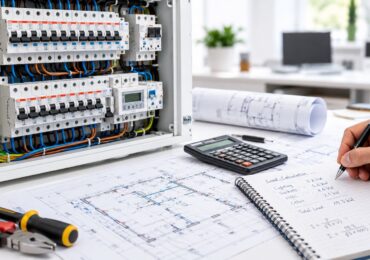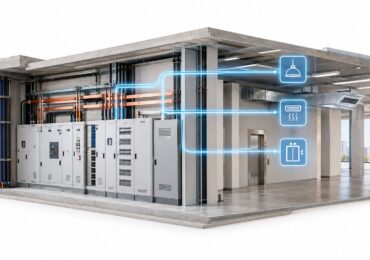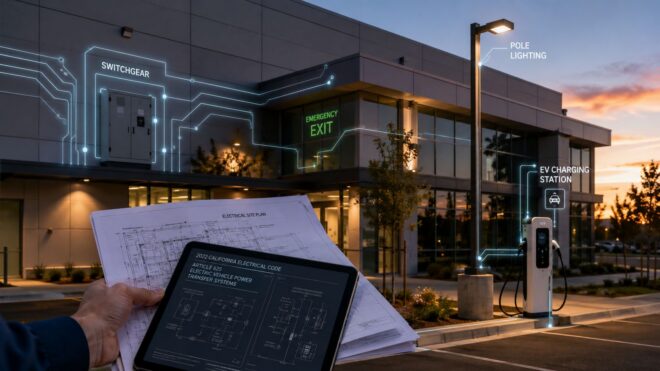
You're in the middle of a tenant improvement, a parking lot retrofit, or a panel upgrade, and the inspector flags something nobody on the team expected. The work looks complete, the lights are on, and the equipment is energized, but the job still doesn't clear. That's the part most property teams underestimate about the California Electrical Code. It isn't just about whether the wire is landed correctly, it's about whether the project matches the right code edition, the local amendments, the permit path, and the inspection sequence that California enforces.
For commercial owners and facility managers, that difference matters. A job can be electrically functional and still fail plan check, rough-in, or final inspection because the submittal missed a code update, a local amendment, or an approval path tied to the Authority Having Jurisdiction. California's electrical framework is also tied to life safety, fire response, and energy conservation, so the review is broader than a simple wiring check California's Title 24 history and structure, Title 24 electrical code text and compliance context.
Why the California Electrical Code Catches Property Teams Off Guard
A common failure pattern starts with a manager who assumes the contractor handled “the code stuff.” The installation passes internal review, the equipment energizes, and then the inspector asks for something that wasn't in the folder, a code edition verification, a lighting control document, a load calculation update, or a detail that changes because the site sits under a different local amendment set. The project doesn't fail because the work was random, it fails because California treats compliance as a chain, not a checkbox.
The code is bigger than the wiring
The California Electrical Code is adopted as Part 3 of Title 24, and the state's rules are designed to protect more than electrical function. They connect directly to public health, life safety, fire response, and energy conservation, which is why permit review and inspections often touch multiple disciplines at once Title 24 electrical code text and compliance context. That's also why a project team can't treat electrical scope as isolated from building code, accessibility, or energy requirements.
California's adoption pattern also matters. The state formally unified its building standards in 1978, then required Title 24 to apply to all occupancies statewide by 1988, which made the code system unusually centralized compared with many other jurisdictions California's Title 24 history and structure. The practical effect is simple, the project has to match the state edition, the local amendment environment, and the AHJ's inspection expectations, or it can stall.
Practical rule: if the permit set doesn't show the right edition and the right amendment path, assume the inspector will ask for it.
Why commercial teams feel the pain first
Commercial properties get hit hardest because the electrical scope often crosses lighting, panels, emergency systems, EV charging, and low-voltage coordination in the same project. That means one omission can create a chain reaction. A missed emergency light test can hold turnover, a feeder sizing issue can stop plan check, and a mismatch in lighting controls can trigger rework even when the installation is otherwise complete.
The bigger operational issue is timing. A delayed sign-off pushes occupancy, slows tenant turnover, and extends liability exposure if work was installed without the right permits or inspections. In California, that isn't a paperwork annoyance, it's a schedule risk and a compliance risk at the same time.
How the California Electrical Code Layers Over National Standards
On a California commercial job, the permit set can look complete and still fail at inspection because the team read only the national code path. The actual rule set is layered. National standards form the base, California adds its own requirements, and the local AHJ can add procedural demands or amendment-specific checks on top. If a crew plans from the NEC alone, it is working with only part of the compliance picture.
A simple hierarchy that reflects real jobs
National Electrical Code, NEC
This is the model code California builds from, but it is only the starting point for commercial work.
California Electrical Code, CEC
The electrical provisions sit in Title 24, Part 3, and California updates them on a triennial cycle tied to national model-code revisions California's Title 24 history and structure. The state then layers in amendments that reflect California priorities and enforcement practice. Subsequent references to that history and structure point to the same source.
Local amendments and AHJ review
The Authority Having Jurisdiction can affect permit intake, inspection sequencing, and final sign-off. A design that passes smoothly in one county can still get held up in another if the submittal package does not match local expectations.
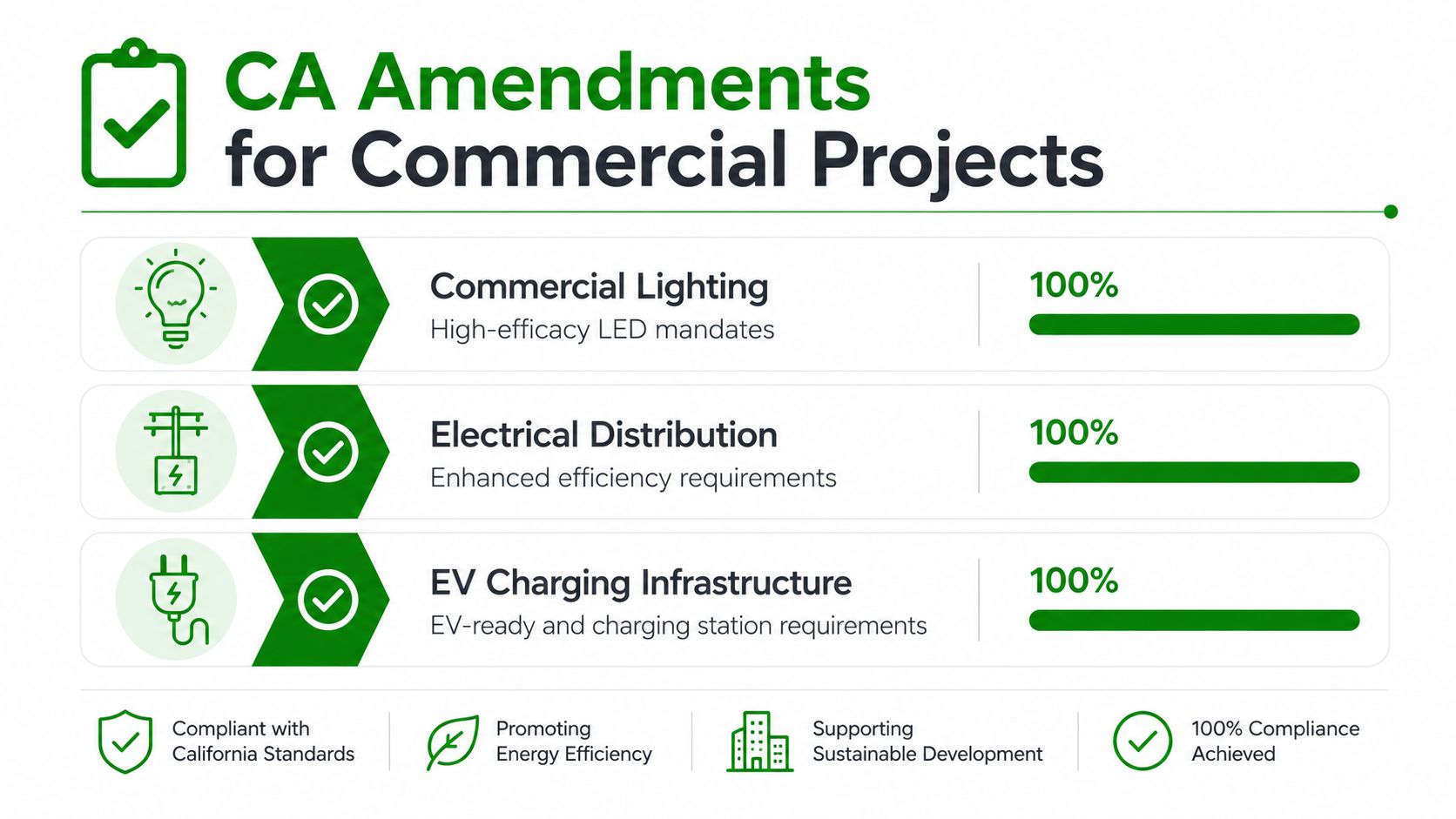
That layering is why “NEC compliant” is not the same as “approved in California.” The gap shows up in commercial lighting, distribution gear, EV infrastructure, and documentation requirements. A state edition can be based on one NEC cycle and then move forward on its own schedule, so contractors have to verify the adopted version instead of assuming the latest national text governs the job.
Why local jurisdiction still changes the job
Los Angeles County has its own long history of electrical code enforcement, with a code in effect since April 26, 1933 Los Angeles County electrical code amendments history. That matters because local practice often decides what gets flagged first, whether it is a missing detail on the plan set, a field condition that was never coordinated, or an inspection note that sends the team back for corrections. The same installation can be viewed very differently depending on the jurisdiction handling the permit.
For property managers, the practical takeaway is straightforward. Check the adopted edition, confirm the local amendments, and verify the AHJ before work starts. If the permit documents only reference the NEC, the package may be incomplete and the project can lose time at plan check or final inspection.
If you need a practical overview of how these requirements get organized on commercial jobs, the guide at Access Electrical and Lighting's electrical code compliance page gives a useful starting point for the broader compliance workflow.
California-Specific Amendments That Reshape Commercial Projects
California's most disruptive amendments are rarely the ones people expect. The biggest impact usually comes from rules that change design assumptions before the field crew ever starts pulling wire. That's where conductor sizing, lighting layout, EV charging, and fixture selection stop being convenience decisions and become compliance decisions.
Voltage drop is not a minor detail
California Energy Commission compliance material states that the maximum combined voltage drop on feeder and branch-circuit conductors to the farthest load must not exceed 5% California Energy Commission compliance material. On paper, that sounds technical. In the field, it affects conductor size, run length, and whether distant loads perform the way the designer intended.
Parking structures and site lighting are the first places this shows up. Long homeruns, raised fixtures, and scattered loads make it easy to under-size conductors if the design is rushed. When voltage drop is too high, luminaires can underperform, drivers can run hotter, and controls or emergency units can behave unpredictably. That's not a theoretical problem, it's the kind of issue that turns into inspection comments, callbacks, and relamping work.
EV charging has moved from simple install work to system work
California's 2016 code package introduced the first national requirements for accessible electric vehicle charging spaces in the accessibility provisions, which pushed commercial properties to think about charger placement, not just charger count Los Angeles County electrical code amendments history. The state's 2022 code then expanded Article 625 to address EV charging, power export, and bidirectional current flow HCAI CEC 2022 webinar handouts. That shift matters for multifamily, hospitality, and mixed-use sites where service capacity, load management, and emergency power planning are already tight.
The newer direction is even clearer in the 2025 changes, which add bidirectional power flow and safety interlocks to EV charging guidelines California Electrical Code overview and 2025 change summary. The message is that EV infrastructure is no longer a standalone device install. It has to fit the electrical system, the occupancy, and the site's operational logic.
Lighting controls are now part of the compliance package
California's lighting rules are also more than an energy checklist. The current mandatory measures require lighting control devices, light sources, and luminaires to meet the applicable section, and recessed ceiling luminaires must not use screw-based sockets, must be airtight with air leakage under 2.0 cfm at 75 Pa, and sealed with gasket or caulk where leakage paths exist California Energy Commission compliance material. That affects LED retrofit design, fixture substitution, and what gets accepted in inspection.
If the retrofit solves the utility problem but breaks the air-sealing or control requirements, it's not a clean retrofit.
The practical move is to treat EV charging, voltage drop, and lighting controls as one design conversation. That prevents the most common kind of California rejection, where each piece is individually reasonable but the assembled package doesn't satisfy the code path.
The Procedural Failures That Sink Electrical Projects
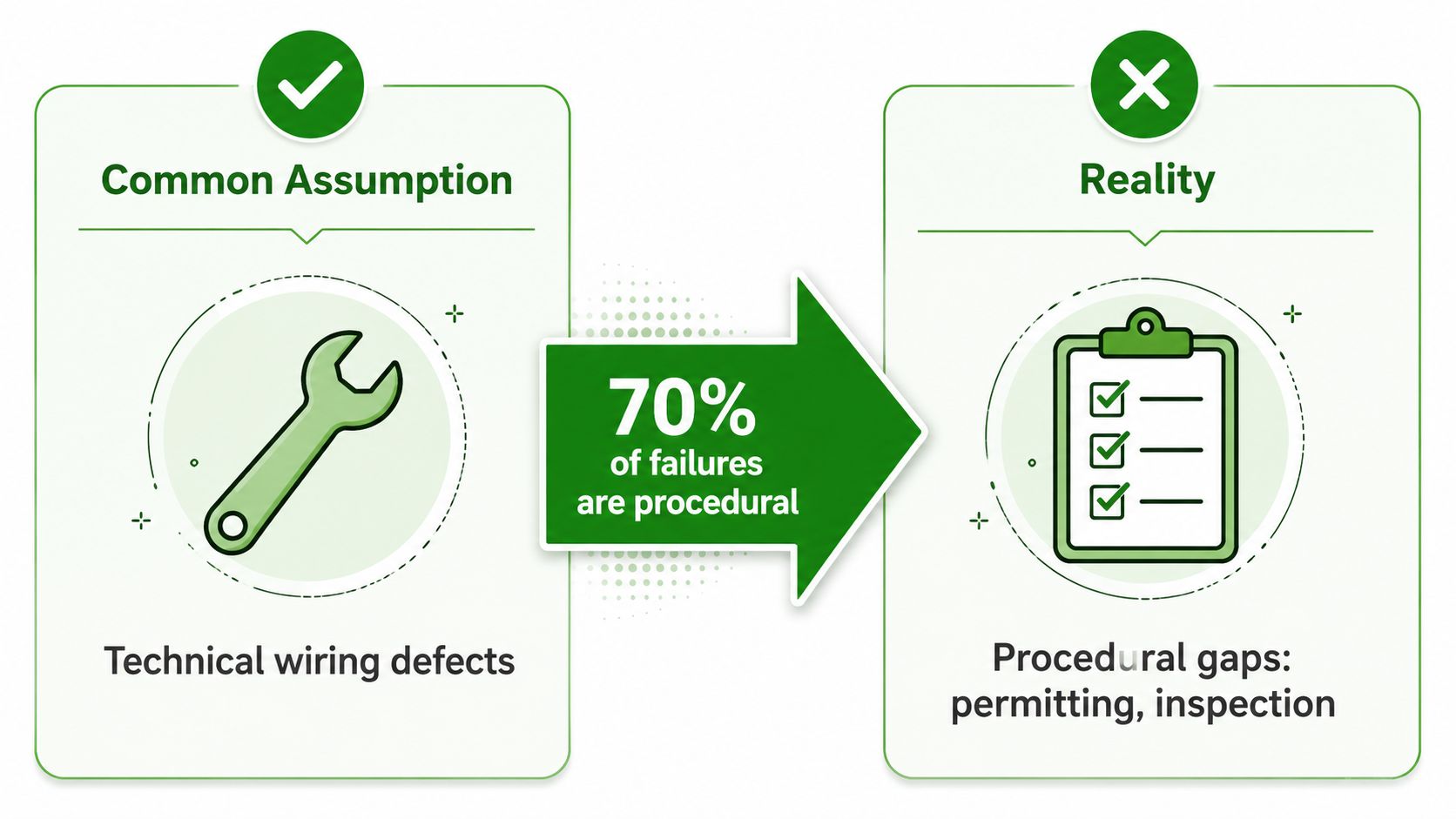
A lot of projects do not fail because the electrician picked the wrong conductor. They fail because someone skipped a step California expects to see in writing. Unpermitted work, missing inspections, and conflicts with local amendments create more problems than many teams want to admit, especially when the job is moving fast and the field crew assumes the paperwork will catch up later.
What a compliant submittal usually needs
On commercial jobs, the path usually includes a code edition check, local amendment review, load calculations, plan check, rough-in inspection, and final sign-off before occupancy or turnover. That sequence sounds procedural because it is procedural. In California, the procedure is part of compliance.
The harder part is that design errors can stop a project before the wiring is even installed. Service sizing mistakes, feeder routing conflicts, or equipment selections that do not match the occupancy can get flagged at plan check even when the proposed installation is electrically functional. The inspector is not only checking whether the system works, the inspector is checking whether the system was approved correctly.
The common assumption versus the actual outcome
| Common assumption | Actual outcome |
|---|---|
| “If the work is clean, it will pass.” | Clean work still fails if the edition, amendment, or permit path is wrong. |
| “The contractor handles compliance.” | The owner or manager still owns the project schedule and occupancy risk. |
| “Inspection is just the last step.” | Inspection can stop the job if documents, labels, or testing records are incomplete. |
That mismatch is where property teams get burned. A low-voltage contractor and a line-voltage contractor can both do good work, but if their scopes are not coordinated early, the permit package can fall apart. California enforcement often looks at the electrical scope against the base code and the local amendments at the same time, so siloed work creates avoidable delays and liability exposure.
What keeps a project moving
The cleanest jobs are the ones where the team documents the code edition early, aligns the permit set with the local AHJ, and coordinates the electrical scope with life-safety and controls before installation starts. That approach is less dramatic than field rework, but it saves the schedule.
For owners who want a practical inspection baseline, this electrical safety inspection resource is a useful reference point for the kind of documentation and verification that reduces surprise failures.
Compliance Strategies for Emergency Lighting and Critical Systems
Emergency systems are where code and operations overlap the most. A commercial property can have excellent lighting, solid panels, and good-looking finishes, then lose a final inspection because the emergency lighting documentation, battery backup testing, or life-safety coordination was incomplete. California treats those systems as part of the whole building safety picture, not as separate maintenance items.
Treat line-voltage and low-voltage as one compliance problem
The practical advantage comes from coordinating the scopes early. Emergency lighting, exit signs, switchgear, controls, and low-voltage infrastructure all interact during review and during maintenance. If a facility team lets different trades work from different assumptions, the documentation gets fragmented and the inspection gets harder.
That problem shows up fast in parking structures and pole lighting. These systems live outdoors, age unevenly, and often involve work at height, controls, and periodic replacement. A pole that looks fine from the ground can still have hidden deterioration at the base or at the mounting hardware, and that is where preventive documentation matters more than a quick visual check.
Documentation has to match the operating reality
California's framework makes compliance and maintenance inseparable. Emergency lighting testing, battery backup verification, and control documentation help prove that the system still works as intended after installation. For lighting retrofits and controls work, the record set should also show the Title 24 certification path, because the inspection question is not just whether the fixture is on, but whether the installed system satisfies the applicable control and performance requirements.
For teams managing multifamily or hospitality sites, the challenge grows when the same building includes chargers, backup power, guest-area lighting, and life-safety circuits. The more interconnected the building becomes, the more important it is to document which system serves which load and what happens during an outage or transfer event. For detailed procedures on emergency lighting compliance, see Access Electrical and Lighting's emergency lighting testing guide at https://accesselectricalandlighting.com/emergency-lighting-testing/.
Practical rule: if a system protects egress, occupancy, or emergency response, keep its test record with the permit file, not in a separate maintenance folder.
Access Electrical and Lighting provides emergency lighting testing, infrared electrical inspections, and Title 24 compliance support. That fits this kind of documentation-heavy environment when a property needs one contractor to handle the electrical and lighting side of the record set.
Building a Documentation and Inspection Readiness Framework
A property that passes once can still fail later if nobody maintains the paper trail. California compliance gets easier when the team stops treating records as afterthoughts and starts treating them as operational assets. The goal is simple, when an inspector asks for history, the answer should already be in the file.
Build the file around the code edition
Start with a property-level record that identifies the applicable code edition, local amendments, permit history, and inspection history. That keeps every future remodel, replacement, or emergency repair tied to the right framework instead of whatever the last contractor happened to know.
Then add system-specific folders for panels, lighting controls, emergency lighting, EV charging, and any bidirectional or export-capable equipment. Those items age differently, and they get inspected differently. A good record set shows what was installed, when it was approved, and what has been tested since.
Put the testing schedule in writing
Preventive maintenance is the other half of readiness. Schedule infrared thermography for distribution equipment, emergency lighting testing for life-safety systems, and periodic verification of labels, panel directories, and control documentation. If the system includes charging infrastructure or advanced controls, keep the O&M manuals and commissioning documents in the same file.
A practical checklist helps:
- Track permit status: keep approved plans, revisions, and inspection cards together.
- Match the installed scope to the approved scope: record any field changes before turnover.
- Store test results with dates and locations: emergency lights, panels, controls, and chargers should each have their own history.
- Use licensed C-10 contractors for electrical work: that keeps scope, responsibility, and compliance aligned.
- Review local amendments before each project: the last job's approval path may not apply to the next one.
Keep the turnover process disciplined
When a contractor closes out a job, the property team should receive the permit record, the final inspection sign-off, and the test documentation in one handoff. That prevents the common problem where the building operates fine, but nobody can prove compliance later.
The best inspections are the boring ones. The inspector arrives, the documents are ready, the labels match, the testing records are current, and the project moves on without drama.
Turning Code Compliance Into a Competitive Advantage
Proactive compliance doesn't just avoid trouble, it makes the building easier to operate. Properties with organized records, current testing, and documented maintenance spend less time scrambling during inspections and less time explaining gaps after the fact. That reduces liability exposure and makes tenant coordination smoother, especially when work has to happen during occupied hours.
The practical value shows up in the failures that never happen. A hidden hot spot found during an infrared inspection gets corrected before it becomes an outage. A lighting control issue gets fixed before the next inspector asks for documentation. An emergency lighting battery problem gets caught during testing instead of during a real power event. That's operational value, not just code hygiene.
For commercial owners, the best contractors are risk mitigators. They look for issues before enforcement actions do, and they document the fix so the property can prove it later. That's especially important in California, where electrical work, energy rules, and life-safety systems often intersect in the same project file.
When compliance is built into the maintenance program, the property team stops reacting to surprises and starts controlling the schedule. That's the difference between a building that merely operates and a building that stays ready.
If you're dealing with permit questions, inspection friction, emergency lighting testing, or a commercial retrofit that has to satisfy California code on the first pass, talk with Access Electrical and Lighting. They handle commercial lighting, electrical distribution, infrared inspections, Title 24 documentation, and emergency systems work that lines up with the compliance issues covered here.