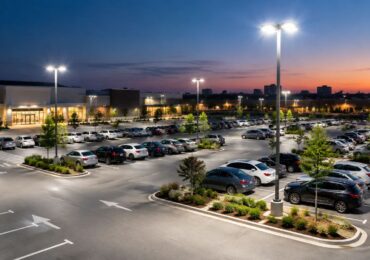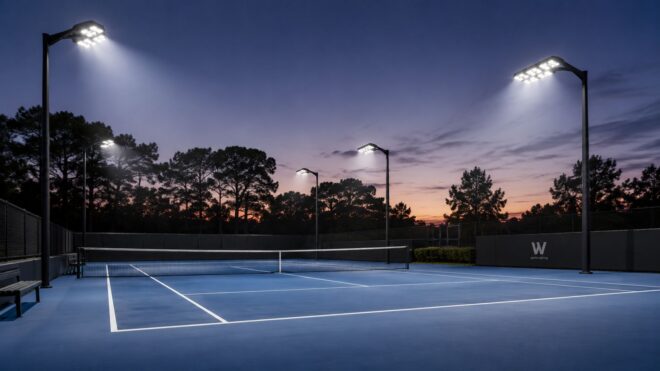
You're probably dealing with the same scene I see on old tennis properties all the time, a bank of tired metal-halide heads taking forever to warm up, a few dark corners on the court, and a utility bill that keeps getting harder to justify. The lights still turn on, but they no longer behave like a reliable system, they behave like aging equipment that's been patched one season too long. That's where tennis court LED lights stop being a nice upgrade and start being the practical move.
Why Tennis Court LED Lights Are Replacing Metal Halide
A court under failing metal-halide lighting usually tells the same story. The fixtures cycle on slowly, the output looks uneven, and maintenance keeps coming back for another round of relamping, troubleshooting, and complaints from users who can see the difference.
LED changes the whole system, not just the lamp. Tennis Victoria's 2023 energy-efficiency report assumes a court lit by LED uses 2.4 kW while the lights are on, compared with 5.5 kW for non-LED lighting, and says the upgrade reduces power and energy consumption by 44% (Tennis Victoria energy-efficiency report). That kind of shift matters on multi-court properties because lighting isn't just a utility line item, it's a recurring operational load.
What changes on the ground
LED fixtures switch instantly, so staff don't have to wait for warmup, and users don't sit around watching a court come alive in stages. They also give designers more control over where the light goes, which is a key reason LED works better on sports courts than a simple source swap.
Tennis Victoria's report also notes that about one quarter of lit courts in Victoria were already using LED at the time (Tennis Victoria energy-efficiency report). That's a meaningful sign of market penetration, not an experimental trend.
Practical rule: If the existing system is eating maintenance time and still missing the court edges, the problem isn't just age, it's optical control.
For facility managers, that distinction matters. LED isn't only about lower wattage, it's about having a lighting package that can be tuned to the site, the court layout, and the people who live next door.
Illuminance and Uniformity Standards by Court Type
Lighting a tennis court correctly starts with the performance target, not the fixture brochure. A recreational court can live at a different level than a tournament court, and a broadcast court needs tighter control still, because ball tracking, shadows, and camera visibility all get more demanding as play level rises.
For outdoor courts, expert design guidance typically targets 200–300 lux for recreational and club play, 500–750 lux for competitive and tournament play, and 1,000–1,500+ lux for professional broadcast use, with uniformity moving from about ≥0.5 to ≥0.8 as the play level increases (Unicornlite tennis court lighting standards). In practice, uniformity is what keeps the court from feeling patchy. Players notice shadows much faster than they notice raw brightness.
What the numbers mean in a specification
If you're writing an RFP, the cleanest way to think about it is this, the target lux tells you how much usable light you need, while the uniformity ratio tells you how evenly that light is spread. A design that hits the lux target but leaves dark bands near the baselines will still feel wrong in play.
LED Spot's photometric data gives a useful real-world comparison. A single recreational/residential court is designed around an average of 60.91 foot-candles with 107,800 lumens, while a single tournament/club court reaches 70.73 foot-candles with the same lumen rating, and a dual tournament/club court rises to 77.09 foot-candles (LED Spot photometric data). All of those examples mount fixtures at 22 feet and show max/min ratios from 1.4 to 2.14, which tells you modern tennis court LED lights are being engineered for distribution, not just brightness.
| Court Type | Target Lux | Uniformity Ratio | Avg Foot-Candles | Total Lumens |
|---|---|---|---|---|
| Recreational or club play | 200–300 lux | ≥0.5 | 60.91 | 107,800 |
| Competitive or tournament play | 500–750 lux | ≥0.8 | 70.73 | 107,800 |
| Professional broadcast use | 1,000–1,500+ lux | ≥0.8 | 77.09 | 107,800 |
If you need a quick conversion reference, the most practical approach is to work from foot-candles to lux using a dedicated calculator like this foot-candles to lux conversion guide.
Choosing the Right LED Fixtures and Optics
The biggest mistake I see is treating all outdoor floodlights as interchangeable. They're not. Tennis courts need fixtures that can handle the court geometry, the pole spacing, and the nuisance-light limits around the site, which means wattage alone tells you very little.
Modern tennis-court LED fixtures are commonly specified at 100–400 W per luminaire, with published examples showing 130–150 lm/W efficacy, 9,000–52,000+ lumens output, 0–10V dimming, 120–277 VAC or wider input ranges, and IP65/IP66 protection (CIP Lighting tennis court fixture data). Longer-life products claim 88,000 to 176,000 hours L70 or L70-equivalent, which is the kind of spec that matters on a property where lifts, access, and downtime are expensive.
Symmetric versus asymmetrical optics
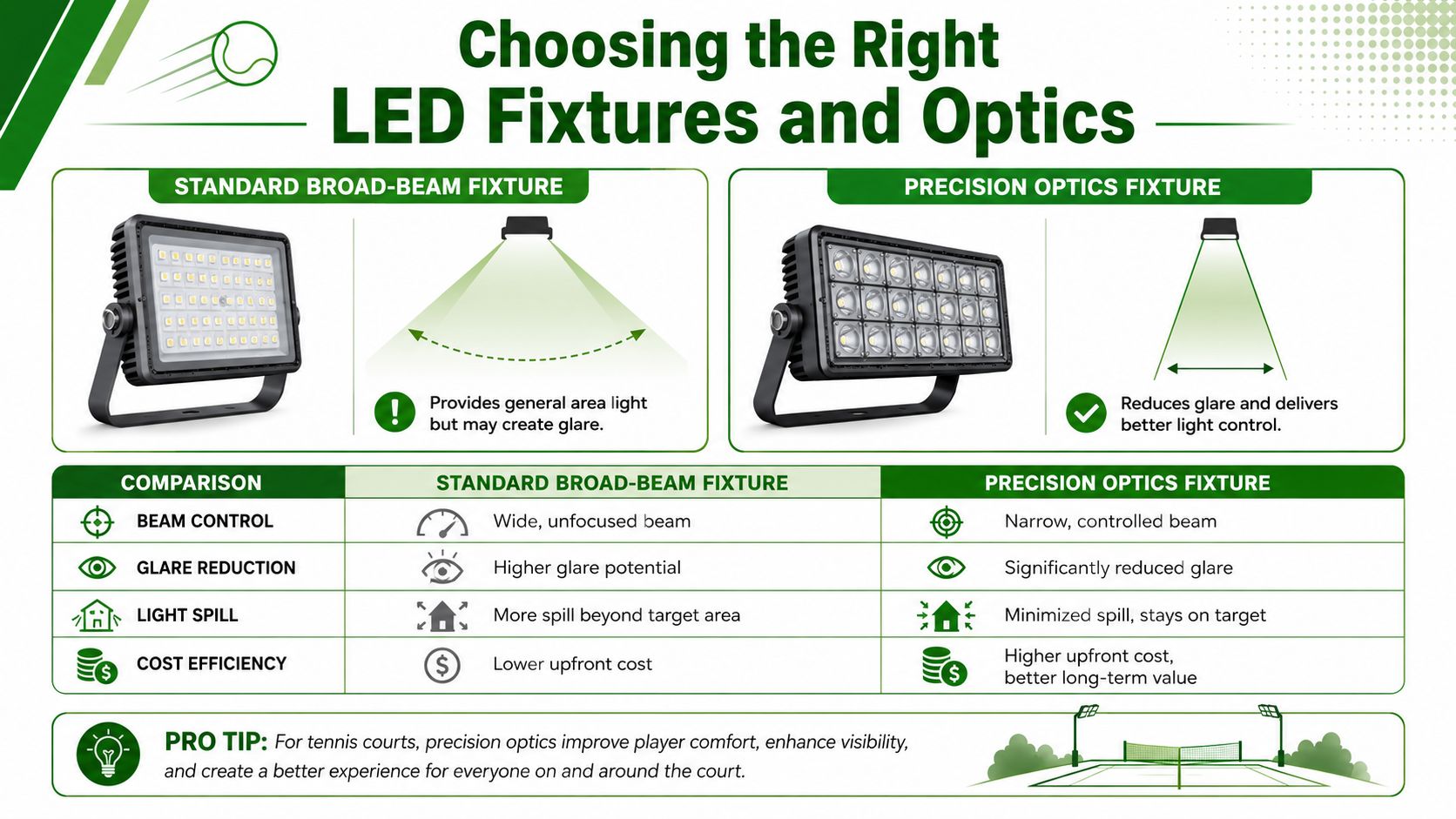
Many projects run into trouble. Standard symmetric floodlights can work, but on tennis courts they often waste light, throw glare into the player's line of sight, and send unnecessary spill beyond the boundary. Asymmetrical optics are better when the pole locations are constrained or the site sits close to neighboring windows, trees, or walkways.
A fixture with the right output but the wrong optic still fails the job. That's why design should start with beam distribution and layout, then move to wattage and cost.
A good fixture on the wrong optic is still the wrong fixture.
For multi-court properties, the choice often comes down to how much control you need versus how simple you want the installation to be. Precision optics usually pay off when the court is near homes, when poles can't be placed generously, or when the facility wants tighter control over glare. Standard beams are easier to understand, but they're less forgiving when the site is tight.
Pole Heights, Aiming Angles, and Layout Design
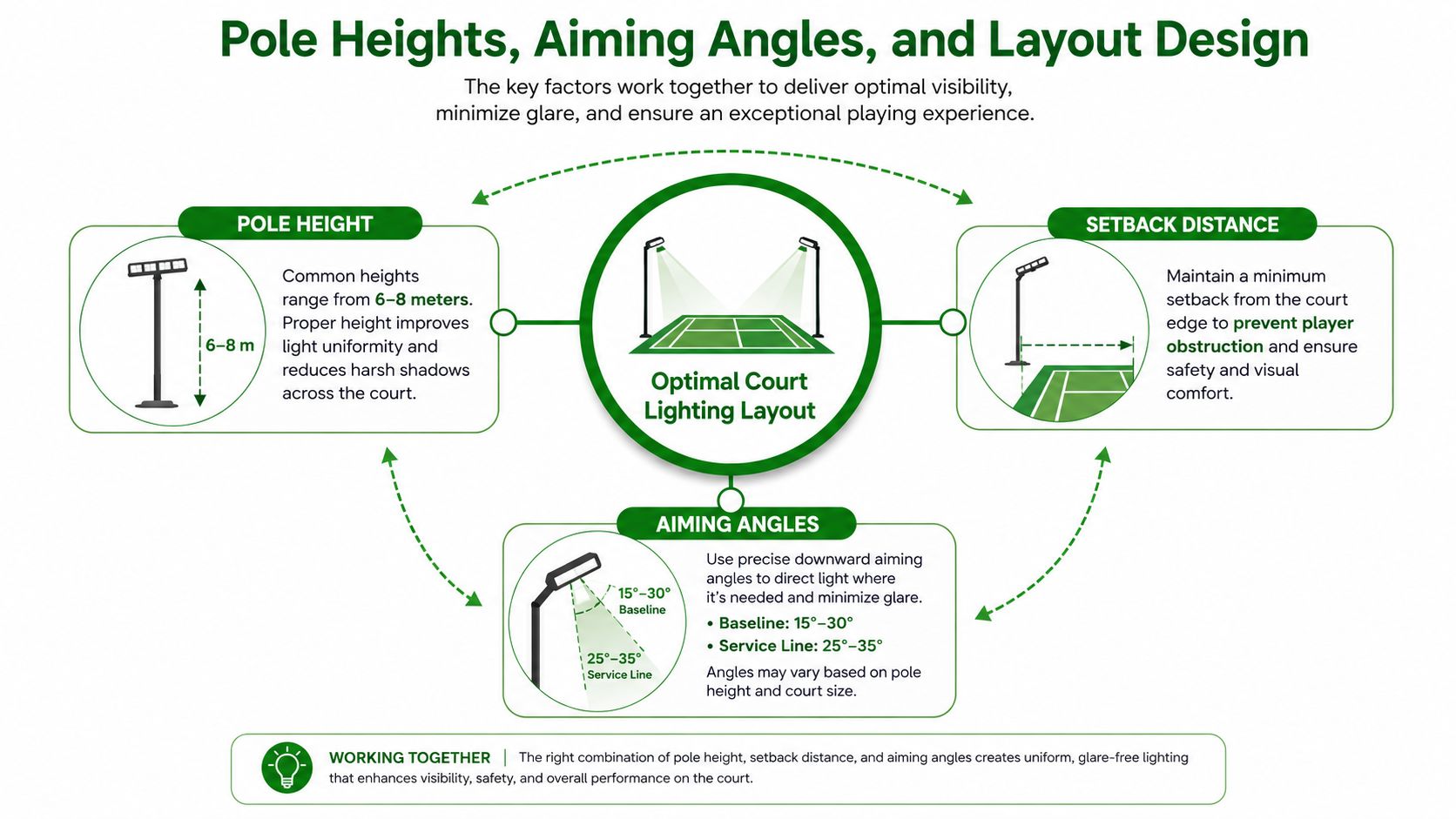
A court can have the right fixtures and still light poorly if the geometry is off. Pole height, setback, and aiming angle work together, and if one of them is wrong, the whole installation starts fighting itself.
LED Spot's data examples all use fixtures mounted at 22 feet above the court (LED Spot photometric data). That doesn't mean every property should copy that height, but it does show how much the mounting point affects coverage and uniformity. On a constrained site, a shorter pole can force narrower optics or more careful aiming, while a taller pole can improve spread but may create a different structural and permitting conversation.
The three layout decisions that matter most
Pole height determines how far the beam can travel before it lands on the court. Too low, and glare gets harsher and the light pool gets harder to shape.
Setback distance affects whether the pole and mast feel intrusive to players. It also changes how much of the beam reaches the court edge versus the fence line.
Aiming angles decide whether light is placed where it belongs or wasted outside the playing area. Once the optics are selected, bad aiming can still ruin the distribution.
If you're planning a retrofit on an existing site, the pole grid may already be fixed by the old system. That's when the design has to adapt to the structure, not the other way around. The most productive review usually happens before anyone orders fixtures, not after poles are installed and the court still looks uneven.
For an overview of pole installation as a lighting investment, this commercial light-pole installation guide is a useful reference point.
Controlling Glare, Spill Light, and Neighbor Impact
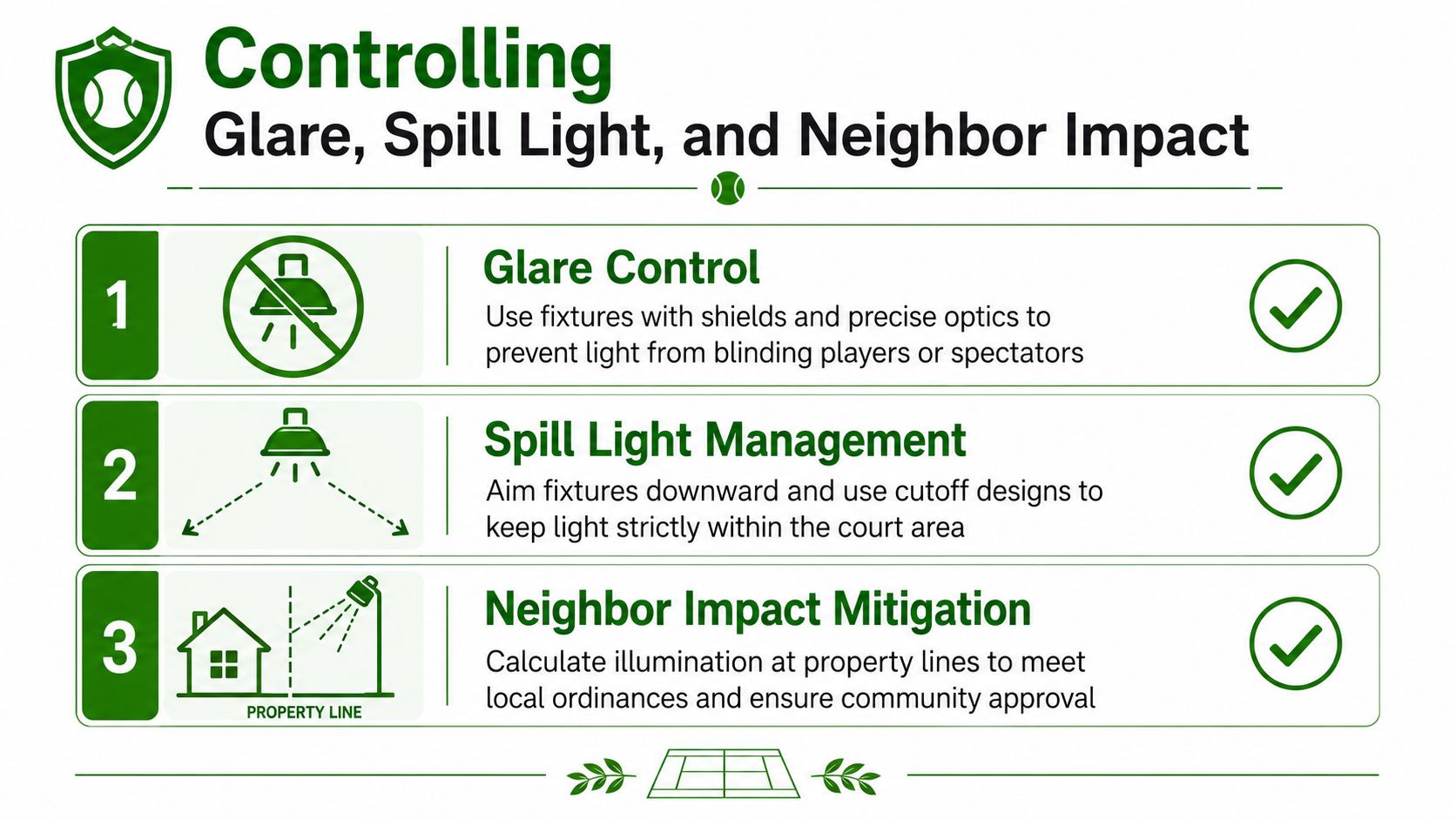
A court can meet the lux target and still be a bad installation. If players squint, neighbors complain, or the property line glows like a second court, the design failed where it matters most.
The LTA guidance is blunt about the site context around floodlighting. Venues should identify nearby properties, trees, and wildlife that the lighting could affect, and it recommends community and planning review before the design is finalized (LTA floodlighting guidance). That matters because permit approval often turns on nuisance-light concerns, not just court performance.
What actually works on site
Narrow beams and good shields help, but only if the pole positions support them. A bad pole location can force light to travel at a shallow angle, and that's usually when glare complaints start.
The common mistake is to judge the design only by fixture output. Site context decides whether that output becomes useful court light or annoying trespass light.
On residential and mixed-use properties, I've found the approval process is smoother when the drawings show who and what sits near the court. That includes windows, pathways, trees, and any sensitive edges where light could spill. It sounds basic, but those details are what planners and neighbors care about.
Check the property line before you check the catalog.
Symmetric floodlights can be the wrong choice on short poles or tight sites because they spread light too broadly. Asymmetrical optics help keep the beam on the playing surface, which reduces wasted light and gives you a better shot at avoiding complaints. The goal isn't maximum brightness, it's controlled brightness.
Retrofit Versus New Installation Workflows
Most facility managers don't have the luxury of starting from scratch. They inherit poles, wiring, conduit, and panels that may be serviceable, or may be one hidden fault away from a bigger problem.
Retrofits are usually the simpler path when the structural and electrical backbone is sound. New builds make more sense when the existing site layout fights the court geometry, the poles are too compromised to reuse, or the electrical system needs more work than the lighting itself.
A retrofit still needs discipline. The existing poles, wiring, and panel capacity have to be checked before anyone assumes the old infrastructure can carry the new load and controls. For projects that combine old infrastructure with LED upgrades, this commercial lighting retrofit resource is relevant because it reflects the same practical sequence most sites follow.
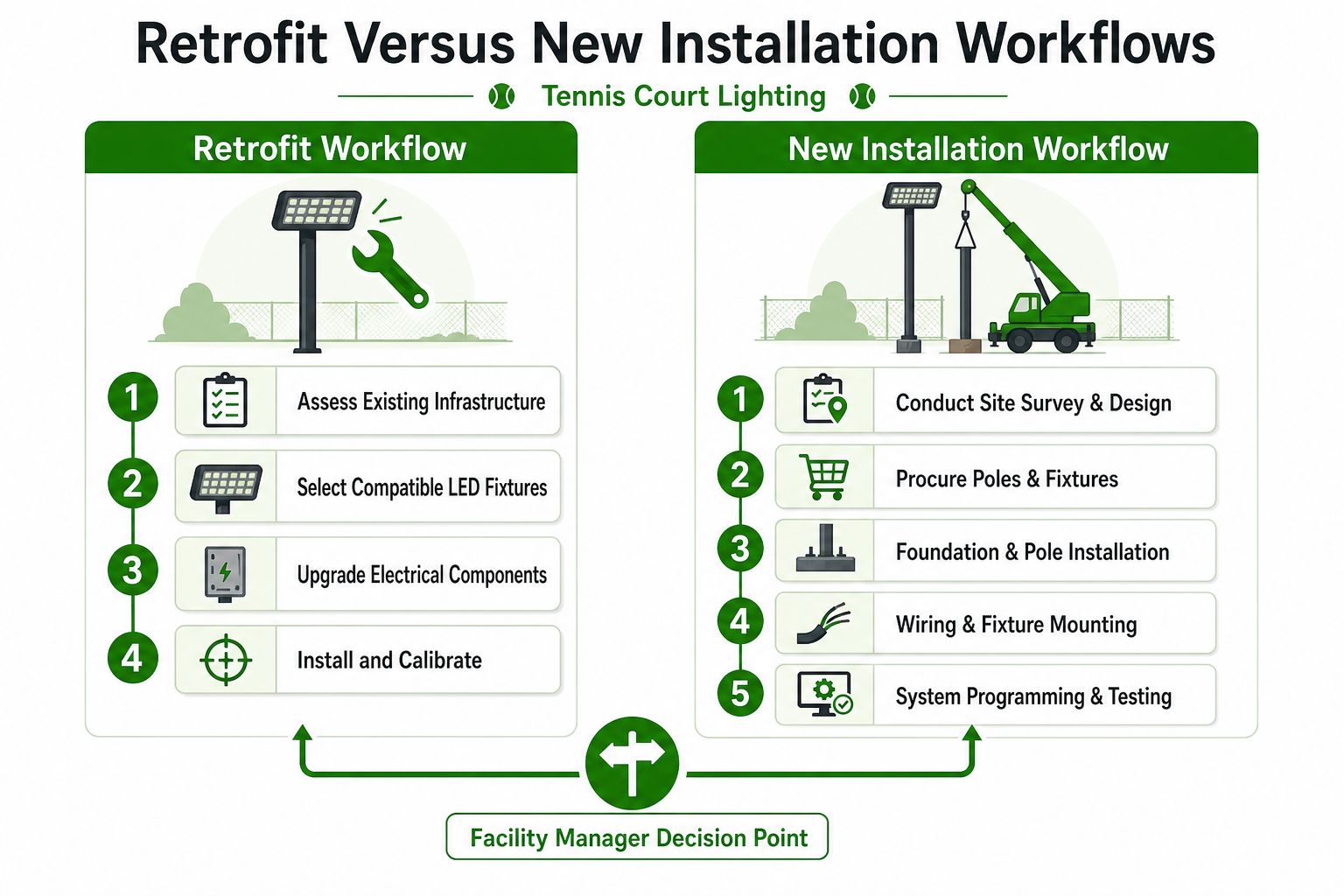
Retrofit workflow versus new build workflow
Retrofit workflow
- Assess existing infrastructure.
- Select compatible LED fixtures.
- Upgrade electrical components.
- Install and calibrate.
New installation workflow
- Conduct site survey and design.
- Procure poles and fixtures.
- Build foundations and install poles.
- Complete wiring and fixture mounting.
- Program and test the system.
The practical difference is control. Retrofit work depends on what's already there, while new installation lets the designer shape the system around the court from the beginning. On a crowded multi-court property, that difference can decide whether the project is straightforward or constantly compromised by old constraints.
Energy Savings, Controls, and Title 24 Compliance
LED savings don't come only from the fixture itself. Controls are what make the system behave like a managed asset instead of a switch that stays on because nobody wants to walk back out and turn it off.
The baseline energy advantage is already clear from the earlier section, but the operating picture gets better when photocells, timers, occupancy controls, and dimming are part of the package. That gives staff a way to match light output to actual use instead of running full intensity for empty courts. On larger properties, that matters as much as the fixture efficiency itself.
What compliance and maintenance look like in practice
In California, Title 24 adds another layer of responsibility for outdoor lighting projects. The contractor needs to support testing, certification, and documentation, not just installation.
The maintenance side is easier with LED, too. Longer-life products claim 88,000 to 176,000 hours L70 or L70-equivalent (CIP Lighting tennis court fixture data), which means fewer relamping cycles and less disruption on courts that can't afford frequent downtime.
A good operating plan usually includes:
- Scheduled control checks, so timers, photocells, and dimming commands still behave as programmed.
- Documented inspections, especially where compliance paperwork is part of the property record.
- Panel and connection review, because a new light head won't solve a weak electrical backbone.
- Spot verification after aiming changes, since a small shift at the pole can change the court pattern noticeably.
The value of LED on a tennis property is that it reduces the number of people and moving parts needed to keep the lights functional. That's a quiet win, but it adds up over time.
Selecting a Qualified Commercial Electrical Contractor
A tennis court lighting job is not a general handyman project. It needs a contractor who understands sports lighting, pole work, electrical distribution, and compliance all at once.
Look for a team that can handle photometric layout, high-reach equipment, pole integrity work, infrared inspections, and Title 24 support under one roof. That matters because separate vendors create handoff gaps, and lighting systems fail in the gaps more often than people expect.
Access Electrical and Lighting is one option for this kind of work, with commercial lighting, LED retrofits, infrared inspections, pole services, and Title 24 documentation in its scope of service. The right contractor should also be able to show licensing, bonding, and a clear plan for aiming, testing, and documentation before the first fixture goes up.
Ask who owns the aiming, the testing, and the paperwork. If the answer is unclear, the proposal isn't complete.
When you compare bids, don't stop at price. Compare the proposed optics, the compliance support, the equipment access plan, and the contractor's experience with raised assets. A good tennis court lighting job looks simple after it's finished, but it only looks that way because someone handled the hard parts before installation started.
If you're planning a tennis court LED lighting retrofit or new installation, Access Electrical and Lighting can evaluate the site, the poles, the controls, and the compliance requirements as one package. Visit Access Electrical and Lighting to discuss a layout that fits your court, your neighbors, and your operating budget.