
You're in the middle of a project where the drywall is going up, the owner wants the network live on move-in day, and somebody just asked why the camera locations weren't marked in the ceiling plan. That's the point where a low voltage cabling contractor stops being a “wire puller” and starts being the person who keeps the whole handoff from turning into a mess.
Commercial buyers usually feel the pain first in the punch list. The devices are there, but the labels don't line up, the test results are missing, the firestopping wasn't coordinated, and the drawings don't match the field. In commercial work, that gap is expensive because low-voltage systems touch data, security, AV, controls, and life-safety-adjacent infrastructure in the same building.
The market has clearly moved past the old “add-on” mindset. The 2024 Electrical Contracting Profile found that 95% of electrical contracting firms perform low-voltage work, and 26% already keep a separate low-voltage division, which tells you this is now a specialized service line with real staffing and closeout demands, not a side task (2024 Electrical Contracting Profile topline).
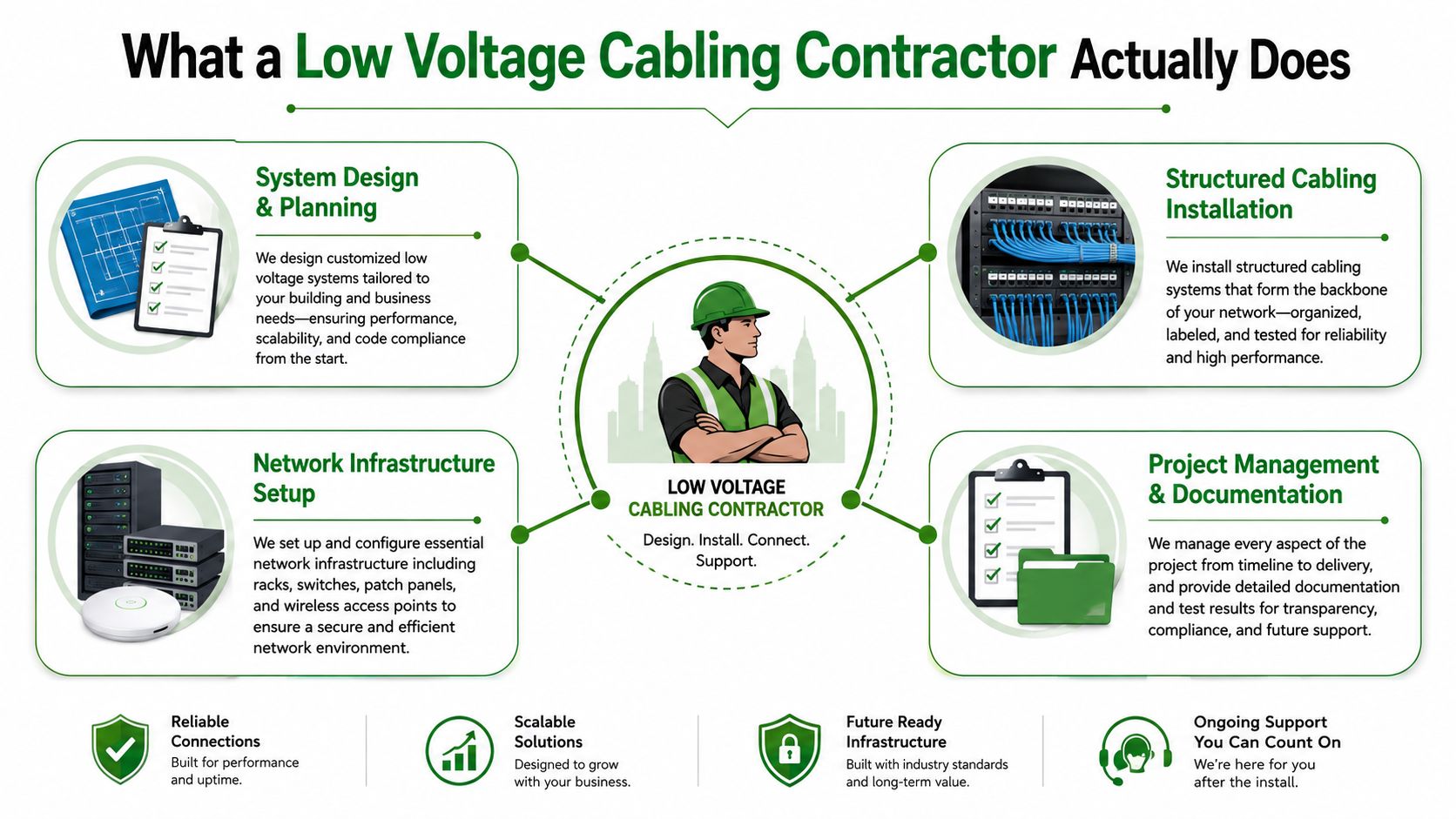
What a Low Voltage Cabling Contractor Does
A property manager usually notices low-voltage problems only after occupancy. The Wi-Fi drops in a tenant suite, the badge reader at the staff entrance lags, or the camera feed stutters right when someone needs footage. By then, the contractor's job is no longer about pulling cable. It is about making the building's communications backbone usable, testable, and supportable.
A day on a mixed-use site
On a mixed-use commercial property, a good low voltage cabling contractor is coordinating with the GC, the electrician, the firestop crew, and sometimes the HVAC trades. Ceiling space gets crowded fast, so pathway planning matters before the first cable ever lands. If a run crosses a rated wall, the contractor needs the penetration handled correctly and documented. If the patch panel room is shared with other systems, labeling and rack layout need to stay clean enough that another technician can service it later.
That is why low-voltage work has become a real specialty inside commercial construction. Industry reporting shows that many electrical contractors now touch this scope, and a meaningful share have formalized it into a separate division. (2024 Electrical Contracting Profile topline)
Practical rule: if the contractor cannot describe the pathway, the firestopping plan, and the closeout package before the work starts, the project probably isn't under control.
What gets handled beyond cable pulling
The field work is only one piece. A mature contractor is also handling system design coordination, rack and pathway planning, device placement, rack and closet organization, labeling, testing, and as-built documentation. On occupied sites, that may also include phasing around tenant hours, tying into existing infrastructure, and making sure the owner can hand the building off without a dozen undocumented temporary fixes lingering in the ceiling.
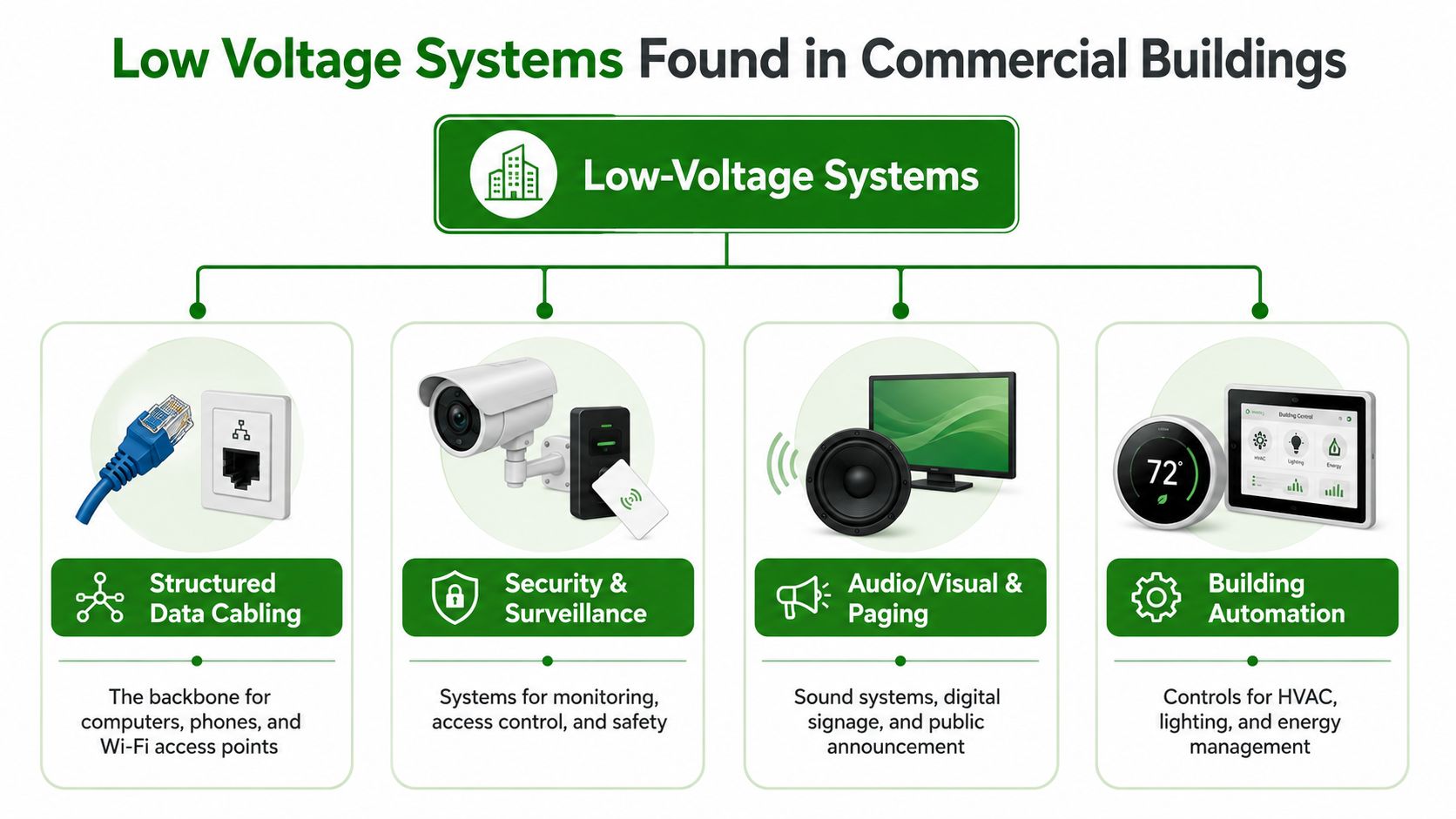
Low Voltage Systems Found in Commercial Buildings
Commercial buildings rarely rely on a single low-voltage system. They usually carry several, and those systems often share pathways, telecom closets, and the same troubleshooting headaches. A contractor has to understand how each system behaves in the building, not just how it looks on a cut sheet.
The backbone systems
Structured data cabling is the backbone for workstations, phones, Wi-Fi access points, and building network devices. In an office tower, that means the cable plant behind desks, conference rooms, and wireless coverage. In a retail center, it supports point-of-sale traffic, back-office connectivity, and store network equipment. Market reporting on structured cabling and low-voltage cable market data points to how much commercial connectivity infrastructure now matters.
Fiber comes into play when distance, bandwidth, or backbone design calls for it. In a campus-style property or a large multifloor building, it often serves as the link between telecom rooms, MDF spaces, or remote equipment locations. The planning matters because a poor fiber route can create avoidable splicing, testing, and service issues later.
Security, AV, and automation
Access control is common at employee entrances, garage doors, and restricted tenant areas. CCTV shows up in lobbies, loading zones, and parking structures. Distributed audio is common in retail, hospitality, and common-area paging. Digital signage and video walls are common in corporate lobbies, shopping centers, and amenity spaces where the owner wants messaging visible without exposed cabling cluttering the finish work.
Building automation ties low-voltage work to lighting controls, thermostats, and energy management. That can pull low-voltage crews into the same rooms and corridors as line-voltage electricians, so coordination has to be settled early. If the contractor does not know who is handling conduit, control wiring, device mounting, and startup, the job turns into a sequence of handoff problems.
| System Type | Where It Commonly Appears | What It Does for the Building |
|---|---|---|
| Structured data cabling | Offices, retail suites, multifamily common areas | Supports network access, phones, and wireless coverage |
| Security and surveillance | Entrances, garages, loading docks, lobbies | Supports visibility, access control, and monitoring |
| Audio and visual | Lobbies, conference rooms, retail floors | Delivers announcements, branding, and presentations |
| Building automation | Mechanical rooms, tenant spaces, common areas | Connects controls for comfort, lighting, and efficiency |
That mix is why the cleanest-looking installation is not always the easiest one to close out. Firestopping, labeling, pathway separation, and room-by-room documentation all have to line up before the owner takes over. For a practical example of how those pieces fit together, see this low voltage cabling installation overview.
Typical Project Scopes and What They Cost
A project budget often gets squeezed before the first cable is pulled. New construction gives the contractor open pathways and cleaner sequencing, but it also demands tight coordination with framing, drywall, ceiling trades, and startup timing. Tenant improvement work is harder in a different way, because the crew may be working around occupants, existing infrastructure, and limited access windows. Retrofits add hidden conditions, older finishes, and whatever surprises the original installation left behind.
How scope changes by project type
Labor is a major budget driver in structured cabling, and industry reporting shows it can make up a large share of project cost (market source). That is why the lowest bid often leaves the owner with the most expensive problems later. Cable itself is rarely the issue. The cost comes from field changes, rerouting, testing delays, and rework after ceilings are closed.
| Project Type | Typical Timeline | Key Coordination Needs | Cost Drivers |
|---|---|---|---|
| New construction | Usually the cleanest to execute because pathways are open early | Framing, ceiling rough-in, drywall sequencing, other trade access | Labor coordination, device placement, testing, closeout |
| Tenant improvement | Often compressed and phased around occupied spaces | Tenant hours, existing infrastructure, shared pathways, punch lists | Access restrictions, change orders, after-hours work |
| Retrofit | Usually the hardest because the building is already built out | Concealed pathways, legacy cabling, firestopping, occupied-space protection | Demo, reroutes, difficult access, unexpected field conditions |
What good scope control looks like
Scope clarity matters more than broad promises. If the package just says “install all cabling,” the field team ends up guessing where devices go, who owns pathway conflicts, and what counts as completion. A better scope names pathways, labeling, terminations, test expectations, and closeout deliverables so the contractor can manage the work instead of improvising through it.
That same discipline shows up in the field details that owners rarely see until closeout. Firestopping has to match the rated assembly, pathways need to stay separated from line-voltage work, and each room has to be documented in a way that ties back to the drawings. A practical example of that approach is outlined in the low-voltage cabling installation overview.
The price gap between two proposals usually comes down to what is included for coordination, cleanup, testing, and turnover. A proposal that looks lighter on paper may leave out the work that keeps the rest of the project from slipping.
Testing Standards and Certification Documentation
A clean install isn't the finish line. A commercial owner needs proof that every run was installed and tested to the required standard. For copper horizontal cabling, project specs commonly require compliance with and testing to ANSI/TIA/EIA-568-B.2 Category 6 procedures, and structured-cabling guidance also points to full cable test reports for every run (project specification example). That is a very different standard from “it has continuity.”
Why certification matters
The issue isn't just whether a cable passes today. It's whether the installation preserves the geometry and signal integrity the system was designed for. Cable stress from suspended runs and tightly cinched bundles should be minimized, and AVIXA F502.01:2018 recommends hook-and-loop fastening for category, coaxial, and fiber cables with tie spacing of three times the loom diameter or 10 cm, whichever is smaller (cable installation standards guide). That kind of detail matters because excessive tension or compression can create intermittent faults that don't show up on a quick visual walk.
What to expect at closeout
A complete closeout package should include:
- Fluke test reports or equivalent test results, tied to each run and link
- Certified as-built drawings showing actual pathways, terminations, and closet layouts
- Labeling schedules that match the field installation
- Manufacturer warranty submittals that activate the product coverage
- Compliance verification showing the work matches the project spec and local code
A property manager should also expect those documents to be usable by the next technician, not just filed away. If a future service call starts with tracing mystery cable, the closeout failed.
For owners who care about inspection-readiness, the mindset used in an electrical inspection report applies here too. The paperwork needs to show what was installed, where it lives, and what was verified.
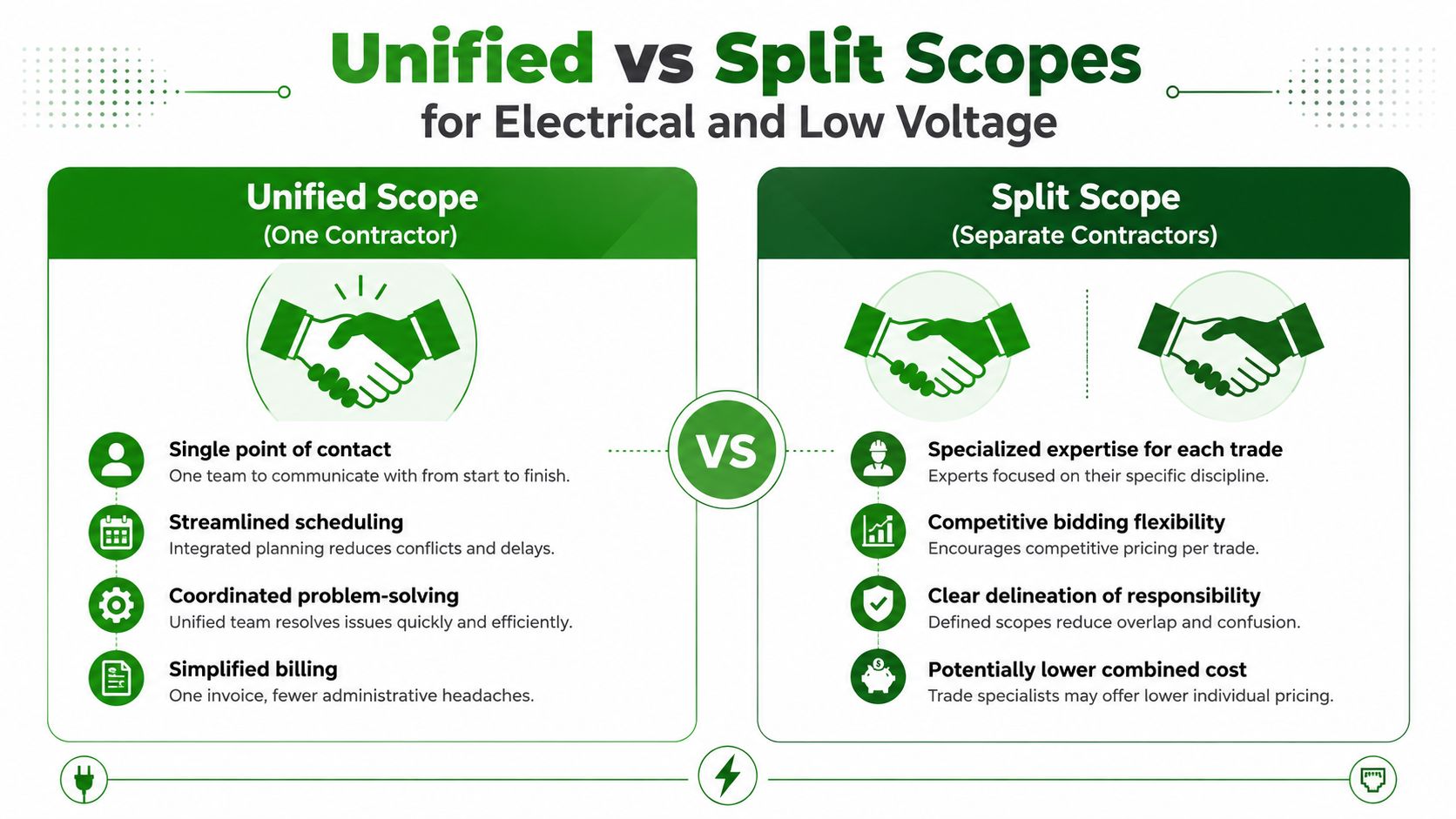
Unified vs Split Scopes for Electrical and Low Voltage
Owners and GCs usually have two choices. They can hire one contractor to handle both line-voltage electrical and low-voltage cabling, or they can split the work between specialists. Neither option is automatically right. The right answer depends on coordination complexity, the skill set required, and how much risk the project team wants to carry.
When one contractor helps
A unified scope usually works better when pathways, controls, power, and cabling all intersect. Shared conduit routes, lighting controls that need network coordination, and EV charging stations that need both power and data are common examples. One contractor can reduce field conflicts because the same team sees the power requirements and the data requirements at the same time.
That doesn't mean every electrical contractor should handle every low-voltage task. It means the boundary between systems is blurrier than it used to be, and the project benefits when the team coordinating the work understands both sides.
When split scopes make sense
Split scopes can work when the project needs highly specialized fiber work, advanced AV integration, or a vendor the owner already trusts for a specific system. That can help if the contractor base is strong and the scope lines are clean. The risk is coordination drift. If nobody owns the interface between power, pathways, and low-voltage devices, the job can turn into finger-pointing when something doesn't line up.
Coordination rule: if two contractors are sharing pathways, they need a single person who owns the schedule, the access windows, and the final location approvals.
What buyers should evaluate
A practical evaluation comes down to three questions.
- Can one team coordinate both scopes without creating trade conflicts?
- Does the low-voltage work require specialized knowledge that the electrical contractor doesn't have?
- Will separate contracts create more control, or just more handoff risk?
Southern California owners often choose Access Electrical and Lighting when they want both line-voltage and low-voltage scopes handled under one contract, especially on commercial, retail, office, and multifamily properties where coordination and closeout discipline matter.
Questions to Ask Before Hiring a Low Voltage Contractor
Most buyer checklists ask about licensing and references. Those matter, but they don't tell you whether the contractor can keep a commercial job under control. The better questions expose how the contractor handles firestopping, pathways, inspection readiness, labeling, and closeout discipline. Those are the details that separate a clean turnover from a long troubleshooting cycle.
Ask about the work process, not just the price
Start with the basics, then get specific. A contractor who works commercial properties should be able to explain how they coordinate cable routes with other trades, who approves device locations, and how they document field changes. If they talk only about hardware brands and not about installation control, that's a warning sign.
Use the same kind of practical discipline you'd use when screening a commercial electrician, because the underlying issue is the same, dependable execution under real jobsite pressure. A useful reference for that mindset is how to find a reliable commercial electrician in Orange County.
The questions that actually matter
- How do you handle firestopping? Good answers mention rated assemblies, coordination with other trades, and documented penetrations.
- What labeling standard do you use? Strong contractors can describe how labels match panels, ports, and as-builts.
- What testing do you deliver? You want test results tied to each run, not a verbal “it all checked out.”
- What does your closeout package include? Look for drawings, labels, test reports, and warranty paperwork.
- How do you manage punch lists and callbacks? Mature firms have a process for warranty response, not a shrug and a phone number.
- Who coordinates with the GC when the field changes? The right answer is usually a named person, not “we'll figure it out.”
Red flags to watch for
If the contractor can't explain inspection readiness, treats as-builts like optional paperwork, or brushes off trade coordination as “site stuff,” keep looking. That attitude usually shows up later as missed penetrations, messy closets, and unsupported claims that the owner has to sort out after turnover.
Why Southern California Properties Choose Access Electrical and Lighting
Southern California buildings bring their own realities. Local code knowledge matters, title and inspection requirements matter, and owners want contractors who can move between lighting, power, and low-voltage scopes without losing control of the project. In Orange County, the Inland Empire, and San Diego, that combination is often more useful than a narrow specialty with no field coordination depth.
Access Electrical and Lighting fits that model as a regional commercial contractor with over 60 years of combined team experience, a California C-10 electrical license, and the ability to handle line-voltage and low-voltage scopes under one contract. Their service mix includes commercial, retail, office, and multifamily properties, plus emergency response and infrared thermography for non-invasive diagnostics and preventive maintenance.
That matters on the kinds of projects covered in this article. When the low-voltage scope has to align with power, lighting controls, and closeout documentation, one team that understands the whole building can keep the work moving with fewer handoff gaps.
If you're planning a retrofit, tenant improvement, or new commercial build, talk with Access Electrical and Lighting about the low-voltage scope before the ceilings close and the punch list starts growing. Visit Access Electrical and Lighting to review their commercial services and request a conversation about your project.