You've got a lighting proposal waiting for approval, tenants asking when the parking lot will be fixed, and an owner who wants competing bids before releasing funds. The prices look comparable until you read the exclusions. One bidder includes controls testing, another excludes permitting, and another hasn't opened the electrical room.
Hiring electrical contractors in Orange County, CA, means sorting out those differences before anyone mobilizes. Treat the selection as a property-risk audit. Each credential, site observation, and contract requirement should answer a practical question: what problem does this prevent, and who's accountable if it happens?
The Hidden Cost of a Cheap Electrical Bid
A property manager approves an LED retrofit on an occupied building, expecting fixture swaps and limited disruption. After award, the contractor walks the site and flags a planned tenant expansion that needs an electrical-capacity review nobody included in the bid.
The LEDs may not need a larger service at all. The bidder priced fixture work without evaluating the broader project, and the owner now has to choose between separating the expansion, authorizing design work, or postponing part of the installation. Then an emergency-lighting defect surfaces, and the closeout package arrives without the lighting-control testing the project team expected. On jobs I've supervised, that second discovery is the expensive one. The manager ends up coordinating corrective scopes while explaining why a routine improvement can't close out.
Questions that surface unresolved decisions
Treat this as a planning example, not a reported case study. The pattern behind it shows up on real jobs: a low number can mean the bidder left decisions open instead of pricing them.
Before comparing totals, ask each bidder to state, in writing:
- Capacity assumptions: Which panels, feeders, and service equipment did the contractor evaluate, and what remains unverified? The risk is a mid-project redesign that stalls occupied spaces.
- Occupied-building constraints: Who coordinates tenant notices, access, shutdowns, and restoration? Unclear ownership here becomes schedule slip you manage.
- Compliance responsibility: Who determines the applicable requirements, performs testing, and delivers closeout records? Missing documentation delays sign-off and leaves you without evidence at audit time.
- Excluded equipment: Are emergency units, exterior controls, pole-mounted and high-mounted fixtures, and adjacent systems in scope? Anything excluded becomes a second contract you didn't budget.
- Unforeseen-condition procedures: What evidence must accompany a change-order request? A vague clause invites open-ended extras.
Don't reject a contractor who flags uncertainty. A qualified allowance with a resolution path beats an unconditional price built on guesswork. Make the bidder explain how each open item gets resolved before mobilization.
Compare the cost of disruption
Build the evaluation around installation cost, owner coordination, operating interruptions, corrective work, and future serviceability. Repeated mobilizations and undocumented equipment create management work no savings forecast needs to justify.
Practical rule: An exclusion isn't automatically unreasonable. An exclusion nobody discusses before signing is a project-management problem.
Draft your change-order clause with the same discipline. One workable version: the contractor submits dated photos of the concealed condition, a marked-up drawing showing the affected system, and a labor-and-material breakdown within two business days of discovery, and no extra work starts until you countersign. A bidder who accepts that language without argument is showing you how the job will run.
Licenses and Insurance That Actually Matter in California
A license number on a proposal is a starting point, not a completed review. Independently check the contractor's record with the California Contractors State License Board, and match the legal business name to the proposal and intended contract.
For a commercial electrical bidder presenting C-10 qualifications, ask the contractor to identify which work its classification covers and how it will handle adjacent specialties. Don't assume a credential establishes competence in occupied-building shutdowns, controls commissioning, or complex troubleshooting. Evaluate those capabilities separately.

Match each credential to an exposure
Minimum vs Recommended Contractor Credentials
| Credential | Minimum to Hire | What to Look For |
|---|---|---|
| License | Independently verified status and scope suitability | Matching business identity and a clear explanation of specialty responsibilities |
| Contractor bond | Verified status appropriate to the engagement | Clear distinction between licensing-related bonding and project-specific protection |
| General liability | Coverage accepted by your insurance adviser and contract requirements | Review of exclusions, applicable endorsements, and the proposed work |
| Workers' compensation | Verified coverage or a properly reviewed applicable exemption | Confirmation that the actual staffing arrangement matches the documentation |
| Subcontractor credentials | Identified subcontractors with reviewed qualifications | Consistent insurance and responsibility requirements throughout the contracting chain |
These are owner-side hiring standards, not a substitute for a legal determination of California requirements. Have your insurance adviser establish appropriate coverage rather than borrowing limits from an unrelated property's contract.
A certificate should initiate the coverage review, not end it. Ask your adviser whether the policy and endorsements address the actual operations, subcontracting arrangements, and contractual obligations. A lease requirement and an owner's exposure during major distribution work deserve separate consideration.
Don't confuse responsiveness with protection
Request current documentation early enough to resolve discrepancies before award. A delayed certificate warrants follow-up, but speed alone doesn't establish that coverage is appropriate. Likewise, don't make assumptions about lien rights or the legal consequences of a bonding issue without qualified legal advice.
Walk away from deliberate identity mismatches, unverifiable documents, or pressure to sign before material questions are resolved. Treat bid shopping separately: asking bidders to clarify a common scope is sound procurement; circulating another contractor's detailed solution to obtain a cheaper number can discourage careful estimating.
The strongest credential package gives the manager a traceable contracting entity, reviewed coverage, and a clear chain of responsibility. It doesn't replace field supervision.
Matching Scope of Work to Contractor Capability
Start the site walk with the property's operating problem, not a shopping list of products. A dark parking structure might call for fixture repairs, control adjustments, circuit troubleshooting, or a coordinated replacement. Ask the bidder what it needs to inspect before recommending a scope.
Then follow the work across trade boundaries. Lighting power, control wiring, network connectivity, signage, and access-control interfaces shouldn't become separate unresolved obligations because different technicians perform them.
Define who owns each interface
Have the bidder mark up a scope matrix rather than answer whether it “does everything.”
| Property scope | Question that reveals capability |
|---|---|
| Site and pole lighting | Who provides elevated access, evaluates the proposed work, and restores affected surfaces? |
| Distribution upgrades | Who coordinates design, shutdown planning, utility communication, and testing? |
| Lighting controls | Who programs the system and demonstrates the intended operating sequence? |
| Low-voltage infrastructure | Who installs cabling, configures equipment, and verifies end-to-end operation? |
| Infrared inspections | Who interprets findings and develops corrective recommendations? |
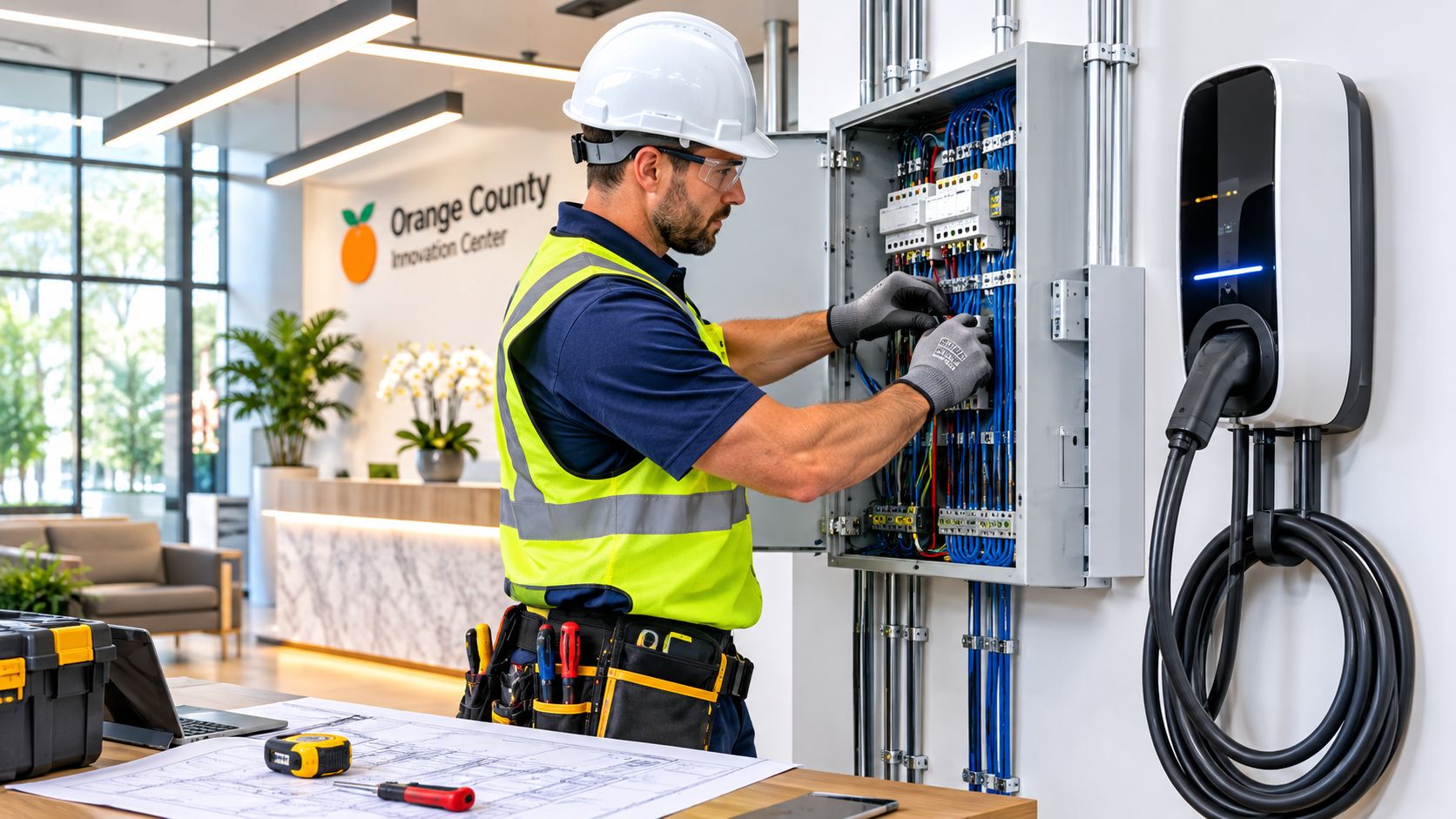
| EV infrastructure | Who evaluates electrical capacity, parking use, routing, and permit jurisdiction? |
Self-performance isn't the only acceptable model. A contractor can use qualified specialists effectively if it identifies them, coordinates their work, and accepts responsibility for the finished interface.
For a hypothetical retail-center improvement, the electrical contractor might energize digital signage while a separate vendor supplies the display and network connection. Unless someone owns the final demonstration, each vendor can finish its individual task without delivering an operating sign. Specify who witnesses acceptance and resolves defects.
Treat EV charging as an infrastructure decision
An EV proposal should distinguish charger installation from property readiness. Ask for the service-capacity review, panel-loading assessment, branch-circuit route, parking-use assumptions, and any potential transformer or switchgear implications.
California's 2025 code changes distinguish multifamily properties from hotels and motels, increase applicable multifamily common-use Level 2 charging provisions to 25%, and address altered or added parking spaces, so the bidder should explain applicability through the California Building Standards Commission's code-change guidance.
Don't accept that percentage as a blanket requirement for every existing parking lot. Require the design team to identify the project trigger, affected spaces, governing code, and approving jurisdiction before you approve equipment purchases.
Pressure-Testing Emergency Response Before You Need It
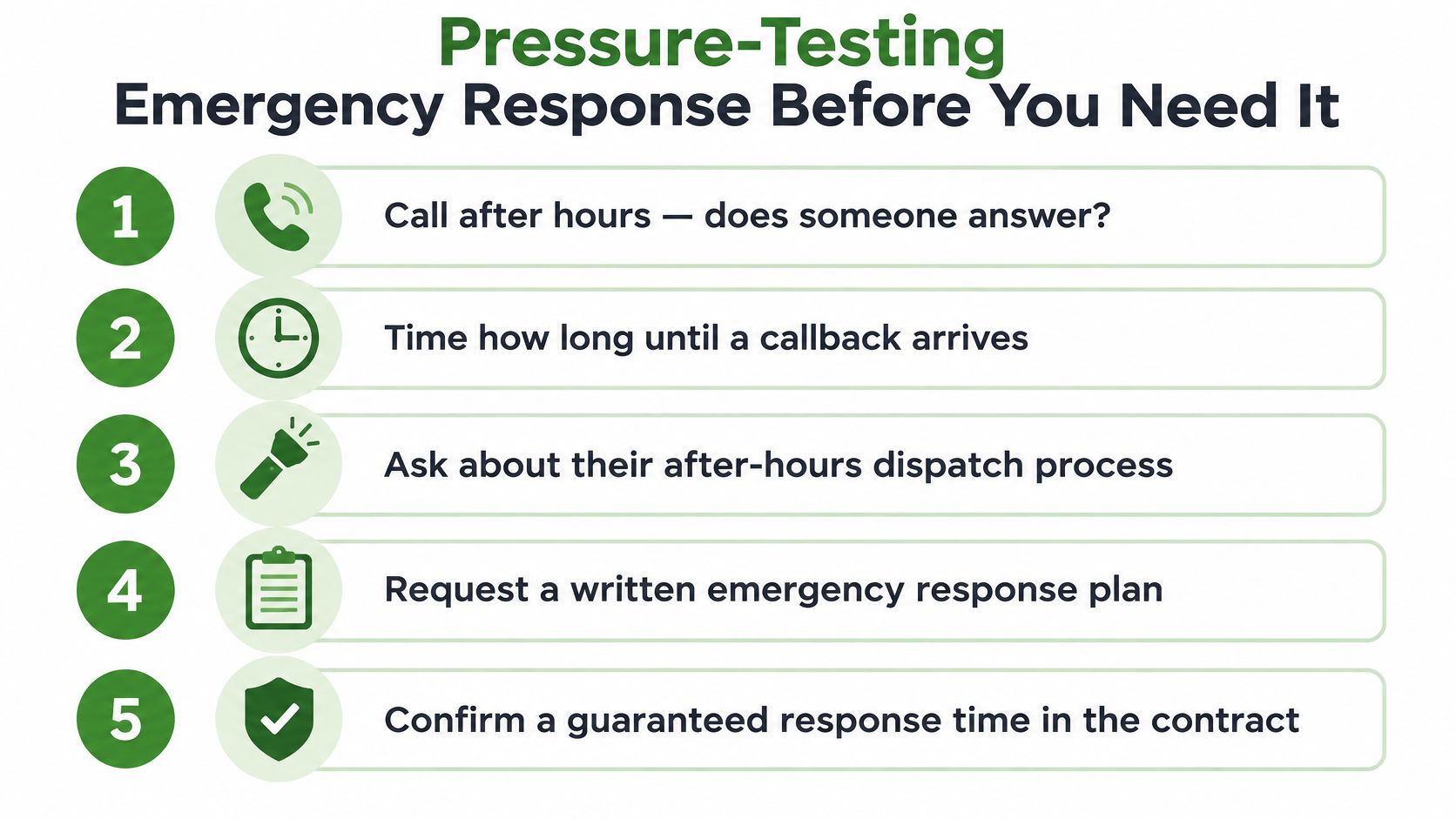
Ask a prospective service contractor what happens when a vehicle damages a parking-lot pole after business hours. You need more than confirmation that somebody answers the telephone. You need to know who assesses the hazard, authorizes dispatch, and communicates the property's condition.
Have the contractor describe a recent dispatch process without disclosing another customer's confidential information. Ask who took the call, how a qualified technician became involved, and how the contractor distinguished temporary stabilization from permanent repair.
Test the operating process
Use scenario questions that require an operational answer:
- Damaged exterior equipment: Who advises the manager on restricting access while qualified personnel assess the equipment?
- Main distribution trouble: Who determines whether utility involvement, specialist support, or replacement equipment is necessary?
- Unavailable components: What temporary measures might be considered, and who approves their limitations?
- Concurrent incidents: How does dispatch prioritize a life-safety concern against a routine outage?
- Service-vehicle readiness: What diagnostic tools and commonly needed materials are stocked, and what usually requires procurement?
A controlled after-hours contact test can reveal communication gaps. Arrange it in advance rather than creating a false emergency that could divert a crew.
Define response before negotiating speed
Write separate expectations for acknowledgment, technical callback, dispatch, and arrival. A guaranteed callback isn't a guaranteed repair. Define geographic coverage, escalation contacts, emergency authorization, and how the contractor handles conditions outside its control.
A credible emergency agreement explains what the contractor will do when the preferred repair isn't immediately available.
Regional reliability planning supports taking these questions seriously. The California Energy Commission's outlook describes a contingency need exceeding 2,600 MW under a severe heat and wildfire-disruption scenario, despite a favorable average-condition outlook, in its electricity reliability assessment. That's planning context, not a prediction that your property will lose power.
Require a written incident report identifying findings, temporary restrictions, unresolved work, and follow-up recommendations. For fault investigation, evaluate the contractor's electrical troubleshooting services separately from its dispatch promises. Where overheating is suspected, ask whether a follow-up infrared assessment under suitable operating conditions belongs in the corrective scope.
Documentation That Proves Compliance Beyond Paperwork
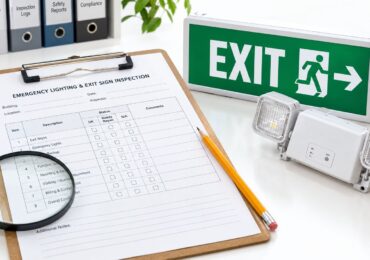
A clean binder doesn't prove that a sensor works or an emergency unit will remain illuminated after normal power fails. Ask bidders for anonymized examples of actual turnover records. Look for equipment identifiers, observations, results, deficiencies, and completed corrective actions.
The distinction is traceable evidence versus completed forms. A useful record lets another technician locate the asset, understand what was tested, and determine whether the issue remains open.
Compare the evidence behind the file
| System | Paper-only warning sign | Evidence to require |
|---|---|---|
| Title 24 lighting | Generic forms disconnected from installed conditions | Applicable compliance method, fixture inventory, load calculations, control sequences, functional-test results, and certification records |
| Emergency lighting | A checklist showing only that indicators were illuminated | Asset-level inspection and test results, battery condition, defects, corrective work, and retest status |
| EV readiness | Charger quantities without infrastructure assumptions | Capacity assessment, parking classification, routing concept, jurisdiction confirmation, and upgrade dependencies |
For lighting work, require the contractor to inventory fixtures, connected load, schedules, controls, and space use before calculating lighting power density against the applicable method. Construction-stage functional testing and retained certification records belong in the scope, not in an optional administrative allowance.
California's evaluation of its 2008 code found that 82 of 91 analyzed buildings met lighting requirements, illustrating why compliance must be checked rather than assumed; the California lighting-code evaluation also supports a measurement-based approach to project performance. Don't turn historical results into a guaranteed savings figure for another property.
Follow the asset through a multifamily walkthrough
Suppose a manager opens an emergency-lighting report while walking a multifamily property. The fixture identifier should match a physical asset tag and location. If the report lists a failure, the manager should be able to find the corrective work order and a documented retest.
Build the program around inspections at least every 30 days and an annual 90-minute operating test, with loss of normal power simulated appropriately; NFPA's emergency-lighting testing guidance explains the endurance and testing expectations. Don't accept an indicator-lamp check as proof of battery endurance.
- For energy verification: Retain baseline and post-installation kWh, fixture wattage, operating schedules, control settings, and available interval data.
- For failed emergency units: Record whether the technician investigated the battery, charger, lamps, inverter, wiring, or transfer circuitry.
- For turnover: Require editable asset information and organized reports the owner can retain independently.
Make these deliverables part of your electrical code-compliance scope. Files should reflect what technicians inspected and tested, not what someone expected the installed system to do.
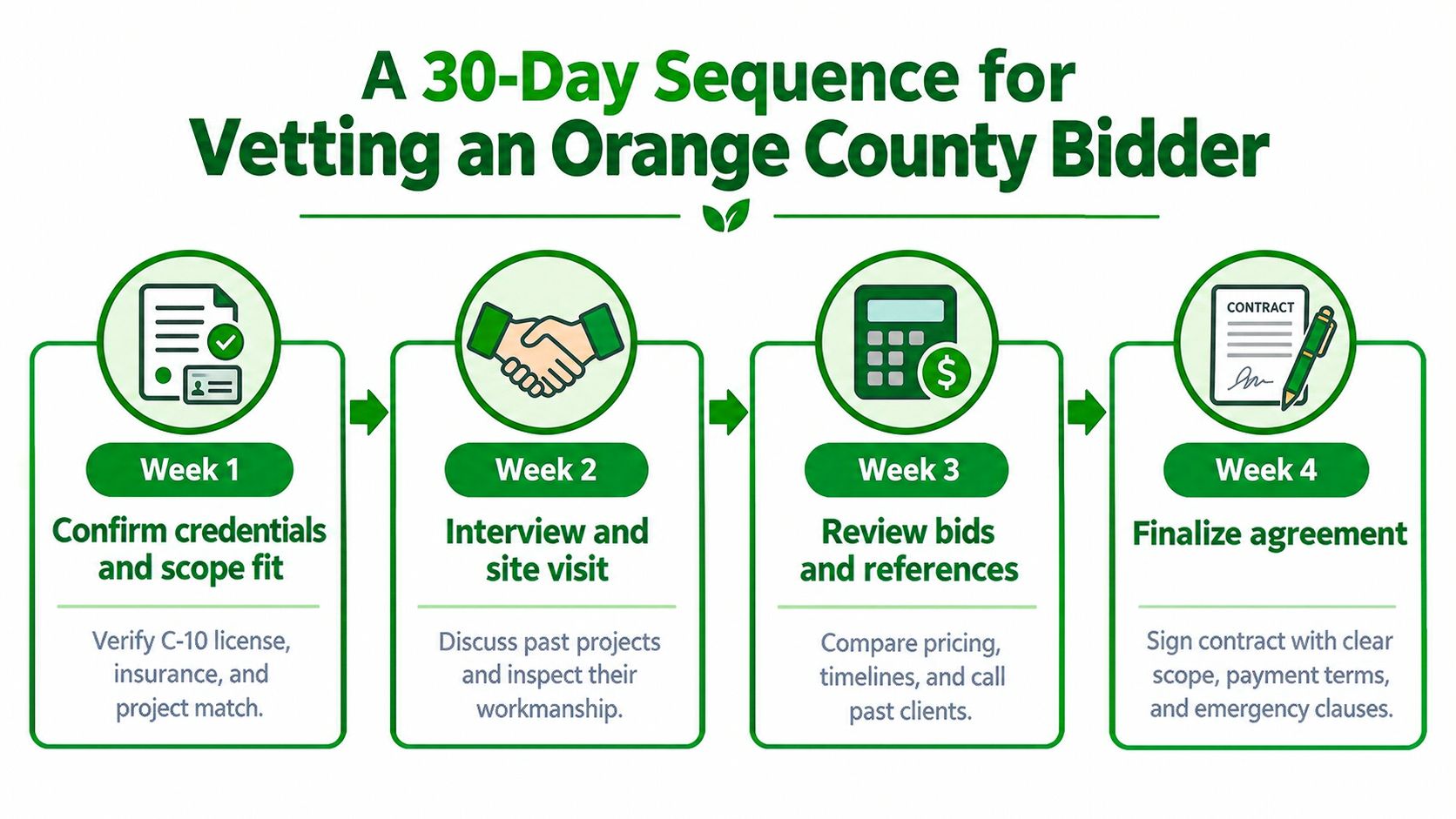
A 30-Day Sequence for Vetting an Orange County Bidder
Use the following month-long schedule as a procurement plan, not a regulatory deadline. Adjust it for project complexity, but don't compress unresolved technical questions just because a proposal is about to expire.
Assign a property-management coordinator to maintain a decision log. Record each question, the responsible respondent, the supporting document, and whether the answer changes scope or price.
Establish eligibility before discussing discounts
During the opening week, collect the contracting entity's information, credential package, relevant project examples, and preliminary scope matrix. Confirm that each bidder understands the property type and occupied-site restrictions.
The deliverable is an eligible-bidder list with unresolved questions attached. Don't let an attractive price become the benchmark before you know what it buys.
During the site-walk week, give bidders access to the same spaces and existing records. Require written assumptions concerning equipment access, shutdowns, concealed conditions, and work by others.
Issue material clarifications to all remaining bidders. Otherwise, you're comparing different projects under the same description.
Validate execution and finalize responsibility
Use the reference-review period to call customers with comparable operating conditions. Ask what happened when the contractor encountered an unexpected condition, how it handled authorization, and whether the owner received usable closeout information.
- Reference deliverable: Notes on communication, disruption management, corrective work, and turnover quality.
- Insurance deliverable: Adviser-reviewed evidence that addresses the proposed work and contracting arrangement.
- Bid-review deliverable: A normalized comparison showing inclusions, allowances, exclusions, and owner responsibilities.
During the closing week, negotiate acceptance criteria, payment milestones, change authorization, warranty procedures, and the emergency-service terms already evaluated. Identify who can approve additional work and what supporting information that person must receive.
Award standard: Don't sign with a bidder who refuses to put a material promise in the agreement.
Disqualifying conditions include knowingly misleading documentation, refusal to explain scope boundaries, or pressure to bypass unresolved safety concerns. Ordinary questions aren't disqualifiers if the contractor answers them candidly and provides a credible resolution.
Finish onboarding with named contacts, approved access procedures, required tenant communications, and a turnover schedule. Keep the unsuccessful bids and clarifications as part of the procurement record, not merely as evidence that someone collected competing prices.
Choosing a Long-Term Service Partner Instead of a Low Bid
A long-term contractor should make your property easier to operate without making you dependent on information only its staff can access. You should retain the asset records, corrective-work history, operating instructions, and outstanding recommendations.
Evaluate the relationship through completed work, not familiarity. A technician who knows the property is valuable. A contractor who relies on that familiarity instead of maintaining records leaves the manager exposed when personnel change.
Require a maintenance program with decisions attached
A useful preventive program identifies what needs attention, why it matters, and what the owner should authorize next. Infrared findings, for example, should lead to a documented assessment and corrective recommendation, not a collection of thermal images.
Review proposals for preventive commercial electrical maintenance against your operating priorities. Separate immediate corrective work, planned replacement, and items that warrant continued observation.
For portfolios extending into the Inland Empire or San Diego, confirm service boundaries, mobilization charges, and emergency arrangements in writing. Regional coverage doesn't automatically mean identical pricing or availability at every address.
| Relationship signal | What the manager should expect |
|---|---|
| Proactive recommendations | A clear condition, supporting evidence, and proposed action |
| Scope coordination | Named responsibility for adjacent trades and final acceptance |
| Commercial transparency | Explained rates, authorization rules, and disclosed travel terms |
| Continuity | Owner-accessible records and a handoff process when personnel change |
Keep the incumbent accountable
Hold a periodic review that includes unresolved defects, repeat service calls, upcoming tenant work, and anticipated infrastructure needs. Ask the contractor to explain whether changed property use warrants a fresh assessment rather than assuming the original design remains suitable.
Don't retain a vendor solely because changing contractors seems inconvenient. Equally, don't replace a capable service partner over a price difference without comparing supervision, documentation, and follow-through.
The practical question to ask your incumbent each year is: Which unresolved electrical conditions at this property need an owner decision, and what evidence supports your recommendation? A useful answer gives you a prioritized work plan, not a sales pitch.
Access Electrical and Lighting provides commercial electrical installation, lighting maintenance, infrared inspections, low-voltage work, and compliance testing for Southern California properties. Visit Access Electrical and Lighting to discuss a property walkthrough and request a scope that identifies existing conditions, testing deliverables, and responsibility for corrective work.