
Every unit on your property needs a 30-second functional test at least once a month, and every unit needs a 90-minute full-duration discharge test once a year, with both results written into a permanent log that names the asset, the result and the person who did the work. Running the short test every 3 to 5 weeks keeps you inside the monthly window without pinning the whole program to one calendar date that slips the moment a holiday lands on it.
It's 9:40 on a Tuesday night when the transformer feeding your east building lets go. The corridor goes dark, the stairwell goes dark, and the only light left is whatever battery-backed heads still hold a charge. Fourteen units, a few of them older than the current owner. Nobody at 9:41 is asking whether the building passed a fire inspection last spring. They're asking whether all fourteen still come on.
That gap between what a certificate says and what happens in the dark is the whole reason this work exists. An emergency lighting inspection done properly is not a walkthrough with a clipboard. It's an asset-level program with unique IDs, two tiers of testing and a paper trail that holds up when a fire inspector, an insurer or a plaintiff's attorney asks what you did.
What an Emergency Lighting Inspection Must Prove
Picture a smoke event in retail back of house: a fire starts near a stockroom and the utility service is still live, but the local circuit trips. Now every unit in that back corridor has to transfer to battery instantly, light the path to the nearest exit, and keep burning while staff and customers move through smoke they've never walked through before. Either the units do that or the exit route stops functioning as an exit route.
That obligation doesn't reset annually. The OSHA evacuation and emergency standards guidance requires every exit route to be adequately lighted so an employee with normal vision can see along the route, and it requires protective safeguards, exit lighting included, to remain in proper working order at all times. Continuous readiness is the standard, not a scramble the week before an annual inspection.
So an inspection has to prove specific things, not a general impression. Every visit verifies that:
- Presence and access: each luminaire and illuminated exit sign is where the drawings say it is, unobstructed and reachable for testing.
- Physical condition: housings intact, lenses clean and uncracked, heads still aimed along the path of travel.
- Charging status: the charge or status indicator shows the unit is being maintained.
- Transfer under failure: simulated loss of normal power produces immediate battery operation.
- Output: every lamp or LED head lights, and the exit sign stays legible from the route it marks.
A failed battery, lamp, charger, test switch or exit sign removes visibility at exactly the moment smoke, panic or a utility outage makes wayfinding hardest.
That last point is why this matters to property managers in offices, retail centers, multifamily buildings and hospitality properties, where most occupants don't know the building by heart. Documented inspection and prompt repair also produce something beyond compliance: evidence that the system was actively maintained rather than assumed operational.
Inspection Frequencies and Test Durations at a Glance
A test calendar is only useful if each unit has a traceable record. Assign every fixture a unique ID, then log the test type, date, result and any corrective work against that ID. The schedule below separates routine checks from tests that measure battery endurance.
| Test type | Frequency | Duration | What it verifies | Typical basis |
|---|---|---|---|---|
| Visual inspection | Monthly, alongside the functional test | Walk-through | Units present, unobstructed, clean, undamaged, charge indicator on | OSHA maintenance duty; NFPA 101 |
| Functional test | At least monthly (every 3 to 5 weeks is common) | 30 seconds | Immediate transfer to battery, all lamps or LEDs lit, aiming toward exits | NFPA 101; manufacturer test switch |
| Partial-duration test | Some programs add a six-monthly test under BS 5266 | Set by the applicable program | Battery sustains output beyond a brief burst | BS 5266; AHJ direction |
| Full-duration discharge test | Annually | 90 minutes (rated duration) | Every unit stays lit for the entire period under load | NFPA 101 |
| Charging check | After every discharge test | Until indicators reset | Batteries recharge and charge indicators return to normal | Manufacturer instructions |
| Self-testing (diagnostic) units | Visual check at least every 30 days | Automatic self-diagnostics | Fault indication accepted by code; manual testing reduced where allowed | Code- and AHJ-dependent |
Why the schedule has two tiers
The short test and the long test expose different failures. A 30-second functional check can reveal a dead lamp, defective battery, failed charger or stuck test mechanism. A discharge test checks whether a battery can sustain illumination for its rated duration, rather than merely light up briefly.
United Kingdom guidance for higher-risk houses in multiple occupation illustrates this two-tier approach. The Cherwell District Council HMO fire safety standards call for monthly emergency lighting tests during routine management inspections and an annual full-duration test, typically a three-hour rundown, by a competent professional in accordance with BS 5266. The system must maintain illumination for its rated duration; afterward, normal supply is restored and the charging system is checked. Some programs also add a six-monthly partial-duration test under BS 5266.
Where self-testing units fit
Self-testing fixtures reduce the need for manual functional checks only where the applicable code and authority having jurisdiction accept their automatic tests and fault indications. A documented visual inspection remains part of the schedule at least every 30 days.
Use the table as a baseline, not a substitute for the adopted code edition, manufacturer instructions, building risk assessment or local AHJ requirements. Confirm the applicable calendar before setting the inspection program.
How to Run the Monthly Functional Test
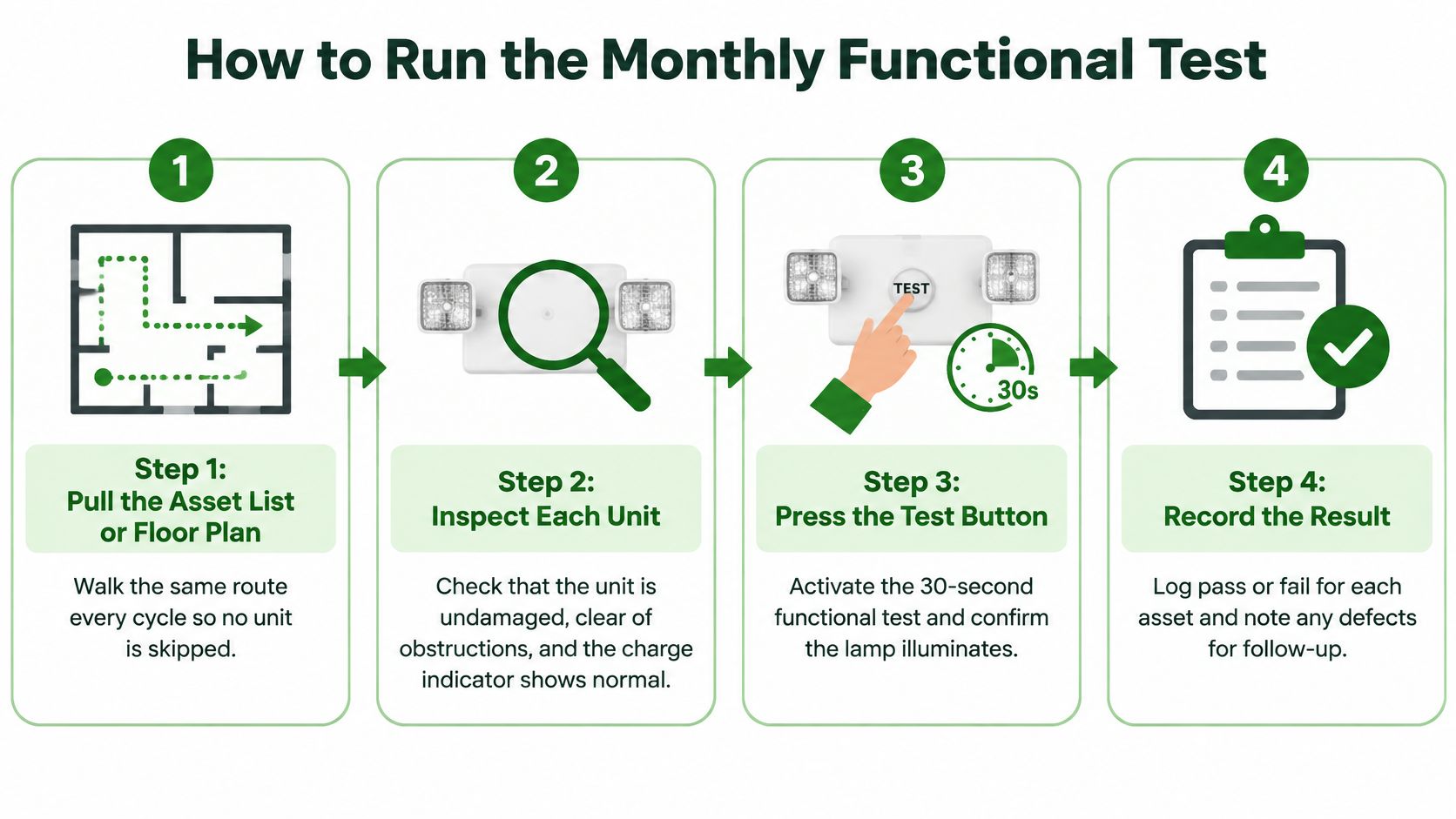
The monthly round works when it's boring and identical every cycle. Same route, same order, same fields in the log. A trained maintenance tech can run it without an electrician on site, and that's the point: the job is to catch a dead unit within a month, not to schedule a specialist visit.
Start by building the asset list. The NFPA Journal guidance on NFPA 101 testing frames it as a two-stage cycle, and stage one is inventorying every emergency luminaire, exit sign, stairwell unit and remote battery system by unique location or asset ID. If your building has never had IDs assigned, make that the first month's work and label the units physically as you go.
Then run the steps in order:
- Pull the asset list and walk the fixed route. Following the same path every cycle is how you stop skipping the unit behind the water heater.
- Inspect before you test. Housing damage, lens condition, head aim, accessibility, obstructions, and a charge indicator that's lit.
- Simulate the outage. Use the manufacturer's test switch or an approved circuit-isolation procedure, never a random breaker.
- Confirm transfer and output. Battery operation should be immediate, with every lamp or LED head lit.
- Check direction. Heads get knocked out of aim by carts, ladders and cleaning crews. Re-aim toward the egress path.
- Restore normal power. Watch the charge indicator come back before you walk away.
- Log it on the spot. Date, asset ID, result, defect, corrective action. Not later, not from memory.
Field rule: a unit isn't compliant because someone wrote "needs battery" in a notebook. It's compliant when it's repaired, retested and recorded as passing.
Units that fail get tagged out of service, repaired or replaced, and retested. Batteries, lamps, ballasts, chargers and test switches are all replaceable components, and the retest is the only thing that closes the work order.
A few habits cut downtime. Test on a consistent weekday so tenants and staff expect it. Photograph defects and attach the image to the log entry, because a photo ends most arguments about whether damage predates your visit. Stock replacement batteries, lamps and exit-sign heads for the exact fixture models on site; a $30 battery pack that ships in three days is a week of non-compliance.
How to Perform the Annual 90-Minute Discharge Test
This is the test that finds out what your batteries are made of. The 30-second check proves a unit transfers and lights. The full-duration discharge proves it can hold output under sustained load, which is the only performance that matters in a real evacuation.
Schedule it as a planned event, not an errand. Low occupancy, tenants notified, security aware, and enough time in the day to do the route properly instead of racing the clock.
- Confirm everything is charged first. Every unit should show a normal charge indicator before you start. Testing a bank that's been recovering from a power event proves nothing.
- Isolate normal power to the emergency lighting circuit or to individual units using the test switch or an approved breaker procedure, and write down the start time.
- Walk the full route on a set interval. Every 15 to 30 minutes, confirm each luminaire is still lit at full output and each exit sign is still illuminated. Watching for a unit that dims before it dies is half the value of the walk.
- Record the end time once the full 90 minutes has elapsed and every unit is still burning.
- Restore normal power and verify each charge indicator returns within the manufacturer's recharge window.
- Complete the log with start and end times, per-asset results, failures and the corrective action opened for each one.
Hard rule: any unit that fails to transfer, dims noticeably, flickers out or doesn't stay lit for the entire duration fails. It gets tagged, repaired or replaced, and retested. There's no partial pass and no "monitor next cycle."
Sequencing matters on a large property. Test a floor or a wing at a time and let each group recharge before moving on, rather than dropping the whole building's emergency lighting at once. If the building has a generator-backed portion or a central inverter system, that equipment follows its own maintenance standard with its own test regime, so don't fold it into the battery-unit route.
When the results come back clean across every asset, sign and date the record and file it with the fire alarm and sprinkler reports. When they don't, the failures belong in the log as failures, with the repair and retest documented beside them.
Common Failures and How to Fix Them
Here's the pattern that catches property managers off guard. A unit passes the 30-second test month after month and looks perfect on every walkthrough, then dies eleven minutes into the annual test. Nothing changed in the last month. The battery has been losing capacity for two years, and the short test was never designed to detect it.
That's normal battery behavior, not a defect in the testing. Sealed lead-acid and nickel-cadmium packs lose capacity with age, heat and charge cycling, and a pack at 40 percent of rated capacity still runs a 30-second test without complaint.
| Symptom | Likely cause | Fix |
|---|---|---|
| Dead during the 30-second test | Dead battery, blown lamp or driver, faulty test switch | Tag out; check the test switch and lamp first, then replace the battery; retest |
| Transfers late or not at all | Failed transfer relay, bad test switch, loose wiring | Repair the relay or switch, re-terminate wiring, retest transfer |
| Passes 30 seconds, fails the 90-minute test | Battery capacity loss from age or sulfation | Replace the battery pack and pass a full retest before returning to service |
| Lamps dim or brown out mid-test | Low charge, aged battery, undersized replacement battery | Verify charger output, install the correct battery, repeat the duration test |
| Charge indicator stays off after testing | Charger failure or dead battery | Measure charger output; repair or replace the charger or battery |
| Exit sign lit but hard to read | Yellowed or dirty lens, failing LED board | Clean or replace the lens, replace the sign or LED board, confirm visibility from the exit path |
| Damaged, blocked or misaimed units | Impact, stored goods, renovation work | Repair the enclosure, clear obstructions, re-aim heads toward the egress path |
Read the pattern before you read the individual rows. If three units on the same circuit all failed in the same month, suspect the charging circuit or the supply rather than three coincidental battery deaths. Check whether a breaker got switched off during other work, which happens constantly during tenant improvements.
Practical advice: keep spare battery packs, lamps and exit-sign heads for the exact models on your property. Waiting on a single part is how a failed unit sits dark for two weeks.
Two edge cases trip up inexperienced testers. The first is dimming that starts twelve minutes into the discharge test: the unit lit, the tester ticked the box, and nobody watched the second half. The second is the exit sign that's technically illuminated but unreadable through a yellowed lens, which passes an electrical test and fails a human one. Walk the egress path from occupant eye level, in the dark, and ask whether you could find the door. When exit signs are the recurring problem, the right long-term fix is often replacing aging units rather than chasing boards and lenses, and emergency exit lights with battery backup are worth pricing against another year of repairs.
Every repair ends the same way: a documented retest with a pass result.
Inspection Records That Survive an Audit
A log that lives in a technician's truck isn't a record. It's a rumor. The inspection log is a permanent, auditable document, and it belongs with the fire alarm and sprinkler test reports where anyone can produce it in under a minute.
Each entry carries the date and time, the asset ID or location, the test type (visual, 30-second functional, partial-duration or full-duration discharge), the pass or fail result, the defect found, the corrective action taken, the name of the person who performed the test, and confirmation that normal power was restored and charging resumed. A bound logbook works. So does a controlled digital log with restricted edit rights, backed up off the device it's written on.
Use asset IDs that match the floor plan. When an inspector points at a corridor fixture and asks for its history, "EL-014, Corridor 2 near Stair A" ends the conversation in ten seconds.
| Asset ID | Location | Test date | Test type | Result | Defect and action | Technician |
|---|---|---|---|---|---|---|
| EL-014 | Corridor 2, near Stair A | 2026-03-04 | 30-second functional | Pass | None; charge indicator on | J. Rivera |
| EL-027 | Parking level P1 | 2026-03-04 | 30-second functional | Fail | Battery dead; pack replaced, retested pass | J. Rivera |
| EL-014 | Corridor 2, near Stair A | 2027-03-09 | 90-minute discharge | Pass | Full duration; recharge confirmed | M. Chen |
What auditors actually ask for: show me twelve months of monthly entries and one annual duration test per unit, without leaving the room.
Attach completed work orders to failed entries so the repair and the retest sit in the same place. Back up digital logs, and keep the previous cycle's records on site rather than in a filing cabinet at a corporate office. Where the program spans several buildings, roll the entries into a formal electrical inspection report so owners and insurers have one document to read end to end.
This record is your evidence that the system was actively maintained. Inspectors, insurers and attorneys all ask the same question in different words: prove you knew about the condition of these units and acted on it.
California Code Notes and Your Next Step
A failed egress light can raise questions under several rules at once. OSHA sets workplace requirements for exit routes and safeguards, while the OSHA lighting standards provide a starting point for understanding those obligations. NFPA 101 describes a testing model commonly used by authorities having jurisdiction: monthly functional checks and an annual full-duration test at rated duration.
California requirements include the California Building Code (Title 24, Part 2), the California Fire Code and Title 19. Local authorities enforce applicable provisions during plan review and inspections. Title 24 documentation applies when lighting controls are altered, which can include a lighting retrofit that touches the egress path, while emergency lighting itself is governed by the California Building Code and fire code provisions that local authorities enforce.
In-house or licensed contractor
Trained in-house staff can handle monthly visual and functional checks using a checklist and asset log. Assign responsibility, record each result, and flag failed units for repair and retesting.
Bring in a licensed C-10 contractor when annual duration testing is beyond staff capacity, fixtures are difficult to reach above stairs or in parking structures, or the same asset fails repeatedly. Central battery and inverter systems also call for qualified electrical work.
Build the program this month
Start with an asset list, even if it begins as labels on a floor plan. Schedule monthly functional checks and annual duration tests, assigning an owner to each task. Record failures with the corrective work and retest result.
Access Electrical and Lighting installs, maintains and tests emergency lighting systems, battery backup systems and exit signs. The licensed and bonded California C-10 contractor, license 952234, has serviced or replaced tens of thousands of emergency lighting fixtures and systems in commercial and multifamily spaces across Southern California.
Access Electrical and Lighting offers emergency lighting testing and maintenance, Title 24 testing and documentation, and 24/7 emergency response. Contact the company to schedule a free estimate for your property.