If you manage a warehouse, you already know the pattern. A lamp goes out over an active aisle. Someone puts in a work order. Maintenance has to find a lift, carve out a safe work window, and replace one failed component in a fixture row that probably has more failures coming. Meanwhile, the floor never looks evenly lit. Some areas are washed out, others feel dim, and your utility bill keeps showing up like nothing is wrong.
That's why LED high bay warehouse lighting gets attention from facility managers who are tired of treating lighting like a recurring nuisance. In a warehouse, lighting affects more than visibility. It affects picker accuracy, forklift safety, maintenance planning, energy spend, and how often your team has to work overhead in live operating space. A lighting upgrade isn't just a product purchase. It's an operational decision.
A lot of projects still go sideways for one reason. People buy by fixture price or advertised wattage instead of total cost of ownership. They pick a “commercial” high bay for an industrial space, skip proper controls, or underestimate what California code requires. The result is predictable: poor light levels, failed inspections, callbacks, and a system that costs more over time than a properly designed installation would have.
Good planning starts with performance, not catalog language. The same principle applies in broader commercial lighting design for business facilities. In a warehouse, that means matching fixture type, lumen package, controls, and code requirements to the actual work being done under the lights.
An Introduction for Facility Managers
Most warehouse lighting problems don't start with a total outage. They start with gradual decline.
Aisles get patchy. Labels are harder to read from a forklift. Old metal halide fixtures take too long to come back after a power event. Fluorescents flicker. Maintenance spends money one lamp and one ballast at a time, but the building never feels fully corrected. Facility managers often inherit this situation and keep funding repairs because a full upgrade seems disruptive.
That usually changes when lighting starts hitting three pain points at once:
- Operating cost climbs: Legacy fixtures burn more power and throw off more heat, often exceeding expectations.
- Safety gets harder to manage: Uneven light creates shadowed travel paths, poor contrast at floor markings, and weak visibility in picking zones.
- Maintenance becomes a scheduling problem: Every overhead repair requires labor, equipment access, and coordination with operations.
LED high bay warehouse lighting solves those problems when it's specified correctly. When it's not, it creates a different set of headaches. That's the part many buying guides skip.
Practical rule: In warehouses, the cheapest fixture is often the one that creates the most expensive labor, compliance, and rework later.
The right approach is to look at lighting as infrastructure. You want the right light levels at the floor, reliable controls, clean installation, emergency coverage where required, and a design that won't force a second project because the first one was undersized.
That matters even more in California. Title 24 doesn't reward guesswork, and warehouse spaces don't forgive underspecification. If you're replacing high bays in a Southern California facility, every fixture and control decision needs to hold up in the field, on the drawings, and at inspection.
The Evolution of Warehouse Lighting
Warehouse lighting used to be a tradeoff. You could get output, or you could get efficiency, or you could get acceptable maintenance intervals. You rarely got all three.
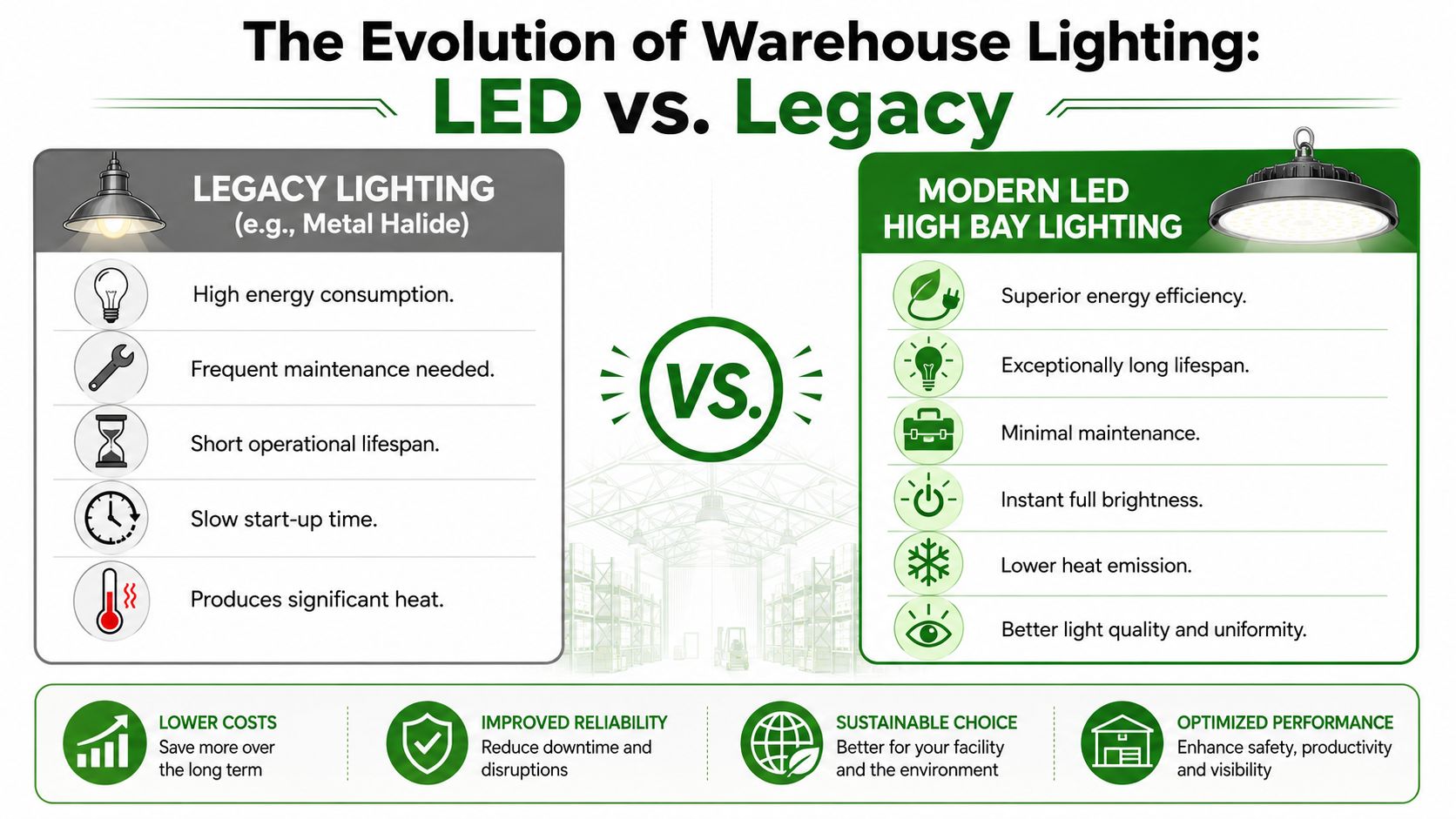
Metal halide and high-pressure sodium systems were common because they could throw light from high ceilings, but they came with baggage. Warm-up delays, color shift, fading output, and a lot of wasted energy as heat were all part of the package. Fluorescent high bays improved some things in lower applications, but they still added maintenance and didn't solve the bigger durability and control issues in tougher warehouse environments.
What legacy systems get wrong
The biggest mistake I see in older warehouses is that teams normalize bad lighting behavior. If fixtures take time to reach full output, people accept it. If the color is poor and labels are harder to read, they work around it. If maintenance is constant, they budget for it as if it's unavoidable.
It isn't.
Modern LED high bays address the exact weak points that made older systems expensive to own. According to LED Lighting Supply's overview of commercial LED high bay performance, LED high bay lighting systems often reduce consumption by 50 to 75% compared to legacy metal halide or HPS sources. The same source notes that advanced models exceed 135 lumens per watt, and a 150W LED can replace a 400W traditional bulb while improving light quality.
That change matters on two fronts. First, lower wattage cuts direct lighting energy use. Second, lower heat output reduces the burden on the building. In a large warehouse, that turns into less wasted energy and less stress on cooling.
Why LEDs became the default
The move to LEDs wasn't driven by fashion. It was driven by economics and uptime.
A warehouse manager doesn't care that a fixture is “newer.” They care that the building is bright at shift start, the aisles are readable, the maintenance tickets slow down, and the utility spend makes sense. LEDs answer those concerns better than legacy fixtures because they're more controllable, more efficient, and more stable over time.
A few practical differences stand out:
| System trait | Legacy high bay behavior | LED high bay behavior |
|---|---|---|
| Startup | Slow recovery after outage or switching | Immediate full output |
| Heat | Higher heat generation | Lower heat emission |
| Maintenance | Frequent lamp or ballast attention | Longer service intervals |
| Light quality | Output and color degrade | Better consistency when properly specified |
Old high bays often force you to pay three times for the same light. Once on the electric bill, once in maintenance labor, and once again in lost visibility.
The bottom-line shift
Once you compare systems on ownership cost instead of first cost, the argument gets straightforward. LEDs reduce the number of expensive maintenance events above active warehouse floor space. They also give you a better platform for controls, emergency integration, and code-compliant upgrades.
That doesn't mean every LED high bay is a good fit. Some are built for lighter-duty commercial spaces and get pushed into industrial ceilings where they don't belong. That's where projects start failing on performance even though the technology itself is solid.
Decoding the Specs That Matter
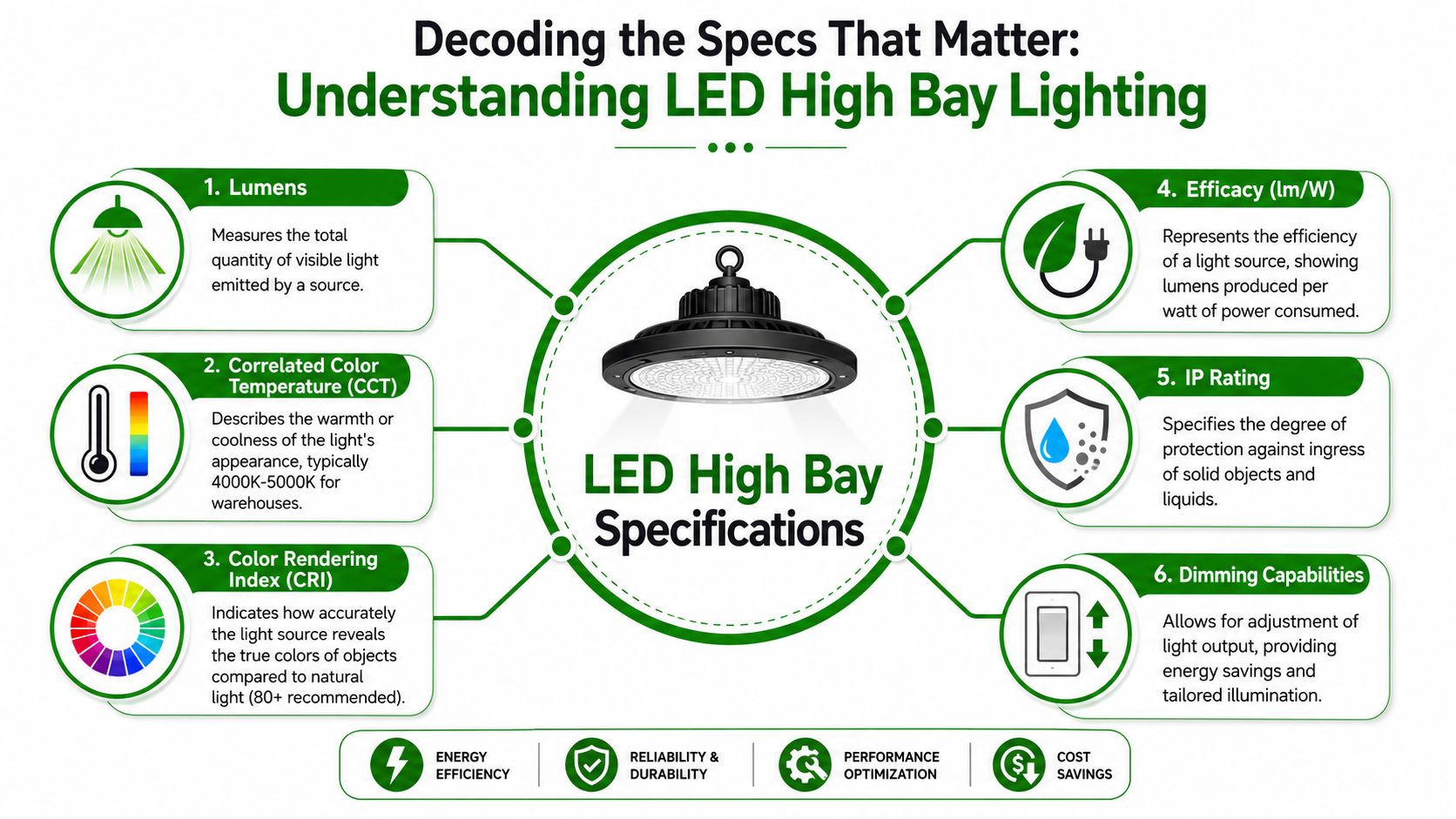
Most bad lighting purchases happen because buyers focus on the wrong spec. Wattage gets all the attention, but wattage only tells you what a fixture consumes. It doesn't tell you whether the floor will be lit properly.
The specs that matter are the ones that affect visibility where people work.
Start with lumens, not watts
Lumens are the usable output conversation. In plain terms, lumens tell you how much light the fixture is putting into the space.
Mounting height drives how many lumens you need. According to Commercial LED Lights guidance on warehouse high bay output by ceiling height, warehouses with 20 to 30 foot ceilings typically need fixtures delivering 22,000 to 35,000 lumens, while 31 to 40 foot ceilings need 35,000 to 47,000 lumens.
That's the simplest rule of thumb a facility manager can carry into a lighting discussion. The higher the fixture sits, the more output and optic control it takes to put useful light on the floor.
Imagine a shower head. If you stand close, a wider spray works fine. Raise the shower head much higher and the same spray pattern loses force by the time it reaches you. Light behaves the same way.
Beam angle decides where the light lands
A fixture can have plenty of lumens and still perform poorly if the beam angle is wrong. In open floor areas, you may want a broader distribution. In rack aisles, too wide a beam can spill light into the tops of racks while leaving the lower vertical surfaces underlit.
That's why two buildings with the same ceiling height can need different layouts. Open storage, picking aisles, cross-docks, and packaging zones don't use light the same way.
Use these questions when reviewing optics:
- Open area or aisle-driven layout: Aisles usually need more directional control.
- High racks or low obstructions: Vertical visibility matters when workers read labels from equipment.
- Need for uniformity: Fewer, brighter fixtures often create hotspots and dark gaps.
Fixture shape matters more than buyers expect
Facility teams often compare UFO and linear high bay fixtures as if one is automatically better. It isn't that simple.
UFOs are compact and often make sense in open warehouse applications or tougher environments. Linear high bays can work well where the building layout, existing fixture rows, or aisle geometry favor a more elongated distribution. The right answer depends on the plan, not the product category.
A practical selection review should include:
| Spec choice | What it affects on the floor |
|---|---|
| Lumens | Whether target light levels are even possible |
| Beam angle | Glare, shadows, and aisle coverage |
| Fixture form | How well the layout matches aisles or open bays |
| IP rating | Whether dust or moisture will shorten fixture life |
| Dimming capability | Future control flexibility and code alignment |
CCT and CRI are visibility tools
CCT is the appearance of the light, from warmer to cooler. In warehouses, many managers prefer a cleaner, cooler look because it supports visual clarity across racks, floor striping, and loading zones.
CRI is how accurately the light reveals colors. That matters when teams identify wire colors, packaging differences, product labels, floor markings, and safety signage. Poor color rendering can make an area feel bright enough while still making visual tasks harder.
Good warehouse lighting doesn't just brighten the slab. It helps workers distinguish labels, edges, markings, and moving equipment faster.
Efficacy tells you how hard the fixture works for each watt
Efficacy is the efficiency relationship between light output and power draw. You don't need to memorize the engineering side. You need to know what it means in purchasing terms. Higher efficacy usually means more useful light for the electricity you buy.
That affects operating cost, but it also affects system design. A more efficient fixture can sometimes help you hit performance targets without oversizing the electrical burden.
Don't skip environmental ratings and controls compatibility
A warehouse may look dry and simple on paper but still be hard on fixtures. Dust, hose-down areas, heat, vibration, and long operating hours all matter. That's where IP ratings, driver quality, and controls compatibility stop being technical trivia and start becoming warranty and uptime issues.
If the space needs occupancy sensing, dimming, or emergency integration, the fixture has to support that cleanly. Otherwise you're buying a lighting system that already limits your options.
Navigating Retrofits Controls and Safety Systems
A warehouse lighting project usually starts with one decision. Keep the existing housings and retrofit, or remove the old system and install new fixtures.
There isn't a universal answer. The right choice depends on the condition of the existing system, the labor required to adapt it, the controls strategy, and whether the old layout was good in the first place.
Retrofit versus full replacement
A retrofit can make sense when the existing fixture locations are sound, structural support is adequate, and the housing can be converted without creating a patchwork system that's hard to service later. It may reduce disruption if operations can't tolerate a bigger changeout window.
A full replacement usually makes more sense when the old layout is wrong, the fixtures are deteriorated, or the building needs a clean controls package and updated emergency strategy. In many warehouses, replacement solves problems that retrofitting leaves behind, especially if the original system was designed around outdated light distribution.
Here's the practical comparison:
- Retrofit works when the layout is already usable and the existing fixture body isn't the problem.
- Replacement works when the building needs new optics, new control zones, or a reset on reliability.
- Either option fails when the design ignores real mounting height, aisle geometry, or code requirements.
For facility managers reviewing options, a contractor with experience in commercial LED retrofits and warehouse lighting upgrades in Orange County should be able to explain not only the material cost difference, but also the serviceability difference five years from now.
Controls are part of the savings, not an add-on
A lot of buyers treat controls like phase two. That's a mistake.
Modern high bays are well suited for occupancy response, scheduling, and daylight-responsive strategies where the building allows it. Controls can cut waste in low-traffic aisles, intermittent staging areas, and perimeter zones that receive daylight. More important, they help the building use light intentionally instead of running everything at full output all day because that's how the old system worked.
Good controls design depends on operations. You don't put the same settings in a fast-moving pick module that you'd use in a low-traffic storage bay. Sensor placement, timeout settings, zoning, and override logic all need to match the way the facility runs.
The best control package is the one operators don't fight. If employees have to work around it, the design missed the mark.
Emergency lighting and battery backup can't be an afterthought
Warehouse lighting conversations often focus on general illumination and skip the life-safety side. That's risky.
Emergency egress lighting, exit signage, and battery backup requirements need to be considered during design, not after the general high bays are ordered. In some facilities, emergency function is handled by dedicated units. In others, selected fixtures may be integrated into backup strategies. Either way, the system has to be coordinated.
That includes:
- Fixture selection that supports the intended emergency design.
- Circuiting and controls coordination so normal and emergency functions don't conflict.
- Testing and documentation so the installed system can be maintained and inspected properly.
Listing matters because warehouses punish weak products
The longer a building runs and the harder the environment, the more product quality matters. That's why UL and DLC listing should be treated as baseline requirements, not optional selling points.
A warehouse isn't kind to cheap drivers, poor thermal management, or fixtures with weak control compatibility. You might save money on the initial quote and spend it back in failures, nuisance behavior, and replacement labor. With high ceilings, every service event costs more than it would in an office or retail space.
Long life is one of the core ownership advantages of LED systems. LED high bay lights are typically rated for over 50,000 hours, and a warehouse running continuously might only need bulb replacements about once every 5.7 years, according to this discussion of LED high bay lifespan in industrial settings. That benefit only shows up if the installed system is designed and built for the actual environment.
Calculating Your Return on Investment
When a facility manager asks for budget, the conversation usually shifts fast from light quality to math. That's fair. A warehouse lighting upgrade has to perform on the floor and on the spreadsheet.
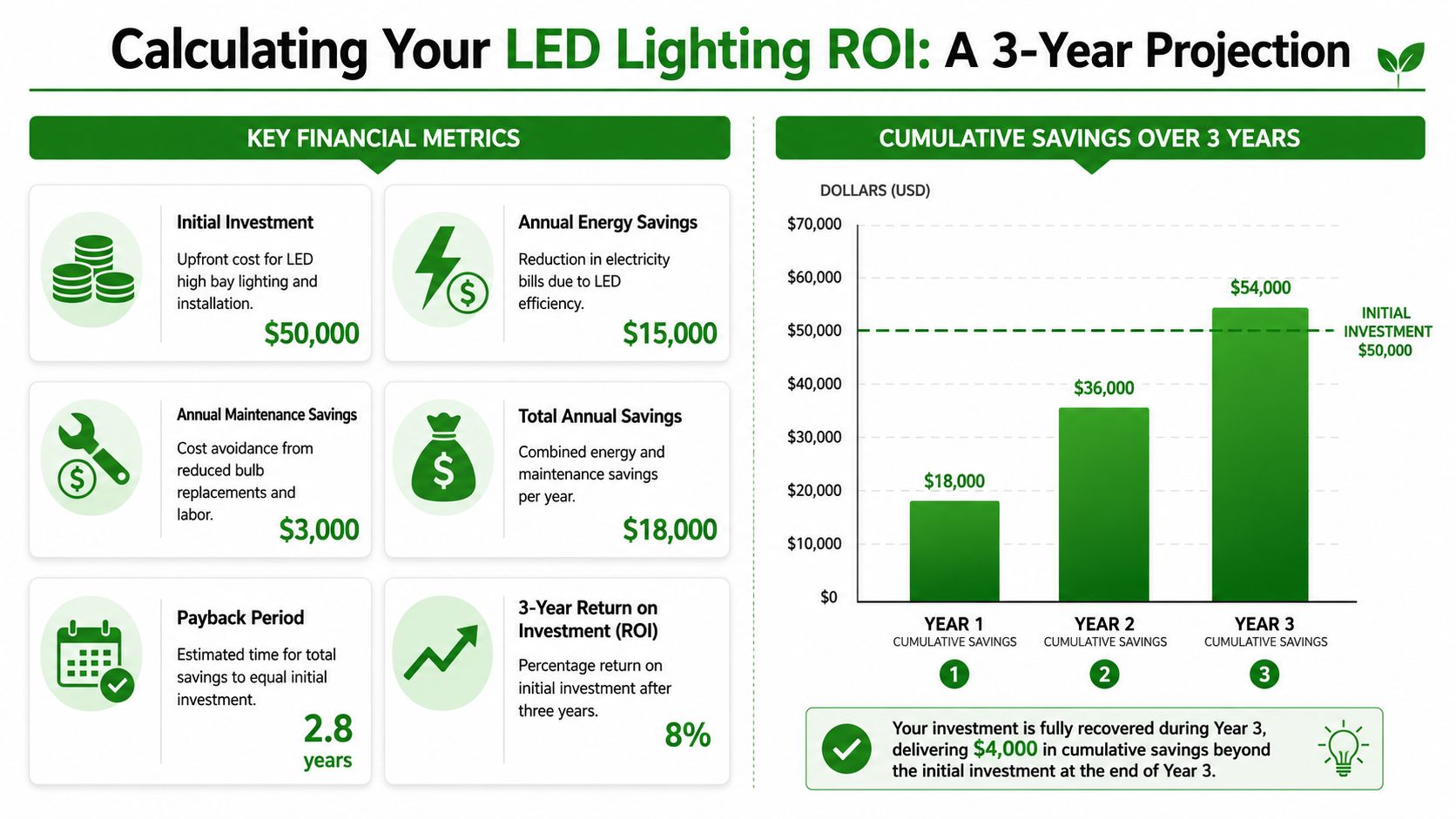
The cleanest way to build the business case is to separate ROI into three buckets: energy, maintenance, and project-related offsets such as rebates if they apply in your utility territory. Even when rebate availability changes, the framework stays the same.
The simple ROI framework
Use this working formula:
ROI case = energy savings + maintenance savings + available incentives – project cost
That formula sounds obvious, but a lot of proposals leave out one major category. The missed category is usually maintenance. In a warehouse, maintenance isn't just the cost of a lamp. It's labor coordination, lift access, downtime risk, and the cost of doing overhead work safely in an active facility.
What to include in each bucket
A strong internal estimate should account for the following:
- Energy savings: Compare existing connected load to the proposed LED load, then look at actual operating hours.
- Maintenance savings: Include lamps, ballasts or drivers where relevant, labor, access equipment, and after-hours service coordination.
- Utility incentives: Check what's available locally, but don't build the entire project case around a rebate that may change.
- Compliance-related cost avoidance: A code-aligned system with the right controls avoids expensive correction work later.
A sample way to present it internally
If you need a finance-friendly example, this format works well:
| Cost category | Existing system | Proposed LED system |
|---|---|---|
| Electric use | Higher due to legacy wattage and heat | Lower due to efficient fixtures and controls |
| Service events | Frequent overhead maintenance | Reduced service frequency |
| Operational disruption | More recurring interruptions | Fewer lighting-related interruptions |
| Code exposure | Higher if controls are outdated | Lower when current requirements are built in |
That table won't replace a full estimate, but it helps a CFO or property owner understand why first-cost comparison alone is incomplete.
Why total cost of ownership wins the argument
Savings often show up in the places accounting doesn't initially connect to lighting. Fewer boom lift rentals. Less time pulling a crew off another task. Fewer dark aisles waiting on parts. Fewer complaints from operations because one corner of the warehouse always feels dim.
That's why I push facility teams to avoid “fixture price only” decisions. A low-cost package that undershoots the required output, skips controls, or creates repeat service calls isn't a bargain. It's deferred expense.
If a proposal looks cheap because it ignores labor, controls, and correction risk, it isn't an ROI case. It's a callback schedule.
A good ROI summary should be short, direct, and tied to your actual building. Show the current burden, show the proposed performance, and show how the upgrade lowers recurring cost while improving reliability. That's the language decision-makers respond to.
Installation Maintenance and California Compliance
A warehouse lighting project can look good on paper and still fail in the field. Installation quality, electrical capacity, controls setup, and compliance details determine whether the system performs the way it was sold.
In California, that issue gets sharper because Title 24 isn't optional. If the controls, documentation, or acceptance requirements are wrong, the project can stall at inspection or require costly rework after installation.
Installation starts before the fixtures arrive
A serious high bay project begins with site verification. The contractor should confirm panel capacity, voltage, circuiting strategy, mounting conditions, and how the work will be sequenced around active operations. Warehouses aren't blank boxes. You've got racks, equipment travel, fire protection constraints, and access issues overhead.
Poor planning usually shows up in familiar ways:
- Wrong mounting assumptions: The fixture is selected for ceiling height, not actual mounting height.
- Weak support planning: Hardware and mounting methods don't match the structure or vibration conditions.
- Bad zoning decisions: Controls are grouped by convenience instead of operational use.
Those mistakes get expensive because they're hard to hide once the lights are on.
Maintenance changes with LEDs, but it doesn't disappear
LED systems cut reactive lamp replacement, but they still need structured inspection. Drivers, sensors, emergency components, and control behavior should be checked proactively. Dirt accumulation, damage from impacts, and environmental exposure still matter in warehouse settings.
The maintenance mindset changes from “replace failed bulbs” to “verify system performance before small issues become outages.” That's a better model for uptime, especially in high-reach applications where every service dispatch carries cost and safety implications.
California compliance raises the stakes
Title 24 pushes lighting projects to include the right control functions, documentation, and acceptance testing. If a contractor doesn't know how warehouse lighting, occupancy response, dimming behavior, and emergency systems interact under California requirements, the risk lands on the building owner.
That risk isn't theoretical. Underspecification is already a common failure point. A warehouse lighting buying guide citing a 2019 IES study and OSHA recommendations notes that 30-foot ceilings need at least 20,000 lumens, while many commercial-grade fixtures can't sustain the output needed to support OSHA's recommended 30 to 100 foot-candles for packing zones. That leads to safety risks and premature failure in larger warehouses.
In California, combine underspecified fixtures with weak control design and you've got a project that can miss performance targets and compliance requirements at the same time.
Why local code knowledge matters
A contractor can be competent in general commercial lighting and still struggle with California warehouse work. The job requires more than fixture replacement. It requires coordination between electrical installation, controls programming, emergency systems, and acceptance documentation.
Use OSHA lighting standards as a practical safety reference during planning, but don't stop there. California projects also need a contractor who understands how local enforcement, Title 24 testing, and warehouse operations intersect in practice.
That's why regional expertise matters. The wrong contractor can install a system that technically turns on but still leaves you with failed inspections, poor aisle visibility, and a second round of work nobody budgeted for.
Your Next Step Choosing a Qualified Contractor
By the time a warehouse lighting project reaches bid stage, most of the risk is already defined. Either the contractor understands light levels, controls, emergency requirements, service access, and California compliance, or they don't.
That's what facility managers should screen for first.
The right contractor for LED high bay warehouse lighting should be able to do five things well:
What to verify before you award the job
First, they should understand fixture application, not just product catalogs. That means they can explain when a commercial-grade high bay is wrong for an industrial ceiling, dusty environment, or harsher duty cycle.
Second, they should be comfortable discussing total cost of ownership. If the proposal talks only about fixture count and material cost, you're not getting the full picture.
Third, they need proven experience with controls and emergency integration. Warehouse lighting doesn't exist in isolation. It ties into occupancy response, egress strategy, battery backup, and ongoing testing.
Fourth, they should have the means to work safely at height. High bays aren't office troffers. The contractor needs the equipment and procedures to install and service high-mounted fixtures without turning the building into a hazard.
Fifth, and most important in Southern California, they need real Title 24 experience. Not vague familiarity. Actual testing, certification support, and documentation experience.
Why regional expertise makes a difference
A regional specialist stands apart from a low-bid installer. Access Electrical and Lighting fits the profile facility managers should be looking for in Southern California. The company is a licensed and bonded California C-10 electrical contractor (license 952234), has operated since 2000, and brings over 60 years of combined team experience across commercial electrical and lighting work. It also provides Title 24 compliance support, testing, certification, and documentation, plus high-reach boom truck services for fixtures and poles at height.
Those details matter because warehouse lighting projects fail in very predictable ways. The contractor can't reach the work safely. The control package isn't configured for local code. The emergency side is treated as separate. The fixture selection doesn't match the ceiling height or operating environment.
A qualified regional expert closes those gaps before they become change orders, failed inspections, or unsafe workarounds.
If you're planning an LED high bay warehouse lighting upgrade in Southern California, Access Electrical and Lighting brings the mix that matters: C-10 licensing, high-reach capability, commercial lighting and electrical expertise, Title 24 testing and documentation support, and long-standing experience serving Orange County and surrounding markets. For facility managers who want a project that performs on cost, safety, uptime, and compliance, they're the kind of contractor worth calling first.