Commercial buildings switched to LEDs faster than most owners had budgeted for. The Energy Information Administration's Commercial Buildings Energy Consumption Survey found that the share of commercial buildings using LED lighting rose from 9% in 2012 to 44% in 2018. LEDs also use less energy and last longer than incandescent bulbs, so the swap can look finished on the invoice.
Controls work like a volume knob. An efficient speaker still fills the room if the knob stays at full. A store can cut connected watts and still miss the energy bill when new lights sit at full output all night.
An LED swap is not the finish line. A bright sales floor does not defend the owner if the emergency log is blank when an inspector asks. The one-time lamp sale turned into a running job of fixtures, controls, maintenance, and records that still have to hold after the invoice is paid.
Why Retail Lighting Is Three Jobs at Once
After dark, a shopping center can look finished from the sidewalk. The sales floor is even, the window displays pop, and the parking rows tell another story: a dead pole, a stair that goes dark, a photocell that never steps the lot down. Those failures sit on the same utility bill and the same inspection file as the lamps over the merchandise.
The U.S. Department of Energy's 2020 Lighting Market Characterization shows why the load is this large. Commercial buildings contained approximately 1.6 billion installed lighting units in 2020, and commercial lighting consumed approximately 69% of the 244 terawatt-hours used for building lighting nationwide, even though homes have more lamps. Higher wattage and longer hours do most of that work. The average commercial unit used about 27 watts. Linear fluorescent and LED technologies together represented 95% of commercial lighting inventory. LED products represented roughly 48% of the combined residential and commercial installed base in 2020, compared with only 1% in 2010. Fluorescent and metal-halide stock that is still in service is a retrofit queue, not a leftover detail.
Name the three jobs before anyone prices a fixture.
- Light that sells. Aisles and feature walls have to make labels readable at standing height, without glare that pushes a shopper past the display.
- Light that makes the site safe to cross. Stalls, drives, entries, and stairs run longer than the sales floor. A failed head is a safety problem before it is an energy problem.
- Light that must work when normal power fails. Exit signs and battery units are a separate fleet. They don't follow the dimming schedule of the sales floor.
Buying brighter lamps without a zone plan is like repainting a store without fixing the roof.
The walk from here sets a target for each zone, compares three LED paths, then shows how controls, parking circuits, emergency logs, and a year of follow-up determine whether the project pays.
Lighting Targets for Every Retail Zone
Retail light is judged by the job, not by the wattage on the box. Hand a designer this table before a single fixture is chosen. Tick the zones the property has, then price LEDs against those rows.
| Zone | Job of the light | Typical target | Control that fits |
|---|---|---|---|
| Sales floor aisles | Even light so shoppers can read labels | 300-500 lux (about 30-50 fc) | High-end trim, then occupancy after close |
| Feature displays | Contrast that draws the eye without glare | Often 3-5 times ambient; 1000 lux or more on the feature | Separate dimmable accent circuit |
| Checkout | Speed and accuracy at the counter | About 500 lux | Schedule locked to trading hours |
| Back of house | Safe work for staff at lower energy | About 200-300 lux | Occupancy sensors with a short timeout |
| Parking stalls and drives | Faces, curbs, and vehicles visible | Often 10-20 lux average, higher at crosswalks | Photocell plus schedule or after-hours dimming |
| Facade and entries | Wayfinding and the storefront after dark | Brighter at the door, lower on the wall | Astronomical time clock and curfew dimming |
| Emergency egress | A usable path when normal power fails | About 1 fc (10.8 lux) average along the path for 90 minutes | Dedicated battery or generator, not general dimming |
How to read each row
Sales floor aisles sit in a band of 300 to 500 lux, about 30 to 50 footcandles, so a shopper can read a label without stepping under the shelf. Checkout sits near 500 lux because receipts, cards, and small print fail first when the counter is dimmer than the aisle. If you only have a phone app, convert with a foot-candle calculator and write the number on the plan, not in a separate spreadsheet nobody opens.
Feature displays are a contrast job. They often need three to five times the surrounding ambient light, and sometimes 1,000 lux or more on the merchandise itself. Put that light on its own dimmable circuit. A promo wall can change for a weekend sale without relighting the whole aisle. If the accent shares a driver with the ambient row, the display either washes out or the aisle gets too bright.
Back of house can sit nearer 200 to 300 lux. Stockrooms don't need sales-floor levels, and they should shut off when the room is empty. A short sensor timeout matters more here than a prettier housing. Parking stalls are often planned around a 10 to 20 lux average, with crosswalks and entries held brighter. Facade and entries use the door as the bright point and the wall as the quieter one, on an astronomical clock so the storefront doesn't blaze until sunrise.
When a zone changes
Two edges catch owners who only asked for brighter lamps. A jewelry or cosmetics counter needs more light on the vertical face of the case than a grocery aisle needs on a shelf. Measure the product, not just the floor. Energy codes such as California Title 24 can still require automatic shutoff, multilevel control, and acceptance testing even when the request was only "make it brighter." And the emergency path, about 1 footcandle average for at least 90 minutes, must not be dimmed with the general lighting. If that circuit shares a trim setting with the sales floor, the path fails the moment someone saves energy.
LED Retrofit Options and Their Trade-offs
Three paths cover almost every retail ceiling and pole. Match each one to the zone targets before anyone talks payback.
Lamp replacement puts LED tubes or lamps into the housings you already own. Upfront cost is the lowest, and a crew can move through a sales floor quickly. You also keep the old optics, sockets, and often the old ballast or driver. Dimming and sensor compatibility have to be checked on a sample bay before the pallet arrives. Older gear flickers, drops out early, or refuses to dim below a high floor. Use this path on sound housings in even aisles, not on corroded site lights.
Retrofit kits install a new LED engine and driver in the existing housing. Cost sits in the middle. Light distribution usually improves because the optic is designed for the LED, not for a fluorescent lamp, and most kits are dimming-ready. This is the practical middle for troffers and many high-bays when the housing is square, the ceiling isn't opening, and you still need high-end trim.
New fixtures cost the most up front and bring the best optics, control options, and warranties. Choose them when housings are corroded, a remodel is already opening the ceiling, or parking poles are coming down. A new head on a bad pole is the wrong sequence. Specify the driver protocol, 0-10V or whatever the control system speaks, before the order. Require every quote to state expected watts and operating hours per fixture type. Those two numbers are what the payback math has to use, not a catalog lumen claim.
LED Retrofits That Pay Back With Controls
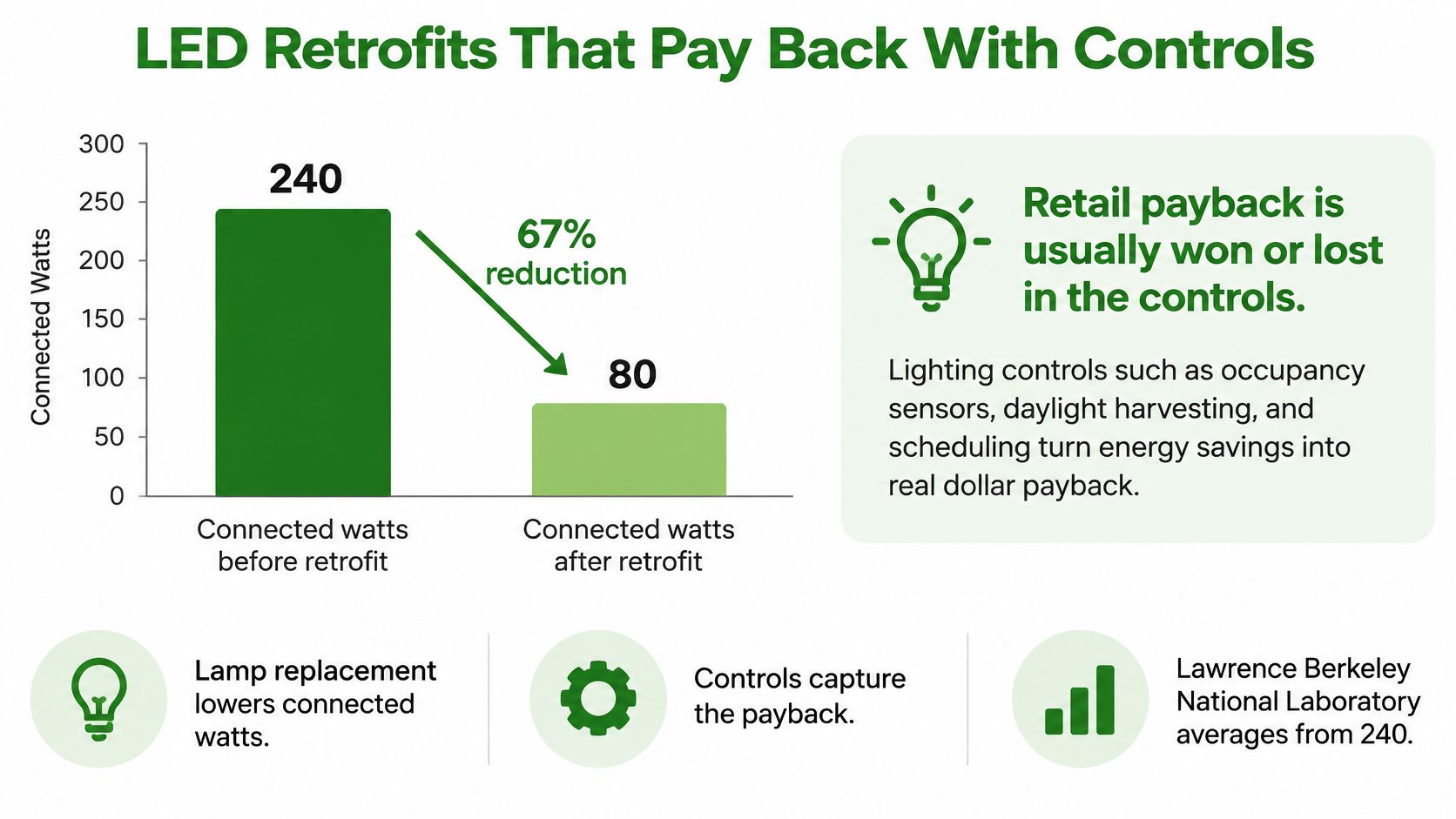
A Lawrence Berkeley National Laboratory meta-analysis of 240 lighting-savings estimates put average lighting-energy savings at 38% when several approaches were combined. Carry that combined figure into the business case. The rows below are pieces of one operating profile, not separate discounts you can add up.
| Strategy | Average lighting-energy savings | Where it fits | Watch-out |
|---|---|---|---|
| Occupancy | 24% | Stockrooms, offices, sales floor after close | Timeouts left too long waste the savings |
| Daylighting | 28% | Skylights and glazed storefronts | Simulations overstated savings by at least 10% on average |
| Personal tuning | 31% | Offices and some back-of-house | Little use on a public sales floor |
| Institutional tuning (high-end trim) | 36% | Whole store after an LED swap | Output must match the merchandising plan, not the driver maximum |
| Several strategies together | 38% | Multi-zone stores and centers | Do not add the row percentages; model one operating profile |
A store that adds occupancy, daylighting, and high-end trim as if they were independent coupons invents a savings rate the building cannot deliver. Model one profile: operating hours, the trim level, and which zones see daylight or vacancy. Daylight is the easy place to over-claim. Simulations overstated those savings by at least 10% on average, so start conservative and check the result after the store opens.
What a field job actually returned
A Pacific Northwest National Laboratory field evaluation.pdf) of five commercial buildings, including a grocery store, tested LED systems with task tuning, occupancy sensing, and daylighting. With applicable utility rebates included, simple payback fell in a multi-year planning band rather than a single promised year. A site with short hours and no rebate sits toward the long end of that band.
Work the job in this order. Measure fixture watts and hours before demolition. Set high-end trim to the merchandising plan, not to the driver's maximum. Commission occupancy and daylight by zone, because skylights, trading hours, and foot traffic change from the entry to the stock hall. Automated lighting controls earn their keep only when someone sets timeouts, photosensor aim, and trim on site.
High-end trim works like a volume knob locked below the point where extra light stops helping the sale.
An LED swap left at 100% all night is efficient over-lighting. Watts are lower than the old fluorescents, and the bill still pays for hours nobody needed. The same gap shows up in the file. Poorly commissioned controls erase the savings the model assumed. Thin emergency-lighting records erase the owner's ability to defend the property when someone asks what was tested, and when.
Parking Lots Poles and After-Hours Light
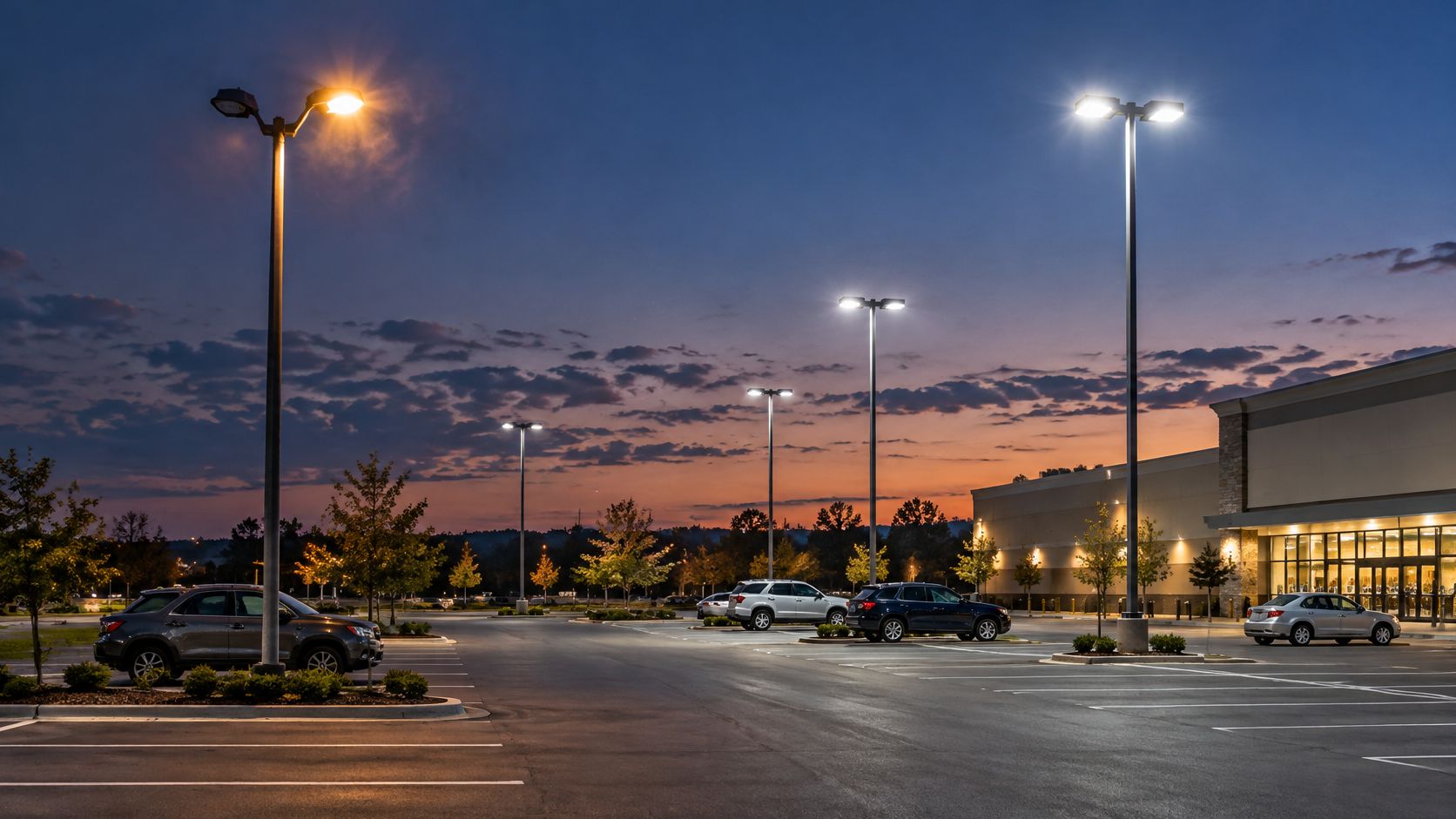
Treat the lot as its own project. It is not a box of wall packs tacked onto the store order. The failure owners already live with is simple: a photocell turns every head on at dusk and holds full output until dawn, including the rows nobody uses after the last tenant locks up.
Metal halide makes that worse. After a blink, those lamps restrike slowly, so a short outage leaves the lot dark for minutes. Leaning poles and light spilling into bedroom windows are the other two complaints that show up before anyone mentions kilowatt-hours.
Hardware that can step down
Specify LED area lights and wall packs with 0-10V or networked dimming. Give the circuit two decisions, not one. A photocell or astronomical clock handles on and off. A second step drops output after the store closes, while crosswalks and entries stay brighter. Color temperature in the 3000K to 4000K range is a practical retail compromise: faces and cameras stay readable without a harsh blue lot.
Bollards mark walks. Don't ask them to light a drive aisle. They sit too low, and the result is glare at bumper height with dark pavement beyond. Where a center backs onto homes, trespass and glare are design limits, not neighbor complaints to handle later. Shield, aim, and curfew the heads that face those windows.
The pole, not just the head
Pole work is more than a new lamp. Base corrosion, nut torque, and arm condition decide whether the pole is safe to climb or has to come out. Raised heads need a high-reach truck, not a ladder and a hope. We handle jobs from a single failed pole through a full parking-structure LED retrofit, and the base often fails the inspection before the lamp does.
Before you call for pricing, walk the lot once at night and keep four notes.
- Count the poles and mark which circuits they sit on.
- Note dark stalls, not just "the back row is dim."
- Photograph leaning bases and rust at the anchor bolts.
- Record whether lights are full-on at 2 a.m., when the stores are closed.
That last photo is the control problem in one frame. If every head is at full output with an empty lot, the retrofit scope includes a schedule, not only a lumen package.
Emergency Lighting Tests Owners Can Defend
UK fire services issued 2,066 enforcement and prohibition notices between June 2024 and May 2025 involving fire-regulation breaches, and Electrical Contracting News identified emergency-lighting maintenance and testing as part of that compliance concern. A bright sales floor on an ordinary night only shows the primary circuit. The blackout path is a separate fleet: batteries, exit faces, and a test log with dates on it.
An LED swap is the start of that record, not the closeout. Controls that were never commissioned, and emergency files too thin to hand an inspector, can erase the energy savings and leave the owner unable to defend the property. Networks, firmware, and communications drop. Every control zone needs a documented fallback, and the emergency circuit has to run without the network.
The two tests that belong on a calendar
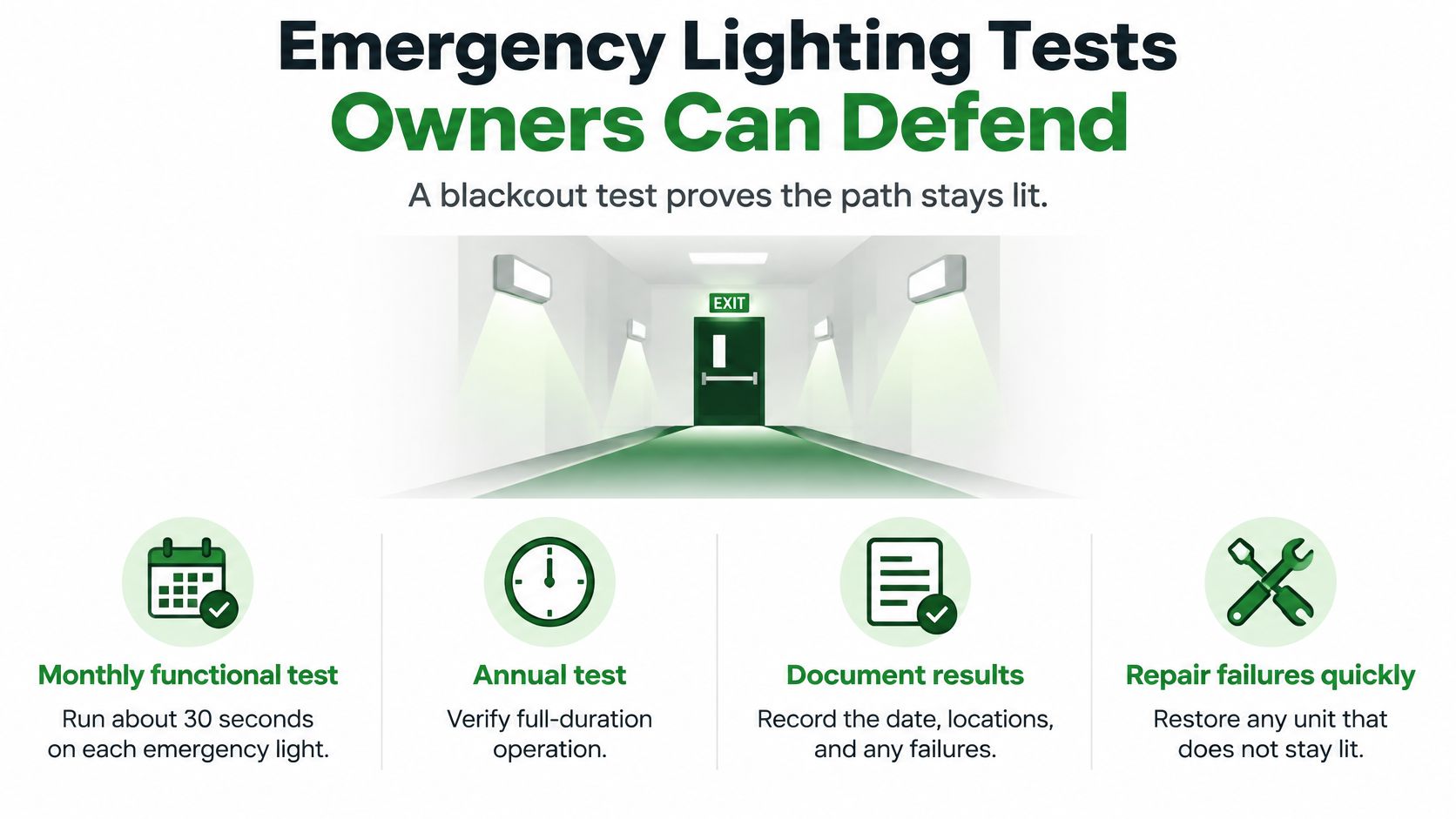
Run the calendar the way a project manager runs a punch list: same items, same order, a name next to every open item. Align the routine with common NFPA 101 practice, and keep emergency lighting testing on the same work order as lamp repairs.
- Monthly functional test. Run about 30 seconds on each emergency fixture and exit sign. Confirm the lamp transfers and the face is visible.
- Annual duration test. Run the full battery fleet for at least 90 minutes. A unit that fades at minute 40 is a failure, not a pass with a note.
- Write the result. Date, tester, location, pass or fail, and the name of whoever fixed each failure. A verbal "we checked them" does not survive a claim or an inspector.
Batteries work like dated stock in a back room. The carton can look fine while the contents are already past useful life. Many sealed units are due on roughly a four-year cycle, and sooner if the 90-minute test fades early. Learn the install year from the log, not from the next outage.
Ordinary failures, and the one-page log
Exit signs fail in retail for dull reasons. Merchandise blocks the face. A lamp burns out. A remodel paints over the unit. Apply the same routine to parking-structure stairs and exterior egress. A dark stair during tenant turnover is a continuity problem, not only a code line. Access Electrical & Lighting has serviced or replaced tens of thousands of emergency lighting fixtures and systems in commercial and multifamily spaces across Southern California, and blocked faces show up as often as dead batteries.
Keep one page the owner can hand over:
- Device count by floor, stair, and parking level
- Last 30-second test date and last 90-minute test date
- Battery install year
- Open repairs, with who owns the fix
- Fallback mode for each control zone if the network is down
A smart system that can't run offline has added a failure, not removed one.
Prove the Savings After the Retrofit
An LED swap is not the finish line. A floor pinned at full output, or an emergency-lighting file too thin to hand over, can erase both the kilowatt-hours and the owner's ability to defend the property.
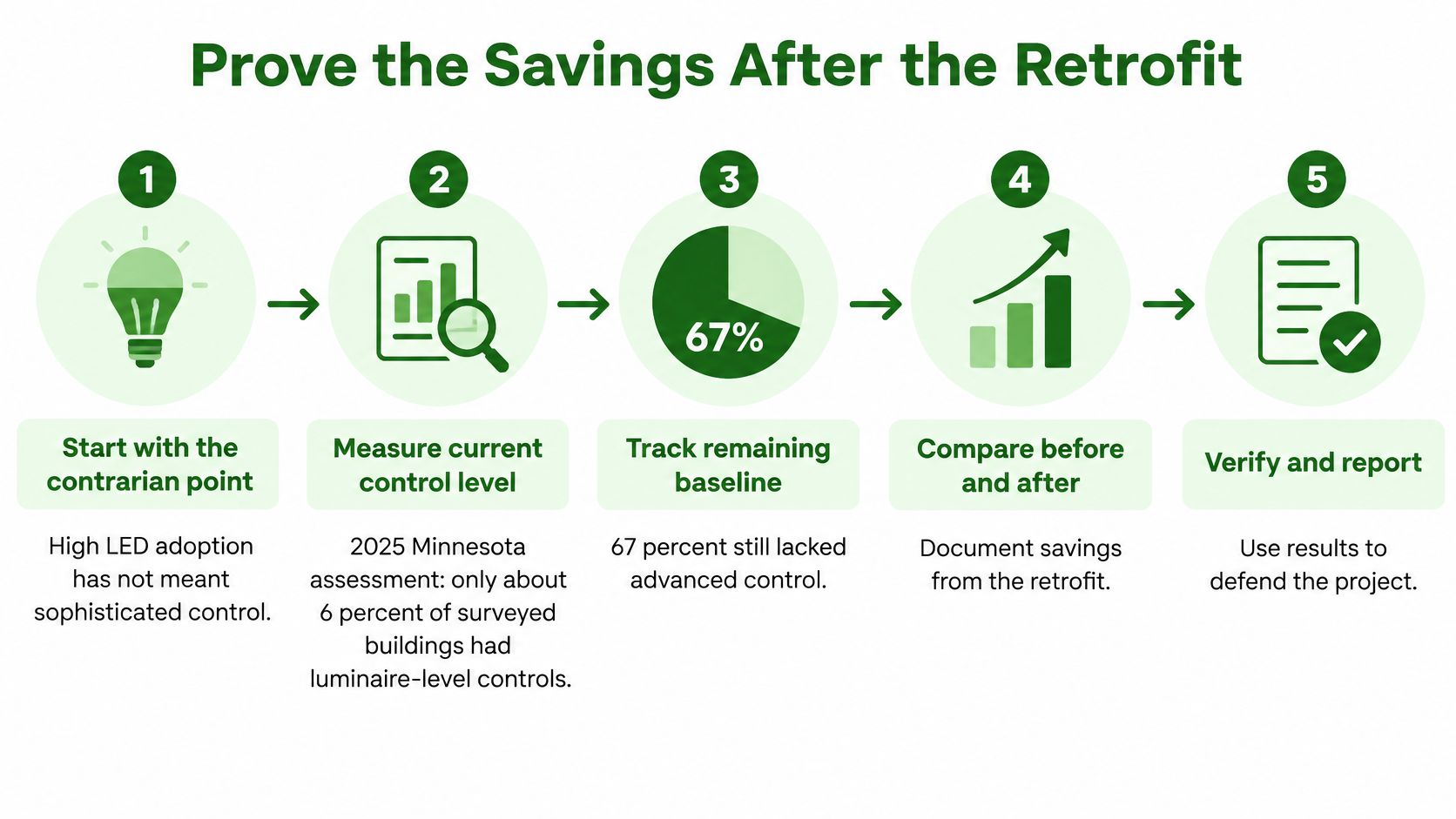
High LED adoption has not meant advanced control. Market assessments of commercial buildings still find luminaire-level controls uncommon. Traditional non-networked controls remain the usual setup, and some buildings have no controls at all. A 2025 Puerto Rico commercial-building study found that manual switches remained the most common interior control strategy in office and retail buildings, and that small retail sites frequently relied on manual exterior switching or photocells rather than integrated controls. Lower connected watts do not equal a lower bill if the sales floor stays at full output after the contractor leaves.
A sequence you can put in the spec
The retrofit works like a new thermostat. Savings show up only if someone checks that it was not left on hold.
- Before demolition, record fixture wattage, counts by zone, and a month of operating hours or a normalized utility bill. Without that baseline, later arguments are opinions.
- At turnover, confirm sensor coverage, time clocks, daylight response, and high-end trim. Prove that a tenant override cannot pin the floor at full output after the contractor leaves.
- At 30 days, compare nighttime kilowatt-hours, or a sample of fixture power, with the model. Fix obvious overrides and sensors aimed at a bright sign.
- At 90 days, walk the floor again for seasonal daylight and for trading-hour changes. A holiday schedule left in place is a quiet leak.
- At 365 days, normalize the bill for weather and hours before anyone claims the savings in a report to ownership. Attach the current emergency-lighting record to that same report. A lower bill with no test history still leaves the property hard to defend.
Who owns the numbers
The landlord owns data for common area and site lighting. The tenant owns it where the lease puts interior lighting on their meter. Write that split into the commissioning scope so nobody waits a year to learn the other party has the only interval data.
Recalibrate before you replace drivers when the fault is a timeout, a photosensor aimed at a poster, or a hold button at the manager's desk. New hardware does not fix a schedule.
Fault alerts help only if a person is named to clear them. A dashboard full of unread sensor faults is a manual switch with extra steps. Name the closer, set a response time, and treat an open override the same way you treat an open repair: it stays on the report until someone clears it.
Start With a Lighting Survey
Pause the fixture shopping until four items sit in one folder. A year of lighting-related utility bills, or a demand snapshot if a full year isn't available, shows the load you're buying down. A fixture and pole count by zone stops a quote that prices the sales floor and forgets the garage. The latest monthly and annual emergency-test logs show whether the life-safety fleet can be defended. A note of every place tenants can override controls shows where savings will be undone after move-in.
Then book a walk-through that measures where the site is dark or glaring, not only where wattage can be swapped like for like. We have over 25 years of commercial lighting work in Southern California, and our surveys look at brightness, placement, and energy use together. Access Electrical and Lighting offers a complimentary lighting survey for commercial and retail properties in Orange County. We assess the property and recommend more efficient options, rather than handing back only a lamp quote. Design, install, controls, and maintenance can stay with one licensed and bonded C-10 contractor instead of splitting the record across vendors.
Harbor View Apartments put that sequence in plain language: "They installed brand-new lighting in our parking structure, ensuring everything met the latest Title 24 requirements." The useful part isn't the new heads alone. It's that the work was tied to the energy-code requirements the property has to show.
Your next step is to book that survey, or an equivalent licensed C-10 contractor, with the folder above on the table. Put commissioning, and the 30, 90, and 365-day checks, in the same scope as the LED price. A low fixture number with no one assigned to trim, test, and recheck is how both the savings and the inspection file slip.
Access Electrical and Lighting designs, installs, and maintains commercial lighting for retail centers, offices, and multifamily properties, including LED retrofits, parking and pole lighting, controls, and emergency-light testing with the records inspectors ask for. If your sales floor, garage, or exit path needs a measured plan instead of a lamp-for-lamp swap, start with a walk-through of the zones you operate. Visit Access Electrical and Lighting to book a survey and put commissioning in the same scope as the fixture price.