The most repeated advice about LED parking light bulbs is to buy by equivalence: find the lamp advertised as a "400W metal halide replacement," screw it in, and bank the difference on the utility bill. That advice skips the two things that decide the outcome. A parking lamp is a part inside a listed luminaire, so it has to fit the socket, the ballast path and the housing's thermal design before anything else. And it's a light source inside a photometric plan, so a lower-wattage swap isn't savings until someone measures light levels at grade, checks glare, and confirms the controls still satisfy code.
I'd treat wattage as the last number you look at, not the first. Here's the order that keeps a retrofit from turning into a dark lot with a smaller electric bill.
Specs to Check Before You Buy LED Parking Bulbs
This applies to LED lamps and retrofit kits for parking lots, garages and building entrances. A car's small parking lamp is a separate product with separate rules, covered briefly below.
| Spec | Target value | Why it matters | Where to verify |
|---|---|---|---|
| Efficacy | At least 70 lm/W for the light source | Shows light delivered per watt | Manufacturer test data and ENERGY STAR listing |
| Maintained illuminance | Stated at grade, at a stated hour count | Initial lumens overstate real performance | Photometric file and lighting calculation |
| L70 projection | Based on recognized testing, not a marketing claim | Shows when output falls to 70% of initial | Test report and projection method |
| Correlated color temperature | 4000K typical for parking areas (3000K to 5000K range) | Affects visibility and perceived glare | Fixture data sheet |
| Color rendering index | 70 or higher | Helps faces and vehicles read clearly | Fixture data sheet |
| Power factor | Numeric value stated at full load, not a "high PF" claim | Limits electrical load on the circuit | Driver specification |
| Ambient temperature rating | At or above local summer highs | Heat drives early lumen loss | Luminaire label and enclosure rating |
| Surge protection | Rated surge protection documented | Protects the driver from voltage transients | Driver or fixture specification |
Efficacy first, then maintained output
Efficacy is delivered luminous flux divided by input power, expressed in lumens per watt, and the ENERGY STAR commercial luminaires specification sets a floor of at least 70 lm/W for the light source, with outdoor commercial products also required to document lumen maintenance. That floor is useful for screening products, then it stops being useful. A lower-wattage LED lamp can still produce less usable light at grade than the fixture it replaces. The lamp has to fit the socket, ballast path and listed luminaire before its efficiency number means anything. Then the output has to be checked against the photometric plan, glare and the controls code.
That is why the number to demand is maintained illuminance at grade, at a stated hour count, not initial lumens on a box. Ask for the photometric file (IES format), the distribution type, and a calculation run at your actual mounting height and pole spacing. A lamp with strong initial output can underperform if its distribution pushes light past the curb, across the property line or into drivers' eyes. Treat savings as unproven until the measured layout meets the intended light levels and the controls still comply.
The specs sellers leave out
A useful submittal names LED drive current, power factor, ambient-temperature rating, surge protection and an L70 projection based on recognized testing. High drive current in a sealed shoebox housing is how a nominally efficient lamp cooks itself into early lumen loss. Optical distribution matters just as much: light thrown past the property line is paid for and wasted. Correlated color temperature changes how a lot reads at night, and color rendering affects whether faces, vehicles and obstacles are easy to identify. Power factor should be stated as a number at full load, because a vague "high PF" label gives you nothing to check against the circuit. Surge protection belongs in the submittal too, since the driver is the part most exposed to voltage transients.
If the seller can't supply delivered lumens, a photometric file and a tested L70 projection, don't buy the product.
A car's parking lamp is a different purchase
Automotive LED parking bulbs raise socket type, polarity, CAN-bus compatibility, thermal clearance and turn-signal interaction, plus whether the lamp stays photometrically compliant in the original housing. A 2024 SAE study of LED replacement bulbs in halogen headlamps found that legal road use depends on vehicle-specific photometric performance, measured as luminous intensity at defined angles rather than assumed from a lumen rating. More lumens isn't automatically more usable light, and that principle carries straight over to a parking lot pole.
Match the Bulb to the Socket and Ballast First
Two questions decide whether a lamp is even a candidate, and neither involves brightness.
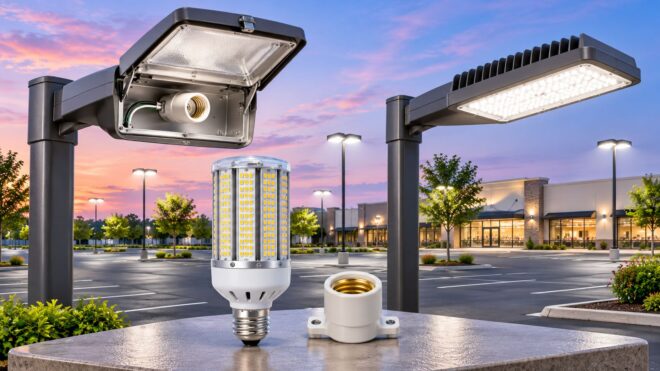
What base is in the fixture? Medium E26 and mogul E39 bases aren't interchangeable, and adapters that let you force one into the other add a failure point inside a hot enclosure. Pull the existing lamp, read the base and the etched lamp code, and photograph it before you order anything.
What happens to the ballast? A direct-wire, ballast-bypass lamp requires the HID ballast to be disconnected and the socket wired for line voltage, with the work labeled inside the housing so the next technician doesn't install an HID lamp into a bypassed fixture. A ballast-compatible lamp keeps the ballast in circuit, which means you keep its losses, its failure mode and its aging capacitors. On a lot full of pulse-start metal halide and high-pressure sodium fixtures, the honest starting points are a screw-base LED corn lamp rated for enclosed fixtures, or a purpose-built retrofit kit for that specific luminaire.
The listing is not optional
The lamp must be listed as an approved retrofit for that luminaire model, not merely able to thread into the socket. A retrofit listing means someone tested that combination for temperature and electrical safety. Without it, you own the liability for a modification nobody evaluated.
Then check the physical realities. Corn lamps need clearance for the heat sink and airflow around the diode boards, and a tight shoebox lens cavity rarely provides it. Compare the enclosure's ambient-temperature rating against local summer highs, not against a mild coastal average. Confirm the existing photocell or time clock is rated to switch the new load, since LED drivers draw an inrush current that can pit relay contacts sized for a slow-starting HID ballast.
Fit test before you order: base type, ballast path, and a retrofit listing for that exact fixture. Three yeses, or keep looking.
Optics close the loop. A brighter lamp in a housing designed for a different source throws glare at driver eye level and can push spill light past the property line, which is a complaint you'll hear about long before you notice the energy savings.
Choosing Between a Bulb Swap and a Full Luminaire
The cheapest route is usually assumed to be a bulb-for-bulb swap. Sometimes it is. Often it's the most expensive way to buy a lighting problem, because you've paid for labor at height twice and still don't have a system that meets the design.
| Path | What changes | When it is enough | What to verify |
|---|---|---|---|
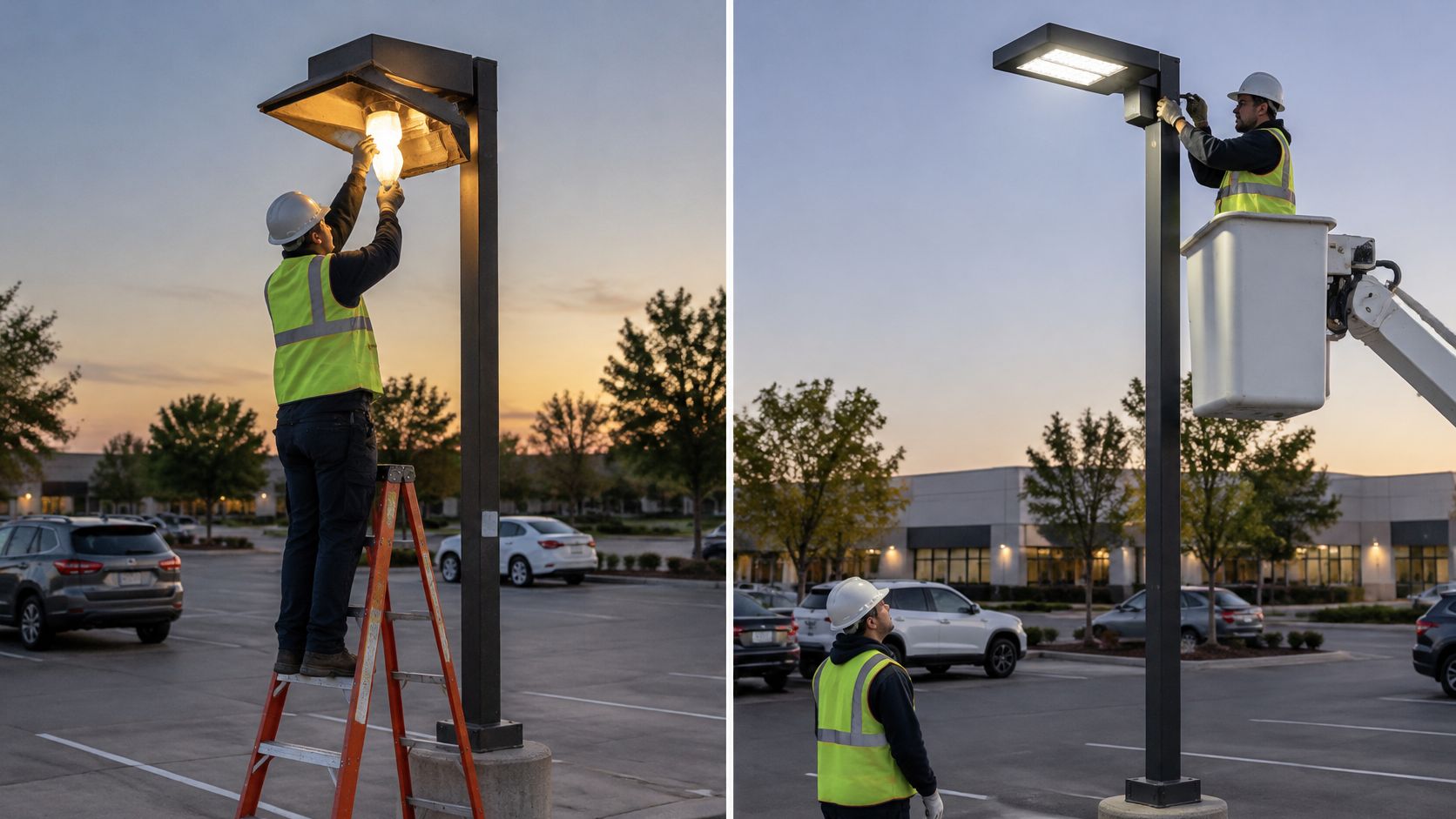
| Lamp replaced inside the existing housing | Light source only; optics, thermal path and driver location stay as they were | Housing is rated for the lamp and the existing optic still meets the design | Thermal rating, approved retrofit listing for that luminaire, socket base, photometric output at the actual mounting height and pole spacing |
| Retrofit kit for the existing luminaire | Light engine and driver replaced, original housing retained | Kit is listed for that exact luminaire model | Manufacturer kit listing, ambient temperature rating, surge protection, controls compatibility |
| Full LED luminaire | Optics, thermal design, driver and photometric pattern all replaced | Existing optic, driver or controls cannot meet the design, or the alteration triggers controls and documentation | Photometric file, L70 projection, motion sensing and scheduling capability, shielding |
Where California code enters the decision
In California, changing lighting isn't only an energy decision. The California Energy Commission's 2025 outdoor lighting guidance applies to lighting serving parking lots, hardscape and building entrances, and it requires motion-sensing controls for outdoor luminaires over 40 watts mounted 24 feet or lower. Automatic scheduling must be capable of reducing lighting power by 50% to 90% and switching lighting off when it isn't needed, and parking garages plus common service areas in multifamily properties are treated as separately documented lighting scopes.
A lower-wattage lamp proves none of that. It doesn't demonstrate adequate illumination, glare control, egress visibility or Title 24 compliance, and a lamp inside an old housing may not offer the same compliance path as a complete listed luminaire with dimming and sensing built in. For phased work across a portfolio, our guide to commercial parking lot lighting fixtures covers how housing and optic choices interact with pole layout.
Five checks before you approve a swap
- Confirm the existing housing's thermal rating and optic type.
- Confirm the lamp is an approved retrofit for that luminaire model.
- Compare photometric output at the actual mounting height and pole spacing.
- Check whether the alteration triggers controls and documentation.
- Choose a full luminaire if the optic or driver can't meet the design.
A swap makes sense only when all five pass.
What LED Parking Retrofits Save in Practice
| Project | Energy reduction | Layout or light change | Conditions |
|---|---|---|---|
| Leavenworth Walmart Supercenter vs 1,000 W pulse-start metal halide | 63% | 21% fewer fixtures and 12% fewer poles | Simple payback 4.4 to 7.5 years, depends on wattage and power price |
| Leavenworth Walmart Supercenter vs 400 W pulse-start metal halide | 44% | Same redesign | Payback within the 4.4 to 7.5 year range |
| Separate DOE parking-lot demonstration | Large reported savings | Substantial drop in average light levels | Includes motion-sensor savings in unoccupied areas |
The strongest documented numbers come from a full redesign. In the DOE Commercial Building Energy Alliance case study at a Walmart Supercenter in Leavenworth, Kansas, the first installation under the LED Parking Lot Performance Specification, LED fixtures cut energy 63% against 1,000-watt pulse-start metal halide and 44% against 400-watt pulse-start metal halide. DOE reported simple payback estimates of 4.4 to 7.5 years, depending on the incumbent wattage and the electricity price.
Read the conditions, not just the percentage
The same project reduced the fixture count by 21% and the number of poles by 12%. That's the part a bulb swap can't reproduce. Better optical distribution let the designer delete hardware, and deleted hardware saves energy, maintenance and lift time every year afterward. If your poles stay where they are and your fixture count stays the same, expect a result closer to the lower end of that range.
The counterweight matters more. A separate DOE parking-lot demonstration paired major energy savings with a substantial drop in average light levels, plus additional savings from motion sensors dimming unoccupied areas. A large share of the light was gone. Anyone quoting a savings figure like that without the light-level caveat is selling you a dimmer lot.
Compare savings only at equal maintained illuminance and identical control schedules. Ask every vendor what light level the reference project kept.
Build your own number
A retail center running its lot dusk to dawn and a neighboring office property shutting down at midnight can use the same fixtures and the same lamp and still land on wildly different annual kWh and payback. Run your own hours, your own utility rate and your own fixture count through an LED lighting savings calculator before you accept a payback claim from a product page, then measure the delivered light levels and confirm the layout still does the job it was designed for.
How Long LED Parking Lights Last and When to Replace
LED life works on output loss, not a clean burnout date. DOE describes useful life around L70, the point where output falls to 70% of initial lumens. That fade is gradual. A parking fixture can glow all night and still be below the illuminance its layout was designed to deliver.
The DOE lumen-maintenance guidance published through OSTI notes that ENERGY STAR commercial-luminaire requirements specify a 35,000-hour L70 value. Products claiming longer lives must hold defined percentages of initial output at test intervals. A 25,000-hour product must retain at least 95.8% at 3,000 hours and 91.8% at 6,000 hours.
| Rated life claim | Test hour | Minimum retained output | Years at 12 hours nightly |
|---|---|---|---|
| 25,000-hour product | 3,000 hours | 95.8% of initial lumens | About 0.7 years |
| 25,000-hour product | 6,000 hours | 91.8% of initial lumens | About 1.4 years |
| 25,000-hour product, end of rated life | 25,000 hours | 70% of initial lumens (L70) | About 5.7 years |
| 35,000-hour L70 baseline | 35,000 hours | 70% of initial lumens (L70) | About 8 years |
Why two identical ratings age differently
At 12 hours of nightly operation, 35,000 hours works out to roughly eight years, but that is a laboratory projection, not a warranty on your pole. Heat-sink design, enclosure temperature, driver quality, moisture ingress and voltage transients determine the actual result. A sealed coastal fixture with a corroded gasket and a driver sitting next to a hot lens will fall off long before an open, well-ventilated housing on the same rating.
That is why the bulb has to fit the socket, ballast path and listed luminaire before anyone counts a lower-wattage swap as savings. Check the photometric plan and controls code after that. Light level, glare and compliance still decide whether the retrofit works.
For Southern California lots, I specify a complete temperature-rated luminaire or an approved retrofit kit over an unverified replacement bulb. The thermal path is the part you cannot inspect from the ground. Access Electrical & Lighting handles this scope through LED retrofits, parking structure lighting and systems, lighting installation and replacement, and light pole repair and replacement. That covers a single failed light pole up to a full parking-structure LED retrofit.
Set replacement triggers you can measure
Replace on evidence, not on whether individual diodes still emit light. Useful triggers include:
- Measured light loss against the acceptance readings taken when the system was new.
- Failed or flickering drivers, which usually show up as one dark fixture or a visible shimmer on camera.
- Degraded uniformity, where bright pools under poles sit next to dim stretches between them.
- Visible moisture or lens yellowing, both of which accelerate output loss.
- Controls that no longer dim, schedule or respond as intended, since a working lamp can still waste energy or leave a lot too dim.
Book a nighttime walk with a meter on a recurring schedule. It catches a fixture that is technically alive and functionally finished, and it keeps replacement decisions tied to the photometric plan instead of product-life claims.
Verify the Install On Site and Catch Failures Early
Acceptance is a measurement job, not a glance from the parking lot entrance. Do it after dark, at full output, with the controls in their normal operating state.
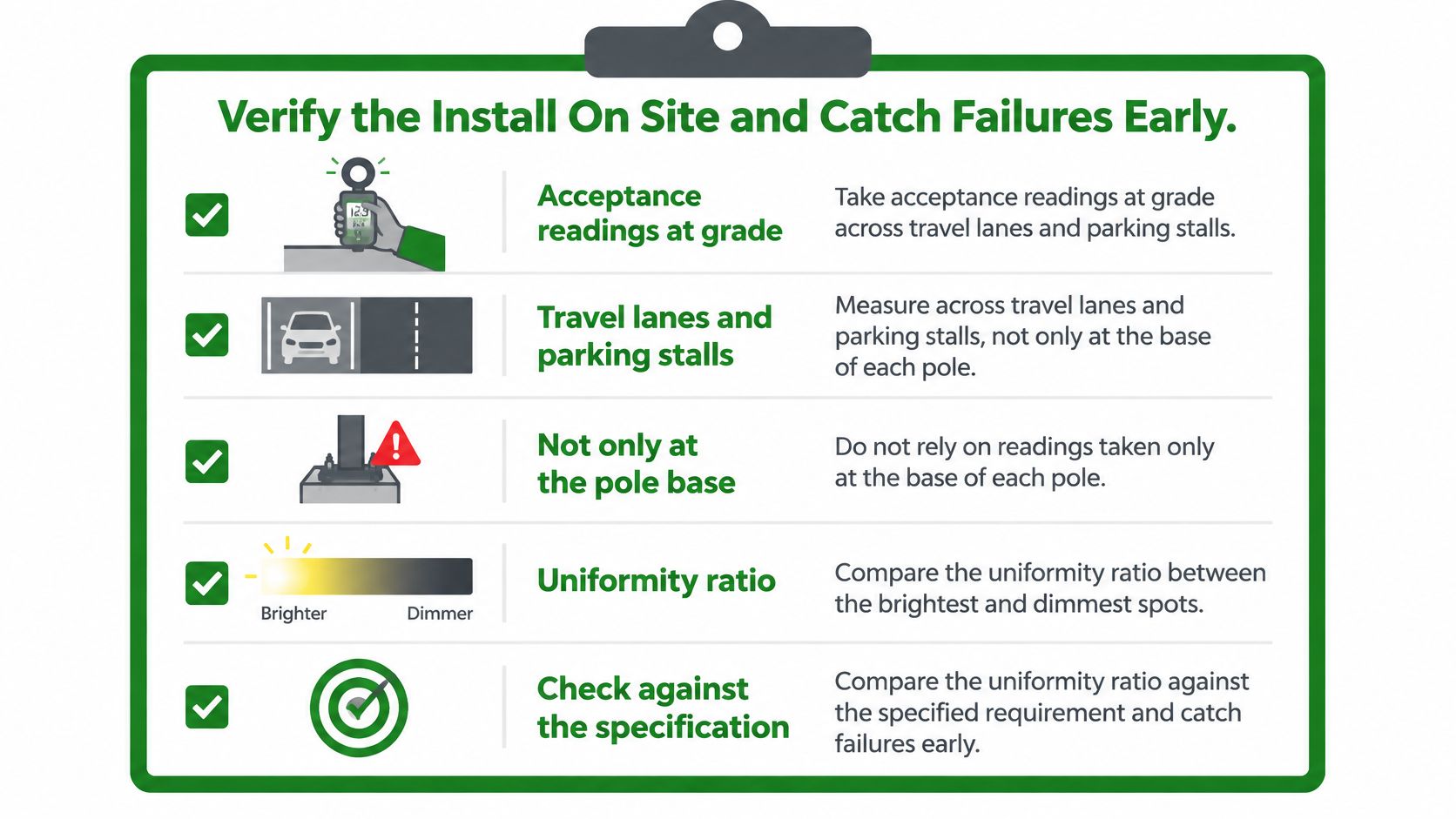
The acceptance walk
Lay a grid across the pavement and read at grade with the meter's sensor flat on the surface, cosine-corrected, your body shadowing nothing. Take points in travel lanes and parking stalls, including the midpoints between poles where the layout is weakest. Readings only at the pole base tell you the fixture works, which was never the question. Our walkthrough on how to measure foot-candles covers meter handling and grid setup in detail.
- Uniformity ratio: divide average by minimum, and maximum by minimum, then compare both against the photometric plan rather than against a general target.
- Geometry check: confirm mounting height and pole spacing match the model before fixtures go up, because a lamp at a height the plan never modeled produces glare and uneven coverage you can't fix with a different bulb.
- Spill and glare: stand at the property line and at driver eye level in the travel aisle, especially where new fixtures replaced higher-output lamps in old optics.
- Entrances read separately: people must be recognizable at doors, stair landings and elevator lobbies, so measure vertical illuminance there, not just the horizontal plane.
Record the controls, not just the light
Write down the schedule setpoints, the daylight shutoff behavior, the dimmed level during unoccupied periods, and how quickly motion sensors restore full output. Trigger a sensor by walking and by driving, and note any fixture that fails to respond or latches on. Controls that were never commissioned erase the savings the project was justified on.
The failure checks that catch most bad retrofits
Run these before you sign off, because each one is a common way a promising retrofit underperforms:
- You compared maintained illuminance, not wattage or initial lumens.
- The lamp is an approved retrofit for that housing, with the listing documented.
- The ambient-temperature rating covers local summer highs inside the enclosure.
- Surge protection is documented and driver power factor suits the circuit.
- A periodic nighttime inspection is on the calendar instead of trust in a rated life.
Save every acceptance reading, with the date, meter model, grid layout and control state. That file is the baseline every future complaint gets measured against.
Without a baseline, a tenant's "it's darker than it used to be" is an argument you can't settle. With one, it's a five-minute measurement.
Confirm Your Retrofit Path With a Site Survey
The decision gets easy once you have data on the existing system. Five things to pull together before you talk to a contractor, and none of them require a lift.
- Fixture schedule. Lamp type, wattage, housing model, pole heights and pole spacing, ideally on a site plan with each pole numbered.
- Current light readings at grade. Note dark spots, glare complaints and any areas tenants avoid after dark.
- Operating hours and control status. Photocell, time clock, motion sensors, or nothing at all, plus what happens at 2 a.m.
- A photometric comparison request. Ask for the proposed lamp or luminaire modeled against the existing one at the same mounting height and spacing, showing average and minimum illuminance and uniformity.
- A recommended path per fixture group. Lamp, retrofit kit or full luminaire, with the compliance notes attached to each group rather than one blanket answer for the whole property.
Why the per-group answer matters
Most properties aren't uniform. A retail center might have shoebox fixtures on interior poles that accept a listed retrofit kit, wall packs at the loading dock whose optics can't be salvaged, and garage fixtures that fall under a separately documented lighting scope. Pricing all three as one line item is how a budget gets approved and then blown. Grouping them lets you phase the work: fix the safety-critical entrances and stairwells first, then the interior lot, then the perimeter.
We offer complimentary lighting surveys that assess brightness levels, fixture placement and energy consumption, and recommend the most energy-efficient solutions for the property, covering everything from a single failed light pole to a full parking-structure LED retrofit. One survey can carry both the repair list and the upgrade plan, so you're not paying for two rounds of assessment.
The point of the survey isn't a product recommendation. It's a documented comparison you can hold a vendor to, showing what light level you keep, what glare you accept and what the controls have to do. Wattage printed on a box tells you none of that. Measured data does, and it's the only basis I'd sign a retrofit scope on.
Access Electrical and Lighting surveys Southern California parking lots, garages and building entrances, measures what's reaching the pavement, and recommends a lamp, retrofit kit or full luminaire path for each fixture group with the Title 24 controls and documentation handled alongside the installation. If you're weighing LED parking light bulbs against a full fixture replacement and want the comparison done with readings instead of guesses, visit Access Electrical and Lighting to request your complimentary lighting survey.