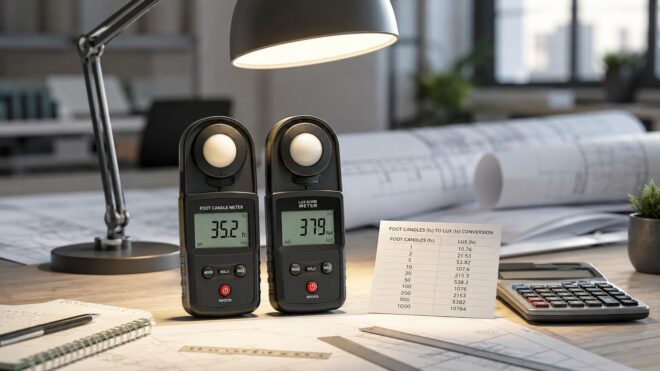
To convert foot candles to lux, multiply the foot candle value by 10.764. You can multiply by 10 for a quick estimate, but professional lighting work needs the exact factor.
If you're reviewing a lighting submittal right now, this is probably the problem in front of you. One sheet shows light levels in foot candles, the fixture cut sheet from an overseas manufacturer shows lux, and someone on the project is treating them like they're interchangeable without checking the math.
In a commercial building, that shortcut can create real trouble. It affects fixture selection, lighting layouts, final punch lists, Title 24 documentation, emergency lighting verification, and in the worst cases, failed inspections and liability questions after an incident. The formula is simple. The consequences of using it loosely are not.
Your Guide to Foot Candles and Lux Conversion
A common Southern California scenario goes like this. The architect's reflected ceiling plan is written in foot candles, the LED fixture package is specified in lux, and the property team needs to approve the budget before anyone has reconciled the two.
That mismatch doesn't just slow down decision-making. It can lead to ordering the wrong fixtures, over-lighting a space, under-lighting a task area, or creating a compliance problem that shows up late, when the schedule is already tight.
What these units are measuring
Both foot candles and lux measure illuminance, which means the amount of light landing on a surface. The difference is the measurement system.
- Foot candles: Common in the United States for commercial lighting plans and field readings.
- Lux: The SI unit used internationally and common on many manufacturer data sheets.
- What matters on site: You need to compare like with like. A workplane requirement in foot candles must be converted correctly if the fixture documentation is in lux.
The working rule
The practical rule is straightforward.
On the job: If the plan says foot candles and the spec sheet says lux, convert before you approve anything. Don't assume the numbers are close enough.
That matters most when the number is being used for more than a rough conversation. Early budgeting can tolerate a little approximation. Final documentation, code checks, and sign-off cannot.
Why facility managers should care
If you're responsible for an office, retail center, parking structure, or multifamily asset, lighting isn't just about visibility. It's tied to safety, tenant satisfaction, maintenance planning, and whether your project passes inspection the first time.
The right conversion helps you answer practical questions fast:
- Will this fixture package meet the design intent
- Are the measurements being taken at the correct surface
- Is the documentation strong enough for compliance review
Those are building operations questions, not just math questions.
The Foot Candle to Lux Formula and Calculator
The exact conversion is based on area. Because one square meter is larger than one square foot, the lux value is higher for the same illuminance level.

The formula you actually use
Lux = Foot candles × 10.764
That's the number to use when you need a reliable answer for design review, audit work, or compliance documentation.
The reason contractors push back on the rounded shortcut is simple. For professional applications like commercial lighting audits or Title 24 certification, using 10 instead of 10.764 creates a systematic error of about 7.6%, which can cause designs to fail compliance checks when the target illuminance threshold is tight, as noted by Star LED Profile's explanation of lux to foot candle conversion.
Quick examples
Here are a few common conversions you can use as a field reference.
| Foot candles | Lux |
|---|---|
| 1 fc | 10.764 lx |
| 5 fc | 53.82 lx |
| 10 fc | 107.64 lx |
| 20 fc | 215.28 lx |
| 30 fc | 322.92 lx |
| 50 fc | 538.20 lx |
A simple calculator format
If you need to convert a reading on the spot, use this process:
- Take the foot candle reading
- Multiply by 10.764
- Round only after the math is done, if your documentation allows it
Example:
- Measured illuminance: 20 fc
- Conversion: 20 × 10.764
- Result: 215.28 lux
That gives you a clean number you can compare against fixture data, imported photometric reports, or owner requirements.
When the shortcut is acceptable
For a rough conversation in the field, multiplying by 10 is often enough to decide whether you're in the right range. If a space is clearly over-lit or clearly under-lit, that estimate can save time.
But don't let the rough estimate migrate into the final paperwork. That is where small math shortcuts turn into rework.
A fast estimate helps with planning. Exact conversion is what protects the final sign-off.
Why Do Both Foot Candles and Lux Exist
The reason both units still show up on the same project is straightforward. The industry still operates across two measurement systems.
One is imperial, one is metric
A foot candle is based on the imperial system and is defined as one lumen per square foot. A lux is based on the SI system and is defined as one lumen per square meter. The conversion factor is about 10.764 because one square meter equals 10.7639 square feet, which makes the relationship a direct result of area, not an arbitrary lighting rule, as explained in Electrical Marketplace's discussion of lux and foot candles.
Once you understand that, the number stops looking random. You're not translating two different kinds of light. You're expressing the same illuminance in two different unit systems.
Why both units still appear on commercial jobs
In practice, many U.S. drawings, punch lists, and field reports still use foot candles. At the same time, fixture manufacturers, global design teams, and imported product documentation often default to lux.
That creates a mixed-language environment on real projects:
- A domestic plan reviewer may talk in foot candles.
- A fixture cut sheet may show lux.
- A controls or photometric package may include both.
- A facility manager may need one consistent unit set for internal records.
Why this matters beyond the math
This isn't just a trivia point about imperial versus metric. It affects how people interpret specs, compare products, and defend decisions later.
If one contractor is talking in foot candles and one manufacturer is talking in lux, someone has to translate accurately. When no one owns that step, mistakes get buried inside lighting layouts, fixture substitutions, and closeout documents.
When Accurate Conversion Is Non-Negotiable
The rough estimate ends where liability begins. In commercial properties, there are moments when exact conversion isn't a preference. It's the difference between defensible documentation and a bad record.
Emergency lighting and life safety
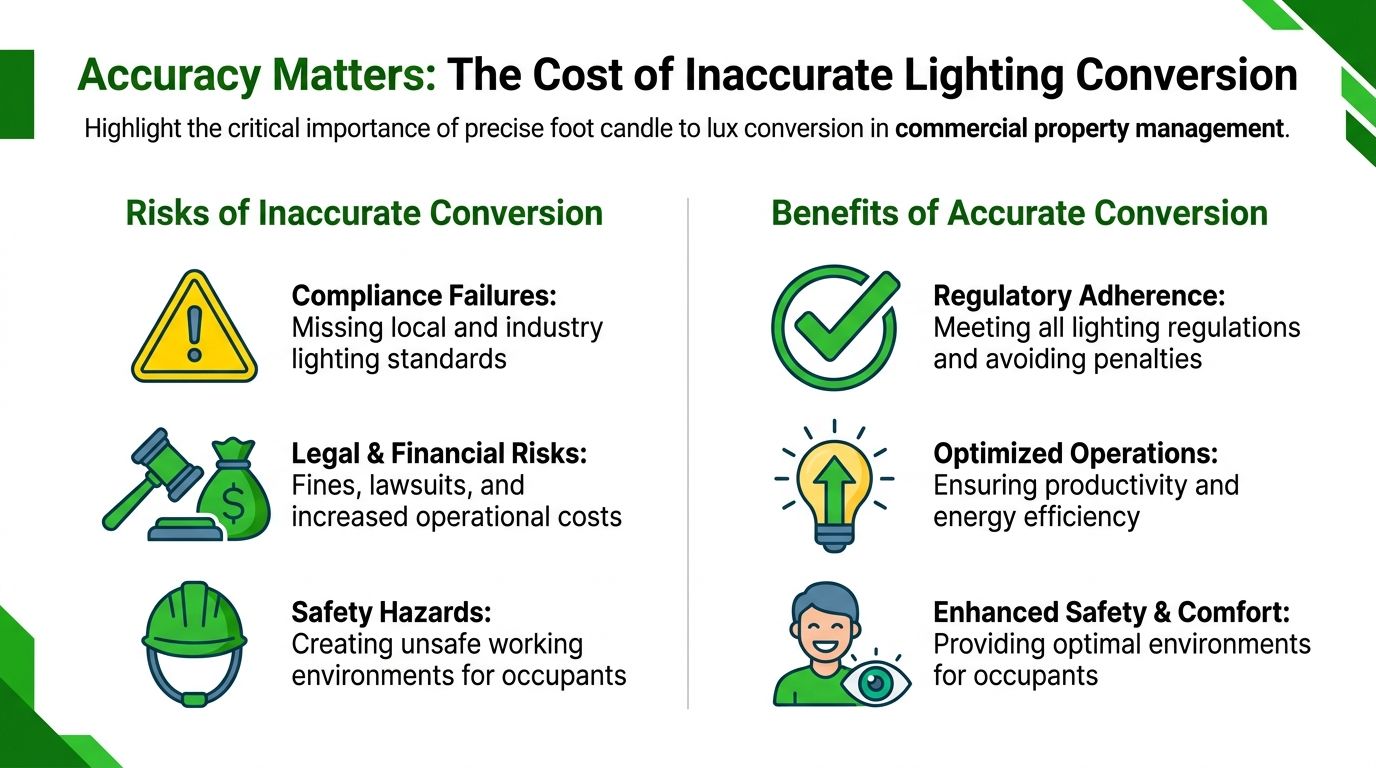
Emergency lighting is the clearest example. For legal and compliance documentation, the exact 10.764 conversion matters. Emergency lighting often requires a minimum of 1 fc, which equals 10.76 lux. Using the rounded factor of 10 can leave a system 7.6% under-lit, which can contribute to a failed safety inspection, as noted by LED Lighting Supply's foot candle to lux conversion guidance.
That matters in stairwells, egress paths, parking areas, and other spaces where light levels aren't just a comfort issue. They're part of the life-safety record for the building.
Title 24 and formal project closeout
In California, this gets more serious because lighting documentation doesn't live in isolation. It ties into controls, energy compliance, testing, and sign-off.
A field team can use estimates during layout conversations. But once the project is moving toward certification, owners and managers need exact values in their records. Borderline designs are where mistakes show up first. If the calculation is loose, the paperwork is weak, and that creates avoidable exposure during review.
If you're managing a building and want broader context on workplace lighting obligations, OSHA lighting standards for commercial facilities are also worth reviewing alongside local code requirements.
Where owners get into trouble
The risky pattern is usually the same:
- A proposal uses rounded conversions: The numbers look close enough during budgeting.
- A fixture substitution changes performance: The replacement product doesn't match the original intent exactly.
- The final readings are marginal: Now every decimal matters.
- The project team scrambles late: Re-testing, fixture swaps, or added fixtures cost more when ceilings are closed and schedules are tight.
If the number might end up in an inspection file, convert it exactly the first time.
The budget side nobody likes discussing
Bad conversion doesn't always create an obvious code failure. Sometimes it creates a quieter problem. The building ends up over-lighted to create a safety margin, and the owner pays for more fixtures, more labor, and more energy use than the space needed.
Under-lighting is the inspection risk. Over-lighting is the budget risk. Exact conversion helps avoid both.
Commercial Lighting Scenarios and Best Practices
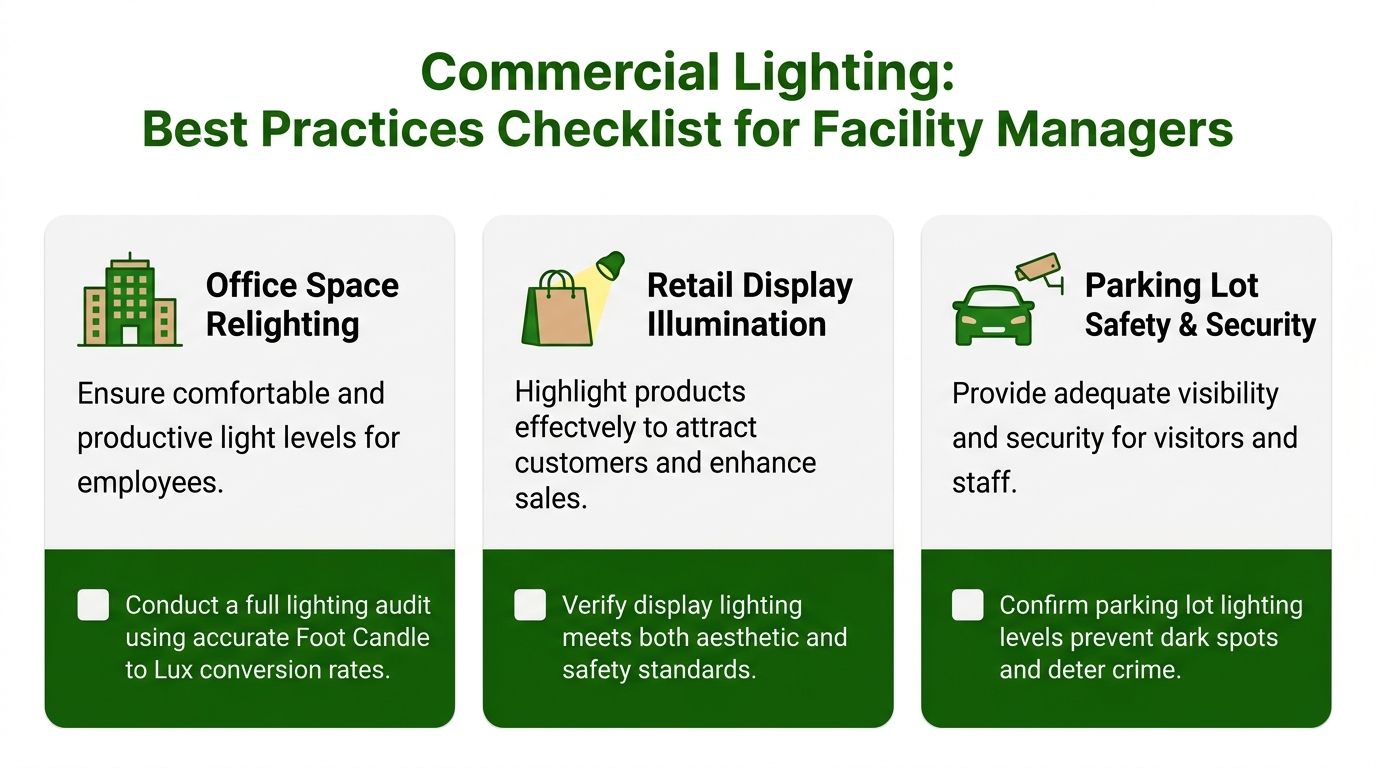
A tenant improvement is ready for final walk-through. The plans call for 30 fc at the work surface, the inspector wants clean documentation, and the owner does not want to hear that a simple conversion mistake now means fixture changes after the ceiling is finished. That is why this section matters. In commercial buildings, a bad foot-candle-to-lux conversion can turn into a compliance problem, a budget hit, or an avoidable liability issue.
Open office tenant improvement
An office lighting schedule may call for 30 fc at the task plane. That converts to 322.92 lux. On paper, that part is easy.
The expensive mistakes show up in the field. If the reading is taken at the floor instead of the 30-inch task plane, the result does not reflect how the space is used. As noted in FSG's foot candle measurement guidance, measurement location has to match the intended work surface.
What I look for in offices:
- Read at the actual task height: Desks, counters, and collaboration tables matter more than the finished floor.
- Sample more than one zone: Perimeter offices, open workstations, and conference rooms rarely perform the same.
- Check after fixture substitutions: A different lens, driver, or fixture spacing can push a design from acceptable to marginal.
That matters for more than comfort. If a project is being documented for Title 24 acceptance or owner records, a bad reading method weakens the whole file.
Retail floor and display areas
Retail spaces create a different problem. The store can look bright to a customer and still miss the lighting target where merchandise needs it.
A display area target of 20 fc converts to 215.28 lux. The question is whether that light is landing evenly on shelves, racks, and faces of product, or whether the reading only looks good directly under accent heads.
Three field checks usually sort this out:
- Measure the right plane: Retail often needs vertical as well as horizontal readings.
- Verify aiming after install: A well-specified fixture can still miss the target if the head is pointed wrong.
- Account for finishes: Dark flooring, black shelving, and matte displays absorb light differently than light-colored surfaces.
Retail owners feel the cost of over-lighting fast. Extra fixtures and higher wattage add up, especially across multiple tenant spaces.
Parking structures and exterior circulation
Parking decks and exterior paths are where liability concerns get real. Average light level matters, but dark transitions, perimeter dead spots, and poor uniformity create the complaints and claims.
If a parking area reads 5 fc, that converts to 53.82 lux. That number by itself does not tell you enough. A single reading near the center can miss the low spots that affect visibility at ramps, stair doors, and vehicle-pedestrian crossings.
Use a grid and document the points. In garages, I care less about one flattering reading and more about whether the full pattern supports safe movement through the space. That is the kind of detail owners need when they are defending maintenance decisions, handling incident questions, or trying to stay aligned with local code expectations.
Fixture selection also matters in large utility spaces with higher mounting heights. The layout principles used in LED high bay warehouse lighting apply here too. Distribution, spacing, and mounting height affect usable light on the surface far more than catalog lumen output alone.
Field habits that reduce callbacks
A few practices consistently save rework:
- Use a measurement grid: One spot check does not represent the room.
- Use a meter suited to the light source: LED readings can vary with poor-quality meters.
- Record the conditions: Height, location, date, and operating conditions should go in the report.
- Separate illuminance from lamp or fixture output: Foot candles and lux describe light arriving at a surface, not total emitted lumens.
- Recheck after changes: Value engineering, fixture swaps, and dimming adjustments can change the final numbers enough to matter.
Good lighting documentation protects the owner twice. It helps avoid paying for unnecessary fixes, and it gives you a stronger record if a code reviewer, tenant, or attorney ever asks how the lighting was verified.
Frequently Asked Questions About Lighting Measurement
Is lux the same as lumens
No. Lux and foot candles measure light falling on a surface. Lumens measure total light emitted from a source. Mixing those terms is one of the fastest ways to make a lighting proposal confusing.
A fixture can produce a certain lumen output, but the actual lux or foot candle level at the work surface depends on layout, mounting height, aiming, and the room itself.
Can I use a phone app to measure lighting
For casual checks, a phone app can help you spot obvious differences between bright and dim areas. It isn't the right tool for professional verification, compliance documentation, or final acceptance.
If the reading will affect a sign-off decision, use a proper light meter and follow a repeatable measurement method.
Why does a space still feel dark when the reading looks acceptable
Measured illuminance is only part of what people notice. Surface colors, wall reflectance, shadows, glare, fixture distribution, and contrast all change how a space feels.
That's one reason parking areas, lobbies, and retail spaces should never be judged by a single number alone.
Where should parking lot and site lighting questions start
If you're evaluating outdoor visibility, security, or fixture replacement planning, start with commercial parking lot lighting fixtures for property safety and coverage. It helps frame the fixture side of the decision before you get into final measurements.
What's the safest rule to remember
Use 10.764 when you convert foot candles to lux for any real project record. Use the rounded shortcut only for rough conversations, never for final documentation.
If you're managing a commercial property in Southern California and need help with lighting audits, Title 24 documentation, emergency lighting, parking structure lighting, or fixture upgrades, Access Electrical and Lighting handles commercial electrical and lighting work across office, retail, multifamily, and site applications.