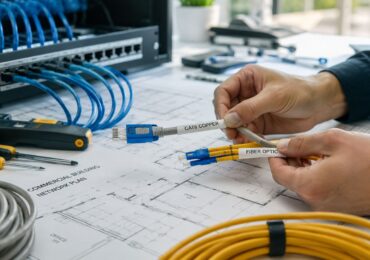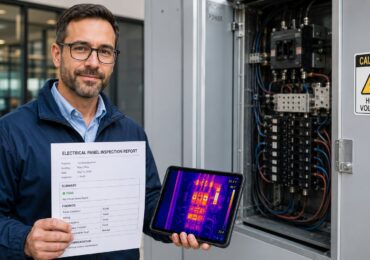
Electrical faults are a primary cause of fires and workplace injuries, and in the U.S. 74% of workplace electrical fatalities occur in non-electrical workers, averaging 150 deaths annually according to Meteor Electrical's electrical safety statistics summary. That should change how commercial property managers think about an electrical safety inspection.
This isn't a box-checking exercise for the maintenance file. It's a risk-control process for buildings where tenants, staff, vendors, and visitors rely on electrical systems every hour of the day. When power distribution is neglected, the problem usually stays hidden until it turns into heat, nuisance tripping, equipment damage, a dark parking lot, or an after-hours outage.
In commercial and multifamily properties, blind spots are rarely the obvious ones. The two that matter most today are hidden thermal issues inside energized equipment and EV charging infrastructure that was added without a full compliance and load review. A proper inspection addresses both before they become emergencies.
What Is a Commercial Electrical Safety Inspection
A commercial electrical safety inspection is a structured evaluation of a building's electrical system for safety, code compliance, and operating reliability. It goes far beyond looking at outlets or replacing a few breakers.
In a commercial setting, the inspection starts at the service entrance and follows the system through switchgear, distribution panels, feeders, branch circuits, disconnects, lighting, emergency systems, grounding, and connected equipment. The point is to verify that the system is installed correctly, carrying load safely, and showing no signs of conditions that could lead to shock, fire, or failure.
A residential-style checklist usually focuses on visible hazards. Commercial work doesn't stop there. The electrical system supports business operations, life safety equipment, site lighting, tenant improvements, HVAC, elevators, access control, and more. If one weak point fails upstream, the impact spreads fast.
What makes it different from a basic check
A basic check asks, “Does this device work?”
A commercial inspection asks more important questions:
- Is the equipment properly protected: Are breakers, conductors, disconnects, and terminations matched to the load and application?
- Is there evidence of stress: Heat, corrosion, contamination, loose terminations, moisture intrusion, damaged insulation, and overloaded circuits all matter.
- Can the property defend its condition: A documented inspection record helps show that management took reasonable steps to identify and correct hazards.
Practical rule: If the only inspection you're getting is visual, you're only seeing part of the risk.
The goal isn't to make a building look tidy. The goal is to identify unsafe conditions early enough that repairs can be planned instead of forced by an outage, an incident, or a failed inspection.
Why Inspections Are Non-Negotiable for Property Managers
Property managers usually come to this issue from one of three directions. Something failed. An insurer, owner, or tenant wants documentation. Or a new project, often EV charging, changed the building load and exposed weaknesses that had been dormant for years.
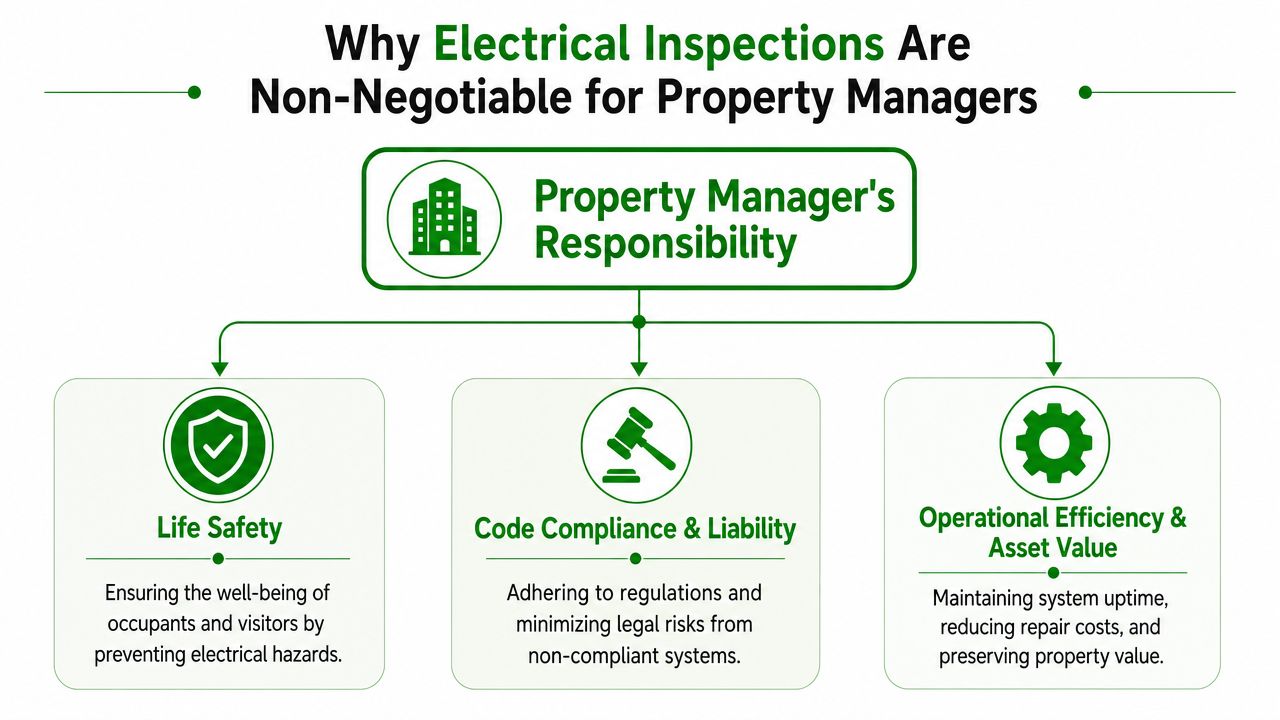
Life safety comes first
Property managers aren't just maintaining equipment. They're controlling hazards for people who often have no idea the hazard exists. Electrical incidents don't only affect electricians. Office staff, janitorial crews, leasing teams, delivery drivers, residents, and vendors all interact with powered systems every day.
That matters most in common areas and shared infrastructure. A compromised panel, a bad connection in site lighting, or a failing emergency circuit doesn't stay isolated for long. It shows up when occupants need the system to work.
Compliance and liability are no longer simple
Compliance used to mean making sure panels were labeled and obvious violations were corrected. That's no longer enough in many commercial properties, especially in Southern California, where energy rules, retrofit work, and EV charging projects overlap.
A major pressure point is EV infrastructure. A 2025 industry analysis found that 32% of new commercial electrical inspections fail due to EV charger installation errors, particularly improper load calculations and missing GFCI protection according to Grounded Electric's discussion of EV-related inspection failures. For property managers, that means an EV project can expose older capacity issues, grounding problems, and documentation gaps that weren't part of the original scope.
Common failure points include:
- Load assumptions that don't match real conditions: Added chargers can push existing distribution equipment into a range it wasn't designed to support comfortably.
- Protection requirements that get missed: GFCI, grounding, and disconnect details can turn into inspection failures late in the project.
- Coordination problems between trades: The charger may be installed, but panel capacity, labeling, and supporting documentation may still be incomplete.
The expensive part usually isn't the correction itself. It's the delay, the reinspection, and the disruption to tenants or opening schedules.
Reliability protects operations and asset value
A property manager's electrical program should reduce surprises. That means fewer nuisance trips, fewer after-hours calls, and fewer situations where one overheated connection takes out a tenant space or darkens a parking area.
Inspections also help with budgeting. Instead of reacting to whatever fails next, you get a prioritized repair list. Some findings need immediate correction. Others can be bundled into planned maintenance, panel upgrades, tenant improvement work, or a lighting retrofit cycle.
The business case is simple. When electrical systems are inspected regularly, management gets better control of risk, scheduling, and documentation. Those three things are what owners, insurers, and tenants usually care about most.
What a Thorough Electrical Inspection Actually Covers
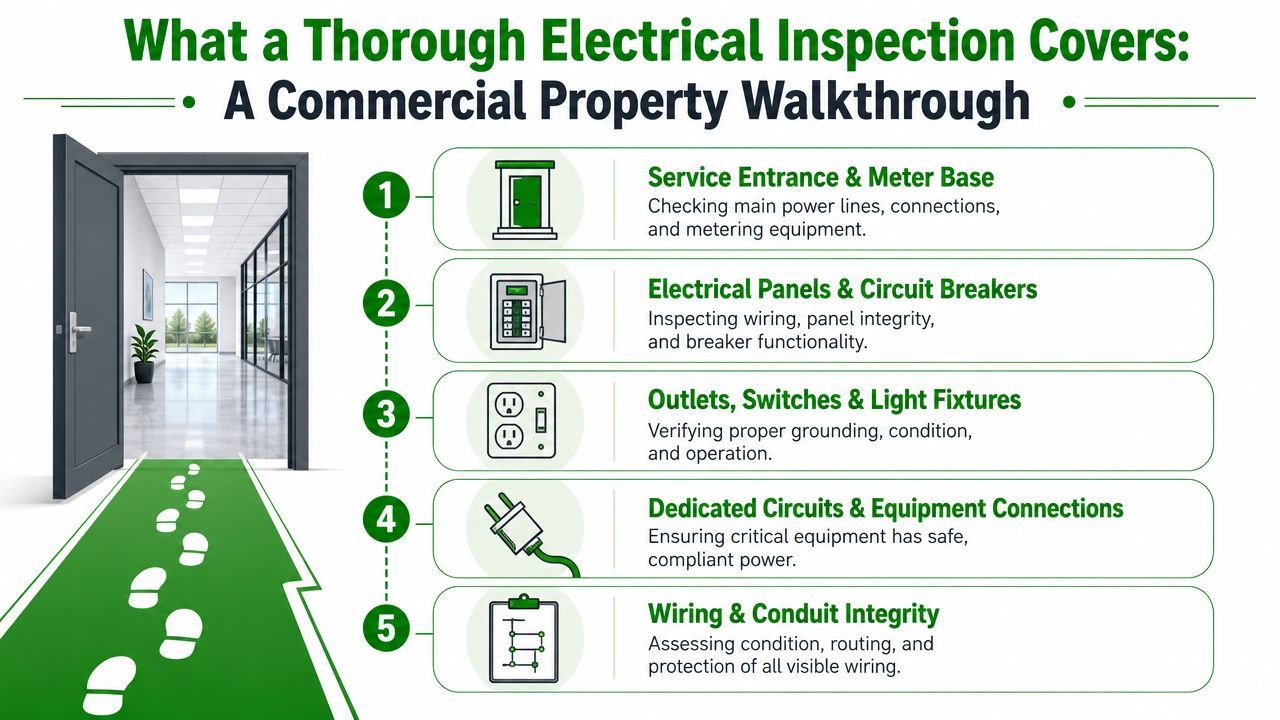
A real commercial inspection follows the power path. It starts where utility power enters the property and moves downstream through each distribution point until the electrician reaches the final connected loads.
Service equipment and main distribution
The first stop is the service entrance, meter section, and main switchgear or service equipment, where an electrician looks for signs of overheating, corrosion, moisture intrusion, damaged enclosures, loose lugs, missing blanks, compromised dead fronts, and labeling issues.
This part matters because upstream defects have the widest blast radius. A problem at the service or main distribution level can affect multiple tenants, life safety systems, or the whole property.
The inspection also checks whether the equipment condition matches how the building is being used now. Many commercial properties have changed loads over time through remodels, added HVAC, signage changes, and EV charging work. The equipment may still function, but that doesn't mean it's operating with healthy margin.
Panels, feeders, and branch circuits
From the main gear, the walkthrough moves to subpanels, tenant panels, distribution sections, and the feeders that connect them. Here the electrician checks breaker condition, panel organization, conductor terminations, circuit identification, fill issues, physical damage, and evidence of overloading.
A few examples of what matters in the field:
- Breaker mismatch: An incorrectly sized breaker can fail to protect conductors properly.
- Double-lugged or loose terminations: These often create resistance and heat.
- Panel crowding after tenant improvements: This can make future service riskier and troubleshooting slower.
- Unclear circuit directories: During an outage or emergency shutoff, bad labeling wastes valuable time.
For facilities that want a deeper look at hidden heat issues, infrared electrical testing for energized equipment helps identify developing trouble that won't show up on a visual pass.
If a panel only gets opened after something trips, management is already late. The safest repairs are the ones scheduled before failure.
Devices, equipment connections, and support systems
The last part of the walkthrough covers the field devices and connected systems people interact with every day. That includes receptacles, switches, lighting, disconnects, dedicated equipment circuits, exposed wiring methods, and visible conduit runs.
The electrician is looking for conditions such as:
| Area | What gets checked | Why it matters |
|---|---|---|
| Receptacles and switches | Damage, looseness, grounding, wear | Prevents shock exposure and unreliable operation |
| Lighting circuits | Fixture condition, controls, switching, branch protection | Reduces nuisance outages and unsafe dark areas |
| Dedicated equipment feeds | Proper disconnects, conductor condition, terminations | Protects connected equipment and serviceability |
| Grounding and bonding | Continuity, integrity, visible defects | Helps fault current clear correctly during a problem |
| Visible wiring methods | Support, protection, physical damage, unauthorized modifications | Prevents insulation damage and code violations |
In multifamily and commercial properties, this is also where years of small untracked changes show up. Temporary fixes, abandoned conductors, undocumented additions, and damaged devices often tell the true story of how the system has been managed.
A thorough inspection doesn't just note these conditions. It ties each one to a practical risk so the property manager can decide what to fix now, what to schedule, and what to monitor.
Understanding Your Electrical Inspection Report
A good inspection report should make decisions easier. If it only dumps photos and technical notes into a PDF, it hasn't done its job.
What property managers need is a report that separates urgent hazards, near-term corrective work, and longer-range upgrade recommendations. The cleanest way to read it is through a simple framework: finding, meaning, and action.
How to read common findings
Finding: Thermal anomaly at a breaker or lug.
Meaning: The connection is likely loose, overloaded, or deteriorating. Even when the circuit is still operating, increased heat is a warning that failure may be developing inside the equipment.
Action: Schedule corrective service to de-energize the affected equipment, inspect the termination, verify loading, and repair or replace components as needed.
Finding: Repeated evidence of low voltage at distant loads or poor equipment performance.
Meaning: The issue may involve conductor sizing, load distribution, connection quality, or excessive circuit length. In practical terms, the system may be suffering from voltage drop in electrical distribution, which can affect motors, lighting performance, and electronics.
Action: Have the electrician test under load and recommend whether the fix is re-termination, redistribution, conductor upgrade, or circuit redesign.
Finding: Missing panel identification or unclear circuit directories.
Meaning: The equipment might operate normally day to day, but emergency response, lockout planning, and troubleshooting become slower and riskier.
Action: Update directories and field labeling so staff and service vendors can isolate circuits safely.
How to prioritize the report
Not every item belongs in the same bucket. Good reports usually sort out naturally into three classes:
- Immediate correction items: Active overheating, damaged conductors, exposed energized parts, failed protective devices, or conditions that present direct shock or fire risk.
- Planned maintenance items: Worn devices, aging breakers, deteriorated enclosures, lighting circuit issues, and other problems that aren't safe to ignore but can usually be scheduled.
- Capital planning items: Capacity constraints, obsolete gear, panel replacement, EV-related service upgrades, or broader distribution changes.
Field advice: If a report doesn't tell you what needs same-day action versus what can wait for the next maintenance window, ask for a clearer corrective priority list.
What a useful report should include
The best inspection reports give property managers enough context to act without turning them into electricians. Look for:
- Clear location references: Building, panel, circuit, room, or equipment ID.
- Photos tied to findings: Not generic pictures, but images that support a specific correction.
- Plain-language recommendations: What failed, why it matters, and what kind of work should happen next.
- Documentation value: Something you can file for owners, insurers, and future service history.
That report becomes more valuable over time. One report shows today's condition. A series of reports shows whether the property is improving, drifting, or repeatedly deferring the same risks.
Beyond the Visual Check Advanced Diagnostic Services
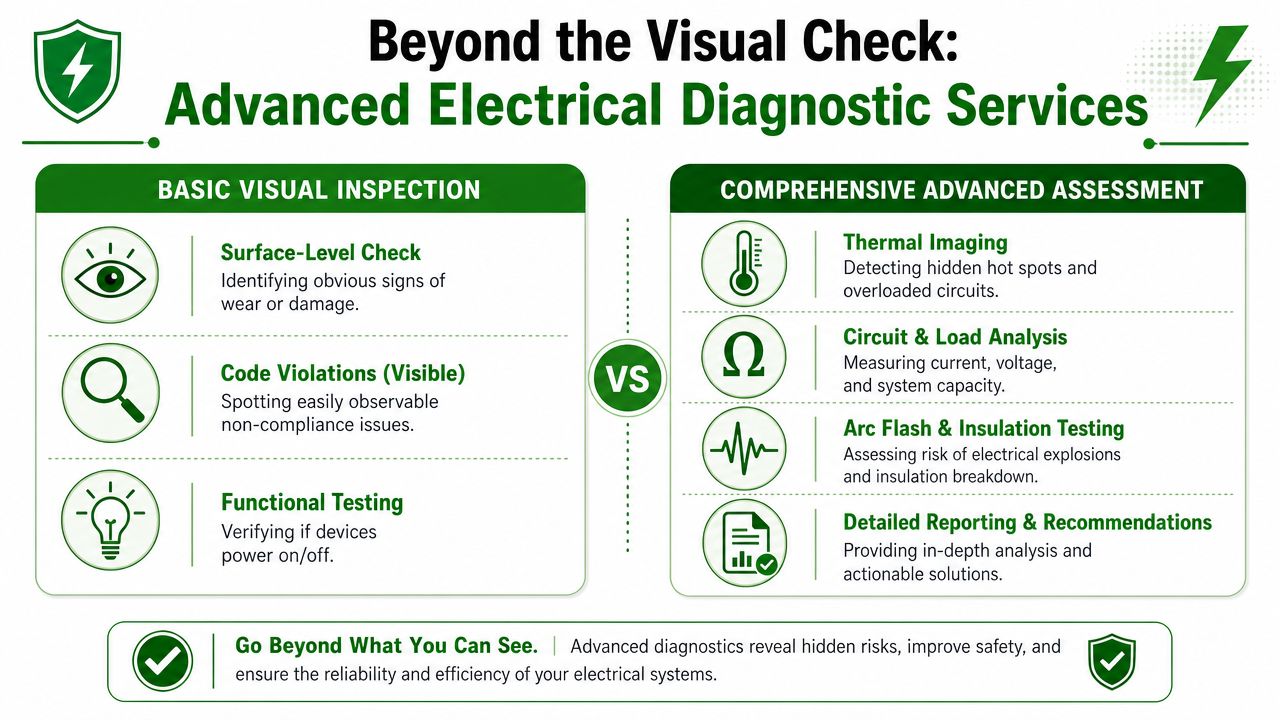
A visual inspection has limits. It can catch damage you can see, missing covers, corrosion, poor labeling, and obvious code issues. It can't see heat building inside a connection that still looks normal from the outside.
Why infrared testing changes the outcome
That hidden-heat issue is the biggest blind spot in many commercial maintenance programs. Industry data shows that over 50% of electrical fires originate from undetected hotspots in distribution equipment that visual inspections miss entirely according to Hastings Utilities on why infrared thermography matters in inspections.
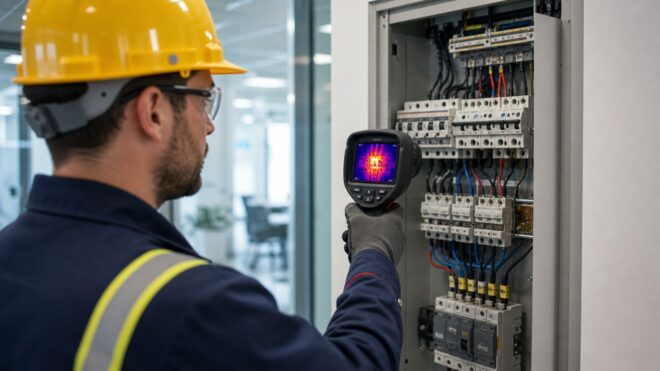
Infrared thermography fills that gap. With the equipment energized and under load, the camera identifies abnormal heat patterns in breakers, lugs, bus connections, contactors, disconnects, and other components. A hotspot often appears long before a device fails outright.
That matters because hidden heating tends to create the worst kind of maintenance event. The system looks fine until it doesn't.
Basic check versus diagnostic assessment
Here's the practical difference:
- A visual inspection finds what's already obvious.
- A diagnostic inspection finds what's developing.
- A documented thermographic scan helps management repair the issue during a controlled maintenance window instead of during a tenant outage.
In Southern California, one option property managers use is Access Electrical and Lighting, which provides infrared electrical inspections with documented reports for commercial properties. That kind of service is most useful when the contractor can connect the thermal image to a specific corrective action instead of only handing over pictures.
“If you only inspect what you can already see, you'll miss the faults that cause the hardest outages.”
Other advanced services that matter on commercial sites
Commercial properties also have assets that don't fit into a basic panel-and-device checklist.
Some examples include:
- Emergency lighting and exit sign testing: These systems matter when normal power fails, not when everything is calm.
- Light pole and high-reach asset inspection: Parking lot poles, high-mounted fixtures, and structure-mounted lighting need specialized access and condition checks.
- Load review for modified systems: Particularly important after tenant improvements, equipment additions, or EV charger installation.
- Targeted troubleshooting under operating conditions: Some faults only show up when the building is occupied and the system is carrying real load.
The common thread is simple. Advanced diagnostics aren't upsells when they address a failure mode the eye can't detect. They're part of responsible preventive maintenance.
Inspection Frequency Costs and Finding the Right Partner
For most commercial properties, the right question isn't whether to inspect. It's how often, how thoroughly, and with which contractor.
How often inspections should happen
NFPA 70B recommends annual inspections for commercial settings, and the Energy Department data cited by Team UIS says properly maintained systems experience 40% fewer unplanned outages and 35% lower fire incidence rates in this review of inspection frequency and maintenance outcomes. That's the clearest argument for treating inspections as a scheduled operating discipline rather than an occasional reaction.
Not every building needs the same scope each time. A newer office building with stable loads may focus on routine annual inspection and targeted thermal scanning. An older retail center with service additions, parking lot lighting issues, and EV charger work may need a more aggressive maintenance plan.
A practical schedule usually depends on:
- Building use: High-occupancy and business-critical sites justify tighter oversight.
- Equipment condition: Older or stressed gear deserves more attention.
- Load changes: Remodels, tenant turnover, and added charging infrastructure change the risk profile.
- Operating environment: Moisture, heat, contamination, and outdoor exposure accelerate deterioration.
How to think about cost
The inspection itself is a controlled cost. Unplanned outage response isn't.
Property managers get better value when the inspection leads directly to prioritization. The useful comparison isn't inspection cost versus doing nothing. It's inspection cost versus emergency labor, tenant disruption, dark common areas, failed compliance reviews, damaged equipment, and deferred issues that become larger repairs.
How to vet the contractor
The contractor matters as much as the checklist. Use a simple screen before you hand over a live commercial system.
- License and insurance: In California, confirm the contractor holds the proper C-10 license and appropriate coverage for commercial work.
- Commercial experience: Ask whether they regularly inspect office, retail, multifamily, and common-area distribution systems, not just homes.
- Infrared capability: If they don't offer thermography, they're leaving out a major failure-detection tool.
- Reporting quality: Ask to see a sample report. It should include findings, photos, locations, and corrective priorities.
- Related compliance knowledge: If the property includes lighting controls, emergency systems, or EV infrastructure, the contractor should understand how those systems affect inspection scope.
Property teams that are comparing vendors can use a broader commercial electrical contractor selection checklist for Orange County properties to screen qualifications before awarding the work.
Turning Electrical Inspections into a Strategic Asset
The strongest property operations teams don't treat an electrical safety inspection as a one-time event. They use it as a decision tool.
That shift matters. A scheduled inspection program helps management catch thermal issues before they create outages, document due diligence before a claim arises, and evaluate whether EV charging additions or tenant improvements are pushing the system past where it should be. It also creates a repair roadmap instead of a series of emergencies.
When inspections are handled that way, they support more than compliance. They protect tenant experience, nighttime safety, maintenance planning, and asset value. They also give owners a clearer picture of where capital spending is needed.
The properties that avoid electrical surprises usually aren't lucky. They're documented, tested, and maintained with discipline.
If you manage a commercial or multifamily property, the practical move is to review your last inspection record, identify whether infrared testing was included, and check whether recent electrical additions, especially EV charging, changed the building's load or compliance exposure. If you can't answer those questions confidently, the inspection program probably needs work.
Access Electrical and Lighting serves commercial, retail, office, and multifamily properties across Southern California with services that include electrical distribution work, infrared inspections, emergency lighting and exit sign testing, EV charging installation, Title 24 support, and high-reach lighting and pole work. If your property needs a documented electrical safety inspection that addresses both hidden thermal risk and real-world compliance issues, you can review their commercial services at Access Electrical and Lighting.