
You're staring at another building issue that can't wait until Monday. A parking structure is half dark, a panel room smells warm, or the fire marshal is due and the exit lights are acting up again. At that point, the question isn't whether you need a contractor. The question is whether you need someone who can keep a commercial property running, document the work properly, and come back when the next problem shows up.
A commercial electrical contractor is not just a wire-puller with a truck. In a live property, that contractor becomes part of your operations rhythm, handling power distribution, lighting, life-safety systems, diagnostics, and after-hours failures without turning every visit into a new learning curve. For property managers, facility teams, and owners in Southern California, that distinction matters because uptime, inspection readiness, and recurring maintenance are where the money leaks first.
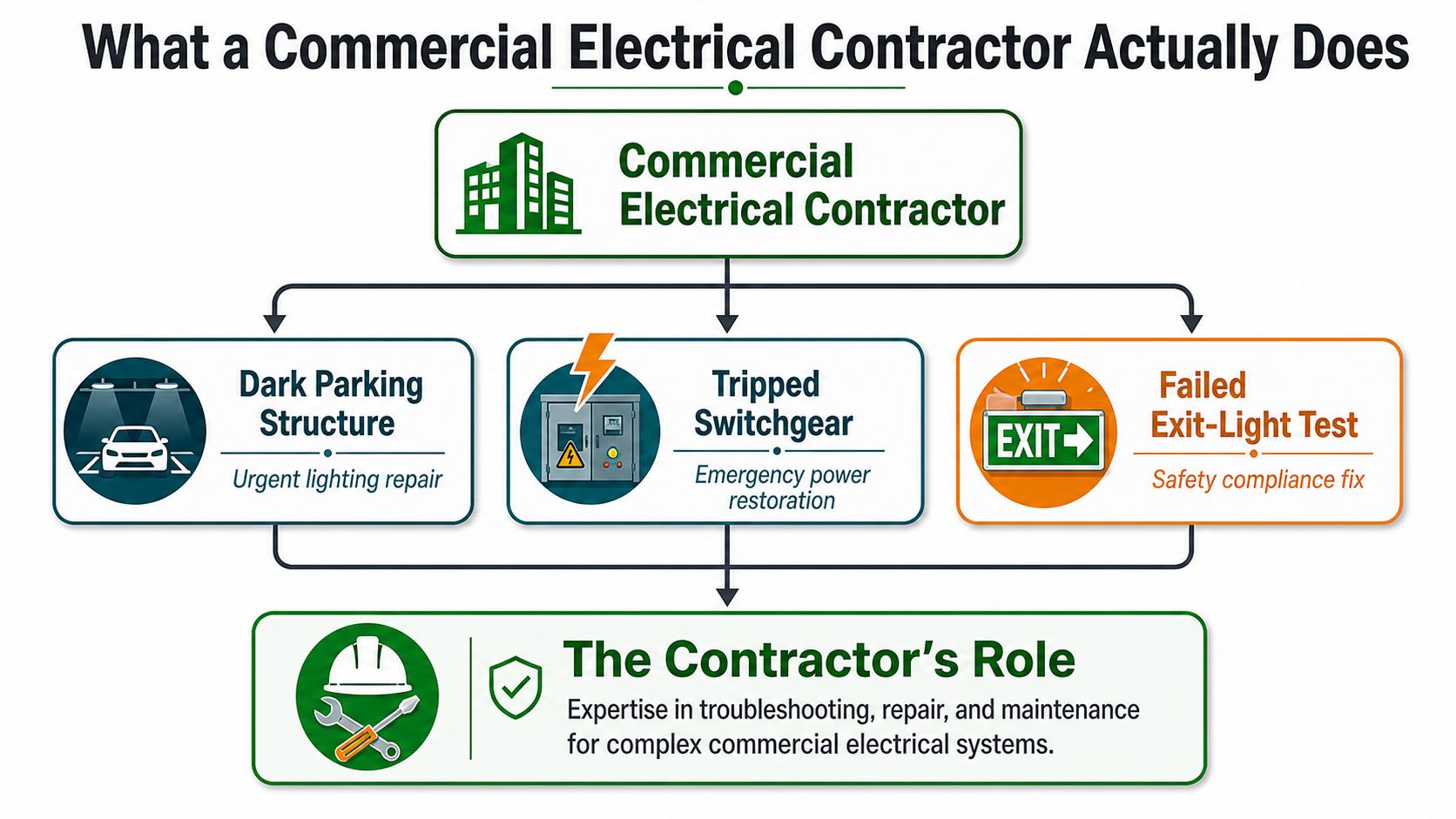
What a Commercial Electrical Contractor Actually Does
A dark parking structure at 9 p.m. tells you more than any sales pitch ever will. Tenants notice the lighting failure immediately, security sees the blind spot, and your maintenance team gets the call because nobody wants a half-lit garage with a broken fixture somewhere over the drive lane. That's the kind of moment where a commercial electrical contractor earns the relationship, not the bid.
The work is operational, not cosmetic
Commercial electrical work sits inside NAICS 238210, the electrical contracting trade, and it covers more than installs. In practice, the contractor handles lighting, power distribution, maintenance, troubleshooting, and inspection readiness for facilities that can't afford to guess when something fails. The U.S. electrical contracting industry generated about $225.1 billion in 2023, and commercial work makes up roughly 38% to 40% of that revenue, which is why this is a core facilities function, not a side trade. The scale is documented in the industry summary from electrical contractor statistics.
A competent contractor is the person you call for a tripped main, a failed exit-light test, or a bad circuit hiding behind a tenant complaint. They also deal with recurring maintenance, because the primary work in occupied buildings is keeping systems stable, not just installing them once.
What separates commercial from residential
Commercial properties run on more complex systems. You're dealing with three-phase distribution, higher loads, code documentation, and work that often has to be done without shutting down the building. That means the contractor needs to troubleshoot under pressure, work around occupancy, and leave behind records that stand up to inspection.
Practical rule: if a contractor talks only about installations and never about maintenance, documentation, or after-hours response, they're not really selling commercial service.
The other difference is continuity. A commercial electrical contractor is usually a long-term service partner who comes back for lighting repairs, panel issues, emergency calls, and retrofit work. That's the right model for offices, retail centers, multifamily buildings, and any property where one outage can trigger a chain of complaints.
Core Services Property Managers Should Expect
A good contractor doesn't just “do electrical.” They should be able to tie each service to an asset, a failure point, or a compliance need. If they can't explain what problem a service solves, they're probably selling scope, not reliability.

Lighting, controls, and power distribution
Commercial lighting design and installation matter when a space is being built out or reconfigured. LED retrofits for site lighting, parking lots, and pole lights make sense when older fixtures are failing, maintenance tickets keep piling up, or the property wants fewer lamp changes and better uniformity. Lighting controls matter even more in California because they affect both energy use and documentation.
Switchgear and panel upgrades are the next level up. If a building is tripping breakers, running hot, or expanding service loads for new tenants or EV chargers, the contractor should be able to inspect, replace, or upgrade the distribution equipment. Parking structure lighting, light pole repairs, and high-reach boom truck work belong in the same service family because they all deal with assets at height and site safety.
Life-safety and low-voltage scopes
Emergency lighting, exit signs, and battery backup systems are not optional extras. They need installation, testing, and maintenance, and the contractor should document all of it. Low-voltage work matters too, especially in modern properties where structured cabling, distributed audio, digital signage, video walls, and mass notification systems are tied into the building's daily operation.
A contractor with both line-voltage and low-voltage capability reduces coordination headaches. One team can handle the power side, the control side, and the documentation instead of making you manage three vendors for one failure.
If you're comparing service models, look at the long game. New construction, tenant improvements, and maintenance are often handled by the same firm because accountability is cleaner when one contractor knows the building's history.
Qualifications and Certifications That Actually Matter
Procurement paperwork can hide weak operators behind polished language. The boxes that matter are simple. If they can't answer these clearly, keep looking.
License, bond, and insurance come first
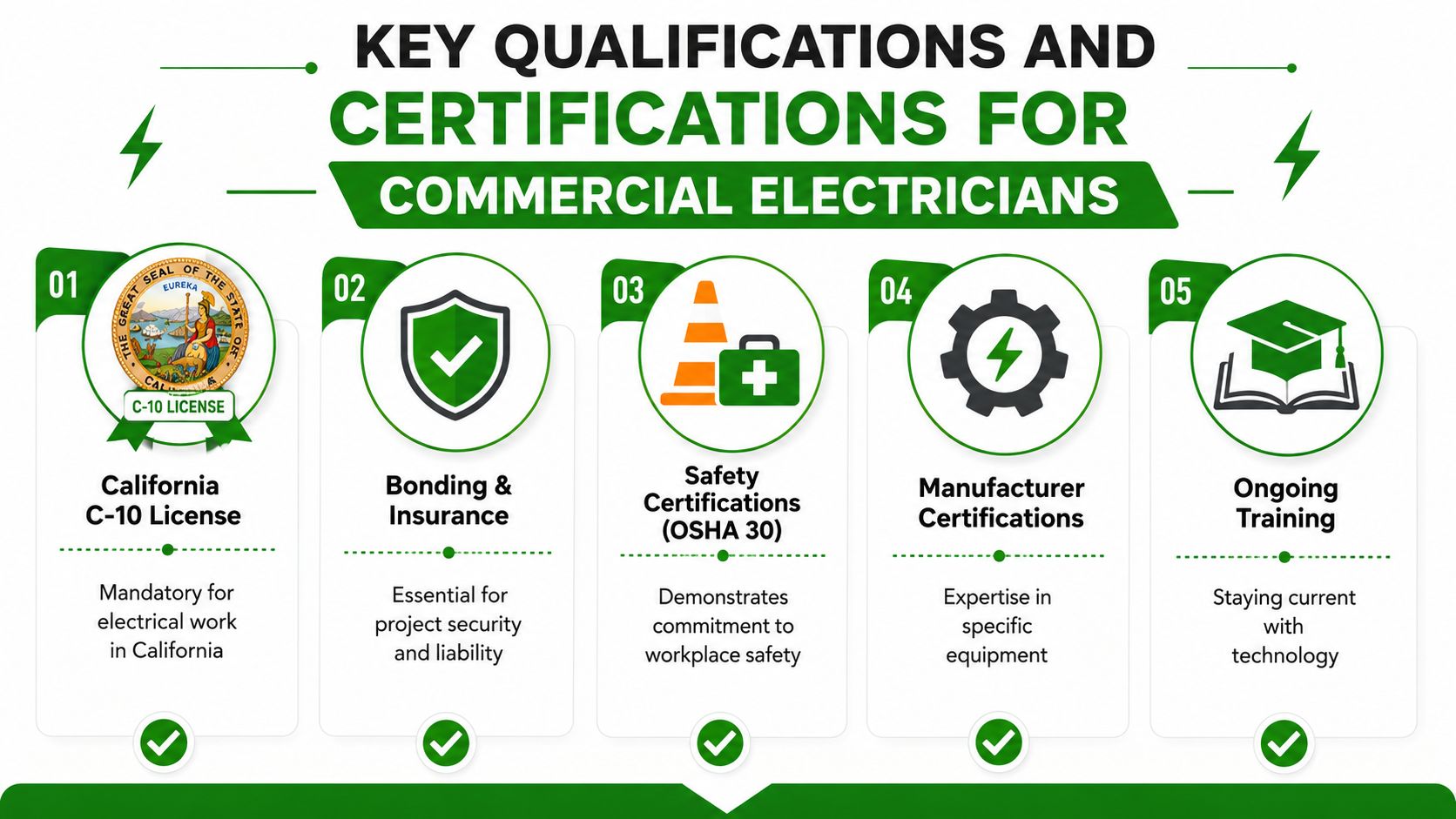
For California work, verify the C-10 electrical contractor license, bond, and insurance before you discuss price. That's not paperwork theater, it's basic protection if the job goes sideways. The contractor should also understand the code environment that governs commercial facilities, including electrical installation standards and the inspection trail expected by authorities. The California code reference on electrical code compliance is the kind of documentation a serious contractor should already know how to work within.
Experience has to match the asset, not just the trade
A crew that does houses well is not automatically a good fit for retail centers, office towers, or multifamily communities. Ask for examples of similar properties, similar equipment, and similar operating constraints. If they say they've done “commercial work” but can't speak clearly about panels, lighting controls, emergency systems, or after-hours access, that's too thin.
Title 24 capability matters for California facilities because the contractor needs to support lighting control testing, certification, and paperwork. Infrared thermography training matters because it helps spot hot connections and overloaded components before they turn into outages. Emergency-lighting inspection capability matters because those systems only prove their value when they're tested, logged, and ready.
A contractor's real value shows up in the report, not just on the wall after the job is done.
Workforce depth is part of the qualification
The trade is labor-heavy, and hiring pressure is real. The U.S. Bureau of Labor Statistics reported 1,045,300 electricians employed across NAICS 238210 in May 2023, with median annual wages reported at $69,290 in that release, then $62,350 in May 2024, alongside a projected 9% employment growth from 2024 to 2034 and about 81,000 openings per year according to workforce research. That matters because scheduling reliability depends on whether a contractor has licensed people available when you need them.
How to Choose the Right Contractor for Your Facility
The cleanest way to choose is to stop treating every bid like it's interchangeable. A low installation number doesn't matter if the contractor misses inspections, takes three days to respond to an outage, or can't produce clean documentation when your insurer asks for it.
Use a pre-hire checklist that reflects operations
Start with the basics. Verify the license, bond, and insurance. Then ask for similar work in your property type, not just similar line items. A retail center, a multifamily common area, and an office building have different access rules, peak-hour constraints, and tenant expectations.
Ask for sample reports too. If they do infrared inspections or Title 24 testing, the documentation should be legible, organized, and easy to hand to a property manager or inspector. If the report looks improvised, the field work probably is too.
Test response claims with real scenarios
Don't ask whether they offer emergency service. Ask what happens if a parking lot goes dark at 8 p.m. on a Friday. Ask who answers, how dispatch works, and how fast they can get a qualified technician on site in your coverage area. In Southern California, that question is more useful than a glossy list of service promises.
You should also ask whether they self-perform both line-voltage and low-voltage scopes. If they don't, you'll spend more time coordinating handoffs. That may be fine for a one-off project, but it's a bad fit for recurring maintenance.
Watch for the weak signals
- Vague scope language: If the proposal says “electrical work” without naming the asset, the method, or the documentation, expect surprises.
- No maintenance thinking: If every conversation starts with install price and ends with install price, they're not operating like a facility partner.
- Thin references: Good references describe response time, communication, and cleanup, not just “the job went well.”
A contractor who understands maintenance will usually be better for occupied buildings than one who only wants the biggest upfront job. That's not theory, that's how facilities stay open.
Cost, Timeline, and Access Considerations
Commercial electrical pricing is driven by more than parts and labor. Scope size matters, but so does access, working height, occupancy, and the amount of documentation you expect at the end. A clean proposal should make those drivers obvious instead of hiding them inside a lump sum.
What usually moves the number
Fixture count drives lighting work. Switchgear size and condition drive upgrade work. Working in an occupied building drives labor planning because crews may only get short access windows. If the job needs boom trucks, night work, escorts, or repeated tenant coordination, the price should reflect that.
The most common mistake is comparing a one-time install quote to a service-agreement model as if they're the same thing. They're not. A recurring agreement spreads inspection, minor repairs, and response planning across the year, which is often the smarter model for portfolios and multi-site owners.
Practical rule: if a quote ignores access constraints, the final invoice usually won't.
A quick sanity-check table
| Service Category | Primary Cost Driver | Typical Scheduling Constraint |
|---|---|---|
| LED retrofit | Fixture count and access to the work area | Occupied-space coordination |
| Panel or switchgear upgrade | Equipment condition and load complexity | Shutdown windows |
| EV charger installation | Electrical capacity and routing | Utility coordination and site access |
| Emergency response | After-hours dispatch and diagnosis | Immediate availability |
Timelines follow the same logic. LED retrofits can be straightforward when access is open, but occupied properties slow everything down. Panel upgrades and EV charger installs need more coordination because power interruptions and equipment clearances matter. Emergency calls are different altogether, because the priority is restoring operations, not building a neat project calendar.
Maintenance Programs and Emergency Response
The contractor relationship becomes useful only when it is built around upkeep, response, and documentation. Once a building is already operating, the ultimate test is simple. Can the contractor reduce surprises, keep records that matter, and get someone to the site when the problem hits after hours?
Preventive maintenance beats repeat failures
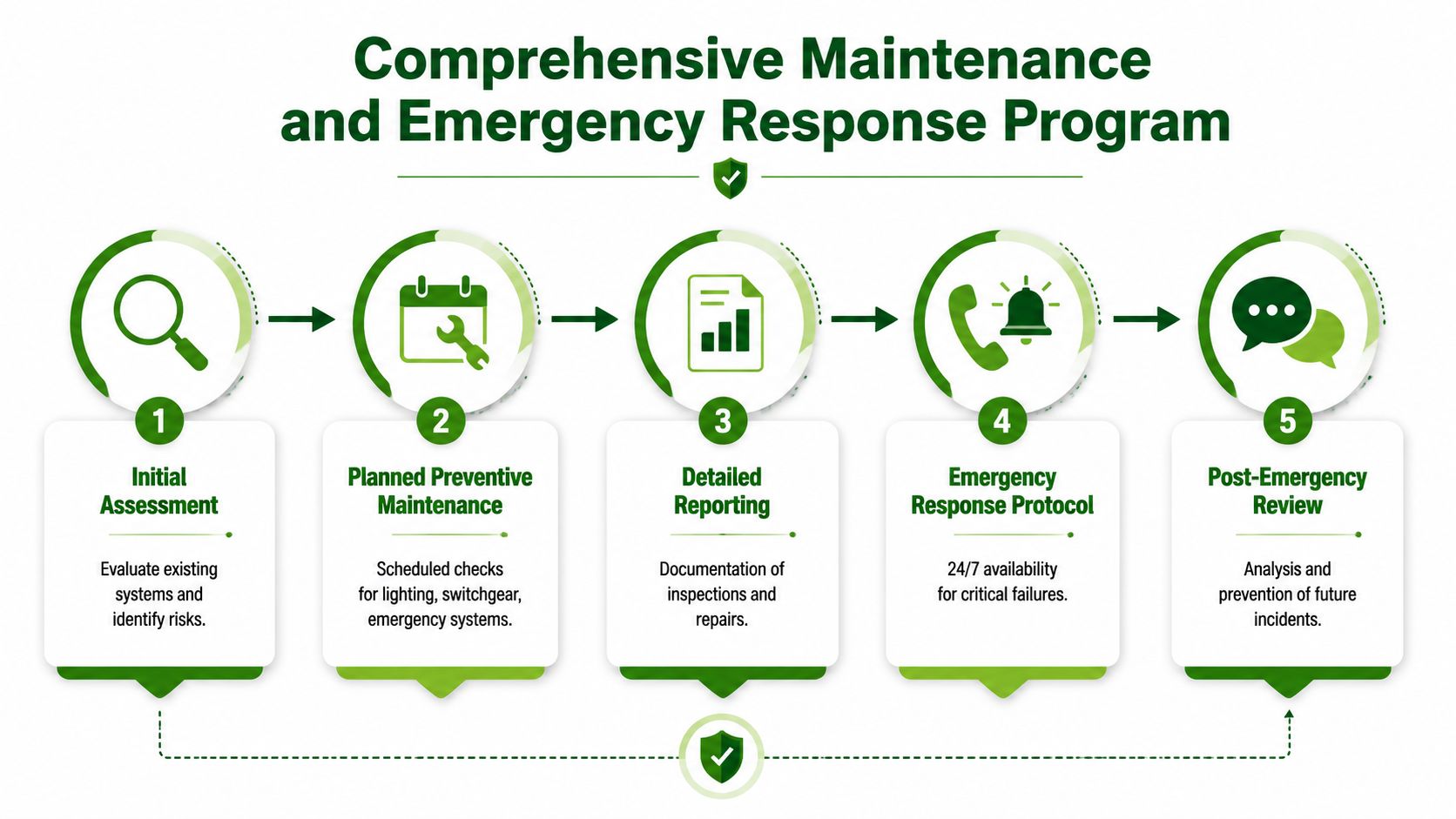
A solid maintenance program starts with inspection, not with a panic call. Lighting circuits, panels, switchgear, and emergency systems need regular attention because loose terminations, thermal stress, and insulation wear rarely announce themselves in dramatic fashion. They show up as nuisance failures, warm equipment, and a growing stack of service calls.
Infrared thermography belongs in that routine because it can reveal hot spots and overloaded connections before they turn into outages. The guidance on preventive electrical service makes the point plainly, periodic inspection and upkeep matter for assemblies, grounding, and emergency systems. For property owners, the value is straightforward. Catch the problem before the outage catches you. If you want a practical example of how ongoing service programs reduce disruption, review how preventative electrical maintenance saves businesses time and money.
Emergency response is a process, not a promise
A contractor that says it offers 24/7 response needs a dispatch path, not a voicemail greeting. Someone has to receive the call, triage the issue, route a technician, and document the repair. If a contractor cannot explain that chain clearly, the emergency service claim is just sales copy.
Maintenance logs and inspection reports matter as much as the repair itself. They help during audits, insurance reviews, and property transactions because they show a pattern of care instead of a pile of excuses. In a larger portfolio, that documentation becomes part of the asset record, and it carries real weight when a building changes hands or a claim gets reviewed.
For teams that want a service partner in Southern California, Access Electrical and Lighting provides installation, maintenance, testing, repair, and infrared diagnostics for commercial, retail, office, and multifamily properties.
Orange County and Southern California Compliance Notes
Southern California properties sit inside a compliance-heavy environment, and the contractor you hire needs to handle that reality without turning every service call into a lecture. Title 24 shapes lighting and controls work in California, so documentation for controls, testing, and certification carries real operational weight, not just paperwork value. If the contractor cannot support that process, the building owner absorbs the delay and the risk.
That matters in ordinary operations. A multifamily community preparing for an audit needs exit lighting, controls, and records that line up. A retail center doing a parking-lot LED retrofit needs the work done in a way that supports compliance and reduces future maintenance churn. An office building with an overheating panel needs a technician who can inspect, document, and correct the issue before it turns into a larger failure.
Regional response also matters. Coverage across Orange County, the Inland Empire, and San Diego affects how fast a contractor can realistically reach a site after hours. The right choice is the firm that knows your jurisdiction, your access rules, and your building type. If you want a tighter checklist for vetting that fit, review choosing the right commercial electrical contractor in Orange County.
Building a Long-Term Relationship With Your Contractor
Choose the contractor like you are choosing a maintenance partner, not a one-time vendor. Verify the license, review the documentation, and weigh emergency response as heavily as install price. If they cannot support your building after the lights are on, they are not the right fit.
A good contractor earns repeat work by keeping your facility steady. That means clear records, fast response when something fails, and technicians who know the difference between a quick patch and a repair that will hold up under daily use. Property managers should expect help with recurring maintenance, outage response, and the paper trail that keeps inspections from becoming a scramble.
Ask how they handle service history. If a breaker keeps tripping, a ballast keeps failing, or an emergency light keeps missing its test, the contractor should track the pattern and fix the cause, not just reset the symptom. That is the kind of discipline that protects operating budgets and keeps tenants from dealing with the same problem twice.
Frequently asked questions
How often should emergency lighting be tested? On a schedule your facility can document and defend, with records that show the system was checked and corrected when needed.
What should you do first after an unexpected outage? Call for diagnosis, secure the affected area, and get the failure documented before you start guessing.
When is an infrared inspection worth it? When you want to find hidden heat issues, reduce unplanned downtime, or verify suspect equipment before it fails.
Access Electrical and Lighting handles commercial lighting, maintenance, testing, repair, Title 24 documentation, and infrared inspections across Southern California. If your building needs a contractor who can stay with the asset after the install, talk through the maintenance, emergency response, or compliance work your property needs next.