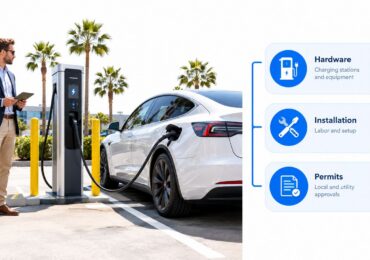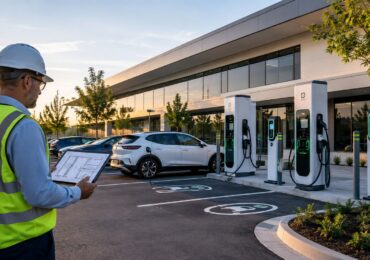
A property manager can install a row of Level 2 chargers, watch them operate normally for weeks, and still get an unpleasant surprise when the first Southern California Edison or San Diego Gas & Electric bill arrives. The energy charge may look manageable, while the demand-charge impact reflects the short period when chargers, HVAC equipment, elevators, and tenant loads all pulled power at once.
That problem isn't solved by buying a “smart” charger and hoping the software handles everything. EV charging load management is a planning discipline that connects electrical capacity, charger behavior, utility rate design, parking patterns, and California code requirements. The right answer may be a managed system, a service upgrade, or a combination of both.
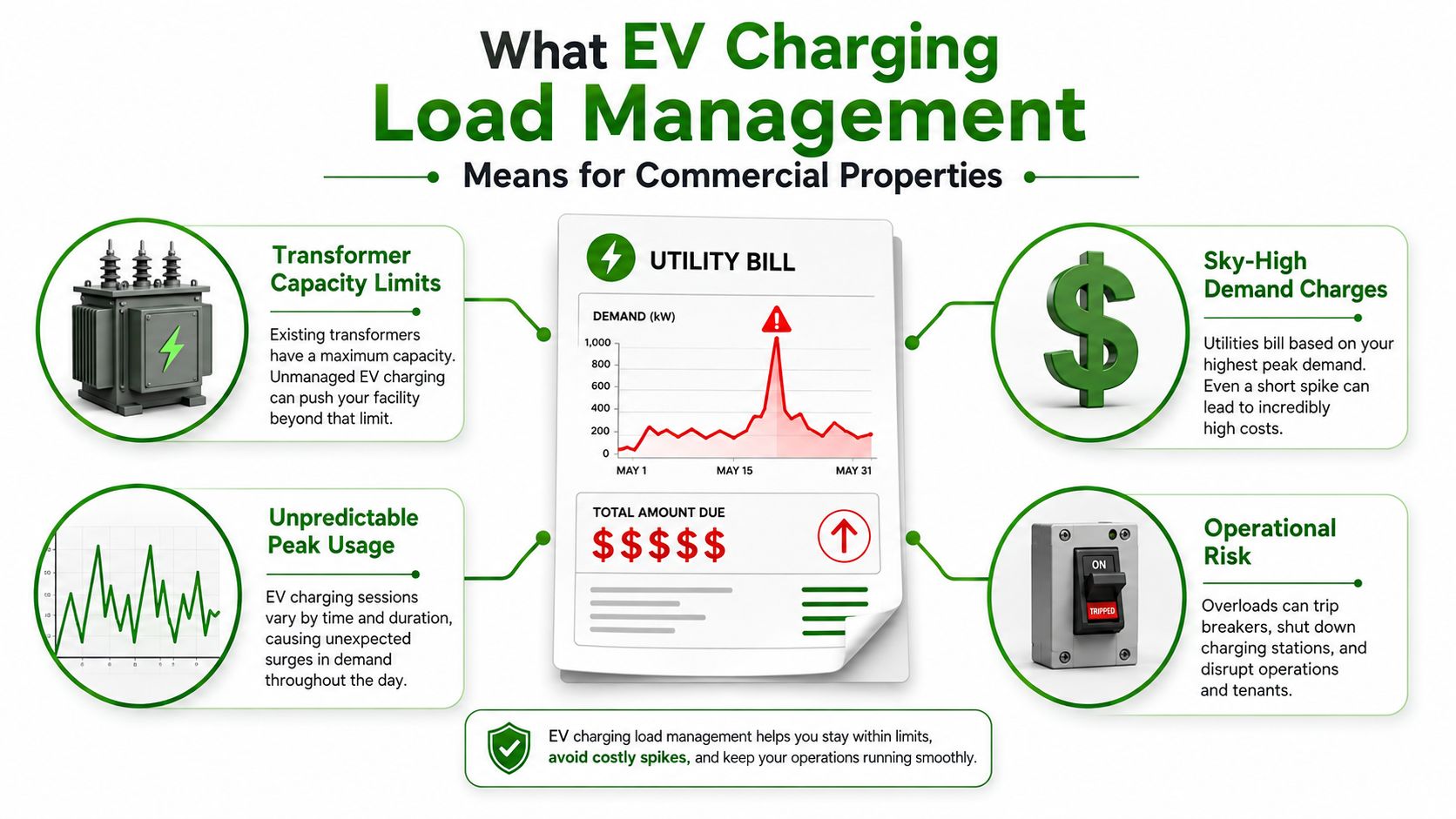
What EV Charging Load Management Means for Commercial Properties
A multifamily garage may have plenty of overnight dwell time, but that doesn't mean every vehicle should charge at full output the moment residents return home. An office property may have the opposite pattern, with many employees arriving during the same period and expecting their vehicles to be ready later in the day. In both cases, the electrical design has to account for the building's existing load, not just the charger nameplate.
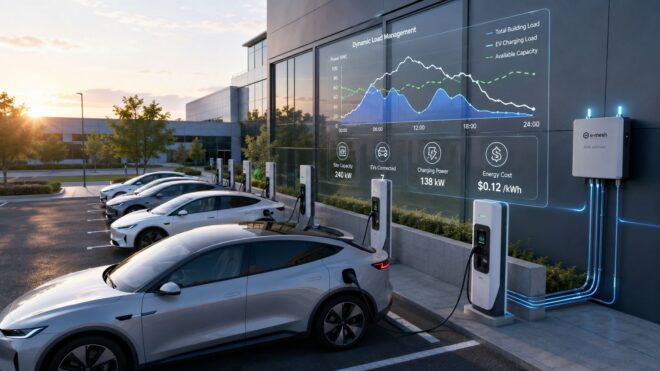
EV charging load management coordinates how, when, and how quickly chargers draw electricity. A site controller can enforce a total power limit, distribute available capacity across active sessions, respond to building demand, or schedule charging during more favorable periods. The controller's job is to keep the site within electrical and operational boundaries while delivering enough energy by the time drivers need to leave.
Why the grid connection changes the conversation
The scale of EV charging is no longer trivial from a planning perspective. The IEA electric vehicle charging and grid integration tool reports that electricity used to charge the global EV fleet reached 55 TWh in 2021, about 0.5% of global electricity consumption. Under announced climate pledges, the IEA projects road-transport electricity demand could reach nearly 4% of power demand by 2030, approximately 20 times the 2021 level.
That growth explains why utilities and facility engineers increasingly care about controllability. A commercial property doesn't need to treat EV charging as a fixed block of demand if it can use real operating data to determine which sessions are flexible and which have hard departure requirements.
Software isn't a substitute for planning
A controller can't create transformer capacity that doesn't exist. It can use spare capacity more intelligently, but the design still needs a load calculation, protective-device coordination, communications plan, and clear operating rules. California projects also need to account for Title 24 and CALGreen requirements, especially where electrical infrastructure, lighting controls, documentation, and future EV readiness affect the permit scope.
Field rule: Specify the building load, EVSE, control hardware, tariff, and driver requirements as one system. Treating them as separate purchases creates avoidable surprises.
Core Concepts Behind Charging Load Management
Start with four terms. They sound similar, but they solve different problems.
Load management controls the combined draw of chargers against a site limit. If the property can safely dedicate only a portion of its available capacity to EV charging at a particular moment, the controller keeps the combined charger load below that boundary.
Demand charges are based on the site's highest measured demand interval under the applicable commercial tariff, not just the total amount of energy consumed. A charger can use a reasonable amount of energy over a billing period and still contribute to an expensive peak if it operates alongside the building's largest loads.
Peak shaving reduces the site's highest demand by limiting or shifting charging during the critical window. It doesn't necessarily reduce the energy required to charge vehicles. Instead, it changes the timing and rate of that energy draw.
Demand response adds an external signal. A utility or program operator may ask the site to reduce charging during a grid event or another defined period. Participation depends on program rules, equipment capability, and the property's willingness to accept temporary charging constraints.
A simple building analogy
Think of a building's electrical service as a shared loading dock. HVAC, elevators, lighting, tenant equipment, and EV chargers all want access. Without coordination, every load can arrive together and create a capacity problem. With load management, the controller gives each load room to operate while preventing the combined demand from exceeding the site's limit.
For a Southern California property, the bill translates these concepts into tariff details. A time-of-use structure affects when energy costs apply, while the demand component reflects how high the site's measured demand rises. A commercial EV rate may treat charging differently from the building's general service, so the tariff must be confirmed before anyone promises savings.
| Term | What It Means | Where It Shows Up on the Bill |
|---|---|---|
| Load management | Coordinates charger output against a site or feeder limit | Influences the demand profile and charging schedule |
| Demand charge | A charge tied to the property's highest measured demand interval | Appears as a demand-related billing line |
| Peak shaving | Keeps charging from adding to the property's highest demand | Can reduce the measured peak used for demand billing |
| Demand response | Temporarily changes charging after an outside grid or program signal | May affect program compensation or event-related charges |
The practical question isn't, “Can the chargers run?” It's, “Can they run at the required times without creating an unacceptable site peak or missed departure?”
Hardware Foundations for a Load-Aware Site
Load management starts with hardware that can measure and enforce limits. A software dashboard can't protect a site if the electrical architecture doesn't provide accurate measurements or if the charger controls can't respond reliably.
Layer one is the service entrance
Begin with the transformer, service rating, main breaker, distribution equipment, and actual base load. HVAC compressors, elevators, refrigeration, pumps, lighting, and tenant equipment may consume the spare capacity that appears available on a one-line diagram. A load study should compare measured operating demand with the proposed EVSE load and identify how much headroom remains during the property's difficult operating periods.
The main panel rating alone isn't enough. A large service can still have limited practical capacity if the building's demand is already high, if a feeder is constrained, or if the proposed EV distribution requires additional equipment.
Layer two is the charging equipment
Level 2 and DC fast charging create very different planning problems. Level 2 equipment usually provides longer dwell-based charging, while DC fast charging can create a much sharper demand profile. Per-port amperage, simultaneous operation, hardwired or plug-in installation, breaker sizing, conductor capacity, and the charger's ability to accept remote power limits all matter.
A charger with a high nameplate rating doesn't have to operate at that output continuously, but the design needs to document the permitted operating range. Equipment that can't accept a reliable control signal limits the value of dynamic management.
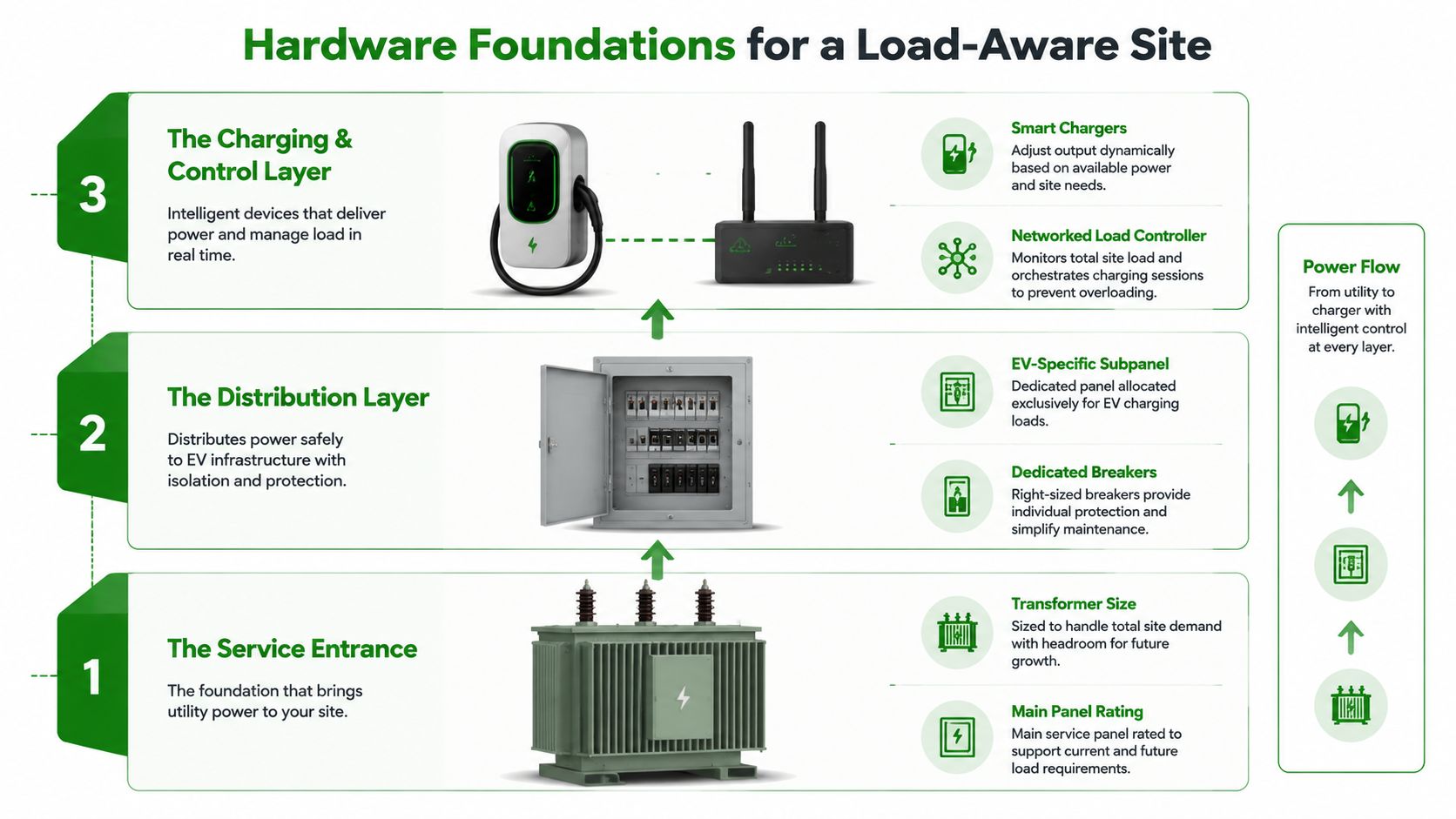
Layer three is the controller and metering
The site controller or energy management gateway measures building demand, communicates with the EVSE, and enforces the selected cap. Some systems use a fixed charger-group limit. Others read the building in real time and adjust charging as HVAC or tenant loads change.
The controller also needs a dependable communications path and a defined fallback mode. If connectivity drops, the site should have a documented behavior that doesn't leave chargers uncontrolled or strand drivers unexpectedly.
For a practical overview of electrical planning considerations, property teams can review commercial EV charger installation requirements. The key lesson is simple: service capacity, EVSE capability, and control hardware must be specified together. Over-specifying chargers against an undersized panel is one of the most common errors in Southern California retrofits.
Software Strategies and Smart Charging Platforms
Commercial sites usually have four software approaches available. The cheapest option isn't automatically the right one, because each strategy assumes a different level of predictability.
Match control sophistication to site behavior
Scheduled charging works when arrival, departure, and tariff periods are stable. An office garage with predictable daytime occupancy and limited overnight use may get enough value from time windows. The weakness appears when a driver needs an unexpected departure or when the building's load changes outside the schedule.
Static load balancing assigns a fixed ceiling to a charger group. It works well for a small retail strip where a known number of ports share one feeder and the building load doesn't vary dramatically. It is straightforward, but it won't respond intelligently when HVAC or tenant demand rises.
Dynamic load management uses live site measurements and a changing cap. This is usually more appropriate for multifamily and mixed-use properties, where resident arrivals, common-area loads, and building demand vary. The controller can reduce charging temporarily, then restore output as capacity returns.
OCPP-backed platforms connect compatible chargers with a charging-management system and, in some designs, a third-party energy management system. They make more sense when an owner needs fleet reporting, multi-site visibility, charger interoperability, or participation in utility and incentive programs. Before selecting one, confirm exactly which functions are included and which require separate subscriptions.
| Strategy | How It Works | Best-Fit Property Type | Watch Out For |
|---|---|---|---|
| Scheduled charging | Starts or limits charging during programmed time windows | Office garages with predictable use | Missed needs when arrival or departure patterns change |
| Static balancing | Holds a charger group below a fixed limit | Small retail strips sharing one feeder | Doesn't see changing building demand |
| Dynamic management | Adjusts charger output using live site measurements | Multifamily and mixed-use properties | Requires accurate metering and reliable communications |
| OCPP-backed platform | Connects compatible chargers to centralized software and energy controls | Fleet or multi-site programs | Network interruptions, vendor lock-in, and per-port fees |
A network failure is more than an IT inconvenience. Some controllers may stop sessions, revert to conservative settings, or fail to apply a new limit. Non-OCPP hardware can also make it difficult to change vendors later.
Property teams comparing installation scope can use commercial EV charging station planning information as one reference point, then ask each vendor to demonstrate offline behavior, exportable data, access controls, and the total recurring cost.
Demand-Charge Mitigation and Peak Shaving Tactics
If a bill already shows a demand spike, start with the interval data rather than guessing. Identify when the peak occurred, what the building was doing, how many vehicles were charging, and whether HVAC, elevators, pumps, or other equipment contributed. A controller should be programmed around the actual site peak, not a generic “overnight is cheaper” assumption.
Use the bill to define the control problem
Time-of-use scheduling can move charging away from expensive periods, but shifting energy isn't the same as reducing the maximum demand. Peak shaving requires a cap that prevents EV charging from pushing the building above a selected ceiling during the relevant demand window.
Managed charging has demonstrated meaningful peak reduction under the right conditions. EnergyHub reports that about 60% of on-peak charging energy can be shifted to off-peak periods, with distribution-asset peak demand falling by as much as 30% compared with unmanaged charging. The result depends on arrival patterns, available dwell time, feeder constraints, and the control strategy.
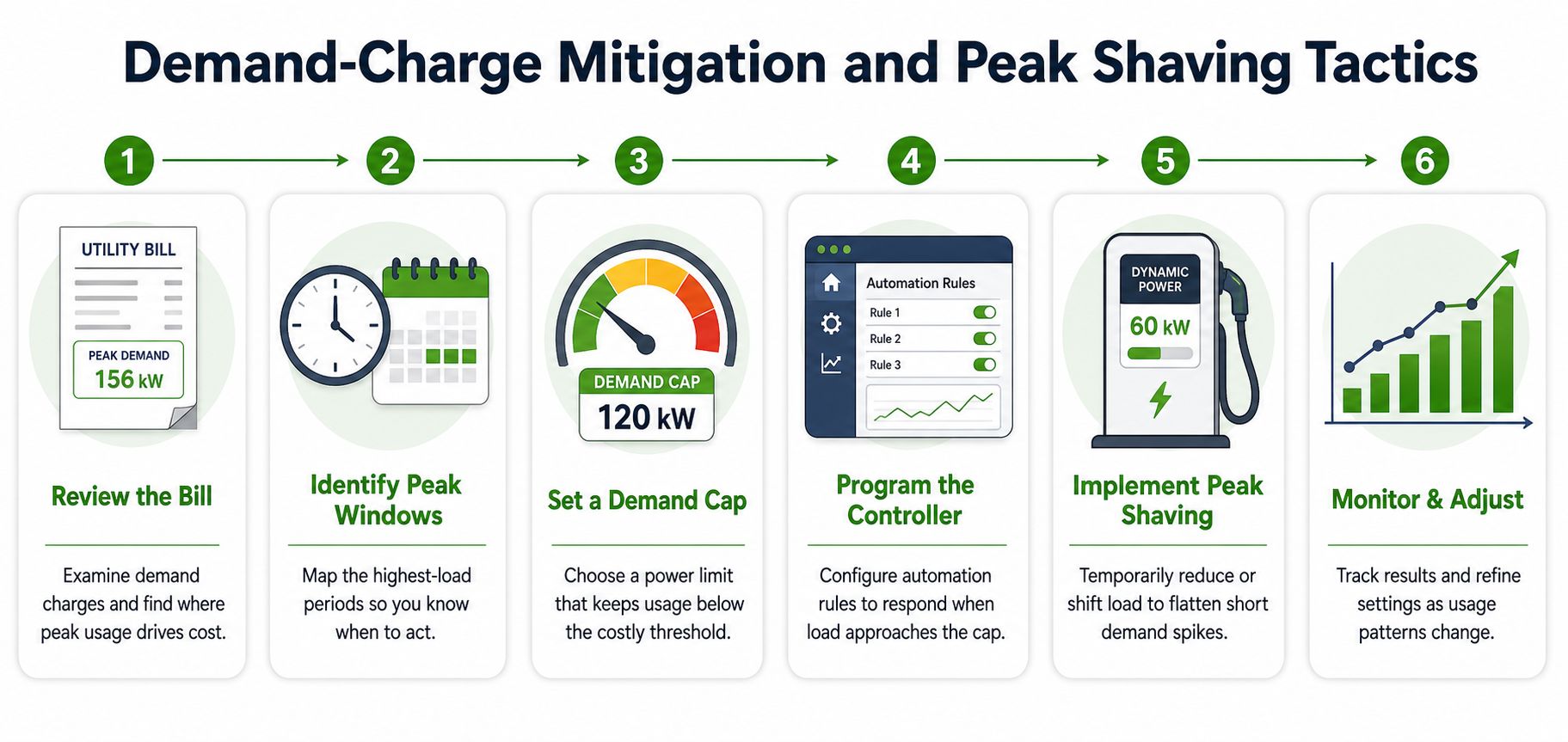
Choose the least expensive effective lever
A practical sequence looks like this:
- Review the bill: Find the highest demand interval and the applicable tariff components.
- Identify peak windows: Compare the utility interval with building schedules and charger sessions.
- Set a demand cap: Leave operating room for non-EV equipment instead of consuming the entire service limit.
- Program the controller: Use schedules, priorities, and live measurements together.
- Monitor outcomes: Check whether the cap protects the site without creating unacceptable delays.
Battery storage adds another tool. A battery can discharge while chargers operate, shielding the building's demand profile from some EV load. It may help where charging is concentrated and dwell time is too short for software-only shifting, but it adds equipment, controls, maintenance, permitting, and capital cost. Managed charging generally avoids that storage investment, but it can only shift flexible charging. It can't replace energy that must be delivered immediately.
California field results reinforce the importance of control design. A California Energy Commission smart-charging study found peak demand in one public-charging window fell from 24.2 kW to 10.0 kW, while another low-voltage pilot reported peak-load reduction of up to 40% with negligible inconvenience. Those results aren't a guarantee for every property, but they show why a site cap aligned with building and utility conditions works better than arbitrary delays.
Operational warning: A lower peak isn't a success if drivers miss required departures. Configure priorities and minimum energy requirements before tightening the cap.
Utility Integration, Rate Design, and Grid Programs
Southern California properties don't make load-management decisions in a vacuum. The applicable utility tariff determines how demand and time affect the bill, while interconnection and service rules determine what the electrical infrastructure can support. A site served by SCE, SDG&E, or LADWP may face a different economic case even with similar chargers and parking behavior.
Start by confirming the actual rate schedule. SCE commercial tariffs such as TOU-8 or B-19, SDG&E commercial EV offerings, and LADWP commercial or industrial options can apply different demand, energy, and time-period structures. Don't assume a published EV rate automatically produces a lower bill. Model the property's measured load and charging profile against the exact account configuration.
Code and utility review belong in the same meeting
Title 24 and CALGreen requirements can bring EV infrastructure into a project before the utility bill becomes the trigger. New construction, remodels, tenant improvements, lighting controls, and electrical distribution work may require documentation that affects equipment selection and commissioning. The design team should coordinate the electrical permit, utility service review, controls narrative, and Title 24 documentation rather than treating them as unrelated tasks.
Interconnection matters most when the project includes batteries, solar, or equipment that can export power. A charger-only project generally focuses on service capacity and demand behavior, while a storage-integrated design may add utility review and protection requirements.
Programs also change. Demand-response offerings may be active for eligible customers, while CPUC-managed charging efforts and utility pilots may still be limited by geography, enrollment, equipment, or evaluation status. Treat incentive or event revenue as a possible project input only after confirming current eligibility and contract terms.
The planning sequence should be:
- Confirm the tariff: Use the actual utility account and rate schedule.
- Review service conditions: Verify transformer, switchgear, feeder, and panel constraints.
- Check program status: Separate active offerings from pilots and proposed programs.
- Coordinate code documentation: Include Title 24 and CALGreen obligations in the scope.
- Model operating trade-offs: Compare bill impact, driver service, and infrastructure cost.
Service Upgrades Versus Managed Charging Systems
A service upgrade is not automatically the responsible choice, and managed charging isn't automatically the economical choice. The decision depends on how much capacity the site has, how quickly vehicles need energy, how the tariff bills peaks, and whether future utilization is already known.
Managed charging tends to fit properties with long dwell periods, predictable sessions, and meaningful but usable electrical headroom. Overnight multifamily parking and workplace garages often have time to distribute energy across the available window. A controller can protect the building while still delivering the required energy, provided the site operator defines priorities and departure requirements.
A service upgrade becomes more compelling when utilization is consistently high, dwell time is short, or the property plans to expand the charging fleet soon. Retail sites with rapid turnover, fleet depots with fixed dispatch schedules, and DC fast charging locations may not have enough flexibility for a software cap to meet every operational requirement. Very limited headroom also leaves little room for error or future building growth.
Compare the decision by operating condition
| Criterion | Managed Charging Wins | Service Upgrade Wins |
|---|---|---|
| Parking dwell | Vehicles remain parked long enough for controlled charging | Vehicles need energy during short stops |
| Load pattern | Arrivals and charging needs are flexible | Demand is concentrated and predictable |
| Building headroom | Existing capacity can support a controlled EV load | Existing capacity is too constrained for required service |
| Expansion plan | The owner wants to optimize current infrastructure first | Additional chargers or higher output are already committed |
| Utility exposure | Demand charges make uncontrolled charging expensive | The project can support the upgrade and needs unrestricted output |
| Operational tolerance | Drivers can accept managed output with clear priorities | Missed departures or turnarounds aren't acceptable |
Don't decide from the panel label alone. A load study should examine measured building demand, EVSE operating assumptions, parking dwell, tariff intervals, future tenant loads, and utility upgrade requirements. It should also compare the cost of gateway hardware, software subscriptions, commissioning, monitoring, and maintenance with the cost and schedule of transformer, switchgear, feeder, or service work.
For a project-level budgeting discussion, property teams can review EV charger installation pricing considerations, then request separate line items for electrical infrastructure, controls, networking, utility coordination, and ongoing software.
Decision rule: Choose managed charging when time is your available capacity. Choose a service upgrade when time can't deliver the required energy.
Common Misconceptions and Your Next Steps
Managed charging isn't free. Gateway hardware, metering, software subscriptions, commissioning, configuration, monitoring, and support all carry costs. Those costs may still be lower than a service upgrade, but the comparison has to include the full operating period.
Off-peak charging isn't automatically the cheapest strategy. Demand charges, facility charges, tariff details, and site behavior can change the result. A schedule that moves energy overnight may work well at one property and perform poorly at another if vehicles all start charging together or if residents need morning departures.
Software also can't solve every panel problem. If the available capacity is below the EVSE load required for the property's operating needs, a controller can only reduce, delay, or shed charging. It can't make a constrained feeder larger, and an aggressive cap may produce frustrated drivers.
A practical starting checklist
- Pull utility records: Gather the last twelve months of bills and interval data available for the account.
- Request a load study: Measure building demand and identify real headroom at the service, distribution, and EVSE levels.
- Map parking behavior: Document arrival times, dwell periods, departure deadlines, fleet routes, and resident charging expectations.
- Model the tariff: Compare scheduled, capped, and storage-assisted charging against the actual rate structure.
- Shortlist platforms: Ask two or three vendors to demonstrate offline operation, priority rules, data access, and total recurring fees.
- Coordinate the permit scope: Include utility review, Title 24 or CALGreen documentation, commissioning, and maintenance responsibilities.
Access Electrical and Lighting can evaluate commercial electrical capacity, coordinate EV charger installation, and address related panel, distribution, lighting-control, and Title 24 requirements for Southern California properties. Visit Access Electrical and Lighting to request a site discussion focused on load studies, managed charging, and the infrastructure path that fits your building.