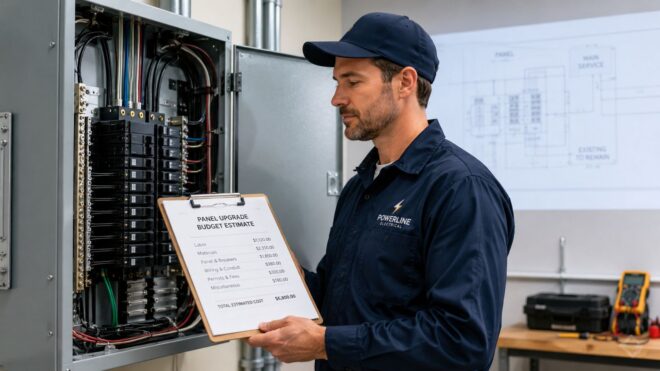
Commercial electrical panel upgrade cost commonly ranges from roughly $2,000 for a like-for-like panel swap to $5,000–$11,000 or more for a 200A to 400A service upgrade, with most multifamily and small commercial jobs in Southern California landing between $3,000 and $8,000 depending on scope. The panel cabinet is rarely the item that determines the final number, service-entrance work, utility coordination, access, code corrections, and outage planning usually do.
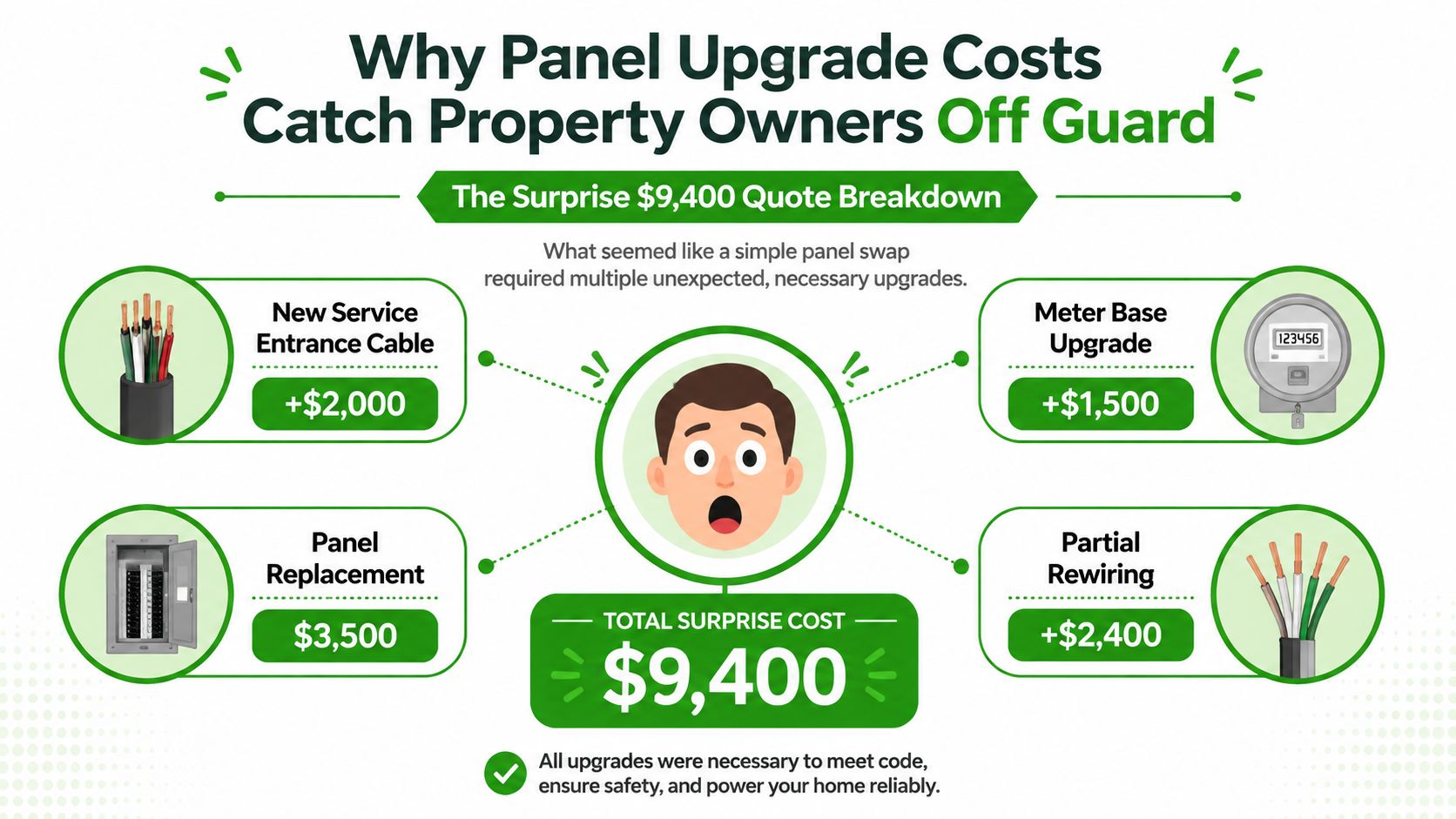
A property manager in Anaheim may call expecting a quick replacement after a tripped main breaker or a failed inspection. Then the proposal comes back at $9,400. The reason isn't necessarily an inflated labor rate. The original panel swap may have uncovered a deteriorated service entrance, an undersized meter base, damaged feeders, and circuits that can't be reconnected without corrections.
That difference, between replacing equipment and modernizing the building's service, is the key to understanding electrical panel upgrade cost. The figures below are planning ranges, not a substitute for a site assessment, because a quote can change substantially once the electrician opens the equipment, verifies the utility requirements, and checks the permitted installation.
Why Panel Upgrade Costs Catch Property Owners Off Guard
The Anaheim manager's $9,400 proposal looked excessive beside the expected $2,500 replacement. The quote made more sense after the contractor separated the work into a new service entrance, meter equipment, panel replacement, and partial rewiring. What appeared to be one task was several connected scopes that had to be completed before the utility and inspector would approve the system.
A like-for-like replacement on an existing adequate service is very different from an amperage upgrade. A standard 100A-to-200A upgrade may fall around $1,300 to $3,000 when the existing service can already support the larger equipment, while a broader service upgrade involving utility-side work can reach $3,000 to $6,000 or more, according to 2026 electrical panel upgrade cost guidance. Broader installed-cost guides place panel upgrades around $1,600 to $5,200, with full-service work potentially reaching $5,000 or beyond when the meter, riser, or service conductors need replacement, as described in this commercial panel pricing reference.
Read the scope boundary, not just the total
The panel enclosure is only one line item. The quote can expand when the electrician must replace service conductors, modify the meter base, install a new riser, correct grounding and bonding, add compatible breakers, repair conduit, or coordinate a planned outage with the utility.
A useful proposal should identify whether it covers:
- Panel replacement: New cabinet and breakers connected to the existing service.
- Service upgrade: Increased capacity requiring larger conductors, meter equipment, or utility coordination.
- Circuit corrections: Reworked feeders, grounding, bonding, or obsolete breaker replacements.
- Operational work: Tenant notices, shutdown planning, after-hours labor, cleanup, and inspection support.
Practical rule: If a quote doesn't clearly state what happens at the meter and service entrance, you don't yet know the true project scope.
The same property can receive a modest quote for replacing a damaged 200A panel in place and a much larger quote when the panel must move, the service must increase, or the utility requires new equipment. That distinction is what turns an apparently simple $2,000 project into a $10,000-plus modernization.
Understanding How a Commercial Electrical Panel Works
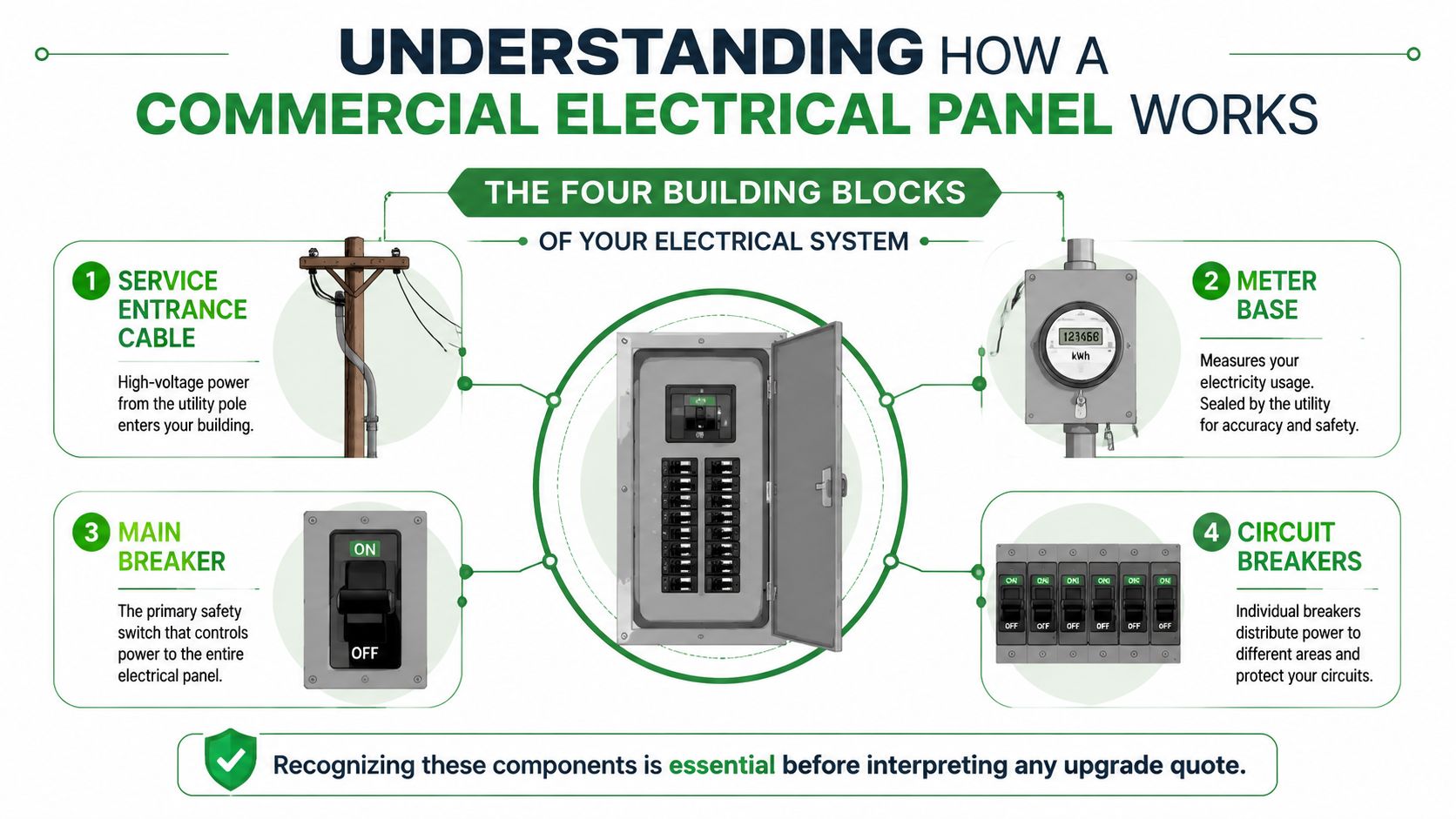
Before reviewing a proposal, identify the four parts that carry power from the utility into the building. Each part has a different owner, function, and cost implication.
The service entrance cable is the conductor path bringing electricity from the utility connection toward the building's service equipment. Its size must match the approved service capacity and installation conditions. The meter base houses the utility meter and is typically sealed or controlled by the utility. If the service size changes, the meter equipment may need approval, replacement, or coordinated access.
The main distribution panel, often called the MDP or main breaker panel, receives the metered supply and distributes it through the building. Its main breaker establishes the equipment's rated service capacity, but installing a larger main breaker doesn't create capacity if the upstream conductors and utility service can't support it.
Sub-panels distribute power to defined areas or loads. A restaurant kitchen, elevator room, tenant suite, or group of multifamily units may use separate sub-panels fed from the main distribution equipment. A full main-panel replacement won't automatically correct an overloaded feeder or undersized sub-panel.
Amperage sets the ceiling
Amperage describes how much current the building can draw at the same time. In Orange County commercial work, 200A, 400A, and 600A are common service tiers, but the correct size depends on a calculated load assessment rather than the number printed on an old panel.
A panel replacement keeps the service capacity and usually reuses the existing service conductors, subject to condition and code approval. A service upgrade increases capacity and may require new conductors, meter equipment, riser work, utility approval, and a larger main distribution panel.
That vocabulary matters because “replace the panel” can mean a same-capacity equipment swap to one contractor and a complete service modernization to another. Ask the estimator to label the work clearly. The proposal should state the existing service rating, proposed rating, voltage, main breaker size, meter scope, feeder scope, and which utility tasks are included.
What Goes Into the Final Bill
A commercial proposal usually combines four cost buckets. The amounts vary by equipment and site conditions, but separating them makes an estimate easier to compare.
Parts and materials include the panel enclosure, main breaker, branch breakers, lugs, grounding hardware, conduit, fittings, labels, and related accessories. The equipment selection changes with amperage, breaker count, interrupting rating, available fault current, and whether the installation requires a main distribution panel, switchboard, or additional distribution equipment.
Labor often controls the total because electricians must de-energize, disconnect, identify, relocate, terminate, torque, label, test, and document every affected circuit. A clean replacement in an accessible electrical room takes less time than work involving a service mast, long feeder route, tight tenant space, or extensive corrections.
Permits and inspections form a smaller line item, but they can affect scheduling. Permit fees for panel upgrades are commonly $75 to $350, particularly when jurisdictions price by service size and scope, as outlined in this permit cost reference for electrical work. Orange County cities may apply different fee schedules, plan-review requirements, and inspection procedures.
Shutdown, disposal, and utility work cover outage coordination, removal of old equipment, temporary protection, meter handling, reconnection, and cleanup. These costs matter more on occupied properties, where a shutdown affects tenants, point-of-sale systems, refrigeration, access control, elevators, or life-safety equipment.
| Line Item | Typical Range | Share of Total |
|---|---|---|
| Panel, breakers, and materials | Qualitative range varies by amperage and equipment | Equipment-dependent |
| Electrical labor | Often the dominant portion of the quote | Scope-dependent |
| Permits and inspections | Commonly $75–$350 for panel upgrade permits | Usually a smaller portion |
| Shutdown, disposal, and utility coordination | Varies with outage and meter requirements | Higher on occupied properties |
The reliable comparison is not “Which contractor has the cheapest panel?” Compare the included equipment, labor scope, utility responsibility, permit handling, testing, cleanup, and warranty. A low bid that excludes meter work or inspection corrections may become the most expensive option after change orders.
The Cost Drivers That Move a Quote the Most
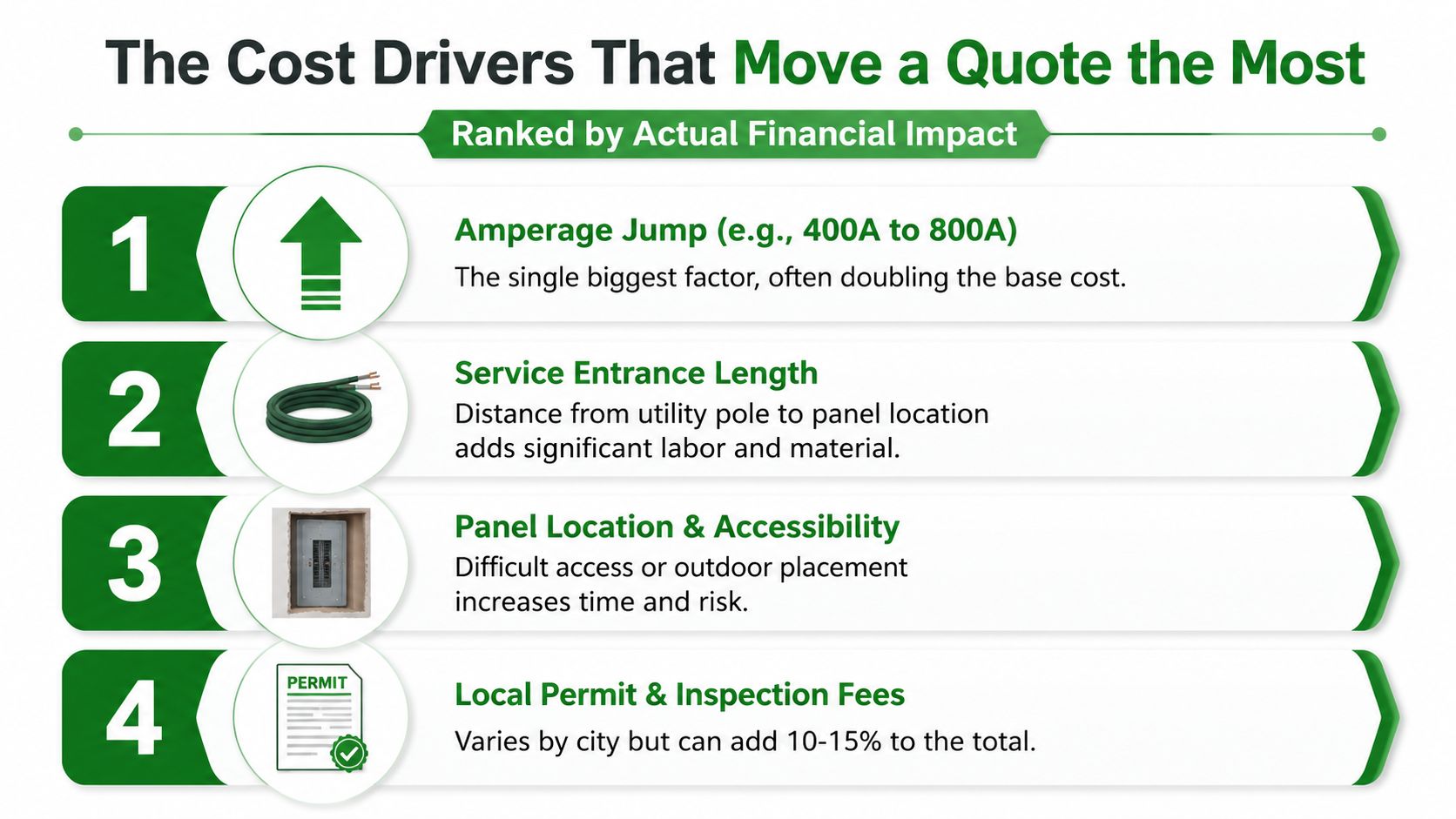
Some variables change a proposal far more than the brand printed on the panel door. In practice, the major drivers rank roughly as follows.
1. Amperage and service entrance scope
Increasing service capacity is usually the largest swing. A 200A-to-400A project can require a new meter base, larger service conductors, a new riser or CT cabinet, utility review, and a larger main distribution assembly. Published 2026 examples place 200A-to-400A work around $5,000 to $11,000, depending on the scope, as shown in this commercial upgrade cost comparison.
2. Panel location and access
A panel that stays in place is simpler than one that moves across a corridor or into a new electrical room. Relocation can require new conduit, surface metal raceway, wall openings, firestopping, patching, and longer feeder runs. Ten feet of distance can create a meaningful scope change when the route crosses finished tenant areas.
3. Breaker count and circuit density
Every circuit must be identified, disconnected, terminated, torqued, labeled, and tested. A crowded panel with mixed conductor types and poorly marked circuits takes more labor than a clean installation with an accurate circuit directory. New tenant equipment, kitchen loads, HVAC equipment, EV charging, or solar interconnection can add distribution work beyond the replacement itself.
4. Code and hazardous-condition corrections
An estimator may find obsolete Federal Pacific or Zinsco equipment, degraded insulation, improper neutral bonding, missing grounding components, or breaker compatibility problems. Arc-fault and ground-fault protection, working-clearance corrections, surge protection, and labeled disconnects may also enter the scope when the authority having jurisdiction reviews the work.
A realistic $5,000 baseline can become a $10,000-plus project when the service entrance, relocation, circuit corrections, and outage requirements appear together.
For larger facilities, the panel is only one part of the distribution design. Owners planning transformers or major new loads should review the transformer sizing resource before approving equipment that may not match the building's calculated demand.
How the Upgrade Process Actually Unfolds
The work should begin with a site walk, not a price guessed from a photograph. The contractor verifies the existing service rating, counts circuits, checks the meter and service entrance, reviews panel access, and identifies conditions that could affect permitting or shutdowns.
From assessment to approved scope
The load assessment determines whether the property needs a replacement or additional capacity. The written proposal should then identify equipment, conductor sizes, breaker types, utility responsibilities, permit responsibilities, exclusions, outage assumptions, and change-order conditions.
The contractor or designated permit holder submits the electrical application to the local authority having jurisdiction. If the service entrance or meter must change, the contractor also coordinates with Southern California Edison for the disconnect, meter pull, inspection release, and reconnection sequence.
Installation and closeout
For an occupied multifamily property, outage planning deserves the same attention as material selection. Management should notify tenants, protect sensitive equipment, coordinate access, and confirm whether elevators, fire alarm systems, gates, pumps, or other essential loads need temporary arrangements.
Installation follows the approved outage window. The electrician isolates the service, removes the old equipment, installs the new panel and related conductors, reconnects circuits, performs testing, and leaves the system ready for inspection and utility re-energization.
The closeout file should include:
- Permit documentation: Permit card and inspection results.
- System records: Updated circuit directory and as-built single-line diagram.
- Equipment information: Panel schedules, breaker data, and warranty documents.
- Operational confirmation: Notes on testing, labeling, and any remaining recommendations.
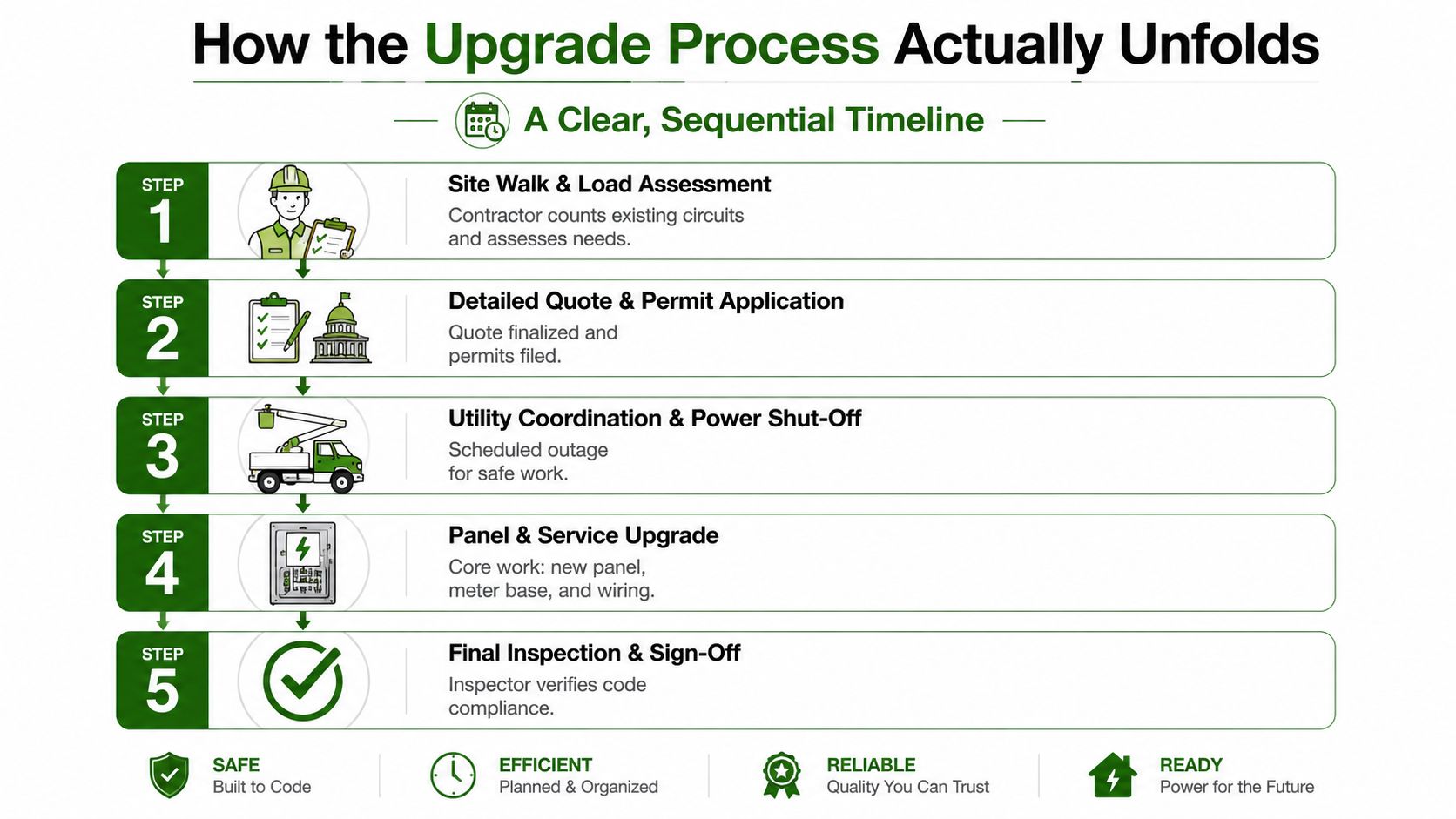
A contractor who can't explain the outage sequence, utility handoff, and final inspection process hasn't given the owner enough information to manage the risk.
Example Scenarios and Ballpark Estimates for Southern California
Three buildings can use the words “panel upgrade” while requiring very different work. The service rating, equipment location, number of circuits, and utility interface matter more than the label on the proposal.
A small retail storefront in a strip mall may need a 200A like-for-like panel swap. If the service entrance is adequate, the panel stays in place, and the branch circuits are serviceable, the budget may fall around $2,000 to $3,500. The price rises when the work must happen after hours, the panel sits behind finished walls, or the tenant needs new dedicated circuits.
A mid-size office suite moving from 200A to 400A represents a different project. New meter equipment, larger service conductors, selective coordination, utility scheduling, and inspection requirements can place the budget around $7,000 to $11,000. Long conductor routes, CT cabinet work, or restricted access can push the quote higher.
A multifamily building with four to eight units may need obsolete equipment replaced with a modern 300A or 400A main serving several sub-panels. That work can fall between $8,000 and $18,000, depending on the number of units served, feeder length, service entrance condition, and the extent of circuit corrections.
| Project Type | Service Change | Typical Scope | Ballpark Total | Main Price Drivers |
|---|---|---|---|---|
| Small retail storefront | 200A like-for-like | Panel, breakers, testing, permit, cleanup | $2,000–$3,500 | Access, after-hours outage, circuit condition |
| Mid-size office suite | 200A to 400A | Meter base, service conductors, coordination, selective coordination | $7,000–$11,000 | CT cabinet, feeder route, utility scheduling |
| Multifamily building | Existing service to 300A or 400A main | Main panel, sub-panels, feeders, obsolete equipment replacement | $8,000–$18,000 | Unit count, feeder length, corrections, tenant interruption |
These are planning figures, not fixed bids. A commercial electrical panel cost guide also emphasizes that EV charging, heat pumps, and future solar can turn a panel project into a broader service-capacity decision. The right question is what capacity the property needs, not just what the panel cabinet costs.
Permits, Inspections, and Code Compliance in Orange County
A commercial or multifamily panel project normally involves an electrical permit, utility coordination, and inspection by the local authority having jurisdiction. Orange County has multiple cities and jurisdictions, so permit requirements and fees aren't uniform. The C-10 contractor should verify the responsible city or county department before finalizing the proposal.
Plan review may become relevant when the project increases service capacity, relocates equipment, changes the service entrance, or affects larger distribution systems. The contractor should also determine whether service equipment sits in a public right-of-way or requires utility approval before installation.
California Electrical Code requirements can create corrections beyond the original equipment replacement. Depending on the property and scope, reviewers may examine working clearances, grounding and bonding, labeled disconnects, conductor terminations, breaker compatibility, arc-fault or ground-fault protection, surge protection, and accessibility. Commercial projects may also involve Title 24 energy-efficiency documentation when related lighting or controls work is included.
Put responsibility in writing
Ask the contractor to separate:
- Permit charges: Application, plan review, and inspection fees.
- Utility charges: Meter pull, temporary disconnect, service release, and reconnection.
- Correction work: Items discovered during the site walk or required by the inspector.
- Scheduling duties: Who books the utility outage and who attends inspections.
A documented commercial electrical inspection service can help identify visible deficiencies before the panel work is scheduled. Early review reduces the chance that the installation crew arrives during a planned outage and discovers a condition that prevents reconnection.
Don't treat the inspection as paperwork at the end. It determines whether tenants regain normal service on schedule and whether the owner receives a complete closeout record.
Budgeting, Financing, and Your Next Steps
Start with the reason for the project. Nuisance tripping, added HVAC equipment, an EV charger, tenant improvements, insurance requirements, and a failed inspection can lead to different scopes. The contractor needs to know the intended loads, service voltage, existing amperage, number and type of circuits, panel location, and whether the meter or utility service must change.
Obtain at least three itemized proposals from licensed C-10 contractors with commercial service experience. Compare the actual scope, not just the totals. Each bid should identify:
- Equipment: Panel, main breaker, branch breakers, meter equipment, lugs, and grounding hardware.
- Conductors and pathways: Service conductors, feeders, conduit, raceway, and wall repairs.
- Labor: Installation, circuit identification, testing, labeling, cleanup, and outage attendance.
- Approvals: Permit application, inspection attendance, utility coordination, and reconnection.
- Commercial conditions: Tenant notices, after-hours work, temporary protection, and access restrictions.
- Risk allocation: Warranty, insurance, exclusions, change-order rates, and correction responsibility.
For older buildings, ask the contractor to price likely contingencies instead of hiding them in vague allowances. Confirm who pays utility fees, after-hours labor, patching, taxes, disposal, and inspection corrections. Financing may come through a property-improvement loan, equipment financing, a business line of credit, or owner-funded phased work, but don't split service equipment into unsafe temporary phases merely to spread payments.
The most useful next step is a documented site walk followed by a formal proposal. Request a fixed or not-to-exceed quote only after the contractor verifies panel capacity, service-entrance condition, utility requirements, and local permit fees. A commercial electrical contractor should also explain the outage duration, tenant-notification plan, equipment schedule, single-line updates, inspection sequence, and warranty before work begins.
Ask these questions before signing:
- What service rating exists today, and what rating will the completed system provide?
- Does the price include the meter base, service entrance conductors, riser, and utility coordination?
- Which circuits or feeders require correction before they can be reconnected?
- Who schedules the outage, inspection, meter release, and reconnection?
- What happens if concealed damage or code deficiencies appear?
Access Electrical and Lighting provides commercial panel repairs, replacements, and service upgrades for retail, office, and multifamily properties across Southern California. To discuss your electrical panel upgrade cost, outage requirements, and service capacity, visit Access Electrical and Lighting and request a documented site assessment.