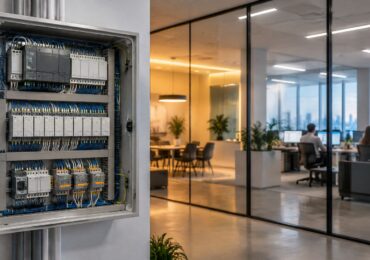
The garage is still lit at 11 p.m. The corridor outside a vacant suite never went dark. The back-of-house stair looks like a sales floor. You already swapped most of the lamps for LEDs, and the bill barely moved.
That is where a lot of property managers are sitting right now. Fixture wattage dropped. Runtime did not. Lighting controls systems decide when those fixtures run and how hard they run. Buy the hardware without owning commissioning, interoperability, and support after turnover, and you bought a spreadsheet, not a lower bill.
Judge any savings claim against a measured baseline, a local manual fallback, and a named owner for cybersecurity. Wattage on the cut sheet is the easy number. It is also the wrong one.
Why Lighting Controls Systems Matter on Site
Walk a commercial or multifamily property after the last person leaves and you will still find lights earning a paycheck. Parking levels stay bright. Corridors stay bright. Storage rooms and electrical closets stay bright because nobody told them to do anything else.
Swapping fluorescent or high-intensity-discharge lamps for LEDs changes the watts on the fixture. It does not change the hours. A control system is what sets when and how much those fixtures run. That is the gap between a cheaper lamp and a cheaper building.
Three behaviors do the heavy lifting on site. Occupancy response cuts runtime in spaces people use in bursts, such as restrooms, stairs, storage, and garage drive aisles. Photocells and daylight dimming belong only where daylight is genuinely present: a storefront, a lobby glass wall, or a perimeter office. Schedules and institutional tuning cover the rest of the site so a whole floor does not sit at full output because one late cleaner needs a path.
In 2013, Lawrence Berkeley National Laboratory reported that lighting was about 26% of a commercial building's electricity load and about 10% of operating costs, while only about 1% of U.S. commercial buildings were using lighting control systems. That same research put average savings potential at 24% for occupancy controls, 28% for daylight-responsive controls, 31% for personal tuning, and 36% for institutional tuning. Measured field results ran from 26% to 66%, averaging 46%.
Practical rule: How, when, and where the lights operate can matter as much as the fixture you bought.
Those figures are not a promise you can paste into the next bid. They show why controls are not an accessory bolted onto an LED package. A regularly staffed office, a 24-hour clinic, and a half-empty garage will not return the same number from the same box of sensors. Start from your hours and your occupancy, or the proposal is fiction.
How Lighting Controls Systems Work in Layers
One occupancy sensor is not a system. Treat controls as stacked layers, and commission each layer on its own before you trust the package.
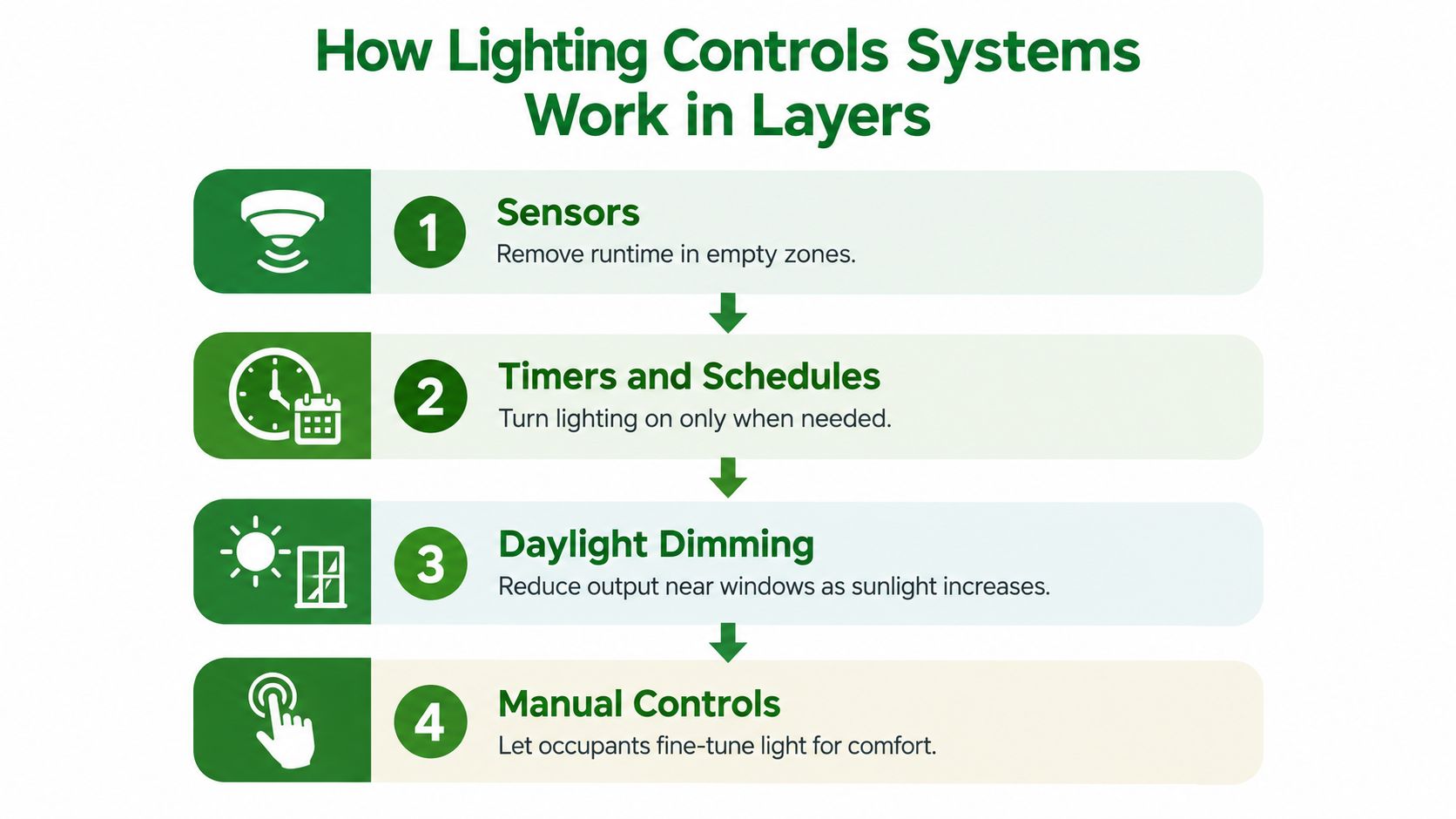
A Lawrence Berkeley National Laboratory meta-analysis covering 240 savings estimates from 88 studies found the gains stack. Each layer removes a different kind of waste. Skip a layer, and that waste stays on the bill.
What each layer actually changes
Sensors remove empty runtime. Vacancy and occupancy devices drop the lights when a zone is empty. Coverage and timeout are the whole game. A sensor aimed at a door, or a timeout so long the space never really turns off, saves nothing. Occupancy sensor lighting only pays when the device sees the people who are there.
Timers and schedules stop the overnight default. They hold site lighting, common corridors, and back-of-house rooms to the hours the building is used. A schedule that matches last year's tenant, not this year's, is just a switch left on with extra steps.
Daylight dimming and tuning cut output, not hours. Photocells and daylight dimming pull fixture output down when sun already meets the setpoint. Tuning then caps the maximum so a design that was brighter than the task never runs there. Measure the dimming curve against real daylight, and write down the light levels after install. If you only watch wattage, you will miss both.
Networked controls assign the rules by zone. Scenes, dimming limits, and fault alerts belong to a zone, not to an entire panel or floor. One bad sensor or one bad schedule should not blank a whole level. Manual overrides stay in the stack so an occupant can correct a bad setpoint without defeating the sequence.
Building automation is coordination, not a substitute
Tying lighting into a building automation system lets HVAC and lighting share schedules and occupancy. It does not replace local lighting logic. If the panel loses the network, the room still needs a sane local state.
Commission sensors, schedules, and daylight response as separate tests. A single "system passed" checkbox hides the layer that never worked.
An office on a weekday schedule, a 24-hour facility, and a parking structure will not produce the same result from one hardware list. If a proposal names devices and never names sequences, you do not have a design yet.
Energy Maintenance and Title 24 Outcomes
Owners do not buy layers. They buy three results: less lighting energy, fewer failures and truck rolls, and a file an inspector will accept. Those are different outcomes, and a bidder who blends them into "smart building" has not answered the question.
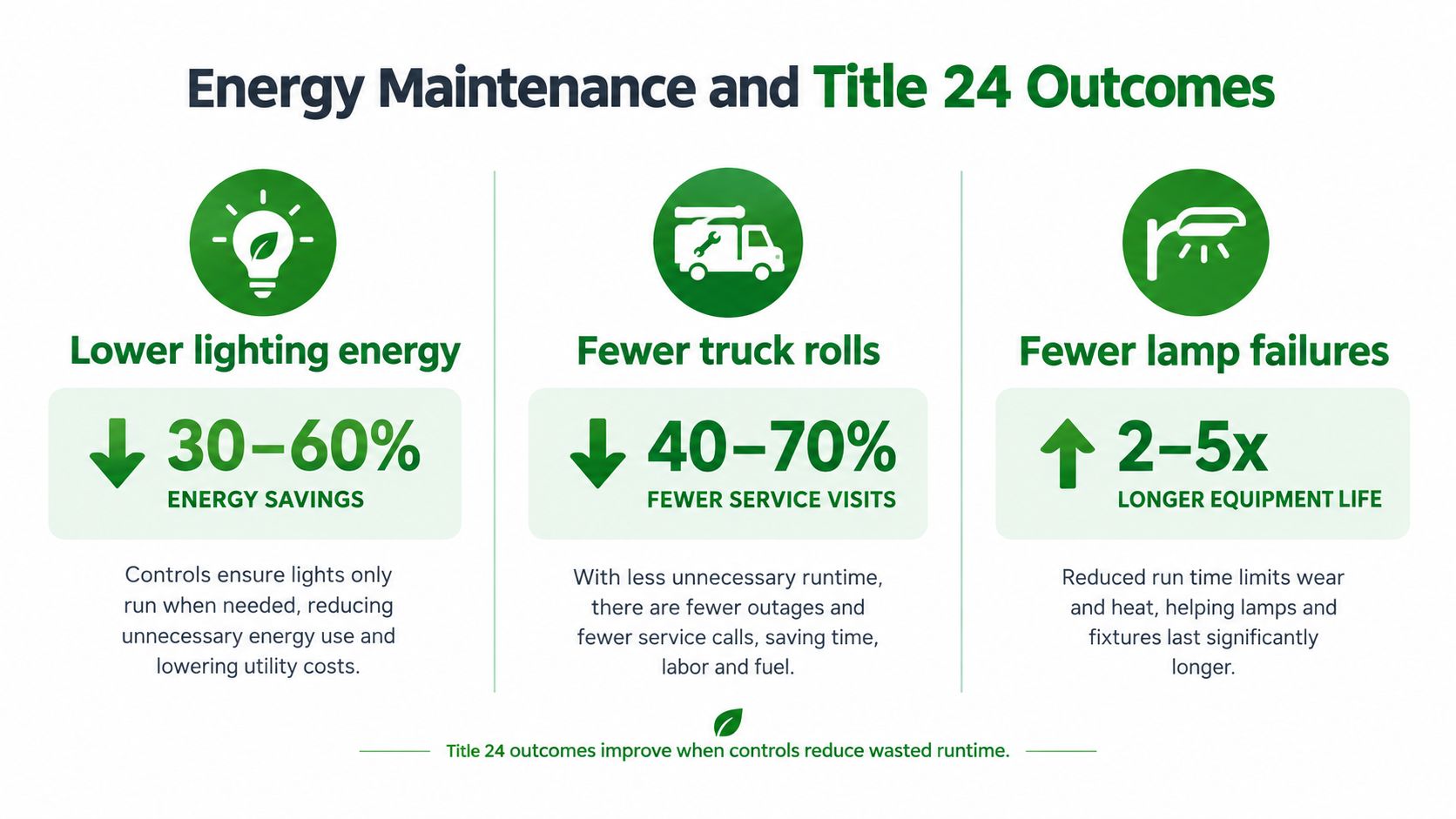
Three results, not one slogan
Lower lighting energy comes from shorter hours and lower output, not from the LED nameplate alone. If the baseline was never metered, you cannot tell a control win from a lamp win.
Fewer truck rolls and fewer lamp failures follow when fixtures run fewer hours and at lower drive current. Maintenance is the quiet half of the payback. A lamp that is off is a lamp that is not failing.
A cleaner inspection follows when automatic shutoff, occupancy response, scheduling, and daylight response are written down and tested. Undocumented sequences fail the same way a missing device fails.
Codes moved controls from optional to expected
ASHRAE/IES Standard 90.1 was first published in 1975, then revised in 1980, 1989, 1999, and 2001, and after 2001 it moved to a three-year cycle. The U.S. Department of Energy treated Standard 90.1-1999 as a national commercial reference, and by 2004 states had to adopt a commercial code at least that stringent or justify staying behind. Daylighting controls entered ASHRAE 90.1-2010, then carried into 90.1-2013 and the 2015 International Energy Conservation Code. The national trend is plain. Shutoff, occupancy, schedules, and daylight response became part of the design, not a nice-to-have.
California does not let you stop at that slide deck. Requirements turn on jurisdiction, space type, lighting power density, and how the system is built. A Southern California project has to be checked against the Title 24 edition that applies to that permit. Title 24 lighting requirements are a local test, not a national rule of thumb.
Emergency lighting, exit signs, and battery backup keep their own test and paperwork duties. Dimming and shutoff cannot take them offline. Drivers, sensors, and emergency function have to be checked as one assembly, or a passed energy sequence can still fail a life-safety test.
Ask every bidder two questions before you compare price. Which sequences will be acceptance-tested, and which Title 24 forms will be left in the job file? If the answer is a brand name, you do not have an outcome yet.
Where Controls Pay Off by Property Type
The same layers behave differently once you leave the conference table and walk the property. Model from actual hours. Do not copy a package from the last job.
Offices
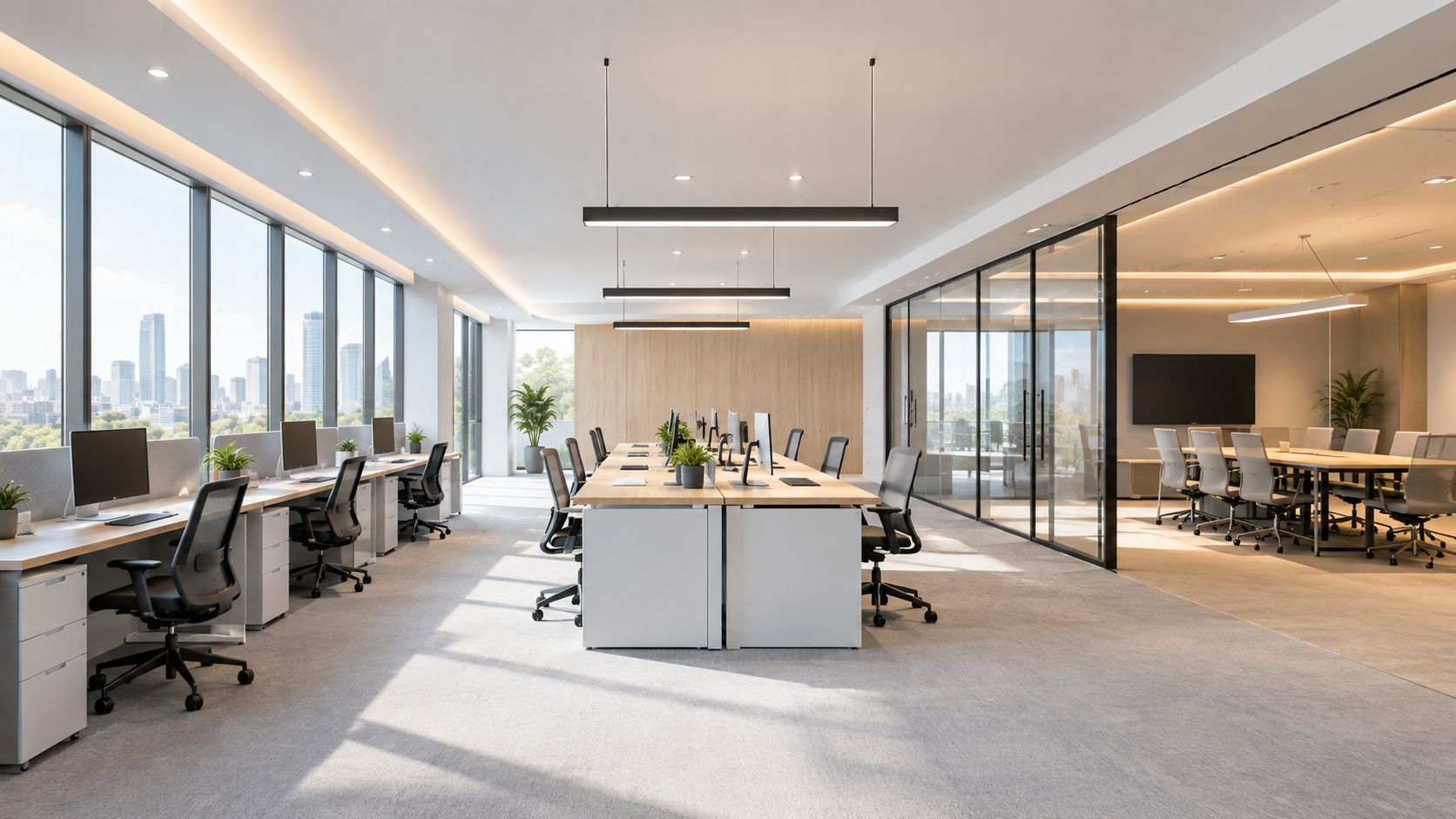
People sit near glass, and the original design is often brighter than the task. Perimeter daylight dimming and task tuning do more here than another vacancy sensor in a room that is occupied all day. Conference room lighting is the exception inside that pattern. Those rooms empty for hours, so vacancy and scenes matter more than a flat schedule.
Retail and shopping centers
Storefront daylight, after-hours overrides, and sales-floor scenes decide the bill. A single vacancy timeout fights the way a store runs. Staff need a clear override for stocking and events, and that override has to time out or the storefront stays at full output until morning.
Multifamily communities
Corridors, garages, amenities, and site poles are intermittent, and tenants will complain the moment a path goes dark at the wrong second. Staff turnover then undoes a poorly labeled override. If the night porter cannot tell a bypass from a broken sensor, the bypass stays on.
Parking structures and pole lighting
Vacancy is predictable and mounting heights are high. Zoning, sensor coverage, and whether a tech can reach the device decide whether the savings survive the first year. A sensor you cannot service is a sensor you will eventually jumper out.
A U.S. General Services Administration evaluation found that, after LED conversion, light-level tuning plus occupancy sensing cut lighting energy by another 43%, about 0.82 kWh/ft²/year, with roughly half from tuning and half from occupancy. The same work reported average annual savings of 27% from integrated daylight harvesting at five federal sites, with simple payback as low as four years. Use that as a reason to start with perimeter offices, lobbies, storefronts, and daylit parking edges. Do not treat it as a quote for every garage.
Check drivers, sensors, gateways, and emergency function together. Flicker, failed dimming, or nuisance shutoff will erase the gain faster than any schedule can create it.
How to Choose Lighting Controls for Your Property
Stop shopping sensor catalogs. The buying decision is who verifies the zones after turnover, what you can still change, and whether a second vendor can service the gear in year five.
| Approach | Best fit | Owner can adjust | Main risk after turnover |
|---|---|---|---|
| Standalone sensors and time clocks | Small rooms, stairs, storage, simple site poles | Timeouts and on/off schedules, if they are labeled | No zone history, and a failed device is invisible until someone complains |
| Room or zone controllers | Offices, retail suites, amenity rooms with scenes | Scenes, dimming caps, local overrides | Sequences live in one box nobody documented |
| Networked lighting controls | Multi-floor offices, garages, retail centers | Schedules, limits, and alerts by zone | Wireless blocked by structure, and a gateway with no replacement plan |
| Lighting tied to a building automation system | Campuses that already staff a BAS | Shared schedules with HVAC, central alarms | Lighting dies with the network, and IT and electrical argue over who owns it |
The gap is not the brand name
Market research on luminaire-level lighting controls still flags perceived complexity, high first cost, and cross-brand interoperability as reasons projects stall. The same body of work finds that installation and commissioning training can matter more than equipment price or a fragmented vendor list. An "open" protocol does not mean plug-and-play. Third-party parts can make commissioning harder, not easier, because each device still has to be proven in the sequence.
Require this handover, in writing, before you sign:
- Zone and sequence records: every zone, what turns it on, what dims it, and what turns it off.
- Four-mode testing: normal, override, emergency, and failure, each witnessed.
- Device records: firmware, network IDs, and a parts list a future tech can read.
- Staff training: the people who will touch overrides, not a slide deck left in a trailer.
- A second service path: support that does not die if one proprietary vendor leaves the market.
Access Electrical and Lighting is one contractor set up for that scope. The firm installs and maintains commercial lighting and controls, tests and documents Title 24, and keeps line-voltage and low-voltage work under one licensed C-10 team serving Orange County, the Inland Empire, and San Diego since 2000. Pick them or pick someone else, but pick against that handover list, not against a logo.
Commissioning ROI and Long-Term Support
A control package does not have a guaranteed payback. Treat any number that says otherwise as a sales line until you have your own baseline.
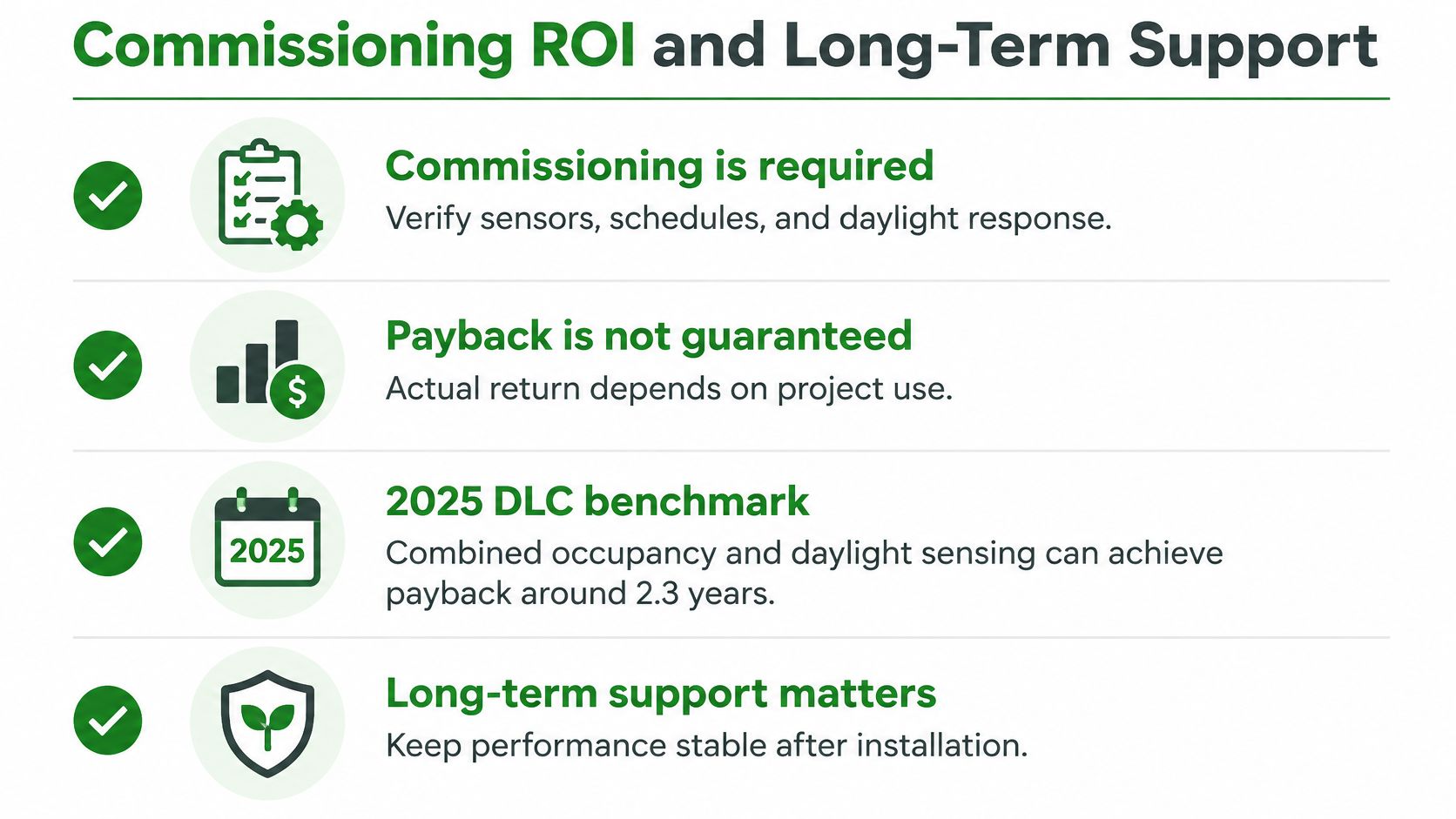
A 2025 DesignLights Consortium research report found combined occupancy and daylight sensing had an average energy-savings potential of 38%. An industry program overview in that same research stream reports that integrating lighting and HVAC controls can produce whole-building energy savings above 20%. Both figures are potential. They are not a quote for your garage, your store, or your corridors.
What moves the result off the brochure
No baseline. If you did not meter lighting energy before the work, you cannot prove the controls did anything. Lamp wattage changes will steal the credit.
False offs and occupant overrides. A sensor that kills the lights on a cashier, or a bypass left on after closing, wipes the model. Retail and multifamily spaces swing harder here because occupancy is bursty and complaints are immediate.
Wireless and layout. Concrete decks, metal decks, and long garages block radios. A layout that looked fine on a plan can drop zones for months.
Nobody owns it together. Owner, installer, and IT have to agree on access, alerts, and who gets called at 9 p.m. If that meeting never happens, the system rots in place.
Cybersecurity is part of the cost
Connected controls expose occupancy patterns, schedules, network devices, and remote-access paths. A buying guide that only talks about convenience and utility savings skipped the risk. The cheapest box is not the lowest lifecycle cost if poor commissioning, recurring dropouts, or software nobody will patch erase the savings.
Hold every proposal to this test:
- A pre-install lighting-energy baseline, not a generic wattage table.
- A defined measurement period after turnover, with who reads the meter named in the contract.
- Local manual fallback so a dead gateway does not black out a floor.
- Access rules and a patching owner, in writing, shared with IT.
- A replacement plan for failed gateways and obsolete devices, including who stocks them.
- Compatibility confirmed among drivers, sensors, gateways, and emergency lighting before anyone trusts the spreadsheet.
If a proposal cannot pass that list, do not argue about the payback year. You do not have a project yet. You have a catalog.
What to Do Before You Specify Controls
You can brief a contractor in one meeting if you show up with the building, not with a wish list. Leave the sensor types and the comparison matrix behind. Bring operating facts.
Gather this before anyone prices a panel:
- Fixture types and hours for the areas you want to change, including what already got an LED retrofit.
- Spaces that stay lit with nobody in them, named by level and use, not "the garage."
- Daylit edges you can point at, such as storefronts, lobby glass, and perimeter offices.
- After-hours uses that are real, including cleaning, stocking, events, and night staff routes.
- Emergency and exit lighting that must keep working when dimming or shutoff misbehaves.
- Who on staff owns overrides, by name and shift, not "engineering."
What to demand back
Ask for sequences, not device counts. Ask for acceptance tests of normal, override, emergency, and failure modes. Ask for Title 24 documentation matched to the edition on your permit, left in a file your team can find after the GC is gone. Training and device records are part of the deliverable. If they are "available on request," they will not exist when the first sensor fails.
The practical next step is a site walk with a licensed commercial electrical contractor who will install the controls, commission them, and leave the training and the records behind. For commercial, retail, office, multifamily, and parking properties in Southern California, start that scope review with a bonded C-10 contractor that already combines lighting controls, Title 24 certification support, emergency lighting, and low-voltage work, and that can answer an after-hours outage instead of waiting for the next business day. Schedule the walk. Do not schedule another slide about smart buildings.
Access Electrical and Lighting installs, commissions, and maintains commercial lighting controls, including occupancy and daylight response, scheduling, Title 24 testing and documentation, and emergency lighting, for offices, retail, multifamily, and parking properties across Orange County, the Inland Empire, and San Diego. If your lights are still running after the building empties, a measured baseline and a witnessed handover will tell you more than another fixture swap. Visit Access Electrical and Lighting to schedule a site walk and put sequences, testing, and long-term support in the scope before you buy the hardware.