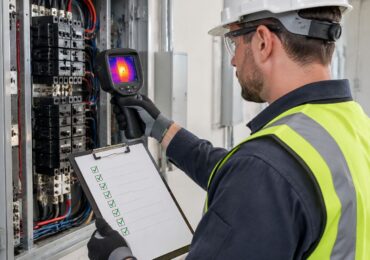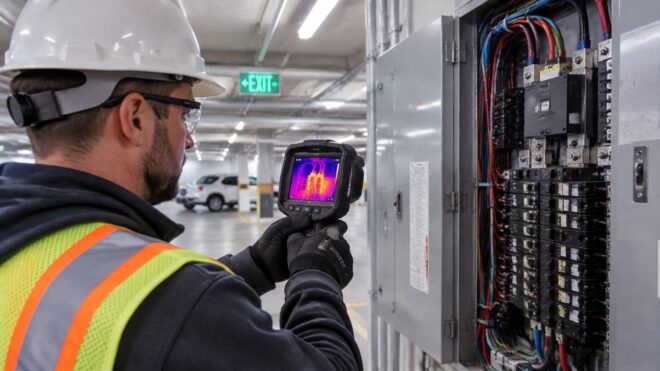
It's 8:45 on a Tuesday night when your phone lights up. Half the third-level fixtures in your parking structure just went dark, and a ground-floor retail tenant is texting because their back-of-house breakers tripped twice during dinner service. You dig through old invoices looking for whoever swapped a ballast last winter, only to realize you don't have an updated panel schedule, an emergency-lighting test log, or a confirmed after-hours dispatch number.
Most property teams only call electrical maintenance companies when something stops working. Treating electrical upkeep like an emergency repair call leaves your building exposed to preventable outages, failed fire-marshal inspections, and premature switchgear wear. A dependable maintenance program works differently: it runs as a documented, scheduled asset calendar that tracks equipment condition year-round.
That shift matters even more now that commercial sites are layering LED lighting controls, networked sensors, and EV charging onto panels designed decades ago. Installing new equipment is only half the job. Keeping those loads balanced, tuned, and code-compliant after the installation crew leaves is what separates a predictable property budget from recurring midnight emergencies.
Services Commercial Electrical Maintenance Companies Provide
Picture a busy mixed-use property at 9 p.m. where half the parking deck goes dark right as a tenant loses power to a back-office circuit. That single evening illustrates why commercial electrical maintenance isn't one narrow trade. The crew responding to that call might need to trace a tripping breaker inside an electrical room, troubleshoot a failed lighting contactor, inspect raised deck fixtures, and verify that egress pathways stayed illuminated on battery backup.
Three Work Types Every Property Team Buys
Commercial maintenance budgets generally split across three operational buckets, and knowing the boundary between them helps you control billing and response times:
- Routine maintenance: Planned service calls that keep day-to-day systems reliable, including fixture and ballast repairs, circuit troubleshooting, breaker servicing, receptacle replacement, and site lighting upkeep.
- Emergency response: Urgent, after-hours dispatches for occupied buildings that can't wait until morning, covering unplanned power losses, overheating electrical panels, tripped main disconnects, and failed exit lighting.
- Planned capital and retrofit work: Scheduled upgrades such as LED lighting conversions, panel and switchgear replacements, tenant improvements, and EV infrastructure additions that alter your building's load profile.
Many property managers hire a single repair vendor and assume that same shop handles all three buckets. In practice, a contractor built for daytime tenant build-outs may lack a staffed 24/7 dispatch line, while a small service truck rarely owns the bucket lifts required for 30-foot parking lot poles.
Matching Service Scope to Building Risk
Commercial maintenance spans eight core service categories. Mapping your property against each category clarifies what you need in a service agreement before you ask for bids.
| Service | What It Covers | Property Need It Answers |
|---|---|---|
| Routine repairs and troubleshooting | Fixture and circuit repair, panel service, lighting maintenance | Day-to-day reliability |
| Emergency response | After-hours outages, overheating panels, failed fixtures | Occupied buildings that cannot wait |
| Emergency lighting and exit signs | Battery backup installation, testing and maintenance | Life-safety code compliance |
| Infrared electrical inspection | Thermal scans of energized connections and equipment | Hidden fault detection |
| LED retrofits and lighting controls | Site, parking and pole lighting upgrades with controls | Energy use and maintenance cost |
| Switchgear and panel upgrades | Panel replacement and switchgear relocation | Capacity and reliability |
| Light pole and parking structure work | Pole integrity testing, replacement, high-reach access | Elevated and exposed assets |
| Low-voltage systems | Distributed audio, controls, signage, mass notification, fiber | Building systems and communications |
The contractor ecosystem delivering these services is massive, yet heavily fragmented. According to the U.S. Bureau of Labor Statistics, the U.S. electrical contractors and other wiring-installation contractors industry employed 1,112.4 thousand people in December 2024. Alongside those employer firms, the U.S. Census Bureau counted 171,644 nonemployer establishments in electrical contracting and other wiring-installation services in 2024.
That structure means solo operators, small regional specialists, and multi-site commercial contractors all compete in the same local market. Big doesn't automatically mean attentive, and small doesn't automatically mean cheap.
Most commercial buildings rely heavily on three or four of these service categories every year. Writing down which ones your site depends on before requesting proposals stops you from paying for capabilities you never touch or discovering too late that your vendor lacks a bucket truck.
Start by auditing your building's physical footprint. A garden-style multifamily community leans heavily on exterior pole lighting, communal emergency fixtures, and rapid after-hours response. A Class A office building with subterranean parking depends far more on switchgear capacity, infrared diagnostics, lighting controls, and low-voltage mass notification systems. List your top four operational dependencies first, then match contractors to that list.
Inspection and Testing Intervals to Schedule
A property with a reliable electrical maintenance program does not depend on memory. It uses a tracked asset register, dated test records, and clear ownership for every life-safety fixture, panel, pole, and control system. That matters most when managers change, ownership changes, or a vendor visit leaves behind a repair invoice with no evidence of what was tested.
Emergency lighting deserves a firm place in that program because a functional fixture has to prove two things: it switches to backup power when normal power drops, and its batteries hold charge for the required discharge period. A 2025 municipal electrical safety policy from Haringey Council shows the kind of operating standard facility teams face: communal emergency lighting is checked monthly, tested annually by accredited electricians, and logged in a digital register. In my judgement, emergency lighting is a frequent compliance weak point because the visible fixture looks fine even when the battery, transfer function, or record is missing.
The audit question stays the same across different code regimes. Inspectors want dated proof showing the asset ID, test duration, pass or fail result, corrective repair, and verified closeout. A recurring commercial electrical inspection turns scattered tickets into a record that can be produced without searching email threads or asking a former technician what happened.
Core Recurring Electrical Tests
Use the baseline intervals below to anchor an annual electrical calendar. Tighten frequencies where equipment age, environmental exposure, tenant risk, or prior failures justify closer attention.
| Asset or Test | Typical Interval | Basis |
|---|---|---|
| Emergency lighting monthly function test | Monthly short test | Local fire code and facility safety policy |
| Emergency lighting annual duration test | Annual full test | Local fire code and accredited-electrician testing standards |
| Battery backup and emergency fixture load check | Annual | Manufacturer and local code requirements |
| Infrared scan of switchboards and panels | Annual minimum, shorter for high-risk gear | NFPA 70B guidance |
| Lighting control schedules and sensor coverage | After installation and after layout changes | Controls commissioning best practice |
| Light pole integrity test | At baseline audit, then per corrosion and exposure findings | Set by condition assessment |
Light pole integrity testing does not carry one universal interval. A steel pole inland in dry weather ages differently from one exposed to coastal salt spray, irrigation overspray at the anchor bolts, or repeated bumper hits in a tight retail lot. The first physical assessment should check base rust, anchor-bolt tightness, handhole covers, and plumb alignment. Those findings set the cadence for each pole group.
Retrofits and electrification change the maintenance burden after the installation crew leaves. LED retrofits, EV chargers, lighting controls, and parking-structure systems can reduce some operating costs while adding new load profiles, controls, and failure points that need tracking. A site that adds chargers or new lighting without updating the asset register often discovers the gap during an outage, an inspection, or a tenant complaint.
Building a Working Maintenance Calendar
Turning the schedule into daily practice takes four straightforward steps:
- Inventory every electrical asset: Walk the property with a contractor and tag every main switchboard, subpanel, disconnect, emergency light, exit sign, battery inverter, and exterior pole with a permanent asset ID.
- Rank assets by consequence: Flag life-safety gear and single-point-of-failure distribution equipment as top priority so they never slip behind cosmetic repairs.
- Assign intervals from the schedule: Attach each tagged asset to its monthly, annual, or event-triggered inspection interval inside property management software or a dedicated spreadsheet.
- Log every outcome in one register: Record the test date, technician name, asset ID, measured result, and corrective work-order number in a single digital file rather than burying PDFs inside email threads.
The calendar is working when three checks hold at any point in the year. Every completed test has a dated digital entry. Every failed fixture or panel defect links to a closed work order. Life-safety assets do not cross their due date without a documented check.
How Infrared Inspection Finds Hidden Electrical Faults
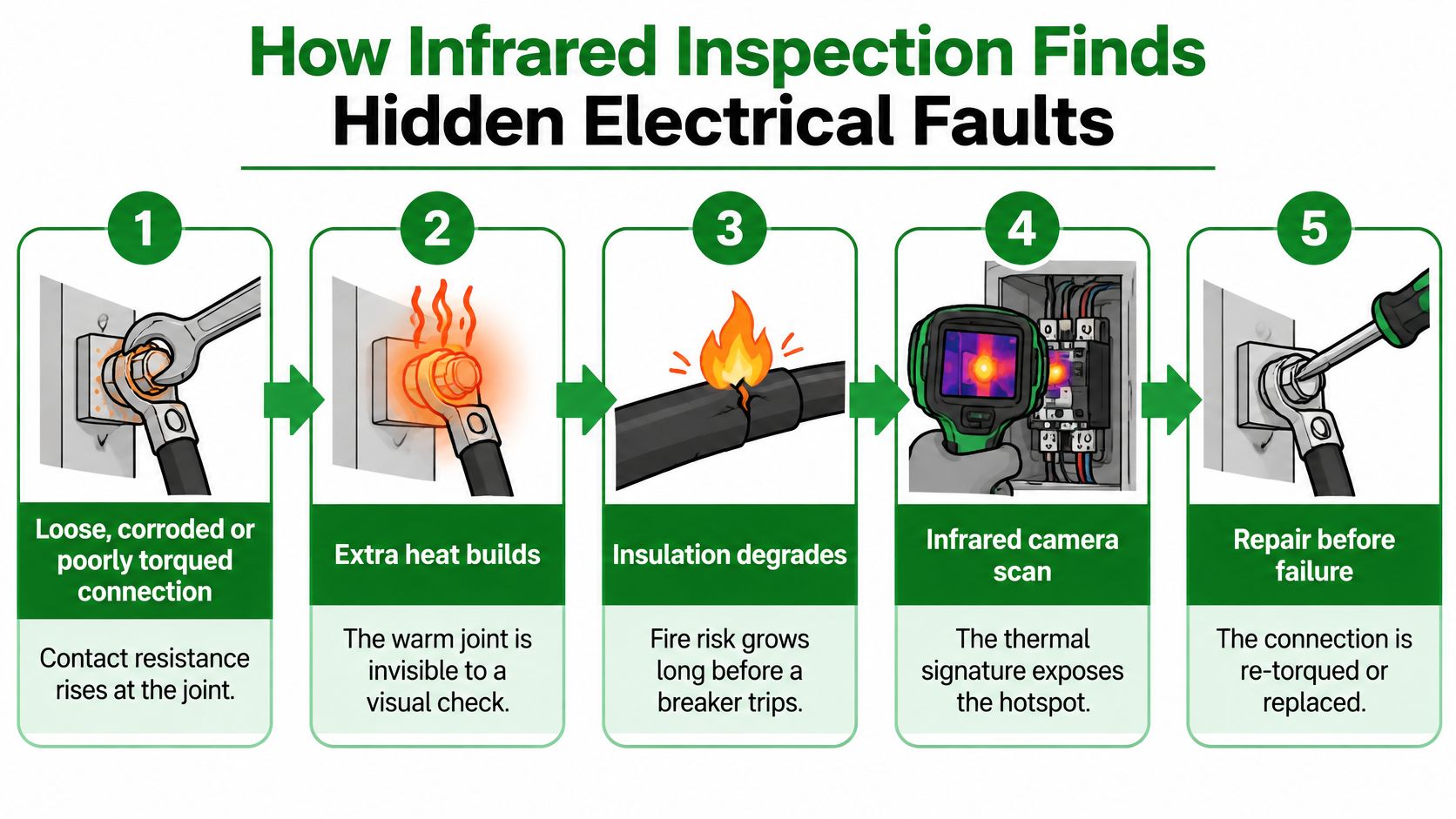
Electrical failures rarely announce themselves with smoke or sparks on day one. Most begin inside an energized enclosure where a lug has backed off a fraction of a turn, aluminum wiring has oxidized, or a breaker stab has lost spring tension. Those loose, corroded, or improperly torqued connections raise contact resistance.
As current pushes across that high-resistance joint, localized heat builds up inside the enclosure. That extra heat dries out conductor insulation, warps plastic housings, and increases fire risk long before current spikes high enough to trip a circuit breaker. A technician who opens a panel cover for a visual check sees tidy wires and intact paint, completely missing a connection cooking at dangerous temperatures.
The diagram below traces how a routine joint defect escalates into a hidden fire hazard and how thermal imaging interrupts that chain before equipment fails.
The Six-Step Thermography Protocol
Infrared thermography only delivers reliable answers when your contractor treats it as a documented, load-dependent diagnostic procedure rather than a quick walk-through with a handheld camera. According to a Schneider Electric data bulletin on NFPA 70B, NFPA 70B guidance requires thermographic inspection of energized electrical connections and terminations, with temperature differences evaluated both between comparable components under similar loading and between the component and ambient air, recording the concern area and reference temperature. Those materials also identify annual infrared inspection as the routine interval, with shorter intervals for higher-risk equipment based on condition and operational consequences.
Booking dedicated infrared thermography inspection services should follow six disciplined steps:
- Inventory high-consequence gear: List every switchboard, panelboard, main disconnect, lighting contactor, automatic transfer switch, and motor control cabinet, prioritizing gear whose failure would shut down tenants or life-safety systems.
- Scan under representative operating load: Schedule scans when HVAC chillers, lighting loads, and tenant equipment are actively drawing current. Scanning an unloaded panel on a quiet Sunday morning hides resistance heat and produces false confidence.
- Log baseline conditions with every image: Have the technician capture a clamp-on ammeter load reading, ambient room temperature, reference component temperature, and exact circuit label alongside each thermal image from a calibrated camera such as a FLIR unit.
- Compare temperature differentials: Evaluate each hot termination against twin phases carrying comparable amperage and against ambient air temperature so severity rankings reflect true electrical stress.
- Correct hotspots and verify the repair: De-energize the circuit, clean oxidized surfaces, replace heat-damaged lugs or conductors, re-torque terminations with a calibrated torque wrench, and run a follow-up thermal scan under load to confirm normal temperatures.
- Trend readings across inspection cycles: Compare this year's thermal baseline against prior reports to catch slow thermal creep before components hit critical limits.
Reading Trends vs Isolated Faults
Trending turns raw thermal photos into clear maintenance decisions. Say two identical 400-amp subpanels sit side by side feeding adjacent retail spaces under matching amperage, and one phase lug in Panel B runs 30 degrees hotter than the matching lug in Panel A. That sharp, isolated jump points straight to a single loose, corroded, or poorly torqued termination that a targeted repair will solve.
Now contrast that with a main distribution panel whose three phases all run slightly warmer every year across three consecutive annual scans, with no single lug standing out. Re-torquing connections won't fix that pattern. Steady, system-wide heating signals creeping overloading or a persistent phase imbalance caused by tenant equipment additions, telling you it's time to rebalance circuits or plan a capacity upgrade.
Report standard: Never settle for a verbal all-clear or a one-line invoice note after a thermal scan. Require a dated thermography report containing side-by-side infrared and visual images, measured load conditions, ambient and reference temperatures, observed temperature differentials, and corrective-action status for every flagged anomaly.
Upgrades and Controls That Need Ongoing Maintenance
Many commercial owners treat capital projects like finish lines. You approve an LED conversion or install four EV pedestals in the garage, pay the final draw, and assume electrical upkeep drops to zero for the next decade. Two years later, utility bills drift back up, occupancy sensors leave hallways dark while tenants are walking through, or a main breaker trips during a summer heatwave. Modern electrical upgrades don't eliminate maintenance; they change what your maintenance crew has to monitor.
Keeping LED Retrofits and Controls Tuned
Swapping fluorescent tubes or metal-halide parking fixtures for LEDs cuts raw wattage immediately, yet hardware replacement alone leaves major operational savings on the table. A U.S. Department of Energy field evaluation.pdf) conducted with Pacific Northwest National Laboratory and the DesignLights Consortium tested advanced lighting controls across five commercial buildings: offices, a grocery store, a brewery, and a medical office. Evaluating task tuning, occupancy sensing, and daylight harvesting, the team found that task tuning delivered the largest control-related savings, while total energy reductions came primarily from pairing LED conversion with control strategies.
DOE forecasting in that same evaluation highlighted commercial, industrial, and outdoor lighting as major sources of potential LED savings because of their high light-output demands and long operating hours, with networked and controllable fixtures adding substantial further value. Capturing that value over time requires four post-installation habits:
- Commission controls before sign-off: Verify every dimming zone, astronomical timeclock, and daylight sensor under real daytime and nighttime conditions rather than accepting factory default settings.
- Check sensor coverage and schedules: Walk garages, corridors, and stairwells quarterly to confirm occupancy sensors aren't blocked by new storage racks, signage, or signage glare, and confirm timeclocks adjust cleanly across daylight saving shifts.
- Document connected load and run hours: Record baseline wattage and daily operating hours right after commissioning so you can spot control overrides immediately when utility bills spike.
- Retune after tenant or layout changes: Re-aim photocells and adjust task-tuning trim levels whenever a tenant moves partitions, swaps retail displays, or changes operating hours.
Access Electrical and Lighting pairs LED retrofits for site lighting and light poles with lighting control systems, parking structure lighting maintenance, and EV charger services so properties don't lose efficiency after installation crews pack up. Treating commissioning and retuning as routine service items protects your original payback math.
Planning Electrification Without Overloading Switchgear
Adding EV charging stations, electric heat-pump HVAC, and commercial induction kitchens introduces a heavier maintenance challenge than lighting ever did. According to a 2025 U.S. Department of Energy Building Technologies Office report, Siemens' 2025 building survey found that 54% of respondents planned to increase investment in building electrification and 55% in smart-building technologies, even as 60% of commercial-real-estate respondents viewed decarbonization as too expensive. That gap between investment pressure and tight capital budgets tempts teams to bolt new chargers onto aging panels without a long-term load plan.
The same DOE report points to coordination between EV charging and building loads, along with interoperability between vehicle and building controls, as key technology priorities, while ASHRAE emphasizes workforce training for professionals who design, install, operate, and maintain electrified building systems. There's a real operational trade-off here too: shifting off natural gas reduces fuel exposure, yet increases your dependence on the electrical grid and introduces added resilience and cybersecurity risks through networked load controllers.
Before adding high-draw electrified loads to an existing building, work through a four-stage capacity sequence. First, baseline your actual available panel and switchgear capacity using utility interval data and a 30-day load study rather than guessing from nameplate stickers. Second, phase new chargers and electric HVAC units in stages so you don't trigger costly utility service upgrades all at once. Third, use automated load management to coordinate EV charging schedules around peak building HVAC demand, preventing steep utility demand spikes. Fourth, keep emergency and life-safety circuits strictly segregated and protected from nuisance trips when peak loads surge.
Before you sign any EV installation quote, ask one practical question: how will the contractor measure our existing switchgear capacity beforehand, and what load monitoring will we use to track demand afterward?
Criteria for Judging an Electrical Maintenance Contractor
Brand recognition and headcount tell you very little about whether a contractor will keep your specific building compliant. Data from the U.S. Census Bureau 2022 Business Patterns shows 81,842 establishments in NAICS 238210, "Electrical Contractors and Other Wiring Installation Contractors," employing roughly 968,734 workers with more than $69.1 billion in annual payroll. Concentration figures from the same Census release show the 50 largest firms generated about $47.5 billion in receipts, just 19.1% of total sector receipts.
With more than four-fifths of industry revenue spread across regional and local contractors, vetting capability line by line matters far more than picking the biggest logo or the cheapest estimate.
Verification Checklist for Commercial Contractors
Score every bidding contractor against these seven criteria before letting a crew open an electrical room door.
| Criterion | What to Verify | Red Flag |
|---|---|---|
| State contractor license | License number and classification match the scope of work | No license number on proposal |
| Bonding and insurance | Current bond and liability coverage on file | Refuses to provide certificates |
| Technician qualifications | Licensed electricians assigned to your specific scope | Unclear who will perform the work |
| Documented inspections | Sample dated report with images and reference temperatures | Verbal findings with no written record |
| After-hours response | Stated 24/7 dispatch process and emergency contact | No emergency contact or response time |
| Equipment access | High-reach capability for poles and elevated fixtures | Subcontracts all elevated work without notice |
| Scope breadth | Line-voltage and low-voltage work under one contractor, or named partners | Vague or split responsibility |
Safety Record and Local License Checks
Skilled electrical labor stays in tight supply, and the hazards inside commercial switchgear are unforgiving. The U.S. Bureau of Labor Statistics reported approximately 821,000 electrician jobs in 2025 and projects employment to reach roughly 896,900 by 2035, an increase of about 75,900 jobs, or 9%, with electrical contractors employing 66% of all electricians. The same BLS safety data on electricians documents what is at stake on your property: electric shock, falls, and burns rank among the trade's most common injuries, and accidents can be fatal.
A certificate of insurance only proves coverage exists. It says nothing about how a crew behaves inside a live panel room, so ask how the contractor enforces lockout/tagout procedures, verifies zero-energy states before servicing panels, and assigns licensed technicians to live diagnostic work.
Verify public licensing records directly rather than relying on brochure claims. When reviewing electrical contractors in Orange County, CA, look up the contractor's number on the state board database to confirm active status, bonding, and workers' compensation coverage. Access Electrical and Lighting, for example, is licensed and bonded, holds California C-10 License #952234, and has served commercial properties in Orange County since 2000; running that quick public lookup confirms the classification matches commercial electrical work before a single truck rolls onto your lot.
Weighting Criteria by Property Type
Every criterion in the table matters, yet your building type dictates where to place extra weight. A multifamily apartment community or HOA prioritizes verified 24/7 dispatch, quiet after-hours troubleshooting, and clean monthly and annual emergency-lighting documentation for common corridors and stairwells.
An open-air retail center or multi-level parking structure shifts more weight toward owned high-reach boom trucks, pole-base inspection capability, and integrated lighting controls. A medical office or hospitality resort gains real efficiency from a single contractor handling both line-voltage distribution and low-voltage systems like mass notification, automated controls, digital signage, and fiber cabling, avoiding finger-pointing between separate trades when a system fails.
Whatever the property, weight documentation heavily. You are buying a scheduled asset program, not a repair hotline: dated infrared reports, emergency-lighting test registers, and updated panel schedules that survive staff turnover. That paperwork matters even more after upgrade work. When a contractor finishes an LED retrofit or adds EV chargers, the closeout package should include revised load records and a maintenance schedule that accounts for the new equipment, because added demand keeps stressing your switchgear long after the crew leaves.
Bid filter: I'd walk away from any proposal missing a license number, written scope, or sample inspection report. A vague bid is an unpriced liability waiting to show up during an audit or a midnight outage.
Request a Site Assessment Before Your Next Outage
Waiting for a tripped main breaker or a dark parking deck to choose your maintenance partner puts you at the mercy of the clock. Emergency callers accept premium overtime rates, skip reference checks, and end up with temporary patches that never make it into a maintenance log. Scheduling a baseline site assessment during normal daylight hours lets you evaluate technical rigor calmly, compare apples-to-apples scopes, and fix hidden hazards on your own budget timeline.
Six Steps to Launch Your Program
You don't need a six-month consulting study to move from reactive calls to a documented maintenance plan. Work through these six steps over the next two weeks:
- List every life-safety asset: Compile a working sheet of all emergency lights, exit signs, and battery backup units across common areas, stairwells, and parking levels, noting the last verified test date next to each group.
- Pull your existing inspection files: Locate your most recent infrared thermography report and emergency-lighting register. If neither document exists, write that down plainly so every bidding contractor knows you need a baseline scan and fresh register setup.
- Request site assessments from two or three qualified contractors: Walk the property with each finalist and score them using the verification table instead of defaulting to the lowest quote, because cut-rate bids routinely drop formal documentation, follow-up verification scans, and guaranteed after-hours coverage. If your properties are in Southern California, Access Electrical and Lighting provides free estimates and complimentary lighting surveys that assess brightness levels, fixture placement, and energy consumption to recommend energy-efficient solutions, backed by 24/7 emergency response handled after hours by calling (949) 364-6063.
- Collect verification paperwork up front: Before signing an agreement, gather current license and bonding proof, a redacted sample of a dated inspection report showing thermal images and reference temperatures, and the contractor's written after-hours dispatch procedure.
- Save the emergency contact everywhere it's needed: Load your verified 24/7 electrical dispatch number into your on-call binder, property management platform, and evening security post orders before an outage forces someone to hunt for it.
- Load your recurring calendar: Enter monthly emergency-lighting checks, annual duration tests, annual infrared scans, and post-retrofit control checks into your maintenance tracking system with clear asset IDs and named owners.
The Inspector-Ready Standard
A few months after launching your schedule, measure your contractor against one straightforward standard. Could you hand your electrical binder to a local fire marshal, an insurance risk engineer, or a prospective building buyer tomorrow morning without scrambling?
When your program meets that bar, you have dated thermal and lighting reports written in plain language, an up-to-date digital register covering every life-safety fixture, and a closed work order verifying repairs for every item that failed testing. That paper trail doesn't just satisfy regulators. It protects tenants, stretches the service life of expensive switchgear, and keeps midnight phone calls rare.
Whether you manage a retail center, office building, resort, or multifamily community in Southern California, our team handles routine electrical maintenance, documented infrared inspections, emergency lighting compliance, LED retrofits, EV charging, and 24/7 emergency response under one roof. Request a free estimate or book a complimentary lighting survey by visiting Access Electrical and Lighting today.