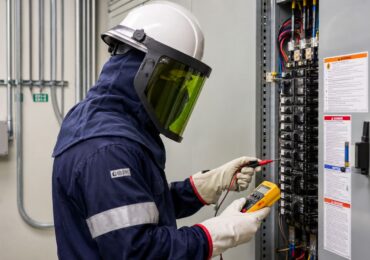
A tenant emails about a faint burning smell near a closet panel. The panel door is warm, nothing has tripped, and the technician who looks at it finds no obvious fault, so the ticket gets closed as a nuisance. Six weeks later, on the first hot afternoon of summer, the connection that had been cooking since spring lets go and half the building goes dark.
That sequence is the normal shape of a commercial electrical failure. It rarely starts with a bang. It starts with a warm termination, a slightly discolored breaker handle, a battery that no longer holds its full duration, a bonding jumper a renovation crew left dangling. Every one of those conditions is visible to someone who looks on a schedule.
An electrical preventive maintenance checklist earns its keep when it does three things. It names the task, it fixes an interval that matches how the equipment is used, and it defines the finding that stops being routine maintenance and becomes a contractor call.
What follows are the eight tasks that carry the most weight in office buildings, retail centers, multifamily communities, and hospitality properties. Treat the intervals as starting points for normal commercial duty. Anything serving life safety, or sitting in a parking structure, deserves a shorter cycle.
1. Infrared Thermographic Inspection of Energized Electrical Equipment
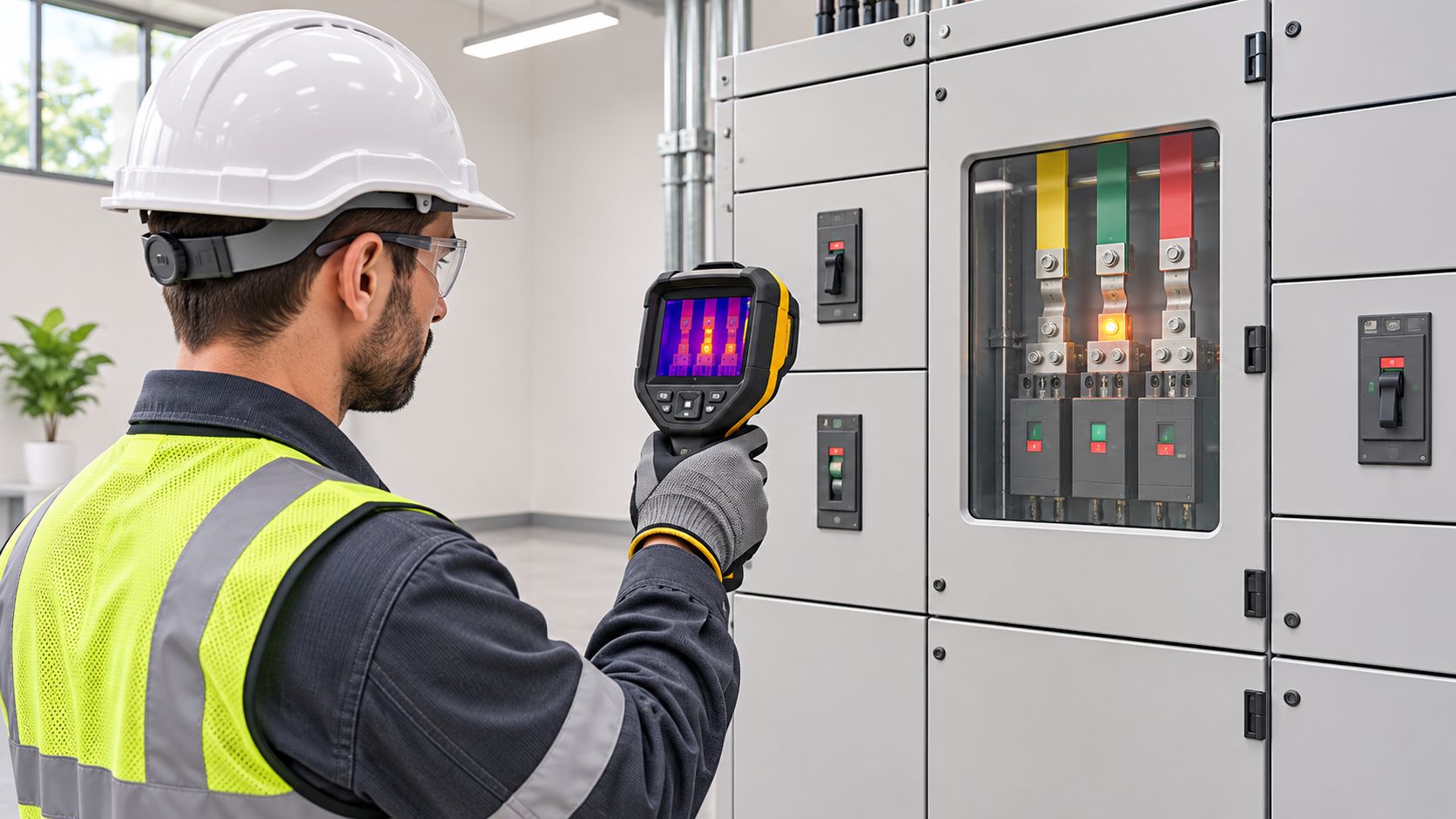
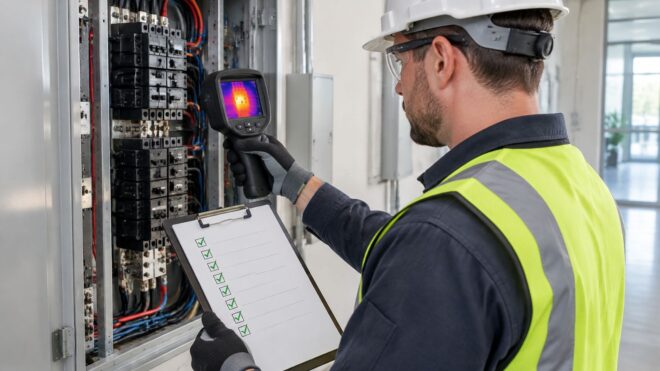
A thermal camera finds failures before they become outages. Loose lugs, worn equipment, overheating circuits, and unbalanced phases all raise resistance at a joint. Resistance turns current into heat long before it turns into smoke. Thermography images energized equipment under normal load, so those hot spots get ranked and scheduled before they become emergency repairs. Access Electrical & Lighting's infrared electrical testing pinpoints issues such as overheating circuits, loose connections, and worn-out equipment.
What a scan actually catches
The camera does not diagnose the fault by itself. It shows a temperature rise. The skill is comparing that rise with a sister phase, an identical breaker, or the same lug photographed during an earlier scan. Grade anomalies against a comparable component, not against the ambient temperature of the room. A hot breaker in a cool electrical closet may be normal if every neighboring breaker reads the same. One warm lug beside two cool ones is a maintenance finding.
The ANSI/NETA temperature-differential benchmark assigns the differential. A rise of 1 to 3°C is a possible deficiency worth investigating, 4 to 15°C is a deficiency to repair as conditions permit, and 16°C or more is a major deficiency requiring immediate repair. Those bands turn a thermal image into a work order with a priority attached.
How often to scan
ABB's preventive maintenance services guide lays out the NFPA 70B intervals. Infrared thermography sits at a maximum of 12 months for Condition 1 and Condition 2 assets, and 6 months for Condition 3 assets, meaning equipment with missed maintenance cycles or identified issues. For a commercial portfolio, that translates to annual scans on mains and distribution panels, twice a year on anything already on a repair watchlist. Parking-structure equipment and life-safety circuits deserve a shorter cycle than relaxed interior distribution.
Image equipment at 40 percent of rated load or more, and write the load down next to every image. A scan taken on a quiet Sunday morning proves almost nothing.
When a hotspot becomes a contractor call
Treat any reading of 16°C or more above a comparable connection as a contractor call. The same applies to any hotspot on a main service, elevator feeder, or life-safety circuit, and any reading that returns at the same termination after a re-torque. A loose lug on a multifamily house panel feeder running well above its phase counterparts calls for same-week re-torque and a follow-up image, not a line item on next year's budget.
The report is the product. It should carry the image, the load at the time, the severity, and the corrective action. That is what infrared thermography inspection services from a licensed contractor should hand you, ready to forward to an owner or an insurer. Access Electrical & Lighting is licensed and bonded. For background on what thermal imaging can and can't prove, E & I Sales on electrical safety is a reasonable primer.
2. Torque Verification of Electrical Connections

Copper and aluminum move. Every load cycle expands a lug a fraction of a millimeter, every cool-down contracts it, and after a few thousand cycles a termination that was torqued correctly at commissioning sits looser than the engineer intended. Vibration from rooftop units and the creep that comes with age finish the job. What's left is a high-resistance joint, which is exactly what an infrared camera finds six months later.
Torque verification is the cheapest correction in the whole program. A calibrated wrench, the value printed on the equipment label, and a few minutes per connection, and you've removed most of the heat that starts electrical fires.
What gets checked and what you need first
Lock out and tag out, then verify the absence of voltage at the point of work. Read the torque value from the equipment label or the manufacturer's instructions rather than from memory, because a panel built in 1998 and a panel built last year rarely share a specification. Tighten, then stripe the fastener with a contrasting witness mark so the next technician can see movement at a glance.
- Main and branch terminations: the lugs, neutral bar, and ground bar where heat concentrates.
- Busbar joints: bolted connections inside switchgear, done to the manufacturer's sequence with the specified hardware.
- Breaker terminals: especially after any panel modification or load addition.
How often, and the condition override
NFPA 70B doesn't override the manufacturer, and Eaton's NFPA 70B white paper makes that hierarchy explicit. Where instructions exist, they govern. Where they don't, the standard's method applies, and the highest-risk assessment among condition, criticality, and environment sets the interval. A switchboard in a humid parking structure or serving a critical tenant gets checked annually. A clean office panel can ride a longer cycle tied to its shutdown.
A witness mark is the cheapest maintenance record you'll ever make. One stripe of paint across the bolt head and the lug tells the next technician whether anything moved since the last visit.
When it becomes a contractor call
Aluminum feeders, busbar joints that call for a torque sequence and Belleville washers, and any lug that won't hold its value after a re-torque. A termination that spins or strips is a replacement, and on a main that's a planned outage, not a screwdriver and hope. Say a hospitality property's shutdown turns up a warm terminal flagged by an earlier scan. The corrective work is a torque check plus a follow-up image, and it doesn't happen while the building is occupied.
3. Emergency Lighting and Exit Sign Functional Testing
Emergency lighting fails without drama. A fixture sits dark for years, gets a quick button test now and then, and the battery is already past its useful life when an outage finally asks it to run.
Two tests, two intervals
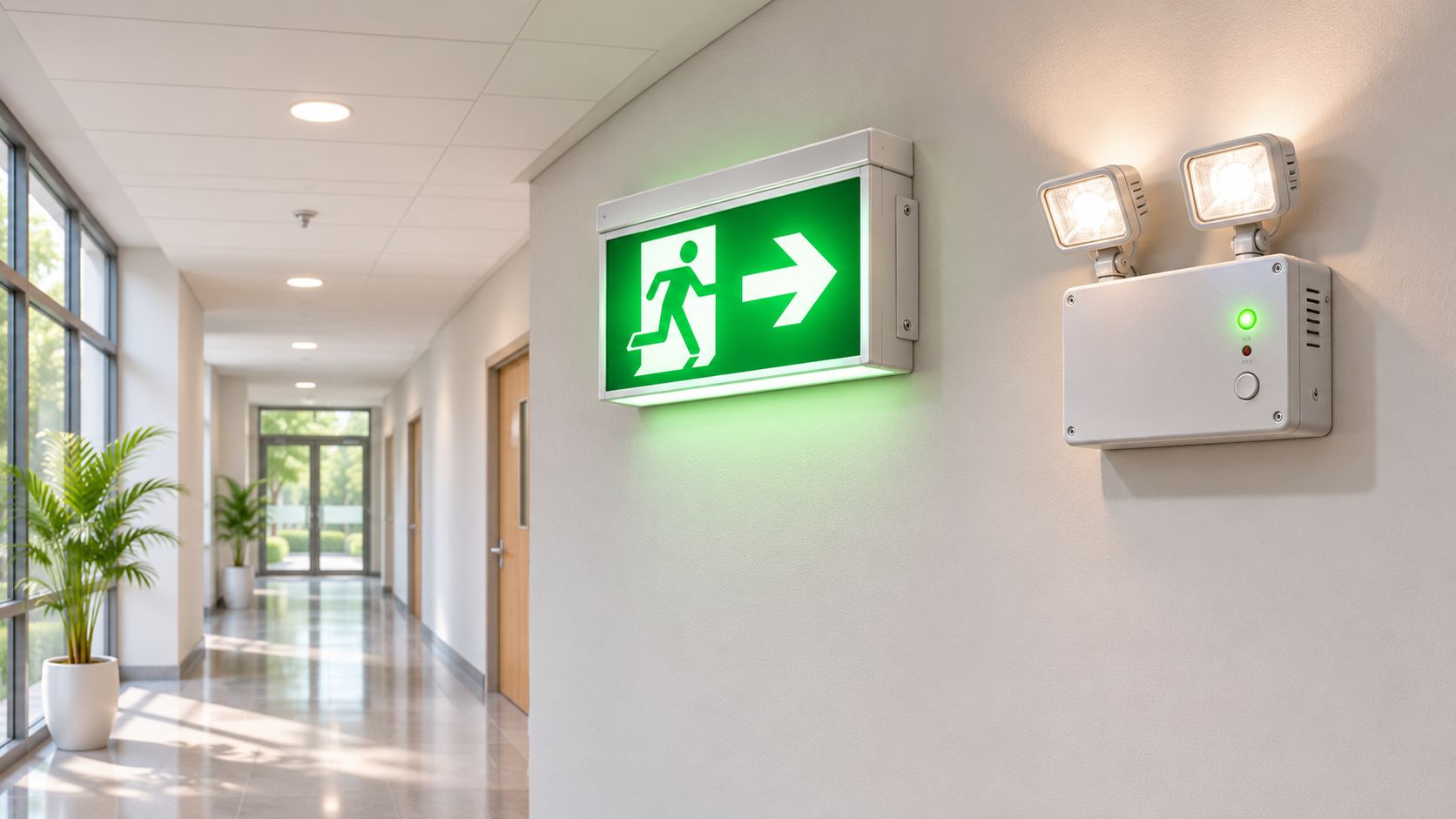
The monthly function test means switching each unit to battery for roughly 30 seconds and confirming it illuminates and the charge indicator reads normal. It catches dead lamps, failed transfer circuits, and units someone unplugged to use the outlet. The annual duration test runs every unit on battery for a full 90 minutes and confirms sustained output, which is where aging batteries show themselves.
Why the monthly test gets skipped
The discipline problem is measurable. A 2024 survey of 686 U.S. maintenance professionals reported by FacilitiesNet found teams completed only 54% of scheduled preventive-maintenance tasks. Monthly fixture testing is exactly the kind of work that gets dropped when a property is short-staffed and nothing appears broken.
- Log every unit: location, test date, result, and battery replacement date, not a single checkbox for the building.
- Tag the fixture: a label with the last test date turns a fire marshal walkthrough into a two-minute check.
- Replace on schedule: batteries in hot stairwells and parking structures give up years early.
When it becomes a contractor call
A unit that fails the 90-minute duration test, a battery that swells or leaks, several fixtures from the same batch failing together, or a head that lights but dims within two minutes. If half a floor goes dark on the same circuit, treat it as a wiring problem rather than a battery problem and stop replacing parts.
Testing is also a service you can hand off entirely. Emergency lighting inspection covers both tests with the documentation a fire marshal expects, which is usually faster than rebuilding the program in house.
4. Insulation Resistance Testing of Conductors and Equipment
Megger testing answers a trend question, not a pass-fail one. A feeder reading 500 megohms means very little on its own. The same feeder at 500 megohms last year, 300 the year before, and 180 the year before that is a cable you plan to replace.
What the test actually measures
The tester applies a DC voltage across the insulation and measures leakage current, which converts to resistance. It's used on feeder cables, motors, transformers, and switchgear buses. Three habits make the results usable. Record the temperature and apply correction factors before comparing readings, use the same test voltage every year, and discharge the equipment fully after testing so nobody touches a stored charge.
- Baseline first: a single reading taken during a fault investigation tells you almost nothing without history.
- Trend over pass-fail: a steady decline across three years is the signal, even while numbers still look acceptable.
- Motors separately: polarization index on a motor tells you about moisture and contamination in the winding.
Testing carries its own risk
Sensitive electronics don't enjoy test voltage. Variable-frequency drives, surge protective devices, electronic trip units, and controls need to be isolated or disconnected before you apply it, or the test damages the equipment you were trying to protect. Sequence matters too. ELECTRI International's guide to NFPA 70 walks a panelboard job through an energized infrared scan first, then lockout/tagout, torqueing, moisture and corrosion checks, re-energization, and load-current measurement, precisely because intrusive work creates risk of its own.
When it becomes a contractor call
Three consecutive readings heading down, a motor's polarization index falling, any result under the manufacturer's minimum, or equipment you can't isolate without an outage. That last one is the honest limit. If shutting down the service to test it would take down a data room or a refrigeration case, the test gets planned into a shutdown window, not squeezed into a quiet afternoon.
5. Circuit Breaker Inspection and Operational Testing
A breaker that hasn't tripped in ten years isn't necessarily a breaker that will trip when you need it. Lubricants dry out, mechanisms seize from disuse, contacts pit, and the device sits there looking perfectly normal while it does none of its job.
What the visual pass catches
Discolored handles, cracked cases, heat damage on the enclosure, missing accessory covers, and breakers that smell of scorched plastic. None of those need a test set to identify. They need a replacement ordered.
What the testing pass catches
Exercising each breaker, opening and closing it, keeps the mechanism free. Larger frames get trip testing on the manufacturer's schedule, and the settings get verified against the coordination study any time equipment is added downstream. Scan thermally before and after so you know the operation didn't create a new hotspot.
The failure rate on inspected equipment is not small. Technical Safety BC's 2024 assessment data reported that 24% of 15,577 in-person electrical assessments failed. Roughly one in four assessments turns up something that doesn't pass, which should recalibrate how much faith you place in a panel that "has always been fine."
Do not reset and hope. A breaker that has tripped twice in a month is telling you something about the load, the wiring, or the device itself, and a reset answers none of those questions.
Industry respondents say the same thing about maintenance in general. The 2025 Plant Services Electrical Safety Survey found 37.0% of more than 150 respondents identified poor or ineffective equipment maintenance as a key electrical safety challenge, roughly level with ineffective training.
When it becomes a contractor call
A breaker that fails to trip under test, one that trips repeatedly without an overload, a handle that's hot or discolored, or an obsolete frame with no replacement parts available. Obsolete gear is a budget conversation, not a maintenance task, and it's better had before the failure than after.
6. Panel Enclosure Cleaning, Clearance Verification, and Labeling
Panels fail from the outside in more often than owners expect. Dust bridges across insulators, moisture tracks down a bus, a pallet of tile parked in front of a disconnect for three months because the electrical room had a spare corner.
The program argument for documentation
NFPA 70B moved from a recommended practice to a standard in 2023, and as NTT's electrical safety white paper notes, that shift makes documented maintenance programs relevant to OSHA enforcement and asks facilities to define covered equipment, frequencies, testing, worker qualifications, and audits. The label and the log stop being housekeeping and start being evidence.
What the task involves
- Clear the working space: mark the required clearance in front of every panel on the floor, and enforce it with housekeeping, not memos.
- Clean dry, not blown: use a vacuum rather than compressed air, which drives dust into contacts and mechanisms.
- Look for water: staining, rust, and mineral trails at service and meter panels are findings, not cosmetic issues.
- Restore the envelope: missing deadfronts, open knockouts, and damaged covers defeat the enclosure rating.
- Update the directory: circuit labels drift with every tenant improvement, and a wrong label is a safety hazard during an outage.
When it becomes a contractor call
Water intrusion at a service or meter panel, a scorched bus or terminal, a missing deadfront, an arc flash label that no longer matches the equipment after a service change, or a clearance problem you can't fix without relocating gear. Say a parking structure's electrical room is cleared of stored materials after an inspection finds the working space blocked. The follow-up is a switchgear maintenance visit that documents interior condition, because a room that got used for storage rarely got inspected during that time.
7. Grounding and Bonding System Testing
The grounding system is the one circuit nobody examines until someone gets shocked. Its job is to give fault current a low-impedance path back to the source so the breaker trips quickly, and to hold metal surfaces at a safe voltage while it does. A high-resistance ground path means a fault sits there energizing equipment instead of clearing.
What goes wrong over time
Corrosion eats connections at grade. Clamps loosen. Bonding jumpers get removed during a renovation and never reconnected, water piping gets replaced with plastic without anyone revisiting the electrode system, and a new service gets installed while the old bond stays where it was.
Testing means checking continuity at bonding points with a clamp-on tester and measuring electrode resistance where the system allows it. Nothing exotic, but it has to be done on a schedule with the results recorded per test point.
Take ground resistance readings in dry weather and write the conditions next to the number. A measurement taken after a week of rain flatters the system.
When it becomes a contractor call
A bonding jumper that's missing or disconnected, electrode resistance trending upward across visits, corrosion that has eaten into a connection at grade, or any service upgrade that didn't document the electrode system. Keep a site diagram showing electrode locations and test points. Without it, the next technician spends an hour with a shovel.
8. Light Pole and Outdoor Fixture Integrity Inspection
Outdoor pole inspection is a once-a-year task for parking lots and site lighting, and twice a year along the coast where salt air accelerates corrosion. Poles fail at the base, and they fail slowly. Corrosion eats wall thickness from the inside, the base plate rusts under the paint, anchor bolts lose tension, and the first person to notice is usually the one who parked under it.
What the inspection covers
- Shaft and base plate: surface rust, pitting, deformation, and any crack in the weld at the base. These findings matter because base corrosion and weld cracking can reduce the pole's ability to carry wind and fixture loads.
- Anchor bolts and leveling nuts: check tension where accessible, and look for missing or corroded hardware. Loose hardware lets the pole move, which opens up the base seal and speeds up water intrusion.
- Handhole covers and wiring: a cover missing or a handhole holding water means the connections inside are sitting in it. Water in the handhole points to failed sealing, damaged wiring, or connections that need repair before the circuit starts tripping or corroding further.
- Controls: photocells, time clocks, and contactors drift, and a failed photocell burns power all day. Controls that stay on during daylight waste energy and shorten fixture runtime.
- Fixture condition: cracked lenses, loose heads, and water intrusion at the top of the pole. Any of these can lead to failed lamps, damaged drivers, or a fixture that drops parts into the parking area.
A practical check from the ground catches obvious lens damage, lean, missing covers, and wet handholes. It does not replace close access. A multifamily community using a boom truck to inspect 40 parking lot poles may find two with base corrosion advanced enough to schedule replacement. High-reach equipment, not a ladder, is what makes that inspection honest.
When it becomes a contractor call
Visible lean, corrosion that has gone through the wall, a cracked weld, standing water in a handhole, or any pole that has taken a vehicle hit. Those are structural, and no amount of re-lamping fixes them. Pair the inspection with an LED retrofit or controls upgrade when access is already planned. That is the point where the trip up the pole buys more than one repair.
How the eight preventive maintenance tasks compare by standard, risk addressed, and energized work
| Item | Key Standard | Primary Risk Addressed | Work on Energized Equipment |
|---|---|---|---|
| Infrared Thermographic Inspection of Energized Electrical Equipment | NFPA 70B; ANSI/NETA MTS; NFPA 70E | Undetected hotspots, connection failures, and electrical fires | Yes; non-contact inspection under load |
| Torque Verification of Electrical Connections | NFPA 70B; NFPA 70E; OSHA 29 CFR 1910.147 | Loose connections, overheating, arcing, and fire | No; typically de-energized and locked out |
| Emergency Lighting and Exit Sign Functional Testing | NFPA 101; NFPA 70 Articles 700 and 701 | Failed emergency illumination or signage during evacuation | No intrusive energized work; tests verify battery operation |
| Insulation Resistance Testing of Conductors and Equipment | ANSI/NETA MTS; IEEE 43; NFPA 70B | Insulation deterioration, ground faults, and short circuits | No; equipment must be de-energized and disconnected |
| Circuit Breaker Inspection and Operational Testing | ANSI/NETA MTS; NFPA 70B; UL 489 | Breaker failure to trip, fire, and equipment damage | Usually no; testing commonly requires an outage |
| Panel Enclosure Cleaning, Clearance Verification, and Labeling | NFPA 70 Section 110.26; NFPA 70E; NFPA 70B | Shock and arc-flash exposure, contamination, and blocked access | Prefer de-energized for cleaning; some checks are visual |
| Grounding and Bonding System Testing | NFPA 70 Article 250; IEEE 142; ANSI/NETA MTS | Electric shock, hazardous voltage, and ineffective fault clearing | Some checks can be performed energized; depends on method |
| Light Pole and Outdoor Fixture Integrity Inspection | ANSI/ASCE 7; AASHTO LTS; NFPA 70 Article 410 | Pole or fixture failure, injury, and wiring-related faults | May include energized functional checks; electrical work should be de-energized |
Turning This Checklist Into a Year-Round Maintenance Schedule
A retail center loses half its lot lights in August, and the panel that feeds them has been running hot since May. That failure was preventable. Put infrared scans and torque verification in spring, before heat and peak load expose every weak connection. Run monthly emergency lighting function tests with the full duration test once a year. Schedule pole and grounding work for dry months, when access is clear and readings stay stable.
Give each log one owner and keep baseline readings with every visit. A scan without history is a photo. A scan compared to last year is a decision, because you can see which connection is heating, which insulation reading is sliding, and which pole is losing metal at the base.
Call a licensed contractor when a thermal scan shows a hotspot at or beyond a major deficiency, when insulation resistance trends down across consecutive tests, when a breaker fails to trip cleanly, when grounding continuity cannot be restored, or when a pole base shows section loss. Those results stop being maintenance tasks. They become repair, shutdown, and liability decisions.
Condition monitoring is moving toward permanent sensors. Eaton's 2025 continuous thermal monitoring survey reported the technology specified in 71% of surveyed electrical engineering and power-distribution applications. That approach helps on switchgear that is hard to scan, and it does not replace the annual walkdown, the torque check, or a technician's judgment.
Access Electrical and Lighting, a licensed and bonded California C-10 contractor (license 952234) serving Orange County and surrounding regions, handles infrared inspections with documented reports, emergency lighting and exit sign testing, and 24/7 emergency response, with free estimates on corrective work. Teams building out the mechanical side of the same program can use this guide on how to build a motor maintenance schedule as a companion.