You're standing in a building where the tenants can tell you exactly what's wrong, even if they don't say it politely. The office feels flat in the morning, too harsh in the afternoon, and someone keeps blaming “the lighting” for headaches, glare, or just a space that feels tired. On a retrofit job, that's usually the moment tunable white LED lighting stops sounding like a spec-sheet feature and starts looking like a practical tool.
The technology has moved well beyond boutique applications. Independent market estimates put the tunable white LED lighting market at $2.87 billion in 2024 with a projected $11.42 billion by 2033, based on a 16.7% CAGR over that forecast period, and another analysis put the market at over $2 billion globally in 2023 with commercial uses around 70% of demand, and residential and industrial each around 15% (market estimate summary). That doesn't mean every building needs it. It does mean owners are asking the right question now, which is whether a controllable white system improves the space, or whether simple dimming gets the job done.
Why Tunable White Is Showing Up in Commercial Buildings
A property manager usually doesn't start with a lighting theory. She starts with tenant complaints, a lease renewal conversation, or a common area that feels dated compared with the office next door. When a building's lighting can't shift with the workday, the property starts to feel less flexible than the tenant expects, and in commercial real estate that's a real problem.
Tunable white LED lighting is the practical answer to that pressure. It lets a fixture move between warmer and cooler white light without changing the luminaire itself, which makes it a stronger fit for leased offices, hospitality lobbies, retail environments, healthcare spaces, and amenity areas where people spend time at different parts of the day. The market mix matters too. Commercial demand is where most of the action is, which lines up with what contractors see on job sites, owners want more control, not just more light.
Why it moved from specialty to mainstream
This wasn't only a design trend. It became useful because tenant expectations changed faster than old lighting systems did. A warm lobby in the evening can feel inviting, while a cooler white setting in the morning can make a space feel sharper and more active, which is why the same technology shows up in offices, hospitality, retail, healthcare, and other commercial settings.
The deeper reason is architectural. Most legacy systems were built to do one thing well, turn on and dim. Tunable white gives owners a second dimension, color temperature, so a property team can align the light with the use of the space instead of forcing every room to live at one fixed visual tone.
Practical rule: if occupants notice the light only when it feels wrong, the property already has a lighting problem. Tunable white can solve that, but only when the building actually needs control, not just replacement lamps.
Before anyone bids the work, the three questions are always the same. What does the system really do, what does the control package add, and can the existing building support it without turning a clean retrofit into a coordination mess. Those questions matter more than the fixture brochure.
How Tunable White Works
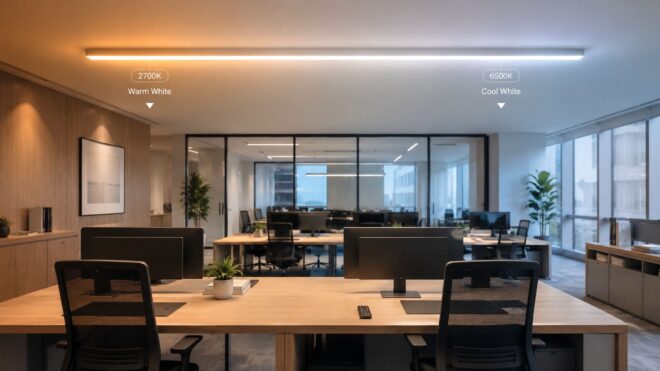
Tunable white is easier to understand if you stop thinking about it as a special lamp and start thinking about it as two light sources blended inside one fixture. One channel is usually a warmer white, the other is a cooler white, and the control system mixes them so the output moves across a range of white tones without swapping fixtures or changing lenses.
The technical term you'll see is correlated color temperature, or CCT. In plain English, that means how “warm” or “cool” the white light looks. Candlelight sits on one end, midday daylight on the other. The U.S. Department of Energy describes tunable white products as systems with two controllable phosphor-coated LED channels, usually a warm-white channel around 2700K and a cool-white channel around 5000K to 6500K (DOE explanation), and ERCO notes that ranges commonly run from roughly 2700K to 6500K, with some literature extending from about 2000K to 6000K (ERCO technical overview).
Tunable white is not RGBW
A lot of people lump tunable white in with color-changing systems, but they're not the same thing. RGBW adds red, green, blue, and sometimes white for decorative color effects, while tunable white stays focused on the white spectrum, which is what most commercial spaces need. Offices, corridors, retail floors, and multifamily common areas usually want better white light, not a rainbow.
That distinction matters on a job site. If the owner wants brand accents or a feature wall that shifts colors, that's one conversation. If the goal is to make a conference room feel sharper in the morning and calmer late in the day, tunable white is the cleaner tool.
Drivers and controls are where projects succeed or stumble
The fixture is only half the system. You also need a driver that can handle two channels and a control method that tells those channels how to blend. On retrofits, that's where 0-10V, DALI, and wireless control come into the conversation, because the same fixture can behave very differently depending on the signal layer behind it.
0-10V is common and familiar. DALI gives more granular control and tends to make sense when a project needs tighter zoning or more addressable behavior. Wireless systems can be useful where pulling new control wiring would create too much disruption. The right choice depends on the building, not the brochure.
Benefits That Show Up in Operations
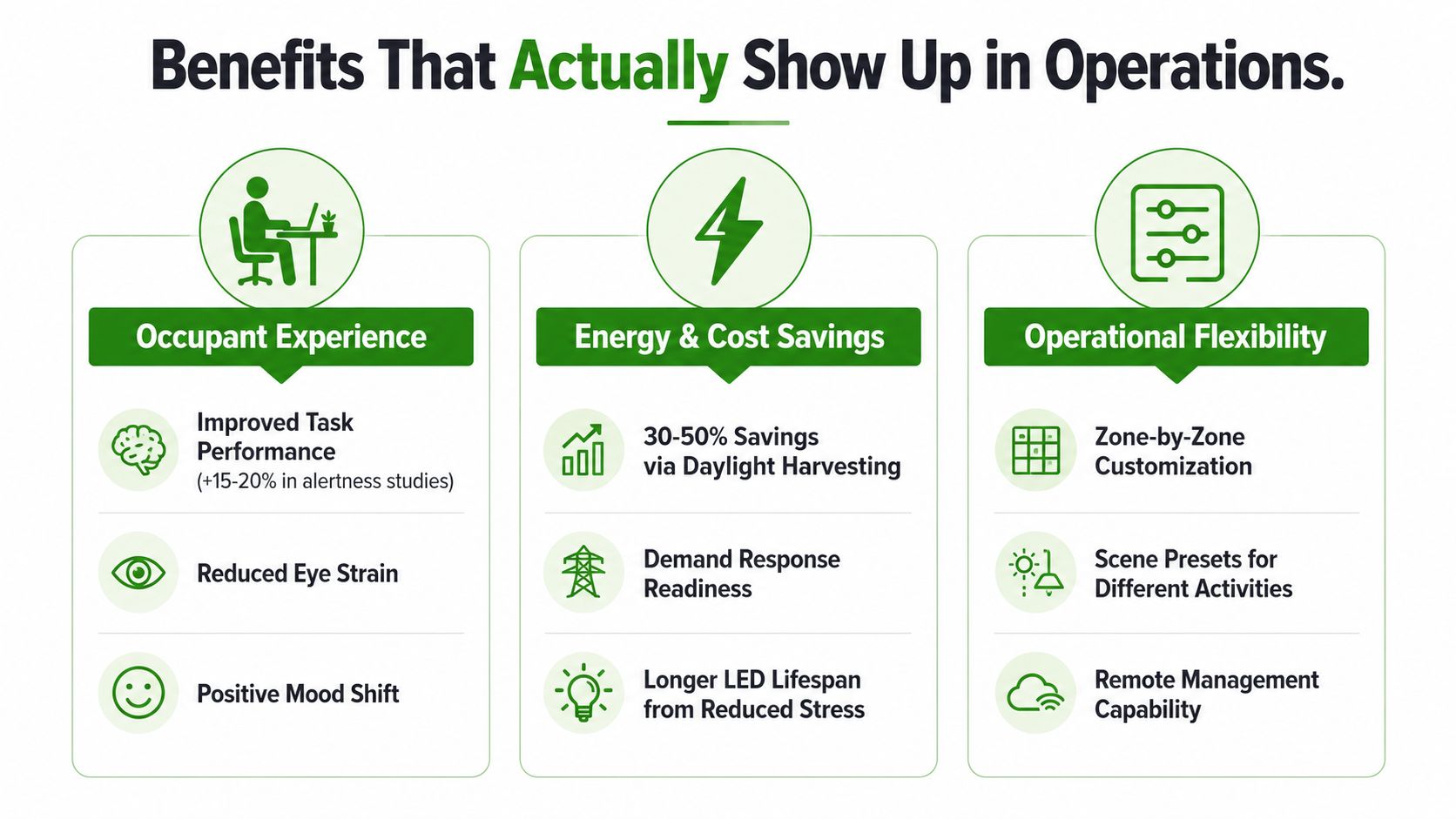
Tunable white gets sold as a wellness feature, but facility teams care about what they can see, verify, and maintain after turnover. In practice, the value usually lands in three buckets, occupant experience, financial performance, and risk reduction. Those buckets do not show up the same way in every building, and that is where a lot of sales talk gets too broad.
Occupant experience
The strongest case shows up in spaces where people stay put for long stretches, especially offices, healthcare settings, and amenity rooms. In those environments, a cooler setting in the morning and a warmer tone later in the day can make the space feel better aligned with how people use it. People may not talk about the color temperature, but they do notice when the room feels less harsh and less static.
A building team can build that behavior into a well-commissioned control sequence, then leave it alone once the settings prove out. That only works if the owner is willing to support the schedule in real use, not just during the punch list.
Tunable white carries less value in places people only pass through. Corridors, storage areas, and some parking applications usually do not need a light schedule that tries to influence behavior. They need consistent visibility and control that works every day.
Financial performance
Owners sometimes assume tunable white automatically saves energy. It does not, at least not by itself. The savings usually come from the LED platform, zoning, daylight controls, occupancy logic, and better scheduling, not from color tuning alone. If the controls are simple and the building is already moving away from inefficient legacy fixtures, the operating picture can improve, but the system still has to be designed with the right sequences and the right commissioning plan.
That is where the trade-off shows up on retrofit jobs. A project with good dimming, clean zoning, and a straightforward schedule can deliver a lot of the operating benefit without adding the extra coordination that tunable white needs. Once you add multiple channels, more programming, and more points of failure, the owner has to care enough to keep using those features or the value fades fast.
Risk reduction
This is the part many brochures skip. Good white light can reduce visual complaints, improve task visibility, and support a safer-feeling environment in areas where people work, wait, or move through a space at odd hours. That matters in multifamily amenity areas, lobbies, and certain retail spaces where the quality of the light changes how secure and cared for the property feels.
The risk side is practical, not theoretical. If a tenant is getting complaints about glare, uneven color, or a space that feels tired by midafternoon, the right tune and schedule can solve a real problem. If nobody has a complaint and the building already dims well, a simpler package may be the better spend.
A building team should ask one question before approving a tunable white proposal, where will the control change daily decisions. If nobody will touch the settings after commissioning, a simpler dimming package may be the smarter spend.
Where Tunable White Fits in Real Property Types
In office work, the best tunable white schedules are usually boring in the best way. A cooler morning setting helps the floor feel active when people arrive, and a warmer late-afternoon tone can soften the space before people head out. That doesn't need to be dramatic. It just needs to be consistent enough that the tenant feels the building is working with the day instead of against it.
Retail is different. The job there is visual merchandising, not circadian design. A clothing store, cosmetic counter, or showroom can use tunable white to make materials look right under different conditions, or to shift the feel of a space by zone. One area can read cleaner and brighter, while another holds a warmer, more relaxed tone that slows people down.
Multifamily needs separate thinking for each area
Amenity spaces, leasing offices, and parking garages should not be treated like one lighting project. A leasing office may benefit from a polished white tone that feels professional during showings, while an amenity room may want a softer setting for evening use. Parking structures are mostly about uniform visibility and reliability, so tunable white is only worth it when the owner has a specific operational reason, not just because the fixture can do it.
A day in the life of a building schedule
A commercial building with tuned white zones often follows the same pattern, even when the settings are customized.
- Morning arrival: a cooler scene makes desks, reception areas, and showrooms feel more alert.
- Midday operation: the system holds a stable white tone that supports the main use of the space.
- Late afternoon: a warmer scene softens the visual feel before occupancy drops.
- After hours: occupancy sensors and scheduled shutoff take over, so the space isn't manually babysat.
That kind of schedule works because it matches use, not because the light is fancy. If the building's real activity is transit, storage, or short-duration occupancy, tunable white often adds more complexity than value.
Choosing the Right Controls and Integration Path
The control layer decides whether a tunable white project feels elegant or annoying. Fixtures can be excellent and still underperform if the zones are wrong, the programming is too complicated, or the staff can't remember how to call up a scene without calling the installer.
DALI, DMX, and wireless side by side
| Protocol | Best Fit | Cost Per Zone | Retrofit Friendliness |
|---|---|---|---|
| DALI | Commercial spaces that need addressable, flexible control | Moderate | Good when wiring can be updated |
| DMX | More specialized scenes and precise control behaviors | Moderate to higher | Less common in standard office retrofits |
| Wireless | Retrofits where pulling new control wire is difficult | Variable | Strong when the ceiling is hard to open |
The question is not which protocol sounds smartest. It's which one the property team can support after turnover. A good system should let on-site staff make routine changes without a specialist every time a tenant moves a desk wall.
What the software should do
Circadian scheduling usually means programmed scenes, not some magical live tracking system. In most commercial projects, the controls hold a morning scene, a midday scene, and an evening scene, then switch them on a clock or sensor logic. That's enough for many buildings, and it's far easier to maintain than overbuilt automation that nobody understands.
Practical rule: if a controls sequence can't be explained to the maintenance supervisor in two minutes, it's probably too complicated for a retrofit.
For retrofit work, I look hard at occupancy sensors, daylight response, and how the system reports faults. Access Electrical and Lighting handles this kind of control integration on commercial properties, along with lighting installation and Title 24 work, but the same logic applies no matter who installs it. Simplicity usually wins when the building needs reliability more than gadgetry.
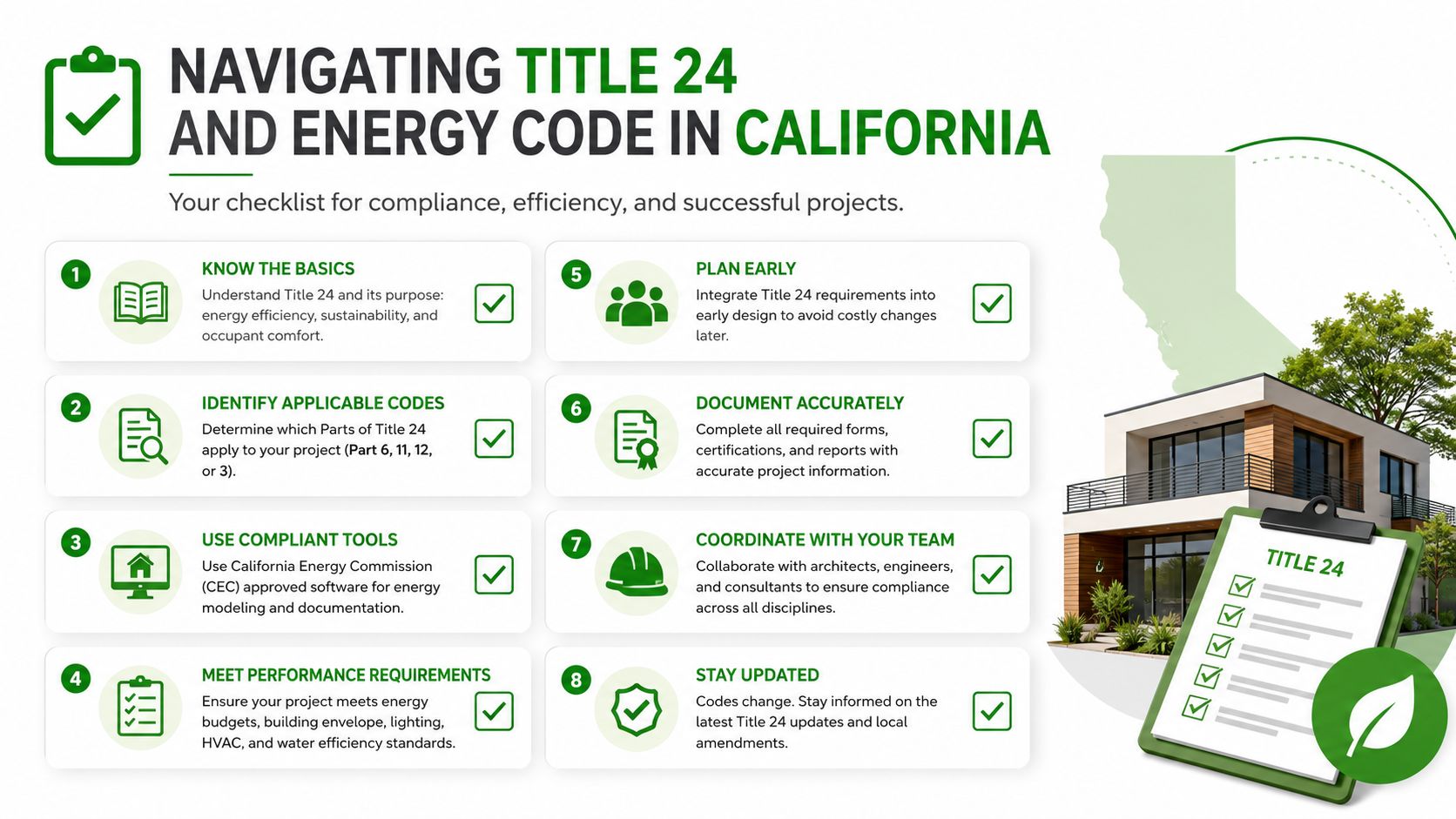
Navigating Title 24 and Energy Code in California
California projects live or die on paperwork as much as hardware. Tunable white can help because dimming, zoning, and control functions often align with what inspectors want to see, but it can also create extra documentation if the team doesn't verify the system correctly during commissioning.
Acceptance testing is the real gate
Title 24 isn't just a design checkbox. It's a field process. Inspectors want proof that the lighting shuts off when it should, that manual override works, that time-based control behaves as programmed, and that daylight harvesting responds to actual conditions. In a tunable white project, the installer also needs to show that the CCT transitions and scene changes match the sequence of operation.
The legal and practical burden falls on the contractor to commission the system properly and keep the records in order. That's why a licensed C-10 electrical contractor matters on these jobs, not only for installation quality but for the documentation trail that follows.
What owners should ask for
- Acceptance test records: Keep the signed paperwork, not just a verbal sign-off.
- Scene schedules: Make sure the programmed transitions are written down.
- Sensor locations: Verify daylight and occupancy devices are installed where the drawings say they are.
- Control narratives: Keep a simple description of what each zone is supposed to do.
The internal reference for property teams that need the baseline code conversation is Title 24 lighting requirements. If the project also has a control-system layer, the broader workflow fits with automated lighting controls.
Retrofit Versus New Construction Decisions
The retrofit question should start with the ceiling, not the sales pitch. If the existing housing, driver space, control wiring, and ceiling access are all reasonable, a tunable white upgrade can make sense. If the building is full of plaster ceilings, mixed circuit types, old conduit that can't be reused, or hidden conditions that keep changing the scope, forcing the upgrade now can waste money.
A few honest diagnostic questions
- Are the fixtures worth keeping? If the housing is sound and the layout is already right, you may not need a full rebuild.
- Can the driver and control method support two channels? If not, the retrofit path gets more expensive fast.
- Will the ceiling trades make the work painful? Access issues can turn a straightforward lighting project into a coordination project.
- Is this really a temporary condition? If the tenant improvement is coming soon, waiting for that remodel may be smarter.
For Orange County and nearby Southern California properties, commercial LED retrofit installation is often the right umbrella scope when the owner is replacing aging fixtures anyway. Tunable white belongs in that conversation when the tenant use case justifies the extra control layer, not just because the old lights are tired.
Installation, Commissioning, and Long-Term Maintenance
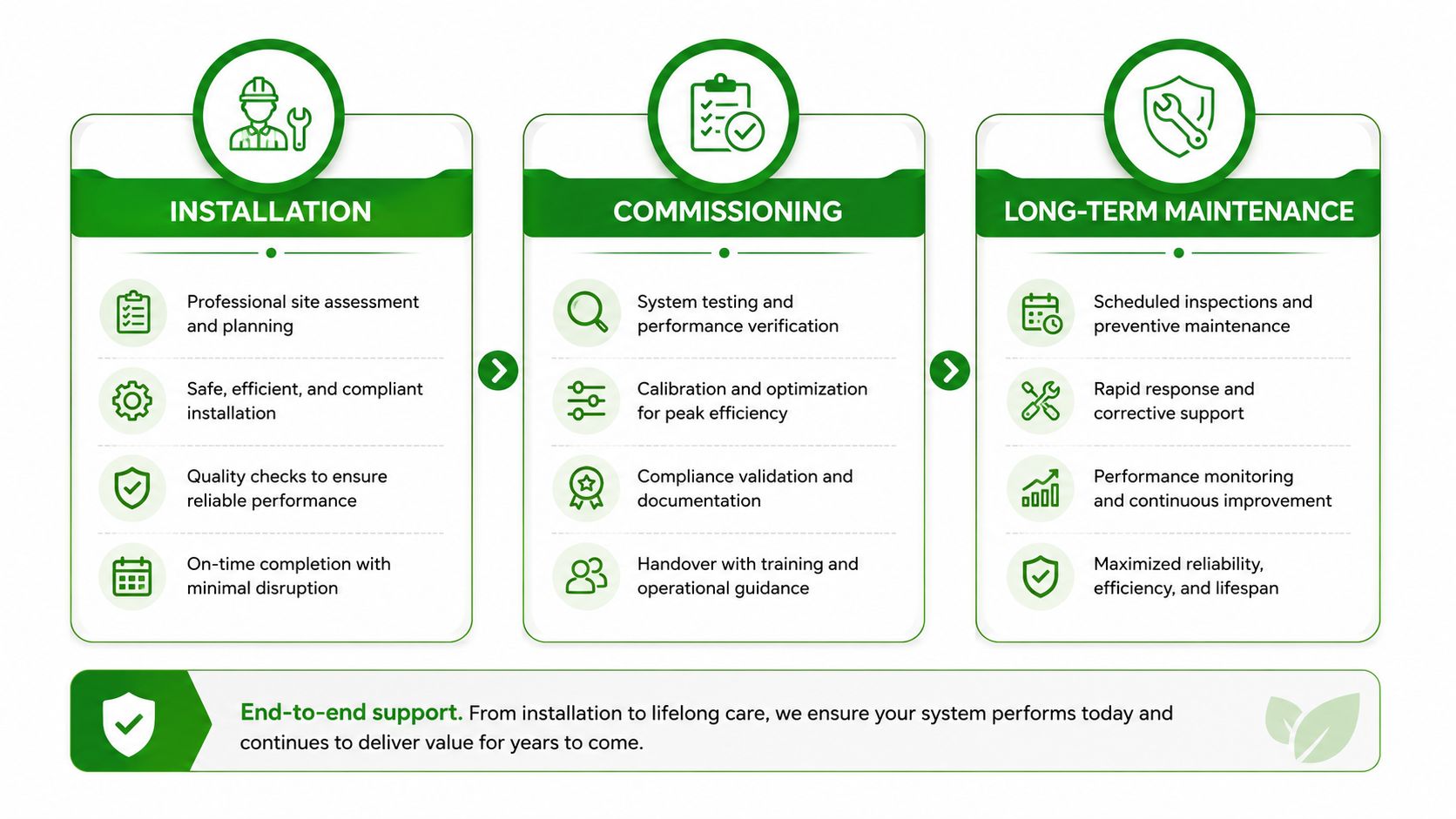
The cleanest tunable white jobs are the ones where the field crew thinks like a controls team from day one. Fixtures need to be grouped by zone, low-voltage control wires labeled clearly, and ceiling trades coordinated so somebody doesn't bury a control path that has to be found later. That sounds basic because it is, and it's also where a lot of projects lose time.
Commissioning is where the system becomes real
Commissioning should verify the CCT range, dimming curve, scene recall, and sensor behavior under actual site conditions. If the light doesn't blend smoothly, if one zone shifts differently from another, or if the occupancy logic is too aggressive, those problems need to get caught before turnover. That's the moment when a project either feels polished or disappoints the tenant for years.
Maintenance planning should be written before turnover
Color consistency matters over time, especially across open office floors and retail fronts where mismatched whites show up fast. Driver replacement strategy matters too, because a failed component on a two-channel system can create a nuisance if the spare parts plan was never discussed. Wireless systems also need firmware awareness, since controls platforms evolve and someone has to own that update path.
The strongest proposals don't just list fixture cutsheets. They tell you how the building will be maintained after the install crew leaves, how future tenant changes will be handled, and who is responsible for reprogramming scenes when a space changes use. That's the difference between a lighting upgrade and a lighting asset.
If you're evaluating tunable white LED lighting for a retrofit, tenant improvement, or new commercial project in Southern California, Access Electrical and Lighting can help with layout review, installation, controls integration, and Title 24 documentation. Visit Access Electrical and Lighting to discuss whether tunable white makes sense for your building, or whether a simpler dimming package will deliver the better result.