The popular advice is simple. Get three bids, compare lamp prices, pick the shortest payback. Don't hire that way. A cheap lamp on a pole you can't reach, with a sealed driver you can't replace and controls nobody commissioned, isn't a bargain. It's a future lift rental and a dark lot.
Hire LED lighting retrofit contractors on proof, not promises. Demand a measured baseline, a tested sample zone, repairable parts, and a named person who'll tune the system after handover. If a bidder can't show verified hours, controlled watts, and who owns the settings, the payback number is marketing.
How to Vet LED Lighting Retrofit Contractors
Run one scorecard on every bidder before you read a sales number. If a firm fails a row, remove it. Price comparisons mean nothing when one bidder is a licensed electrical contractor and another is a lighting reseller who'll subcontract the actual work to whoever answers the phone.
Start with licensing because it controls everything else. In California, confirm an active C-10 electrical license for the jurisdiction, check the license status yourself, and confirm a current bond. Don't accept a business card, a distributor certificate, or a promise that a partner company holds the license. The firm signing your contract should be the firm legally allowed to do the work.
Paperwork That Protects the Property
Ask for general liability and workers compensation certificates that name the owner or property manager as required by your risk team. Check the dates, then check the exclusions. Height work, pole work, and parking structure work can't be carved out of the policy while the crew is pricing exactly that scope.
An expired certificate is a stop sign. So is a certificate from a different entity than the one on the proposal. You're not being difficult. You're making sure an injury on a boom lift or damage in a garage doesn't become your property's uninsured problem.
Practical rule: No current license, bond, and insurance that covers the actual height and site conditions means no site walk, no bid review, and no second meeting.
Require three projects from the last five years with similar fixture counts and similar access problems. A 200 space surface lot, a multifamily garage, and a retail center test different skills, so match the reference to your site. Call the facility manager, not the salesperson who supplied the name as a favor.
Access and Controls Separate Contractors From Resellers
Confirm who supplies the boom truck or lift, who operates it, and whether the crew can work after dark. Pole and parking deck work often has to happen when customers and residents aren't moving through the work zone. A bidder with no operator plan will discover that constraint after you've signed.
Ask who designs the control zones. Occupancy sensing in a garage, photocell control on a lot, and dimming in a corridor aren't fixture features you turn on by accident. Someone has to decide zones, timeouts, light levels, and override behavior, then put that sequence in writing.
Where California Title 24 applies, ask who produces the acceptance forms and who performs the required testing. Don't let that become a surprise line item at closeout. The same rule applies to emergency and exit lighting. It belongs in the base scope, with a test plan, not in a change order after an inspector asks why a battery unit didn't transfer.
The Scorecard to Run on Every Bidder
| Criterion | What to verify | Red flag |
|---|---|---|
| License and bond | Active California C-10 license under the contracting firm's name, current bond, and license status checked directly | Unlicensed reseller or handyman bid |
| Insurance | Liability and workers compensation certificates naming the property, with height and pole work covered | Expired certificate or height exclusion |
| Similar sites | Three jobs in the last five years with similar fixture counts in parking, multifamily, retail, or office | Only residential or new-construction references |
| Access equipment | Owned or contracted boom or lift and a crew trained for night work | No operator plan for poles or decks |
| Controls and code | Zoning, dimming, and Title 24 acceptance documents where required | Fixture swap with no sequence of operation |
| Emergency lighting | Exit signs and battery units in the base scope and test plan | Emergency circuits discovered at inspection |
| After install | Warranty labor, spare drivers, and after-hours response | Manufacturer-only warranty and no site labor |
The scale of outdoor work is why this matters. The U.S. Department of Energy LED adoption report found outdoor applications reached 51.4% LED penetration by 2018, compared with 29.8% for indoor lighting. Outdoor fixtures run long hours and cost more to access, so weak access planning and weak parts support hurt you faster outside than they do in an office ceiling.
After install support is the row owners skip and later regret. Ask for the spare driver policy in writing. Ask who answers after hours when a pole goes dark, how warranty labor is handled, and whether the crew stocks the sensor or driver your project uses. A manufacturer phone tree isn't a service plan.
Shortlist only firms that clear every row. Then send each finalist the same fixture inventory, the same access notes, and the same operating schedule. That's how you get comparable prices, instead of three different scopes disguised as three bids.
Questions to Ask Each Bidder
Use these questions twice. Ask them on the reference call with the facility manager, then ask the bidder again during your site walkthrough. Strong answers name projects, counts, and dates. Vague answers on a reference call predict vague answers when your garage is half finished.
- Did the crew finish on the quoted schedule and hours? Ask what changed along the way and who approved it. A good contractor can explain a delay without blaming every other trade.
- How many fixtures were replaced, and how many were measured in the sample zone? You want a real count before the bulk order, not a showroom demo under different spacing.
- Which drivers or sensors failed in the first two years? Ask how fast the contractor returned and who paid for the lift. Parts fail. Response time is the differentiator.
- Who set the timeouts and dimming levels? Ask whether anyone retuned them after occupants used the space. Factory defaults rarely match a garage, stairwell, or retail back room.
- Did the lift operator work after dark? Ask about tenant or resident complaints, blocked spaces, and how notice was handled. Night work only helps if it's coordinated.
- Will you hand over as-built drawings, the sequence of operation, and network credentials? If the answer is hesitant, expect to pay later for access to your own system.
- Which warranty items cover labor and which cover parts only? Ask who pays for a return visit when a warranted driver fails above a parking deck.
- How do you price change orders when access or hidden wiring differs from the survey? You need the method before the crew opens a fixture and finds brittle conductors or a damaged housing.
Listen for ownership. "We set the sensors, we came back at 60 days, and we replaced two drivers under our labor warranty" is an answer. "The manufacturer handles that" is a warning.
What a Complete Proposal Must Include
Treat the proposal as a measurement plan, not a unit price. A complete bid tells you what's there now, what'll replace it, how it'll be tested, and what assumptions drive the savings. Walk every proposal through five gates, in order.
Gate 1 and Gate 2 Build the Baseline
1. Inventory the existing system. Require fixture types and quantities, connected wattage, operating hours, illuminance, existing controls, and at least 12 months of utility data in your review file. The proposal should separate a pole that runs dusk to dawn from an office fixture on a weekday schedule, because they don't produce the same savings.
2. Split the product options. Make the bidder price tubes, retrofit kits, and new luminaires as distinct paths where they apply. Flag housings that are rusted, cracked, heat damaged, or too small for the proposed kit. Reusing a failed housing to save first cost usually buys you a second mobilization.
| Option | Best when | Controls potential | Repair risk |
|---|---|---|---|
| LED tubes | Housings and sockets are sound and labor must stay low | Low | Nonstandard tube often means the driver is not serviceable |
| Retrofit kits | Housing is reusable but optics or heat need an upgrade | Medium to high | Medium when driver and optic are field replaceable, high when the kit is sealed |
| New luminaires | Failed housings, poles, decks, or an emergency redesign | Highest | Lowest if the bill of materials lists modular drivers and spares |
Gate 3 Tests Light, Not Brochures
3. Measure a sample zone before the bulk order. The U.S. General Services Administration TLED retrofit evaluation found two T8 LED retrofit products delivered only 27% and 29% energy savings against a generic electronic ballast T8 baseline. That result is why you should refuse a generic savings claim with no stated baseline.
The same evaluation recommended testing at least four fixtures in the predominant spacing before committing to a technology, because products with similar ratings can produce materially different light output. Test light level, distribution, glare, and color quality where people park, walk, and work. A single fixture over a loading dock doesn't prove a full garage layout.
Watch the practical failure points during the sample. Incompatible wire harnesses, poor fixture fit, and installation hardware that can create electrical problems show up in the first few fixtures if someone is looking. Selecting by lumen rating alone misses distribution, so a bright fixture can still leave dark gaps between poles or bays.
Gate 4 and Gate 5 Expose the Real Price
4. Separate every cost line. Labor, lifts, disposal, controls, commissioning, training, and as-built drawings should each be visible. A cheap lamp can hide expensive access, and a low fixture price can hide the fact that nobody priced sensor setup. For Southern California sites, confirm how the bidder will handle Title 24 lighting requirements and put the acceptance documentation in the base scope where it applies.
5. State the operating assumptions and ownership. The proposal must name assumed hours, controlled watts, control zones, and who owns schedules, logins, and any building automation link. It should also capture emergency lighting operation, dimming and control response, ceiling height, and ambient temperature where those conditions affect product choice.
Don't award a project because the spreadsheet is neat. Award it because the sample zone passed at the spacing, height, and light levels your property actually has.
Prefer replaceable drivers, optics, and control modules over sealed units that force a whole fixture swap when one part fails. Ask for the bill of materials by component, not just by fixture model. If a driver fails in year four, you need to know whether a technician can swap that driver from a lift in one visit.
Award only after the sample passes light level, glare, color, control response, and emergency transfer. If it fails, change the product or the layout before the bulk order. That's the cheapest moment to be wrong.
How Payback Changes with Controls
A fixture-only retrofit pays back on one lever: lower wattage. Controls add a second lever, fewer operating hours, and that second lever is where aggressive payback claims come from. Price both levers separately, or you'll never know which one is carrying the spreadsheet.
The ACEEE evaluation of integrated lighting systems reported 50% lighting electricity and demand savings from LEDs alone versus 93% when controls were implemented, with estimated payback improving from eight years to four years. Independent evaluations of integrated lighting and controls point the same direction: adding controls to an LED upgrade can materially increase savings beyond what the fixture swap delivers on its own.
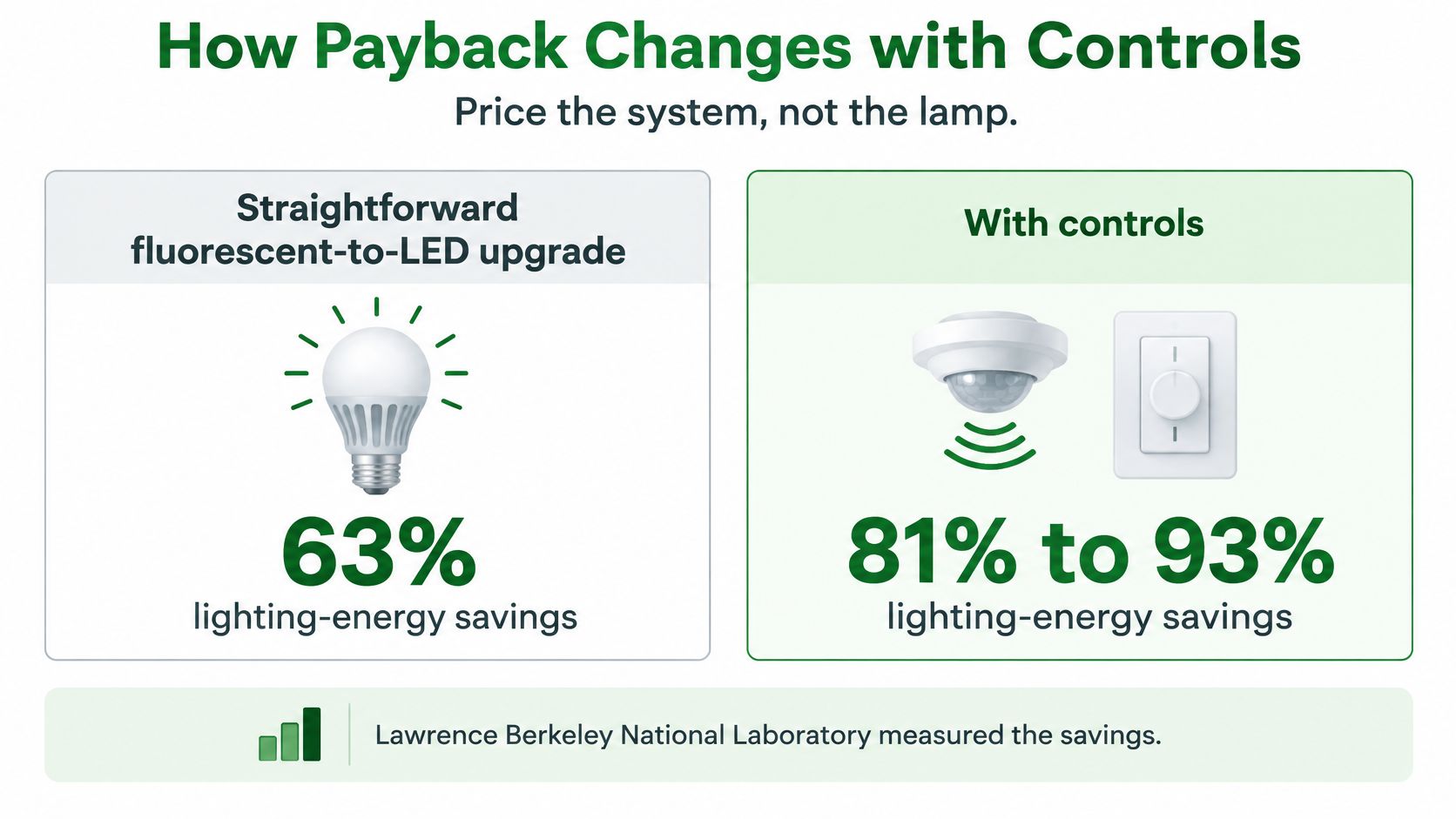
Those ranges don't transfer automatically to your building. A parking garage that stays lit all night has more hours to capture than a single-shift office. A lot already run by photocells has less waste left to remove. A warehouse aisle that sits empty most of the day is a strong candidate for occupancy control, while a continuously occupied sales floor can't claim the same credit. The question is never whether controls save energy in general. It's whether your zones have idle hours left to cut.
Force the Model to Show Its Work
Require three separate lines in every payback model.
- Baseline kilowatt hours: Existing connected watts multiplied by your documented operating hours, not a national schedule pasted into a template.
- Proposed connected watts: The new fixture load before control credit, so you can see what the hardware alone saves.
- Control credit: The added reduction from occupancy, daylight, scheduling, or task tuning, tied to named zones and settings.
Keep rebates out of the energy number. A rebate improves cash flow, but it doesn't reduce kilowatt hours, and it shouldn't disguise a weak operating case. Show the rebate as a separate scenario if you want one. Underwrite on energy and maintenance you can verify.
Put maintenance in its own column too. You'll make fewer relamping trips, especially at height, but the budget still needs drivers, sensors, batteries in emergency units, and periodic retuning. A contractor who presents LEDs as maintenance free is handing you an operating budget that will break.
Where the Four Year Case Breaks
If the four year case depends on occupancy sensors, the proposal must name the zones, timeouts, dimming ranges, and the person who commissions them. If it can't, underwrite the longer lamps only case and treat controls as an option you haven't bought yet. That's honest budgeting.
The failure modes are predictable. Controls get under-zoned, so one sensor keeps a large area lit. Sensors end up behind partitions, shelving, parked vehicles, or stored material. Timeouts stay excessive, and occupant overrides never expire, so schedules exist on paper while lights run at full output.
Sequence the work correctly. Establish the baseline, identify occupancy, daylight, scheduling, and task tuning opportunities, select compatible luminaires and control zones, then commission sensor coverage, timeouts, dimming ranges, and override behavior. Then compare measured operation against the design assumptions.
Many bids go quiet at that last step. Ask how automated lighting controls will be verified after installation, who can change the settings, and what happens when tenants complain that a space feels too dim. A control system nobody can adjust will either waste energy or get overridden into uselessness.
Underwriting rule: Savings projections that skip commissioning and maintenance are a sales figure, not a budget.
A credible bidder will welcome the split model because it shows where the money comes from. A weak bidder will defend one blended percentage. Refuse the blend. Make the contractor prove which part is wattage, which part is hours, and which part depends on people behaving exactly as the spreadsheet assumes.
Commissioning and Handover Before Final Payment
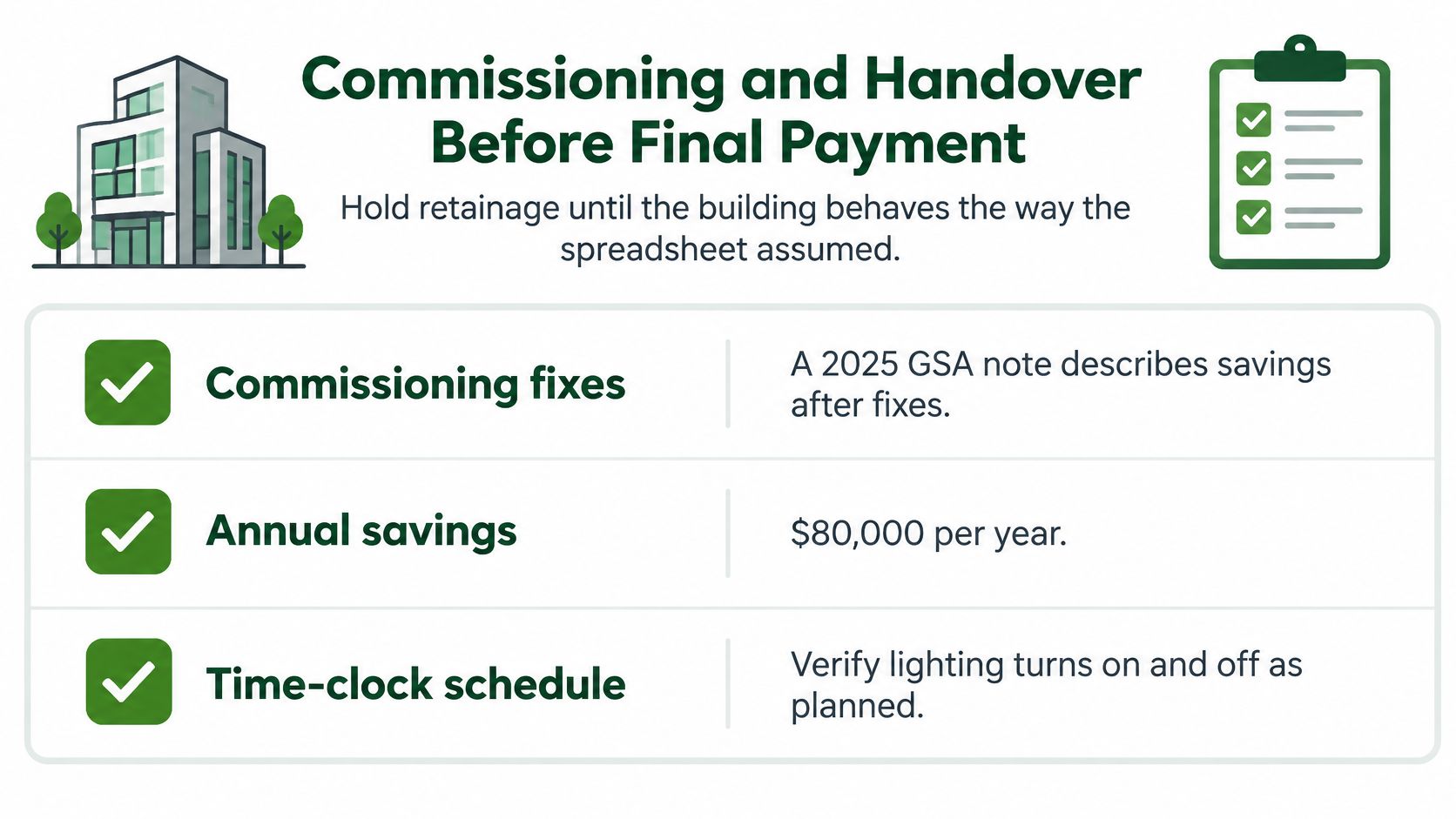
Hold retainage until the building behaves the way the spreadsheet assumed. Fixtures on the ceiling don't prove savings. Sensors have to see movement, schedules have to run, dimming has to stop at safe levels, and overrides have to expire. Pay for verified operation, not installed hardware alone.
The 2025 GSA LED and controls guidance documents a federal facility that saved approximately $80,000 annually after commissioning corrections, including time clock subroutine updates, task tuning, and reduced light levels. That's the business case for commissioning in one result. The corrections, not the fixture swap alone, captured money the building was still wasting.
A protocol label isn't proof of compatibility. A product can claim BACnet compatibility without supporting the BACnet version your building automation system requires. DALI-2 devices require testing and verification. Make the contractor demonstrate the interface with your system, not just point to a logo on a cut sheet.
The Five Item Handover
Attach this list to the contract and tie final payment to it.
- Baseline hours and controlled watts: Signed by both parties, with the final fixture count matched to the inventory.
- Sensor map: Coverage areas, timeouts, dimming limits, high end trim, and override rules for every zone.
- Credentials and protocol record: Network logins, protocol version, gateway details, and who may change schedules.
- Spare parts and warranty split: Drivers, sensors, and optics on hand or available, plus which warranty covers labor and which covers parts only.
- Training and tuning visit: Staff training at handover and a scheduled 30 to 90 day tuning visit to correct settings after real occupancy.
Failed savings usually come from small settings. A sensor sits behind shelves. A timeout stays at 30 minutes in a restroom or storage room. An override lets a whole garage level run at full output all night. Fix those items in the tuning window while the contractor still has retainage at risk.
Compare a week of measured operation with the design hours before you release the last check. Walk the site at the times the schedule claims lights should be dimmed or off. Test emergency transfer, dimming response, and manual override expiration in front of your engineer or property manager.
Run the Job Through Four Gates
Project management needs the same discipline. First, name one site lead for the contractor and one for your property, hold a single weekly call, and approve every change order in writing before work starts. Verbal approvals beside a lift become invoice disputes later.
Second, schedule by zone. Put lift and pole work in night windows where retail customers and residents stay out of the lift path, give written notice before each window, and use a daytime plan in garages that keeps cars clear. Keep emergency circuits alive during cutover or provide an approved temporary plan.
Third, photograph each pole base, nameplate, and driver before and after replacement when poles are in scope. Log every fixture against the inventory so the as-built count matches the accepted proposal. Those photos settle warranty and quantity questions faster than memory does.
Fourth, hold the sample zone approval gate before bulk installation, then a punch list review within five business days of substantial completion. Track progress against these gates, not against invoices. An invoice proves someone billed you. A passed gate proves the work is ready to move forward.
Award Only After a Measured Survey
Don't award from a unit price email. Send the same fixture inventory to two or three licensed bidders that clear the scorecard, then require the measured sample in the predominant spacing before anyone orders in bulk. You're comparing verified performance, not confidence.
Ask every finalist for two numbers. The first is savings from lamps only. The second is savings from lamps plus commissioned controls, with zones and settings named. Compare both against the sample results, stated hours, and controlled watts.
Use measured light, not claimed equivalence. If you need a refresher for your team before the walk, review how to measure foot candles and bring the readings into the bid review. A space can save watts and still fail the people who have to park, walk, or work in it.
On California properties, put Title 24 acceptance forms and emergency lighting tests in closeout so they don't return as change orders. Keep retainage until the handover list is signed, including baseline hours, sensor map, credentials, spares, and the 30 to 90 day tuning visit.
We bring over 25 years of experience in commercial lighting in Southern California, we're licensed and bonded, and we offer complimentary lighting surveys that assess a property and recommend the most energy efficient lighting solutions for it. Pick the bid whose savings survive the sample zone, whose crew answers when a driver fails, and whose hours and spares are in the contract. The lowest lamp price is the wrong award if it can't show all three.
If you're comparing LED lighting retrofit contractors for a Southern California commercial, retail, or multifamily property, start with a measured survey instead of a lamp quote. Access Electrical and Lighting will assess your fixtures, hours, controls, and access conditions, then recommend energy efficient options you can test and verify before a full award. Visit Access Electrical and Lighting to request your complimentary lighting survey and free estimate.