A commercial track system commonly built around a 20 A, 120 V branch circuit has a theoretical capacity of 2400 W, with a practical loading limit of about 1920 W after applying an 80% rule. That makes commercial lighting track a strong choice for spaces that need frequent reconfiguration, but not a universal replacement for integrated architectural lighting.
The popular advice says commercial spaces should move toward invisible luminaires as quickly as possible. That advice is incomplete. A retail floor that changes merchandise, an office that moves partitions, or a showroom that refreshes displays needs lighting that can move with the operation. A perfectly integrated ceiling can look excellent on opening day and become a limitation after the first layout change.
The better question isn't whether track lighting looks modern enough. It's whether the building benefits more from re-aiming, zoning, and fixture replacement than from a concealed, low-touch ceiling. In Southern California, that decision also has to account for branch circuits, equipment listings, controls, inspection requirements, and Title 24 documentation.
Is Commercial Track Lighting Still Relevant in 2026
Track lighting isn't obsolete because architectural lighting has become more discreet. The shift is that owners now have more than one credible option, and each option solves a different operational problem.
Current design coverage points toward “light without visible luminaires” and tighter architectural integration, while also recognizing that retail and other commercial environments continue to value modularity and reconfigurability. Recent coverage of commercial lighting trends captures the practical tension. A concealed system can support a refined ceiling, but it won't automatically handle a new merchandise wall, a relocated reception desk, or a tenant improvement with the same ease.
Where the exposed system earns its place
Commercial lighting track remains especially useful when:
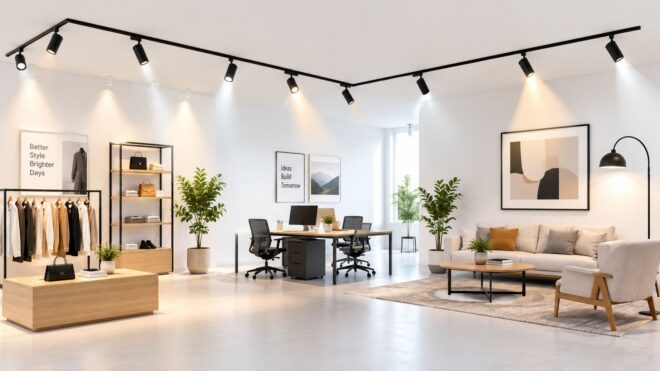
- Displays change frequently: Heads can be re-aimed or repositioned as shelving, mannequins, artwork, or feature tables move.
- Tenants turn over quickly: A new occupant can adjust the lighting strategy without opening the ceiling for a complete rewiring project.
- The space needs targeted illumination: A gallery, showroom, or boutique often needs accent control rather than uniform illumination everywhere.
- The ceiling is difficult to reopen: Exposed track can provide a practical path where access above the ceiling is limited.
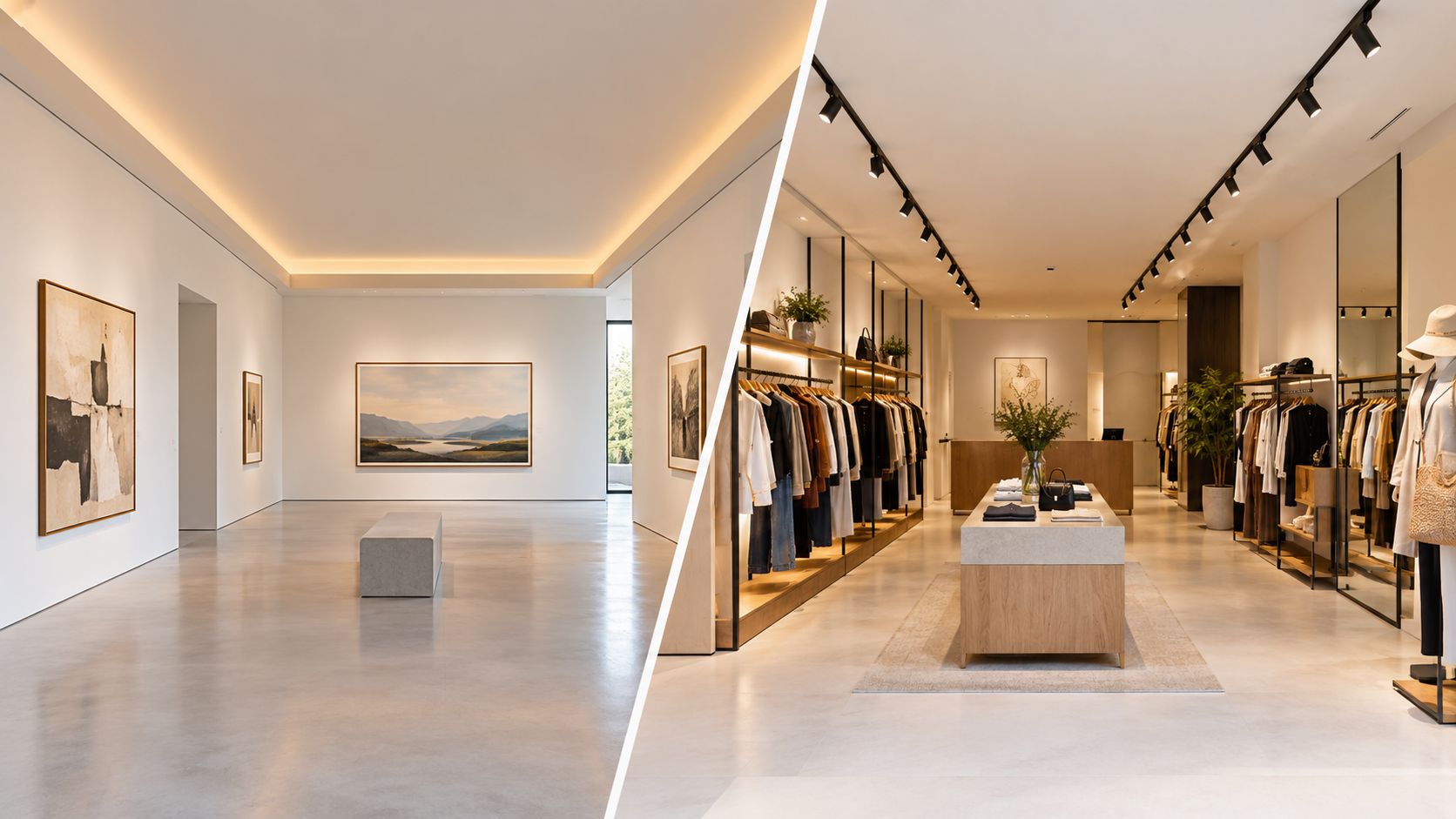
The system works against you when the owner wants an almost invisible ceiling, minimal exposed hardware, highly coordinated controls, or very little future adjustment. In those settings, a recessed, suspended, or surface-mounted linear solution may create fewer maintenance decisions and a cleaner architectural result.
For Orange County property teams, the decision should sit inside a broader electrical and lighting plan, not inside a fixture catalog. A commercial lighting planning guide for Orange County businesses can help connect the lighting layout with energy, maintenance, and installation considerations.
Practical rule: Choose track where the business changes faster than the ceiling. Choose integrated lighting where the ceiling itself is part of the permanent architecture.
How Commercial Track Lighting Systems Work
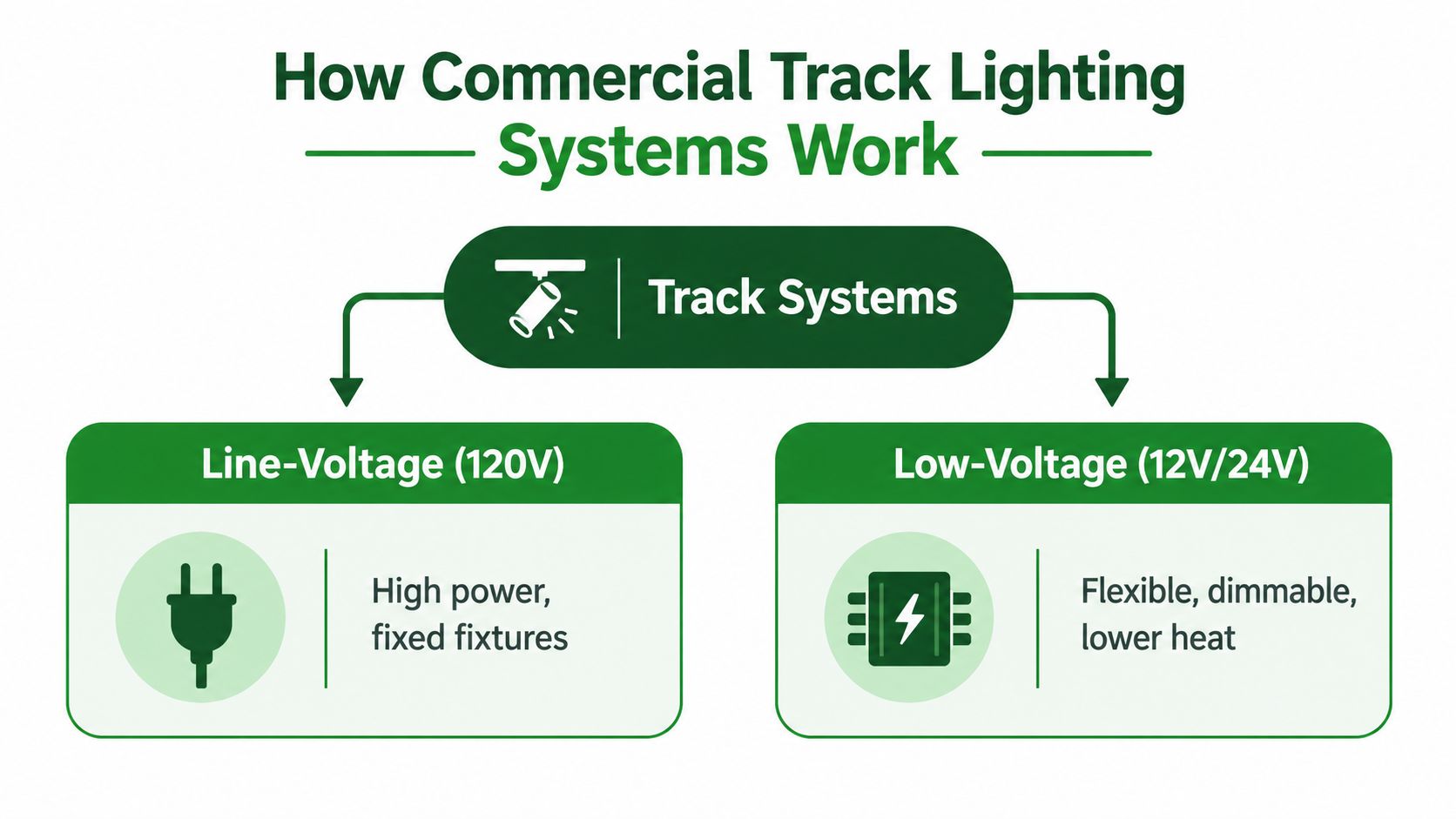
A track system is a powered rail with removable fixtures. The rail carries electrical power along its length, while each compatible head locks into the track and draws power through the bus. That arrangement lets an electrician establish the power path once, then lets authorized personnel reposition or replace compatible heads without rewiring every fixture.
Start with the voltage class
The first specification question is line voltage or low voltage. It isn't a cosmetic distinction. It affects the power source, equipment listing, fixture compatibility, and the safety requirements that govern the installation.
Under UL 1574 requirements for track lighting systems, track lighting is treated as permanently connected equipment for ordinary commercial or residential locations under NEC NFPA 70. Line-voltage systems can connect to a branch circuit rated up to 300 V and 50 A, while low-voltage systems may use a remotely located source rated up to 30 Vac or 60 Vdc at 25 A. The applicable requirements differ by voltage class. Line-voltage assemblies follow luminaire requirements, low-voltage assemblies follow low-voltage lighting system requirements, and integrated LED components also need to comply with UL 8750.
That is why a low-voltage head shouldn't be treated as a plug-and-play substitute for a line-voltage head. The transformer, driver, track, connectors, and fixtures need to work as one listed system.
Understand the track standard
H-track is widely used in modern commercial interiors because its bus construction supports repositionable heads and broad fixture compatibility. Commercial track lighting guidance describes H-track as the dominant modern format and emphasizes the system's ability to accommodate changing layouts and displays.
Before ordering, verify four items:
- Track type: Confirm whether the rail is H-track, J-track, or L-track.
- Circuit arrangement: Check whether the rail supports one circuit or multiple circuits.
- Polarity and grounding: Make sure the heads and connectors match the rail's polarized, grounded bus.
- Fixture listing: Confirm that the selected heads are approved for that specific track and voltage class.
The most expensive compatibility mistake usually happens before installation, when a team mixes visually similar components that don't share the same electrical standard.
For projects that include dimming, occupancy control, daylight response, or multiple lighting zones, coordinate the track specification with the commercial lighting control system before procurement. The control method can affect driver selection and circuit planning.
Commercial Track Lighting vs Alternatives
No lighting system wins every commercial application. Track lighting earns its keep through changeability, while other systems often win through visual integration, even distribution, or reduced exposed hardware.
| System Type | Modularity | Aesthetic Integration | Best Commercial Use Case |
|---|---|---|---|
| Commercial track lighting | High. Heads can be moved, swapped, or added within the compatible system | Visible rail and fixtures, with a deliberate technical appearance | Retail, galleries, showrooms, restaurants, and tenant spaces with changing layouts |
| Recessed downlights | Low after installation | High, because the housing can disappear into the ceiling | Permanent layouts, offices, corridors, and spaces where a quiet ceiling matters |
| Continuous suspended channels | Moderate, depending on the system | High when the linear form is part of the architecture | Open offices, collaborative areas, and spaces needing broad, consistent illumination |
| Surface-mounted linear systems | Moderate | Moderate to high, depending on housing and ceiling conditions | Exposed ceilings, retrofit work, corridors, and areas where continuous light is preferred |
Match flexibility to the rate of change
A boutique with changing collections benefits from the track's ability to redirect light toward new displays. A gallery may value the same capability when artwork changes, but it must also manage glare, contrast, and conservation concerns. A restaurant can use track to reinforce zones, though an exposed rail may conflict with a refined hospitality concept.
Recessed lighting makes more sense when fixture locations are unlikely to change and the owner values a clean ceiling above all else. It also creates a maintenance reality of its own. A failed driver or inaccessible fixture may require ceiling access, lift equipment, or a specialized replacement process.
Suspended channels and surface-mounted linear fixtures are often better when the task is broad, even illumination rather than accent work. They can establish a visually continuous ceiling plane, but they don't provide the same independent aiming flexibility.
Look beyond the opening-day photograph
A lighting selection should survive a lease change, furniture move, display reset, or control upgrade. Ask facility staff how often they expect to adjust the system and who will perform that work. If the answer is rarely, exposed modular hardware may add visual and maintenance complexity without delivering meaningful value.
The right comparison isn't “track versus modern lighting.” It's “how often will this ceiling need to change, and how expensive is that change?”
Why Modularity Drives Retail and Office Value
The value of commercial lighting track appears after installation. The first layout is easy to design for almost any system. The operational advantage emerges when a tenant changes a display, an office team moves into a different work pattern, or a property manager needs to refresh a common area without scheduling invasive electrical work.
In retail, lighting follows the selling surface. A wall that once carried folded apparel may later hold shelving, signage, or a seasonal installation. With a compatible track, the electrician can often reposition heads, change aiming, or replace a fixture without pulling new conductors through the ceiling. That reduces disruption and gives the merchandising team more control over how the space presents itself.
The turnover test
Ask these questions before approving the layout:
- Will the tenant reconfigure the floor? If yes, put the rail where future displays can use it rather than locking every head to today's plan.
- Will different zones need separate control? If yes, specify circuit and control capability early.
- Will maintenance staff service the heads? If yes, document compatible replacements and safe adjustment procedures.
- Will the ceiling be remodeled later? If yes, avoid creating a system that depends on one discontinued fixture family.
Office projects need a slightly different assessment. Track can support changing collaboration areas and presentation zones, but it isn't automatically the right choice for every open office. If the primary need is comfortable, uniform ambient light across workstations, a linear or recessed system may produce a more coherent result with less aiming work.
The same principle applies to multifamily common areas. Track can serve leasing displays, amenity spaces, lounges, and artwork, particularly where managers refresh the environment over time. It becomes less attractive where residents need consistent, low-glare general illumination and staff don't have a clear process for maintaining multiple adjustable heads.
Modularity has a limit. More movable parts create more opportunities for misalignment, incompatible replacements, glare, and inconsistent aiming. The owner should capture the original lighting intent in a fixture schedule and commissioning record, rather than assuming that every future adjustment will improve the space.
Selecting the Right Lumens and Beam Angles
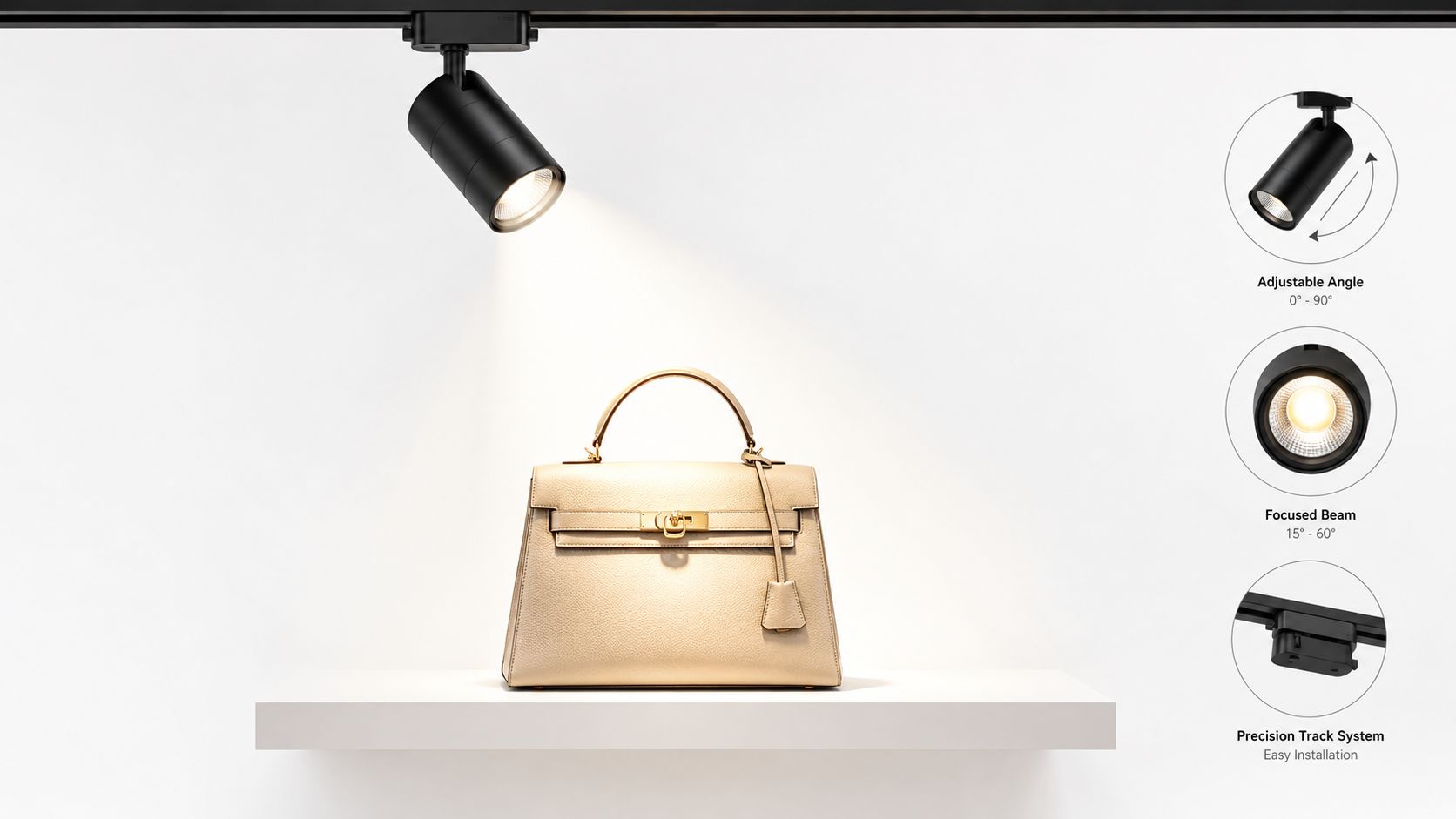
Fixture selection starts with the task, not the wattage printed on a product page. Lumens describe the light output of the fixture. Beam angle describes how broadly that output spreads. Color temperature shapes the appearance of the light, while color rendering affects how accurately products, finishes, and artwork appear.
A high-output head with a narrow beam can make a display stand out, but it can also create glare and harsh contrast when aimed at a workstation or a reflective surface. A broad beam can support wall washing or general illumination, but it may flatten a premium display that needs visual emphasis.
Set the hierarchy by zone
Use the room's functions to establish a lighting hierarchy:
- Hero merchandise and signage: Use controlled, directional light where the goal is to draw attention. A narrower beam can create emphasis, but check the aiming angle from normal viewing positions.
- Product walls and shelving: Use broader distribution when several objects need similar illumination. Wall washing can reduce bright spots and dark gaps across a vertical surface.
- Office and collaboration areas: Favor visual comfort and controlled brightness over dramatic contrast. Aiming heads away from screens and glossy table surfaces helps limit reflected glare.
- Artwork and galleries: Balance beam control with color accuracy, glare management, and the requirements of the objects on display.
- Restaurants and hospitality areas: Separate task, accent, and ambient needs. A single head type rarely performs equally well over tables, circulation paths, and decorative features.
Commercial LED track fixture guidance discusses the use of narrow beams for artwork, signage, and premium displays, and broader beams for general illumination, product walls, and open spaces. Those are useful starting points, but the final selection still depends on mounting height, surface reflectance, viewing direction, and the distance from the fixture to the target.
Specify color with the merchandise in mind
Color temperature should support the environment rather than follow a generic retail formula. Warm white may suit hospitality or a luxury display, while a more neutral appearance may support offices, salons, or technical merchandise. Keep the chosen color consistent within each visual zone unless the contrast is deliberate.
Ask for the fixture's color-rendering data, not just its appearance in a showroom. Retailers, galleries, salons, furniture dealers, and food operators all depend on believable color. A fixture that makes the space bright but shifts product color can create a more serious operational problem than a fixture with lower output.
Review a mockup at the actual mounting height whenever possible. Confirm the beam spread on the target surface, inspect shadows at eye level, and test the dimming range with the proposed driver and control system. Those checks catch problems that a lumens-only comparison won't reveal.
Installation and Circuit Loading Considerations
A track layout can look simple while still carrying meaningful electrical load. Commercial systems are commonly engineered around a 20 A, 120 V branch circuit, which provides a theoretical capacity of 2400 W. Published manufacturer guidance recommends limiting practical loading to about 80%, or 1920 W, to support dimmer and connector compatibility and reduce thermal stress across long runs. Track rail loading guidance provides those circuit and derating figures.
That limit is a design reference, not permission to fill a rail without checking the actual equipment. LED driver inrush, dimmer ratings, circuit configuration, connector ratings, and ambient conditions can all affect performance.
Build the load plan before the rail goes up
A reliable installation process includes:
- List every connected fixture: Include heads, pendants, adapters, and any equipment powered from the track.
- Confirm the circuit arrangement: A long rail may use one or multiple circuits, depending on the system and control strategy.
- Apply the practical load limit: Keep the planned load within the manufacturer's instructions and the applicable electrical requirements.
- Verify protection and controls: Match breakers, dimmers, relays, and control devices to the system's ratings.
- Inspect the bus and connections: Polarized, grounded construction helps maintain safe operation as heads are repositioned.
A common field mistake is treating the rail's physical length as the main constraint. Electrical loading, voltage class, connector compatibility, and control behavior matter just as much. Another is adding fixtures later without updating the circuit schedule.
Maintenance should include visual inspection of connectors, loose heads, damaged housings, discoloration, and unexpected flicker. If a run trips protection or develops heat at a connection, don't solve the problem by repeatedly resetting the breaker. Have the circuit, bus, driver, and load evaluated by a qualified electrician.
LED Retrofits and Southern California Compliance
For Southern California commercial properties, an LED retrofit should be planned as a compliance and operations project, not just a lamp swap. The owner needs to confirm that the selected fixtures, drivers, controls, and documentation fit the applicable project requirements before installation begins.
Title 24 obligations depend on the scope, occupancy, alterations, controls, and local enforcement process. The practical response is to involve the design professional and electrical contractor early, preserve the product documentation, and plan for testing and certification rather than trying to assemble records after the inspection. The Title 24 lighting requirements resource is a useful starting point for coordinating that process.
Why LED is the sensible track upgrade
LED track fixtures generally reduce the maintenance burden associated with frequent lamp changes and provide a controlled platform for modern dimming and zoning. They also work well with the modular operating model because a compatible head can be replaced or re-aimed without redesigning the complete rail.
The retrofit still needs discipline:
- Assess the existing system: Identify the track type, voltage class, circuit arrangement, condition of the bus, and compatibility of the existing heads.
- Select listed equipment: Confirm that the rail, LED heads, drivers, connectors, and controls form a compatible system.
- Coordinate controls: Verify dimming, occupancy, scheduling, and daylight-response requirements before ordering drivers.
- Document the installation: Keep cut sheets, schedules, control settings, inspection records, and certification materials together.
- Commission the result: Aim fixtures, check glare, test controls, and verify that the installed system matches the approved design.
Know when a C-10 contractor is necessary
A professional electrical contractor is essential when the work changes branch circuits, adds power, modifies track feeds, introduces new controls, replaces transformers or drivers, or requires inspection documentation. The same applies when the existing rail shows heat damage, loose connections, corrosion, or uncertain compatibility.
Don't assume that an LED head makes an old system compliant. A retrofit can preserve the modular advantage of track while correcting outdated components, but only after the complete assembly and control strategy have been reviewed. For property managers, that review also creates a defensible maintenance record for future tenant improvements and service calls.
Access Electrical and Lighting provides commercial lighting installation, maintenance, LED retrofits, lighting controls, and Title 24 testing and documentation for Southern California commercial, retail, office, and multifamily properties. If you're evaluating a commercial lighting track retrofit or a new tenant-improvement layout, visit Access Electrical and Lighting to discuss the circuit, control, compliance, and maintenance requirements before equipment is ordered.