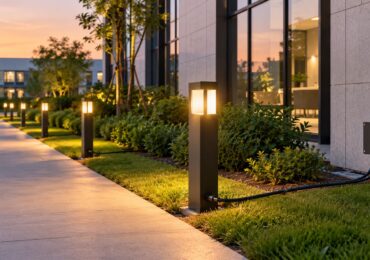
You've approved the same repair three times now. A cracked lens on the second level of the garage. A wall pack beside the trash enclosure that won't sit flush anymore. The sconce at the breezeway door, dark again. Each invoice looks small on its own, and the pattern behind them isn't small at all.
A vandal resistant light fixture is a luminaire whose housing, lens, and fasteners are chosen to survive mechanical abuse and still hold the lamp, the wiring, and the gasket together. That's a different purchase than a standard fixture with a tough-sounding description in the catalog. The difference is measurable, and it starts with a rating most specifiers never put on the submittal.
This guide walks through the impact rating scale in plain site language, names the materials that do the surviving, builds a location matrix for parking, multifamily, and retail work, and ends with an install and inspection routine that keeps the rating true after the first hit.
Why Site Lights Keep Breaking
Picture the corner of a covered parking deck where the same fixture gets replaced twice a year. A shopping cart clips the lens on the way to the stair tower. A bottle hits the sconce beside the elevator lobby. One strike on an unsupervised walkway leaves an entire run dark until somebody calls it in.
That corner is not unlucky. It sits in the overlap of three failure modes, and each one needs a different answer.
- Accidental impact. Carts, ladders, mop handles, and sports gear. The fixture is in the way rather than under attack, and the abuse comes in low-energy hits that repeat weekly.
- Repeated deliberate strikes. Anything reachable at shoulder height in an unsupervised area. Here the goal is to make the fixture boring to hit, so the person stops.
- Environmental attack. Salt air, irrigation overspray, and hose-down cleaning ruin gaskets and fasteners even when the shell itself survives intact.
A phrase like vandal proof doesn't help you buy. It's a marketing word with no test behind it and no number attached. The comparable figure is an IK code, a two-digit rating earned in a defined joule test under the International Electrotechnical Commission's IEC 62262 classification, which covers enclosures including luminaires and runs from IK00 through IK10.
So the path from here is practical. The rating chart comes first, then what the housing and lens are made of, then a location matrix for parking, multifamily, and retail, then the fixture forms you'll meet on a night walk, then install and inspection. The goal is a spec you can hand to purchasing and a maintenance plan that keeps the rating honest after the first real hit.
IK Ratings from a Light Knock to 20 Joules
Read one row of the chart left to right and you have the whole argument: the code, the impact energy in joules the housing must survive, the test object that delivers it, and the kind of abuse that energy maps to. The IK code comes from the IEC 62262 impact-protection classification, which assigns enclosures a two-digit code from IK00 through IK10 based on the mechanical impact energy they withstand during testing. IK00 provides no specified protection, and IK01 begins at 0.14 joules.
| IK code | Energy (joules) | Test mass and drop | What it stands up to |
|---|---|---|---|
| IK00 | None specified | No impact test | Ordinary enclosure, not vandal resistant |
| IK01 | 0.14 | 0.25 kg from 56 mm | Very light contact |
| IK02 | 0.2 | 0.25 kg from 80 mm | Light bump |
| IK03 | 0.35 | 0.25 kg from 140 mm | Small tool knock |
| IK04 | 0.5 | 0.25 kg from 200 mm | Modest accidental hit |
| IK05 | 0.7 | 0.25 kg from 280 mm | Noticeable knock, still light duty |
| IK06 | 1 | 0.25 kg from 400 mm | Reachable fixture with low abuse |
| IK07 | 2 | 0.5 kg from 400 mm | Firm strike, the first serious step up |
| IK08 | 5 | 1.7 kg from 300 mm | Cart, tool, or hard thrown object, common covered-area floor |
| IK09 | 10 | 5 kg from 200 mm | Heavy blow short of full anti-vandal |
| IK10 | 20 | 5 kg from 400 mm | Heavy-duty and anti-vandal mark for parking, transit, and public sites |
| IK11 | 50 | Added by the September 2021 amendment | Exceptionally severe impact, not a default commercial spec |
The jumps between codes are steeper than the numbers look
IK10 is not "a bit better" than IK08. At 20 joules against 5 joules it carries four times the impact energy, and against IK07 at 2 joules it carries ten times. Treating the labels as mild, medium, and strong is how a property ends up with an IK07 lens at bumper height and a repair schedule nobody budgeted for.
IK11 sits above the traditional ceiling as an exceptional case for equipment exposed to severe impacts. It is not a default commercial specification.
What the test masses mean on site
The upper ratings translate into objects a manager recognizes. An IK07 test represents a 0.5-kilogram mass dropped from 400 millimeters. IK08 represents 1.7 kilograms from 300 millimeters. IK09 represents 5 kilograms from 200 millimeters. IK10 corresponds to 20 joules, the level commonly associated with heavy-duty or anti-vandal luminaires in exposed locations such as transport areas, public spaces, parking facilities, industrial sites, and sports environments, per the same IEC impact rating reference.
The distinction to hold onto: IK measures resistance to mechanical impact. IP measures protection against solid-particle and water ingress. A high IK number tells you nothing about water.
Two limits sit beside the chart
The test strikes the submitted enclosure face. It does not score the photocell, the battery door, the conduit entry, or the screws holding the diffuser on. And because IK and IP are separate scales, an impact-tough fixture can still leak.
Verification takes three steps. First, ask for the test report or manufacturer certificate that names the exact catalog number and lens. Second, confirm the IK code appears on the submittal, not only in the marketing copy. Third, reject a lower IK or a substituted lens at shop drawing review, because the rating belongs to the configuration that was tested, not to the product family.
For most reachable commercial exteriors, IK08 is the covered-area floor and IK10 is the floor for unsupervised areas or anything at bumper height.
Housings Lenses and Fasteners That Take a Hit
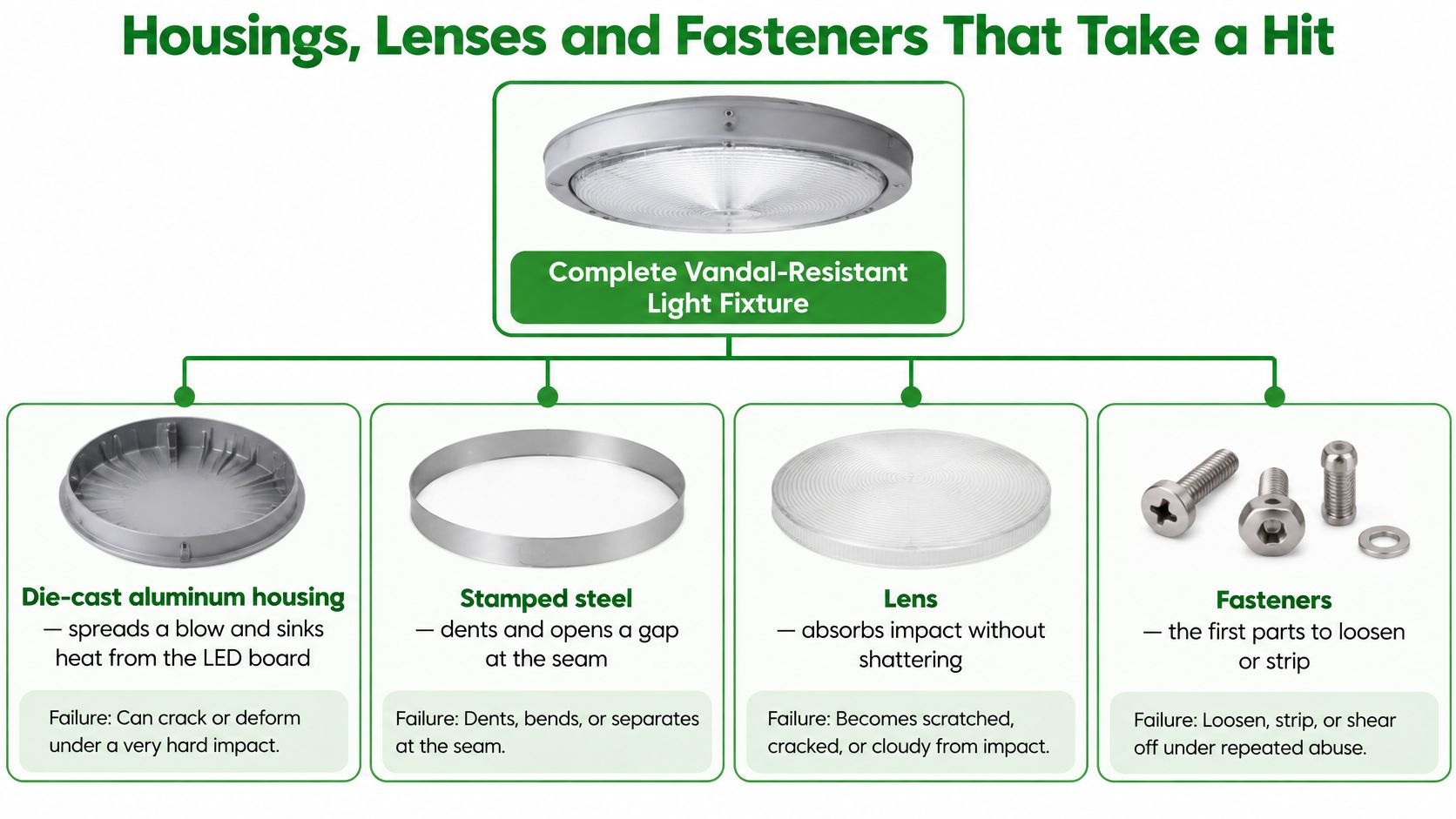
A cart can strike the lens, while a thrown object hits the housing or loosens its fasteners. Each part can fail differently, so specify the full fixture assembly rather than relying on a material name or IK code alone.
IEC 62262 sets out the impact-test method and rating framework. Luminaire safety requirements are covered by IEC 60598-1, while road and street lighting has its own requirements in IEC 60598-2-3, as the IEC guide to IK and IP testing for lighting products explains. These standards help establish what a rating represents; they do not mean every component on a fixture has the same impact resistance.
The housing carries the blow and the heat
Die-cast aluminum spreads impact across the housing and conducts heat away from the LED board. Thin stamped steel can dent, potentially opening a gap at the gasket. When comparing fixtures with the same IK code, check the housing construction and wall thickness rather than assuming the rating tells you how sturdy the whole product is.
The lens decision is polycarbonate versus glass
Polycarbonate flexes under impact, while glass can break. A thicker, UV-stabilized polycarbonate lens may suit a fixture exposed to carts or thrown objects. Prismatic or opal polycarbonate can soften glare in a garage, with a possible trade-off in light output.
Practical rule: Use the lens material and configuration covered by the fixture's impact rating. Replacing a tested polycarbonate lens with glass changes the assembly, so do not assume the original rating still applies.
Fasteners and seals are where the spec quietly fails
Tamper-resistant fasteners, such as pin-in-Torx, make casual removal harder. Captured lenses or continuous hinges can also make it more difficult to pull a diffuser free. Near salt air, specify stainless fasteners or include their replacement in the maintenance plan. For the finish, ask for documented corrosion protection on the product cut sheet.
Serviceability matters too. A fixture with a separate driver may allow that part to be replaced without replacing the entire unit. By contrast, damage to a sealed fixture may require full replacement.
Put the housing material and thickness, lens material, fastener type, finish, and IK and IP ratings for the exact configuration on the cut sheet. That gives the property team a clear specification to check during submittal review and after repairs.
Which Rating Fits Parking Multifamily and Retail
Here's the gap the chart cannot close. Passing IK10 means the tested face survived about 20 joules. It does not mean the mount, the conduit entry, the diffuser screws, or the emergency-battery door will, and IEC 62262 leaves product-specific pass criteria to the applicable product standard, as an independent IK rating testing lab points out.
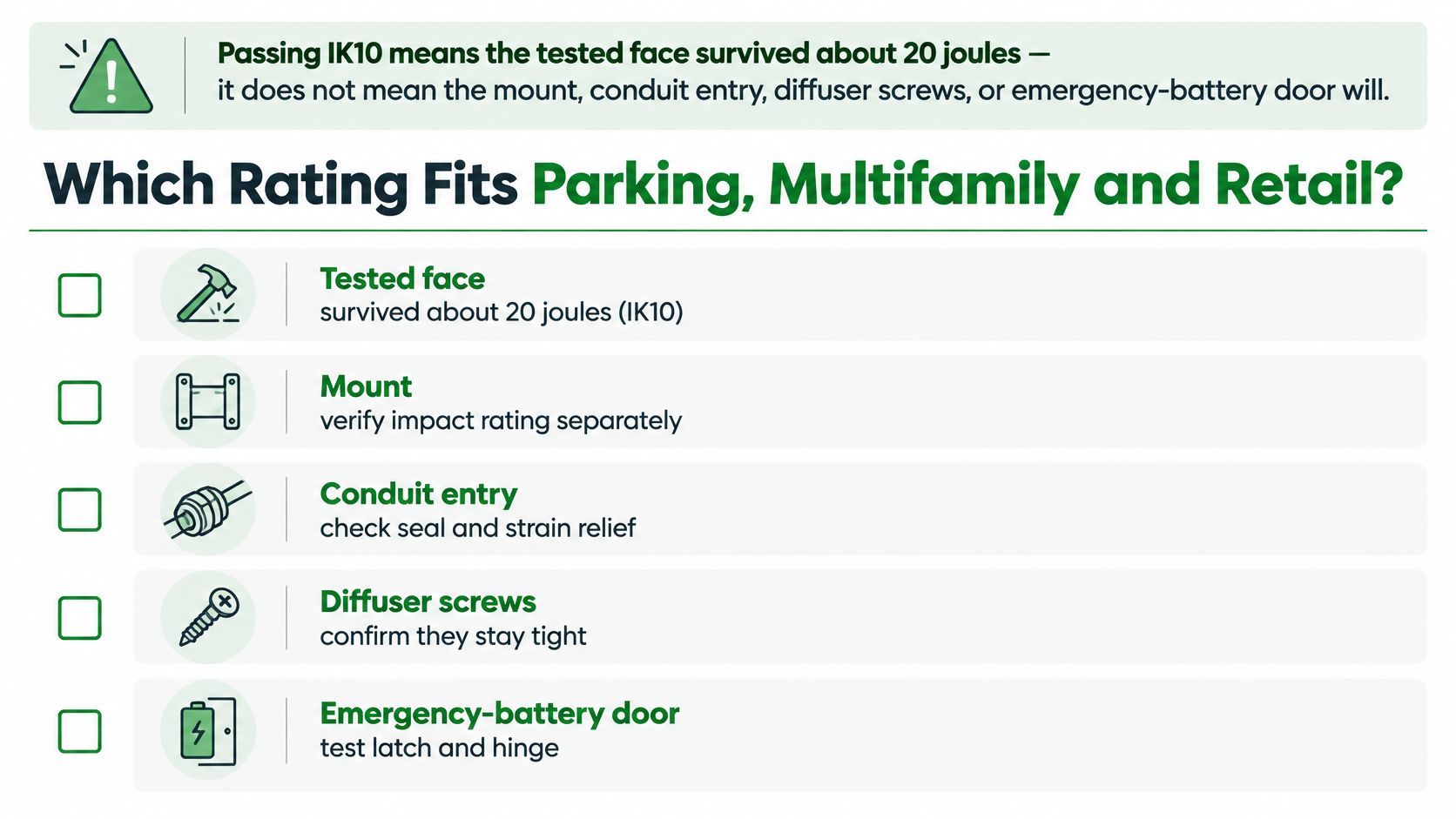
That's the difference between impact survival and security performance. A fixture can pass a laboratory impact test and still be vulnerable at its mounting points, wiring entry, or adjacent conduit. So the rating chart gets paired with a risk matrix.
| Location and abuse | Minimum IK | Housing and lens | Specify beyond the IK test |
|---|---|---|---|
| Covered garage, carts and door swings | IK08, IK10 at bumper height | Die-cast housing, thick polycarbonate | Anchor to concrete, protect ramps and columns |
| Open walkway or stair, repeated strikes | IK10 | Full polycarbonate, shielded optic | Mount above easy reach, inspect after outages |
| Multifamily corridor or breezeway | IK08 to IK10 | Low-glare lens, captive diffuser | Keep emergency battery and egress heads on a separate check |
| Retail canopy or storefront, public contact | IK08 | Impact lens with cleaner face if rated | Tamper screws, confirm the decorative trim is part of the tested model |
| Drop-off, transit edge, or sports impact | IK10, IK11 only for proven extreme hits | Heavy housing and lens | Third-party evidence for that catalog number |
| Coastal or heavily irrigated exterior | IK10 on exposed heads | UV-stable polycarbonate, corrosion-rated finish | IP66 or equivalent seal plus stainless fasteners |
Covered garages reward height awareness
Carts and door swings live at the bottom two meters. Put IK10 at bumper height and on ramp turns where a turning vehicle drags a mirror along the wall, and let IK08 handle the ceiling-mounted runs. The housing has to be lagged into concrete or structural steel, not into fascia or thin cladding that will pull out before the casting cracks.
Open walkways and stair towers need the highest band
This is the IK10 row, with shielded optics so glare doesn't hide faces from a camera or a resident. Where the ceiling allows, mount above easy reach. Pair exposed heads along a drive with the property's broader parking lot lighting standards review, which covers mounting height and uniformity alongside durability.
Spec line to copy: "Luminaire shall be listed IK10 and IP66 for the specified catalog number, with polycarbonate lens, tamper-resistant fasteners, and test evidence submitted for that configuration."
Corridors, storefronts, and coastal sites need separate lines
Multifamily corridors and breezeways run IK08 to IK10 with low-glare lenses, and the emergency heads or battery packs get specified on their own so a lens strike doesn't take the egress path dark. Retail canopies take IK08 wherever the public can touch the fixture. Along the Southern California coast and on heavily irrigated inland sites, add a corrosion line and prefer IP66 on exposed heads, because salt and sprinkler overspray defeat a tough shell through the gasket.
Write one sentence per area covering the IK code, the IP code, the lens, the fastener, the substrate, and who checks the fixture after an incident. Optical output, controls, and Title 24 compliance stay outside this matrix. They're required, but they don't make a housing vandal resistant.
Fixture Forms for Garages Grounds and Storefronts
Walk the property at night, in the order a driver would, and each fixture form shows you where it fails.
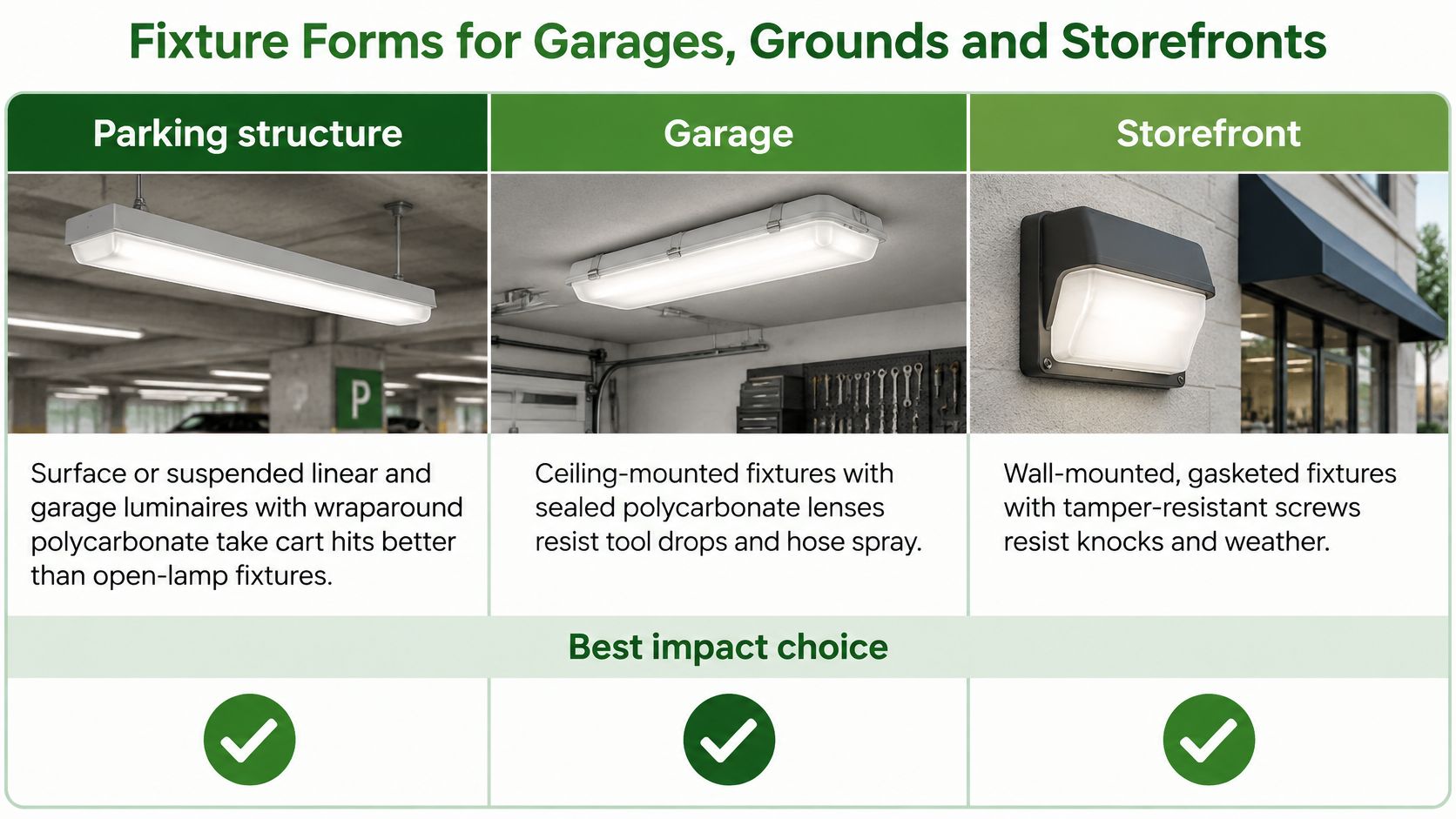
Start on the drive. Surface or suspended linear and garage luminaires with wraparound polycarbonate take cart hits better than open-lamp strips, and the weak points are the end caps and the suspension hardware, not the lens. Recessed downlights look tidy in a finished soffit and fail at car-door height when the trim is thin metal and the lens is glass. Use them only if the whole trim is impact rated.
| Form | Typical site | Main vulnerability | Spec note |
|---|---|---|---|
| Linear or garage luminaire | Parking decks and covered drives | End caps and suspension hardware | Continuous polycarbonate, mounts into structure |
| Recessed downlight | Finished soffits at car-door height | Glass trim and thin flange | Use only if the whole trim is impact rated |
| Wall pack | Stairs, service yards, retail backs | Rear gasket, knockouts, loose box | Tamper screws and a rated lens on that SKU |
| Bollard | Paths, drives, gates | Shaft base and removable top cap | Specify shaft thickness and anchor, not just the head |
| Pole area light | Lots and perimeters | Handhole, photocell, rusty pole base | Pair the head rating with pole inspection |
| Canopy luminaire | Retail walks and porte-cocheres | Lens clips under wash-down | Lens retention plus a matching IP rating |
| Exit or emergency unit | Egress at shoulder height | Brittle plastic legend housing | Rate these separately from the area lights |
The back of the fixture is the part nobody rates
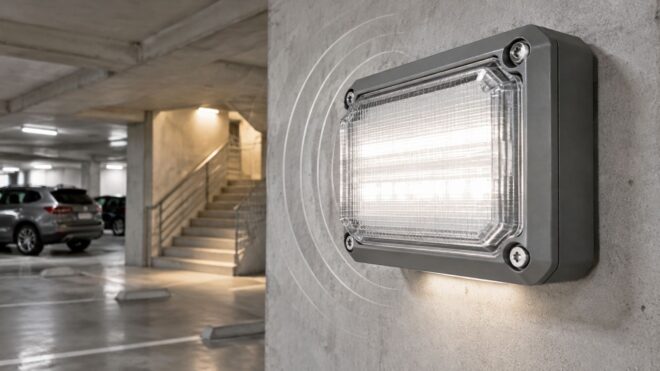
Wall packs cover stair towers and retail back walls, and the failure is usually at the rear gasket and the knockout rather than the front face. A handsome IK10 door on a loose box still leaks, still loosens, and still lets water into the driver compartment.
Bollards mark paths and drives and invite kicks and vehicle bumps. Specify a thick shaft, a buried or bolted base, and a lens that isn't a removable cap. If a bollard family has no published IK at all, that's your answer.
Pole-mounted area lights sit above most vandals, so their real problems are the handhole, the photocell, and a pole base nobody has checked for rust or cracks. The head rating and the pole inspection are two different line items.
Canopy lights at fuel, retail, and porte-cochere edges need a lens that survives pressure-wash wands as well as thrown objects. Exit signs and emergency combo units in the same zones need their own impact thinking, because a tough area light does nothing for a plastic legend at shoulder height.
The misses repeat in both directions. A property orders the high-impact lens as an accessory and receives the standard glass version installed by default. Or it matches a bollard style with no published rating, then wonders why the caps keep disappearing.
A multifamily garage might use IK10 linears on the drive, IK10 wall packs on the stairs, and bollards only at the pedestrian gate, with the commercial parking lot lighting fixtures schedule reviewed alongside the pole structural check. A retail center might use rated canopy heads over the walk and wall packs on the service side.
Mount Inspect and Repair Without Losing the Rating
A rated fixture installed badly is an unrated fixture with a certificate. The install sequence below is short enough to put in a scope of work.
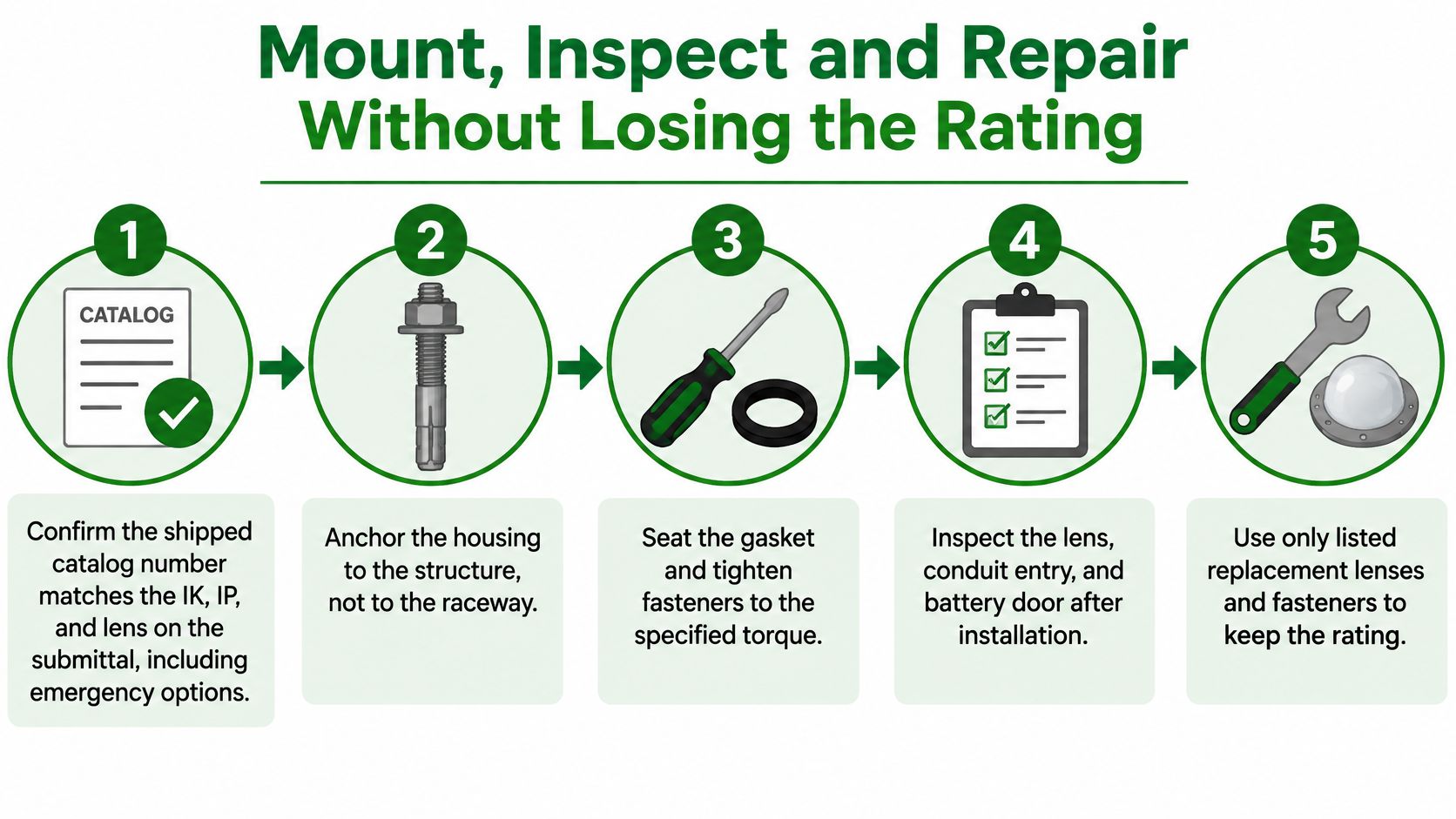
- Confirm the shipped catalog number matches the IK, IP, and lens on the submittal, including any emergency option.
- Anchor to structure. Concrete, steel, or solid blocking. Never thin cladding, foam trim, or a single drywall anchor.
- Use the supplied tamper-resistant fasteners for that model. Replace a missing one with the same drive rather than a field screw that leaves the door proud of the gasket.
- Seal the conduit entries so a strike can't pull conductors, and keep photocells and battery compartments inside the protected envelope or in a separate rated box.
- Aim and meter after the lens is on, because a thick prismatic lens changes the beam.
- Label the approved IK and IP in the space so the next replacement doesn't drift to a cheaper head.
What happens after the first strike
Inspection is a different list from selection. The rating applies to tested exposed surfaces and does not guarantee that mounting hardware, conduit, photocells, emergency-battery compartments, or adjacent walls survive the same event, as Spilma's guide to EN 60598 luminaire safety states. An IK10 housing is tested at 20 joules using a hammer or pendulum method and is intended to tolerate thrown objects, carts, and tools in parking structures, corridors, schools, and transit areas. That's a real standard, and it stops at the tested face.
After any impact, dark spot, or wash-down, check four things: a cracked lens, a bowed door, water inside the optic, and loose anchors. A housing can look intact and still have a compromised gasket.
The repairs that quietly void the work
Don't put a standard glass replacement lens on an IK10 body. Retire poles and bases that move, even when the new head is fine. Group repairs so a garage doesn't end up with mixed housings that fail at different heights, because mixed stock is how a good spec erodes over five years. Route the routine side through a parking lot lights maintenance program that includes post-impact checks, not just relamping.
Some events fall outside the rating entirely. A direct vehicle collision, a cut conduit, or a missing driver are replacement events, not evidence the test was fake. Keep the test report with the as-built drawings so the next owner specifies the same assembly.
Specify the Assembly Then Survey the Site
For each area on the property, write the assembly in one line: the IK band from the location matrix, the IP rating, the housing and lens, the tamper-resistant fasteners, and the substrate the mount must hit. Reject any submittal that shows a different lens, a lower IK, or no test evidence for that exact configuration.
Don't blanket-replace every head at the highest rating. Handle it in priority order.
- First, bumper height and unsupervised fixtures go to IK10, because those are the ones that generate repeat work orders.
- Second, covered and occasionally abused areas stay at IK08, where the abuse is accidental and the mounting is protected.
- Third, exit and emergency units get their own list, so a lens program never leaves an egress path dark.
Before ordering anything, run a night walk that records dark zones, broken lenses, pole bases, and control settings. A tough fixture aimed at the wrong place still fails the property, and a lighting survey that captures brightness levels, fixture placement, and energy consumption turns the IK conversation into a scope you can price. Access Electrical and Lighting runs those surveys at no cost and can carry the work from a single failed pole up to a full parking-structure LED retrofit.
Your move this week is small. Mark the three worst zones on the property, attach the one-line spec to each one, and only then ask for pricing.
Access Electrical and Lighting specifies, installs, and maintains vandal resistant light fixtures across Orange County, the Inland Empire, and San Diego, from IK-rated garage linears and wall packs to bollards, canopy heads, and the emergency units that share the same zones. We handle the parts the rating chart leaves out: mounting to structure, tamper-resistant hardware, sealed conduit entries, and the post-impact inspections that keep an IK10 assembly rated after the first hit. Visit Access Electrical and Lighting to book a complimentary lighting survey, and call (949) 364-6063 after hours when a fixture goes down and the property can't wait until morning.