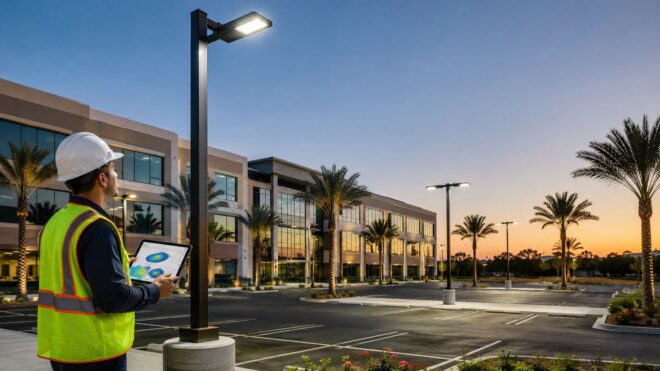
A parking lot can look acceptable at noon and still be a serious operational problem after dark. A property manager may be dealing with aging metal halide fixtures, failed pole bases, dark areas that generate slip-and-fall concerns, and an electricity bill that keeps climbing. The first request is often simple: replace the heads and restore the light.
That request rarely stays simple. Commercial outdoor lighting installation can involve a photometric redesign, panel-capacity review, trenching, controls, emergency egress fixtures, permits, inspections, and conduit for future EV charging. The fixture is only one part of a project that must be planned, installed, tested, documented, and maintained.
Why Commercial Outdoor Lighting Installation Is a Project, Not a Fixture Swap
A parking lot retrofit starts with conditions, not a product catalog. The contractor needs to know where illumination fails, whether glare reaches neighboring properties, whether poles and foundations remain sound, and whether the existing electrical distribution can support the proposed layout. Replacing fixtures without answering those questions can preserve dark zones, overload an undersized circuit, or leave the owner with a new system that still fails inspection.
Commercial properties also have a meaningful lighting operating burden. U.S. Department of Energy materials cite roughly 303 TWh of commercial-sector electricity used for lighting in 2009, about 23% of commercial electricity consumption, while parking structures were estimated at 29.1 TWh per year and parking lots at 22 TWh per year. A separate DOE source places commercial-building lighting closer to 35% of electricity use, which reinforces why exterior areas are frequent retrofit targets. These figures are documented in the DOE lighting energy-use report.
What the original request usually becomes
A “swap the heads” request commonly expands into several coordinated scopes:
- Photometric design: The layout must address uniformity, glare, property lines, and pedestrian routes.
- Electrical verification: The crew checks breaker space, circuit loading, conductor condition, voltage drop, and panel capacity.
- Civil work: Trenching, conduit, pole bases, paving restoration, and utility locates can affect the schedule more than fixture delivery.
- Controls: Photocells, astronomical time switches, occupancy sensors, dimming logic, and network gateways must operate as designed.
- Life-safety work: Emergency fixtures and exit signs require a separate testing and documentation process.
- Future infrastructure: EV-ready conduit is easier to install while pavement and electrical pathways are already open.
Each scope can involve a different subcontractor, permit condition, inspection, or site constraint. Active retail centers add tenant access, deliveries, pedestrian protection, and after-hours work to the coordination effort.
Practical rule: Treat the fixture as a design output, not the starting point.
A disciplined project follows a sequence: kickoff meeting, site audit, design and submittal package, load review, permit coordination, installation, control programming, acceptance testing, and commissioning report. That sequence protects the owner from approving a low fixture price that excludes the work needed to make the system safe, code-compliant, and serviceable.
Planning and Preconstruction for Your Site
The nighttime site walk should happen before anyone finalizes fixture counts. A calibrated light meter and a documented photometric survey help the team identify dark zones, excessive brightness, glare at property lines, poorly lit pedestrian paths, and areas where landscaping or signage blocks the intended beam. Walk the property with the lights operating under normal conditions, not only during daylight, because aiming and uniformity problems often disappear on a daytime inspection.
Build the electrical and civil picture
Next, trace the existing lighting circuit back to the panel. Record the breaker arrangement, available spaces, voltage, conductor condition, and the proposed load. The calculation should also account for wire length and voltage drop, especially where new runs extend across a large parking field or travel through multiple pole groups.
The design team then develops the fixture count and pole layout against the applicable project criteria. For parking areas, the plan may use IES RP-20 targets such as 0.2 footcandles minimum and a 4:1 maximum-to-minimum ratio, but those values must be confirmed against the project's adopted standards and site classification rather than copied into every design. The photometric plan should show mounting heights, fixture distributions, aiming, spill light, and calculated points across the property.
Trenching needs the same level of attention. Mark the proposed route, request an 811 USA dig alert, identify irrigation and communications conflicts, and confirm conduit depth under CEC 300.5. Asphalt saw-cutting limits, concrete restoration, tree roots, and tenant traffic can change the best route even when the electrical plan looks straightforward.
Close the approval gaps before mobilization
Permit pulls and plan reviews should be assigned early. Depending on the property, the package may require review by the local authority having jurisdiction, an HOA, a city department, or a utility. Southern California projects also need a practical construction plan for pedestrian routing, barricades, lift operations, and work around occupied buildings.
The missed items are often administrative rather than technical:
- Construction safety: Define pedestrian protection and vehicle separation before trenching begins.
- Inspection timing: Ask whether the AHJ requires an after-hours inspection when the site is operating at night.
- Utility coordination: Confirm whether SCE, LADWP, or SDG&E service information affects the work.
- Submittals: Include fixture cutsheets, control sequences, photometrics, pole details, and emergency equipment.
- Tenant communication: Set expectations for outages, parking closures, noise, and temporary lighting.
A complete preconstruction package gives the installer a reliable sequence. It also gives the owner a defensible record when a change order results from concealed conditions rather than an omitted investigation.
Choosing LED Fixtures, Poles, and Controls
Fixture selection should follow the site's geometry and operating requirements. A shoebox is usually efficient for broad parking-area distribution, an area light suits a more focused zone, a flood fixture handles a wall or large perimeter surface, and a wall pack works well at building-mounted locations. None of those families is automatically correct for every pole, façade, driveway, or loading area.
The table below is a practical comparison format for the submittal package. Actual wattage, L70 rating, and optical performance vary by manufacturer and model, so the contractor should fill in the proposed product data rather than rely on generic ranges.
Fixture family comparison
| Fixture Type | Wattage Range | L70 Life (hrs) | Best Application |
|---|---|---|---|
| Shoebox | Project-specific | Project-specific | Parking lots, drives, and broad area distribution |
| Area light | Project-specific | Project-specific | Walkways, plazas, loading areas, and site zones |
| Flood | Project-specific | Project-specific | Building façades, signs, perimeters, and security coverage |
| Wall pack | Project-specific | Project-specific | Doorways, service corridors, and building-mounted paths |
For product selection examples and parking-lot fixture considerations, review this guide to commercial parking lot lighting fixtures, then compare its recommendations with the project photometrics and the owner's maintenance requirements.
Poles and drivers need equal attention
New construction often favors straight square steel poles because they provide a predictable structural and architectural package. Existing sites may need hinged poles, breakaway bases, or replacement foundations when access, impact exposure, or inspection findings make a standard retrofit unsuitable. Aluminum can be a sensible choice where irrigation overspray creates a corrosion concern, but the selection still depends on wind loading, mounting hardware, finish, and local conditions.
The driver is a critical failure point. Specify thermal performance, surge protection, access for replacement, and a warranty that identifies the luminaire, driver, and labor separately. A low-cost fixture with weak thermal management can erase the expected maintenance advantage, particularly on poles exposed to heat and direct sun.
Controls are a separate design decision
A photocell-only arrangement can be simple to commission, but it provides less scheduling and diagnostic capability than a networked system. Wireless platforms such as Clevest, Synapse, or Hubbell Lighting may support remote scheduling, dimming, fault reporting, and group control, but they add gateways, addressing, communications planning, and cybersecurity administration.
The right question isn't which control is more advanced. It's whether the proposed sequence satisfies the adopted Title 24 requirements, can be tested at the site, and can be maintained by the property team. Coordinate contactor panels, low-voltage wiring, gateway locations, and spare capacity for future EV charging before the equipment is ordered.
The Installation Workflow From Lift to Energization
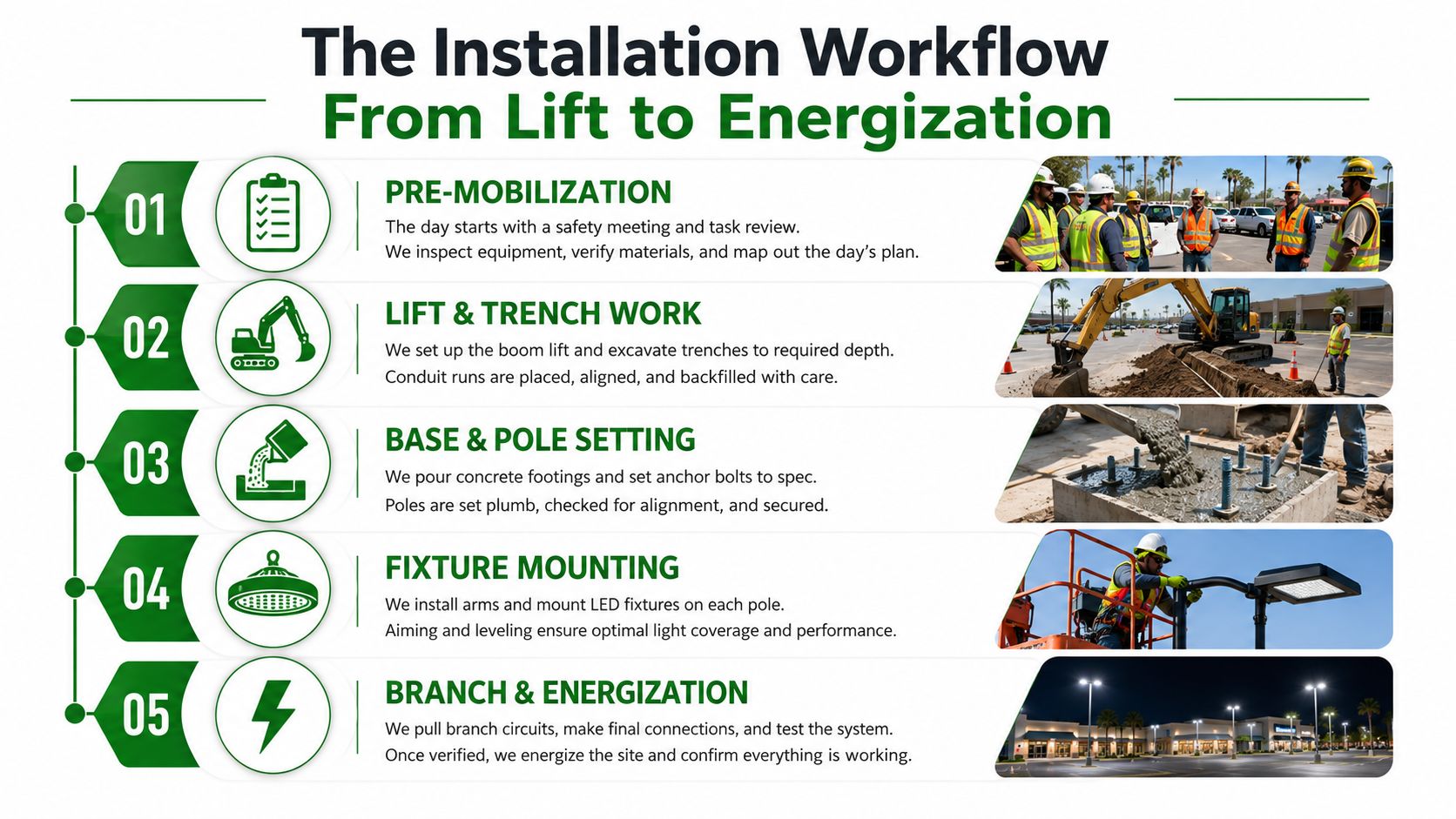
A reliable crew sequences the work around access, concrete cure time, utility conflicts, and tenant operations. The work isn't just a lift arriving, fixtures coming down, and power being restored by the end of the day.
Mobilize before opening the pavement
Before mobilization, the superintendent confirms the approved drawings, submittals, permits, outage plan, lift locations, material staging area, and pedestrian controls. The crew should verify pole identifiers and circuit groups in the field, because plan labels and existing labels don't always agree.
Trenching follows utility verification and route marking. The crew uses the 811 information, exposes conflicts safely, coordinates with irrigation and communications trades, and protects open cuts from vehicle and pedestrian traffic. If EV conduit is included, install it during the same pavement operation where practical. This avoids repeating saw cuts and restoration in a later phase.
Set bases and mount equipment in the right order
Pole bases must be evaluated before new poles arrive. Existing foundations may require inspection, anchor-bolt verification, or replacement rather than an assumption that the old base can carry a new assembly. For new foundations, the crew sets reinforcing steel, conduit, anchors, and concrete in accordance with the approved structural details, then waits for the required condition before loading the pole.
Fixture mounting comes after pole work is stable and access is safe. The installer confirms orientation, hardware torque, arm attachment, gasket condition, and cable protection at every head. Use a work sequence that keeps lifts away from tenant entrances, fire lanes, delivery routes, and customer parking whenever the property remains open.
Pull, program, test, and energize
Branch circuits are pulled and identified by pole group. Controls are then connected, photocells and sensors are positioned, and networked devices are addressed and associated with the correct zones. A control system that operates one fixture correctly but assigns the wrong group to a schedule still represents a failed installation.
The final stage includes aiming, torque checks, insulation-resistance testing where specified, control-sequence verification, and a controlled energization. The contractor should document the measured results, fixture locations, circuit identifiers, control settings, deficiencies, and corrections before the AHJ inspection.
For the structural and safety considerations associated with pole work, see this resource on commercial light pole installation.
Title 24 Controls, Emergency Lighting, and Certification
California outdoor controls must be designed as an operating sequence before installation, not added after fixtures are mounted. Title 24 requires exterior lighting to shut off automatically when daylight is available, using a photocell, astronomical time switch, or equivalent control. During scheduled unoccupied periods, the system must reduce power by at least 50% and no more than 90%. Motion-sensing controls must dim or turn lighting off within 15 minutes after vacancy, according to the Title 24 2022 design guide. For full code specifics, see our guide to Title 24 lighting requirements.
Test the sequence, not just the hardware
The design review should assign fixtures to control zones and define the expected result for each operating state. Acceptance testing should demonstrate full output, reduced output, and off conditions wherever the design requires them. Verify sensor placement, sensitivity, schedules, daylight response, and manual override functions.
Common failures include a photocell aimed at a security light, a time switch with the wrong schedule, an occupancy sensor covering only part of a pedestrian route, or a control group that cannot demonstrate the required behavior. A daytime walkthrough will not confirm that the system responds correctly under every required condition.
Use a certified acceptance test technician when the project requires one. The signed test documentation should list the equipment tested, sequence verified, deficiencies found, corrections completed, and responsible parties.
Keep emergency testing separate
Title 24 acceptance testing does not replace emergency lighting testing. Emergency fixtures, exit signs, and battery-backed equipment have separate life-safety obligations under the applicable California Fire Code and NFPA requirements. Property teams should keep test logs, repair records, equipment inventories, and inspection documents where staff and inspectors can retrieve them.
A useful maintenance record includes:
- Monthly functional checks: Record short-duration operation and any failed fixture or battery.
- Annual duration testing: Document the full required duration and result for every emergency unit.
- Five-year verification where applicable: California properties must follow their adopted local requirements for this testing.
- Acceptance records: Retain Title 24 certificates, control narratives, commissioning results, and approved plans.
- Correction history: Note the date, location, repair, replacement part, and return-to-service verification.
The property team should receive a final compliance package, not only a signed invoice. Include the control sequence, emergency test records, deficiencies, corrections, and commissioning results. These records support occupancy documentation, insurance reviews, warranty claims, and later troubleshooting.
What Really Drives the Cost of a Commercial Outdoor Lighting Job
The fixture price rarely explains the full bid. Cost moves with the number of fixtures, optical reach, pole height, foundation condition, trench footage, pavement restoration, panel work, control complexity, inspection requirements, and the amount of time the crew must work around tenants.
A proposal should separate base scope from assumptions and alternates. If the contractor has included fixture replacement but excluded pole-base repairs, panel modifications, emergency fixtures, or restoration, the initial price won't be comparable with a proposal that carries those items.
Cost drivers on a commercial outdoor lighting installation
| Cost Driver | Typical Impact | Way to Reduce | Watch For |
|---|---|---|---|
| Fixture count and photometric reach | More equipment, lift time, wiring, and aiming | Improve layout before ordering | Under-lighting hidden by a low fixture count |
| Pole height and foundation | Affects equipment, structural work, and access | Reuse sound poles where appropriate | Unverified foundations or anchor conditions |
| Trenching and restoration | Can dominate labor and site disruption | Coordinate routes with EV conduit and other work | Unknown utilities, irrigation, and paving repairs |
| Panel capacity and circuits | May require breakers, conductors, or distribution upgrades | Complete load review early | “Existing circuit assumed adequate” |
| Controls | Adds hardware, programming, testing, and documentation | Match system complexity to operating needs | Network scope omitted from the base bid |
| Emergency lighting | Adds equipment, testing, and records | Survey life-safety devices during design | Exit signs and batteries excluded |
| Occupied-site logistics | Increases night work, traffic control, and supervision | Phase work around tenant schedules | Access restrictions treated as owner responsibility |
Soft costs deserve the same scrutiny. Title 24 acceptance testing, traffic control plans, after-hours inspections, prevailing-wage exposure on public-facing work, utility coordination, and permit fees can all affect the final number. Ask the contractor to state whether each item is included, excluded, or carried as an allowance.
A low bid isn't useful if it leaves the owner paying for the missing sequence.
Read the proposal line by line. Confirm fixture quantities, pole quantities, trench length, conduit type, restoration method, controls, programming, commissioning, permit pulling, emergency scope, warranty labor, and disposal. Require written alternates for uncertain items rather than accepting vague exclusions.
Hiring a Southern California Commercial Lighting Contractor
The bid walk should test the contractor's process before it tests the price. A qualified team should be able to explain how it will survey the property at night, verify the electrical system, coordinate with the local AHJ, protect pedestrians, manage lifts, and produce a commissioning record. If the conversation stays focused on fixture wattage, the contractor may not be accounting for the actual project.
Run this selection checklist
Verify the basic qualifications before reviewing the proposal:
- C-10 license: Confirm the California electrical contractor license is active and matches the entity signing the contract.
- DIR registration: Check registration when the project or owner's procurement rules require it.
- Safety training: Ask for OSHA-10 or OSHA-30 training records appropriate to the crew and site risks.
- Insurance: Review general liability, commercial auto, and workers' compensation coverage against the property's exposure.
- Bonding capacity: Confirm the contractor can bond the trenching, pole, and electrical scope if the project requires it.
- Relevant references: Request comparable parking, retail, office, multifamily, or resort work with similar access constraints.
- Service coverage: Ask whether the contractor can provide a practical same-day response for failed parking-lot fixtures.
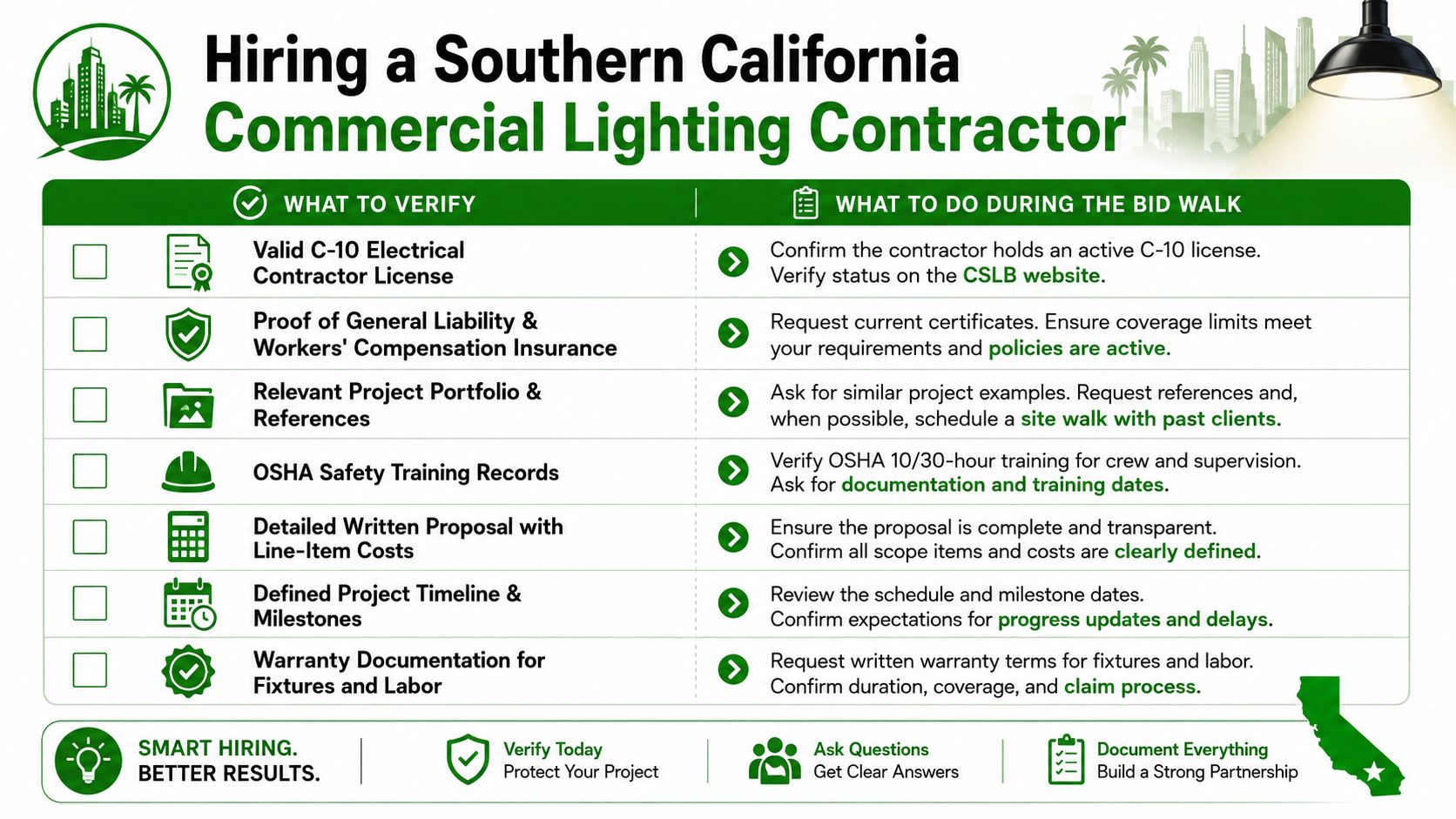
The proposal should be comparable without a separate phone call to discover what each bidder assumed. Demand line-item fixture counts, a photometric plan revision, pole and foundation notes, trench footage, conduit details, permit responsibility, Title 24 documentation, controls programming, emergency lighting scope, restoration, testing, and warranty terms.
Southern California adds coordination issues that can change the schedule. The contractor may need to work with SCE, LADWP, or SDG&E, coordinate city or HOA reviews, and address prevailing-wage rules on public-facing work. Retail properties may require night work, temporary lighting, traffic plans, and a tenant notification process. Those items should appear in the schedule and the price, not emerge as surprises after award.
Check the warranty and the operating plan
Ask for warranty language that identifies the luminaire, driver, controls, and labor separately. Request references that can discuss service response, not only installation quality. Before-and-after kWh records can help validate an efficiency project when the owner has reliable baseline data, but the contractor should also explain how controls, operating schedules, and maintenance affect the comparison.
A maintenance plan should be part of turnover. Useful tasks include annual infrared scans of driver and breaker terminations, pole-base corrosion inspections every two to three years, group re-lamping schedules tied to the fixture's rated L70 hours, and nighttime photometric verification. Those maintenance intervals come from the provided industry guidance and should be adjusted to the manufacturer's requirements and site conditions.
Emergency lighting needs its own calendar. The facility team should perform and log 30-second monthly tests and 90-minute annual tests where required by the applicable California code, while retaining results and corrective actions. A failed unit should generate a work order, repair record, and retest rather than a note that disappears into an email thread.
Access Electrical and Lighting provides commercial lighting installation and maintenance, emergency-lighting testing, infrared inspections, pole services, Title 24 support, electrical distribution work, and EV charging installation for Southern California properties. Those combined scopes can be useful when the owner wants one contractor coordinating line-voltage lighting, controls, life-safety equipment, and low-voltage or EV-ready infrastructure.
Questions owners ask before signing
What is the typical payback on an LED retrofit?
It depends on operating hours, existing wattage, utility rates, controls, maintenance, and project construction. The provided industry benchmarks cite parking-lot pole lighting at about 60% to 65% energy savings with a two-to-four-year payback, canopy lighting at about 65% to 70% savings with a one-to-two-year payback, and façade lighting at about 50% to 60% savings with a three-to-five-year payback. These benchmarks are reported in the commercial exterior LED retrofit guidance, but the contractor should calculate the property's result from measured conditions.
How does trenching affect tenant operations?
It can restrict parking, deliveries, fire lanes, and pedestrian routes. Phase the route, use temporary protection, coordinate closures, and install future EV conduit during the same pavement work where the design permits.
Does Title 24 allow photocell-only controls?
A photocell can satisfy the daylight shutoff function when correctly selected and installed, but it may not satisfy the complete control sequence for scheduling, occupancy response, dimming, or other project requirements. Confirm the approved sequence with the designer and AHJ.
How long does pole replacement take compared with fixture replacement?
Fixture replacement is usually less disruptive when poles, foundations, anchors, and circuits are sound. Pole replacement adds structural verification, foundation work, concrete, lifting, and restoration, so the schedule depends on access and site conditions rather than a universal duration.
Should EV-ready conduit be installed during the same outage window?
Usually, it deserves early evaluation. Sharing trench routes and pavement restoration can reduce later disruption, but the design must account for service capacity, pathway routing, pull boxes, spare capacity, and the future charger locations.
Before approving a commercial outdoor lighting project, ask Access Electrical and Lighting to review the site, electrical distribution, controls, emergency equipment, pole conditions, and EV-ready pathways as one coordinated scope. Visit Access Electrical and Lighting to request a Southern California consultation, bid review, installation plan, testing, or ongoing maintenance support.