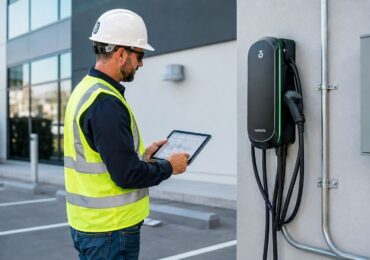
A tenant wants charging at the office. A retail customer has already asked whether the property supports EVs. Your facilities team has a parking lot, an electrical room, and a deadline, but no clear answer on how many chargers the site can support. Three vendors are offering different hardware packages, while the electrician keeps asking for the utility bill, the single-line diagram, and the available service capacity.
That confusion is normal. An EV charging station for business is not primarily a product purchase. It's an electrical infrastructure project with a hardware component. The successful order is usually site capacity first, charger type second, operating model third, and pricing last. Reverse that sequence and a polished proposal can still fail during engineering, permitting, or utility review.
A Property Manager Walks Into an EV Charging Decision
A property manager at a suburban office park receives a charger request from the largest tenant. The tenant wants the stations available within 90 days, preferably near the main entrance, with employee billing and a networked app. The landlord asks whether the work belongs in the capital budget. Three vendors promise a quick installation, but each recommends a different charger. Meanwhile, the electrician asks a less exciting question: how much electrical capacity is left at the property?
That question controls the project.
The parking area may be convenient for drivers but far from the main switchgear. The nearest electrical panel may have limited spare capacity. The transformer may already serve a heavy building load. A service upgrade may require utility engineering, civil work, and a schedule that doesn't fit the tenant's requested launch date. A charger can be in stock and still be unusable at that location.
The sequence that prevents rework
Start with a field assessment. The contractor should locate the service entrance, main switchboard, distribution panels, transformers, parking stalls, accessible routes, trench paths, and communications options. The team should review the existing electrical drawings, confirm conditions in the field, and identify whether a load study or utility discussion is necessary.
Then define the operating need:
- Workplace charging: Vehicles generally remain parked for long periods, so Level 2 often fits better than high-power equipment.
- Retail and hospitality: Charging may support customer dwell time, tenant experience, and public access.
- Multifamily properties: Residents typically need dependable overnight or long-duration charging, with clear assignment and billing rules.
- Fleet facilities: Duty cycles, departure windows, and vehicle count matter more than a generic public-charging package.
Only after those questions are answered should the owner compare charger models, network contracts, payment systems, and warranties.
Practical rule: A charger quote without a documented electrical review is a product proposal, not a project plan.
The manager's first decision isn't which brand to buy. It's whether the property can support the intended charging load, where the equipment should go, and what must be built now to preserve future expansion. That order protects the budget and gives the tenant an honest schedule.
Why Commercial EV Charging Stopped Being Optional in 2026
A property manager can order chargers quickly, then discover the service cannot support them, the utility needs more time, or permitting requires work that was never included in the budget. That sequence is becoming common as commercial charging moves into ordinary facilities planning.
The ICCT market brief reports that non-home charging in the United States grew from about 66,000 chargers in 2020 to about 151,000 in June 2023, then reached 204,000 in 2024. That represented a 35% increase in one year. The 2024 total included about 153,000 Level 2 chargers and 51,000 DC fast chargers, with DC fast equipment showing a 56% increase from the earlier comparison point.
Those figures do not determine how many ports a property needs. They do show that workplace, retail, multifamily, hospitality, and fleet charging now belong in mainstream facilities planning. Tenants increasingly expect property managers to understand charging alongside parking controls, lighting, access systems, and electrical distribution.
Market signals driving commercial EV charging in 2026
| Signal | Data Point | Implication for Site Owners |
|---|---|---|
| Non-home charging growth | About 204,000 chargers in 2024, compared with about 151,000 in June 2023, according to the ICCT market data | Charging is now a recurring commercial property requirement, not an experimental amenity |
| Level 2 expansion | About 153,000 Level 2 chargers in 2024, based on the same ICCT report | Offices, multifamily properties, and destination sites can evaluate established AC charging infrastructure |
| DC fast expansion | About 51,000 DC fast chargers in 2024, a 56% increase from the earlier comparison point in the ICCT market data | High-turnover sites need to plan for larger electrical services and more complex utility coordination |
| Grid constraint | 75% of surveyed developers and operators identified grid limitations as a significant barrier in 2026, according to industry survey reporting | Electrical feasibility must precede procurement and tenant promises |
| Customer spending | One nearby charger was associated with a 1.4% increase in annual spending at a nearby establishment in 2019, about $1,478, in the Nature Communications study | Charging can support commercial traffic, but results depend on proximity, use case, and operating policy |
Local requirements also shape the project. California work may involve CALGreen provisions, while other cities and municipalities impose their own EV-ready or parking rules. The permitting review should confirm whether the site must reserve electrical capacity, install conduit, meet accessibility requirements, or coordinate with a local building program.
For owners, charging belongs in capital planning, tenant improvement reviews, parking renovations, and electrical upgrades. The electrical review comes before model selection. Waiting until a tenant sets a short deadline can leave the hardware easy to order while the power, permits, and utility schedule remain unresolved.
Level 2 vs DC Fast Chargers for Commercial Properties
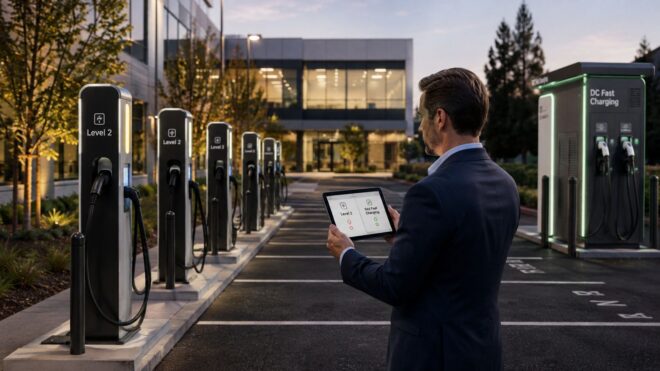
The most common mistake is treating Level 2 and DC fast charging as interchangeable. They solve different parking problems. Level 2 works while a vehicle remains at the property. DC fast charging works when the vehicle needs energy quickly and the site can support a concentrated electrical demand.
The power ranges below are practical planning categories, not promises of identical vehicle performance. Actual charging speed depends on the vehicle, battery condition, temperature, connector, and charger configuration.
Level 2 vs DC fast chargers for commercial properties
| Attribute | Level 2 (AC) | DC Fast (DCFC) |
|---|---|---|
| Power | Commonly planned around 7 to 19 kW at 240 volts | Commonly planned around 50 to 350 kW |
| Charge time | Suited to extended parking and destination dwell | Suited to short stops and rapid vehicle turnaround |
| Hardware cost band | Often lower-cost commercial equipment, with project pricing driven heavily by installation | Higher-cost equipment with substantial electrical and civil requirements |
| Install cost band | Can remain relatively manageable when spare capacity and nearby panels exist | Can become substantial when service, transformer, switchgear, or trenching work is required |
| Ideal site | Offices, multifamily, hotels, retail destinations, and employee parking | Travel corridors, fleet depots, convenience sites, and locations with short dwell times |
Match power to parking behavior
An office employee who parks through the workday doesn't need the same charging experience as a delivery fleet that must return to service quickly. A multifamily resident may value dependable overnight access more than rapid charging. A convenience-store customer may leave before a lower-power session provides meaningful value.
That makes dwell time the first charger question. If vehicles remain parked for hours, Level 2 usually offers a more practical balance between service, infrastructure, and cost. If vehicles turn over quickly or operate on fixed dispatch schedules, DC fast charging may justify its heavier electrical footprint.
A single DC fast port can demand roughly the same service as 10 to 15 Level 2 ports, as a field-planning comparison. That relationship affects transformer loading, conductor sizing, switchgear, utility review, and demand management before anyone compares screens or payment features.
The right starting point for most properties
Most commercial properties should begin with Level 2 unless the use case clearly requires fast turnaround. The owner can install a smaller initial group, collect utilization data, and expand where demand supports it. DC fast equipment makes more sense when drivers have a strong reason to leave quickly, or when a fleet's operating schedule turns charging speed into an operational requirement.
Don't choose DC fast because the name sounds more future-proof. Choose it because the property, electrical service, and vehicle workflow require it.
Owned vs Networked Charging Models Compared
Ownership determines who carries the operational burden after installation. In a self-managed arrangement, the property buys the hardware and takes responsibility for access, billing, software, maintenance coordination, and driver support. In a networked model, a provider supplies a software platform and may handle payment processing, monitoring, customer support, and service escalation.
Neither model is automatically cheaper. The right comparison includes the full operating period, not just the equipment invoice.
Owned vs Networked Charger Models at a Glance
| Factor | Owned, Self-Managed | Networked, Provider-Managed |
|---|---|---|
| Total operating cost | Lower recurring platform exposure, but internal labor and maintenance remain the owner's responsibility | Recurring service charges, with more outsourced administration |
| Data ownership | More direct control if the system provides usable local data | Data access depends on the contract and platform terms |
| Billing flexibility | Owner controls rates and policies, subject to system capability and applicable rules | Provider usually supplies payment tools and pricing controls |
| Driver experience | Owner must manage account setup, support, and issue resolution | Provider commonly supports apps, payment, and driver inquiries |
| OCPP compatibility | Should be specified before purchase to preserve interoperability | Must be confirmed in the hardware and network agreement |
| Service response | Depends on the owner's contractor and maintenance plan | Depends on contracted response times and provider coverage |
| Vendor transition | Owner manages system migration and replacement decisions | Contract termination, ownership changes, and platform migration need explicit protection |
A long-term owner with in-house facilities staff, a private fleet, and predictable users may prefer self-management. The team can keep access private, assign stalls, and fold charger maintenance into an existing service program. The trade-off is that someone must monitor faults, manage payments if charging isn't free, and keep the system operational.
Retail, hospitality, and public-facing office sites often benefit from network support. The provider can manage payment processing and driver communications without forcing property staff to become a charging help desk. The contract should spell out data export, hardware ownership, uptime expectations, repair responsibilities, cybersecurity responsibilities, and what happens if the provider changes its platform or business ownership.
A hybrid model often fits mid-sized portfolios. The property owner may purchase the electrical infrastructure and charger hardware, then use a network for public billing and monitoring. That approach preserves more control over the physical asset while outsourcing the customer-facing workload.
Contract detail that matters: Confirm who owns the charger, who owns the usage data, and who pays for a failed modem, screen, cable, or network migration.
Real Costs, Incentives, and the Budget You Should Plan For
A commercial charging budget has at least four layers: equipment, electrical installation, software and billing, and long-term maintenance. The charger itself is only one line item. A nearby panel with spare capacity can keep installation straightforward. A distant parking structure, overloaded service, or new transformer can change the project completely.
The following planning bands come from the project assumptions provided for this guide. They aren't a bid, and site conditions can move the final number substantially.
Budget bands for a commercial EV charging project
| Line Item | Low | High | Typical Incentive |
|---|---|---|---|
| Level 2 hardware per port | $2,500 | $7,000 | Federal, state, and utility programs may apply if eligibility rules are met |
| DC fast hardware per unit | $28,000 | $150,000 | Program availability and site eligibility vary |
| Simple installation, such as a nearby pedestal | $4,000 | Varies by site | Utility or state incentives may offset eligible installation work |
| Complex installation, including panel upgrades or parking-structure trenching | Varies by site | $60,000 or more | Incentive treatment depends on the program and documented scope |
| Network and software services | Varies by contract | Varies by contract | Usually evaluated as an operating expense rather than a hardware rebate |
| Maintenance reserve | Varies by equipment and service plan | Varies by equipment and service plan | Often not fully covered by installation incentives |
For a six-stall workplace project, start by multiplying the selected Level 2 hardware band by six, then add one installation allowance for the site rather than assuming six identical residential-style installs. Add design, permits, networking, signage, striping, commissioning, and a maintenance reserve. If the parking area is close to an adequate panel, the budget may remain within a manageable commercial retrofit range. If the project needs a service upgrade, long trench, or structural work, the electrical scope becomes the dominant cost.
The federal 30C credit, California programs such as CALeVIP, and utility offerings from SCE, PG&E, and SDG&E may reduce eligible costs. Programs change, funding can be limited, and requirements may include equipment eligibility, prevailing wage, location, accessibility, and application timing. Confirm the rules before construction and document which party applies for each incentive.
For a practical installation-cost reference, review this commercial EV charger installation price guide. Treat any online range as a screening tool, not a substitute for a site walk and electrical review.
Grid Capacity, Utility Upgrades, and Site Selection Reality
A property can have a large main service and still lack usable capacity for charging. A 400-amp service may carry limited spare load during peak building operation, while the nearest transformer is already heavily loaded. Parking may also be far from the practical distribution point, turning a seemingly simple charger installation into a trenching and feeder project.
Utility constraints now determine whether many commercial charging plans proceed on schedule. Industry survey findings identify grid limitations as a major deployment barrier, and some projects require extended utility review or infrastructure upgrades. Treat service capacity and utility lead time as design inputs before choosing charger models.
Read the site before selecting the equipment
Request the existing single-line diagram, service rating, transformer information, panel schedules, and recent demand data. Then verify each item in the field. Renovations, tenant improvements, undocumented equipment, and panel modifications can make older drawings unreliable.
A load study shows whether the property can support the intended charging profile under actual building conditions. Review base building demand, HVAC operation, tenant loads, planned equipment, and the charging strategy together. Use this transformer sizing reference during the early electrical review, before a charger capacity is promised to a tenant or employee group.
The practical question is not how many ports fit on a parking plan. It is how much power the building can deliver while operating normally, and where that power can be routed without creating avoidable civil work.
Options when the service is tight
Dynamic load management allocates available capacity across active charging sessions so total demand remains within a building limit. Static, dynamic, and AI-based systems operate differently. Dynamic controls adjust energy use at the building level in real time, as explained in commercial charging power-management guidance.
A properly engineered system can prevent simultaneous charging from exceeding the property's electrical limit. It may also allow an owner to install more ports than the service could support at full nameplate output. That result depends on controls, communications, equipment compatibility, and clearly defined operating assumptions.
Battery buffering can suit selected sites. It may reduce the need to draw the full fast-charging load from the utility at once, but it adds equipment, controls, maintenance, space requirements, and permitting. It does not correct an inadequate service by itself.
Site placement often has more financial impact than charger branding. Keep equipment close to switchgear or a capable distribution point, limit trench distance, confirm transformer location, preserve accessible routes, and install conduit sized for planned expansion. A lower-power charger near available capacity can be a better project than a higher-power unit that triggers a lengthy utility process.
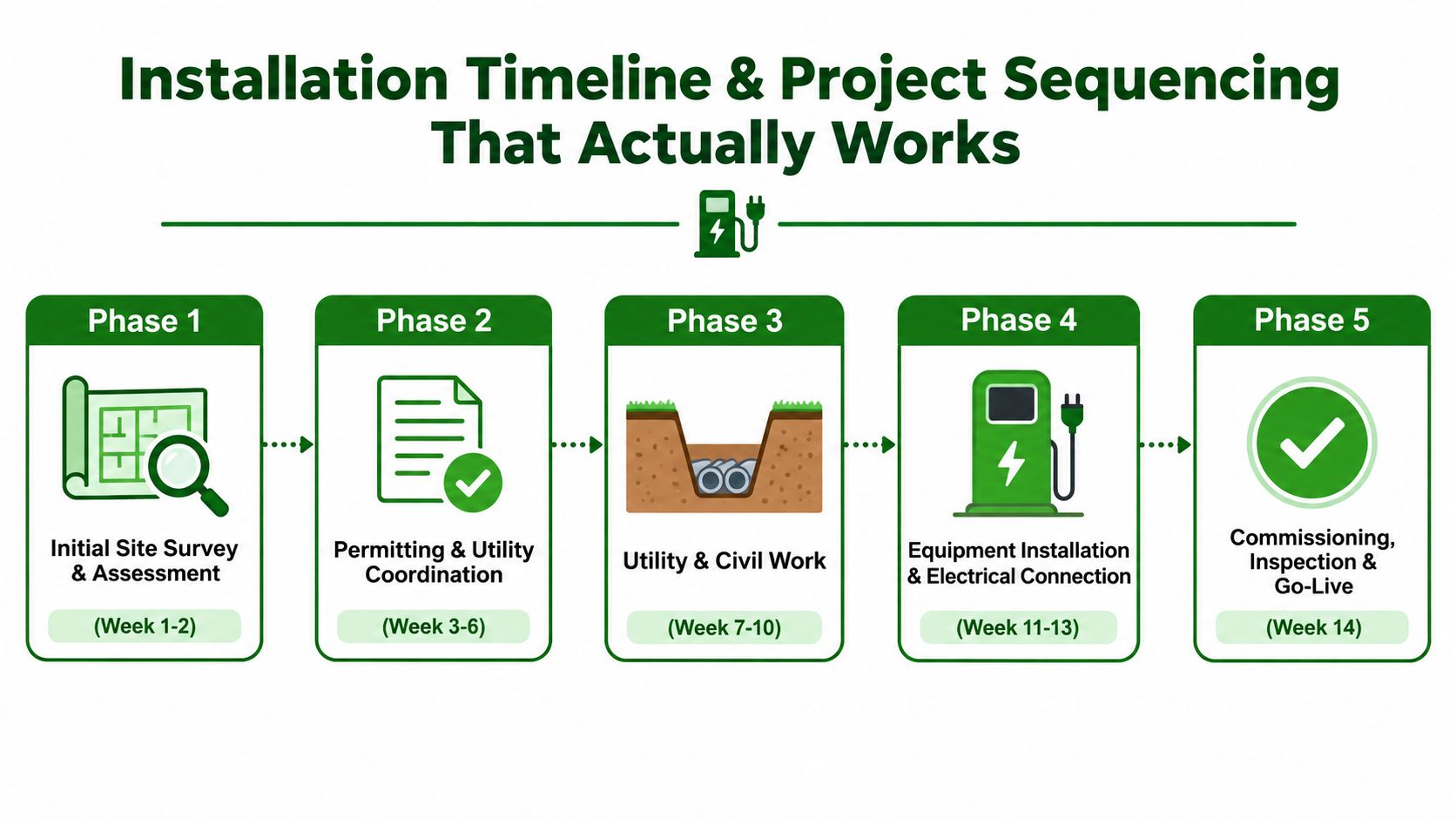
Installation Timeline and Project Sequencing That Actually Works
The schedule starts with dependencies, not delivery dates. A Level 2 unit may arrive quickly while the permit, utility review, or panel work remains unresolved. DC fast projects need even more coordination because equipment procurement, civil work, service design, and commissioning can all affect one another.
A workable sequence is:
- Survey and feasibility: Confirm parking, electrical distribution, load, communications, accessibility, trenching, and equipment locations.
- Engineering and approvals: Prepare drawings, submit permits, and coordinate with the utility if the proposed load affects service.
- Procurement and civil preparation: Order equipment, schedule concrete or trench work, and rough in conduit for the planned expansion.
- Electrical installation: Install feeders, disconnects, panels, protection, pedestals, bollards, and charger heads.
- Commissioning: Complete inspection, network activation, OCPP testing where applicable, signage, striping, payment setup, and the operations handoff.
Utility coordination can take 8 to 36 weeks for service upgrades and longer when transformer work is needed. Engineering and permitting commonly require 4 to 12 weeks, while equipment procurement can take 6 to 12 weeks for DC fast equipment and 2 to 4 weeks for Level 2 equipment. Construction may take 1 to 3 weeks per charger head, depending on site conditions and the amount of shared infrastructure. These planning ranges come from the project brief and should be validated for the local jurisdiction.
Stage capacity instead of guessing demand
The useful question isn't how many chargers the property can fit. It's who will use them, when they arrive, how long they remain parked, and whether access is private or public. NREL's workplace charging dataset tracks more than 300 vehicles across four years, and the DOE workplace charging guidance and related NREL dataset support using employee surveys and actual demand information rather than assuming universal workplace usage.
A sensible first phase may install two or four ports while extending conduit, reserving wall space, and sizing pathways for expansion. That avoids paying for unused equipment while protecting the civil work already completed. Run parallel work streams where possible. The contractor can verify the single-line while the owner surveys employees, and the designer can prepare a permit set while the utility reviews service conditions.
Use the commercial EV charger installation requirements guide to organize the code, access, and installation discussion before equipment arrives. Ordering the dependencies correctly will usually matter more than selecting between two similar charger models.
Turning Chargers Into a Revenue and Retention Asset
A charger can support leasing, customer visits, and sustainability goals, but the operating policy determines whether it creates value or becomes another maintenance issue. The Nature Communications research on charging stations and nearby spending analyzed more than 4,000 EV charging stations and 140,000 business establishments in California. It found that one installed station corresponded with higher annual spending at a nearby establishment, including 1.4% in 2019, about $1,478, and 0.8% from January 2021 through June 2023, about $404. The strongest effect occurred within 100 meters, where spending rose 2.7% in 2019 and 3.2% during the later period.
Those findings do not guarantee a return for every property. They do support deliberate placement. A charger at the far end of a lot may create less commercial value than one near active retail frontage, as long as accessibility, safety, traffic flow, and electrical capacity are addressed during design.
Build the policy before opening the ports
Set the operating rules before drivers arrive:
- Employee access: Decide whether charging is free, reimbursed, or priced to recover electricity and operating costs.
- Public access: Open selected ports during daytime gaps if the site can support public use and customer support.
- Idle control: Use idle fees or clear time limits to prevent vehicles from occupying spaces after charging ends.
- Stall management: Mark reserved, first-come, employee-only, visitor, and accessible spaces clearly.
- Performance review: Audit utilization, faults, revenue, and complaints quarterly before adding equipment.
Commercial owners should track first-time charge success rate, not only uptime. Industry analysis identifies FTCSR as a more meaningful customer-facing reliability measure. NEVI programs require at least 97% uptime per charger port and no more than 96 consecutive hours of downtime, as described in charging reliability analysis.
Utilization versus breakeven
The table is a decision framework, not a revenue forecast. Pricing, electricity costs, demand charges, session length, and utilization vary by property, so the owner should build the model from actual operating conditions.
| Utilization | Level 2 Monthly Revenue | DC Fast Monthly Revenue | Status |
|---|---|---|---|
| 10% | Calculate from actual session pricing and energy delivered | Calculate from actual session pricing and energy delivered | Test demand, control access, and avoid premature expansion |
| 20% | Model against network fees, electricity, maintenance, and capital recovery | Model against demand charges, maintenance, electricity, and capital recovery | Review whether the site is producing enough operational value |
| 35% | Compare recurring revenue and tenant benefits with full operating cost | Compare turnover, demand exposure, and service costs with full capital cost | Consider expansion only after reliability and policy are proven |
At workplace properties, chargers may strengthen retention even when charging revenue remains modest. At retail sites, the same Nature Communications research makes placement and customer dwell time part of the business case. At multifamily properties, resident satisfaction and lease positioning may matter more than public turnover.
The asset requires active management. Review usage reports, correct blocked-stall behavior, respond to failed sessions, and expand from observed demand rather than vendor enthusiasm.
Access Electrical and Lighting provides commercial EV charger installation, electrical evaluation, panel and distribution upgrades, permitting support, and code-compliant rollout for office, retail, multifamily, and other Southern California properties. Start with a site assessment and project-sequencing conversation, then visit Access Electrical and Lighting to request help planning an EV charging station for your business.