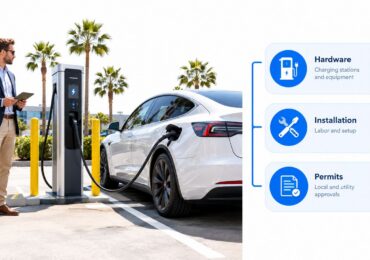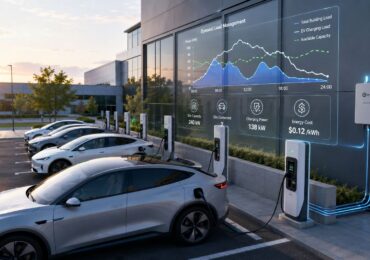
Commercial Level 2 EV charger installations typically run $3,000 to $12,000+ per charger in Southern California, and the hardware is rarely what pushes the number around. The primary swing comes from site work, electrical capacity, trenching, permitting, and whether the property needs a panel upgrade or new feeder work.
That's the part most property managers feel in the gut when a quote lands on their desk. The charger itself may look simple on a spec sheet, but the proposal starts reflecting the parking lot, the service gear, the run length, and the utility side of the job long before anyone talks about the brand of EVSE.
What a Commercial Property Manager Is Really Paying For
A retail center in Orange County can look ready for chargers until the first walk-through with an electrician. The stalls are there, the tenants are asking about EV charging, and the quote still comes back higher than expected because the property isn't paying for a box on a wall. It's paying for a power path that works every day without nuisance trips, code issues, or patchwork fixes later.
Industry estimates place total installed cost for a commercial Level 2 EV charger at roughly $3,000 to $12,000+ per charger, and the spread is driven by labor, permitting, trenching, and especially whether the site needs a panel upgrade or new feeder work (GreenLancer commercial charging guide). That's why two proposals for the same charger can look wildly different while still being perfectly real.
What the quote is actually paying for
The hardware is only one line item. The rest of the budget usually gets consumed by the path from the electrical room to the parking space, plus the paper trail that keeps the job legal and insurable.
Practical rule: If the quote is thin on site conditions, it's probably thin on reality.
Before budgeting, a property manager should get clear answers to a few basics. Is there spare capacity in the existing service? How far is the charger from the panel? Will the run stay on a finished surface, or does it cross concrete, landscaping, or a parking structure? Those three questions usually tell you more about the final price than the charger model does.
The best proposals also separate the charger from the infrastructure. That matters because it helps you compare one bid against another without getting distracted by software features or brand language that don't change the actual construction burden.
The Three Commercial Charger Types You Can Buy
A lot of price confusion starts because buyers compare different charger categories as if they were the same product. They're not. A Level 2 charger is the workhorse for workplaces, retail, and multifamily properties. A DC fast charger is a different animal entirely, built for much faster turnover and much heavier infrastructure.
Think of Level 2 as filling a glass over time and DC fast charging as using a fire hose. Both put energy into a vehicle, but the utility requirements, equipment complexity, and install risk are nowhere near the same.
Know the tier before you compare bids
The simplest way to read a proposal is to identify whether you're buying wall-mount or pedestal hardware, single-port or dual-port equipment, and networked or non-networked functionality. Networked units add remote monitoring, access control, payment, or reporting features, which can matter a lot for a commercial site but don't always help a small private lot.
| Commercial EV Charger Hardware at a Glance | Hardware Price Range | Typical Use Case | Power | Notes |
|---|---|---|---|---|
| Level 2, non-networked | Lower hardware cost, site dependent | Private or low-complexity commercial use | 240V class | Simpler feature set, less software overhead |
| Level 2, networked | Higher hardware cost, site dependent | Retail, multifamily, workplace | 240V class | Adds access control, reporting, payment, or management tools |
| DC fast charging | Highest hardware class | Corridor, hospitality, high-turnover sites | Much higher power delivery | Requires much more infrastructure and coordination |
The DOE's historical pricing data makes the difference obvious. For non-residential sites, a single-port Level 2 EVSE unit typically cost $400 to $6,500, while DC fast charging equipment ranged from $10,000 to $40,000 in that 2015 analysis (DOE EVSE cost report). In modern commercial planning, that still translates into a very different decision tree.
A buyer who knows the tier can stop comparing apples to freight trains.
For a commercial property, that distinction matters before the electrician even gets involved. A good proposal should tell you which tier is being installed, whether the site really needs network features, and whether the project is meant to serve tenants, visitors, fleet vehicles, or all three.
Where Every Dollar Actually Goes in the Quote
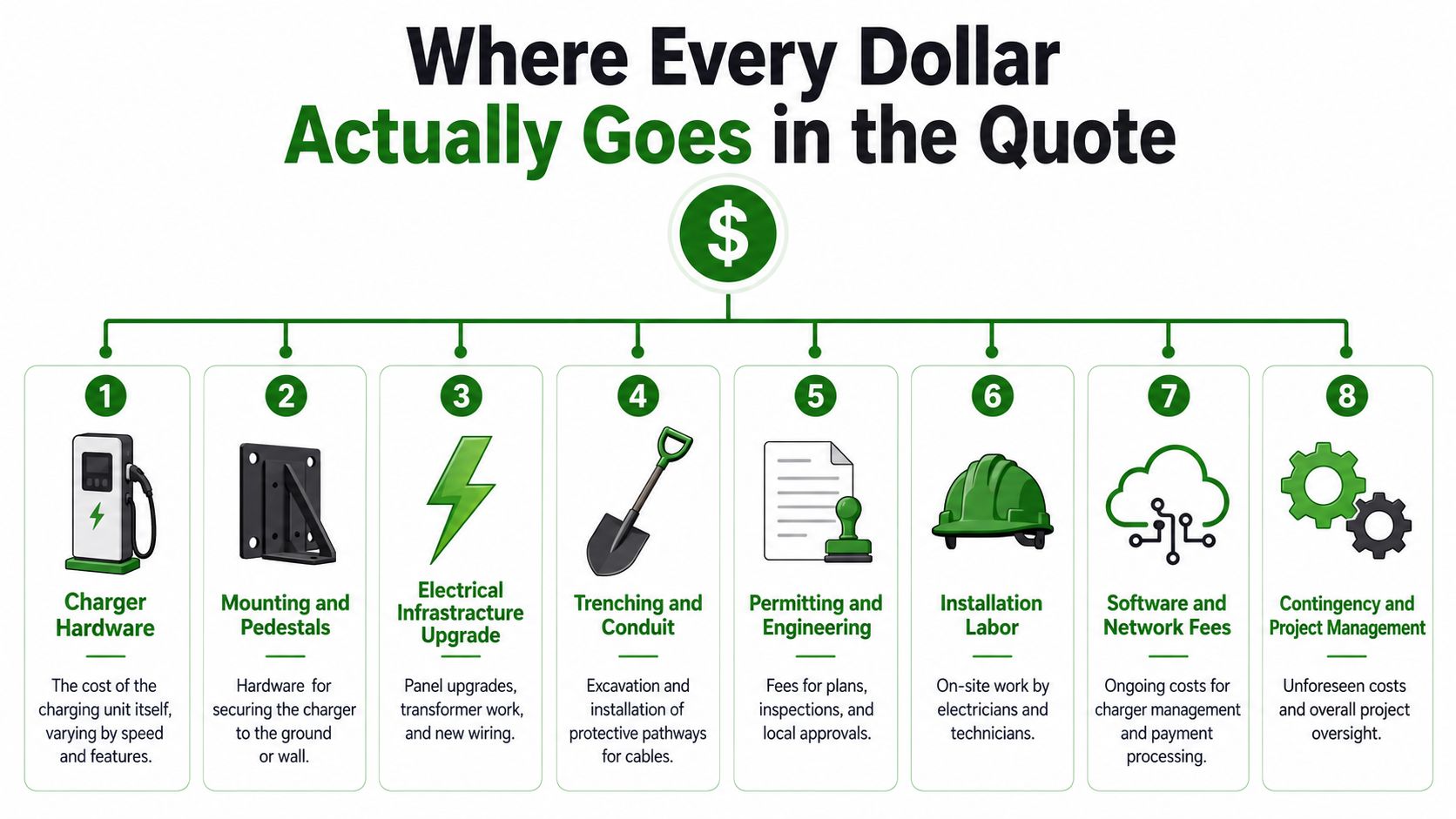
A commercial quote usually breaks into eight buckets, even when the proposal only shows four or five line items. The charger hardware is the obvious one, but the less visible costs are where Southern California projects tend to move.
The line items that move the total
Charger hardware is the unit itself, and it's the easiest part to understand. Mounting and pedestals are the physical supports, which matter more when the unit can't go straight on a wall. Electrical infrastructure upgrade covers panel work, feeder work, and any service-side changes required to carry the load.
Trenching and conduit are the civil and protective paths for the wiring. Permitting and engineering cover plans, inspections, and local approvals. Installation labor is the onsite electrician time, plus the coordination needed to get the job done cleanly. Software and network fees can apply when the charger is connected to a management platform, and contingency and project management covers the stuff that always appears in real jobs, not just bid tabs.
The DOE's older data shows why the quote can look lopsided. Public Level 2 charger installations ranged from about $600 to $12,660, and DC fast charging equipment ran $10,000 to $40,000 with installation adding $4,000 to $51,000 depending on site conditions (DOE EVSE cost report). The lesson still holds today, the electrical path and the civil work often dominate the conversation.
A useful shortcut is to ask whether the site can support the charger without opening up the property. If the answer is no, the budget is no longer just about equipment. It becomes an electrical and construction project with a charger at the end of it.
For the technical side of that conversation, a quick transformer sizing reference helps frame whether the service can handle the load before anyone starts cutting asphalt.
Why Two Identical Chargers Can Cost Three Times Different
Two properties can buy the same charger and end up with very different totals. One has spare panel capacity, a short run, and a clean place to mount the equipment. The other needs a panel upgrade, long conduit, trenching, and coordination that drags the job into a different cost class.
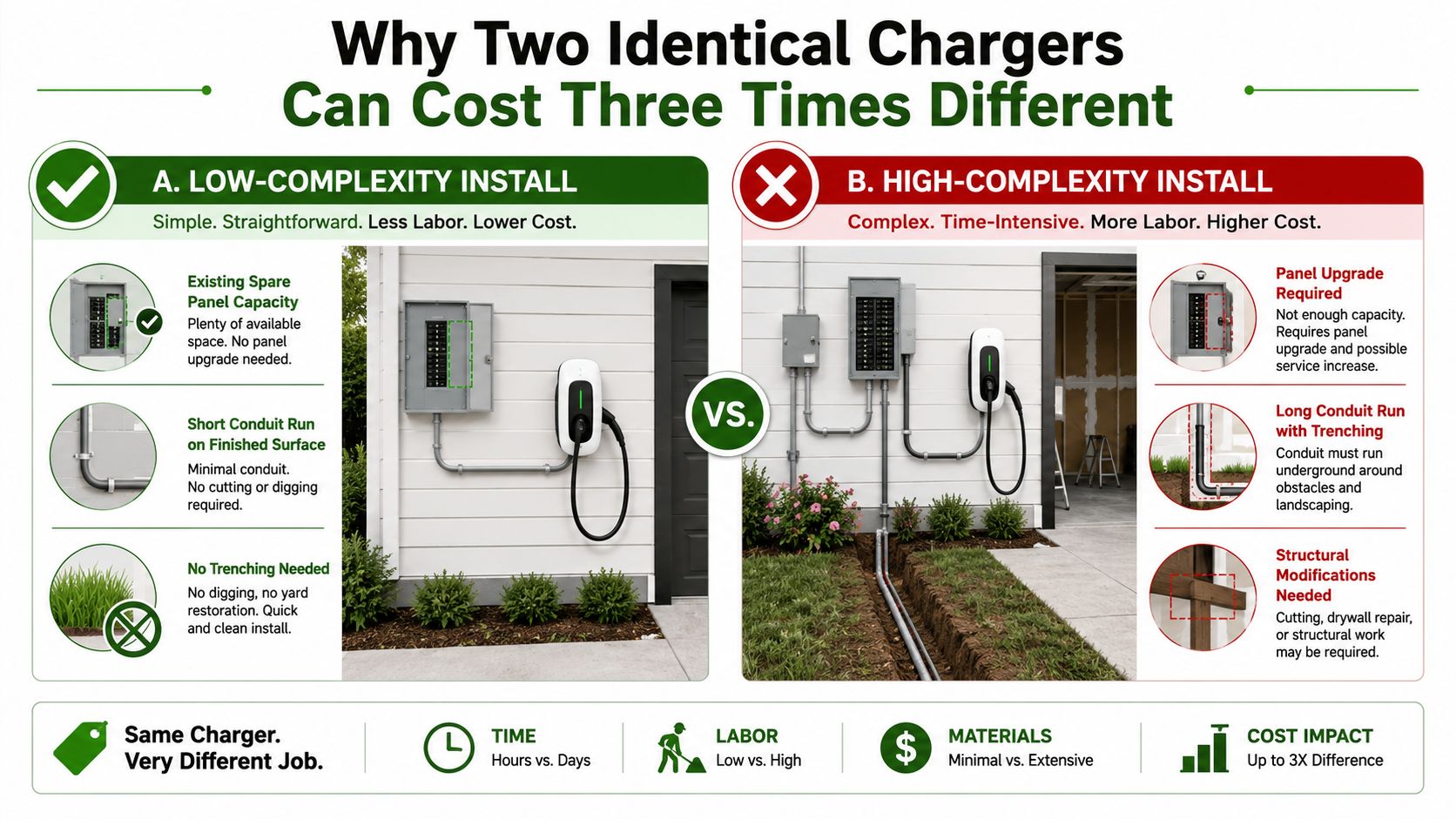
Low complexity versus high complexity
Low-complexity install. The charger lands close to the panel, the service has room, and the conduit run stays simple. In that case, the hardware and labor stay near the lower end of the commercial range, and the proposal usually reads like a straightforward electrical job.
High-complexity install. The charger sits across the lot or in a deck, the existing service is maxed out, and the electrician has to coordinate trenching, concrete work, or a service-side upgrade. That's where the total can climb fast, even though the charger model never changed.
The technical trigger is usually not the charger. It's the property's ability to supply a dedicated 240V circuit with enough capacity and enough room in the electrical system. When the service can't handle that load, the job expands into panel work, longer conductor runs, and additional labor.
The quote gets bigger when the building has to make room for the charger.
That's why location matters so much. ADA placement, distance from the electrical room, finished surfaces, and site constraints all change the labor profile. A bid that looks expensive may just be accounting for the work the cheaper bid left out.
When you compare proposals, look for the reason behind the number, not just the number itself. If one contractor has included trenching, panel changes, and inspections while another has only priced the charger and a basic mount, the gap is telling you something important about the scope.
Three Real-World SoCal Commercial Scenarios
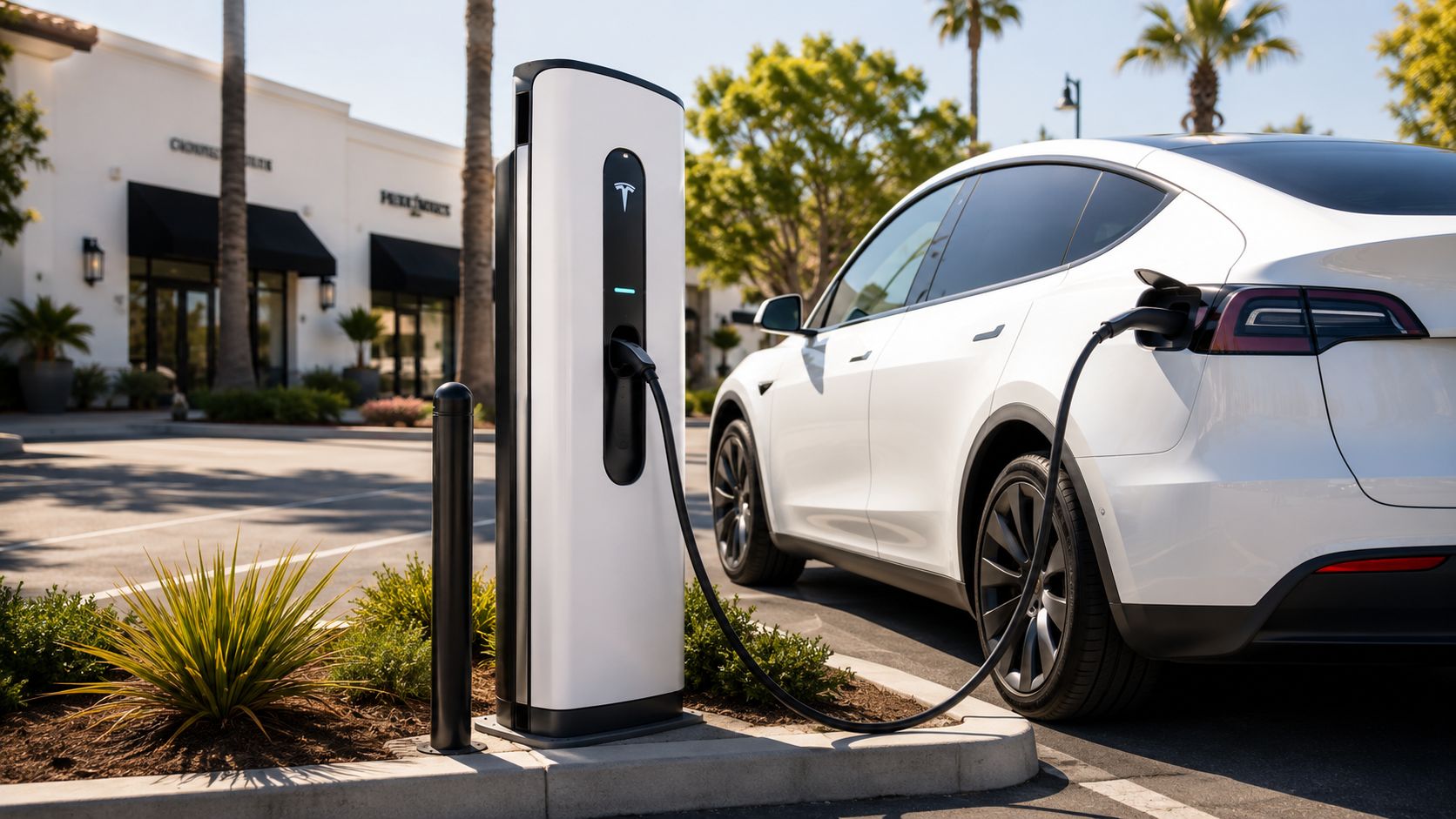
A small retail center with existing electrical headroom is the easiest place to start. Four Level 2 chargers near the main service can stay closer to the lower end of the commercial range because the electrician doesn't have to rebuild the site to power them. The quote still includes permitting and labor, but the budget stays relatively contained when the panel has room and the conduit path is short.
A mid-size office building tells a different story. Eight chargers on a parking deck can force a panel upgrade, longer runs, and more coordination around structure and access. That's the kind of job that quickly moves from “add chargers” to “modify infrastructure,” which is why the total often lands much higher than the hardware line alone suggests.
A multifamily community usually cares about tenant amenity, not just power delivery. A mix of Level 2 charging with one DC fast charger for a flagship location changes the project profile completely. The fast charger is a different cost class, and the site-side work becomes much more intense because the electrical and utility demands are far higher than a simple Level 2 install.
Government and industry data make the range easy to see. Level 2 costs can jump from roughly $2,500 per connector for workplace and public installs to $3,000 to $12,000+ per charger for commercial applications, while DC fast charging can range from $20,000 to $60,000 per connector in one DOE-linked dataset and $80,000 to $250,000+ per charger in newer industry estimates (DOE infrastructure development data).
For owners, the cheapest-looking site is often the one with the fewest hidden constraints.
That's why the right comparison isn't “How much does a charger cost?” It's “How much of my site has to be touched to make the charger work?”
How Incentives Change the Net Cost in 2025 and 2026
The gross quote is only half the story. Federal, state, and utility incentives can change the out-of-pocket number enough that two properties with similar installs end up with very different net costs.
Get the order right before the work starts
The federal Section 30C credit can materially reduce cost, and recent 2026 guidance notes a homeowner example falling from roughly $800 to $1,200 to potentially under $1,000 after the credit, with utility and commercial programs able to offset more depending on location (2026 Section 30C guidance). For commercial owners, the practical issue is timing and documentation, not just eligibility.
The project file has to support the incentive claim. That means confirming whether the property qualifies, checking whether utility rebates stack with federal credit rules, and keeping the permit and scope clean enough that the paperwork doesn't become a mess later. The wrong sequence can wipe out a benefit that would have been available if the reservation and filings had been handled first.
A separate installation requirements reference is useful before bidding, because the incentive discussion only works if the underlying site design passes code and utility review.
What changes the real budget
- Federal credit timing: If the credit applies, it changes the net out-of-pocket cost, not the quote itself.
- Utility coordination: Some projects need reservation or pre-approval before equipment is ordered.
- Commercial documentation: The stronger the paper trail, the less likely the incentive gets delayed.
- Site complexity: Incentives help most when the project is already well scoped, because they don't erase bad engineering.
In a multifamily or business setting, the smartest move is to treat incentives as part of project planning, not as a bonus after the fact. That keeps the team focused on the number that matters most, the one the owner ultimately writes.
Choosing a Vendor Who Protects the Whole Budget
A charger vendor can sell hardware. A full-scope C-10 electrical contractor can protect the total project budget. That distinction matters when the primary cost drivers are trenching, panel work, low-voltage network cabling, and the coordination that keeps the job from turning into a chain of change orders.
The cheapest bid is often the one that assumes the least. If the installer doesn't carry the infrastructure, the owner carries the surprise later.
A solid pre-qualification conversation should cover a few key items. Verify the contractor's license and bonding, ask for similar commercial projects, and find out whether the firm self-performs the electrical work or pushes key scope to subs. If the project includes networked chargers or site lighting changes, ask who handles the related low-voltage and compliance pieces.
For Orange County owners, a practical reference is the right commercial contractor checklist, because the vendor you hire determines how much of the hidden scope stays visible before the contract is signed.
The best contractor doesn't just install the charger, they protect the parts of the budget that get missed in a one-line quote.
A good proposal should also show how incentives and utility coordination will be handled, because a contractor who understands that process can save time and reduce rework. That's especially important on occupied properties where tenant access, parking impacts, and schedule pressure can make a small miss turn into a costly delay.
Smart Strategies to Lower Total Installed Cost and Lift ROI
The fastest way to protect budget is to match the charger type to the use case. Many properties don't need the most aggressive hardware available, they need the right mix of Level 2 capacity, software features, and future-ready conduit paths so the next phase doesn't require tearing up the site again.
That same logic applies to scheduling. Bundling EV work with tenant improvements, lighting upgrades, or panel repairs can reduce repeat mobilization and make the site disruption easier to manage. If the property already needs electrical work, the charger project often makes more sense when it rides along with the larger scope.
For ROI, the owner should track utilization, dwell time, electricity tariff, and amenity value. Retail and multifamily sites often monetize the charger indirectly by attracting tenants, supporting lease value, or improving the stay experience, so the question isn't just what it costs, it's what it helps the property do.
The best next step is simple, a site walk, a written scope, and a contractor who can tell you what's real before the proposal gets too pretty. If you're comparing options for a commercial property in Orange County or anywhere in Southern California, Access Electrical and Lighting can help you scope the electrical work, separate hardware from infrastructure, and build a charger plan that makes sense before you commit to the install.