The most popular advice about an exit sign battery is also the least useful: replace it every few years and move on. That rule may be simple, but it ignores chemistry, heat, test history, access difficulty, and technician time. On a large commercial property, a low-priced battery can become an expensive maintenance decision.
Treat emergency signage as a life-safety asset. Choose the battery for the environment, verify it under load, document every result, and replace units based on condition rather than a calendar alone.
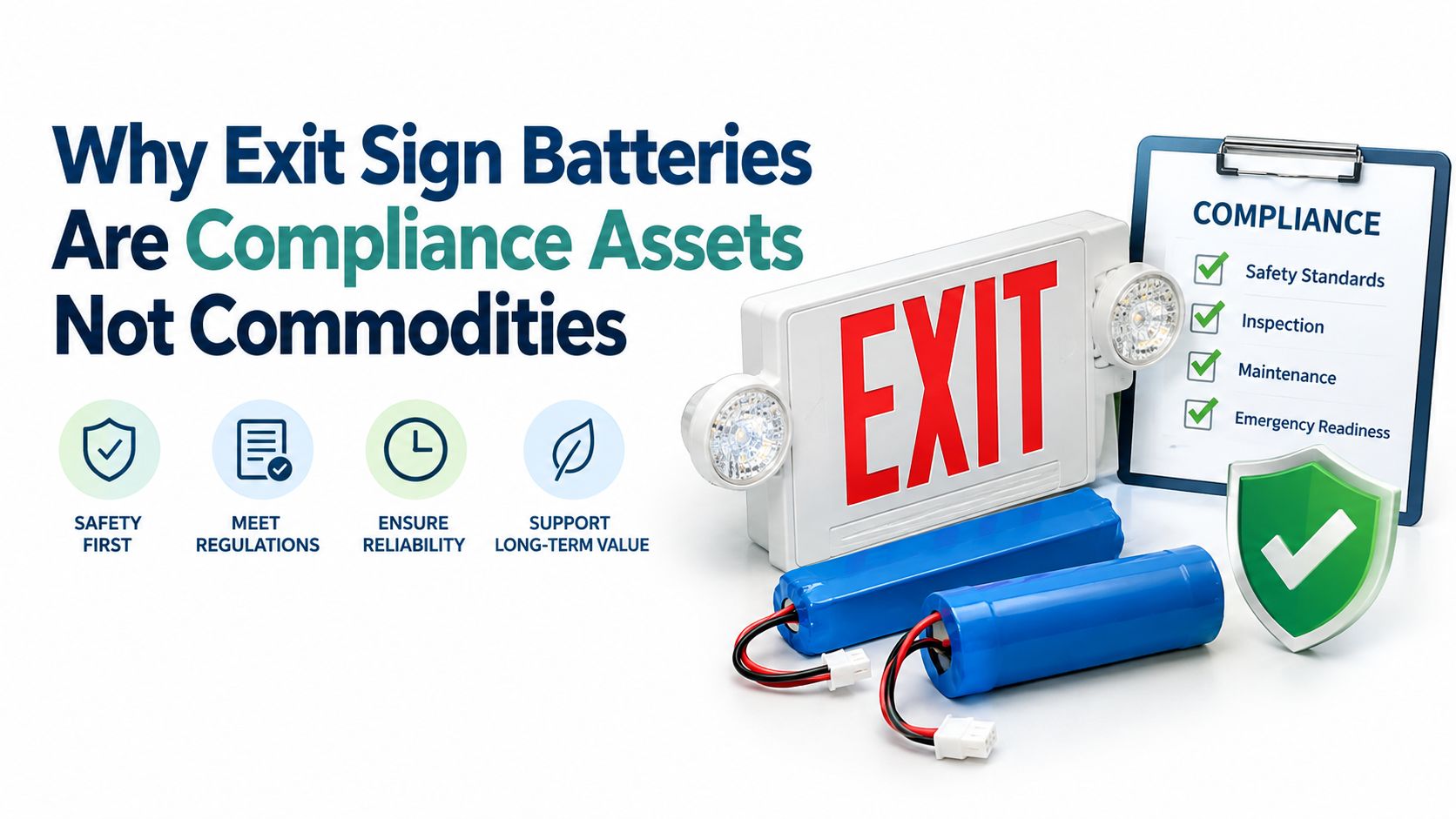
Why Exit Sign Batteries Are Compliance Assets Not Commodities
A powered exit sign is easy to ignore because it operates without drawing attention during normal conditions. Its real job starts when normal building power fails. The internal battery must keep the sign illuminated long enough for occupants to identify and follow an egress route, which is why emergency lighting guidance commonly uses 90 minutes of illumination as the core runtime benchmark under UL 924 and related emergency-lighting code guidance.
That requirement changes the purchasing decision. You aren't buying a generic rechargeable pack. You're buying a component that must transfer correctly, accept a charge, support the fixture's load, and sustain illumination during the required emergency window. A battery that powers a sign for a brief demonstration may still fail the full-duration test.
The battery affects more than one inspection
Battery failure can expose several weaknesses at once:
- Emergency performance: The sign may not remain illuminated throughout the required evacuation period.
- Maintenance control: A failed test reveals that replacement planning hasn't kept pace with asset age or operating conditions.
- Documentation quality: Missing or incomplete records make it harder to demonstrate that the system was tested and maintained.
- Owner liability: Property managers may face difficult questions after an outage, inspection failure, or emergency involving an unlit route.
Rechargeability matters too. Industry guidance notes that emergency units typically need to recharge fully in under 24 hours after discharge, so the charger and battery must work together as a compliant system. See the published exit sign battery and recharge guidance for that operational benchmark.
Practical rule: If a battery is selected only because it's inexpensive and physically fits, the procurement process is incomplete.
A better asset record includes the sign location, fixture model, battery chemistry, installation date, last replacement, monthly test history, annual test result, and environmental conditions. That information lets a facilities team identify units that deserve early attention instead of replacing every fixture blindly.
Comparing Battery Chemistries for Commercial Environments
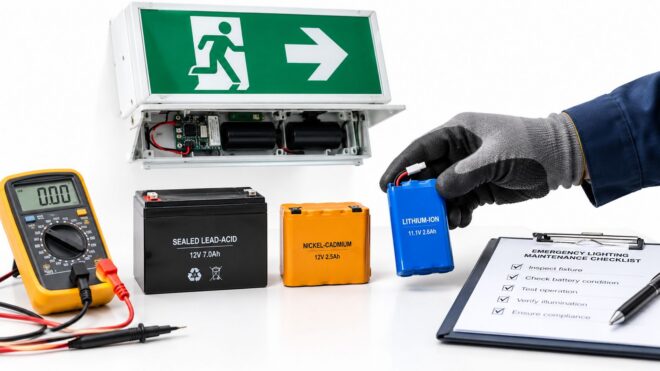
Battery chemistry determines more than expected service life. It affects replacement frequency, charging behavior, heat tolerance, physical installation constraints, and the amount of labor required to keep a portfolio compliant. Published emergency-lighting ranges commonly place sealed lead-acid batteries at about 3 to 5 years, nickel-cadmium at about 5 to 7 years, and lithium-ion at about 7 to 10 years in modern applications, as summarized in this commercial exit sign battery lifespan comparison.
| Battery Chemistry | Expected Lifespan | Best Commercial Application |
|---|---|---|
| Sealed lead-acid | About 3 to 5 years | Conditioned offices, corridors, and cost-sensitive fixture replacements |
| Nickel-cadmium | About 5 to 7 years | Properties needing durable packs and less frequent routine replacement |
| Lithium-ion | About 7 to 10 years | Large portfolios, difficult-access fixtures, and modernization projects |
Sealed lead-acid
Sealed lead-acid is familiar, widely available, and often economical at the point of purchase. It works well in conditioned interior areas where the fixture is easy to reach and the owner already has a straightforward replacement process.
Its weakness is lifecycle labor. More frequent replacement means more access work, more fixture opening and closing, more inventory management, and more opportunities to discover a failed charger or damaged connector during a rushed visit. Heat can shorten practical service life, so an apparently attractive unit may perform poorly in an unconditioned location.
Nickel-cadmium
Nickel-cadmium batteries generally provide a longer published range than sealed lead-acid. They're a reasonable choice where the owner values durability and wants to reduce repeat service activity, but chemistry alone doesn't guarantee capacity retention.
A separate facilities reference cites maintenance-free lead-acid batteries at roughly 5 to 10 years and maintenance-free nickel-cadmium batteries at roughly 10 to 15 years, showing why manufacturer specifications and actual test performance must control the decision rather than a single universal lifespan rule. Review the battery application guidance for emergency lighting before standardizing across a portfolio.
Lithium-ion
Lithium-ion, including lithium iron phosphate designs in some emergency-lighting products, offers the longest commonly published service range among the three options. It can make sense in high-ceiling corridors, parking structures, retail spaces, and multifamily properties where repeated ladder or lift access costs more than the initial battery premium.
Don't install lithium-ion solely because the label promises a longer life. Confirm compatibility with the fixture, charger, connector, enclosure, and listing requirements. For hot mechanical rooms or unconditioned structures, have a qualified contractor assess temperature exposure before selecting the chemistry.
NFPA Testing Mandates and Documentation Workflows
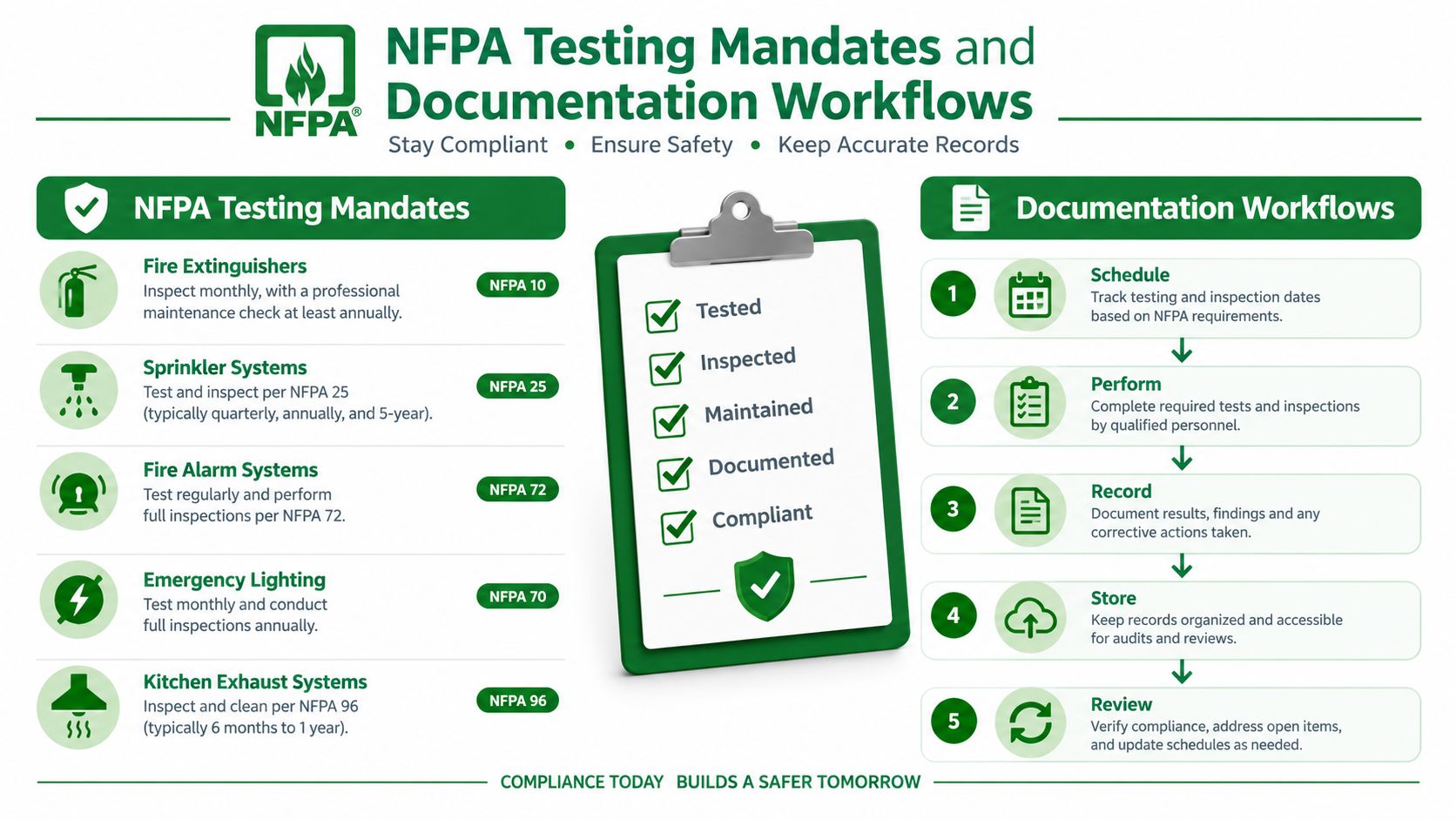
A sign that illuminates on normal power hasn't proven that its backup system works. The useful test is the one that removes normal power and observes the fixture under battery operation. Widely cited emergency-lighting practice calls for a monthly functional test lasting at least 30 seconds and an annual full-duration test lasting 90 minutes, as explained in NFPA Journal's emergency-lighting discussion.
Run the monthly check consistently
Assign one person or team to a defined route and keep the process repeatable.
- Identify the fixture: Record the property, floor, room or corridor, fixture ID, and tester.
- Initiate emergency operation: Use the test switch or approved test procedure to simulate loss of normal power.
- Observe the sign: Confirm prompt transfer, steady illumination, readable directional information, and normal indicator behavior.
- Record exceptions: Note dimming, flickering, delayed activation, unusual sounds, damaged housing, or a battery indicator.
- Create a work order: Don't bury a failure in a spreadsheet. Assign a repair, replacement, or diagnostic action with a due date.
A repeated failed monthly test can point to diminished capacity, charger trouble, or a load problem before a complete outage occurs. That makes the short test a useful early-warning control, not a box to check.
Treat the annual test as a capacity test
The annual test answers a different question: can the battery sustain the fixture through the complete required runtime? Schedule it when staff can inspect the entire route, respond to failures, and restore normal charging afterward.
Use a record that captures:
- Start and finish time
- Fixture condition during discharge
- Any dimming or flicker
- Transfer and recharge behavior
- Battery or fixture replacement recommendation
- Technician or responsible employee
- Corrective action and completion date
A battery that fails the full-duration test should be replaced immediately, not left in service until the next cycle. Facilities teams can use a commercial emergency-lighting testing workflow to organize testing, repair records, and inspection documentation across multiple properties.
Keep records by fixture, not just by building. A property-level note saying “emergency lights checked” won't tell you which sign failed, which battery was installed, or whether the same unit has produced repeated warnings.
The Hidden Labor Costs of Calendar Based Replacement
Calendar replacement feels orderly because it's easy to schedule. It's also wasteful when managers replace healthy batteries solely because a date arrived, while overlooking units that operate in heat, fail short tests, or show declining runtime.
The battery purchase is only one line item. The total cost includes technician travel, access setup, ladder time, lift scheduling, fixture disassembly, disposal, retesting, documentation, and the possibility of a second visit when the replacement doesn't solve the problem. Those costs become significant across a portfolio with many signs.
Calculate the complete maintenance burden
A practical lifecycle review should ask:
- How difficult is each fixture to reach?
- Does the location require a lift, escort, traffic control, or after-hours work?
- Has the unit failed a test before?
- Is the fixture exposed to heat or poor ventilation?
- Can the technician replace the pack and test the charger during the same visit?
- Would a longer-life chemistry reduce repeat access work?
The answer won't be the same for every property. A sealed lead-acid battery may be sensible in a low, conditioned office corridor. The same chemistry may be a poor choice in a high-ceiling parking structure where every replacement requires specialized access.
Replace by risk, not by habit
Use age as one signal, not the whole decision. A newer battery in a hot space with repeated test failures may deserve attention before an older battery in a stable, conditioned environment that consistently passes under load. Conversely, an old unit with no reliable records should be treated as a documentation and performance risk until tested.
Smart and connected emergency-lighting diagnostics can support this model by reporting fixture status and directing technicians to assets that need attention. The category is moving toward monitored lifecycle management, but connected equipment still requires proper commissioning, testing, and record control.
The cheapest battery is often the one that creates the fewest access visits, not the one with the lowest invoice price.
Build a replacement plan that groups work by property, access equipment, chemistry, and failure history. That approach reduces rushed dispatches and gives procurement teams a defensible reason to choose a higher-longevity battery where the labor savings justify it.
Safe Procedures for Identifying and Replacing Failing Units
A plug-in battery replacement may be appropriate for trained maintenance staff, but only when the fixture manufacturer permits it and the person doing the work understands the boundaries. A battery that physically fits can still have the wrong voltage, connector, capacity, chemistry, or charging requirements.
Start with the fixture label and installation instructions. Record the model, battery part number, voltage, connector orientation, chemistry, and any listing information before ordering a replacement. Don't mix chemistries or improvise a connector. The charger was designed for a specific battery system.
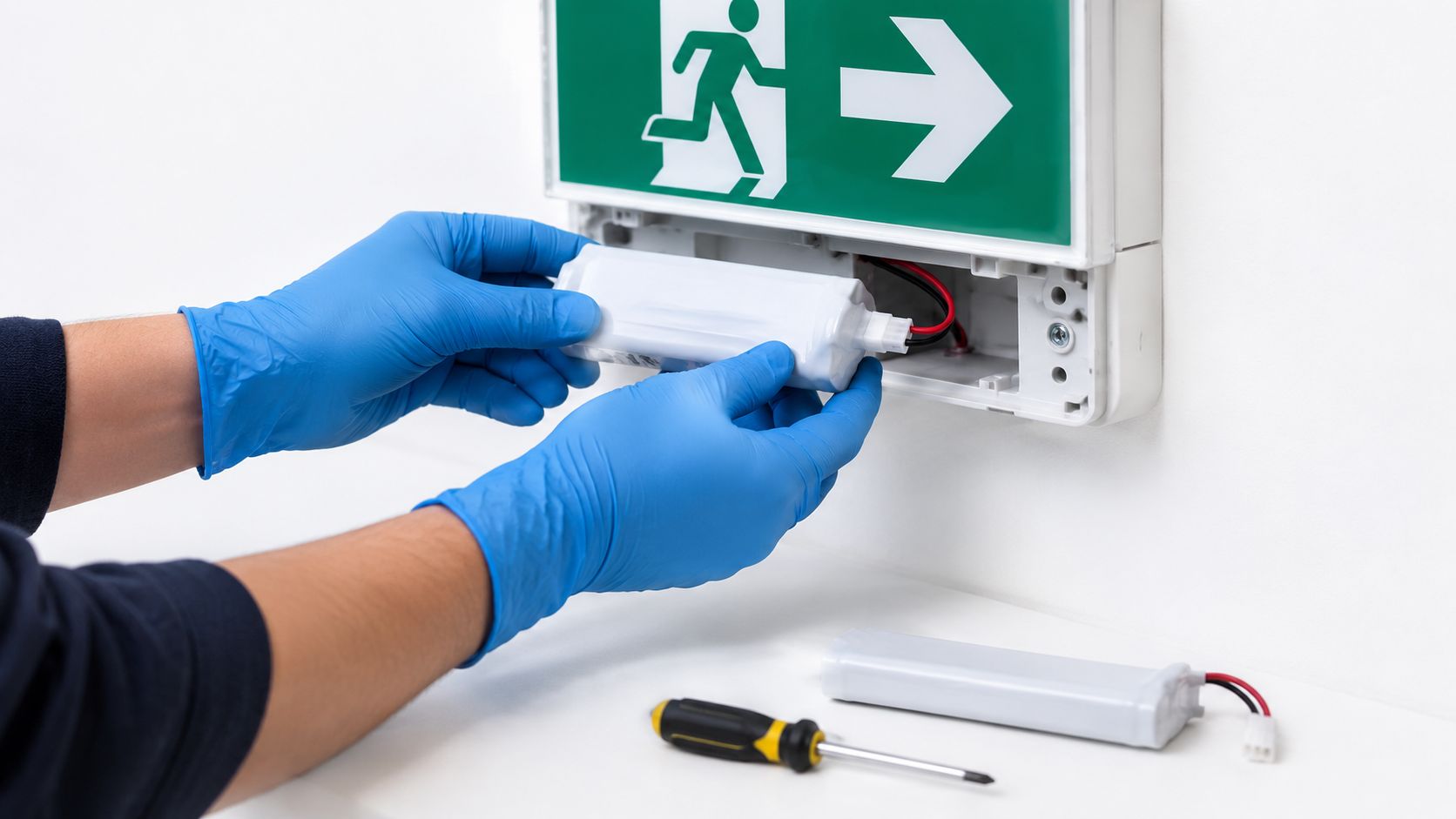
Use a controlled replacement sequence
- Secure the work area: Place barriers below raised fixtures and keep occupants away from the work zone.
- Isolate normal power: Follow the manufacturer's shutdown procedure and verify that the fixture is de-energized where appropriate.
- Open the housing carefully: Avoid pulling on LED boards, test switches, wires, or transfer components.
- Inspect before removal: Look for heat damage, corrosion, swelling, loose terminals, damaged insulation, and evidence of charger failure.
- Match the replacement exactly: Confirm chemistry, voltage, connector, polarity, mounting method, and manufacturer compatibility.
- Reconnect and secure: Route wires away from sharp edges and heat sources, then close the housing without pinching conductors.
- Restore power and verify charging: Check the indicator and allow the unit to return to normal charging operation.
- Test emergency transfer: Activate the test function and confirm stable illumination.
- Update the record: Log the installation date, part number, test result, technician, and follow-up requirement.
A new battery won't fix a defective charger, damaged transfer switch, failed LED driver, or overloaded circuit. If the unit still flickers, fails to transfer, or won't sustain illumination after replacement, stop replacing parts and arrange diagnostic work.
For fixture mounting, circuit changes, replacement of damaged wiring, or new emergency-lighting equipment, use a documented commercial exit sign installation service rather than treating the task as routine handyman work.
When to Call a Licensed Commercial Electrical Contractor
There's a clear difference between replacing an approved battery pack and modifying a commercial life-safety system. Once the work involves branch wiring, emergency circuits, transfer equipment, fixture relocation, controls, or a large retrofit, call a licensed electrical contractor.
A contractor should handle situations involving:
- Hardwired emergency circuits: Troubleshooting line-voltage wiring and shared emergency-power problems requires proper testing and electrical knowledge.
- Panel or transfer equipment: A sign that depends on a central emergency circuit may have a fault far beyond its local battery.
- Unexplained repeated failures: Multiple failed fixtures in one area can indicate a charger, circuit, heat, or load issue.
- Damaged or altered housings: A modified fixture may no longer match its listed configuration.
- High-reach locations: Parking structures, atriums, poles, and tall corridors create fall and access risks.
- Portfolio-wide upgrades: Standardizing fixtures and batteries across many buildings requires surveying, load review, scheduling, and closeout documentation.
- California compliance work: Projects involving Title 24 lighting controls, testing, or certification need a contractor who understands the applicable requirements and documentation.
Know what the inspection record must prove
A professional service visit should produce more than a replacement invoice. Ask for fixture-level results, failed-unit notes, battery details, corrective actions, and outstanding recommendations. That record helps the property team prioritize future work and gives inspectors a clear maintenance trail.
Smart monitoring also needs professional planning. Wireless diagnostics, connected gateways, and automated reporting can improve visibility, but poor commissioning can create false alarms, unmonitored devices, or incomplete records. Integrate the system into the existing emergency-lighting design instead of adding technology without an ownership plan.
For commercial properties in Southern California, Access Electrical and Lighting's commercial electrical contractor services cover emergency lighting, exit signs, electrical troubleshooting, high-reach work, and documented compliance support. The right contractor should also explain what your in-house team can safely maintain and what work requires licensed electrical expertise.
Strategic Audit Checklist for Property Managers
A reliable exit sign battery program starts with an accurate asset list. Don't begin by ordering replacement packs. Begin by finding every fixture, recording its condition, and identifying where the current maintenance process breaks down.
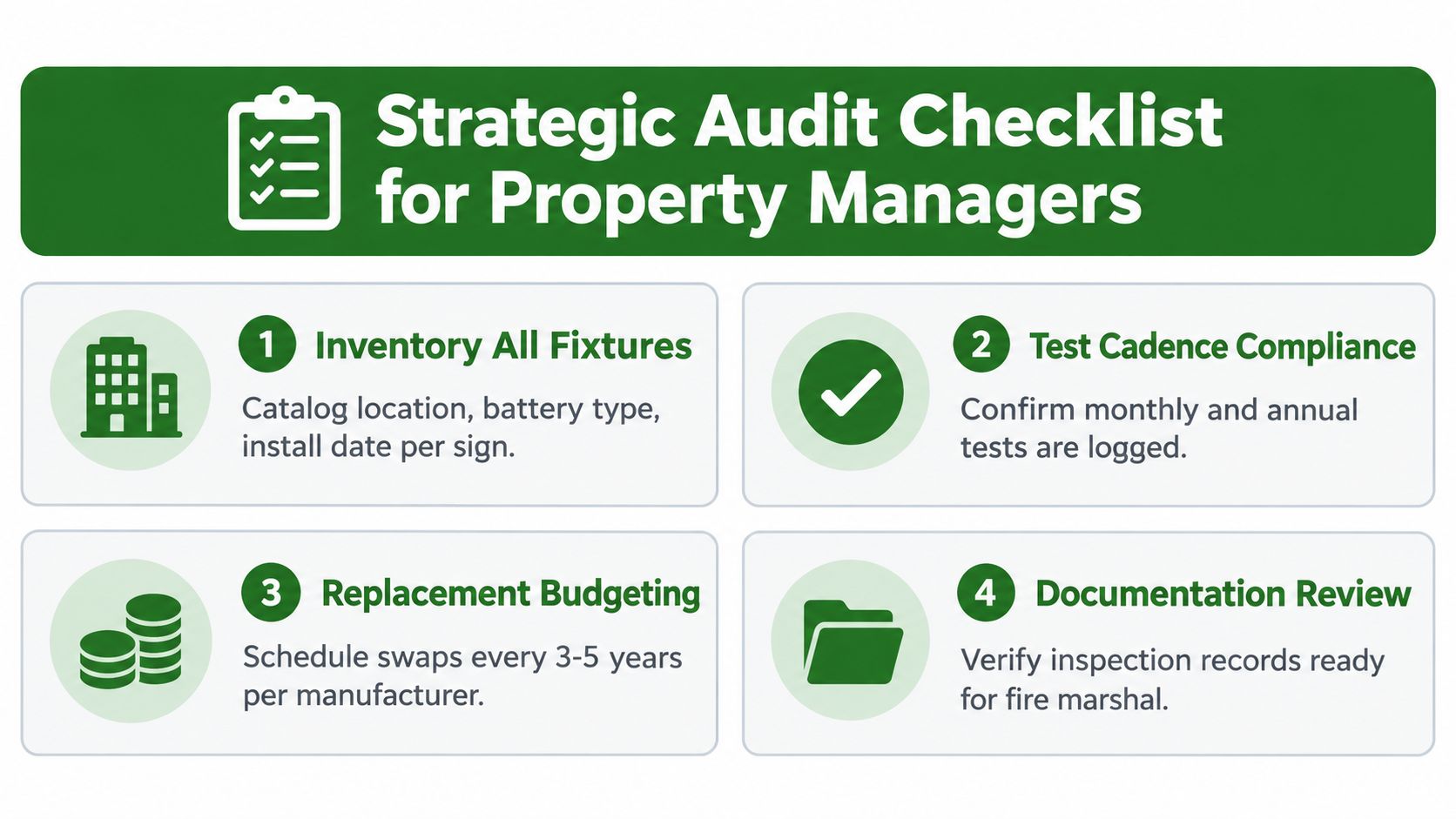
Build the inventory
Record the building, floor, location, fixture model, battery chemistry, installation date, last replacement, access method, and normal operating condition. Flag signs in hot rooms, parking areas, high ceilings, exterior exposures, and locations where a failed sign would obstruct a major egress route.
Verify test control
Review whether every fixture has a monthly functional result and an annual full-duration result. Look for repeated failures, missing entries, unexplained repairs, and tests recorded without fixture identifiers. A spreadsheet can work for a small site, but larger portfolios benefit from asset-management software that ties work orders to individual signs.
Rank replacement priorities
Use a simple risk score based on test history, age, heat exposure, access difficulty, fixture importance, and documentation quality. Prioritize units that combine poor performance with expensive access requirements. Don't automatically replace every battery in the same building if the evidence points to a localized problem.
Review procurement standards
Create approved battery specifications by fixture model. Require exact voltage, chemistry, connector, capacity, and manufacturer compatibility. Standardization can simplify inventory, but it shouldn't override the environmental needs of a parking structure, mechanical room, office corridor, or multifamily common area.
Close the documentation gap
Keep service reports, test results, replacement records, photos where useful, and open corrective actions together. Before a fire marshal visit, confirm that records are accessible and that failed units have documented resolutions, not just notes saying “needs repair.”
A strong program turns mandatory testing into useful maintenance data. It shows which batteries fail early, which locations consume the most labor, and where a longer-life chemistry or monitored fixture could reduce total ownership cost.
Access Electrical and Lighting can survey, test, repair, and maintain emergency lighting and exit sign battery systems across commercial, retail, office, and multifamily properties. Review your fixture inventory and testing records, then visit Access Electrical and Lighting to request a practical compliance and lifecycle-maintenance assessment.