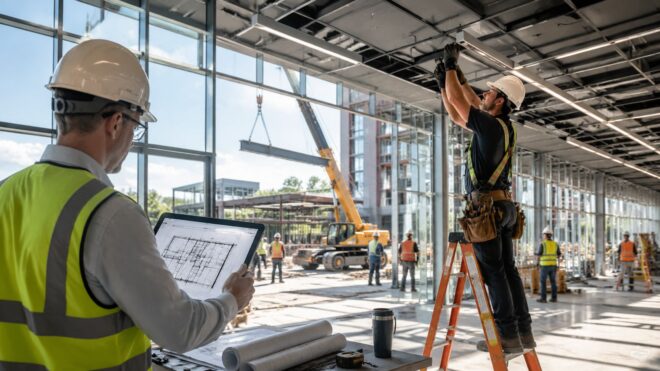
You're staring at a space that's half-working and half-failing. The tenant wants turnover fast, the lights are outdated, the panel room is cramped, and the last thing you need is a project that starts as a refresh and turns into a chain of change orders. That's the point where facility construction services stop being a vague vendor category and become a real risk-management decision.
For a first major project, the hard part isn't finding someone who says they can build it. The hard part is understanding how the scopes fit together, which decisions belong in preconstruction, and where electrical, lighting, and low-voltage work can either keep the job moving or stall it. In Southern California, that matters even more because compliance, commissioning, and handoff quality can't be treated as afterthoughts.
Your Guide to Facility Construction
The call usually comes in after the easy solution is gone. A retail center needs a full tenant turnover, a medical office has outgrown its layout, or a property manager opens a ceiling and finds old wiring, patchwork lighting, and no clean path to keep operations running. At that moment, the project stops being a cosmetic fix and becomes a coordination problem.
That's where facility construction services earn their keep. The work has to protect operations, control downtime, and keep the owner from discovering issues one trade at a time. A good contractor doesn't just “build.” They sequence the job so the owner can stay open, or reopen, with fewer surprises.
The scale of the market explains why the process gets complicated. The global building construction market is projected to reach USD 11,456.50 billion by 2030, growing at a 4.4% CAGR from 2024 to 2030 according to the market outlook linked in the brief, and IMARC independently estimates USD 6.8 trillion in 2024 rising to USD 10.5 trillion by 2033 at a 4.9% CAGR. Those numbers show how much activity sits behind new-build, renovation, and tenant-improvement work across major regions such as North America, Europe, and Asia-Pacific market outlook.
The practical lesson is simple. If you can classify the project correctly at the start, you can make better calls on design, permitting, sequencing, and trade coordination. If you misclassify it, you usually pay for that mistake in change orders, schedule drift, and missed inspections.
Defining the Scope of Facility Construction Services
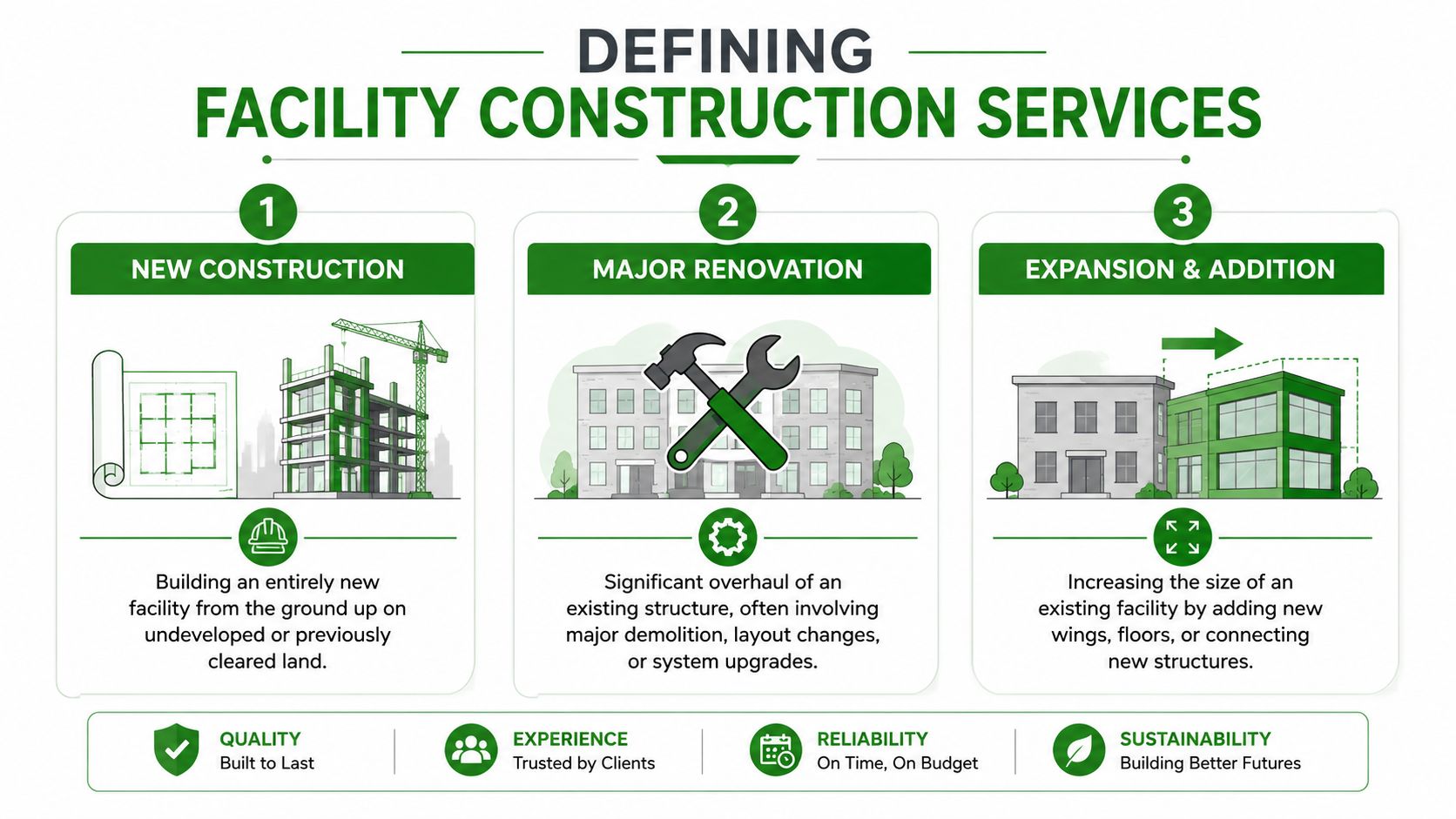
A useful way to think about facility construction services is to compare them to home projects. New construction is like building a house from an empty lot. Major renovation is like gutting a kitchen and moving walls. Tenant improvements are more like finishing a room so it works for a new occupant without changing the whole structure.
New construction
New construction starts with a blank slate. That can mean undeveloped land, a cleared parcel, or a site where the existing structure no longer supports the owner's business plan. Every system has to be coordinated from the ground up, from structural framing to power distribution and lighting layout.
For owners, this type of project has the highest amount of planning friction because every decision depends on the next one. Electrical service size, lighting controls, low-voltage pathways, equipment loads, and future expansion all need to be considered before the first trench is dug. In other words, the cost of getting the layout wrong is highest when you are building from nothing.
Major renovation
A major renovation keeps part of the building and changes the rest. It might involve demolition, reconfiguration of rooms, new finishes, upgraded life-safety systems, or a full electrical reset. In these scenarios, old assumptions get expensive, because the existing structure often hides limitations that only show up after demolition starts.
Renovation work is usually the most vulnerable to surprises. Hidden conduit routes, outdated panels, undersized lighting circuits, and incompatible controls can force redesigns midstream. That's why the contractor's job is not just to install, but to sequence discovery, document conditions, and protect the owner from scope creep.
Tenant improvements
Tenant improvements, or TIs, are smaller in footprint but not always smaller in complexity. A TI might be a new office suite, a retail buildout, or a partial reconfiguration of an occupied space. The job is often faster, but the trade coordination can be tighter because the building still has to function during the work.
That's where electrical and lighting decisions become especially visible. A simple ceiling change can trigger fixture replacement, emergency lighting updates, and control changes that affect permit review and final inspection. If the project is treated like light cosmetic work when it really needs systems coordination, the owner usually feels the pain late.
Practical rule: classify the job by how much of the building's systems are changing, not by how much drywall is moving.
Navigating the Key Phases of a Construction Project
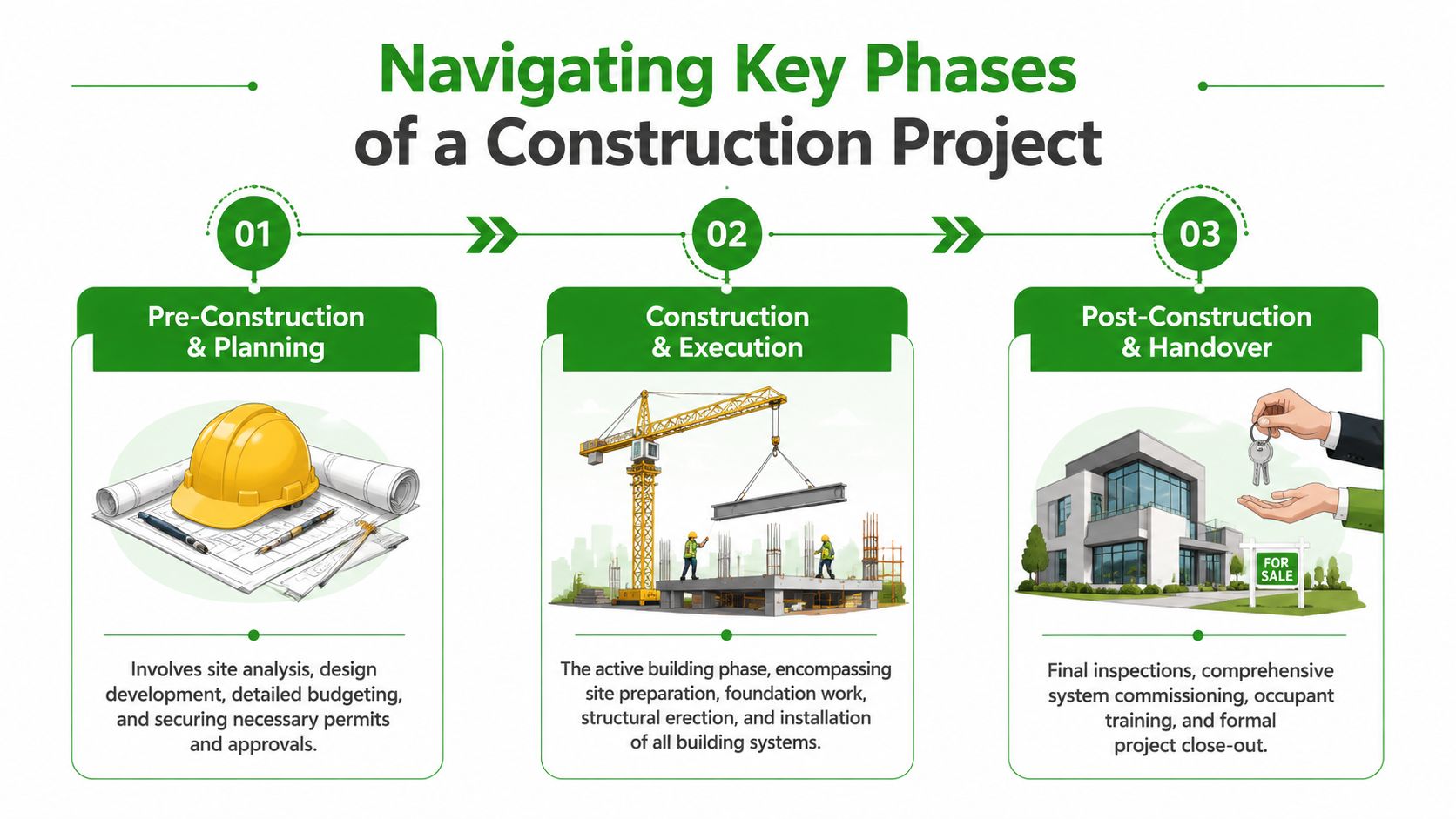
Every project gets easier when the owner sees it as a sequence instead of a blur. The work moves through three phases, and each phase has a different job to do. If one phase is rushed, the next one absorbs the damage.
Pre-construction and planning
Substantial savings are realized during this phase. The team defines scope, develops design documents, builds the budget, and gets permits moving. Early resolution of electrical and lighting details is also critical, as late decisions in these areas tend to ripple through ceilings, controls, equipment layouts, and inspection comments.
The preconstruction package should also make the finish line visible. The LANL Facility Construction Specifications Manual requires a CSI-format specification book for projects over a $300K cost threshold, and says the book must be assembled from multiple specification sections when required LANL specifications manual. That matters because a clear specification package defines materials, installation standards, testing, and closeout procedures before anyone mobilizes.
Construction and execution
Once work starts, the focus shifts from planning to control. Mobilization, demolition, rough-in, inspections, and installation all need to stay sequenced so one trade doesn't block another. Regular progress meetings matter here because field conditions change fast, especially in occupied buildings.
A good superintendent keeps a short list of active risks. Missing submittals, delayed equipment, unresolved RFI answers, and access constraints are the problems that can drag a project off schedule. Strong field leadership keeps those issues visible before they become rework.
Post-construction and handover
The job isn't finished when the building looks done. Final inspections, punch list work, commissioning, training, and closeout paperwork all have to be completed cleanly. Owners should expect this phase to focus on proving that the systems work as intended, not just that they are installed.
For facility managers, this is also the time to document what got built. That record becomes useful when you need future maintenance, system upgrades, or a reference point for the next tenant turnover. A clean handover saves time long after the crew leaves.
For a practical checklist on inspections and testing, use this commercial electrical safety inspection guide.
Key Trades and Integrated Electrical Systems
A construction job is only as coordinated as its trades. The general contractor manages the sequence, but framing, drywall, HVAC, plumbing, fire protection, data, and controls all have to land in the right order. If the electrical scope is treated like a separate lane instead of the backbone of the project, the owner usually pays for it later.
Why electrical and lighting drive so much of the outcome
Electrical work affects more than power. It shapes ceiling coordination, equipment placement, lighting quality, emergency egress, energy use, and the building's readiness for future technology. That's why a lighting plan or panel layout shouldn't be an afterthought once finishes are chosen.
In Southern California, Title 24 governs lighting and energy compliance. A contractor who understands those requirements can help avoid redesigns, failed inspections, and last-minute fixture substitutions. For a plain-language overview, see what Title 24 compliance means in practice.
What bundled scopes actually solve
The best coordination doesn't come from a vague “one-stop shop” claim. It comes from bundling scopes that belong together so handoff failures are less likely. Industry analysis on construction software points to software-enabled coordination and integrated planning as durable growth themes, especially while labor remains tight R.W. Baird analysis.
That logic matters on real jobs. When the same contractor handles line-voltage power, lighting controls, and low-voltage infrastructure, there's less room for finger-pointing between vendors. The owner gets one coordination point for systems that depend on each other.
Commonly bundled scopes include:
- Power distribution and panels: Keeps equipment loads and tenant needs aligned.
- Lighting and controls: Helps with comfort, energy performance, and compliance.
- Low-voltage cabling: Supports data, AV, access control, and other building systems. For a scope example, see low-voltage cabling installation.
- Emergency lighting and exit signs: Critical for life safety and final approval.
- Testing and documentation: Reduces closeout friction and future maintenance guesswork.
The projects that run smoothly usually have fewer isolated scopes and more clearly assigned responsibility.
Access Electrical and Lighting is one option for owners who want line-voltage, lighting, Title 24 support, and low-voltage work under one contractor, but a broader principle applies. The fewer times a design intent has to pass from one subcontractor to another, the fewer chances there are for scope gaps.
Procurement and Compliance in Southern California
Procurement is where many otherwise solid projects get expensive. Owners often focus on the bid number and skip the fine print that assigns the work, sets the governing specifications, and assigns permit coordination. That becomes a costly mistake in Southern California, where compliance review can affect both schedule and occupancy.
A package that looks cheaper on paper can carry more risk in the field. If the scope is split too loosely, the owner ends up coordinating between trades, answering questions that should have been settled before award, and paying for changes that were avoidable.
Contracting models and what they change
Design-Bid-Build follows a familiar sequence. Design comes first, bids follow, and construction starts after a contractor is selected. It works best when the scope is well defined and the owner wants competitive pricing against a completed design.
Design-Build puts design and construction under one team. That can reduce coordination gaps, but it depends on disciplined scope definitions and clear performance requirements from the owner. If expectations stay vague, speed can come at the cost of control.
Why specifications matter
Construction specifications are not filler. They are legally binding contract documents that work with the drawings to define materials, installation methods, and quality standards construction specifications overview. A clear spec set lowers disputes because the installer knows the required standard before work starts.
That matters on commercial jobs where lighting, emergency systems, and controls all have to pass inspection together. The tighter the spec package, the less room there is for expensive interpretation later. It also helps the owner avoid paying for assumptions that should have been settled in writing.
How to stay clean on compliance
For Southern California projects, permit strategy should be settled before procurement locks in equipment. That includes emergency lighting, exit signs, energy compliance, and any life-safety items that will be checked before occupancy. If those items are left vague until the end, the project can stall when the owner has the most pressure to open.
Use the contractor to close the loop between spec, field installation, and inspection sign-off. If the team cannot explain how compliance gets documented, that is a warning sign. Owners should expect direct answers and a clear path through Title 24 compliance requirements, not reassurance without detail.
How to Select the Right Construction Partner
The wrong contractor can turn a straightforward project into a series of delays, change orders, and repair work after handoff. The right one keeps the paperwork tight, raises issues early, and understands where the risk sits before it reaches the field. Selection should go well beyond collecting three bids and picking the lowest number.
What to check before you sign
Start with scope fit. A contractor who handles ground-up office work well may not be the right choice for a tight tenant improvement in an occupied retail center. Look for proof that the team has worked on similar buildings, similar compliance pressure, and similar sequencing constraints.
Communication matters just as much. Do they answer directly, put issues in writing, and explain tradeoffs without hiding behind jargon? If they are vague before award, they usually stay vague once the schedule gets tight.
| Evaluation point | What good looks like | Why it matters |
|---|---|---|
| Relevant project experience | Similar building types and scope complexity | Reduces learning-curve risk |
| Financial stability | Ability to carry the job without cash-flow stress | Protects schedule and procurement |
| Safety and compliance habits | Clear documentation and disciplined field behavior | Lowers incident and inspection risk |
| Communication style | Fast responses and clear answers | Keeps decisions moving |
| Reference quality | Past clients confirm follow-through | Shows how they perform after award |
What separates value from low price
The bid sheet does not tell the whole story. A contractor who respects the written scope is usually easier to manage than one who treats scope language as a bargaining tool later. Clear construction specifications set expectations for materials, installation methods, and quality, and that reduces disputes before they start construction specifications source.
Ask how they handle change management, submittals, and closeout. Ask who will run the job day to day. Ask what happens if a utility issue, a field conflict, or an inspection comment changes the sequence. Those answers tell you more than the spread between bids does.
If a contractor can't explain how they control scope, they probably don't control it.
Managing for Long-Term Facility Value
A good project doesn't end at final inspection. It sets up the next five years of maintenance, upgrades, and operational stability. That's why owners should think about the build as the start of the building's next service cycle, not the finish line.
The long view is backed by the size of the lifecycle market. The global facility management services market is projected by one forecast to reach USD 92.6 billion by 2036, with a 6.1% CAGR from 2026 to 2036, while other forecasts in the brief project even faster growth facility management forecast. That tells you the building's economic life is much longer than the construction phase.
The best construction partners understand that handoff quality shapes future cost. If your team needs maintenance support, emergency lighting testing, infrared inspections, or future electrical upgrades, build with that next phase in mind from the start. Done right, the project improves the asset now and makes it easier to operate later.
If you're planning a tenant improvement, renovation, or occupied-facility upgrade in Southern California, contact Access Electrical and Lighting to discuss electrical, lighting, Title 24, and low-voltage scopes before the next round of drawings is locked in.