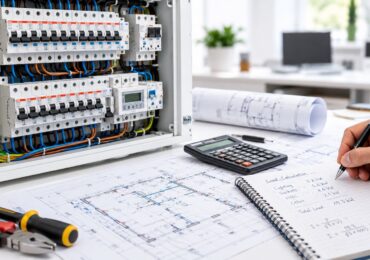
You're looking at a breaker that tripped again on a full floor, a tenant asking why the parking lights flickered, and a proposal to add EV chargers to a panel that was never sized for them. None of those problems started today. They built up through loose terminations, missed tests, and added loads nobody logged.
Good electrical repair and maintenance treats those issues as one decision about risk, outage cost, and capacity, not as separate service calls. You inspect on a calendar, you repair with a record, and you check capacity before you promise a new load. That's how you keep tenants operating and keep a hidden defect from becoming an emergency.
What Commercial Electrical Maintenance Covers
Think of scope in five layers. If a bid doesn't name all five, you can't compare it line by line.
- Service and distribution: A licensed electrician inspects service entrance equipment, switchgear, main and feeder breakers, distribution panels, bus connections, and lugs. Accessible terminations get torque checks, equipment gets tested under load, and you receive panel schedules and condition notes.
- Branch circuits: Technicians test receptacles, dedicated equipment circuits, and GFCI and AFCI devices, and they inspect the junctions feeding them. Records should trace each circuit to its panel and label.
- Lighting and life safety: Crews service interior fixtures and LED drivers, controls and photocells, emergency lighting batteries and chargers, and exit signs. Testing happens under simulated outage conditions, not just at the wall switch.
Site, Exterior, and Growing Loads
Site work covers parking structure lighting, light poles and bases, and weather exposed exterior receptacles. These assets fail differently, through water, vibration, corrosion, and vehicle damage, so they need their own walk through.
The fifth layer is new demand, including EV chargers, heat pumps, and battery systems added to existing panels. Those loads belong in the maintenance scope from day one, with load records and thermal checks.
Repair sits inside this same scope. When a contractor clears a fault, they should complete the repair, retest the circuit, and update the asset record. Clearing an alarm alone isn't a repair.
Separate routine service from project work. Panel upgrades, feeder replacements, and tenant improvements need different budgets, permits, and shutdown planning than a scheduled visit.
Maintenance Intervals for Every Commercial Asset
Put this calendar in place first, then adjust it for building age and failure history. The table gives you a starting schedule a facility team can use today, including the detailed switchgear maintenance program your main distribution equipment needs.
| Asset | Task | Interval | Failure it prevents |
|---|---|---|---|
| Distribution panels | Visual inspection, torque check on accessible terminations, infrared scan | Annually | Loose connections and overheating |
| Switchgear | Visual inspection, breaker operation check, infrared scan | Annually | Breaker failure during faults |
| Emergency lighting | Functional test (30 seconds) | Monthly | Dark egress paths during an outage |
| Emergency lighting | Endurance test (1.5 hours) | Annually | Battery and charger failure under sustained load |
| Exit signs | Visual and functional check | Monthly | Unlit exits |
| Parking and site lighting | Walk through for dead lamps, photocell and driver faults | Quarterly | Security gaps and high utility spend |
| Light poles | Structural integrity test | Every 3-5 years | Pole failure and falling fixtures |
| Multifamily common area panels | Labeling and clearance review | Annually | Access hazards and inspection findings |
| New EV chargers or added loads | Thermal scan after energizing | After commissioning | Hotspots from unplanned load growth |
When to Shorten an Interval
Shorten intervals when the building tells you to. Older panels, high use parking structures, recurring breaker trips, and panels with prior thermal anomalies shouldn't wait a full year between checks. Heat, dust, and heavy HVAC cycling also age terminations faster.
Scheduling rule: If an asset has failed twice in a year, move it to a shorter interval until you have two clean inspections in a row.
Build your first year calendar in three steps. First, inventory every panel, switchgear lineup, emergency fixture, and site pole with an identifier and location. Second, enter each asset's last test date, even if that date is unknown. Third, schedule the overdue items first and spread routine work so shutdowns don't stack into tenant peak periods.
Repair, Preventive and Predictive Maintenance Explained
Use a tire to keep the three strategies straight. Repair is fixing a flat after it fails. Preventive maintenance is rotating and inflating on a set schedule. Predictive maintenance is reading a pressure sensor that warns you before the tire goes flat.
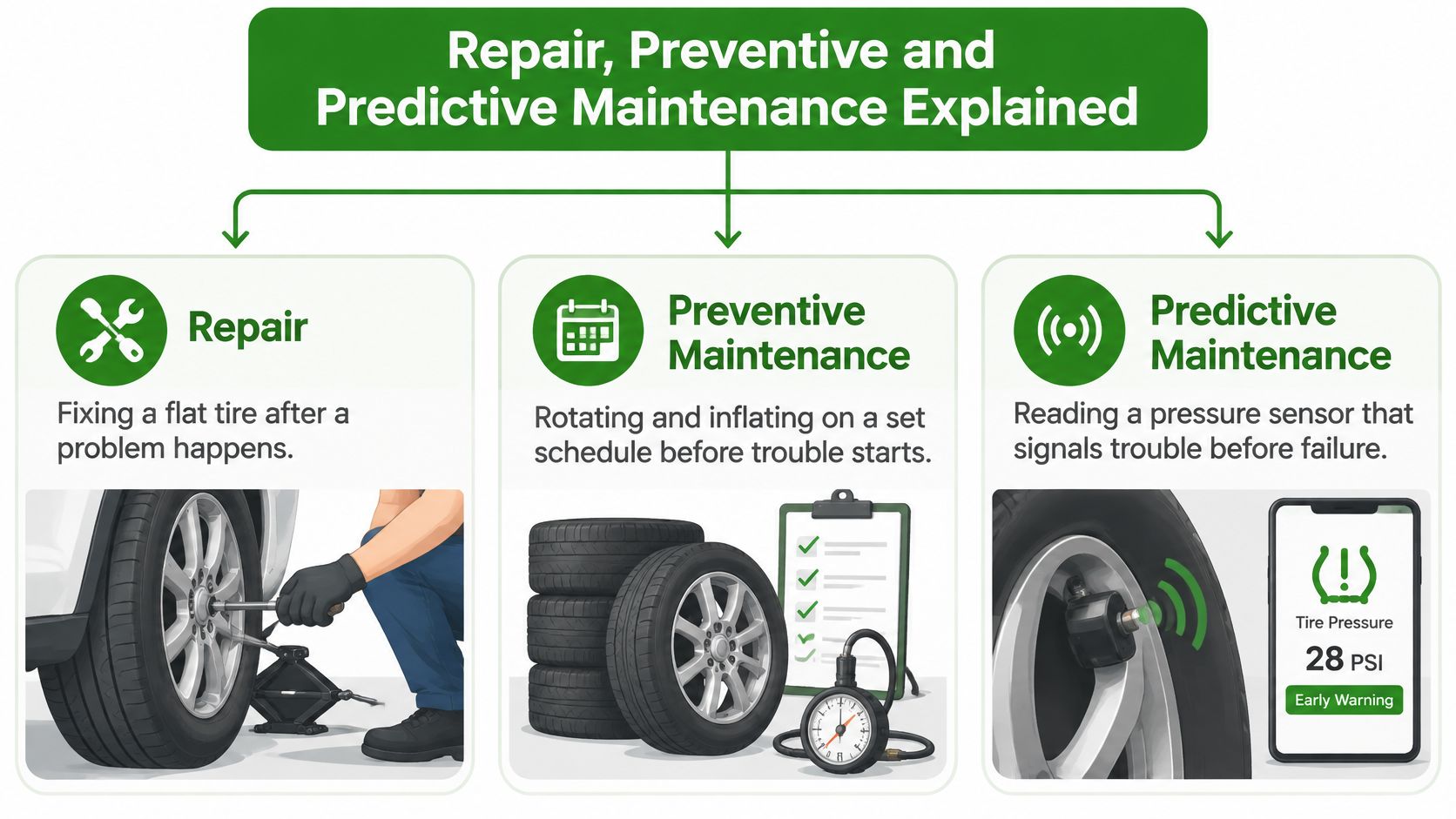
Corrective repair responds to a failure. A breaker won't reset, a parking level goes dark, or an exit sign dies during a test. It's usually the most expensive option per event because you pay for the part, the urgent labor, and the downtime in one bill.
Preventive maintenance follows time, manufacturer guidance, and code. An annual torque check on panel terminations fits here. You do it because connections relax and corrode whether or not they've failed yet, and a planned shutdown costs less than a surprise one.
Where Predictive Work Helps, and Where It Misleads
Predictive or condition based maintenance follows measured data. A thermal scan showing one lug running well above its phase peers, or a load log showing a circuit climbing toward its limit, triggers work before failure. That's valuable when the measurement is reliable.
Don't treat data as protection by itself. Without a baseline, assigned response thresholds, and someone who reviews alerts, sensors create false confidence. A hot connection that nobody converts into a work order is still a hot connection.
I would apply a three question test to every asset. What fails, how quickly does it fail, and what does an outage cost your tenants? If failure is sudden and costly, you need scheduled checks plus condition data. If failure is visible and cheap, a simple preventive cycle may be enough.
How Infrared Inspections Find Hotspots Before Failure
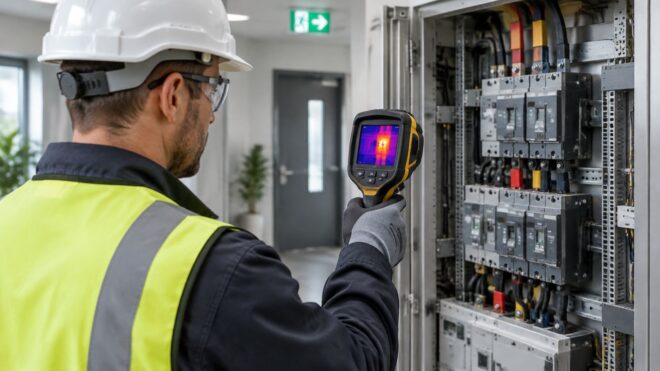
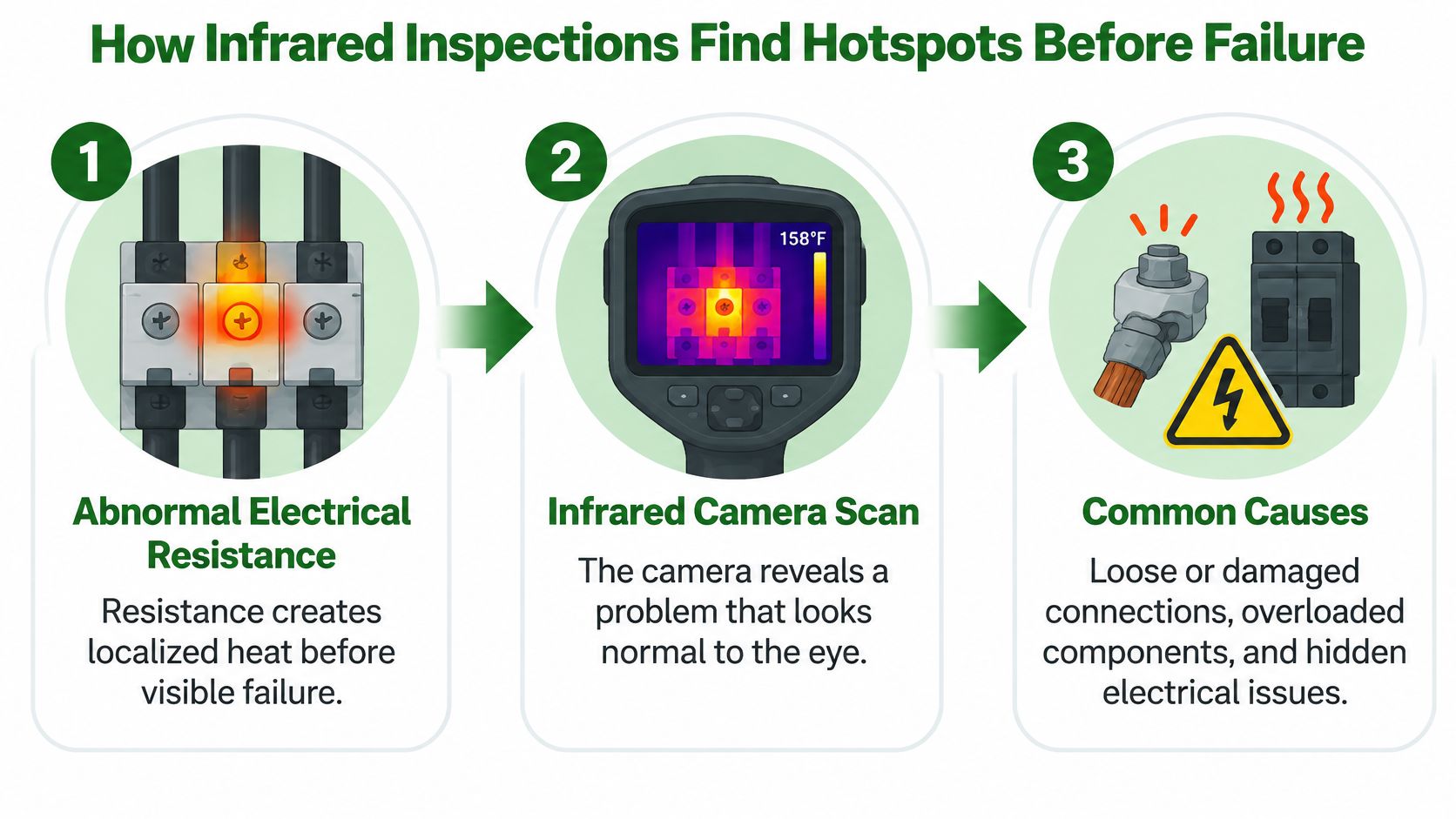
Abnormal electrical resistance creates localized heat before you see discoloration, hear buzzing, or smell insulation. An infrared camera makes that heat visible on energized equipment, which is why thermography works as an early warning tool for panels and switchgear.
Common causes include loose or degraded terminations, overloaded circuits, phase imbalance, poor breaker contacts, harmonic distortion, and deteriorating insulation. The TÜV SÜD electrical power systems guide describes infrared thermography as a practical predictive method because abnormal resistance often produces localized heating before visible failure.
The Six Step Inspection
- Confirm representative load: Scan while equipment runs near normal operation, because a lightly loaded loose connection may not show heat.
- Compare like components: Compare thermally similar lugs, breakers, and phases under similar conditions, so a true outlier stands out.
- Capture paired images: Take both thermal and visual images, so the repair crew can find the exact device later.
- Record the facts: Log equipment identifier, location, measured temperatures, operating load, and severity for each anomaly.
- Assign cause and action: Name a suspected cause and a corrective action, whether that's torque verification, connection repair, load balancing, breaker replacement, or power quality testing.
- Retest and trend: Rescan after repair and at the next cycle, because a recurring or growing temperature difference signals a deeper problem.
A professional infrared thermography inspection should produce that record on every visit. A folder of color images without loads, temperatures, and follow up status won't help you prioritize work or answer an insurer.
A heat image isn't a finding until it has a severity, an owner, and a retest date.
Qualified personnel should do this work with appropriate approach boundaries and safe procedures. Thermal data can be collected without routine contact with energized conductors, but opening equipment and judging severity still require training.
A useful work order reads like this. Panel 2B, main lug L2, running hot compared with L1 and L3 under recorded load, thermal and visual images attached, suspected loose termination, schedule de-energized torque verification and lug inspection, then retest under load and close only after temperatures align with peer phases.
Emergency Lighting and Exit Sign Testing Schedule
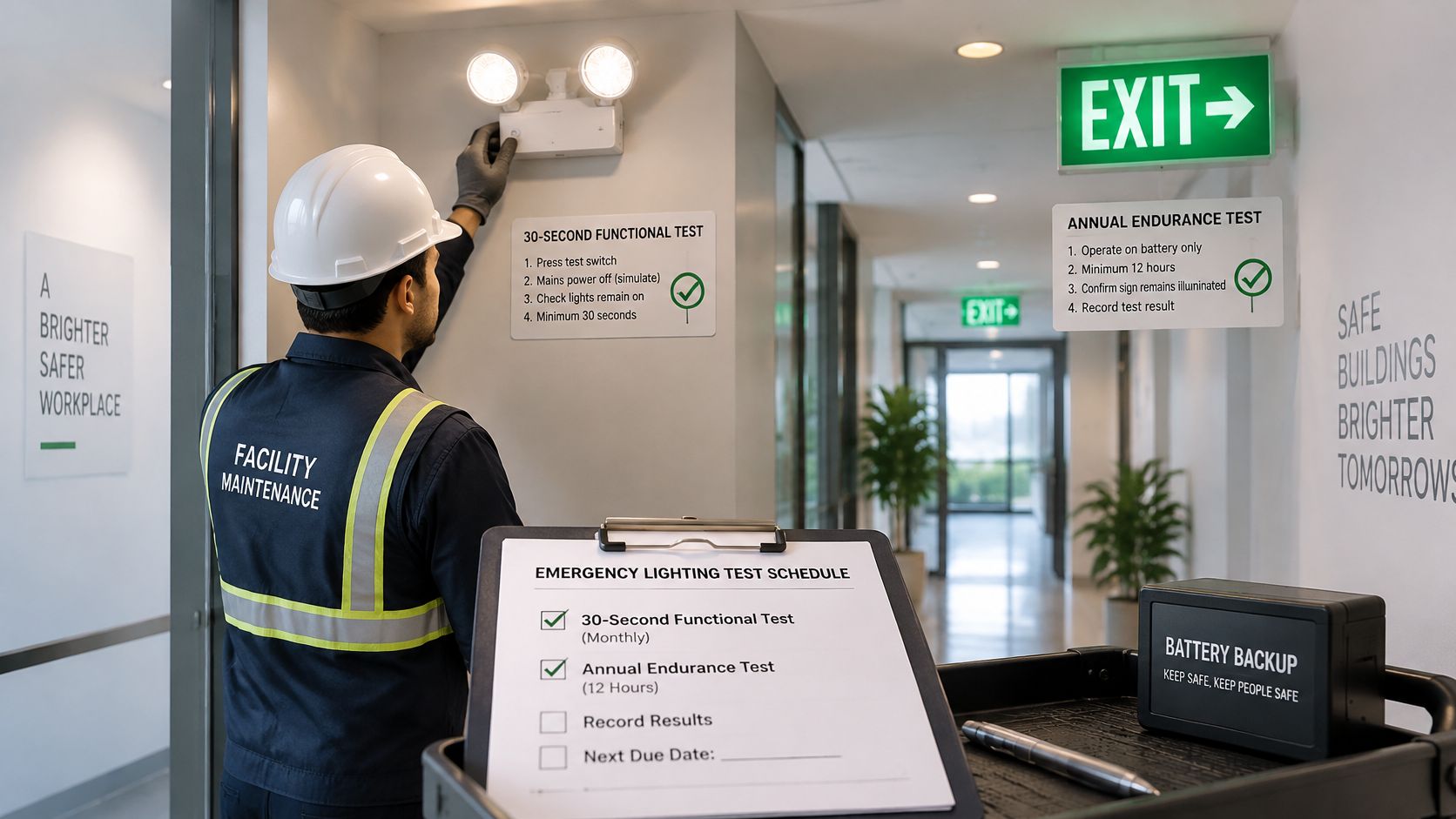
You need two tests, not one. A short monthly test proves a fixture transfers to battery and lights. A long annual test proves it can keep lighting an egress path for the full evacuation period.
The NIST hosted life safety inspection schedule derived from NFPA 101 identifies monthly emergency lighting testing for 30 seconds and an annual test for 1.5 hours. The annual test evaluates batteries, chargers, wiring, and control components under sustained load.
Monthly Procedure
- Log the asset: Use the fixture or circuit identifier on the label, not a vague room description.
- Cut normal power: Switch off the normal supply at the controlling panel for that fixture group.
- Confirm illumination: Check that each fixture lights within the test window and stays lit.
- Restore and record: Restore power and log date, duration, result, and any defect.
- Tag failures: Mark the failed unit so nobody assumes it's been cleared.
- Repair and retest: Close the item only after a passing retest, and record that outcome.
Don't reset a failed unit and move on. Common causes include depleted batteries, failed chargers, failed lamps or LED drivers, disconnected conductors, and defective transfer circuitry. Each one needs a repair, and scheduled emergency lighting testing should generate that corrective work automatically.
Exit signs need a monthly visual and illumination check on the same route. Look for dark legends, damaged faces, missing arrows, and signs that light on normal power but fail on battery.
For multifamily, retail, office, and hospitality properties with hundreds of fixtures across stairs, corridors, garages, and exits, use asset level labels or digital records. You'll spot recurring battery or circuit faults by location, and you'll walk into an inspection with dated proof instead of a binder of incomplete sheets.
Troubleshooting Common Electrical Faults
Start with the stop rule. Smoke, a burning smell, buzzing at a panel, or a hot cover means stop, avoid contact, de-energize only if it's safe to do so, and call for emergency service. Don't reset a breaker into a suspected arc or short to see what happens.
For everything else, diagnose the pattern before you replace parts. Repeated breaker trips often signal an overloaded circuit, not a bad breaker, so measure the load first with a clamp meter and add up what's running. Swapping the breaker without that measurement leaves the overload in place.
Flicker confined to one circuit points you toward a loose neutral or termination on that circuit. Lights dimming when HVAC starts point a different direction, toward voltage drop from an undersized feeder or conductors that can't carry starting current cleanly. Those are different repairs, and the symptom location tells you which to pursue.
GFCI nuisance trips deserve the same discipline. A device that trips repeatedly usually detects a ground fault downstream in a receptacle, appliance, or wet junction. Replacing the GFCI before you isolate downstream loads can hide the fault you need to fix.
| Symptom | Likely cause | First check | Fix direction |
|---|---|---|---|
| Breaker trips repeatedly | Overloaded circuit or short circuit | Measure load and inspect for shorts | Rebalance or split the circuit; replace breaker only if faulty |
| Flickering lights on one circuit | Loose neutral or termination | Inspect and torque connections | Tighten or replace the connection |
| Warm or discolored panel cover | Loose lug or overload | Infrared scan under load | Torque, repair and reduce the load |
| Lights dim when HVAC starts | Undersized conductors causing voltage drop | Measure voltage at the load | Upgrade conductors or feeder |
| Buzzing or burning smell at panel | Arcing or failing breaker | Stop and de-energize if safe | Emergency call; do not reset |
| Exit sign dark on test | Dead battery or failed charger | Check monthly test log | Replace battery or charger, then retest |
| GFCI outlet trips repeatedly | Ground fault downstream | Unplug connected loads and retest | Replace device or repair the circuit |
The Escalation Line
In house staff can observe, log symptoms, check test records, and unplug downstream loads for a GFCI check. Work inside a panel, on switchgear, on feeders, or on any suspected arcing fault belongs to a licensed electrician. That line protects your team and keeps the repair defensible.
Keep one record per fault. Write down the symptom, the check you made, the measured value, and the fix. Without the measured value, the next technician starts over and you pay twice for the same diagnosis.
Code and Safety Duties Facility Managers Carry
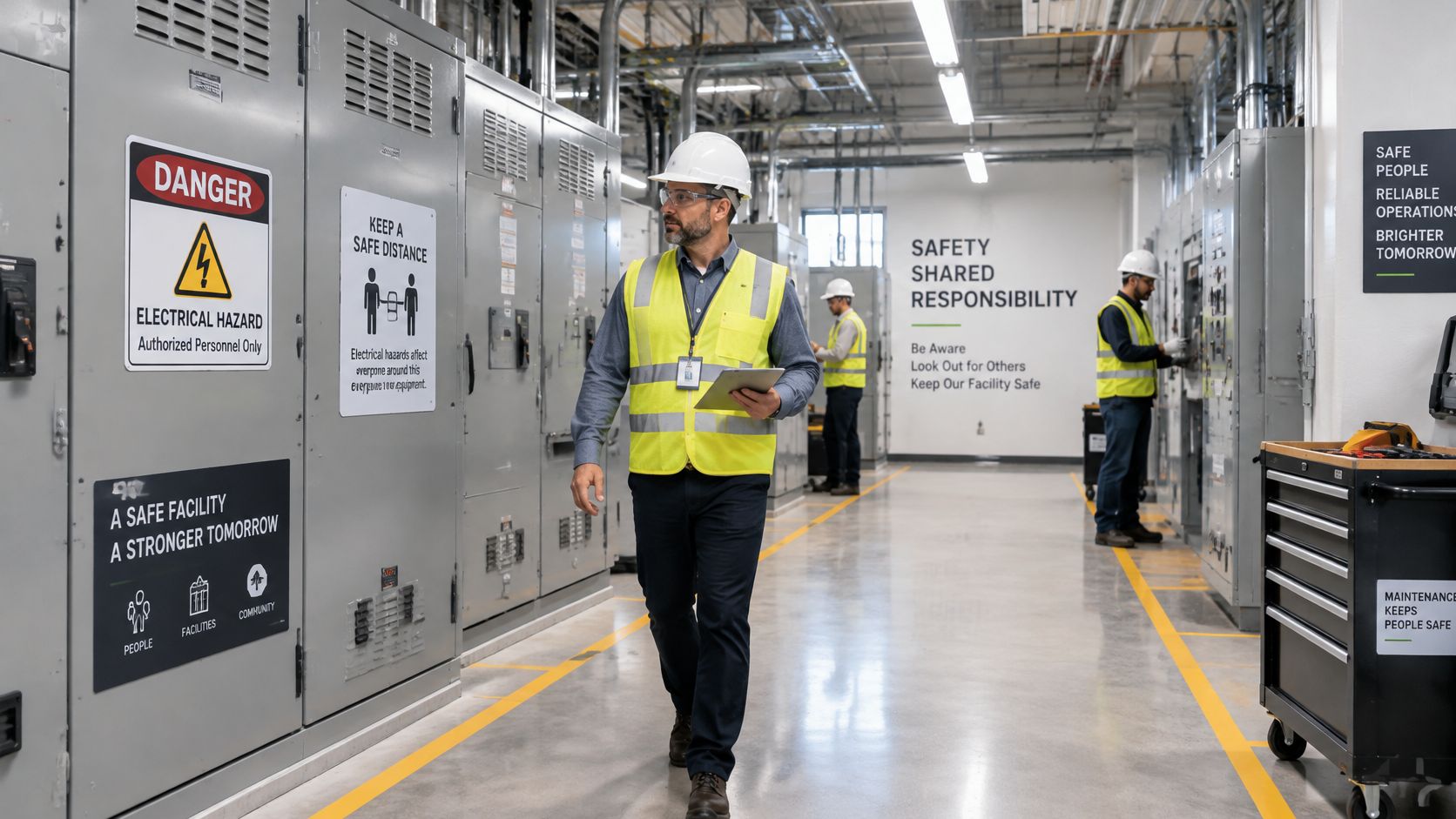
Electrical danger doesn't stay inside the electrical trade. Your HVAC techs, painters, roofers, and tenant contractors all work around panels, lighting, and energized infrastructure, and your procedures have to protect them too.
The Electrical Safety Foundation International workplace safety release reports 1,940 workplace fatalities involving electricity from 2011 through 2023, representing 5.6% of all occupational fatalities during that period. It also reports 74% of electrical fatalities occurred among workers in non-electrical occupations, while 26% occurred in electrical occupations.
Core Controls You Own
- Lockout and tagout: Require de-energization and a written lockout procedure before work on equipment that can be shut down.
- Qualified persons only: Limit energized work, panel access, and switchgear operation to people trained for that equipment and hazard.
- Approach boundaries: Keep unqualified staff and tenants outside marked boundaries around exposed energized work.
- Written procedures: Document who can authorize shutdowns, who tests for absence of voltage, and who restores power.
You also carry code duties for emergency lighting and exit signage under local life safety rules, and for lighting controls and documentation under Title 24 in California. Passing isn't just having fixtures installed. It's proving they were tested, repaired, and retested.
Inspectors, insurers, and attorneys ask for the same packet. Be ready to produce dated test logs, thermal reports, repair work orders, contractor licenses, and current as built panel labels. If a panel directory doesn't match the building, fix it during maintenance, not during an incident.
Records principle: A missing record gets treated as a missing test.
Reliability, Savings and Capacity for Electrified Loads
Maintenance pays in three plain ways. You get fewer unplanned outages that disrupt tenants, you trade emergency call outs for scheduled repairs you can price and time, and you reduce fire and injury exposure from defects that stay hidden inside closed panels.
Electrification adds a capacity question on top of that. EV chargers, heat pumps, and batteries often arrive a few at a time, each one approved on paper, until several run together on a hot afternoon. Paper capacity and safe capacity aren't the same when loads operate simultaneously.
The Lawrence Berkeley National Laboratory technology packages report notes the California Energy Commission identifies older service panels' ability to handle incremental heat pump and EV charging demand as a significant concern, noting panel upgrades can be costly and complicated. It also notes ASHRAE states electrification can substantially increase grid capacity requirements, making efficiency, storage, grid interactive controls, and demand flexibility important considerations.
A Practical Capacity Sequence
Inventory connected loads by panel. Review peak demand against panel and feeder capacity using actual operating data. Inspect terminations and scan for hotspots under those peaks. Then evaluate managed charging, scheduling, storage, and load shedding before you decide on an upgrade.
I would not start with panel replacement. Controls that stagger EV charging or shed noncritical load during peaks can defer or shrink an upgrade, especially in multifamily, retail, and office properties where charging grows gradually.
Keep the records that support capital planning. Save load inventories, peak demand logs, thermal reports, and the reasoning behind each defer or upgrade decision. When ownership asks why a project is needed next year, you'll answer with measurements instead of opinions.
Set Up Your Maintenance Plan and Book the First Inspection
Start from the calendar you've built and take three actions in order.
First, request a free estimate from a licensed commercial electrical contractor to scope inspections and open repairs. Verify the license before work starts. We hold California C-10 license #952234, and you should expect that level of verification from any contractor you hire.
Second, schedule the first infrared scan and the emergency lighting endurance test in the same visit window. Both sets of findings should feed one prioritized work order list, so you approve shutdowns and repairs once instead of twice.
Third, convert every finding into a dated work order. Add each open defect to your first year calendar with an assigned owner and a retest date. Don't let a report sit as a PDF while the defect ages.
The most useful output from that first visit isn't a stack of photos. It's a dated first year calendar showing each asset, its last test date, open defects, and who owns the next step.
For incidents outside business hours, use the 24/7 emergency line at (949) 364-6063. Put that number in your building procedure, not in someone's personal phone contacts.
Access Electrical and Lighting provides commercial electrical repair and maintenance, infrared inspections, emergency lighting testing, and switchgear and panel service for commercial, retail, office, and multifamily properties, with free estimates and 24/7 emergency response. If you want your first inspection to produce a dated calendar, documented findings, and priced corrective work you can schedule around tenants, visit Access Electrical and Lighting and contact us to schedule your estimate.