A tenant calls at 8:10 on a Monday morning. The lights are flickering near the loading area, an office floor has lost power, and the property manager is asking whether the problem is a breaker, a transformer, or something much larger. In the electrical room, switchgear may already be limiting the fault, isolating the affected feeder, and keeping the rest of the building energized.
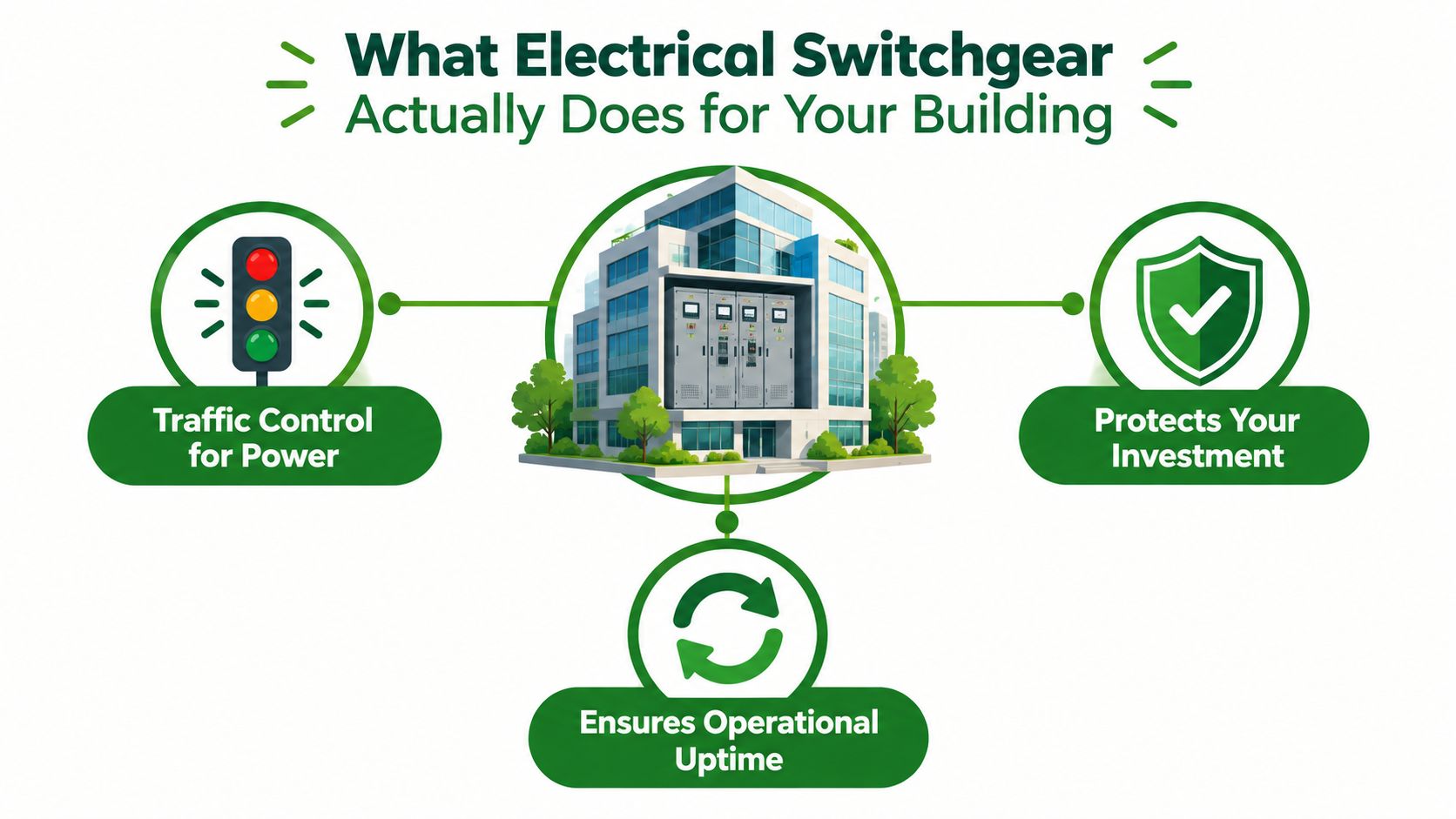
That quiet response is why electrical switchgear deserves more attention than it usually receives. It acts as the building's traffic control system for electricity, directing power where it needs to go, stopping dangerous current when conditions change, and creating safe separation for maintenance. For commercial property teams, the important questions aren't only what switchgear does, but whether the equipment is suitable, serviceable, available when a project needs it, and ready for the building's next phase of growth.
What Electrical Switch Gear Actually Does for Your Building
A commercial building rarely loses all power at once. More often, a feeder serving a tenant space develops a fault, a connection begins overheating, or a new load pushes an older distribution system beyond its intended capacity. Good switchgear helps keep that local problem from becoming a building-wide shutdown.
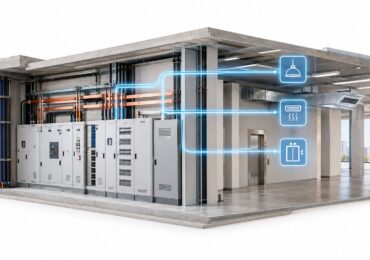
Think of the equipment as a controlled intersection. Busbars are the main roads carrying electrical power. Feeders are the routes leading to tenants, elevators, HVAC equipment, lighting, and life-safety systems. Circuit breakers act like traffic signals that can stop current when a fault appears, while disconnect switches create a clear separation when an electrician needs to work on a circuit.
Switchgear performs three practical jobs:
- Directing power: It distributes incoming electricity to multiple outgoing circuits and allows operators to control those paths.
- Protecting equipment: It detects abnormal current and interrupts the affected circuit before damage spreads to cables, transformers, motors, or downstream panels.
- Providing isolation: It gives qualified workers a way to de-energize and separate equipment for inspection, testing, and repair.
Why a panel isn't the whole system
A panelboard usually serves branch circuits or smaller distribution areas. Switchgear generally handles more substantial electrical distribution and combines switching, protection, measurement, and isolation in a coordinated assembly. The boundary between switchgear and switchboards can vary by standard and application, so a property manager should rely on the equipment nameplate, drawings, and the contractor's specification rather than appearance alone.
The distinction matters during an outage. If a breaker fails to interrupt a fault, the resulting energy can damage the enclosure and connected equipment, expose workers to arc-flash hazards, and interrupt operations well beyond the original problem. If the equipment is too small for the available fault current or the building's future load, a seemingly minor expansion can create a major design and compliance issue.
Switchgear also supports growth. Commercial, retail, and multifamily properties add air-conditioning capacity, elevators, tenant equipment, building automation, and EV charging. Each addition changes the demands placed on the distribution system. A property team that treats switchgear as long-cycle capital equipment can plan inspections, replacements, and capacity upgrades before a failure dictates the schedule.
The broader market reflects that central role. One estimate values the global switchgear market at USD 112.99 billion in 2025 and projects it to reach USD 197.68 billion by 2033, with a projected 7.4% CAGR from 2026 to 2033 (Grand View Research switchgear market analysis). That scale doesn't change what a breaker does in your electrical room, but it shows why switchgear is treated as core infrastructure rather than a niche product.
How Switchgear Works and Its Core Components
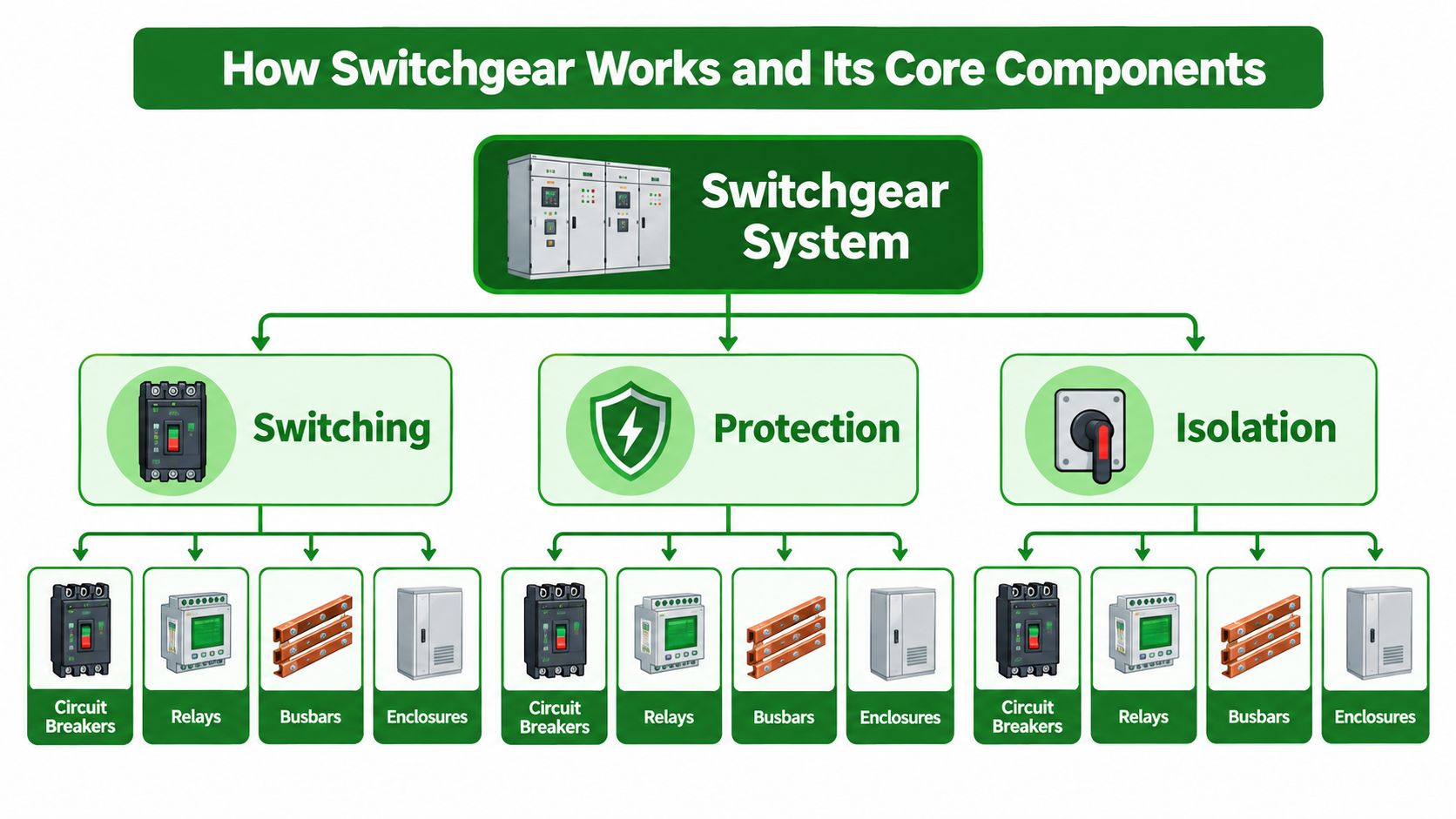
Start with the system's purpose before looking at individual parts. During normal operation, switchgear lets electricity move through the building. When a fault occurs, the equipment detects the abnormal condition, opens the appropriate circuit, and leaves healthy parts of the distribution system available when the design allows.
Key concept: Switchgear doesn't merely turn power on and off. It controls power, limits damage, and creates a safe path to maintenance.
The three jobs inside the enclosure
Switching is the routine control function. A circuit breaker or switching device closes to energize a feeder and opens to remove it from service. Operators may open a circuit for planned work, while an automatic trip mechanism opens it during a fault.
Protection depends on sensing and decision-making. Protective relays monitor current and other electrical conditions through sensing devices. If the relay identifies a short circuit, ground fault, or another abnormal condition, it sends a trip command to the breaker. The breaker then separates its contacts and interrupts current.
Isolation is different from interruption. A breaker may stop current, but a disconnect switch provides the deliberate separation needed for safe work procedures. Depending on the design, workers may also use grounding or earthing provisions to discharge residual energy and establish a safer work condition.
What you're looking at in the room
- Circuit breakers: These interrupt current when protection commands a trip or when an operator opens the circuit. Their interrupting capability must suit the fault current available at their location.
- Busbars: These conductors distribute power inside the assembly. A busbar fault can affect multiple feeders, which is why enclosure design, insulation, clearances, and testing matter.
- Protective relays: Relays act as the system's decision layer. They interpret electrical measurements and tell the breaker when to open.
- Disconnect switches: These create an isolation point for maintenance. They aren't a substitute for the full lockout and verification process performed by qualified personnel.
- Enclosures: The cabinet contains energized parts, supports mechanical components, and helps control access and environmental exposure. Its construction must match the installation conditions.
- Current and voltage sensing devices: Transformers and related sensors reduce electrical quantities to values that meters and relays can read safely.
A useful hierarchy is simple: the assembly receives power, busbars distribute it, sensing devices observe conditions, relays make protection decisions, and breakers or disconnects act on those decisions. When a contractor discusses a switchgear replacement, ask which part of that chain is being changed and how the new equipment will coordinate with the rest of the distribution system.
Types of Switchgear You Will See in Commercial Properties
A property manager may stand in one electrical room and see low-voltage gear, while another building on the same site uses medium-voltage equipment before several transformers. The building label does not decide the switchgear type. Service voltage, load size, available fault current, utility requirements, and the distribution layout do.
Voltage class provides the first useful comparison. Low-voltage assemblies commonly serve building distribution after a transformer reduces the incoming service voltage. Medium-voltage gear appears where a property receives utility service at a higher distribution voltage or operates its own medium-voltage network. Construction also matters, especially the choice between air-insulated and gas-insulated equipment.
The standards framework identifies low voltage as 1,000 volts or less. IEC 61439-1:2020 establishes general and verification requirements for low-voltage switchgear and controlgear assemblies (IEC 61439-1:2020 information). In North America, UL 1558 is associated with low-voltage power circuit breaker switchgear, while UL 891 covers switchboards. Similar-looking cabinets may follow different listing and application requirements.
| Switchgear Type | Voltage Range | Best Fit for Commercial Properties |
|---|---|---|
| Low-voltage switchgear | 1,000 V or less | Main distribution in offices, retail centers, multifamily buildings, and other properties supplied through low-voltage distribution |
| Low-voltage switchboards | 1,000 V or less | Distribution sections where the listed assembly and application align with switchboard requirements |
| Medium-voltage metal-enclosed switchgear | Commonly 3.6 kV to 40.5 kV in IEC practice | Utility service entrances, substations, large campuses, and properties with private medium-voltage distribution |
| Medium-voltage metal-clad switchgear | ANSI/IEEE applications commonly use rated maximum voltages from 5 kV through 38 kV | Higher-duty industrial, utility, and large commercial systems requiring segregated construction and defined protection performance |
| Air-insulated switchgear | Depends on the voltage class and design | Installations with sufficient room for clearances and conventional equipment access |
| Gas-insulated switchgear | Depends on the voltage class and insulating technology | Projects where a compact footprint, environmental objectives, or specific network requirements justify the design review |
Where property managers commonly get confused
A low-voltage main lineup downstream of a transformer may be right for an apartment complex. A retail campus may instead have medium-voltage gear upstream of several transformers. The equipment decision affects room size, cable routing, procurement lead time, maintenance access, and future replacement planning, so the name on the building is only a starting point.
Medium-voltage selection requires more than matching the nominal value on a utility document. IEC markets commonly use rated voltage series from 3.6 kV to 52 kV, while 60 Hz markets commonly use 4.76 kV to 48.3 kV. ANSI/IEEE metal-clad gear commonly includes main bus continuous current ratings of 1200 A, 2000 A, and 3000 A (medium-voltage application guide). A licensed designer must still confirm insulation levels, interrupting ratings, clearances, protection coordination, and actual service conditions.
For an SF6-free option, ask how the equipment will fit the room, satisfy the utility, receive certification, be maintained, and connect with existing gear. Retrofit limits and delivery availability also belong in the procurement review. GE Vernova announced a 170 kV SF6-free gas-insulated switchgear platform in September 2026, while Schneider Electric has supplied clean-air and vacuum switchgear for California substations (SF6-free switchgear market coverage). The technology may support environmental goals, but the project still needs a formal technical review and a realistic replacement schedule.
How to Choose the Right Switchgear for Your Property
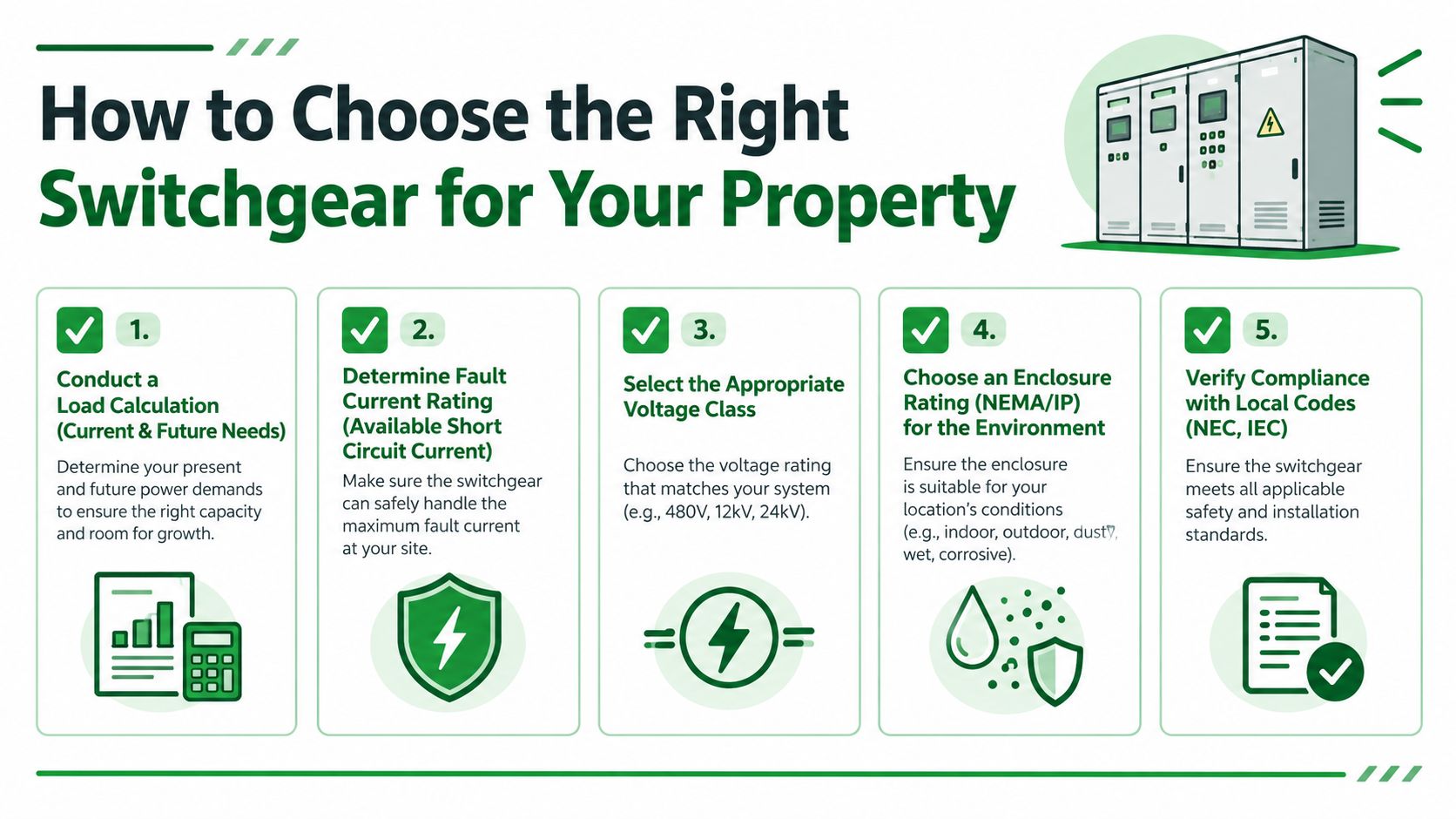
The right assembly starts with the electrical system, not a catalog image. A contractor should review the existing one-line diagram, utility service information, transformer data, feeder demands, fault current, available space, environmental conditions, and planned expansion before recommending equipment.
Begin with present and future load
A load calculation establishes what the property needs today. The design should also account for credible future work, such as additional HVAC equipment, tenant improvements, elevators, solar interconnection, battery systems, or EV charging. Oversizing isn't automatically the right answer, because larger equipment can increase cost, footprint, and coordination complexity. Undersizing creates a more serious problem, especially if the replacement requires structural changes or a second shutdown.
Ask the contractor to explain:
- Current demand: Which feeders are loaded, and which loads are intermittent?
- Future capacity: Can the assembly accept additional breakers or sections?
- Fault current: What short-circuit current can reach the equipment, and does the interrupting rating exceed it?
- Coordination: Will upstream and downstream protective devices trip selectively, limiting the outage to the affected circuit?
- Space: Are working clearances, cable bends, ventilation, and equipment removal paths available?
- Environment: Does the room expose equipment to moisture, dust, corrosive conditions, heat, or outdoor weather?
Treat procurement as a design constraint
A technically suitable assembly doesn't help if it arrives after the construction window. Recent market coverage places medium-voltage switchgear lead times at 52 to 80 weeks for 15 kV gear and 78 to 104 weeks for 38 kV gear, compared with a historical baseline of about 24 weeks (switchgear lead-time coverage). These are market coverage figures, not a promise for every manufacturer or project, but they show why procurement belongs in the first planning meeting.
Reserve a manufacturing slot after the design basis is sufficiently developed. Confirm approved manufacturers, submittal requirements, utility review steps, long-lead components, factory testing, shipping conditions, and the consequences of a late design change. If the building must remain occupied, ask for a phasing plan that explains temporary power, outage windows, tenant notices, and emergency systems.
Review the documents before approving equipment
A property manager doesn't need to calculate relay curves personally, but the project file should contain a clear equipment schedule, one-line diagram, ratings, enclosure information, protection settings, test requirements, and commissioning records. The contractor should also identify what existing cables, transformers, and downstream panels can remain and what must change.
Practical rule: If the project team can't explain the equipment rating, delivery plan, outage sequence, and testing process in plain language, the design isn't ready for approval.
Safety Standards and Code Considerations That Protect People
A breaker trips during a tenant fit-out, and the property manager must decide whether the equipment, labels, study, and work procedure are still suitable. Standards provide the framework for that decision. They define how assemblies are designed, verified, labeled, installed, and evaluated under abnormal conditions. Compliance affects worker exposure, inspection results, insurance records, and the cost of correcting equipment that was never suited to the installation.
Low-voltage equipment can follow different requirements based on its construction and use. IEC 61439-1:2020 sets general requirements, technical characteristics, and verification requirements for low-voltage switchgear and controlgear assemblies. In North American applications, UL 1558 addresses low-voltage power circuit breaker switchgear, while UL 891 covers switchboards. Medium-voltage factory-built metal-enclosed switchgear is addressed by IEC 62271-200 for rated voltages above 1 kV up to and including 52 kV. The applicable standard should appear in the design documents and equipment submittal, not remain an assumption.
Arc flash requires an engineered response
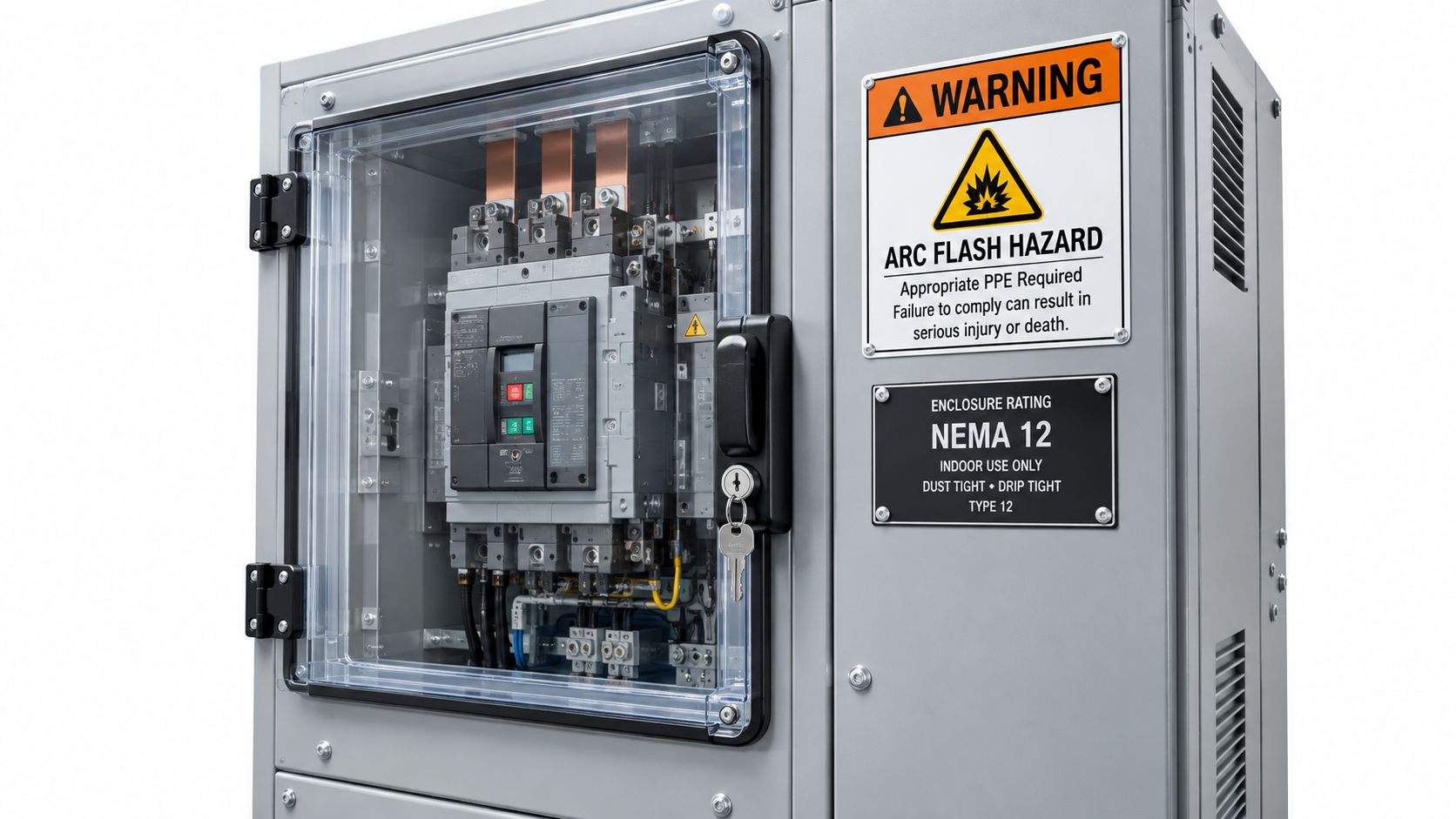
An arc flash occurs when electrical energy travels through an unintended path. Heat, pressure, light, and molten material can injure workers and damage the electrical room. A warning label communicates the hazard, but the protection system, equipment construction, operating procedure, boundaries, maintenance condition, and worker training must work together.
IEEE 1584-2018 provides the mathematical model used to calculate incident energy and the arc-flash boundary. IEEE C37.20.7 covers testing for internal arcing faults, with a preferred arcing duration rating of 0.5 seconds and allowances down to 0.1 seconds when protective devices clear faster (IEEE 1584 standard information). Faster clearing limits the time energy is available. Arc-resistant construction can direct fault effects away from personnel in tested configurations.
What the contractor should document
Request the applicable listing or certification, short-circuit and withstand ratings, arc-flash study information, equipment labels, installation instructions, test reports, and commissioning records. Confirm that the enclosure rating suits the room and exposure. An indoor cabinet is not automatically suitable for damp, dusty, corrosive, or outdoor conditions.
Code compliance also covers clearances, grounding, conductor termination, working space, labeling, fire protection, ventilation, and local inspection requirements. For commercial projects in Southern California, commercial electrical code compliance services can help property teams organize testing, documentation, and corrective work alongside installation. These records also give managers a clearer basis for planning infrared diagnostics and deciding when an upgrade should occur.
Maintenance Troubleshooting and Infrared Inspection Essentials
Switchgear maintenance begins before anyone opens the cabinet. Facility teams can watch for visible damage, corrosion, dust, water intrusion, loose covers, blocked ventilation, abnormal sounds, and odors. They should also review breaker trip history and compare recurring faults with tenant changes, equipment additions, and seasonal loading.
A qualified electrical contractor can then build a documented maintenance workflow:
- Inspect the assembly: Check enclosure condition, labels, barriers, cable entries, ventilation, and signs of overheating.
- Clean safely: Remove contamination using methods approved for the equipment and the energized or de-energized condition.
- Verify connections: During an appropriate outage, inspect and torque accessible terminations according to manufacturer requirements.
- Test protective functions: Exercise breakers, test trip mechanisms, and verify relay operation and settings.
- Record findings: Photograph conditions, identify priority levels, and assign corrective work rather than filing a report with no follow-up.
What infrared thermography can reveal
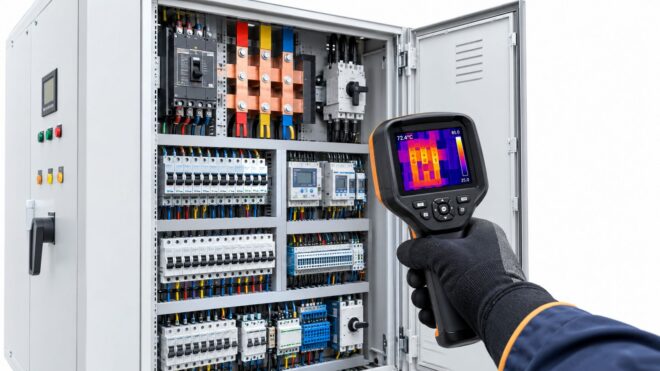
An infrared inspection measures heat patterns from accessible energized equipment without requiring the technician to dismantle the assembly. A thermal image can help identify an abnormal hotspot at a termination, breaker connection, bus joint, or cable lug. The image doesn't diagnose the cause by itself, so the technician must compare similar phases and circuits, consider load conditions, and investigate safely.
A hotspot may point to a loose connection, damaged contact surface, phase imbalance, overload, or another developing issue. The useful result is a documented report that connects the thermal image to equipment identification, observed operating conditions, recommended action, and priority.
Read the symptoms carefully
- Overheating: Look for connection resistance, loading problems, contamination, or ventilation issues.
- Nuisance tripping: Review actual load, breaker condition, relay settings, coordination, and possible downstream faults.
- Buzzing or unusual noise: Have a qualified electrician investigate mechanical vibration, loose components, abnormal current, or failing equipment.
- Burning odor or discoloration: Treat it as an urgent warning. Remove personnel from danger and arrange an appropriate electrical response.
- Repeated feeder failures: Investigate the system rather than repeatedly replacing the same breaker.
For property teams, switchgear maintenance and inspection services can combine visual review, testing, infrared diagnostics, repairs, and upgrade recommendations. The aim isn't to collect maintenance paperwork. It's to identify a developing fault while the work can still be scheduled around tenants and operations.
When to Upgrade or Replace Aging Switchgear
Repair makes sense when the equipment remains suitable, replacement parts are available, the enclosure and insulation are in sound condition, and testing confirms that protection functions correctly. Replacement becomes more compelling when the gear has repeated failures, obsolete breakers or relays, visible heat damage, corrosion, water intrusion, limited expansion space, or documentation gaps that prevent confident coordination and maintenance.
Use clear triggers for the decision
Capacity changes deserve an engineering review. EV charging, added HVAC equipment, new tenant machinery, solar systems, and other large loads can change demand and available fault current. A property may have enough normal operating capacity but still require a different fault rating or protection scheme after a major electrical change.
Parts availability is another practical signal. If a failed breaker requires specialized rebuilding, a long search for obsolete components, or an uncertain substitute, the property is carrying a reliability risk. A repair that restores operation today may not create a dependable lifecycle plan.
Safety requirements can also shift the decision. Arc-flash findings, inadequate interruption performance, inaccessible isolation points, or an enclosure that doesn't suit the environment may justify replacement rather than repeated patchwork. Where a project considers SF6-free medium- or high-voltage equipment, the team should evaluate utility approval, footprint, certification, maintenance training, and delivery readiness rather than treating the choice as a simple material swap.
A replacement project can also be the right time to address the broader distribution system. Review the transformer, feeders, protective settings, grounding, downstream panels, working clearances, and emergency power interfaces. A modern main assembly won't solve a weak feeder, an overloaded transformer, or poor coordination elsewhere.
Plan before failure chooses the date
Begin with a condition assessment and an updated one-line diagram. Ask for repair and replacement options, outage requirements, temporary-power needs, procurement assumptions, factory testing, field commissioning, and a budget range based on defined equipment scope. For a building that can't tolerate an unplanned shutdown, early planning is usually more valuable than waiting for a dramatic failure.
For properties where a main distribution change is part of a broader capacity project, a commercial electrical panel upgrade assessment can help clarify whether the work belongs at the panel, switchgear, feeder, transformer, or service level. Use a licensed C-10 contractor for design coordination, installation, testing, and final documentation.
Access Electrical and Lighting provides commercial switchgear and electrical distribution troubleshooting, infrared inspections with documented reports, maintenance, testing, and upgrades for commercial, retail, office, and multifamily properties. If your building has aging gear, unexplained hotspots, repeated trips, or a planned capacity increase, visit Access Electrical and Lighting to arrange an assessment and plan the work before an outage sets the schedule.