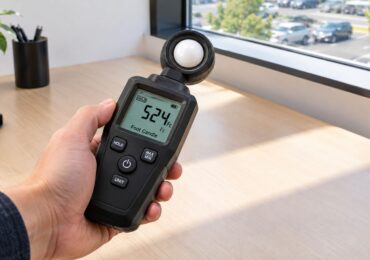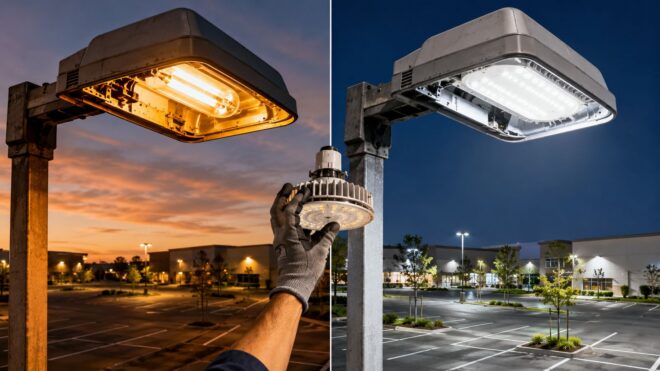
You open a January utility bill and find an unpleasant surprise. Then you walk the parking lot and notice three dark pole lights, even though the property still has a full schedule of nighttime lighting and tenants expect the site to feel safe. The question isn't just whether to install LEDs. It's what is retrofit lighting, and which upgrade path solves the energy, maintenance, code, and reliability problems without creating a larger construction project?
For a commercial property manager, retrofit lighting means improving an existing lighting system with more efficient components while keeping some of the installed infrastructure. That might mean changing only the lamp, installing a new LED kit inside the existing housing, or removing the old fixture and mounting a complete LED luminaire. The right choice depends on the fixture's condition, the application, operating hours, controls, and the economics of labor and future maintenance.
Retrofit Lighting Explained for Property Managers
A lighting retrofit starts with something already in place. The ceiling grid, pole, junction box, wiring pathway, or fixture housing may remain, while the contractor changes the parts that produce, regulate, or control light. In practical terms, an old fluorescent troffer may receive an LED kit, a metal-halide parking fixture may receive a compatible LED system, or a degraded wall pack may be replaced with a new integrated LED unit.
The useful boundary is simple:
- Retrofit: Upgrade an installed lighting system without rebuilding the ceiling, pole, or supporting structure from scratch.
- New construction: Design and install a lighting system where the fixture layout, electrical infrastructure, and mounting conditions are being created or substantially rebuilt.
The existing fixture doesn't always stay. “Retrofit” describes the project strategy, not one specific product. A lamp-only conversion preserves most of the housing, while a full luminaire replacement removes the old fixture but may reuse the existing electrical box and circuit.
What changes during the work
A contractor evaluates the lamp, ballast, driver, socket, reflector, wiring, lens, housing, and controls. The upgrade may remove an aging ballast, install an LED driver, improve optical distribution, add a photocell, or connect occupancy and daylight controls. The goal is to reduce input power while maintaining appropriate light levels and safe operation.
Federal guidance describes retrofit kits as providing about 40% to 60% lighting-energy savings before controls are added, while one federal building example found 27% to 29% savings when linear fluorescent lighting was converted to LED retrofit solutions. Adding zone-based controls pushed the modeled retrofit-kit savings to 65%, according to the U.S. General Services Administration LED and controls guidance.
Working definition: Retrofit lighting is a targeted upgrade to an existing lighting system that lowers energy and maintenance demands without treating the entire building as a construction site.
That definition matters because a property manager is usually solving a cost and operations problem. The electric meter should reflect the lower connected load once the new equipment operates, and the maintenance team should gain a more dependable system. For a plain-language overview of the equipment and installation concept, review this guide to commercial LED retrofit lights.
Three Technical Approaches to a Lighting Retrofit
A site walk usually produces one of three recommendations. The options can look similar from the ground, but they differ significantly in what stays, what gets discarded, and how much responsibility remains with the old fixture.
Lamp-only swap
A lamp-only retrofit replaces the light source inside the existing housing. A common example is an LED corn lamp installed in a high-intensity discharge fixture. The pole, housing, socket, and often the existing optical enclosure remain.
This path can make sense when the housing is structurally sound, the socket is in good condition, and the new lamp is listed for that enclosure. It generally involves the least material removal, but it leaves more of the old system in service. Ballast compatibility, heat management, light distribution, and warranty terms need careful review.
Retrofit kit
A retrofit kit installs a new LED engine, driver, reflector, and related components inside the existing luminaire shell. The contractor may bypass or remove the old ballast, improve the reflector, and preserve the fixture's mounting arrangement.
This is often the balanced choice for commercial properties. It can retain a sound housing while replacing the components most likely to limit efficiency and maintenance. The contractor can also select optics and controls more deliberately than with a simple replacement lamp.
Full luminaire replacement
A full replacement removes the old fixture and installs a complete LED luminaire. The electrical circuit and junction box may remain, but the housing, optics, driver, and mounting hardware change.
This option fits fixtures with corrosion, cracked lenses, failing seals, damaged wiring, poor photometric performance, or incompatible controls. It usually requires more labor and material, but it gives the project a clean equipment warranty and a more predictable optical result.
| Approach | What Stays | What Is Replaced | Typical Cost per Fixture | Best Fit |
|---|---|---|---|---|
| Lamp-only swap | Housing, pole or mounting structure, and often socket | LED lamp, with ballast or wiring changes as required | Lower cost band | Sound fixtures with compatible housings and straightforward operating conditions |
| Retrofit kit | Existing luminaire shell and mounting arrangement | LED engine, driver, reflector, and sometimes controls | Mid-range cost band | Commercial fixtures that are structurally sound but internally outdated |
| Full luminaire replacement | Circuit and sometimes junction box or support | Complete LED fixture, optics, driver, and mounting hardware | Higher cost band | Corroded, damaged, obsolete, or optically unsuitable fixtures |
The cost bands above are relative rather than promised prices. A contractor should price access equipment, lift time, wiring changes, controls, emergency circuits, disposal, and commissioning separately. The cheapest component can become the most expensive choice if it leaves an unreliable housing or creates compatibility problems.
Common Commercial Applications and Where Retrofits Fit
A retrofit specification changes with the environment. A small site fixture beside a walkway doesn't face the same optical, mounting, or controls requirements as a parking-structure luminaire or a tall pole fixture.
Site and landscape lighting
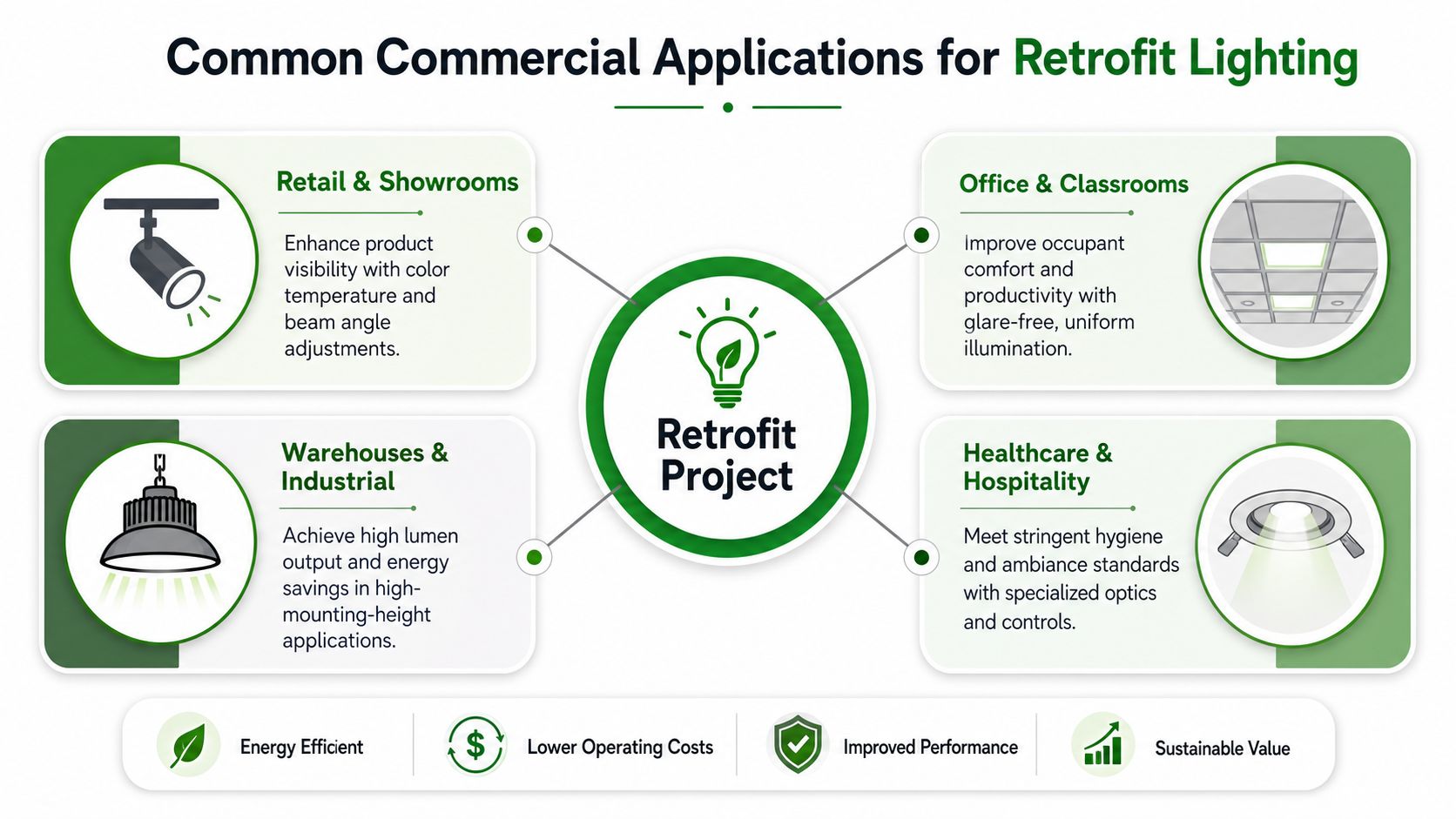
Site lighting includes walkway fixtures, bollards, wall-mounted units, and shorter decorative poles. The contractor needs to consider glare, shielding, color appearance, vandal resistance, and how light reaches pedestrian routes rather than just maximizing lumens. Photocells and astronomical time clocks often control the schedule, while motion sensors may reduce output during low-activity periods.
Parking lots
Parking lots commonly use pole-mounted shoebox and flood fixtures. Mounting heights vary by property, with many commercial installations using poles around 20 to 35 feet high. Distribution, cutoff, aiming, and uniformity matter because a bright fixture that sends light beyond the property line can create glare and trespass.
A photocell may trigger dusk-to-dawn operation, while networked controls or motion sensors can create dimming profiles for periods of limited activity. The control choice can change the driver specification, wiring scope, and commissioning requirements.
Parking structures
Parking structures have low ceilings, concrete surfaces, vehicle exhaust, and pedestrian circulation. Strip fixtures, wraparound fixtures, vapor-tight units, and surface-mounted luminaires are common. The design must account for concrete reflectivity, glare in drivers' sightlines, emergency egress, exit signage, and battery or central emergency systems.
Occupancy sensors need careful zoning. A sensor that sees only one parking bay can leave adjacent travel paths dark unless the controls coordinate fixtures.
Tall poles and sports areas
Tall stanchions and sports lighting bring wind load, vibration, aiming, access, and structural condition into the conversation. A new fixture may weigh differently or expose a different surface area to wind, so the contractor should verify mounting hardware and pole integrity before ordering.
High-reach equipment can reduce disruption, but the work plan still needs traffic control, aiming documentation, photocell settings, and a clear method for verifying light levels after installation. The application determines whether a lamp, kit, or complete fixture is technically defensible.
Energy Savings, Rebates, and Realistic Payback
A Southern California property manager may see a lower utility bill after a retrofit, but the bill alone does not explain the result. A sound financial model separates three effects: reduced wattage, fewer operating hours through controls, and lower maintenance demand. Combine them only after each assumption is visible.
The federal savings ranges cited earlier, 40% to 60% before controls and 65% with zone-based controls, appear on the meter only when the controls strategy matches the building's occupancy pattern. A rarely occupied office and an all-night parking structure should not use the same operating assumptions.
A second study paired LED retrofits with advanced controls and daylighting or shading strategies. It found savings exceeding 70% in perimeter open-office zones, while modeled whole-building savings for large and medium offices ranged from 5% to 11%, depending on the integration scope, as described in the commercial office retrofit analysis. Those results are scenarios, not promises. Occupancy, daylight, schedules, and controls determine how much efficiency reaches the utility meter.
The three savings layers
Energy savings begin with lower fixture input power. Operating hours determine how quickly that difference matters. A parking lot running throughout the night has more opportunities to save than a lightly used office, even if the fixture wattage reduction is similar.
Controls add a second energy layer by reducing unnecessary run time. Scheduling, occupancy response, and daylight response can lower consumption, but only if zones, sensors, wiring, and commissioning support the intended sequence.
Maintenance savings depend on access, failure frequency, and replacement cost. Exterior fixtures may require lifts or boom trucks, so avoiding one service visit can affect the project economics even when the energy calculation looks modest. The equipment choice also matters. A lamp-only swap may preserve more existing hardware, while a retrofit kit or complete luminaire can reduce recurring failures when the existing ballast, housing, or optical system is near the end of its useful life.
Incentives and deductions can reduce the initial project cost. Southern California managers should ask the serving utility about commercial lighting incentives and pre-approval requirements before purchasing equipment. They should also review whether federal deductions, such as Section 179D, fit the property's ownership and project circumstances. Eligibility, equipment documentation, and application timing must be confirmed.
For California properties, Title 24 lighting requirements and documentation belong in the early design review. Compliance can affect controls, shutoff functions, daylight response, occupancy strategies, testing, and records.
A payback model that exposes assumptions
| Line Item | Assumption | Annual Value |
|---|---|---|
| Energy cost reduction | Existing and proposed fixture loads, verified operating schedule, and applicable electricity rate | Calculated from measured conditions |
| Maintenance savings | Existing lamp, ballast, lift, labor, and service frequency compared with proposed equipment | Calculated from service history |
| Utility incentive | Program eligibility, equipment qualification, and required pre-approval | Confirmed incentive amount |
| Tax treatment | Eligibility of the owner and project under applicable federal rules | Reviewed with the owner's tax adviser |
| Net project cost | Installation, equipment, controls, access, disposal, and incentive deductions | Initial cost less confirmed incentives |
| Payback | Net project cost divided by combined annual value | Scenario range, not a guaranteed single figure |
A proposal showing one precise payback without its assumptions deserves closer review. Baseline conditions, energy prices, labor, controls, access, and management decisions can shift forecast savings away from field results. Research on the challenges and benefits of LED retrofit projects also identifies this gap between modeled and realized outcomes.
How a Commercial Retrofit Project Actually Runs
A dependable retrofit is a sequence of decisions, not a truck arriving with boxes of LED fixtures. The first visit should produce a usable inventory, not a rough guess based on a few representative photos.
Start with a field audit
The contractor records fixture families, quantities, mounting heights, dimensions, lamps, ballasts, drivers, circuit information, emergency connections, controls, and physical condition. A clip-on electrical meter or other field measurement can help capture the existing load, while utility bills provide the broader operating context.
The team should also document operating hours. A photocell-controlled parking lot, a manually switched warehouse, and an office with scheduled shutoff require different models even if they use similar fixtures.
Design against the real building
The audit is paired with utility data to estimate energy and maintenance effects. At this point, the contractor checks California code requirements, controls, emergency lighting, equipment listings, and potential utility incentives before hardware is ordered.
The proposal should identify the technical path for each fixture family. It should also include photometric information where distribution matters, driver and dimming compatibility, mounting details, warranty coverage, disposal, access equipment, and a realistic installation schedule.
Practical rule: Don't approve a fixture schedule that doesn't explain what happens to the old ballast, how controls communicate with the driver, and how the contractor will verify the finished system.
Install in controlled phases
Installation sequencing protects tenant access and building operations. Parking structures may require work by level or zone, while retail and office properties may need after-hours work, temporary lighting, or coordination with tenants.
After installation, the crew aims exterior fixtures, checks wiring, programs photocells and occupancy sensors, verifies dimming levels, tests emergency functions, and confirms that the installed product matches the approved specification. Commissioning is where a good design becomes a functioning system.
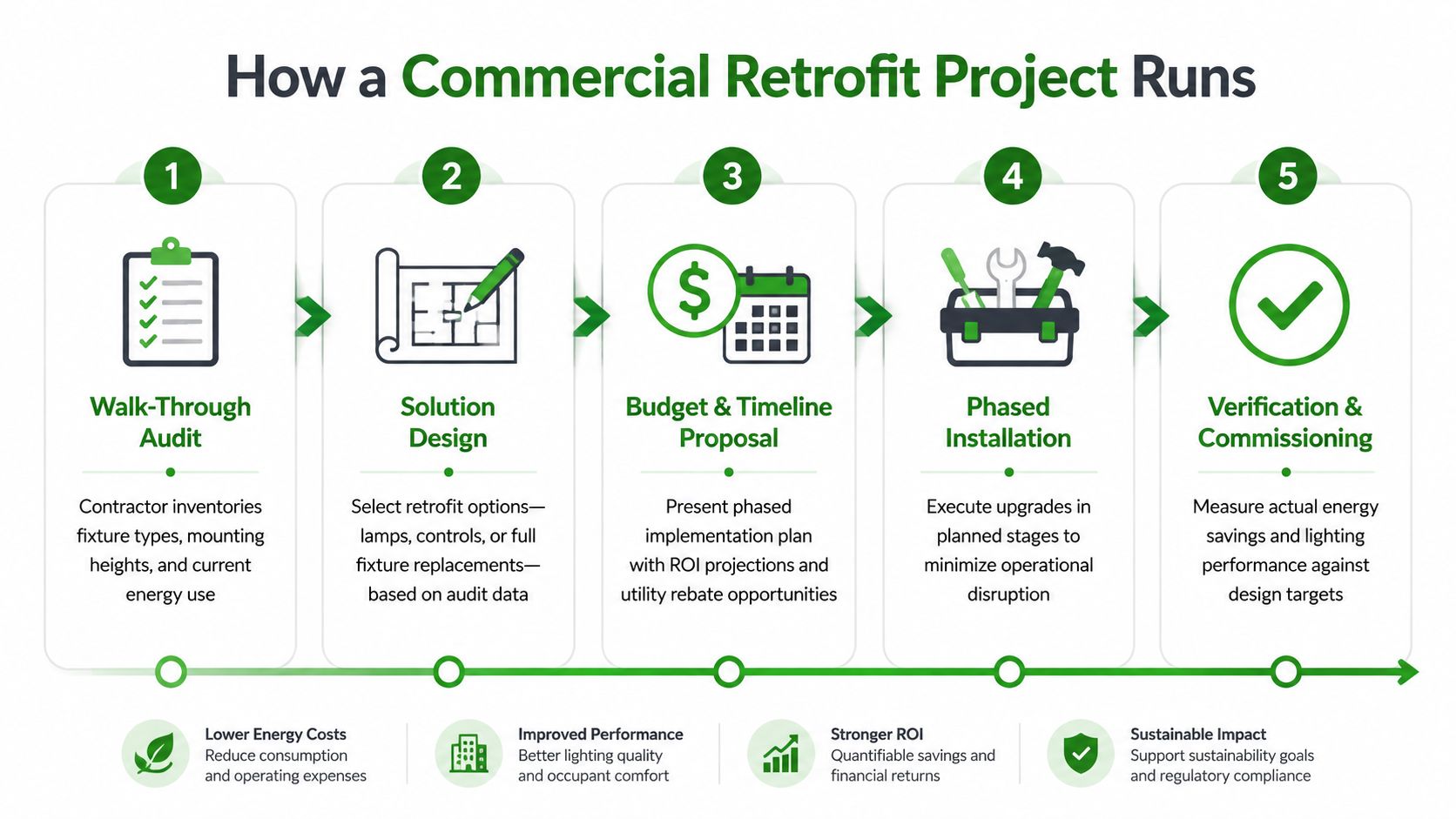
The closeout package should include as-built fixture information, control settings, warranty documents, test records, and rebate paperwork. A follow-up review after the system has operated long enough to produce meaningful utility data can compare actual performance with the original model. For local project coordination, commercial LED retrofit installation in Orange County is one service category property managers can evaluate alongside other qualified contractors.
Failure Modes and How to Spec Around Them
The most common mistake is treating an LED retrofit as a one-for-one lamp exchange. Older fixtures can contain aging optics, wiring, ballasts, transformers, sockets, and control components that were never designed for the proposed LED product. Technical guidance on retrofit decisions highlights incompatibility, flicker, dimming problems, and reduced output as reasons to evaluate the complete existing system before selecting a product.
Compatibility failures
An LED corn lamp installed into a fixture with an incompatible magnetic HID ballast can overheat the lamp or socket. The safer specification may require ballast bypass wiring, a compatible driver, or a kit designed for that exact housing and application.
Fluorescent conversions create a similar decision. Plug-and-play lamps depend on ballast compatibility, while ballast-bypass products require careful rewiring and labeling. A retrofit kit with a new driver may provide a more controlled long-term arrangement.
Flicker and dimming problems
Visible flicker often points to a mismatch between the LED driver and the existing dimming system. A loose neutral, an incorrect 0-10V connection, or a non-dimmable product on a dimmed circuit can produce the same complaint.
Before ordering, identify every dimmed circuit and record the dimmer or control equipment. Specify drivers that support the intended control protocol, including dim-to-off operation where occupancy controls require it. Verify wiring at commissioning rather than assuming the controls will work because the fixture is labeled “dimmable.”
Weak savings models
A proposal can overstate savings if the audit assumes operating hours that the building doesn't use. It can also miss fixture counts, controls, ballast losses, maintenance access, emergency circuits, or installation labor.
Require a fixture-by-fixture inventory and a documented operating-hours profile. The estimate should show existing load, proposed load, controls assumptions, incentive conditions, and maintenance inputs separately.
Warranty gaps
A parts-only warranty doesn't cover the same risk as a labor-inclusive warranty. Ask who pays for lift access, diagnosis, removal, replacement, and disposal if a driver fails. Also ask whether the warranty covers the entire retrofit assembly or only the LED module.
The most reliable specification is the one that makes failure responsibility clear before installation begins.
Putting It Together for Your Next Project
Use the existing system as the starting point. Map each fixture family to its housing condition, mounting height, optical needs, electrical compatibility, operating schedule, and control requirements.
A practical decision framework looks like this:
- Sound housing, usable optics: Consider a lamp-only solution or a listed retrofit kit after confirming compatibility.
- Sound housing, outdated internal components: A retrofit kit often provides a stronger balance between retained infrastructure and improved performance.
- Corroded housing, damaged wiring, poor optics, or unsuitable distribution: Specify a full luminaire replacement.
- Variable occupancy or daylight exposure: Add controls to the design rather than treating them as an afterthought.
- California commercial property: Review Title 24 requirements, testing, documentation, and incentive eligibility before purchasing equipment.
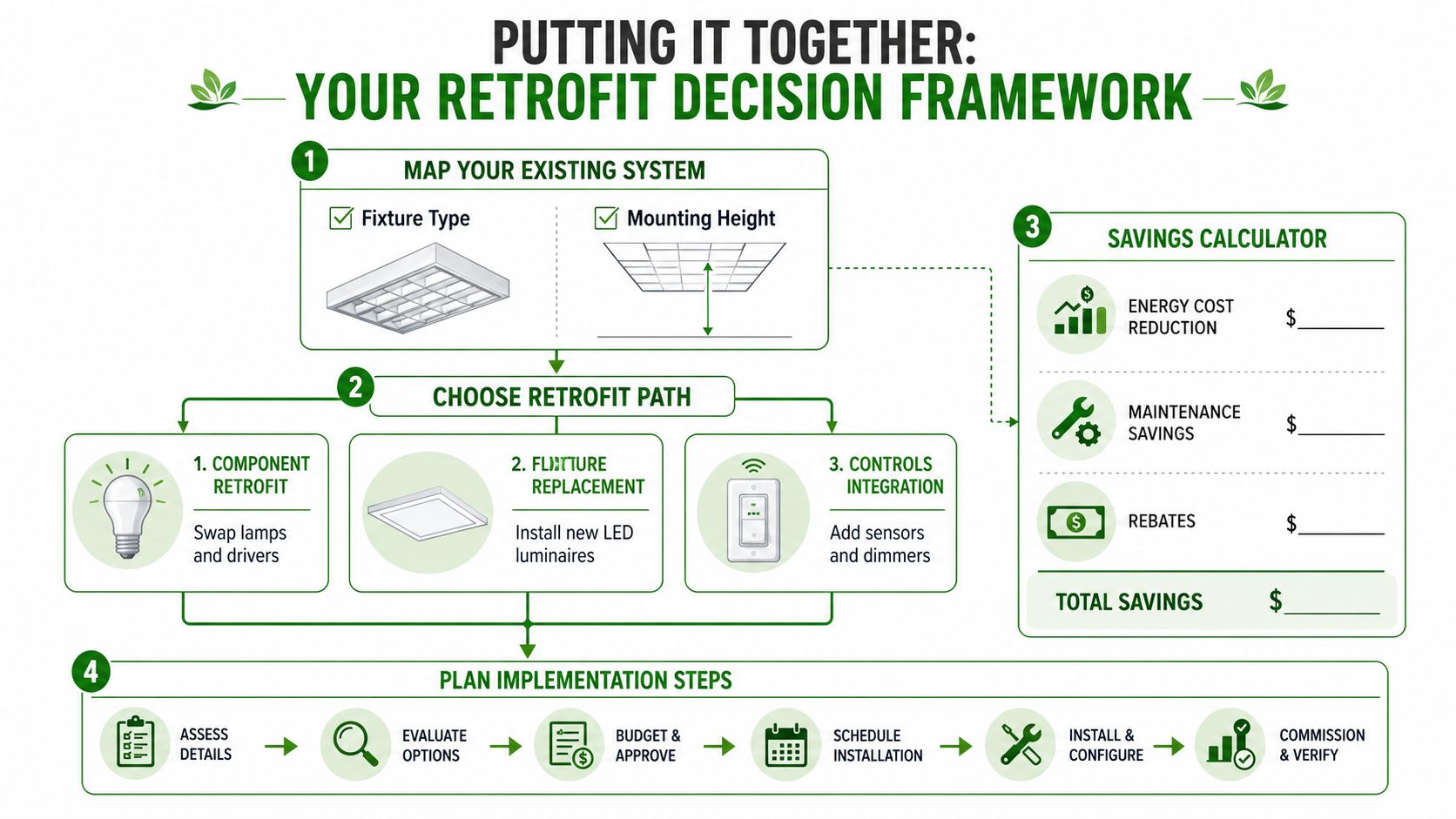
High-burn exterior spaces often offer a clearer energy and maintenance case because the fixtures operate for long scheduled periods and can be expensive to access. Interior office projects may depend more heavily on occupancy controls, daylight response, available incentives, and the quality of the existing troffers.
Rule of thumb: If the existing housing is sound and the optics still work, a listed retrofit kit is usually worth serious consideration. If the housing is degraded or the optics no longer suit the application, full replacement is more than a cosmetic upgrade.
Bring these questions to your contractor:
- What exactly stays in each fixture, and what gets removed?
- Which operating-hours, controls, maintenance, and incentive assumptions support the savings model?
- How will the crew verify light levels, controls, emergency operation, warranty coverage, and rebate documentation after installation?
Access Electrical and Lighting evaluates commercial lighting systems, including site, parking, pole, parking-structure, emergency, and controls applications, for properties in Southern California. Visit Access Electrical and Lighting to discuss a fixture-by-fixture audit, retrofit design, installation, Title 24 documentation, and commissioning plan for your property.