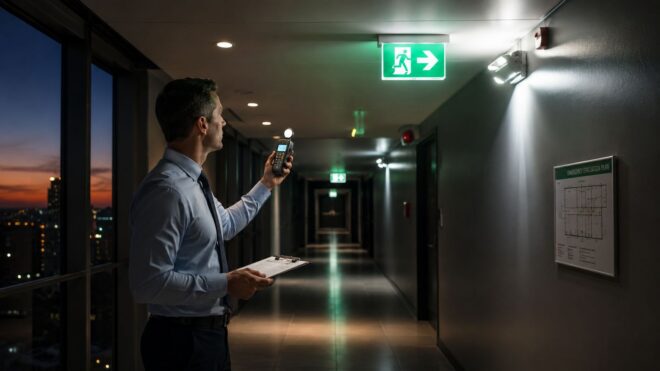
At 11 p.m., a panel trips in a Southern California retail building. The corridor goes black, tenants are still behind closed doors, and the fire alarm loses normal power at the same time. A property manager walking toward the electrical room may discover that the emergency fixtures either illuminate the route or reveal a maintenance problem that has been waiting for the next outage.
That situation is why emergency lighting code requirements focus on performance, not appearance. The system must provide usable visibility along the path occupants and first responders will take, then prove that capability through regular testing and records. The practical questions are straightforward: which rules apply to this building, what must the system do, and how can the owner prove it still works year after year?
Why Emergency Lighting Matters for Commercial Properties
Emergency lighting is a life-safety system, not a decorative fixture package. When normal power fails, occupants need to see corridors, stairs, ramps, aisles, exit doors, and the route beyond the exit. A bright fixture in one lobby doesn't solve a dark turn, stair landing, or parking-structure discharge path.
The owner's responsibility starts with the building itself. In California, unsafe conditions affecting egress can become part of premises-liability disputes, including wrongful-death claims. A failed emergency light may look like a small maintenance issue during normal operations, but during a fire, earthquake, medical emergency, or utility outage, it can affect whether people find the exit without delay.
Four groups may examine the system
A property team usually deals with more than one reviewer:
- Building officials: They review emergency lighting as part of permits, alterations, and building-code compliance.
- Fire authorities: The local authority having jurisdiction may inspect the egress route, equipment, and maintenance records.
- Workplace safety officials: OSHA requirements overlay employee-occupied areas and require employers to maintain usable exit routes. The OSHA lighting standards guide provides a practical starting point for separating workplace obligations from building-code duties.
- Insurance carriers: Insurers may ask for maintenance evidence after a loss or during risk reviews.
These groups don't always use the same document or inspection process. A California building may be permitted under the California Building Code, designed around model-code language, reviewed by a city fire department, and operated as a workplace subject to OSHA requirements.
Practical rule: Treat every emergency fixture as part of an egress system. If a tenant improvement blocks it, a sign covers it, or a battery won't hold its charge, the route has changed even if the original installation was approved.
A compliant installation is only the starting point. The owner must keep the system functional, test it on a recurring schedule, repair failures, and maintain records that show what happened. The rest of this guide connects those obligations into one decision path for commercial property teams.
The Core Performance Benchmarks Every Building Must Meet
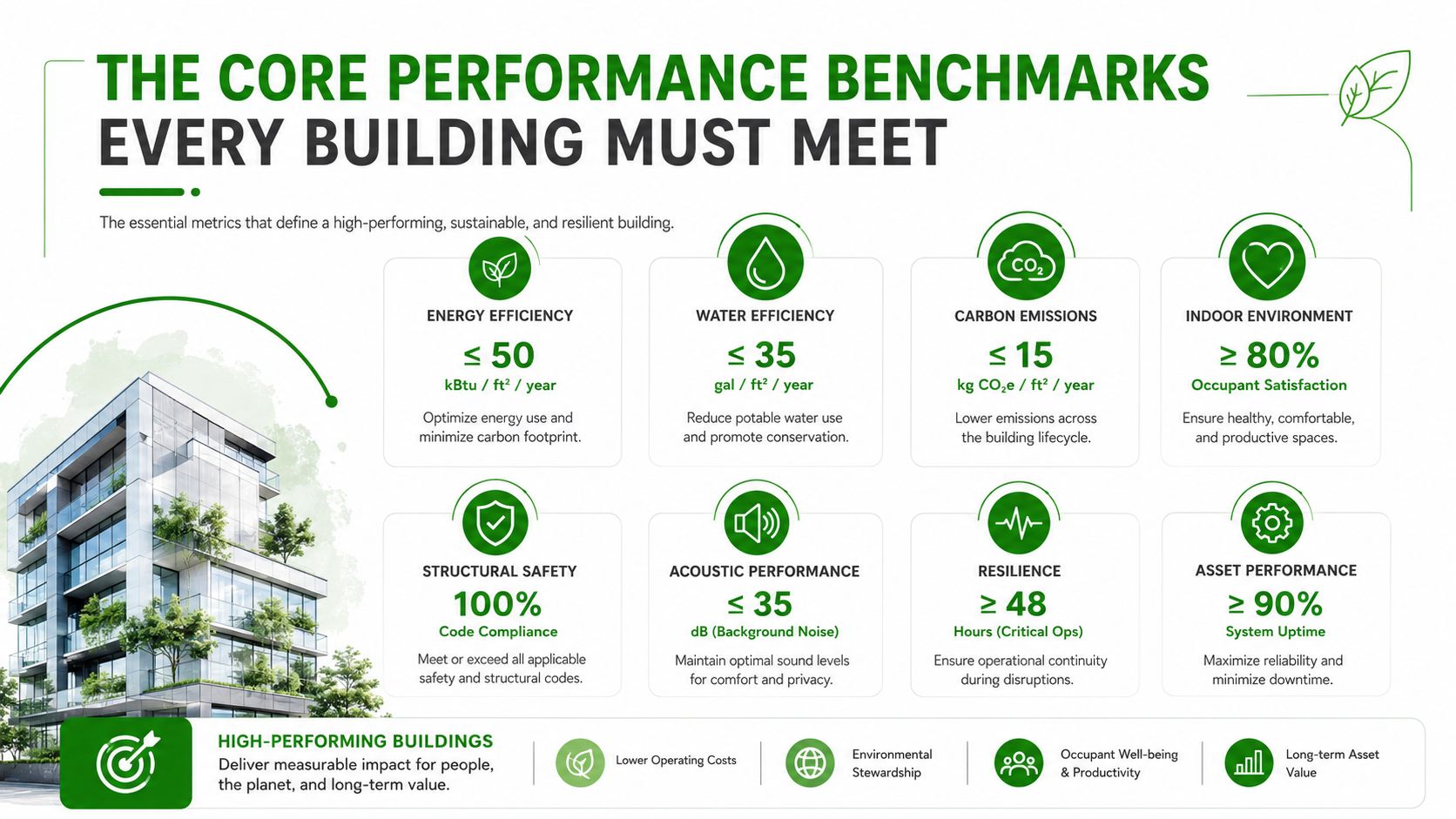
A designer can select different fixture styles, battery systems, or emergency power sources, but the system still has to fit a common performance envelope. For most U.S. commercial applications, the key figures are 90 minutes of emergency operation, transfer to emergency illumination within 10 seconds, and egress illumination that begins at about 1 foot-candle and may decline to 0.1 foot-candle at floor level during the required duration. These benchmarks are summarized in NFPA's Life Safety Code discussion.
Runtime is a capacity test
The 90-minute requirement is similar to a laptop advertised to run through a full work shift. The rating only matters if the battery can support the actual connected load, including remote heads and the fixture's electrical components. A unit that turns on during a quick check can still fail when its battery discharges under load.
NFPA 101 and the International Building Code both use the 90-minute emergency-lighting benchmark, and illuminated exit signs are subject to the same duration expectation. For a property manager, that means the battery, inverter, generator assumptions, transfer equipment, and replacement schedule all belong in the same reliability conversation. The guide to emergency exit signs for Southern California property owners explains why the sign and emergency-lighting functions should be reviewed together.
Transfer time protects the first moments
Emergency illumination must transfer quickly after normal power fails. The commonly applied benchmark is no more than 10 seconds, so the system can't leave the route dark while a transfer switch, inverter, or battery unit responds. Testing therefore needs to include the source changeover, not only the lamp.
Foot-candles describe usable visibility
Foot-candle values are measurements at the walking surface, not a preference for a brighter-looking hallway. The designer must verify the actual route, including turns, stairs, ramps, door thresholds, and exit discharge. A fixture aimed at a wall may appear bright while still leaving the floor below the required level.
The 1 foot-candle initial target and 0.1 foot-candle minimum permitted during the duration must be evaluated across the egress path, not at one convenient point. Product selection, mounting height, spacing, aiming, battery load, and field measurements all affect the result.
How NFPA 101, IBC, OSHA, and Title 24 Overlap
Property managers often get conflicting answers because the rules are read as separate lists. A better approach is to identify the legally adopted California requirements first, then check the model-code language and workplace overlay that apply to the building's occupancy and use.
California Title 24 is the enforceable state framework. California's building code adopts the IBC with state amendments, while the electrical code governs emergency circuits, wiring methods, overcurrent protection, and related installation details. NFPA 101 and the IBC supply much of the performance language used by jurisdictions, but the local building and fire authorities decide how the adopted code is applied to the project.
| Requirement | NFPA 101 | IBC | OSHA 1910 | CA Title 24 |
|---|---|---|---|---|
| Egress illumination | Establishes performance expectations for emergency illumination along the means of egress. | Carries egress-lighting requirements into commercial building provisions. | Requires workplace exit routes to remain adequately lighted and usable. | Enforces California's adopted building and electrical provisions, including state amendments. |
| Emergency duration | Commonly applied 90-minute emergency operation. | Commonly aligned with the 90-minute benchmark. | Supports safe workplace exit routes but doesn't replace the adopted building-code design. | Applies the California-adopted requirements and local enforcement conditions. |
| Power transfer | Emergency illumination must become available promptly after normal power loss. | Coordinates with emergency-power and egress provisions. | Focuses on employee safety and maintained exit routes. | Electrical provisions govern the installation and emergency-circuit arrangement. |
| Testing and records | Provides the basis for recurring functional and duration testing. | May be enforced through building and fire inspection processes. | Gives workplace inspectors a basis to cite unsafe exit-route conditions. | Local fire and building authorities enforce the applicable California requirements. |
| Who controls the final decision | The adopted edition and authority having jurisdiction control. | The adopted edition and project conditions control. | Applies where employees and workplace exit routes are involved. | State amendments, local adoption, occupancy, and AHJ interpretation control in California. |
Use a decision path, not a code grab bag
Start with the occupancy and permit documents. A hospital, high-rise, retail center, multifamily property, and office building may have different provisions or amendments. Next, identify the California code edition adopted by the jurisdiction and ask the building or fire official which provisions govern the project.
Then add the workplace question. If employees occupy the space, OSHA requirements sit on top of the building-code obligations. A system can satisfy one review and still create a workplace problem if an exit route is blocked, unlit, or poorly maintained.
California amendments may also create stricter conditions for certain buildings, including high-rise applications and equipment-listing requirements. Don't assume that a fixture layout copied from another city will receive the same approval in Orange County or Los Angeles County.
The Monthly and Annual Testing Cycle Explained
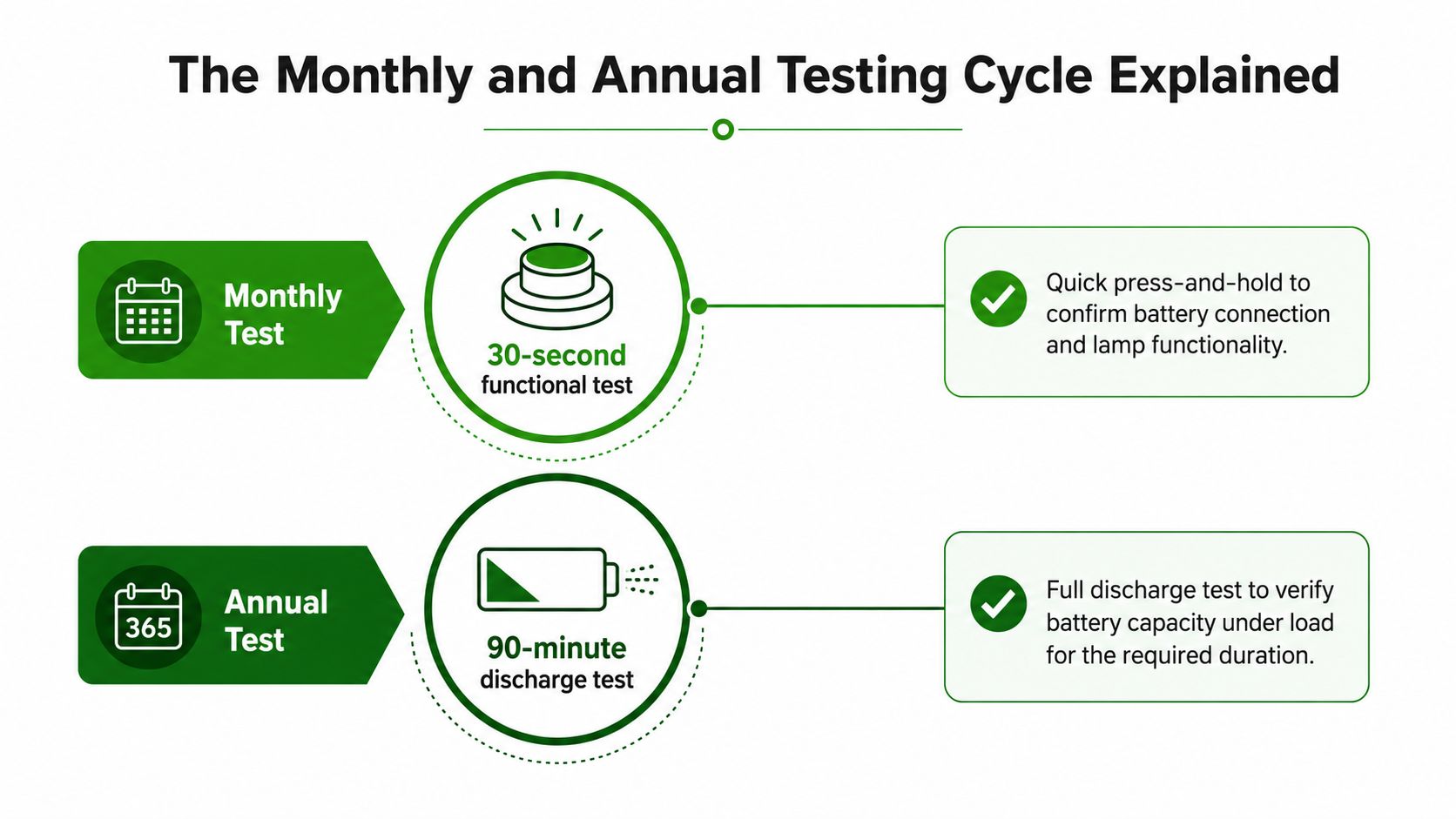
Emergency lighting compliance is a maintenance cycle, not a certificate that lasts for the life of the fixture. NFPA 101-based guidance commonly calls for a functional test every 30 days and a full-duration test once each year. The monthly check is typically 30 seconds, while the annual test runs the emergency system for the full 90 minutes. The emergency lighting testing guide describes this recurring structure.
The monthly check catches obvious failures
A trained building employee can usually perform the short functional test if the property has a clear procedure. Press the test button or use the approved test method, confirm the emergency heads and exit signs illuminate, look for damaged lenses or blocked fixtures, and verify that the charge indicator returns when normal power is restored.
Record the date, fixture identification, location, tester, and pass or fail result. A short test checks activation and transfer behavior, but it doesn't establish that the battery can carry its full load for the required period.
The annual test exposes capacity loss
The annual discharge test is the deeper event. A qualified contractor should coordinate the test for sealed batteries or systems that require access to electrical equipment, record the start and end times, identify units that dim or shut down early, and document repairs and retesting.
The emergency lighting testing service guide offers a useful framework for organizing the work. Self-testing fixtures can reduce manual effort, but they don't eliminate review or documentation. A failed unit needs corrective action, and the record should show what was repaired, what was replaced, and whether the unit passed afterward.
The safest operating rule is simple: schedule monthly testing as a recurring calendar task, reserve a planned outage window for the annual test, and keep the results with the property's life-safety records.
Applying the Rules to Real Southern California Properties
Take a representative Orange County retail or multifamily property with occupied corridors, exit stairs, and a route that reaches a public way through a parking structure. The inspection begins with a floor plan, but the test is a walk through the route occupants would use during a power failure.
In the corridor, the technician checks each turn, intersection, exit door, and change in direction. A fixture mounted above a soffit may illuminate the ceiling while leaving the floor dark. A sign added during a tenant improvement may block a dual-head unit. A photoluminescent exit marker may remain visible in normal conditions but fail to provide the battery-backed illumination required for the broader emergency route.
Follow the route occupants actually take
The walkthrough should include:
- Corridor loops: Trace the complete route rather than checking only the nearest fixture to the exit.
- Stairs and landings: Check every landing, tread transition, handrail area, and door threshold. Decorative stair lighting doesn't count as emergency illumination unless the approved emergency system powers it.
- Parking-structure discharge: Continue beyond the exit door if occupants must cross a garage, ramp, or exterior path to reach safety.
- Directional signs: Confirm that illuminated exit signs remain clear at doors, intersections, and changes in direction.
NFPA 101 provides the performance framework, while the IBC identifies where egress lighting belongs in the building layout. California Title 24 adds state requirements affecting building and electrical work, including energy-related controls in the applicable scope. The local fire authority then reviews the installation and maintenance conditions that apply to that property.
Watch for retrofit problems
Southern California properties change constantly. New storefront signs, added storage, security gates, decorative soffits, tenant partitions, and parking-area improvements can leave an originally acceptable fixture poorly aimed or physically blocked.
A fixture should be judged from the walking path, at the time of inspection, after the latest tenant work. Old approval doesn't guarantee current coverage.
Walk the route after business changes, not only after installation. Verify that battery-backed fixtures cover the path through the final exit, that exterior equipment is suitable for its environment, and that the emergency source still supports every connected head.
Documentation and Recordkeeping That Pass Inspection
A property can have working fixtures and still struggle during an audit if nobody can show when they were tested. Inspectors usually need a clear connection between the fixture on the wall, the test record, the failure, and the repair. A log that says only “lights checked” doesn't identify the system's condition or the person responsible.
Treat the program like an operating asset. Assign each fixture a location or identification number, keep the floor plan current, and attach repair records to the original failure. The annual test deserves particular attention because a brief activation check won't reveal a battery that loses capacity under sustained load.
Build one inspection-ready log
| Log Field | What to Record | Why It Matters |
|---|---|---|
| Date and test mode | Test date, monthly or annual mode, and elapsed runtime | Shows which compliance event occurred |
| Tester identity | Name, company, and initials or signature | Establishes accountability |
| Fixture location | Building, floor, room, corridor, stair, or exit identifier | Lets the inspector match the log to the equipment |
| Result | Pass, fail, early dimming, damaged housing, or blocked head | Creates a useful condition history |
| Corrective action | Battery, lamp, board, fixture, aiming, or obstruction correction | Shows how the deficiency was addressed |
| Retest result | Date and outcome after repair | Closes the deficiency loop |
| Battery information | Replacement date and relevant equipment details | Supports maintenance planning |
Paper binders can work, but they often hide missing signatures, skipped locations, and unresolved failures. A spreadsheet or digital compliance platform can sort by fixture, flag overdue tests, attach photographs, and preserve the repair trail. The tool matters less than the completeness and accessibility of the record.
Keep records for the period required by the applicable code, fire authority, contract, or company policy. A property team should also retain project documents, equipment information, marked floor plans, and acceptance records so a future manager isn't forced to reconstruct the system from the ceiling.
Clean records shorten the conversation with the inspector. More importantly, they show that the owner manages emergency lighting before an outage exposes a failure.
Choosing a Contractor for Install, Testing, and Compliance
The contractor should be evaluated as both an electrical installer and a documentation partner. In California, a licensed C-10 electrical contractor can coordinate installation, emergency-circuit work, testing, repairs, and the records needed for ongoing maintenance. Keeping those tasks within one service agreement reduces the chance that installation data sits with one vendor while testing history sits with another.
Ask candidates for proof of C-10 licensure, insurance coverage, relevant commercial experience, and a sample inspection log. The sample should identify fixture locations, test modes, elapsed runtime, failures, corrective work, and retests. It should also make clear who owns the final records.
Compare the service scope before signing
| Evaluation Criteria | What to Ask For | Why It Matters |
|---|---|---|
| Licensing | Current California C-10 license information | Confirms the contractor's electrical qualification |
| Insurance | General liability and workers' compensation documentation | Protects the property during service work |
| Fixture inventory | Marked plans or an equipment schedule | Prevents missed units during testing |
| Annual testing | Written scope for the full-duration discharge test | Separates real capacity testing from a quick activation check |
| Field measurements | Light-meter readings where required by the design or AHJ | Helps identify underlit portions of the route |
| Battery evaluation | Load, condition, and replacement recommendations | Connects failures to the actual emergency demand |
| Repair process | Response procedure for failed fixtures and blocked coverage | Keeps deficiencies from remaining open |
| Records | Digital or paper logs, photographs, and retest documentation | Produces an audit-ready compliance file |
| Local experience | Familiarity with city and county review practices | Helps reduce surprises during permits and inspections |
Check the technician's method
A good proposal explains how the technician will walk the route, not just how many fixtures will receive a button press. Ask whether the work includes stairs, corridors, ramps, exit discharge, parking structures, remote heads, and exit signs. For a new installation or major alteration, ask how the contractor coordinates with the engineer, building official, fire authority, and applicable Title 24 documentation.
Tools matter, too. A calibrated light meter supports field verification, while battery and load information helps explain why a unit passes a short test but fails during the longer discharge. The contractor should also identify whether self-testing equipment changes the inspection workflow without treating automation as a substitute for records.
Access Electrical and Lighting provides commercial emergency lighting and exit-sign installation, maintenance, testing, and repair as part of its Southern California electrical services. Property teams can compare that scope with other qualified contractors and select the service arrangement that matches the building's occupancy, route complexity, and inspection responsibilities.
A Practical Compliance Checklist for Property Teams
Assign ownership before the next inspection. The property manager should control the compliance file and the AHJ point of contact, while trained staff or a qualified contractor performs the checks appropriate to the equipment and scope.
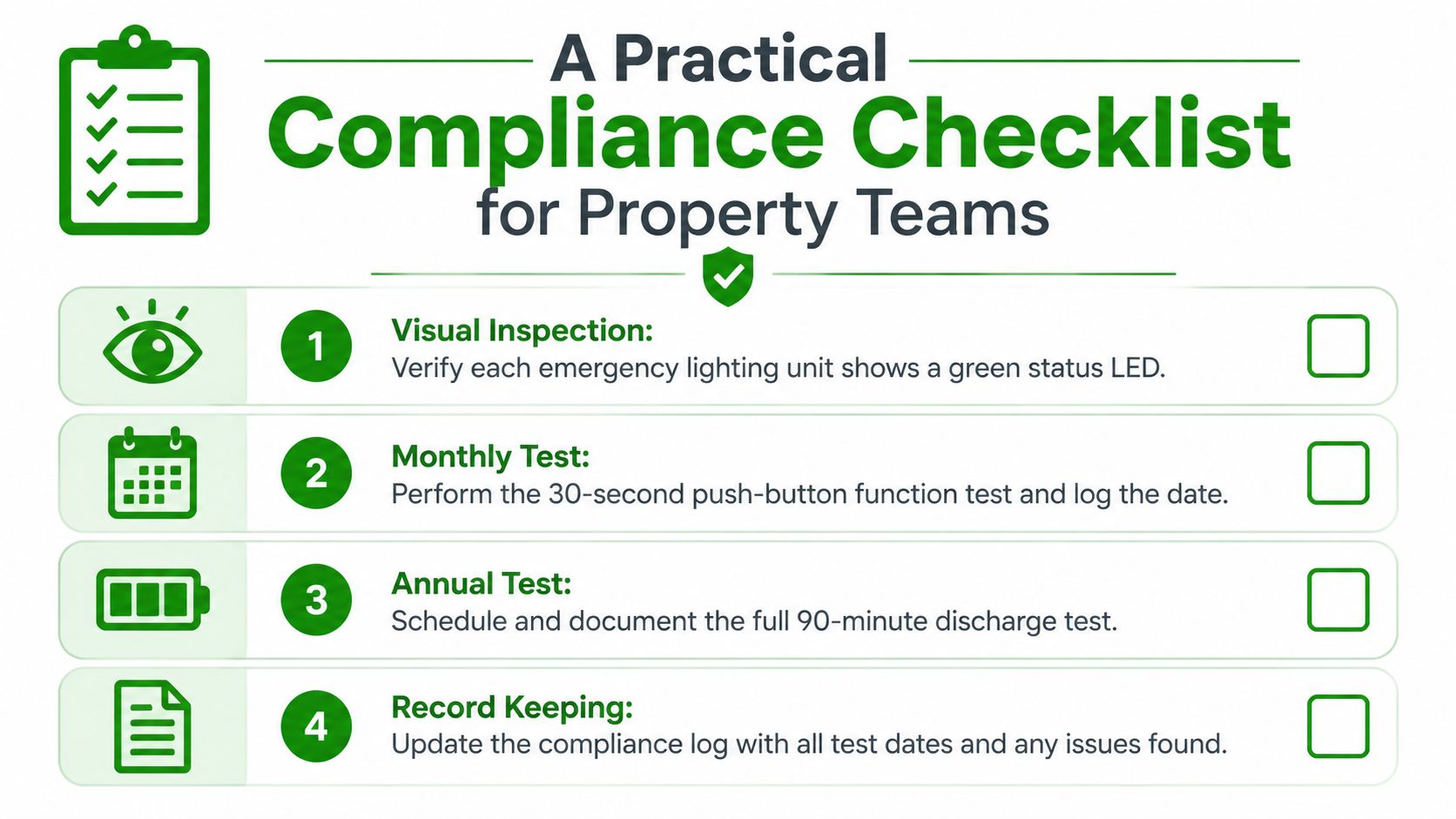
Give each task a named owner
- Walk the route: Inspect corridors, stairs, ramps, exit doors, discharge paths, and parking areas after tenant or construction changes. Look for blocked, damaged, poorly aimed, or unsuitable fixtures.
- Run the monthly test: Schedule the 30-second functional test every 30 days, confirm activation, check exit signs and heads, and record the result. The recurring test cycle is outlined in NFPA 101 testing guidance.
- Schedule the annual discharge: Reserve access for the 90-minute test, document start and end times, note early dimming or shutdown, and arrange corrective work for every failure.
- Review the equipment: Check status indicators, battery information, mounting condition, aiming, remote-head connections, and obstructions. A green indicator alone doesn't prove full-duration capacity.
- Close deficiencies: Record the repair, replacement, photograph, technician, and retest. Don't leave a failed fixture marked “pending” without an assigned action.
- Maintain the packet: Keep the current floor plan, equipment information, monthly and annual logs, repair history, acceptance documentation, and AHJ correspondence together.
Quarterly management review should compare the fixture inventory against the building as it exists today. Confirm that tenant improvements, new signs, storage, security hardware, and landscaping haven't changed the route or blocked coverage. Review the annual test results for patterns, such as repeated battery failures in a hot electrical room or inadequate coverage after a corridor remodel.
A licensed contractor can own the testing calendar and technical work, but the property team should retain the records and know who will meet the inspector. That division keeps responsibility clear: the contractor verifies the system, and management proves that the property operates it.
Access Electrical and Lighting can help commercial, retail, office, and multifamily teams install, test, repair, and document emergency lighting and exit-sign systems across Southern California. Visit Access Electrical and Lighting to request service for a fixture inventory, recurring testing program, or inspection-related correction work.