A garden path can look right beside the transformer and noticeably dimmer at the far end. On a long run, that often leads property owners to question whether the fixtures are receiving the right power at all. The answer usually lies in the system as a whole: the supply, the transformer or driver, the cable layout, the connections and the load.
Low voltage wire lights work well for paths, façades and accent areas when those parts are selected and installed to work together. But “low voltage” describes an electrical category, not a guarantee that a system is simple, maintenance-free or exempt from code requirements.
What Low-Voltage Wire Lights Actually Are
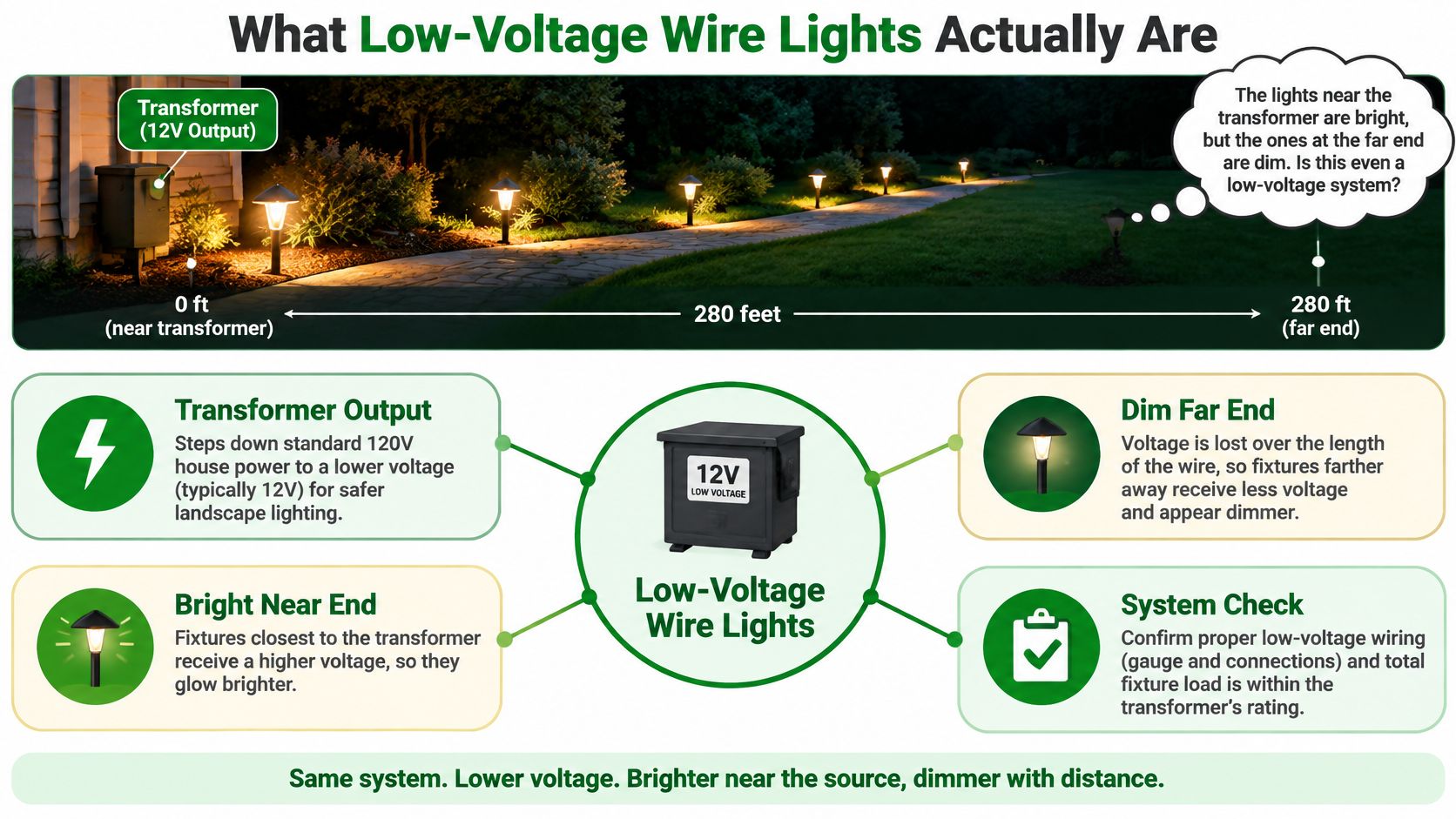
A hotel courtyard can pass inspection on day one and still lose punch on the last bollards a few months later. In that kind of setup, low-voltage wire lights are LED fixtures fed through a cable run from a transformer or driver that steps line voltage down to a nominal supply such as 12 V or 24 V.
The cable behaves like a low-pressure water main feeding many outlets from one pump room. Resistance consumes voltage along the conductors, so a route that is long, crowded or poorly spliced can leave distant fixtures with less than they need.
“Low voltage” is a code category before it is a fixture style. NEC Article 411 is used for low-voltage lighting systems supplied at no more than 30 V, with a 42.4 V peak limit under load conditions. Nominal 12 V and 24 V supplies sit under that 30 V line, which is why the label fits.
Listings such as UL 1838 for low-voltage outdoor-lighting systems and UL 2108 for low-voltage luminaires and fittings still matter during equipment selection. The rating does not excuse mismatched drivers, weak overcurrent protection, undersized conductors or sloppy installation around soil, water and foot traffic.
The system is more than the cable
The cable is only one link. A working installation includes the line-voltage supply, transformer or driver, distribution conductors, splices, fixtures, controls and records showing how the run was laid out and tested. Corroded splices, buried connectors exposed to water or a load clustered at the start of the run can create complaints even when the wire gauge looks adequate on paper.
That is why I'd treat a commercial job as an engineered electrical system rather than decorative fixtures on a wire. Retail façades, multifamily common areas, hospitality terraces and outdoor site features need equipment matched to the actual load, route length and exposure, with the documentation kept clear enough that the next fault can be traced instead of guessed.
Low-Voltage Versus Line-Voltage Lighting
Low voltage is usually the better fit for handling risk and flexible placement on short-to-medium runs; line voltage is usually the better fit for long runs and high-output area lighting. The choice depends on what the light needs to do, how far it must travel and what kind of installation the site can support.
| Criteria | Low-voltage (12 V or 24 V) | Line-voltage (120 V or 277 V) |
|---|---|---|
| Shock exposure at the fixture | Lower under normal operating conditions | Higher; requires full line-voltage practice |
| Practical run length | Limited by voltage drop; best for short-to-medium runs | Better suited to longer runs with conduit and larger conductors |
| Light output per fixture | Moderate, suited to accents and paths | Higher, suited to floods and area lighting |
| Installation work | Low-voltage wiring is simpler; the primary side still needs licensed work | Licensed electrician, conduit and inspection for each branch |
| Changes and expansion | Fixtures are easier to add or move within transformer capacity | Changes can require new branch circuits |
| Typical commercial use | Accents, pathways, landscape and signage edges | Area, parking, security and high-mount lighting |
What low voltage does well
- Lower shock exposure at the fixture: This can be useful where fixtures sit near planting beds, paths or other public-facing areas, but it doesn't make the supply side risk-free.
- Flexible placement: Low-voltage fixtures can suit changing outdoor and architectural details.
- Easy accent changes: A fixture can often be repositioned without redesigning a line-voltage branch, provided the load and wiring layout remain appropriate.
- Efficient LED options: The U.S. Department of Energy says specialized LED products can reach 150 lumens per watt or more, as described in its advanced LED lighting research.
The trade-offs are just as practical: voltage drop limits each run, transformer capacity limits total load, connectors can become weak points, and large sites may need multiple transformers. LED efficiency reduces the wattage needed for a given lighting task, but it doesn't eliminate checks of connections, drivers, weather exposure or voltage at the fixtures.
A courtyard or path often favors low voltage because the fixtures are distributed for guidance and accent. A parking deck generally needs line voltage for its main bay lighting, with low-voltage fixtures reserved for selected pedestrian or architectural zones.
Common Commercial Applications and Typical Setups
A property team at a 40-unit apartment community might replace tired courtyard bollards with 12 V pathway fixtures to make the walking route more legible. At a retail property, a 24 V accent system might outline signage or a canopy without using high-output area fixtures for a task that calls for more controlled light.
Those are different applications, but both need a layout that accounts for distance, connection exposure and the job the light must perform.

| Application | Typical setup | Best fit | Watch for |
|---|---|---|---|
| Landscape and garden | 12 V transformer, direct-burial cable, ground or low-mounted fixtures | Planting beds, tree uplighting, building perimeter | Irrigation damage, splice corrosion and shallow burial |
| Accent and architectural | 12 V or 24 V LED strip or wire-fed fixtures | Signage edges, canopies, cove lines and retail façades | Multiple transformers and heat at tight junctions |
| Pathway | 12 V or 24 V path fixtures at low mounting height | Walkways, courtyards and multifamily common areas | Voltage drop on long loops and uneven spacing |
| Parking structure low-voltage fixtures | Low-voltage soffit or ceiling fixtures in limited zones | Stairwells, pedestrian paths and under-canopy accents | General bay lighting usually needs line voltage; confirm lumen targets and controls |
Fit the light to the task
Fixtures work well around planting beds and building perimeters, but irrigation and gardening tools can damage cable or degrade exposed splices. Use cable and connectors rated for the actual site conditions, and plan the route so maintenance crews can find and protect it.
For signage edges, canopies and cove lines, accent lighting can draw attention to architectural features without trying to illuminate an entire space. Tight junctions deserve particular care: crowding connections or drivers into a hot, enclosed area can undermine reliability. Long pathway loops can also produce inconsistent brightness if fixture spacing and load distribution aren't planned as a system.
Parking structures call for a clear distinction. Low-voltage lighting may suit stairs, pedestrian paths and under-canopy accents, but general bay lighting usually needs line-voltage fixtures. Check that the selected fixtures meet the site's target lumen levels and work with the intended controls.
Wiring and Voltage Drop Planning That Prevents Dim Ends
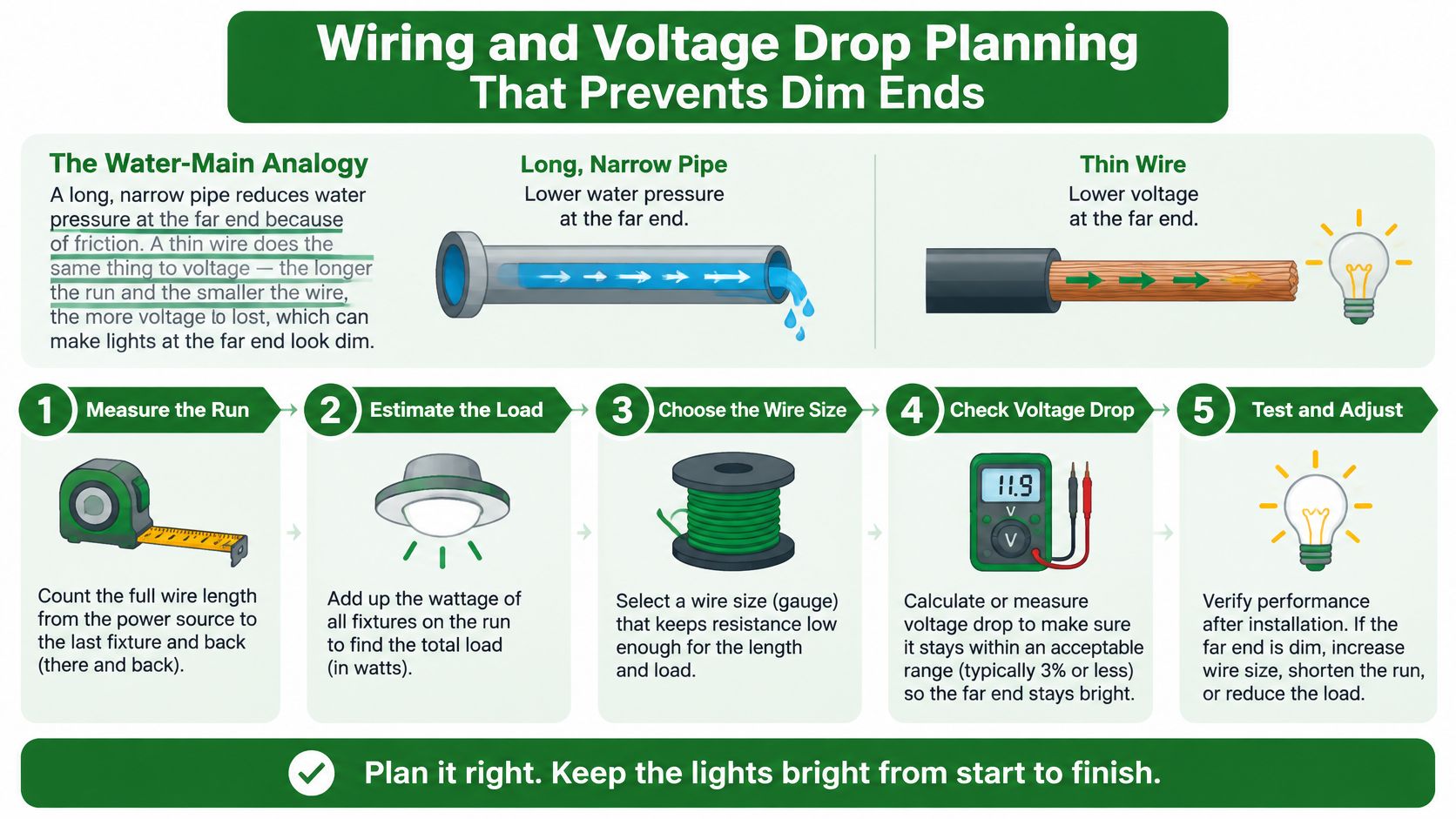
A long, narrow pipe loses pressure at the far end. A thin electrical conductor does something similar to voltage as current travels through it. The farther the load is from the source, the more conductor resistance matters, especially when current is high or the cable is small.
For a 12 V system, a loss of 1.5 V is 12.5% of nominal voltage. The low-voltage lighting design guidance from Electrical Construction & Maintenance notes that this kind of drop can leave far-end LEDs dim, flickering, shifted in color temperature or unable to start.
Plan the run before selecting the cable
- Measure the round-trip conductor length. Count the full electrical path, including the return conductor, rather than measuring only the distance from the transformer to the last fixture.
- Total the connected wattage. Add the input wattage of every fixture on that run.
- Calculate operating current. Use the system voltage and connected load to establish current under normal operation.
- Choose conductor gauge from the numbers. Length and current determine the resistance challenge. Fixture count alone doesn't tell you whether the cable is adequate.
- Choose a hub or loop layout where it helps. Branching to clusters or feeding fixtures from more than one direction can reduce the effective distance to the loads.
- Add a heavier trunk conductor or a second feed point for long runs. These changes can improve voltage uniformity when a simple layout won't hold it.
- Measure voltage at the last fixture under full load. The reading at the transformer alone can't confirm that distant fixtures are receiving an appropriate voltage.
A practical checkpoint is to compare readings at the source, along the route and at connection points:
| Measurement point | What it shows | Design check |
|---|---|---|
| Transformer output, loaded | Supply voltage at the source | Matches rated output |
| Midpoint fixture, full load | Drop along the trunk cable | Compare with the transformer reading |
| Last fixture, full load | End-of-run voltage | Stays inside the fixture operating range |
| Drop as a percentage of nominal | Loss relative to a 12 V or 24 V supply | Keep the design margin small; investigate large losses |
| Each splice and connector | Resistance at joints | Look for warmth, discoloration or a voltage step across the joint |
Read the readings, not just the cable label
If transformer voltage is normal but the far fixture is low, don't assume that a thicker wire is the only fix. A poor splice, corroded connector or unevenly distributed load can create a local loss even when the cable gauge looks adequate. Compare branches before replacing the transformer, and record the end-of-run reading against the fixture manufacturer's operating range. For a practical explanation of the term, see this guide to defining voltage drop.
Code and Safety Checks Before Anything Is Buried
The fixture, cable, connector and power unit need to be compatible as an assembled system. A mismatched rating can lead to overheating, nuisance shutdowns, unreliable dimming or loss of outdoor protection. The UL guidance on landscape and outdoor lighting identifies UL 1838 for low-voltage outdoor systems and UL 2108 for broader systems intended for installation under NEC Article 411. UL 2108 covers power units limited to 25 A, along with Class 2 and other low-voltage luminaires.
Check the complete installation
Use this sequence before cable goes in the ground:
- Confirm the transformer or driver output voltage and maximum current. Check its nameplate against the planned circuit and fixture load.
- Confirm each fixture's input type. AC and DC equipment aren't automatically interchangeable; check the manufacturer's instructions.
- Check cable ratings. Review insulation, temperature, burial, wet-location and mechanical-protection ratings for the route and environment.
- Specify environment-rated connectors. Don't rely on improvised splices where water, irrigation or soil can reach the joint.
- Manage DC polarity. Keep positive and negative conductors correctly identified and connected where the equipment requires it.
- Verify the primary-side circuit, outlet and grounding. The low-voltage output doesn't make an unsuitable supply circuit or outdoor receptacle acceptable.
For a deeper look at the applicable requirements, use this overview of the low-voltage code. Commercial installations should also account for access, inspection and later troubleshooting. A compliant output voltage isn't a substitute for a properly supplied transformer, suitable wiring methods or appropriate protection for the installation.
Keep transformer nameplate data, circuit identification, as-built routing, fixture load and test readings where facility staff can retrieve them. Those records help an inspector understand the installation and give a maintenance technician a starting point when one branch goes dark.
Maintenance Schedule That Keeps Runs Bright
A cable can be sized correctly and still produce dim fixtures if its splices corrode. That's the difference between a design problem and a maintenance problem. In commercial installations, voltage drop can come from conductor resistance, run length, load, connector resistance and the return path, so replacing cable or equipment without comparing readings may miss the actual fault.
The commercial electrical training material on low-voltage lighting faults emphasizes system-level diagnosis. Compare loaded readings at the transformer, midpoint and last fixture, and compare branches before replacing equipment. LEDs reduce fixture wattage, but long runs, multiple junctions and aging connections can still produce downstream dimming or flicker.
| Interval | Task | What it catches |
|---|---|---|
| Monthly | Walk the run; check for lifted, buried or damaged cable and cracked lenses | Irrigation or landscaping damage |
| Quarterly | Measure voltage at the transformer and last fixture under load; log readings | Slow voltage drift and weakening connections |
| Twice yearly | Inspect splices and connectors; clean and re-seal any corroded joint | Resistance that dims downstream fixtures |
| Annually | Test timers, sensors and controls; check transformer housing and ventilation | Nuisance shutdowns and failed schedules |
| After any LED retrofit or added fixtures | Re-measure the full run and confirm transformer capacity | Overload from added load |
Diagnose before swapping parts
If one branch has repeated outages while the others operate normally, check that branch's connections before condemning the transformer. A far-end voltage drop with a normal transformer reading points to the wiring and connections between the source and the affected fixtures.
After replacing lamps or adding fixtures, take new readings under load and verify that the transformer still suits the updated system. Keep the measurements with the maintenance log; a trend across inspections can show a deteriorating connector before the branch fails completely.
When to Bring In a Commercial Electrical Contractor
Low voltage doesn't mean low risk or code-free. The low-voltage output may meet its limits while the transformer's primary-side branch circuit, grounding, underground wiring methods or outdoor receptacle protection still need to comply with other electrical requirements. That distinction matters on commercial and multifamily properties, where unsafe work can affect occupants, tenants, staff and visitors.
The commercial landscape lighting installation guidance also makes clear that the full system matters, from line-voltage supply through transformer, distribution conductors, splices, fixtures and controls. Bring in a licensed professional when:
- The site has liability exposure: Multifamily, retail and hospitality properties serve people who rely on dependable lighting.
- Work reaches the supply side: Transformer feeds, branch circuits, grounding and receptacle work require appropriate electrical expertise.
- A branch keeps dimming or going out: Recurring faults call for measurement and diagnosis, not repeated fixture swaps.
- Panels or splices overheat: Stop and have the equipment assessed before continued operation.
- Construction or tenant work is underway: New construction, remodels and tenant improvements may require coordinated installation and inspection.
- An after-hours failure can't wait: A dark route or failed security lighting may need an urgent response.
Access Electrical and Lighting is a licensed and bonded California C-10 contractor, license 952234, serving Orange County and nearby regions and operating since 2000. The company offers infrared thermography to help locate hotspots, documented reports, 24/7 emergency response, and line-voltage and low-voltage scopes under one contractor. For work involving a commercial property, review its commercial electrical contractor services.
Before calling, gather the transformer nameplate information, circuit identification, as-built routing, fixture load and prior test readings. Include the last-fixture voltage from the maintenance log, measured under load, so the contractor can start with a useful diagnostic baseline.
Access Electrical and Lighting provides commercial lighting installation, maintenance, testing and repair for properties where low-voltage wire lights need reliable performance and documented troubleshooting. If your site has dim runs, recurring outages or an upcoming lighting project, contact Access Electrical and Lighting to discuss the system and the next practical step.