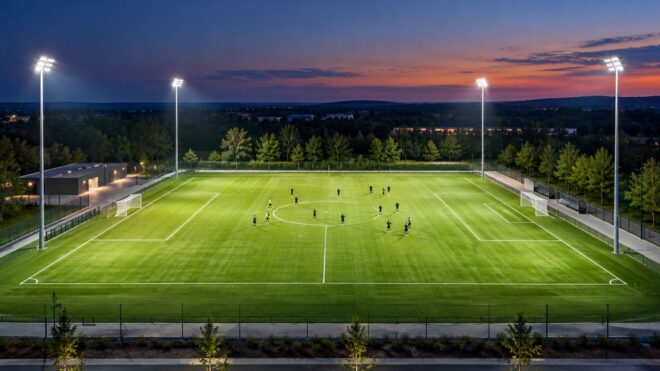
The brightest athletic field lights can create a worse playing environment than a carefully aimed system with lower connected wattage. A high average may still leave dark zones, glare athletes, and spill light into nearby homes. Good sports lighting is measured by what players, officials, spectators, cameras, and neighbors experience over time, not by fixture wattage on a quotation.
For facility managers and school districts, that changes the purchasing question. Instead of asking which fixture produces the most light, ask whether the design will maintain the required illuminance, uniformity, glare control, and reliability for the field's actual use. A lighting system that performs well at commissioning but drifts out of specification after failed drivers, misaligned fixtures, or poor maintenance isn't a successful installation.
Why Athletic Field Lights Require Engineered Design
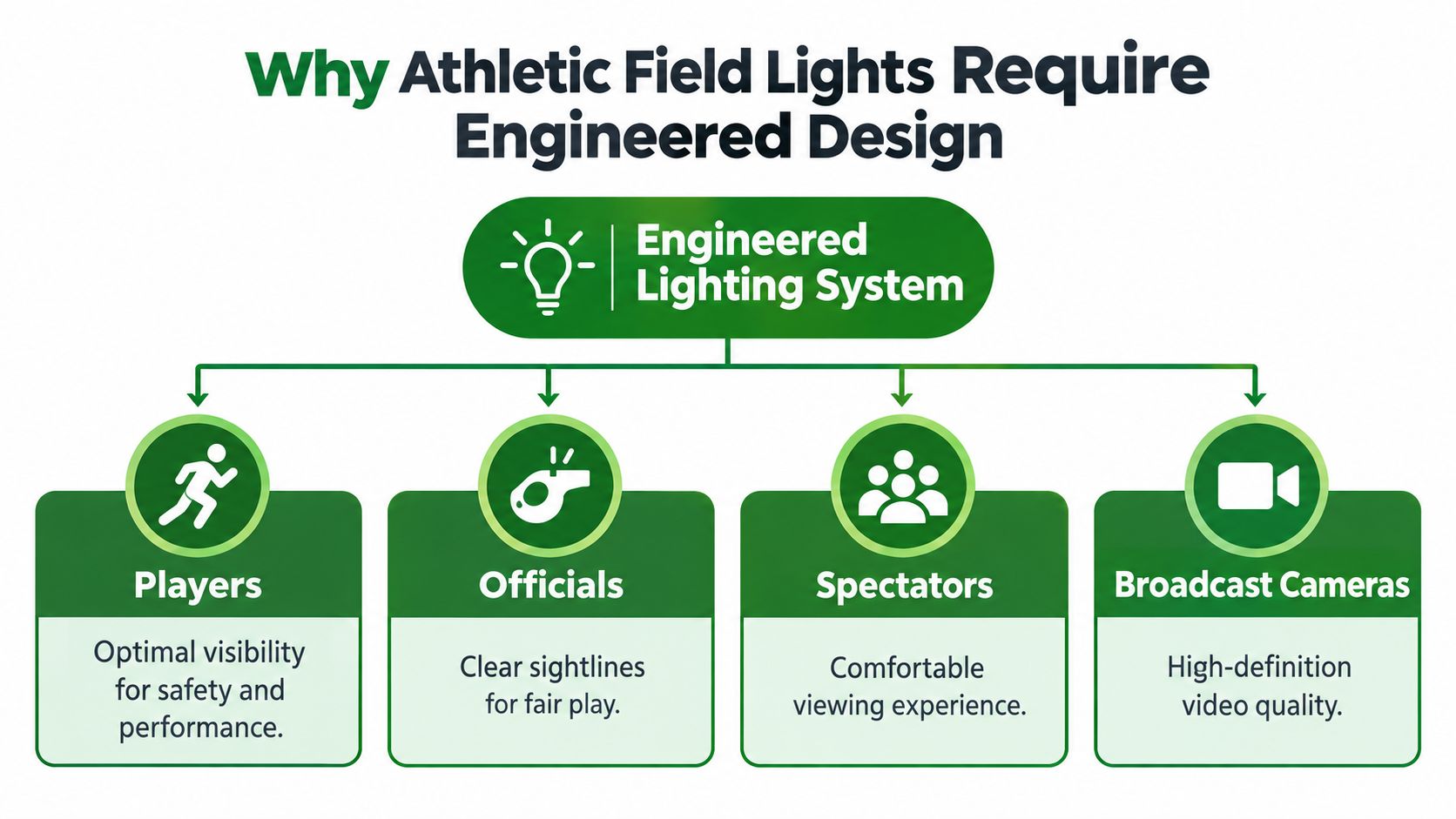
At an evening football match, a player doesn't experience light as a single average number. The player tracks the ball against changing backgrounds, turns toward a cross-field pass, and depends on enough vertical illumination to recognize teammates, opponents, and officials. A spectator needs comfortable sightlines, while a camera needs consistent exposure across the playing surface.
That's why modern athletic field lights are engineered as a complete system. Fixture output, pole geometry, aiming, optics, horizontal illuminance, vertical illuminance, uniformity, glare, and maintenance all affect the result. A brighter fixture aimed poorly can produce hot spots while leaving the far side of the field visually flat or uneven.
Broadcast requirements change the design
UEFA's 2023 Stadium Lighting Guide separates broadcast-ready venues from fields used without television coverage. For UEFA Level D, the guide specifies average horizontal illuminance above 800 lux and horizontal uniformity greater than 0.40. It also specifies average vertical illuminance of at least 350 lux, with a minimum of 200 lux on each reference plane at 0°, 90°, 180°, and 270°.
Those requirements explain why horizontal brightness alone isn't enough. Cameras and viewers need athletes to remain visible from multiple directions, especially as players turn, jump, and move across the field. A non-broadcast community field may not need the higher A to D broadcast specifications, but it still needs lighting suitable for players, officials, and spectators.
Start with use, not fixture wattage
Before selecting athletic field lights, document:
- Playing purpose: Recreational, school, competitive, or professional use.
- Sport and zones: Soccer, football, baseball, softball, or another activity with different visual demands.
- Audience: Players and officials only, or substantial spectator seating.
- Camera requirements: Live broadcast, recorded video, or no television requirement.
- Operating pattern: Scheduled games, practices, tournaments, and shutdown periods.
- Site constraints: Nearby homes, roads, wetlands, property boundaries, and existing poles.
A qualified designer can then produce a fixture-specific photometric model and coordinate the electrical, structural, and control requirements. For broader commercial lighting planning, facility teams can also review commercial outdoor lighting services as part of the site's overall lighting strategy.
Understanding Illuminance Targets by Sport and Use
Athletic fields should be designed around the activity, not a fixture's wattage. Recreational play, school competition, professional events, and televised games place different demands on athletes, spectators, and cameras. Public IES-based guidance places recreational fields broadly around 20 to 50 foot-candles, while professional venues with large crowds and television coverage can require up to approximately 300 foot-candles. These figures come from public athletic-field design guidance. The approved playing classification should set the final target.
Specify maintained performance, not only initial output. Dirt, optical aging, driver failures, aiming movement, and other depreciation factors reduce usable light over time. A fixture schedule based only on initial lumens gives the owner no clear standard for checking performance after installation.
Practical maintained targets
The following examples show how field zones and playing levels change the target:
| Sport | Level | Infield/Playing Area | Outfield |
|---|---|---|---|
| Soccer/football | Level III | 30 fc maintained average | Not zoned |
| Soccer/football | Level IV | 20 fc maintained average | Not zoned |
| Baseball/softball | Level III | 50 fc infield | 30 fc outfield |
The same guidance places recreational fields broadly within the 20 to 50 fc range and notes that professional venues with large spectator areas and television coverage can require up to approximately 300 fc. Baseball and softball need separate consideration because their zones support different visual tasks. Pitchers, batters, and infielders need dependable visibility in the central action area, while outfielders track long, fast-moving balls against a different background.
Specify the measurement method before buying
A fixture schedule should begin with a written performance brief covering the sport, playing class, maintained average, field zones, measurement grid, minimum expectations, and depreciation assumptions. Without those definitions, “bright” lighting has no defensible acceptance standard.
Verify the field with a calibrated light meter held horizontally about 36 inches above the playing surface. Take readings at the prescribed grid points defined in the performance brief. Compare measured averages and minimums with the approved photometric model, rather than just confirming that every fixture turns on.
Facility teams can review what foot-candles measure when documenting the measurement process. The purchasing decision should follow the field's use and its measured performance, so lifecycle checks remain tied to visibility, maintenance, and operating cost rather than a generic fixture package.
How Uniformity Keeps Athletes Safe on Field
Uniformity determines whether athletes can move their eyes and bodies across the field without repeatedly adapting from bright areas to dark ones. A field can meet an average illuminance target and still have poor visibility if one area is over-lit while another is under-lit.
That matters most when an athlete tracks a fast ball, receives a pass, or looks from a brightly lit foreground toward a darker background. Abrupt changes can delay visual adaptation and make the field feel less predictable, even when the total amount of light appears adequate.
Read more than the average
Public athletic-lighting criteria express uniformity in several ways. Maximum-to-minimum ratio shows how far the brightest point is from the darkest. Coefficient of variation, or CV, describes how widely readings vary around the average. Uniformity gradient, or UG, addresses local changes across the playing area.
Representative criteria from NCHSAA lighting standards include:
- Level III baseball/softball infield: Maximum-to-minimum limit of 2.5:1, with a CV limit of approximately 0.21.
- Level III baseball/softball outfield: Maximum-to-minimum limit of 3:1, with a CV limit of approximately 0.25.
- Level III soccer/football: Maximum-to-minimum limit of 2:1, with a CV limit of approximately 0.25.
- Level IV soccer/football: Maximum-to-minimum limit of 4:1, with a CV limit of approximately 0.25.
The same standards recommend limiting local change to no more than 10% per 10 feet across much of the field. That helps reduce sudden visual transitions as players scan, run, and change direction.
Diagnose the cause before replacing fixtures
Poor uniformity can originate in the original design, but it can also develop during service life. Common causes include:
- Pole geometry: Existing poles may be too close, too low, or poorly positioned for the field layout.
- Aiming changes: Vibration, maintenance work, or loose hardware can move fixtures away from their modeled angles.
- Optical depreciation: Dirt, aging components, and failed drivers can reduce output unevenly.
- Partial outages: One failed fixture can create a dark zone even while the rest of the system operates.
- Electrical problems: Voltage issues or deteriorating connections can affect fixture operation.
Retest the same grid after repairs and during scheduled inspections. Record the maximum, minimum, average, CV, and local gradients. When results drift, the records help distinguish a dirty or failed fixture from a design-level deficiency that needs optical redesign.
Pole condition also matters. A lighting contractor familiar with pole-mounted lighting systems can help coordinate raised fixture access with pole integrity, aiming, and electrical checks rather than treating each issue as an isolated repair.
Practical rule: If the measured grid changes significantly after a repair, document the new aiming position and retest the entire affected zone, not just the replaced fixture.
Selecting Poles, Mounting, and Controlling Glare
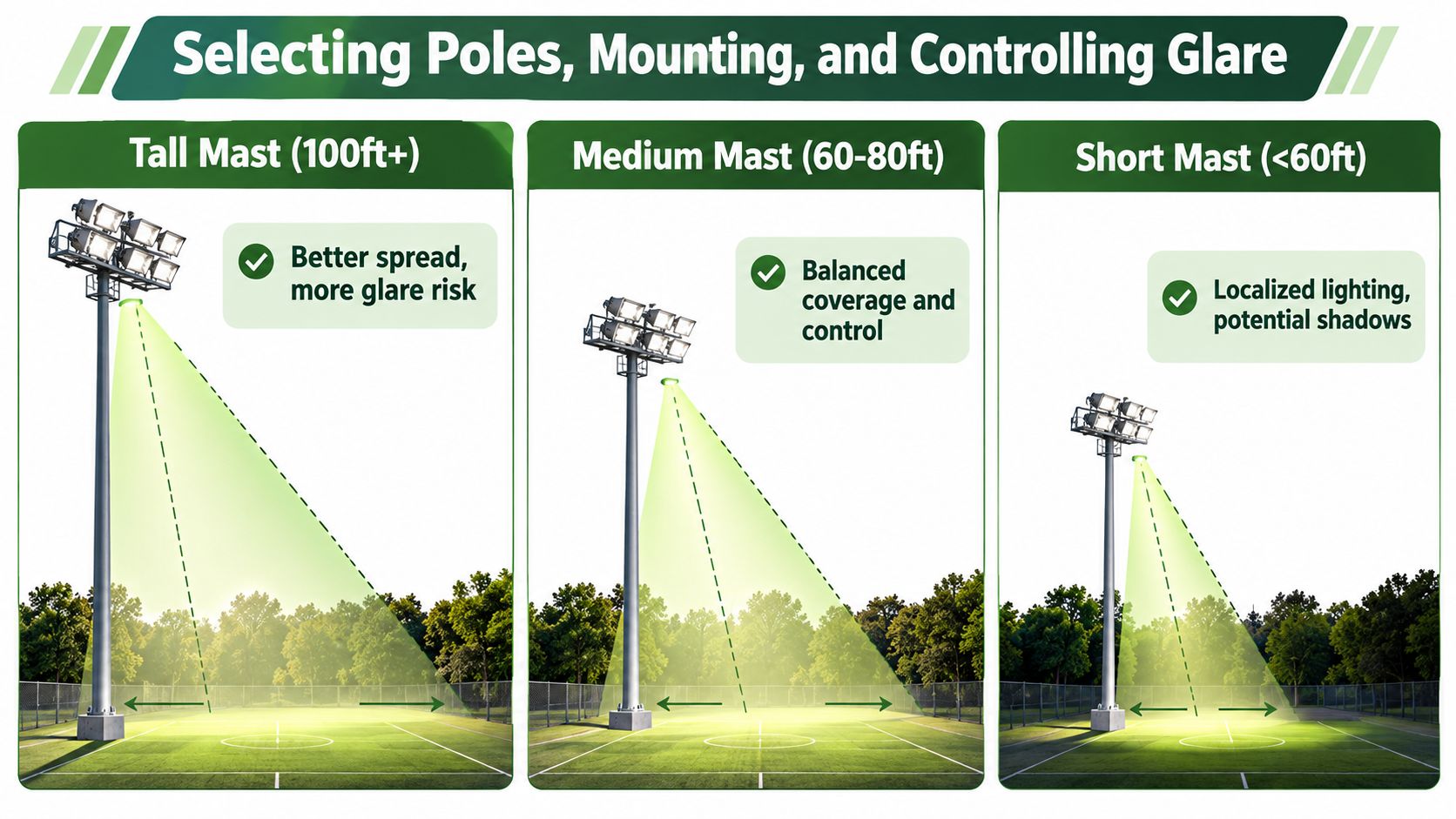
Pole height and placement shape the beam before a fixture is ever energized. A taller mast can spread light across the field and reduce the number of severe aiming angles, but it can also increase visibility of the source from nearby homes. A shorter pole may keep light closer to the activity area, yet it can create shadows, steep aiming angles, and uneven coverage.
Compare the mounting choices
A tall mast, including a 100-foot-plus installation, can provide broad spread and useful throw distance. Its trade-off is greater glare risk if fixtures lack suitable shielding or if aiming is visible from homes, roads, or spectator areas.
A medium mast in the 60 to 80 foot range often provides a practical balance between coverage and control. It may support a more manageable aiming geometry while limiting the amount of light directed beyond the property.
A short mast below 60 feet can work for localized areas, but it may require more precise optical control. Nearby fixtures, steep aiming angles, and obstructions can create shadows or bright transitions that a photometric model must address.
These are design comparisons, not universal prescriptions. Pole height depends on field dimensions, property boundaries, wind exposure, foundation capacity, access requirements, and the selected optic.
Treat glare as an operating issue
The Illuminating Engineering Society guidance on sports-lighting glare identifies direct glare, spill light, and skyglow as important community concerns. A 2025 community survey for a California park-lighting project received 908 responses. In that survey, 72% cited expanded evening sports opportunities as a benefit and 74% cited improved safety and visibility, while residents also raised concerns about light pollution in homes, visual effects, environmental effects, and operating duration and brightness.
That combination is common. Residents may support evening recreation and still oppose poorly controlled light trespass. The brightest system isn't automatically the safest or most acceptable system.
Verify the installation at night
A practical glare-control process includes:
- Model the boundary: Review predicted illuminance at nearby homes, roads, property lines, and sensitive environmental areas.
- Specify shielding: Use visors, louvers, house-side shields, and suitable optics where the model shows off-site exposure.
- Control the schedule: Program dimming, field-specific operating periods, and curfews that match actual use.
- Check aiming after installation: Confirm fixture angles from the field and from surrounding properties.
- Log complaints: Record date, time, field activity, weather, operating level, and the location of the reported impact.
- Measure at night: Repeat measurements after commissioning and after any aiming, fixture, or control change.
A glare complaint is not solved automatically by adding more light to the field. It may require a different optic, a shield, a lower operating level, a revised aiming angle, or a schedule adjustment that preserves playability while reducing off-site impact.
LED Retrofits That Cut Energy Without Sacrificing Performance
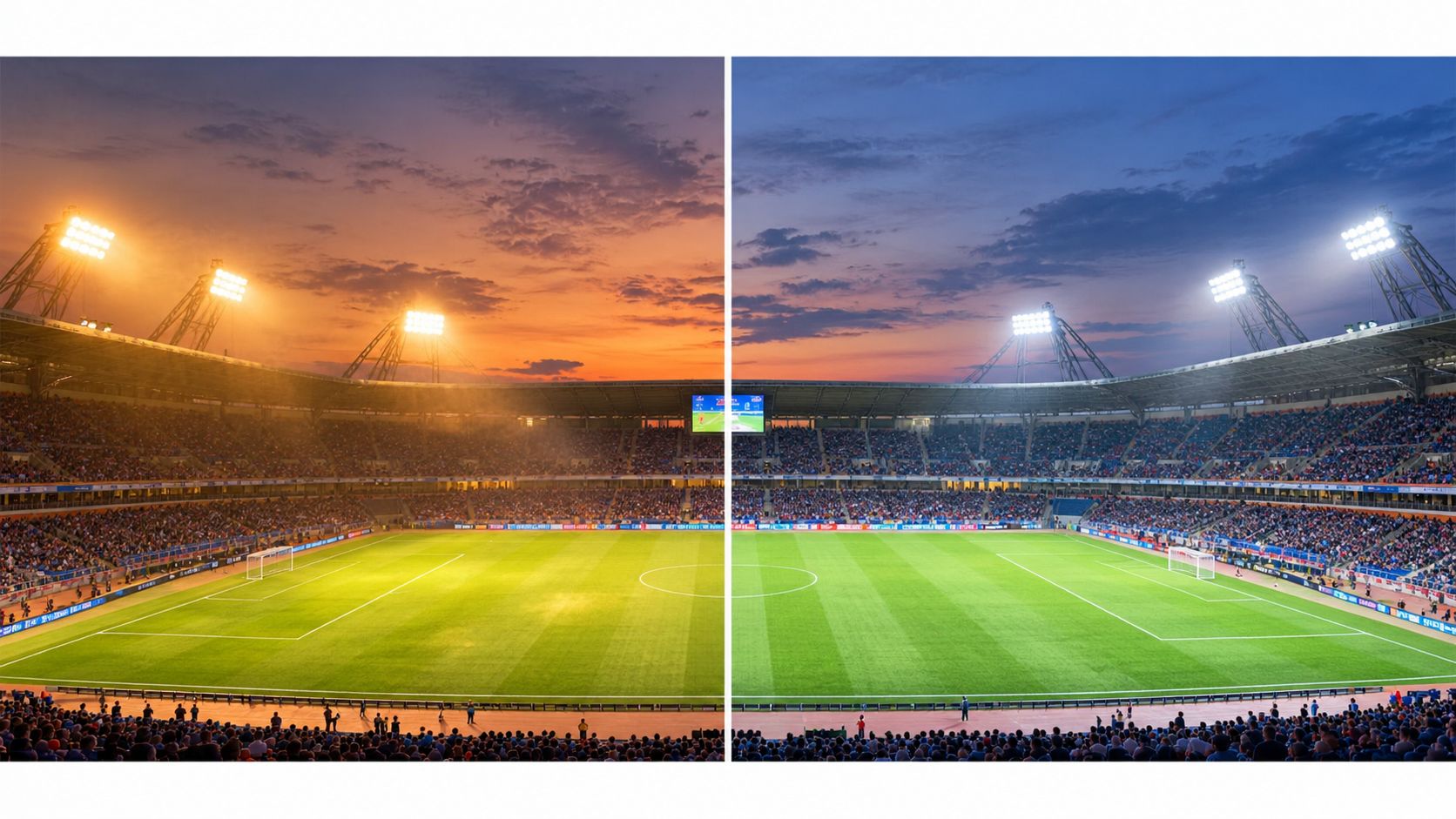
An LED retrofit makes sense when it reduces electrical load while preserving the field's required illuminance and uniformity. Replacing fixtures one for one without reviewing optics, aiming, pole capacity, controls, and measured results can leave an owner with lower wattage but an inferior playing environment.
A documented football-stadium retrofit in Llano, Texas replaced 34 high-intensity-discharge fixtures rated at 1,500 watts each with 34 LED fixtures rated at 850 watts each. The original connected load was 51,000 watts, while the replacement used 28,900 watts, a reduction of 22,100 watts, or approximately 43.3% based on connected fixture power, according to the documented retrofit summary.
Lower load is only part of the benefit
The retrofit reused the existing poles, crossarms, and wiring, and installation was completed in less than one week, as reported in the same project summary. Reusing sound infrastructure can shorten disruption and reduce the scope of structural and electrical work, but it still requires verification. Existing poles must be checked for condition, loading, mounting compatibility, grounding, conductor condition, and access requirements.
Broader technical research cited in the same source found that LED floodlights can reduce primary energy consumption by up to 52% compared with metal-halide floodlights and by up to 32% compared with fluorescent luminaires, depending on system configuration. A separate peer-reviewed analysis of professional stadium installations reported direct electricity savings of up to 70% in some applications and connected LED systems with increasingly demanding television requirements.
Those results shouldn't be treated as a guaranteed project outcome. The actual reduction depends on operating hours, controls, fixture quantity, existing load, utility structure, and whether the replacement design meets the same or improved performance standard.
Require a performance-based retrofit
A sound LED proposal should include:
- Existing fixture count, wattage, controls, and operating schedule.
- Existing measured illuminance and uniformity where available.
- Fixture-specific photometric modeling with documented aiming.
- Pole, crossarm, wiring, grounding, and structural review.
- Glare and spill-light evaluation at surrounding properties.
- Commissioning measurements that compare modeled and installed results.
- A maintenance plan for drivers, controls, aiming, and future testing.
The right retrofit may use fewer fixtures, different optics, or a different aiming pattern. Higher output isn't automatically better if it increases glare, creates hot spots, or exceeds the field's actual target.
Maintenance Testing, Controls, and Lifecycle Planning
A fixture's advertised service life does not show whether a field still performs properly. Owners need a repeatable way to detect declining illuminance, worsening uniformity, control faults, shifted poles, and deteriorating electrical components before those problems disrupt play.
One public 2025 specification requires at least 70 lumens per watt, limits fixture demand to 1,500 watts, and requires components to remain operational during a 25-year warranty period, as described in the public athletic-field lighting specification. These are useful procurement requirements, but field measurements remain necessary because rated output does not confirm maintained performance.
Build the inspection routine around evidence
Commissioning should produce a baseline package that the facility team can use for every later inspection. Include the approved photometric model, fixture schedule, aiming angles, control settings, measured grid, average and minimum readings, uniformity calculations, electrical test results, and photographs showing pole and equipment condition.
Use the same evidence trail after commissioning:
- Measure performance: Repeat the approved horizontal grid with a calibrated meter and compare readings with the required criteria.
- Inspect equipment: Check housings, lenses, brackets, crossarms, fasteners, poles, and visible wiring for damage, movement, contamination, or corrosion.
- Review controls: Confirm schedules, dimming levels, overrides, field zoning, and shutdown behavior.
- Test electrical health: Carry out suitable thermal and electrical inspections to identify loose connections, overloaded components, and abnormal heat.
- Prioritize failures: Address dark zones, failed drivers, control faults, and unsafe pole conditions according to their effect on playability and safety.
- Document every change: Record replacements, aiming adjustments, control revisions, measurements, and corrective work.
Do not wait for a complete outage. One failed driver can create a local uniformity problem while most fixtures still operate. A control fault can also leave the field at an unnecessarily high output or outside the approved schedule, increasing operating cost without improving useful light.
Use cyclic maintenance instead of emergency reaction
Sports lighting needs a cyclic maintenance program whose frequency reflects use and ambient pollution, a principle drawn from Queensland public lighting guidance. A heavily used field exposed to dust, exhaust, salt, or other contaminants may require closer attention than a lightly used site in cleaner conditions.
Budgeting should connect measured performance with corrective thresholds. If readings fall below the approved maintained target, uniformity worsens, or glare changes after repairs, the owner can choose whether to clean, re-aim, replace a driver, revise controls, or redesign the optics. That approach bases lifecycle decisions on field results rather than a manufacturer's service-life label alone.
A useful maintenance record answers three questions: What was measured, what changed, and what action restored the required performance?
Putting It All Together for Safer, Smarter Fields
A reliable athletic field lighting project follows a decision sequence rather than a fixture catalog.
First, define the field's sport, playing class, audience, broadcast needs, schedule, and surrounding land uses. Then set maintained illuminance and uniformity criteria, including the measurement grid and depreciation assumptions. Those requirements should drive fixture optics, quantity, pole height, aiming, shielding, controls, and electrical design.
Next, model the installation before purchase and verify the built system after installation. Commissioning should compare measured results with the approved photometric plan, not merely confirm that the lights energize. The owner should also document glare conditions, spill-light observations, control schedules, pole condition, and electrical test results.
Finally, treat the field as an operating asset. Retest the same grid after repairs, inspect raised equipment, review controls, check electrical condition, and maintain records that show whether the system continues to meet its intended use. This approach protects players from avoidable dark zones, helps officials maintain clear sightlines, reduces neighborhood conflict, and prevents energy savings from being undermined by poor control or over-lighting.
The best athletic field lights aren't the ones with the highest wattage. They're the ones that deliver the required light where it's needed, limit glare where it isn't, and continue doing so through documented maintenance.
Access Electrical and Lighting provides commercial lighting installation, LED retrofit work, controls, testing, pole services, and infrared electrical inspections for facilities that need dependable field and site lighting performance. Visit Access Electrical and Lighting to discuss a measured lighting upgrade, commissioning plan, or ongoing maintenance program for your property.